In the new winter‐spring campaign Communist troops have scored their biggest gains in the fertile Mekong Delta since they were badly mauled here by American and South Vietnamese forces in the late nineteen‐sixties. These advances are especially worrisome to South Vietnamese and American officials because the delta is the country’s major rice-producing area and is home to over a third of the country’s 19.5 million people. Moreover, it was considered one of the most successful examples of the pacification program, the effort to make the rural areas secure.
In the worst-hit province, Vĩnh Bình, along the South China Sea, a Communist regiment has reportedly overrun 21 of the province’s 56 villages since the intensified fighting began early in December. Government soldiers have recaptured 11 of them. The Communists have also seized a district capital — the first to fall in the delta since the Lunar New Year offensive of 1968. They have begun to link up large chunks of territory, and they have cost the government 12,000 casualties, including 2,800 dead in the delta alone. That is 350 more than the Israelis officially listed as killed or missing in the last Middle East war. The Saigon command lists 7,800 Communist dead in the delta in the last two months.
The Communists’ success, it appears, is largely attributable to two related trends: On the one hand, old Việt Cộng guerrilla units, which had been reduced to a fraction of their original size, have been filled out since the cease-fire in January. 1973, with large numbers of fresh North Vietnamese regulars. On the other hand, sharp cutbacks in United States aid, the South Vietnamese are no longer able to count on the heavy air and artillery support they once enjoyed. So far most of the Communist gains have come in the more peripheral parts of the delta — swamps, jungles and isolated villages that were Việt Cộng strongholds before the sweeping United States-South Vietnamese pacification campaigns of 1968 to 1970. The captured district capital, for instance, was little more than a tiny outpost, while the important roads and the cities like Cần Thơ in the central delta, remain in government hands.
Some Vietnamese and Westerners therefore believe that what is happening is a reassertion of the natural balance of forces, which had been artificially extended in the government’s favor by vast American help. “There simply was no way the government could hang on to all that,” said a Western official familiar with the delta. “To defend those outposts they need helicopters, fighters and artillery. Otherwise the Communists just come along and isolate them one by one, with no way for the government to resupply them.” The new Communist troops have also struck at some areas previously considered secure. To cite one strong example, at the end of December 1,000 North Vietnamese occupied the village of Ba Thê in An Giang Province for six days before being driven out.
The incident, never reported by Saigon, was surprising because An Giang is inhabited largely by Hòa Hảo, a militantly anti-Communist religious sect, and the province is considered the safest in the country. If the Communists continue to make similiar gains in other heavily populated delta areas during this campaign, which is expected to last at least through May when the dry season ends, that would be serious indeed for Saigon, officials agree. One village in Vĩnh Bình Province that was overrun contained 12,000 people, half as many as in Phước Long, a province capital. Phước Long and its surrounding province northwest of Saigon were taken by the Communists last month with widespread publicity.
The Communists’ successes and failures in the delta are illustrated by their attacks in Vĩnh Long, a key province in the central delta that straddles Route 4. This is the major artery over which the delta’s rice, fish, and vegetables travel to Saigon and closing it has long been a Communist aim. On the night of December 4, Communist troops stormed the village of Lộc Hòa, a few hundred yards off the highway, overrunning the mud-walled militia outpost and driving many villagers out of their homes. Now, two months later, the Communists are still there, not quite close enough to shut the road, but too close for the villagers to return to their houses.
In one thatch-roofed house along a muddy canal lined with palm trees, there are now four refugee families with a total of 21 members. Three other sons in the families had already died fighting on the government side, and another was accidentally shot recently by local militiaman. A daughter in the Dua family has two children fathered by an American airman in Saigon. It is the first time Lộc Hòa, a Catholic community, has been attacked in Mr. Dua’s memory. As far as he and the other villagers can tell from talks with the Communists, none of them are local Việt Cộng. Most of them are northerners, Mr. Dua said.
In fact, according to local officials, about 60 percent of the men in the old Việt Cộng D-3 Regiment operating in Vĩnh Long are North Vietnamese, including the commanding officer and many of the technical personnel, such as medics and signalmen. The regiment also has better weapons than in the earlier years of classic guerrilla war in the delta — bigger mortars, more machine guns and much more ammunition. In contrast, South Vietnamese officers here complain, they are now limited to four artillery rounds a day, though the restrictions ease during serious attacks. Their troops now receive only two hand grenades per operation, and they have had virtually no air support for long periods during the Communists’ offensive. “They may still have enough ammo in an actual fight,” observed a Western official with long experience in the delta, “but it is the psychological thing. They don’t think they do. And for a soldier, that is the same thing.”
A spokesman said today that the United States Mission to South Vietnam was not “chagrined” by the appointment of Lieutenant General Nguyễn Văn Toàn to the command of the important military region around Saigon. Taking exception to a dispatch from Saigon to The New York Times on February 12, which, said that “members of the American mission” had been “chagrined” by the appointment, Wolfgang Lehmann, the Embassy’s deputy chief of mission, said this was not an official position. Mr. Lehmann said it was the Embassy’s view that General Toàn had been appointed because an aggressive commander was required in the vital area. General Toàn was relieved of his earlier command on October 30 in an apparent bow by President Nguyễn Văn Thiệu to opposition demands for a cleanup of corruption in the military.
The South Vietnamese Government today dropped libel charges against six newspapers that had been accused of defaming President Nguyễn Văn Thiệu by publishing allegations of corruption. Four of the papers have been closed. A statement issued by the Information Ministry said the prosecution of the six newspapers was “no longer deemed necessary” because earlier this month the government, according to its own account, had broken a ring of “underground Communist cadres” who had infiltrated the press.
Four of the six newspapers accused of defaming President Thiệu were closed down by the government for harboring the alleged infiltrators. The two others, Chính Luận and Đại Dân Tộc, are still publishing.
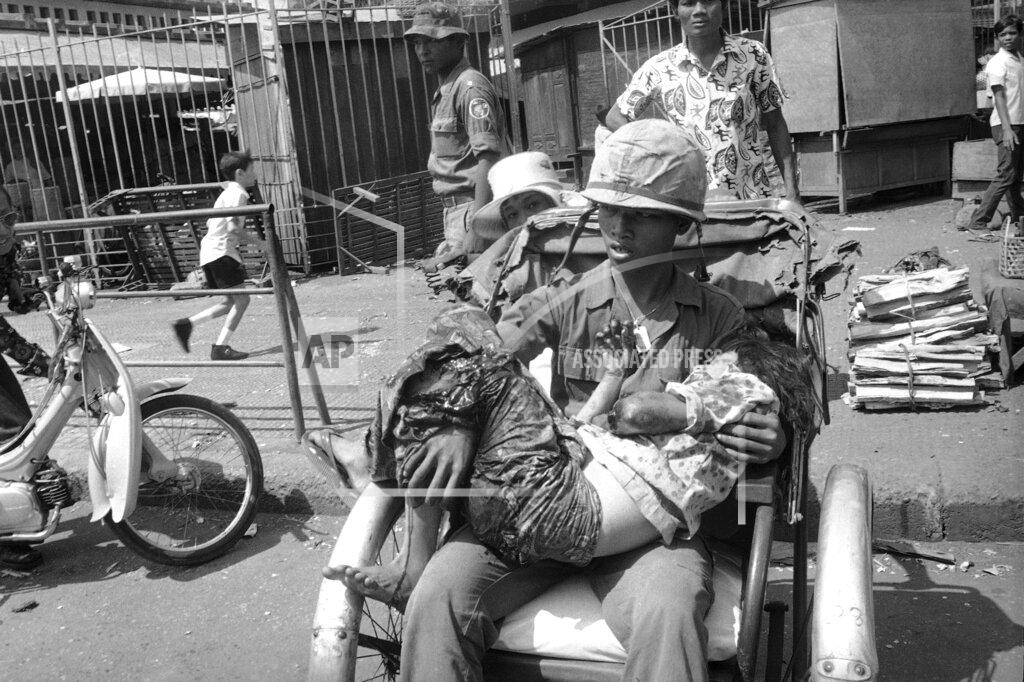
Military sources in Phnom Penh said that the attempt by Cambodian government troops to open the blockaded Mekong River, the principal supply line to Phnom Penh, the capital, is in trouble. The troops were said to be making no progress against Communist-led insurgents who seized control of the river. Government troops sent by boat in recent days to try to establish beachheads and push the Communist‐led insurgents off the riverbanks are being badly cut up and making no progress. The reports suggest that unless there is a dramatic turnaround it could be some time before the Americans can run another supply convoy from South Vietnam — or at least run one without heavy losses.
Some of the reports are even more pessimistic. They say that not only have the Government troops been unable to establish any new beachheads, but they are being forced to abandon river positions they held when the operaion began. The government’s casualty toll is said to be high. Wounded who have been evacuated to military hospitals in Phnom Penh tell of grim conditions: units at half strength or less, shelling so intense that at some places they are pinned down during daylight. Bodies cannot be retrieved and some wounded cannot be evacuated in time. Some boats have been sunk as they tried to reach, the wounded on river beachheads about 45 miles southeast of Phnom Penh. Even when a boat manages to make it to a beach, the wounded say, it often takes three days or more, moving only at night, to creep the 10 miles north to Neak Luong, the last remaining major Government base on the Mekong, where the wounded are then taken to Phnom Penh by helicopter.
The number of Government troops in the Mekong operation is being carefully guarded by American and Cambodian officials, but available reports indicate that it is not more than a thousand or so—nowhere near enough to dislodge the 4,000 or more insurgents who have seized control of two‐thirds of the 60‐mile stretch of the Mekong from the capital to the South Vietnamese border. The Cambodian High Command is aware of the problem. It is reported that at a meeting with President Lon Nol the other day senior generals who are not normally outspoken told him that the only way to save the Government was to pull troops out of some of the province capitals, perhaps losing one or more and use them to open the Mekong and defend Phnom Penh and its airport. It is not known what Marshal Lon Nol’s response was.
The main reason for the lack of troops in the Mekong operation is the heavy toll taken by the insurgents’ current offensive, which began on New Year’s Day. The Government has suffered at least 10,000 killed and wounded in a combat force of at most 50,000. Total strength is over 200,000 men, but most are desk soldiers or have other rearechelon functions. Though the insurgents, who have a combat force of similar size, have suffered losses as heavy as or heavier than the Government’s, they have been able to keep enough pressure on Phnom Penh and other key points to prevent the Government from redeploying units to the Mekong. At the moment the insurgents are attacking hard against a defense line only a dozen miles or so northwest of Phnom Penh, and the Government forces have been falling back, taking severe casualties.
For all the pressure around Phnom Penh, it still appears to be under no immediate threat of ground assault. The main concern remains the Mekong, which normally brings 80 per cent or more of the city’s food, fuel and ammunition. Partly blockaded since the offensive began on January 1, it was blocked February 3 when the insurgents used mines for the first time. Since then at least 19 supply vessels have been sunk by the mines and by heavy shellfire from the banks, and no convoy has been attempted since February 5, when three tugboats were sunk trying to make the run and the three other vessels fled back to South Vietnam. With the Mekong blockaded, the Americans have expanded their supply airlift from Thailand. The airlift, technically being handled by civilian contractors but actually run from beginning to end by the American military, is mostly devoted to ammunition so food and fuel are increasingly scarce.
The situation, though serious, is far from desperate and there is no panic. Rice and fuel stocks, if stretched carefully, can last well over a month and even two months or more. In the long run, however, an airlift to supply a city of two million is probably too costly, so the opening of the Mekong would seem to be the key to survival. According to reliable reports, no significant attempt has been made to clear the mines. The Americans are having difficulty recruiting civilian crews for supply ships. The Cambodian Navy, under American prodding, says it is prepared to provide men to tackle the job — and it may have to.
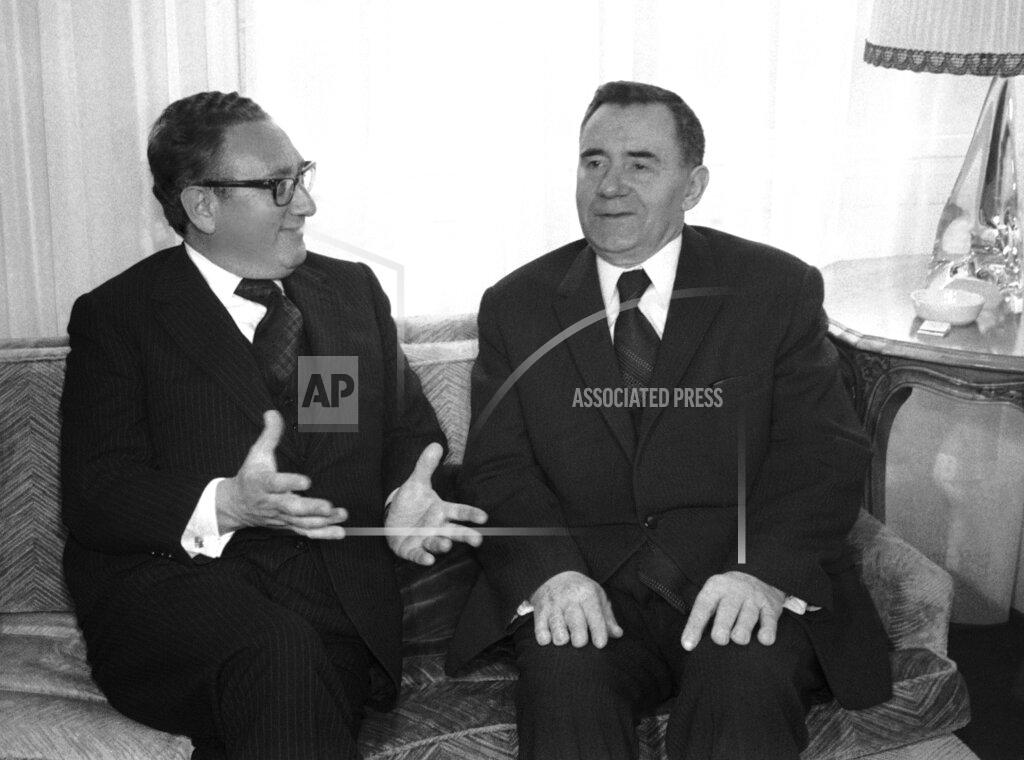
Secretary of State Kissinger and Andrei Gromyko, the Soviet Foreign Minister, completed their talks in Geneva still in disagreement over the Middle East. After five hours of discussion on the Middle East, Mr. Gromyko told newsmen that “there were questions on which our positions did not exactly coincide.” Mr. Kissinger said he concurred with that. Later, on the way to London aboard Mr. Kissinger’s plane, newsmen were told that Mr. Gromyko had urged the immediate reconvening of the Geneva conference on the Middle East and had accused the United States of bad faith in excluding the Soviet Union from the Middle East diplomacy. Although Mr. Gromyko refused the United States’ step-by-step efforts to arrange a new Sinai agreement between Israel and Egypt, Mr. Kissinger believes the Russians are unlikely to mount a campaign to sabotage his approach.
The Soviet campaign for a high‐level meeting this summer to conclude a new European security accord is making headway because “everybody is getting tired of this conference and feels it has gone on too long.” This view, expressed over the weekend by a senior Western delegate at the Conference on European Security and Cooperation, which has been going on — with intermittent recesses — for nearly two years, was echoed by the leaders of neutral and Eastern European delegations, although they also agreed that outstanding points of dispute remain of key importance. One of the major questions remaining involves the proposal to require nations to give advance notice of military maneuvers and to invite observers, a proposal listed under the heading of “confidence-building measures.”
Prime Minister Wilson of Britain, who completed talks with Soviet leaders in Moscow, announced that Britain had agreed to extend the Soviet Union about $2 billion in low-interest credits to encourage purchases of British capital equipment and technology over the next five years. He disclosed the estimate during a news conference at the end of a five‐day official visit. The Prime Minister asserted that his discussions with the Soviet leadership had led to “a new phase in Anglo‐Soviet relations,” politically as well as economically. A joint statement after the visit indicated that while both sides were confident about putting their relations on a more productive basis, they had not yet resolved a number of differences on international issues.
World crude-oil prices have begun to sag noticeably under the impact of reduced consumption by the industrialized nations. Although no major price break is expected, industry experts believe the present price weakness will soon be reflected in slight reductions in consumer prices.
Prague is the dirtiest city in Eastern Europe, according to the Czechoslovak news agency Ceteka. It said Prague produces 70,000 tons of solid and gaseous pollutants a year and it blamed the 6,654 boiler furnaces and 250,000 private stoves, most of which burn low-quality coal. The news agency said the problem was aggravated by too many cars and too little ventilation in the narrow valley where the city is located.
The Municipal Museum in Milan was robbed of 28 paintings, among them works by Cezanne, Gauguin, Renoir and Van Gogh, whose value was estimated at least at $5 million. The theft occurred 11 days after three celebrated Renaissance paintings were stolen from the National Museum in Urbino.
A group of 15 Croatian separatists were sentenced in the coastal town of Zadar to jail terms ranging from 18 months to 13 years for planning a terror campaign to force the secession of the Croatian Republic from the Yugoslav Federation. The three harshest sentences went to Josip Bilusic, 30, a student who got 13 years; Zelimir Mestrovic, 50, a professor, 12 years, and Marko Dizdar, 23, a student, 11 years.
About 15 young Jewish demonstrators, demanding action on behalf of Soviet Jews, barricaded themselves inside the Meditation Room, at the United Nations for several hours. The demonstrators, members of Betar, a militant Zionist youth organization, left peacefully after U.N. security officials promised them they would not be arrested.
Portugal’s governing Armed Forces Movement, after a fierce debate behind closed doors, decided to turn itself into a permanent government body with power “beyond the legislative assembly.” The group declined, however, to specify whether this would include the right to veto laws passed by the future elected government.
West German Chancellor Helmut Schmidt is ill with pneumonia and all his appointments for the rest of the week have been canceled. Before he took ill Sunday, the chancellor met with US. Secretary of State Henry A. Kissinger who briefed him on his five-nation Middle East trip.
Israeli military correspondents reported today that the Suez Canal was open and that some shipping had already transited the waterway. They said that a 24,000‐ton British oil tanker recently passed through and that Egyptian naval vessels had been transferred from the Mediterranean to the Gulf of Suez and others sent north to replace them. In November, 1974, four Egyptian vessels completed the first journey through the canal since it was closed in 1967, going from Port Said to the town of Suez. The correspondents, who gave no source for their reports, said that Egypt’s delay in announcing an official opening of the waterway was a political tactic.
President Hafez al‐Assad of Syria is urging other Arab nations to resist “partial settlements” in the Middle East that could divide the Arabs. Foreign Minister Abdel Haum Khaddam has carried messages expressing the Syrian President’s concern over Secretary of State Kissinger’s step‐by‐step approach toward a peace settlement to King Faisal of Saudi Arabia, Sheik Sabah al‐Salem al‐Sabah of Kuwait and Sheik Zayed bin Sultan al‐Nahiyan, the ruler of Abu Dhabi and President of the United Arab Emirates. According to diplomatic sources in Kuwait, Mr. Khaddam has warned against the danger of a military “neutralization” of Egypt through a partial withdrawal by Israel in the Sinai Peninsula linked to a commitment to nonbeligerency by President Anwar el‐Sadat.
The south Arabian sultanate of Oman is short of cash in spite of big oil revenues and has been warned by bankers they might find it difficult to extend credit unless spending is curtailed, the New York Times reported. Oman has been earning nearly $1 billion a year to spend on fewer than 1 million people, the paper said.
Four main opposition parties boycotted the opening of India’s Parliament today as they planned an intensified nationwide campaign against Prime Minister Indira Gandhi. It was the first time that such a large opposition bloc had refused to appear for the President’s speech. President Fakhruddin All Ahmed, the hand‐picked choice of Mrs. Gandhi and largely a ceremonial figure, said that the immediate food situation seemed promising and that inflation had begun to dissipate.
Pakistan placed its North-West Frontier province under federal rule for the next three months and warned Afghanistan against interfering in the nation’s internal affairs. The statement from Peshawar did not actually name Afghanistan, but said a neighboring foreign force was actively engaged in disrupting normal life in the province. Nine days ago the interior minister of the province died in a bomb blast.
Dr. William B. Sutch, a former New Zealand cabinet minister, pleaded innocent at his trial in Wellington to charges of passing state secrets to a Soviet agent. The state offered evidence that Sutch obtained information calculated to be useful to an enemy and had six secret meetings in 1974 with a former first secretary at the Soviet Embassy.
Two gunmen robbed a Montreal bank and seized five hostages at a nearby gas station before surrendering to a radio station reporter. Police arrested Andre Arsenault, 35, and Real Brousseau, 30, after they had surrendered to Claude Porier of Radio Station CJMS. He drove the gunmen and one remaining hostage to police headquarters in his radio car.
Latin American coffee producers blocked proposals to force prices up by cutting back on sales because they were afraid of trade reprisals by the United States, according to the president of the International Coffee Organization, which ended a meeting in San Salvador Sunday. The president, Fausto Cantu Pena of Mexico, said after returning to Mexico City that African producers had backed at temporary freeze on coffee sales, but some Latin nations, which he did not name, had blocked it.
The Ethiopian Government, which for 17 days has been fighting secessionist guerrillas in Eritrea, the country’s northernmost province, has requested an emergency airlift of arms, ammunition and equipment from the United States.
Prime Minister John Vorster, who has been seeking to improve South Africa’s relations with black Africa, announced to Parliament today that he had paid a two-day visit to Liberia last week.
Frank Zarb, the Federal Energy Administrator, said that President Ford would decontrol the price of “old oil” even if Congress did not impose an excess-profits tax to keep oil companies from benefiting unduly by his action. Decontrol would almost surely mean higher prices. The President’s action could be vetoed by Congress. Mr. Zarb told a House energy subcommittee that decontrol of old domestic crude oil on April 1 was an integral part of Mr. Ford’s plan to make the United States independent of Arab oil-producing nations.
A net loss of $73.5 million, the biggest loss for a quarter-year in the company’s history, was reported by the Chrysler Corporation for the fourth quarter of 1974. In the fourth quarter of 1973, the company reported net earnings of $74.4 million, or $1.38 a share. Chrysler, one of the hardest hit by the recession, reported a net loss of $52 million compared with earnings of $255 million, or $4.80 a share, in 1973, which was a record year in sales for the auto industry. The 1974 loss was also the biggest for any year in the company’s history.
Senator Lloyd Bentsen, a 54-year-old insurance millionaire from Houston, became the fifth Democrat to enter the 1976 presidential race. As a qualification for his candidacy, he offered his business experience to remedy the economy. “The paramount issue is economic recovery” he said in an announcement delivered according to custom in the Senate Caucus Room. The statement was later repeated in Houston.
George Meany, citing worsening unemployment, said today that he now thought a tax cut of $30-billion $10-billion more than the A.F.L.-C.I.O. proposed last month was necessary to stimulate the economy through increased purchasing power. Mr. Meany, who is president of the American Federation of Labor and Congress of Industrial Organizations, was pessimistic, however, about the prospects of Congressional action soon enough to prevent the rate of unemployment from rising by summer from its present level of 8.2 percent to 10 percent. As a result of the continuing high rate of joblessness in recent months, Mr. Meany said “Unemployment is now feeding on unemployment.” Measures enacted since the Depression of the nineteen‐thirties to keep jobless consumers in the market place are becoming ineffective, he said, with some of the unemployed exhausting their benefits and also the supplementary benefits that their unions had negotiated in contracts. He expressed the view that unemployment benefits were needed for more than 52 weeks.
Georgia voted against approval of the proposed Equal Rights Amendment to the United States Constitution, and Utah followed the next day, with ratification failing 21-54 in the Utah House of Representatives.
An apparent attempt to free a dozen Black Liberation Army prisoners from Rikers Island was under investigation in New York City. Police located an abandoned raft in the waters of Hellgate and searched for two others they believe had contained a total of five armed men in scuba gear. Prison officials said that inside, BLA chieftain Herman Bell forced a guard to give up his keys but was quickly overpowered by other guards. Bell is awaiting retrial in the gunshot slaying of two New York City policemen in 1971. Authorities, after warning by an informer, theorized that the BLA plan was to escape by means of rafts but that the men aboard them gave up the plan when police launches began to search the river.
Many cotton farmers are threatening to switch to other crops because of inadequate federal farm programs and the increasing costs of production, the Senate Agriculture Committee was told. Chauncey L. Denton Jr. president of the National Cotton Council of America, said growers have indications that the 1975 cotton acreage might be cut back 32% from last year. Denton noted that the cost of growing cotton has jumped from 32.5 cents a pound in 1972 to more than 50 cents in 1974, a figure that is 12 cents higher than the federal target price of 38 cents. Thus cotton farmers find it more attractive to switch to soybeans and other food and feed crops, he said.
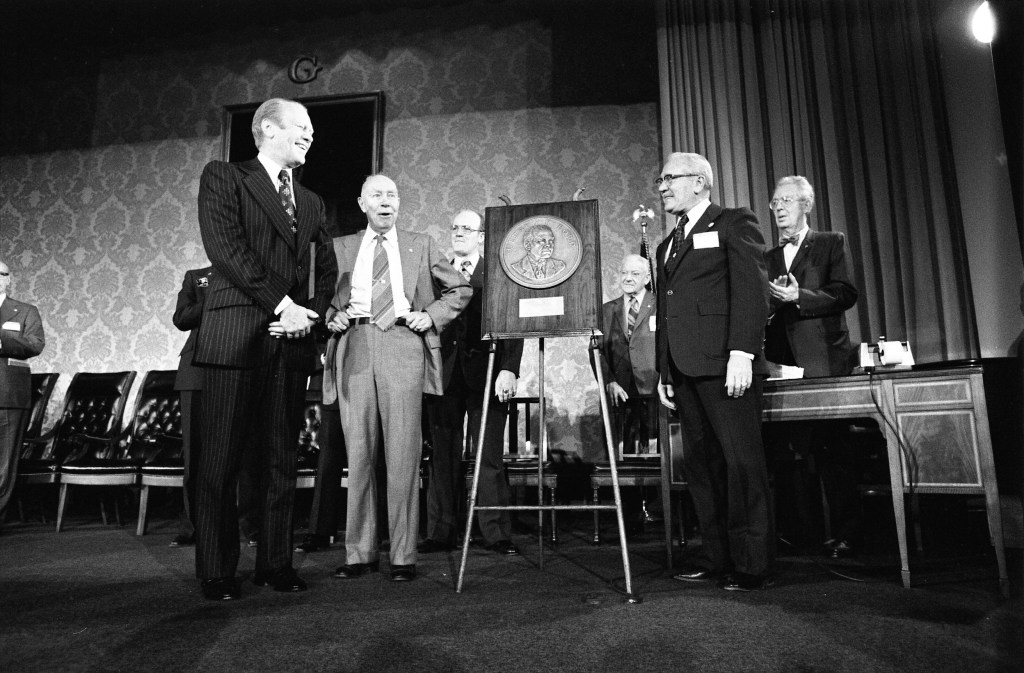
President Ford paid tribute to George Washington, saying that when the nation’s first President was asked about bad times he urged Americans to work to change the situation. Mr. Ford drove to Alexandria, Virginia, for the presentation of the Gerald R. Ford Medallion at George Washington Masonic Hall. Mr. Ford, the 14th President to be a Mason, joined the organization in Grand Rapids, Michigan, in 1949 and rose to the 33rd degree. “Let us today rededicate ourselves to new efforts as Masons and as Americans, Mr. Ford said. “Let us demonstrate our confidence in our beloved nation and a future that will flow from the glory of the past.
Petroleum produced from coal is being used to power the U.S. Atlantic naval fleet and the Navy ultimately hopes to be able to fuel its entire fossil-fueled fleet in that manner, according to Rep. Tom Steed (D-Oklahoma). Steed, speaking in Oklahoma City, said fuel for the Atlantic fleet is being made at a coal gasification facility in Pennsylvania and that the government plans to build a larger gasification plant for $237 million. Steed is attempting to have the new facility built in his state.
Federal subsidies for coal producers are being considered in an effort to double coal production in the coming decade, a federal official said in Louisville, Kentucky. There is a need for incentives, for price guarantees or subsidies,” said Charles W. Perry, planning director for the federal Energy Research and Development Administration’s fossil energy branch At least $750 million will be spent by the government in the next 10 years to develop coal-based substitutes for oil and natural gas, he said.
With about 200,000 blackbirds dead but with thousands more still flocking, a city official of Paducah, Kentucky said another attempt might be made to rid the area of its menace. Due to poor visibility, a plane flying at low level was only able to spray 60% of a 25-acre section that had been estimated to contain 1.5 million birds The soapy chemical spray, tergitol, removes the protective oil from the birds feathers, causing them to die from exposure to freezing rain. “It is possible if the prediction is for more rain and hopefully colder temperatures we will spray again,” said city manager William Howerton.
Conservationists in Alaska said they will go to court to attempt to block an upcoming.state-sponsored wolf hunt south of Fairbanks. The Alaska Fish and Game Department has budgeted $37,000 for the hunt in an effort to replenish the moose population in the area. However, William K. Barnes, spokesman for those opposing the planned hunt, said the state has not provided “evidence that wolves are the biggest part of the (moose) problem.” Noting there were no hunting restrictions on killing moose cows last year, Barnes said “It’s little wonder that the (moose) population dropped. Wolves are nearing extinction in the contiguous United States, but their Alaska population is estimated at more than 12,000.
A&M Records releases John Lennon’s sixth studio album, “Rock ‘n’ Roll” album, cover songs of early rock numbers.
The Australian heavy metal band AC/DC released its first album, “High Voltage,” on the Albert Productions label.
The Atlanta Falcons obtained Steve Smith, offensive tackle, in a trade with the Philadelphia Eagles for Art Malone, running back, the Falcons announced today.
Wimbledon officials said today they would meet with Billie Jean King next week in a bid to forestall a women’s threatened boycott. Mrs. King, United States president of the Women’s Tennis Association, was invited to lunch at the All‐England Club on February 26 to discuss equality in tournament prize money. Wimbledon officials have stated that the prize structure for this year’s championship would not be changed. Women are scheduled to receive 70 per cent of the men’s money from a record purse of $261,300. The W.T.A. has said it would accept a climbing scale towards parity by 1978.
Born:
Václav Prospal, Czech National Team and NHL centre and left wing (Olympic bronze medal, 2006; Philadelphia Flyers, Ottawa Senators, Florida Panthers, Tampa Bay Lightning, Mighty Ducks of Anaheim, New York Rangers, Columbus Blue Jackets), in Ceske Budejovice, Czechoslovakia.
Todd Harvey, Canadian right wing and centre (Dallas Stars, New York Rangers, San Jose Sharks, Edmonton Oilers), in Hamilton, Ontario, Canada.
Kaspars Astašenko, Latvian National Team and NHL defenseman (Olympics, 2002; Tampa Bay Lightning), in Riga, Latvian SSR, Soviet Union (d. 2012, from heroin addiction).
Cláudia das Neves, Brazilian National Team and WNBA guard (Olympics, bronze medal, 2000; Detroit Shock, Miami Sol), in Guarujá, Sao Paulo, Brazil.
Sung-Hee Park, Korean tennis star (1993 Futures-Seoul), in Pusan, South Korea.
Harisu [Lee Kyung-eun], South Korean singer, model and actress, in Seongnam, South Korea.
Died:
George E. Marshall, 83, American film director, known for How the West Was Won.


 History Diaries