Finnish units are withdrawing from western end of the Mannerheim Line as the Soviet 7th Army and 13th Army press forward. Following Mannerheim’s order yesterday to abandon the main defensive line, Finnish troops receive the order to withdraw to intermediate V-line positions at 3.45 PM.
The rapidly deteriorating situation forces General Headquarters to concentrate more troops on the Isthmus. At 3.45 in the afternoon the Finnish troops receive the order to withdraw to the intermediary defensive positions on the Isthmus. By evening the troops have regrouped in their new positions with the enemy in close pursuit.
The Finnish troops manage a controlled withdrawal everywhere apart from the Lähde road sector. Here the enemy breaks through the Finnish lines a little before midday and progresses as far as Kämärä station. In this sector, an inexperienced battalion of the 62nd Infantry Regiment facing the Russians is unable to withstand the preliminary artillery bombardment and the subsequent tank assault; it finally breaks up in panic, abandoning its position.
Near the village of Kuhmo, north of Lake Ladoga, the Finnish 9th division wipes out the remnants of the Soviet “Dolin” ski brigade capturing numerous automatic weapons. Of 1,800 Soviets that skied into Finland, there are only 70 survivors.
The Finns bomb Soviet railway stations and tracks behind the lines. They also claim to have shot down 8 more Soviet planes.
A regular meeting of the Finnish Government and the President of the Republic discusses a legislative proposal for the State to provide compensation for bodily injuries caused by the war.
All 16 women members of the Finnish Parliament publish an appeal to the women of the world. The appeal ends by calling on the world’s women to allow their husbands and sons to come to help the Finns win their struggle on behalf of freedom, humanity and justice.
Sweden rejects the Finnish request for rights of passage of foreign troops across its territory. It is a right assumed by the Allied Supreme War Council in its plans to cross over Swedish territory to Finland and also “protect” Swedish iron ore mines. This unexpected Swedish decision, however, does not cause the Allies to alter those plans.
In Sweden, the evening paper Folkets Dagblad Politiken reveals Foreign Minister Tanner’s secret trip to Stockholm and Sweden’s decision not to support Finland. Swedish Prime Minister Per Albin Hansson confirms the report and insists there has been no change in Sweden’s position.
Swedish construction workers donate 960,000 krona towards fighter aircraft for Finland.
The German press holds that Finland is doomed because instead of yielding to Russian military preponderance she preferred to depend on the empty promises of the Western democracies, who are now leaving her in the lurch like Poland, and any smaller neutrals undertaking to help Finland face the same fate.
In Toronto, the Provincial Parliament of Ontario has asked the Canadian Government for permission to send to Finland the Canadian volunteer division which has already been assembled.
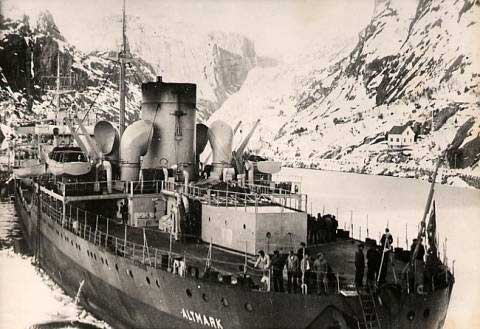
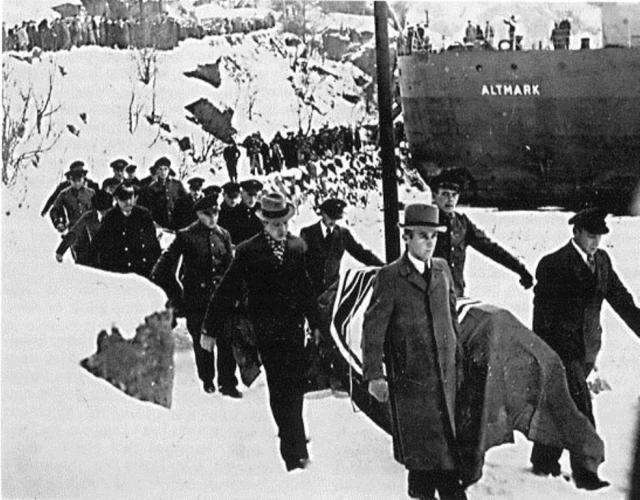
Altmark Incident: Forces of the Royal Navy seized the German steamer Altmark in Norwegian waters and freed 299 prisoners of war. Norway protested the action as a violation of its national sovereignty.
A Lockheed Hudson of No.233 Squadron (RAF Coastal Command) locates the Panzerschiffe Graf Spee’s support ship, the Altmark (suspected of carrying prisoners captured by Graf Spee), in Jøssingfjord, Norway. She is transiting through Norwegian neutral waters, en route to Germany, when she is sighted by British patrol aircraft. As a naval auxiliary, Altmark can legally claim freedom from search by foreign forces. The British light cruiser Arethusa, the name ship of her class, accompanied by the 4th Destroyer Flotilla, intercepts Altmark off the south coast of Norway
Two small Norwegian torpedo boats escort Altmark and warn the British ships not to interfere. The Royal Navy attempts to force the tanker into international waters but is unable to do so as it slips into the Jøssingfjord.
Captain Phillip Vian commanding the Royal Navy Tribal-class destroyer HMS Cossack intercepts Altmark. The Admiralty instructs Captain Vian to aid the Norwegians in escorting Altmark to Bergen for a thorough search. If this is refused Vian is to board the ship himself. When the Norwegians will not act, Winston Churchill personally orders Vian to stop Altmark and board her to free the prisoners. Captain Vian ignores Norwegian efforts to stop him and pursues Altmark, which runs aground in an attempt to ram the destroyer. Cossack comes alongside Altmark and, with cries of “The Navy’s Here!” boards the ship to liberate the prisoners. Four German sailors are killed and five wounded as 299 prisoners are released.
Altmark is refloated at the next high tide and is towed back to Germany in March 1940. After repairs, she will be renamed Uckermark and returned to service.
The ‘Altmark Incident’ was greeted with joy in Britain and the legality of it was never questioned. The Norwegians were angered by what they saw as a blatant infringement of their neutrality. This incident along with reports of troop movements indicating a planned British invasion, sealed Norway’s fate, as well as that of Denmark. Hitler is convinced the Allied will not respect Norwegian neutrality to send aid to Finland, despite Norway’s repeated protests, and steps up his plans for a Scandinavian invasion.
Sir Stafford Cripps, a well-known Marxist sympathizer who plays that role well in the British government, meets with Soviet Foreign Minister Molotov. This is a fascinating example of the British minding their diplomatic fences. On the one hand, they are openly supporting the Finns in their fight against the Soviets, but on the other, they are secretly attempting to learn if there is any room for accommodation with the Soviets.
Germany is supplanting Britain and France in Russia’s trade relations since Soviet trade with the Allies has been “reduced practically to nothing,” the government newspaper Izvestia said today.
Slovak newspapers arriving in Belgrade tonight print a regulation forbidding Jews to enter cafes and restaurants in Bratislava “because they provoke the Slovaks.” Jews are also ordered to report twice a week for street cleaning. A traveler from Slovakia reports that this measure is a result of agitation by the Hlinka Guards, who are thought to be pressing for harsher anti-Semitic action to make way for their increased participation in Slovak commerce and industry. It is known that in Bratislava Parliamentary circles there has been a tendency to delay the expulsion of Jews from Slovakia’s economic life in order to check German infiltration.
That Germany’s actions had removed the war at sea from the range of international law and that henceforth Britain and France would retaliate with unrestricted measures based purely on the notion of reprisals was the French official reaction today to a German announcement that neutral ships that touched British and French ports would be subject to being torpedoed. “If this threat is carried out, we will extend the blockade to the full extent of our technical and material possibilities,” said an official spokesman of the Foreign Office today. “No international convention of any kind ever authorized the view that the German Government has taken and it makes it impossible to deal with Germany under any rules of international law. It is pure gangsterism and piracy, which must be met with reprisals until this lawless power has been overcome.”
In Egypt, the 7th Armoured Division “The Desert Rats” was created out of the Mobile Division, with Major General Michael Creagh in command.
Royal Air Force Hurricanes and Spitfires are converting over to 100 octane fuel. This gives them a performance boost by increasing engine power by raising the boost to +12 lb/sq.in. Every little bit helps against the equally matched Bf 109s, though the Bf 109s as yet cannot make it to Great Britain. No. 602’s Operations Record Book notes today that “100 octane fuel now in all aircraft.”
The British authorities stage a crackdown on “steakeasies” (like “speakeasies” during Prohibition) which are unauthorized slaughterhouses circumventing the rationing process.
The German cargo vessel Baldur is scuttled off Norway during the Altmark Incident to avoid capture by RN warships which include the destroyer HMS Intrepid. Eighteen of Baldur’s crew are rescued and taken prisoner.
The Danish steam merchant Rhone was torpedoed and sunk by the U-14, commanded by Oberleutnant zur See Herbert Wohlfarth, northeast of Scotland in the North Sea (58° 18’N, 1° 46’W). Of the ship’s complement, 9 died and 11 survivors were picked up by the Swedish trawler Standard and the destroyer HMS Kipling (F 91). The 1,064 ton Rhone was carrying coal and was bound for Esbjerg, Denmark.
The Danish Steam merchant Sleipner sank just after midnight after being torpedoed by U-14 shortly before midnight, northeast of Scotland (58° 18’N, 1° 46’W). Of the ship’s complement, 13 died and 28 survivors were picked up by the Swedish trawler Standard and the destroyer HMS Kipling (F 91). The 1,066 ton Sleipner was carrying coal and was bound for Esbjerg, Denmark.
All three lifeboats from Sleipner had already been launched before the ship was hit and they picked up 13 survivors from Rhone, but two of them died in the boats and their bodies were placed on a raft, which was found and recovered three days later by HMS Eclipse (H 08) (LtCdr E. Mack, DSC, RN) in 58°40N/01°05W. 18 survivors from Sleipner and 11 from Rhone in two lifeboats were picked up after 9 hours by the Swedish trawler Standard and landed at Wick. Twelve survivors in the third boat were picked up after about 12 hours by HMS Kipling (F 91) (Cdr A. St. Clair-Ford, RN). Seven of 23 crew members and six of 18 passengers (Greek seamen to join a ship in Denmark) from Sleipner were lost.
At 2125 hours, the Swedish steam merchant Osmed was torpedoed and sunk by the U-14 in the North Sea 20 nautical miles (37 km) north of Kinnaird Head, Aberdeenshire, United Kingdom (57° 51’N, 2° 00’W). The Osmed sank by the bow with a list to starboard within two minutes after being hit on starboard side amidships by one G7a torpedo. Of the ship’s complement, 13 died and 7 survivors were picked up by the British trawler Loch Hope. The 1,526 ton Osmed was carrying coal and was bound for Halmstad, Sweden.
At 2135, the Swedish steam merchant Liana also was torpedoed and sunk by the U-14, 20 nautical miles (37 km) north of Kinnaird Head, Aberdeenshire, United Kingdom (57° 51’N, 2° 00’W). The Liana sank by the stern within one minute after being hit aft by one G7a torpedo. Ten of the ship’s complement died. Two survivors were picked up by the British trawler Loch Hope. Eight survivors were picked up by the Swedish steam merchant Santos, which was herself sunk by the U-63 on February 24 with the loss of six men from the Liana. The 1,646 ton Liana was carrying coal and was bound for Halmstad, Sweden.
U.S. freighter SS Excalibur is detained for several hours by British authorities at Gibraltar but is released; freighter SS Exermont, detained since 14 February, is allowed to proceed as well.
Convoy OA.93GF departs Southend.
Convoy HX.20 departs Halifax for Liverpool.
The War at Sea, Friday, 16 February 1940 (naval-history.net)
RESCUE OF BRITISH SEAMEN FROM GERMAN TANKER ALTMARK
Just after midnight, Admiral Forbes ordered the ships of Operation DT, which began late on the 14th, to intercept German supply ship ALTMARK. The British force split up to search the Leads and offshore islands south of Bergen. Light cruiser ARETHUSA sighted ALTMARK a short time later off Egero Light and destroyers IVANHOE and INTREPID were dispatched to stop her. However, the Norwegian escorts intervened and ALTMARK was able to enter Jossing Fjord. At that time, Norwegian naval units in the Fjord and nearby were torpedo boats KJELL, SKARV, TEIST and armed auxiliaries FIRERN and HVAL IV. Destroyer COSSACK followed ALTMARK in and after unsuccessful talks with the Norwegian escort commander, a boarding party of three officers and thirty ratings (under the command of Lt Cdr B. T Turner) boarded ALTMARK from COSSACK. ALTMARK ran aground, four German sailors were killed and five wounded, but 299 British prisoners from ADMIRAL GRAF SPEE’s sinkings were released. Gunner J J F Smith in the boarding party from light cruiser AURORA was wounded. While alongside ALTMARK, COSSACK’s bow and side plates were damaged and port propeller cracked. When IVANHOE approached German merchant ship BALDUR (5805grt) off Jossing Fjord near Lister Light, she was scuttled.
Still on the 16th, submarines SEAL and TRIAD, and the Polish ORP ORZEL were ordered into the area and joined SALMON and SEALION which were already there. SEAL sighted the sinking BALDUR and the DT operation ships, but the other submarines sighted nothing at all.
Battleship WARSPITE, battlecruiser HOOD, and destroyers FAULKNOR, FOXHOUND, FURY, FAME, FORESIGHT, FORTUNE, and FIREDRAKE of the Home Fleet were at sea near Pentland Firth covering the operation. And after leaving Scapa Flow on the 16th, heavy cruiser NORFOLK met light cruisers SOUTHAMPTON and EDINBURGH and destroyers DARING and IMPERIAL to provide support. There was no German Fleet reaction.
After the rescue, the SOUTHAMPTON group joined convoy HN.12 on the 17th, together with ARETHUSA in support, COSSACK and her force returned to Rosyth arriving on the 17th after which she reached Leith on the 19th for repairs, and the HOOD force arrived back in the Clyde on the 18th.
German steamer WIEGAND (5869grt) arrived in Jossing Fjord on the 21st, supposedly to tow ALTMARK, but left alone the next day. Instead, ALTMARK remained aground under the guard of Norwegian minelayer OLAV TRYGVASSON until 6 March when she was refloated, and headed for Sandefjord escorted by two Norwegian destroyers while submarine UNITY shadowed and the Polish ORP ORZEL patrolled nearby. After reaching Sandefjord, ALTMARK’s repairs were completed on 22 March.
Armed merchant cruiser WORCESTERSHIRE arrived in the Clyde from Northern Patrol.
Submarines TRUANT and TRITON exercised in the Firth of Forth.
Aircraft carrier ARK ROYAL, battlecruiser RENOWN and destroyer HERO arrived at Portsmouth and Force K was dissolved. After short refits, the three oined the Home Fleet.
Anti-submarine whaler THIRLMERE (560grt) at 0905 attacked a submarine contact west of Sumburgh Head in 59-58N, 3-08W. Anti-submarine whaler ELLESMERE was sent to assist, but no further contact was made and the search was abandoned at 1700/17th.
Convoy FN.96 departed Southend, escorted by destroyers WOOLSTON and JANUS and sloop GRIMSBY, and arrived in the Tyne on the 18th.
Convoy FS.98 departed the Tyne, escorted by destroyer JERVIS and sloops FLAMINGO and WESTON, was forced to anchor in the Humber overnight, but arrived at Southend on the 18th.
U-14 sank Swedish steamers OSMED (1526grt) 20 miles and LIANA (1664grt) 24 miles north of Kinnaird Head, with the loss of thirteen and ten crew respectively. Survivors were picked up by Swedish steamer SANTOS (3840grt) and British trawler LOCH HOPE (274grt), but of the eight onboard SANTOS, six were lost when she was sunk on the 24th
Convoy HN.12 of three British, fifteen Norwegian, eight Swedish, one Danish, two Finnish and one Estonian ship departed Bergen escorted by destroyers INGLEFIELD, ILEX, IMOGEN, DELIGHT, and submarine THISTLE. Anti-aircraft protection was provided by anti-aircraft cruiser CALCUTTA and close support by light cruisers EDINBURGH and ARETHUSA. Destroyer DARING departed Rosyth on the 15th to join the convoy at sea. On the 17th, INGLEFIELD and IMOGEN, and EDINBURGH and ARETHUSA detached to Scapa Flow to refuel and arrived on the 18th. Three merchant ships joined from the Orkneys for passage to the east coast, and destroyer IMPERIAL escorted the Methil section. The convoy arrived on the 19th
Convoy HX.20 departed Halifax at 0800 escorted by Canadian destroyers HMCS FRASER and HMCS ST LAURENT and the British HEREWARD. Canadian destroyer SKEENA accompanied the convoy until it was clear of the harbour. Light cruiser ORION and liner DUCHESS OF BEDFORD departed Halifax with HX.20 and then proceeded independently to Liverpool. HEREWARD returned to Halifax on the 20th, but before then, the other destroyers turned the convoy over to the ocean escort, light cruiser ENTERPRISE, at 1400/17th. Destroyers VOLUNTEER and WITCH and sloops FOWEY and ROCHESTER escorted from 29 February to 4 March, when the convoy arrived at Liverpool.
Today in Washington, the House of Representatives passed a bill appropriating $965,772,878 for the Navy Department in the next fiscal year, a sum $112,693,139 less than budget estimates; heard Representative Taber of New York warn departments not to submit deficiency requests to the next session of Congress, and adjourned at 2:31 PM until noon Monday. The Banking and Currency Committee heard Jesse Jones, Federal Loan Administrator, on possible Export-Import Bank loans to Finland; the World War Veterans Committee discussed veteran legislation with Brigadier General Frank T. Hines, Veterans Administrator, and the Labor Committee continued study of amendments to the Wagner Act.
The Senate Agriculture Committee took up the forestry problem; the TNEC continued its study of insurance company practices.
President Roosevelt at sea today approved a series of emergency projects to meet blizzard and storm damages in Massachusetts, Rhode Island, and Connecticut.
A record-breaking appropriation of $965,779,438 for the U.S. Navy won the quick approval of the House today but only after a proposal to make Guam a Pacific outpost for naval patrol planes was stricken from the measure. Heeding warnings that the measure might lead to war with Japan, the House adopted an amendment eliminating $1,000,000 sought by the navy to start work on a $3,000,000 dredging and breakwater construction job to make the island’s harbor safe for both naval and commercial aircraft. The vote was 123 to 114.
Without a record vote, the House of Representatives passed and sent to the Senate today a Naval Appropriation Bill carrying a record peacetime total of $965,772,878. For the second year in succession funds for improvement of the harbors at Guam were eliminated. As in the debate last year, the argument was stressed that such a project was a step in a direction which might lead to war with Japan. The total of the bill as approved by the House was $112,693,139 below budget estimates, but most of the reductions had been made by the Appropriations Committee. The Guam item, eliminated on the floor, called for $1,000,000, a smaller sum than had been asked by the navy last year.
Economy lines, established on previous appropriation bills, held tight today and “big navy” advocates were forced to pin their hopes on Senate restoration of items stricken out in the process of House consideration. The Appropriations Committee assured the House that the cuts it made would not interfere with the efficiency of the navy during the coming fiscal year. It declared that the funds it eliminated would not be actually needed in the period, although they probably would be required in the fiscal year 1942.
The bill as voted provides for the laying down next year of two battleships, one aircraft carrier, two cruisers, eight destroyers, six submarines, one submarine tender, one large seaplane tender, two small seaplane tenders and one minesweeper. It provides funds also to continue construction on eight battleships, seven cruisers, two aircraft carriers, forty-two destroyers, twenty submarines, two destroyer tenders, two large seaplane tenders, four small seaplane tenders, one submarine tender, two minesweepers, two oilers, three fleet tugs, one mine layer and one repair ship. There would be completed under the appropriations four cruisers, seven destroyers and seven submarines.
An amendment by Representative Rich, Pennsylvania Republican, sought to strike out the appropriation for one of the two battleships scheduled to be laid down next year, but the amendment was defeated, 109 to 52. Funds are carried in the bill to increase the enlisted strength of the navy to 152,000 and of the Marine Corps to 25,000.
In the U.S., the Republican Party selects the city of Philadelphia, Pennsylvania as the site of the 1940 national convention, to be held on June 24th. The Republican National Convention will meet in Philadelphia June 24, the national committee decided today as John D. M. Hamilton, its chairman, challenged the Democrats to renominate President Roosevelt. “We would have,” Mr. Hamilton declared, “a clear-cut issue, and once and for all we would have a showdown on the New Deal, Franklin Roosevelt and the third term-and we would finish all three.” The Republican chairman, amid cheers, scathingly attacked the New Deal, which he said was making a “defensive, retreating fight.”
He asserted that the Roosevelt administration had disregarded “the plain mandate of the Constitution,” had “tried to pack the Supreme Court with its partisans” and had given “ardent sympathy and encouragement to subversive elements seeking the downfall of our American system.”
“And now,” he continued, “this regime would torpedo another American tradition — the tradition that no man, irrespective of how great he is, shall fill the Presidential chair longer than eight years.
Vice President John Garner announced today he would enter the Democratic primary in California, seeking to duplicate his 1932 feat of winning the California delegation’s support for the Democratic presidential nomination.
Captain Joseph A. Gainard, master of the City of Flint, performed his duties in connection with the seizure of his vessel by a German prize crew “with wisdom, patience and forbearance,” according to Commander B.S. Field, director of the Bureau of Marine Inspection and Navigation of the Department of Commerce.
The attempt of the Bear, flagship of the United States Antarctic Expedition, to penetrate far into the heart of the Antarctic ice pack has failed temporarily, because of heavy ice and other unfavorable conditions.
Brazilian Foreign Minister Narciso Garay said tonight he had sent to the other American republics a request from Brazil for consultation on a possible collective protest to Britain “against a new violation” of the Pan-American neutrality belt over the Wakama scuttling incident.
Japanese planes made another raid on the French-operated Haiphong-Kunming Railway in Yunnan Province today. No serious damage was reported. The raid occurred between Kiayuan and the border of French Indo-China. The line, a vital channel for Chinese war supplies, has been bombed many times since the Japanese established a base in near-by Kwangsi Province last November.
The Japanese Army spokesman in Shanghai tonight sarcastically expressed the wish that the Chungking military leaders would “abandon their propaganda tactics and instead seriously attempt to recapture any important Chinese city now occupied by Japanese forces, Nanning for instance.” He pointed out that Chungking on Thursday claimed the recapture of Wuyuan in Suiyuan but that “unfortunately” the Japanese took a crowd of foreign newspapermen from Peiping to Wuyuan by airplane last Tuesday, the day the Chinese were said to have recaptured it.
Alleviation of Shanghai’s tension was effected this afternoon when a modus vivendi dealing with policing of the western areas of the city was signed by Cornell S. Franklin, chairman of the International Settlement’s Municipal Council, and Mayor Fu Siao-en, head of the government of Greater Shanghai, composed of Japanese-occupied areas outside the Settlement and French Concession. Simultaneously the Japanese Consulate General announced its readiness to resume negotiations with the Municipal Council for return of the Settlement’s jurisdiction over the Hongkew and Yangtzepoo areas north of Soochow Creek, which have been under Japanese martial law since August, 1937.
Speaking impromptu with a personal sincerity that held listeners closely attentive, Foreign Minister Hachiro Arita last night expressed the opinion that relations between the United States and Japan would not become irreparably worse.
Dow Jones Industrial Average: 148.2 (-0.26)
Born:
Glenn Glass, NFL and AFL cornerback, safety, and flanker (Pittsburgh Steelers, Philadelphia Eagles, Atlanta Falcons, Denver Broncos), in Holopaw, Florida.
Naval Construction:
The Kriegsmarine (German Navy) Type VIID U-boats U-213, U-214, U-215, U-216, U-217, U-218 are ordered from F. Krupp Germaniawerft AG, Kiel (werk 645-650).
The Royal Navy Tree-class minesweeping trawler HMS Wistaria (T 113) is commissioned. Her first commander is Skipper Horace Charles Aisthorpe, RNR.
 History Diaries