
Cambodian gunboats trying to get vital supplies and reinforcements to troops cut off on an island in the Mekong River have been driven back by heavy Communist fire, military sources in Phnom Penh said. The Communists surrounded three battalions on Peam Raing Island, 12 miles south of Phnom Penh after winning control of the island’s shoreline.
One of Phnom Penh’s hallmarks has been its ability to withstand apocalyptic predictions of its imminent collapse. At various times during the five years of Cambodia’s war, people have forecast doom for this capital, a city of two million people, and for the American-backed government. But each time something has turned up — more American aid, a weakness on the insurgent side — to belie the prediction. This year the crucial Mekong River supply line is blockaded by the Communist-led insurgents, commercial flights out of the country have been reduced to a handful because of rocket attacks on the airport, some foreigners are abandoning the city, supplies are getting low and the American emergency airlift aimed at keeping the shortages from becoming critical has probably become too costly to continue indefinitely. And Congress has expressed coolness to President Ford’s special request for more military aid for Cambodia.
But although the situation has more potentially serious factors than before, there is no clear evidence that collapse is likely. Nevertheless, friends and relations back home have been sending alarmed cablegrams to Americans here, expressing concern for their safety and urging them to get out as fast as possible. Some of the Americans receive these frightened messages while they are sunning beside their backyard pools or dining it French restaurants here, which are doing so well that some elaborate new ones have opened recently. The American Embassy summoned foreign corrspondents to a briefing yesterday to explain the limited evacuation measures it is taking.
A senior official explained that the embassy had distributed a letter to American private citizens living in Cambodia, recommending “strongly” that as a precaution all dependents and other “nonessential” Americans should leave the country, at least until conditions improve. The United States has also recommended to other embassies that they also evacuate their dependents. Several, such as the Australian and British Embassies, are doing so. The French, Japanese and South Vietnamese had acted earlier. Moreover, the Americans have offered seats on their own embassy‐plane flights to Bangkok, Thailand, and Saigon, South Vietnam, for people who do not have the money for air tickets or are otherwise unable to get seats on one of the few commercial flights.
But the embassy official said that this was not a general evacuation. Few people were involved — only 30 to 40 Americans or perhaps 50 at most, out of several hundred Americans in Cambodia. The entire embassy staff of 285 is staying. The embassy said that its moves, similar to those taken during the insurgent offensives of 1973 and 1974, were directed primarily at wives and children of Americans here and also at missionaries, teachers, businessmen and tourists. The intent, the American Embassy said, is “to reduce the number of people for whom we are responsible” in the event conditions deteriorate suddenly and a quick evacuation is needed.
South Vietnam began a three-month campaign to stamp out smuggling, which informed sources said accounted for a turnover of up to $100 million a year. Attention will focus on imported alcohol, cigarettes, matches, fruit and sugar, with the main target of the campaign being street stalls. Officials admit privately that the campaign is unlikely to deter big smuggling operators. But they hope that if retailers find it more difficult to sell smuggled goods, local prices will rise and reduce demand from buyers.
Secretary of State Kissinger and Foreign Minister Andrei Gromyko of the Soviet Union began talks in Geneva today with emphasis on Soviet American relations and new American-Soviet proposals on arms-control issues. They also discussed Cyprus and European security questions, but delayed until tomorrow their planned detailed discussion on the Middle East, the main contentious issue at the moment between the two countries.
The Soviet Union renewed its proposal that the Cyprus situation be discussed at a relatively large conference within the framework of the United Nations. The renewal of the Soviet proposal of last August — it was accepted by Greece, but not Turkey — came from Tass, the official press agency. Meanwhile, West German officials said after Secretary of State Kissinger’s talks in Bonn that the government was considering resumption of arms aid to Turkey, but not under American pressure.
Glafkos Clerides, the Greek Cypriot leader, arrived in New York last night for an appearance before the United Nations Security Council, and denounced in a statement at Kennedy International Airport the recent Turkish Cypriot declaration of an autonomous republic in part of Cyprus. “We will explain to the Security Council of the United Nations the coup of the Turkish Army,” Mr. Clerides told reporters, as the Greek Cypriot delegation arrived from Athens. “To create a separate and independent state would be wrong,” he said. “We will fight against any independent state.”
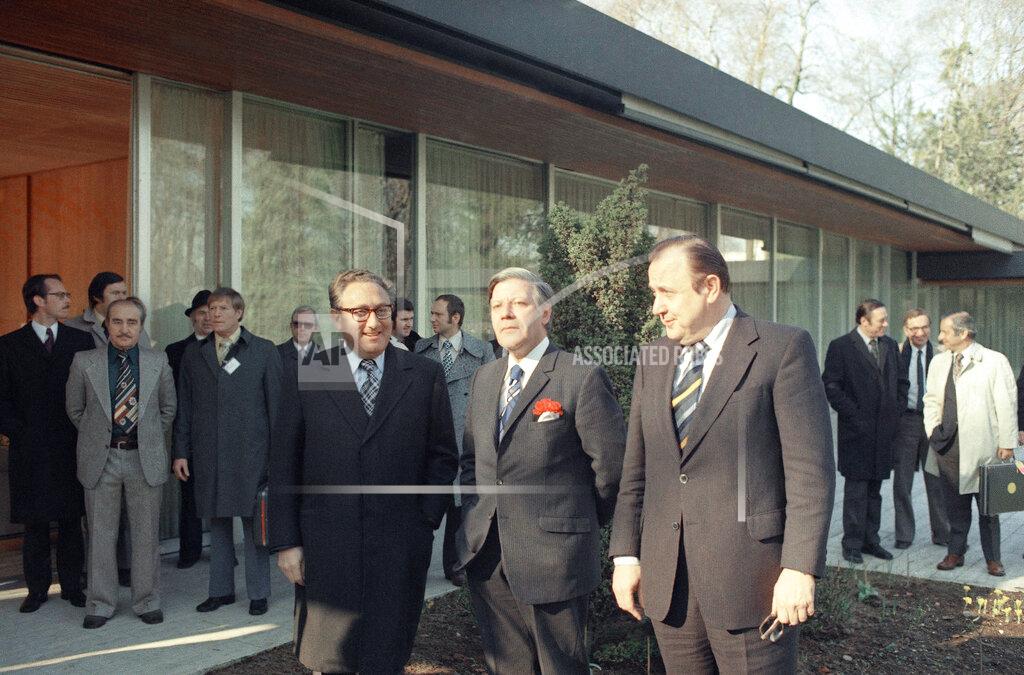
West German officials said after Secretary of State Kissinger’s talks in Bonn today that the Government was considering the resumption of arms aid to Turkey, but not under American pressure. American arms shipments to Turkey were cut off by Congressional action on February 5, over intense opposition from Mr. Kissinger, who said the suspension was a “tragedy” that would only hinder attempts to get Greece and Turkey to negotiate a Cyprus settlement. After a morning meeting with Foreign Minister HansDietrich Genscher at Gymnich Castle, outside Cologne, Mr. Kissinger said that “arms shipments is a question for the Federal Republic to decide.” The issue did not come up during a luncheon meeting in Bonn between Mr. Kissenger and Chancellor Helmut Schmidt, according to the chief Government spokesman, Klaus Bölling.
Turkey is negotiating new arms deals with five Western European countries following the decision by Congress to end United States arms supplies to Turkey, Defense Minister Ilhami Sancar said today. He said that Turkish military buyers had made contact with private and state armaments concerns in Belgium, Italy, the Netherlands, West Germany and France. He declined to specify the companies involved or to give details of what Ankara wanted to buy, and he denied a British press report that a Turkish military team had visited London on a weapons‐buying mission.
Twelve convicted members of the Irish Republican Army ended a prison hunger strike that began more than six weeks ago, the IRA announced. The prisoners ended their East after a “satisfactory settlement” was reached with authorities at Portlaoise Prison outside Dublin, the IRA Baid. The government, however, said it did not agree to the prisoners’ demand that they be treated as political prisoners rather than common criminals.
Soviet Communist Party leader Leonid I. Brezhnev will visit Britain at the invitation of Prime Minister Harold Wilson, according to authoritative sources in Moscow. The sources said no date had been set, but British officials hoped the visit could be arranged soon in order to further warm up Soviet-British relations.
The hooded killer who kidnaped attractive 17-year-old heiress Lesley Whittle from her bedroom a month ago may have formed an emotional attachment to his victim and adopted her as a “pet,” a police official said in London. “He has shown compassion to women in some of his crimes,” Detective Chief Superintendent Robert Booth told newsmen. Speaking of Miss Whittle, he added, “As long as she does not upset him she may still be safe.” The heiress was kidnaped January 14.
HMS Sheffield, a guided missile destroyer, is commissioned into service in the British Royal Navy. The ship would be sunk by the Argentine Navy in May 1982 during the Falklands War, with a loss of 20 lives.
Representatives from 104 underdeveloped nations were asked in Algiers to endorse a “radical transformation of the world economy” to quadruple their share of international wealth. The proposal, which is expected to be passed during a four-day meeting in Algiers, would include the right to form more raw materials cartels like the one for oil, to nationalize foreign industry and to regulate multinational corporations.
The Arab office for the boycott of Israel has not placed a single bank or company on its blacklist because it is owned by Jews, the of fice’s commissioner general, Mohammed Mahgoub, said today.
The Ford administration gave its approval to an investment of $300 million by the Iranian government in the financially troubled Pan American World Airways, the largest airline in the United States. Final terms must still be negotiated and then approved by the Civil Aeronautics Board. Pan American reportedly hopes to use a large part of the Iranian money to make a compromise payment settlement offer to a group of insurance companies to which it owes a total of $380 million, relieving pressure from one of its most urgent debts.
Eighty more people were released from prison after a decision by South Korean President Park Chung Hee to suspend the sentences of most of the 203 people jailed last year for anti-government activities. The releases brought to 130 the number freed so far. Those freed yesterday included Kim Chi Ha, the country’s best‐known poet, Professor Kim Dong Gil, dean of theology at Yonsei University in Seoul. and Pak Hyong Kyu, the Protestant minister who heads the outlawed Urban Industrial Mission. Huge crowds formed in the early morning at prisons in Seoul and other cities. As the prisoners emerged, the crowds, made up of family members, students and opposition politicians, sang the national anthem and “We Shall Overcome.” Embracing his sister, the president of Ewha Women’s University, before the prison in Anyang, 15 miles south of the capital, Professor Kim sounded a defiant note. “I shall continue to struggle for democracy,” he declared.
The finance ministers of Venezuela and Colombia proposed in Cucuta, Colombia, the creation of a new Latin American economic consultative body that would exclude the United States but welcome Cuba and all other Latin American nations. They said the organization would be called the Latin American Economic System and would not interfere with the Organization of American States.
Gunmen killed an Argentine journalist in the wine-growing province of Salta and then blew up the corpse with a bomb, police said. The newsman, Luciano Jaime, 38, belonged to the staff of the Salta newspaper El Intransigente. His killing followed a death squad pattern set by Argentine right-wing terrorists. At least 29 persons have died this year in bloody fighting between rightist and leftist factions in the country.
Thousands of Ethioplans — including many Eritrean Muslims — paraded through the streets here today in a government‐backed demonstration in support of the fight to keep the northern province of Eritrea a part of Ethiopia. Crowds or men, women and children moved, often at a trot, up and down this capital city’s evergreen and eucalyptus-studded hills, chanting: “Eritrea is Ethiopia — Ethiopia is Eritrea.” They chanted in Amharic, the national language, and in Arabic, which is widely spoken in Eritrea.
At a meeting in Cape Town, South African Prime Minister B. J. Vorster informed visiting Prime Minister Ian Smith of Rhodesia that the white minority government of South Africa would no longer provide troops to protect Rhodesia’s white minority government. Smith, who had been reassured earlier of the Vorster government’s support, said later that the decision had struck him “like a bolt from the blue.” Rhodesia’s government would fall in 1979, as a black majority government took power and the nation was renamed Zimbabwe.
The Times of London reported today that Prime Minister John Vorster of South Africa had paid a secret visit to Liberia last week and had told the Liberian President, William R. Tolbert Jr., South Africa would be glad to give up the administration of South-West Africa.
Part of President Ford’s spending slowdown will include total opposition to the creation of any new federal holidays. Aides will tell women’s groups, civil rights organizations and others interested in official recognition of some prominent person or event to forget it. The White House wants no expansion of the present nine paid federal holidays and it is strongly backed by most private employers. Each national holiday costs the government almost double the $141 million daily civilian payroll.
President Ford went to church and played golf in the afternoon as he took a recess from efforts to sell his energy-economy program to Congress and the nation. After traveling to Texas, Kansas and New York-last week, the President planned to stay in Washington this week. He has invited congressmen to the White House in separate groups today through Thursday to seek their support. On his schedule for Washington’s Birthday is a trip to the National Masonic Memorial in nearby Alexandria, Va., where a medallion is being unveiled in Mr. Ford honor as the 14th President who was a Mason.
Senator Hubert H. Humphrey (D-Minnesota), chairman of Congress’ Joint Economic Committee, said the nation might face a depression later this year unless strong economic measures were taken within 60 to 90 days. He called the Administration’s energy package “ill-conceived, inadequate and inequitable” and charged that the main culprit in the economy’s “precipitous decline” was the Federal Reserve Board. He warned board members that “unless they shape up and start to do something about this economy they will be subject to congressional action.”
The United States and the Mariana Islands have signed a commonwealth agreement, the first step toward establishing a new US territory, The accord climaxed two years of formal negotiations between the United States and leaders of the Marianas, which have been administered by the United States under a UN. trusteeship agreement since 1947. The trusteeship will run out in 1980. The commonwealth agreement goes to the 16-member Marianas district Legislature this week for approval. Then, if a June plebiscite approves it, the agreement will be submitted to the U.S. Congress.
FBI-paid informants often travel abroad voluntarily to keep watch on organizations that have activities extending beyond US borders, according to FBI spokesman James Murphy. He emphasized that the informants go abroad voluntarily. Whether they wish to go is up to them, he said. But he added that when they do go “we reimburse them for their expenses and services” Murphy said the informants were not FBI agents or employees of the FBL Overseas intelligence operations are generally handled by the Central Intelligence Agency, while the FBI handles internal security functions.
Former Attorney General Elliot Richardson told a Senate hearing last year that he believed the Federal Bureau of Investigation had wiretapped at least one member of Congress and possibly two congressional aides before the Nixon years. The testimony, which got little public attention when it was given, was part of evidence cited by two subcommittees in a report it released calling for stronger congressional control of electronic surveillance.
First-class postage will rise to 12 or 13 cents in 1975, Postmaster General Benjamin F. Bailar predicted. “I don’t think the 10-cent stamp will last through the end of this year,” Bailar said on ABC radio’s “Issues and Answers.” Citing very substantial cost increases, an operating deficit, inflation and upcoming labor negotiations, Bailar predicted that an increase would come “in the latter half of this year. He said also that in the near future air mail postage probably would be eliminated within the United States because nearly all first-class mail now moved by air anyway.
Next Friday, Soviet space pilots will leave Houston, where they are completing their third training session in this country, and go home to prepare for the scheduled link-up in space next summer of an American Apollo and a Soviet Soyuz spacecraft. The equipment that will be sent into space next July 15, including an American-built docking module and a complete “backup” Soyuz ship, have been delivered to their launch sites on the Atlantic Ocean and in the Kazakhstan desert. Next month, the control centers near Houston and Moscow will carry out their first serious practice sessions on how to handle emergency situations, using their interpreters and a battery of telephone, teletype and television channels. In April, the American astronauts in the project will take part in their third training session in the Soviet Union and visit the Soviet launching site of Baikonur, just as the Soviet space pilots visited Cape Canaveral, Florida, a week ago.
Participants in a conservative political conference in Washington voted to establish a 13-member committee to study the possibilities of a third party for the 1976 presidential campaign. The resolution establishing the group, called the Committee on Conservative Alternatives, avoided the term “third party.” It stated instead the need “to provide a formal mechanism to review and assess the current political situation and to develop future political opportunities,” and it noted that “a growing number of independent voters reject both major parties.”
President Ford received a telegram claiming that 22 million acres of western wildlife preserves are exposed to overgrazing and mismanagement as a result of a decision by Interior Secretary Rogers C. B. Morton. According to the 25 environmentalist groups joining in the protest, Morton “succumbed to pressure by mining and stock-raising interests” in taking jurisdiction for the preserves from the Fish and Wildlife Service and giving it to the Bureau of Land Management.
“The American people are not just frustrated with Congress, we’re fed up with them,” said Charles Earl, a retired naval officer, who was sitting in shirtsleeves in Gert Freedman’s living room overlooking South Lake, Florida. It was a refrain Representative Louis Frey Jr. heard time and again last week as he toured his central Florida district. Representative James C Cleveland heard the same thing from his constituents in New Hampshire. Representative Butler Derrick heard it in South Carolina. Representative Virginia Smith heard it in Nebraska and countless other members of Congress heard it in their districts from one end of the country to the other. For members of Congress, February of a nonelection year is a time for shoring up old fences, not building new ones.
At home last week for the Lincoln Day recess, just three weeks after the new Congress convened, they mostly sounded out their old friends and found, not surprisingly, that the folks who voted for them in November still love them in February. But they also found these constituents deeply disillusioned with Congress as an institution, disgusted with the bickering between the White House and Capitol Hill and unable to fathom why Congress and President Ford cannot get together and devise a policy that would turn the slumping economy around and begin to solve the energy crunch.
Sheila Young of Detroit won the 500-meter and 1,000-meter races today and captured the women’s title at the world speed skating championships.
17th Daytona 500: Benny Parsons captured his first and only Daytona 500 victory as leader David Pearson spun out with 2 laps to go in NASCAR’s premier race in front of a national television audience. Parsons wins after Cale Yarborough sends race leader Pearson spinning on the backstretch; Parsons avoids the accident and takes the victory.
Jimmy Connors had a scare from 20 year-old Vitas Gerulaitis today, but fought off the New Yorker and became the first player in modern times to win three consecutive national indoor tennis championships. The scores were 5–7, 7–5, 6–1, 3–6, 6–0.
Born:
Marty Murray, Canadian NHL centre (Calgary Flames, Philadelphia Flyers, Carolina Hurricanes, Los Angeles Kings), in Deloraine, Manitoba, Canada.
Shannon Taylor, NFL linebacker (San Diego Chargers, Baltimore Ravens, Jacksonville Jaguars), in Roanoke, Virginia.
Ángel Peña, Dominican MLB catcher (Los Angeles Dodgers), in San Pedro de Macoris, Dominican Republic.
Don Jeffcoat, American actor (“One Life to Live”), in Gulfport, Mississippi.
Nanase Aikawa, Japanese rock and J-pop singer, in Osaka, Japan.
Died:
Morgan Taylor, 71, American Olympic hurdler (Olympic gold medal, 400m hurdles, 1924; bronze, 1928, 1932).
(Adanelle) “Norman” Treigle, 47, American operatic bass-baritone, dies of an accidental sleeping pill overdose.





 History Diaries