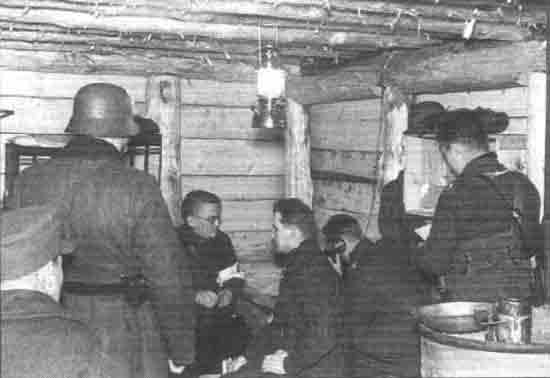
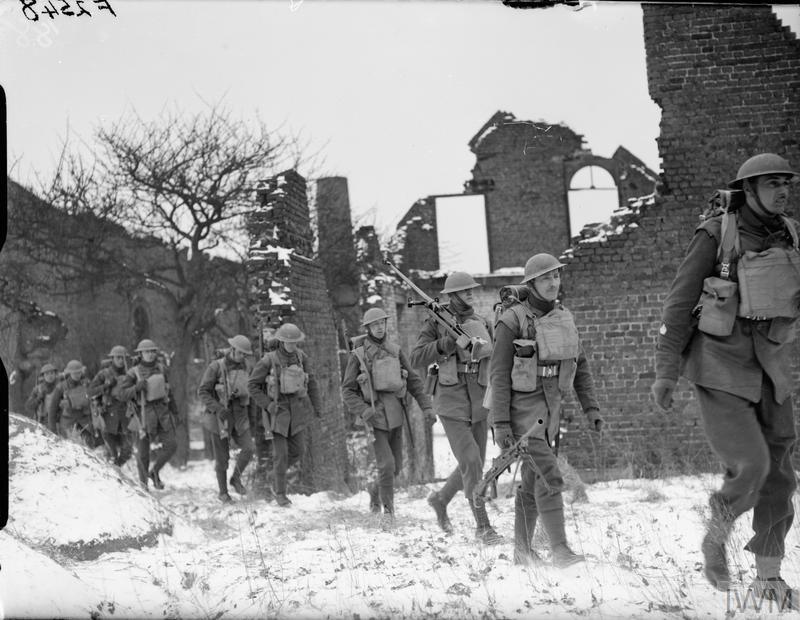
The Soviet 7th Army and 13th Army continue attacking the Mannerheim Line, but are unable to widen the breach. It has now been 72 continuous hours of horrific bombardment and Soviet attacks against the entire line. The temperature decreases in the morning to minus 31 degrees Celsius, and there are no reserves. When ammunition is sent forward, it typically is with a message that this is the last of it, so use it wisely.
The fighting becomes medieval. In one section of the line, on the eastern end of the Suursuo swamp, the Soviets open a renewed attack in the morning with the 24th Rifle Division, composed of the 274th and 168th Regiments. Earlier, at 03:45, the 1st Division HQ refused an order for the 2nd Brigade to retreat. The Soviet offensive on a wide track fails after desperate Finnish resistance by a dwindling group of men (248 men hold a 3-km front, all that is left of 3 battalions). The Finns counterattack by attempting to blow up a key Soviet bunker, but the Soviet 274th Regiment beats them back with a hail of machine gunfire. After that, the Soviets counterattack again, and the two sides remain in hand-to-hand combat all night long.
On a different section of the line, Finnish General-Major Laatikainen in command of the 1st Division orders his men in the 1st Brigade to withdraw behind the River Peronjoki. This is a switch position that can only be held temporarily. By withdrawing, the General uncovers the flanks of adjoining units, but the position simply cannot be held. War requires difficult decisions. The Finns have used up their reserves and the Mannerheim Line can no longer be held in the Lahde sector.
In the Lähde sector of the Mannerheim Line, the Soviet troops are in possession of a 2-3 km section of the line. The Soviets take the Kirvesmäki stronghold on the Taipale River for the final time after it has switched hands repeatedly.
The Finns all along the line are running out of ammunition, and losses in men are becoming critical. Among many other issues, Finnish artillery observers rely on phone lines which the Soviet artillery blasts continually sever despite the best efforts of the Signal Corps to keep them operational.
Finnish troops start pulling out of the Lähde sector of the Mannerheim line, withdrawing to rearguard positions at the V-line and leaving a gap in the Mannerheim Line 2-3 km wide and 6 km deep. The Kirvesmäki stronghold on the Taipale River changes hands for the fourth time in 3 days. Soviets attack with artillery, aircraft and tanks; and they retake the Kirvesmäki stronghold. Finns are out of reserves and cannot mount a counterattack.
On the Eastern Isthmus, fierce fighting in Taipale results in the enemy retaking the Kirvesmäki stronghold which had been recaptured by Finnish troops during the night. After a massive artillery barrage lasting two hours the Russians launch an assault in both Terenttilä and Kirvesmäki. The attack is supported by both aircraft and tanks. Lack of sufficient available strength makes it impossible for the Finnish troops to respond effectively. The ferocity of the battle is illustrated by the fact that the commander of the company with responsibility for the front has to be replaced three times within the space of just a few hours due to the death or injury of his predecessor. There is a lull in the fighting at 5.35 p.m.
In compliance with their orders the Finnish troops in Summa pull out of their positions in the Lähde sector. Fortunately there is no enemy attack during the withdrawal, reorganization and regrouping of the Finnish defences. The Finns also succeed in reinforcing their troops in the Summa sector.
The Russians lose 30,000-40,000 men in Summa.
In the north, the Finnish 9th Division suspends attacks on the Kuhmo ‘mottis’.
The Soviets award an assault tank brigade trapped in a ‘motti’ 300 rubles to distribute among the troops in honour of the 22nd anniversary of the Red Army.
Commander-in-Chief Mannerheim, the commanding officer of the Army of the Isthmus, and the commanding officer of II Army Corps meet in Saarela manor house to discuss the situation on the Isthmus.
Viipuri was bombed repeatedly by Soviet planes, which also raided other Finnish civilian centers, Hamina and Lapeenranta, among them. Numerous buildings were burned in all three towns. Soviet bombers damage the castle bridge and Viipuri Castle itself.
On the home front, Soviet bombers hit Hamina.
The Finnish Government publishes a note aimed at foreign powers on the Soviet Union’s infringements of the customs of war. A Finnish Note (circularized to many foreign governments) accuses the USSR of adopting illegal methods of warfare, including indiscriminate bombing of unprotected towns, hospitals and railway trains and abuse of the white flag (some Soviet troops having feigned surrender before attacking).
The Finns also admit that their forward line on the Karelian Isthmus has been breached, but also say that the Soviet advance has been stopped at the second line of defenses.
British Prime Minister Neville Chamberlain informs Finland’s diplomatic representative in London, Georg Gripenberg that the United Kingdom is prepared to supply Finland with thirty 84 mm field cannons and 30,000 shells. This is around a third of what Finland had asked for.
In answering a question posed in the House of Parliament about British citizens volunteering to help Finland in their war with the Soviet Union, Parliamentary Under-Secretary of State for the United Kingdom’s Home Department Osbert Peake stated that “a general licence has been granted to British subjects to enlist in the Finnish forces, and a licence has been granted to the recruiting organisation which has been established in London.”
The Manstein Plan was tested again in a war game at Mayen. Heinz Guderian concluded that the plan was viable, but Franz Halder did not share Guderian’s confidence that panzers could cross the Meuse on their own without waiting for infantry support. This debate was never resolved except for an agreement that panzer commanders would be authorized to attempt the crossing on their own, but if they failed Army Group A would switch to the infantry option.
A German detachment attempting to raid a French advance post east of the Moselle River was caught in a crossfire from French guns and was forced to withdraw in disorder, leaving behind many dead, military dispatches reported tonight.
An authorized Nazi spokesman said that U-boats had a “theoretical right” to attack United States shipping en route to Allied ports.
Nazi sources in Germany are allowing word to reach Washington directly and indirectly that the German Army may be forced for strategic and trade reasons to attempt to seize the Netherlands in the Spring.
Belgium’s undertaking to refrain from re-exporting more than she did before the war was considered here tonight to be the paramount feature of a British-French war trade agreement that has just been arranged with the Belgian Government. The Allies seek to prevent Germany from using Belgium as a vehicle to avoid the blockade.
IRA operatives plant five bombs in Birmingham. Two shops are damaged.
Negotiations between British and Italian officials for a comprehensive trade agreement have been suspended, it was learned today. Members of the British trade mission now in Rome are returning to London for consultation and while it is expected that they will go back, the sudden interruption of the talks is interpreted here as a bad sign.
Parliament has unanimously ratified an agreement with Rumania benefiting Rumanians of the Greek Orthodox Church. However, current hostilities between the press of the two countries continues unabated.
Rationing is introduced in the Vatican.
The British Government does not intend to increase the Jewish immigration. quota for Palestine, Colonial Secretary Malcolm MacDonald told the House of Commons today. The present quota allowed more than 10,000 Jews to settle in Palestine in six months, which he thought represented a considerable degree of immigration. Replying to a Laborite questioner, who asked whether he fully realized the universal Jewish adherence to the Allied cause and if he would relax restrictions to foster good-will, Mr. MacDonald said he was fully aware of world Jewry’s whole-hearted support of the Allied cause, “one purpose of which is freeing Jews from their cruel persecutors in Central Europe.” British policy allowed for a considerable immigration of Jews into Palestine over the next few years, he said, and there was no question. of departing from that policy.
A Lockheed Hudson of RAF Coastal Command located the German tanker Altmark as it reached Norwegian territorial waters. The Altmark was carrying 299 British merchant sailors who had been taken prisoner by the German pocket battleship Admiral Graf Spee in late September and October of 1939 The Altmark had successfully avoided the Royal Navy since October 29, 1939.
German pocket battleship Admiral Graf Spee’s supply ship Altmark reached Norwegian territorial waters off Trondheim. It was Captain Heinrich Dau’s intension to remain in neutral Norwegian waters to avoid an attack by the British.
The RCAF’s No.110 (Army Co-Operation) Squadron sails from Halifax, Nova Scotia, for Britain. This is the first RCAF squadron to be sent to Europe.
The British government announces that all British merchant ships in the North Sea will be armed. In addition, it will allow British citizens to volunteer for the Finnish Foreign Legion.
At 0135 hours, the British steam tanker Gretafield, a straggler from convoy HX.18, was torpedoed and set on fire by German U-boat U-57, commanded by Kapitänleutnant Claus Korth, southeast of Noss Head, Shetland Islands (58°27′N 2°33′W). Gretafield (Master Ernst Derricks), a straggler from convoy HX-18, was hit by one G7a torpedo from U-57 southeast of Noss Head. The tanker caught fire after being hit aft by one G7e torpedo at 0148 hours. Ten crew members and one gunner were lost. The master and 29 crew members were picked up by the British armed trawlers HMS Peggy Nutten (4.450) (Skipper J.C. Taylor) and HMS Strathalladale (4.458) and landed at Wick. The burning Gretafield drifted ashore at Dunbeath, Caithnesshire in 58°14´15N, 03°25´45W. On 19 March, the tanker broke in two and was declared a total loss. Gretafield was carrying 13,000 tons of fuel oil bound for Invergordon. On 19 March, the tanker broke in two and was declared a total loss.
At 0500 hours, the German submarine U-53, commanded by Korvettenkapitän Harald Grosse, sank the Danish steam merchant Martin Goldschmidt in the Atlantic Ocean northwest of Ireland (55°53′N 12°37′W). 15 men were killed while 5 survivors were rescued by Norweigan ship Berto. The 2,095-ton Martin Goldschmidt was carrying phosphate to Fredericia, Denmark.
At 0800, the British steam merchant Langleeford, a straggler from convoy HX.18, was torpedoed by U-26, commanded by Kapitänleutnant Heinz Scheringer, about 70 miles northwest of Fastnet, Ireland (51° 40’N, 12° 40’W). Langleeford (Master H. Thompson) was hit amidships by one G7e torpedo from U-26, broke in two and sank within 13 minutes about 70 miles northwest of Fastnet, Ireland. Four crew members were lost. The Germans questioned the survivors, handed over two bottles of rum, 100 cigarettes, bread and dressing materials and told them the course to the nearest land. The master and 29 crew members made landfall at Ross, Co. Clare. The Langleeford had been carrying 6,800 tons of wheat to Tyne.
German submarine U-48, commanded by Kapitänleutnant Herbert Schultze, sank the British cargo liner Sultan Star 200 miles west of Land’s End, southwestern England (48°54′N, 10°03′W) at 1655 hours, killing 1 of her 76 crew. U-48 fired a G7e torpedo at the unescorted Sultan Star (Master William Henry Bevan) southwest of the Scilly Isles. The ship was struck on starboard side aft and sank by the stern with a heavy list after 20 minutes. One crewman was killed by the explosion. The survivors abandoned ship in the lifeboats, only the radio operator stayed in the wireless room until the last moment and was picked up by one of the boats after jumping overboard. He was later awarded the MBE and Lloyds War Medal for Bravery at Sea. The attack on Sultan Star was witnessed on the horizon by the destroyers in the screen of HMS Exeter (68) (Capt F.S. Bell, CB, RN), returning to the UK from the Battle of the River Plate. HMS Whitshed (D 77) (Cdr E.R. Conder, RN) was immediately sent to assist and arrived at the scene about 40 minutes after the torpedo hit. The destroyer located the U-boat and her attack was soon joined by HMS Vesper (D 55) (LtCdr W.F.E. Hussey, DSC, RN) and HMS Acasta (H 09) (Cdr C.E. Glasfurd, RN). They claimed the sinking of the U-boat, which in fact escaped undamaged at dusk and reported that 22 depth charges had been dropped. The survivors were then picked up by HMS Whitshed (D 77), the half of them later transferred to HMS Vesper (D 55) and all landed at Plymouth the next day. The 12,306-ton Sultan Star was carrying 7,803 tons of frozen meat, 1,000 tons of butter and general cargo from Argentina to Liverpool.
The Italian cargo ship Giorgio Ohlsen struck a mine and sank in the North Sea (53°17′N 1°10′E) with the loss of 17 of her 33 crew. The survivors were rescued by the British ship Lolworth.
The British cargo ship Glendunn ran aground at Cornaa, Isle of Man and was wrecked. All ten crew members were rescued by the lifeboat Lady Harrison.
The French fishing sloop Alizé sank off Brest, Finistère, after a collision with the Marine Nationale (French Navy) submarine Archimède. All five crew were killed.
The tanker Aztec, caught in the blizzard whipping the Atlantic coast of the United States, sent out an S O S from 50 miles southeast of Sandy Hook, Mackay radio reported. The call for help said: “Steering gear carried away; vessel helpless in full gale; all ships close by please help.” She would be rescued in coming days by the U.S. Coast Guard cutter Pontchartrain.
The U.S. passenger liner SS Manhattan is detained at Gibraltar for several hours by British authorities but allowed to proceed; not as fortunate is freighter SS Exermont, which is also detained there.
Convoy HG.19F departs Gibraltar for Liverpool.
Convoy SL.20F departs Freetown, Sierra Leone, for Liverpool.
The War at Sea, Wednesday, 14 February 1940 (naval-history.net)
German supply ship ALTMARK (10,847grt) was sighted by RAF Hudson’s of 220 Sqn off Trondheim as she was being escorted to Bergen by Norwegian torpedo boats TRYGG and GARM for contraband inspection.
Light cruiser ARETHUSA (Captain Q D Graham), with Rear Admiral Destroyers (Rear Admiral R H C Hallifax) aboard, destroyers COSSACK (Captain P L Vian), SIKH (Cdr J A Giffard), NUBIAN (Cdr R W Ravenhill), INTREPID (Cdr R C Gordon), and IVANHOE (Cdr P H Hadow) departed Rosyth at 2300 on Operation DT. Light cruiser PENELOPE (Captain G D Yates) also began the sortie, but ran onto the submarine baffles at Rosyth, and with damaged propellers, was forced to remain in port for repairs. Orders on this sortie were to sweep up the Norwegian coast from Kristiansand and intercept enemy ships returning to Narvik. ARETHUSA, INTREPID, and IVANHOE were assigned to one group and the Tribal destroyers to the other. Rear Admiral Destroyers normally flew his flag on light cruiser AURORA, and men from AURORA were sent to augment the crews of destroyers MAORI and COSSACK.
After destroyer GURKHA attacked a submarine contact in Moray Firth in 58-22N, 1-40W, destroyers KASHMIR, KIPLING, and BOREAS joined in the search, KIPLING sailing from Scapa Flow on the same day. The search was unsuccessful and was abandoned at 1600/15th.
Anti-submarine trawler LORD HOTHAM (464grt), escorting tug BRIGAND and a battle target off Cape St Vincent in 36-50N, 9-46W attacked a submarine contact.
Anti-aircraft cruiser COVENTRY departed Sullom Voe for repairs at Chatham, arriving en route in the Humber on the 15th.
Armed merchant cruiser SCOTSTOUN departed the Clyde on Northern Patrol.
Destroyers BRAZEN and DIANA departed Rosyth and BOREAS was detached from submarine hunting off Rattray Head. All three reached Invergordon on the 15th and left again later that day to escort the collision-damaged destroyer DUNCAN under tow by tugs ST MELLONS and NORMAN from Invergordon to Rosyth for repairs following the collision of 17 January. BRAZEN and BOREAS were last minute replacements for SIKH and NUBIAN which were needed for DT. DUNCAN repaired at Grangemouth completing on 22 July 1940.
Submarine TRIDENT arrived at Rosyth from patrol.
Submarine TRIBUNE was exercising in the Firth of Forth.
Convoy FN.94 departed Southend escorted by destroyers VEGA and JAGUAR and sloop STORK, and arrived in the Tyne on the 16th.
Convoy FS.96 departed the Tyne escorted by destroyers WESTMINSTER and JAVELIN and sloop LONDONDERRY. WESTMINSTER and LONDONDERRY attacked a submarine contact north, NNW of St Abbs Head in 56 04N, 2 14W. The convoy arrived at Southend on the 16th.
U-26 sank steamer LANGLEFORD (4622grt) 70 miles NW of Fastnet in 51-40N, 12-40W with the loss of four crew.
U-48 sank steamer SULTAN STAR (12,306grt) at 1645, southwest of Ireland in 48 54N, 10 03W with the loss of one member of crew. At the time, destroyers WHITSHED, ACASTA, and VESPER were joining the screen of heavy cruiser EXETER and witnessed the torpedoing on the horizon. WHITSHED was detached to assist, and since the survivors were already in lifeboats, carried out the first attacks, and was then joined ACASTA and VESPER resulting in the claim that U-48 had been sunk, although she escaped. Seventy-two survivors were picked up by WHITSHED, half were later transferred to VESPER, and she remained in the vicinity during the night making further attacks.
U-53 sank Swedish steamer NORNA (1022grt), which had departed Gibraltar on the 7th for Stockholm, in 55 30N, 11 00W with all hands, as well as Danish steamer MARTIN GOLDSCHMIDT (2095grt) in 55 53N, 12 37W. Fifteen of her crew were lost and five survivors rescued by Norwegian BERTO, the same steamer that had picked up the survivors of the Norwegian steamer NIDARHOLM (3482grt) sunk on the 12th.
U-57 torpedoed tanker GRETAFIELD (10,191grt) east of Wick in 58 27N, 02 33W as she was straggling behind convoy HX.18. One Marine was lost and 31 survivors rescued by trawlers PEGGY NUTTEN and STRATHALLADALE. To search for the submarine responsible, destroyers BOREAS and GURKHA were detailed to search off Rattray Head, while destroyers KIPLING and KASHMIR were already hunting in the area. GURKHA made an attack on the 15th in Moray Firth in 58 32N, 2 30W, and was then advised with KASHMIR that if no further contact was made, they were to join in operation WR. Still on the 15th, destroyer KINGSTON was ordered to stand by the still floating tanker for anti-submarine protection, but she run aground at Dunbeath. GRETAFIELD broke in two on 19 March and was declared a total loss.
Convoy HG.19F departed Gibraltar with 25 ships, escorted by destroyer WISHART from the 14th to 16th, French destroyer TIGRE and auxiliary patrol ship MINERVE from the 14th to 21st, and destroyer WREN from the 21st until the 23rd, when the convoy arrived at Liverpool.
Convoy SL.20 departed Freetown on the 10th escorted by armed merchant cruiser ESPERANCE BAY until the 25th, and SLF.20 on the 14th, escorted by armed merchant cruiser CHESHIRE. The two convoys merged on the 25th when they were joined by destroyers VANQUISHER, VANSITTART, VERSATILE, and VETERAN, all the escorts remaining with the convoys until its arrival on the 28th.
In Washington, Congressional economy and naval expansion programs collided today when the House Naval Committee approved the $655,000,000 fleet increase just one day after the House Appropriations Committee had cut $111,699,699 from the navy’s funds for the coming fiscal year. The Naval Committee contended today that the United States must consider the possibility that “a number of potential enemies” might join forces against it in the future, and thus justified the expansion bill to authorize construction of 21 additional warships, 22 auxiliary vessels and about 1,000 more airplanes. The Appropriations Committee, in slashing President Roosevelt’s budget estimates for the navy for the year starting July 1 to $966,722,878, asserted that the navy’s needs could be “adequately met” with that sum.
Soon after the naval committee had endorsed the expansion program, Chairman Vinson and two committee members, Representatives Darden, Democrat of Virginia, and Maas, Republican of Minnesota, conferred privately with Admiral Harold R. Stark, Chief of Naval Operations, regarding the slashes made in the Naval Appropriation Bill. It was learned that Admiral Stark had urged that a substantial part of the money be restored to prevent “hamstringing” of the naval-construction program. The legislators declined to seek any major increases in the bill, but Mr. Maas and Mr. Darden agreed to try to restore some of the 224 planes cut from the bill by the Appropriations group.
Meanwhile, members from farm States, resenting the cuts made in the Agriculture Department Appropriation Bill by the House, declared that they intended to try to trim the Naval Supply Bill even further. They said, however, that there was no organized campaign against the measure.
The House Committee on Naval Affairs approved by a unanimous vote today the $654,902,270 Naval Expansion Bill, which would provide for new combatant ships to cost $372,750,000, auxiliaries to cost $183,000,000, and new aircraft construction at a cost of $99,152,270. The bill will be called up for action by the House probably during the first week in March following action on the regular Naval Appropriation Bill, which was approved yesterday by the Appropriations Committee after it had been reduced $111,699,699 below budget estimates to a total of $966,722,878.
The Expansion Bill, which also has been revised, would entail in the fiscal year 1941 a cost of less than $9,000,000, but the appropriations would progressively increase in the following four years. The committee report to the House on the bill will emphasize world conditions as justifying the proposed expansion. “The 1938 Expansion Bill,” the report says, “had scarcely been approved before events in Europe, culminating in the so-called Munich agreement, required an upward revision of the defense requirements of the United States, and the events of 1939 made the augmentation of our naval forces more urgent.
“The international dislocations, the aggressive line-ups, both actual and potential, the complete disregard of treaties and pacts, the probable disregard of neutral rights in a war-torn world pointed imperatively to the necessity of being prepared for the contingencies likely to arise, especially those which will be adverse to us if we are not adequately prepared to meet them. Just what these contingencies will be no one can predict. What is unthinkable today may be an accomplished fact tomorrow.”
The committee has been thoroughly disillusioned as regards “the structure and workings of international society,” the report asserts. It is fully alive to the fact that “the security of a nation is measured today in terms of that nation’s ability to defend its interests,” the report continues. “We must abandon 1939 ideas which do not meet 1940 conditions,” it declares.
The U.S. Senate Foreign Relations Committee postponed formal consideration of proposals to embargo exports to Japan, but Chairman Key Pittman (D-Nevada), predicted that an embargo resolution would win committee approval this session. He said the group would continue informal discussions next week. No decisions were reached Wednesday, he declared, because so many members were unfamiliar with the pending legislation. Senator Connally (D-Texas) summed up the meeting thus: “We fired a few blanks and fell back.” Two bills, one by Pittman and the other by Senator Schwellenbach (D-Washington), are before the committee. They would permit the President to restrict exports to Japan because of that country’s alleged violation of American treaty rights in China.
President Roosevelt was on the way to Pensacola, Florida, by special train tonight, and tomorrow he will board a navy cruiser there for an indefinite cruise in tropical waters. With his movements under a secrecy which surprised even White House retainers, the President left on his train soon after noon refusing to make any official announcement of his destination, and it was not until late afternoon that White House aides admitted that he was bound for the Pensacola naval base.
Only after reporters had learned of the presence of the cruiser USS Tuscaloosa and the destroyers USS Lang and USS Jewett at the Gulf port would the President’s secretary, Brigadier General Edwin M. Watson, divulge information as to the President’s destination. But the route his train would take, the time of embarkation and the direction and duration of the cruise remained secrets. Before leaving Washington, the President instructed Secretary Hull to keep him constantly informed on European developments.
At his press conference yesterday, President Roosevelt said that he expected to be gone for about ten days, but his special train, with full crew aboard, was ordered to remain indefinitely at Pensacola in readiness to get underway at an hour’s notice. Whether his cruise would be limited to the Gulf of Mexico or be extended to the Caribbean, where foreign submarine operations have been reported, Mr. Roosevelt would not specify.
Neither could White House aides explain why the cruiser which is to be the Presidential flagship was being escorted by two destroyers instead of one as ordinarily. No more than the usual complement of Secret Service operatives accompanied the President on the train. These men will travel with the President aboard the naval vessels. It was understood here tonight that the Presidential party would. reach Pensacola after noon tomorrow and that Mr. Roosevelt would go aboard the cruiser in midafternoon. Accompanying the President on the cruise will be his physician, Rear Admiral Ross T. McIntire; General Watson, and Captain Daniel J. Callaghan, his naval aide. William D. Hassett, acting White House press secretary, was to accompany the party as far as Pensacola.
Study today by the Senate Foreign Relations Committee of proposed legislation to authorize the President to impose embargoes against Japan resulted in postponement of action for at least one week. Two resolutions are before the committee.
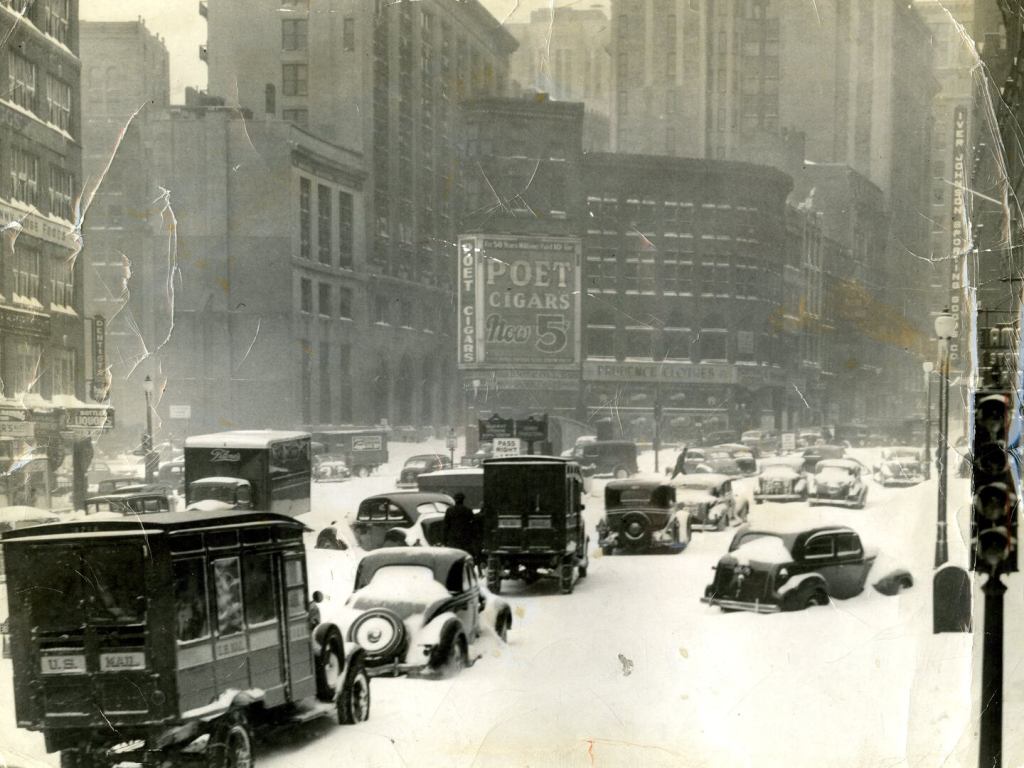
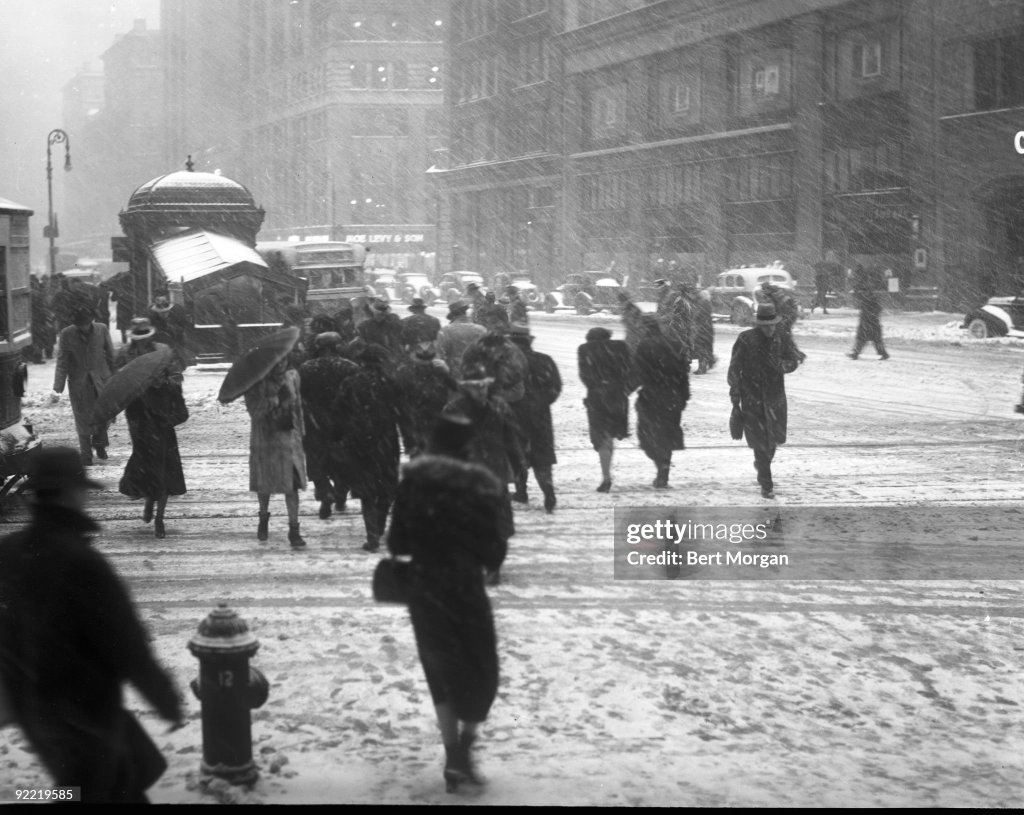
The worst blizzard of the year pounded the Atlantic seaboard all day and Wednesday night with a blinding mixture of snow, rain, sleet, high winds and fog. The storm reached a 100 mile an hour crescendo atop the Empire State building and dropped a burden of deepening snow and ice over a dozen states. The freezing gale force winds, the fiercest since the 1938 hurricane ripped a path of destruction across Long Island and New England, left a trail of traffic deaths and wrecked and harried shipping. The storm blocked highways with snowdrifts up to 20 feet deep and grounded commercial air traffic from Ohio to Boston. Hundreds were hurt in storm-related accidents. President Roosevelt leaves Washington ahead of the storm, heading to Florida by train, to meet the heavy cruiser USS Tuscaloosa (CA-37) for his trip to Panama.
State troopers searched in a cold, blizzard swept swamp Wednesday for another suspect wanted in a farmer’s slaying after two African-American women rescued from an angry mob Tuesday night, had been placed in the safety of the Harford County Jail in Bel Air, Maryland. A posse of about 75 officers and civilians reported the swamp surrounded and predicted the storm and fast dropping temperature would drive the suspect from hiding. Visibility at times was reduced to 25 yards by the heavy snowfall, intermittently swirling and driving.
Amid scenes of near hysteria and heroism, 150 guests escaped Wednesday from the flaming Milner hotel in Burlington, Vermont. Fourteen guests were carried to safety by firemen down ladders. The blaze, which raged for more than six hours, spread to two adjacent department stores, doing total damage estimated at between $250,000 and $300,000.
James Roosevelt, the eldest son of the U.S. president, filed for divorce from his wife Betsey Cushing.
Japan’s invading forces have addressed a proclamation to Generalissimo Chiang Kai-Shek urging him to surrender because, they declared, the Japanese now have won “sufficient areas in China for establishment of the new order in east Asia.” As a result of Japanese “victories” in Kwangsi province in South China during the last two weeks, “further Chinese resistance against Japan is futile,” said the proclamation, issued by the Japanese South China command tonight. Chiang’s Chungking government Thursday indicated what its reply would be by adopting plans to float munitions and reconstruction loans. Bankers said the munitions issued would total about 500 million Chinese dollars (about 35 million U.S. dollars).
The latest South China operations on which last night’s proclamation was based were around Nanning, in Kwangsi Province. The Chinese denied the Japanese claims of victory and asserted the Japanese had withdrawn from this region in the past few days as a result of a Chinese counter-offensive. The long proclamation stated that the Japanese Kwangsi campaign was “annihilating and comparable to those launched by Hannibal at Cannae and by the Germans against the Russians at Tannenberg in 1914.” The Japanese said that 400,000 Chinese and 40,000 Japanese had taken part, at a cost to the Chinese of 200,000 killed and wounded and 100,000 deserting.
The French Embassy in Chungking received reports that the Japanese bombing raid on the French-operated Haiphong-Kunming Railway in Yunnan Province yesterday did little damage. Japanese sources in Shanghai said bridges and track on the line, a vital supply route for the Chinese, had been badly damaged. The French said traffic on the railway, recently resumed after the destructive raid of February 1 in which about 100 persons were killed, continued uninterrupted.
The question of a Japanese-American Pacific pact to govern the spheres of interest of both countries in the Pacific Ocean area was raised in Parliament again yesterday but brought only an indefinite reply from the government.
There is record flooding in Invergargill, New Zealand.
Dow Jones Industrial Average: 148.33 (-0.45)
Born:
Sue Paterno, American philanthropist (Special Olympics); widow of football coach Joe Paterno, in Latrobe, Pennsylvania.
Len Gabrielson, MLB outfielder, pinch hitter, and first baseman (Milwaukee Brewers, Chicago Cubs, San Francisco Giants, California Angels, Los Angeles Dodgers), in Oakland, California.
Naval Construction:
The Kriegsmarine (German Navy) Type IXC U-boats U-513, U-514, U-515, U-516, U-517, U-518, U-519, U-520, U-521, U-522, U-523, and U-524 are ordered from Deutsche Werft AG, Hamburg (werk 309-314 and 334-339).
The Royal Canadian Navy Flower-class corvettes HMCS Nanaimo (K 101), HMCS Alberni (K 103), HMCS Dawson (K 104), and HMCS Edmunston (K 106) are ordered from Yarrows Ltd., (Esquimalt, British Columbia, Canada).
The Royal Canadian Navy Flower-class corvettes HMCS Agassiz (K 129), HMCS Chilliwack (K 131), HMCS Trail (K 174), HMCS Wetaskiwin [ex-Banff] (K 175), are ordered from the Burrard Dry Dock Co. Ltd. (North Vancouver, British Columbia, Canada).
The Royal Canadian Navy Flower-class corvettes HMCS Quesnel (K 133) and HMCS Kamloops (K 176) are ordered from Victoria Machinery Depot Co. Ltd. (Victoria, British Columbia, Canada).
The U.S. Navy Gar-class submarine USS Grampus (SS-207) is laid down by the Electric Boat Co. (Groton, Connecticut, U.S.A.).
The Royal Navy Flower-class corvette HMS Arabis (K 73) is launched by Harland & Wolff Ltd. (Belfast, Northern Ireland). She will be transferred under Reverse Lend-Lease in 1942 and serve until 1945 as the U.S. Navy corvette USS Saucy (PG-65).
The Royal Navy Hunt-class (Type I) escort destroyer HMS Garth (L 20) is launched by the John Brown Shipbuilding & Engineering Company Ltd. (Clydebank, Scotland).

 History Diaries