Moving with surprising swiftness, South Vietnamese Government troops rolled into the small Mekong Delta village of Thới Long recently and, backed by armored cars, rounded up 60 people. It was a strange place for a military operation, since there are no Việt Cộng in Thới Long and there has never been any fighting here. There are no guards on the nearby bridges as in the rest of Vietnam, and artillery never sounds in the distance. The targets of the operation were not Việt Cộng, but members of the civil guard of the Hòa Hảo, a Buddhist sect that is one of South Vietnam’s unique political phenomena. The Saigon Government charged that the Hòa Hảo had taken advantage of the confusion created by the recent Communist offensive to lure government soldiers into the Hòa Hảo’s own guard and had given shelter to draft dodgers and deserters.
The dispute with the Hòa Hảo, a sect that arose between the two world wars out of the social and psychological dislocations of French colonialism, is serious. Saigon is having difficulty finding soldiers to fill ranks reduced by heavy casualties. The Hòa Hảo, who have one million to three million adherents in five of the Delta’s provinces, have been staunch anti-Communists since the Việt Minh were accused of killing the leader of their sect in the nineteen-forties. Apparently on orders from President Nguyễn Văn Thiệu, government policemen suddenly seized the leading Hòa Hảo “general” two weeks ago during a session called to negotiate the dispute. Other police units and local militia then moved to round up and disarm the Hòa Hảo civil guard, or Bảo An. According to the government, about 600 suspected draft dodgers and deserters were caught. The Hòa Hảo put the figure of those arrested in the thousands. Hundreds of well-armed Bảo An members are still thought to be holding out against government forces in several villages.
Western military sources reported today that Phnom Penh Government troops were making determined efforts to open the blockaded Mekong River, this capital’s main supply link to the outside world. As yet there are no reports of progress. The Western sources said the Lon Nol Government was trying to land troops by boat along the river in a bid to wrest back control of strategic sections of the river bank from the Communist-led insurgents. Government navy boats were also said to be trying to clear mines laid recently. They are the rebels’ most effective weapons of the blockade.
Unofficial reports said the government had already landed several hundred troops in enemy territory. These reports were extremely sketchy, and some diplomatic sources here remained skeptical about a quick reopening of the Mekong. Meanwhile, to cope at least partially with the supply shortages caused by the blockade, the government’s sole support, the Americans, continued their expansion of their supply airlift from Thailand. The basic arm of the airlift, a contract with a civilian company named Bird Air that is using Air Force planes on loan and former Air Force pilots, has been increased in the last few days from 10 cargo flights a day to 12 and will eventually reach 20. While Bird Air is building up, the Pentagon as an interim measure, is also using some American charter cargo lines with large DC‐8 jets. They will start flying in here tomorrow from the American base at Utapao in southern Thailand on a 10‐day supplemental contract. However, the total tonnage they will be able to bring will still be less than half of this capital’s basic needs of food, fuel and ammunition, so the reopening of the Mekong remains vital.
Authorities are being vague here about supply stocks, either to forestall panic or perhaps to create a darker impression than is warranted, to coax more money out of the United States Congress. The evidence suggests that there are enough basic supplies in this city of two million to last a month or so. Since their dry‐season offensive began on New Year’s Day, the insurgents have seized control of two‐thirds of the 60‐mile Phnom Penh to South Vietnam. Some supply vessels got through, but two weeks ago the insurgents laid mines in the river. Since then, at least 19 supply ships have been sunk and the waterway has been completely shut. As supplies shrink, the government — under American Embassy direction — has begun rationing and conserving rice and fuel.
The city’s power supply has been cut at least two‐thirds, gasoline has been rationed and rice is now being rationed, which has caused the blackmarket price to surge. The Australian Embassy today joined the list of embassies that have advised their nationals that for the time being women, children and other nonessential personnel should leave Cambodia. The French and Japanese issued such advice a few days ago, and the South Vietnamese are said to have done so unofficially. The Americans have sent out six wives of embassy staffers. The United States Embassy is now sending letters to those members of the private American community who have dependents, encouraging them to send their wives and children out of the country. At most, 30 to 40 people are involved. The embassy has also recommended to other embassies here that they, too, send out their dependents as a precautionary move.
Admiral Noel Gayler, commander of United States forces in the Pacific, visited Phnom Penh yesterday to assess, the blockade and the military supplies here. American Embassy officials have said that ammunition was running dangerously low. Admiral Gayler met with President Lon Nol and the Cambodian armed forces commander, Lieutenant General Sosthene Fernandez. The nature of the discussions was not made known but one subject, presumably, was the Americans’ “last resort” plan, under which the Air Force would begin a huge supply airlift to Phnom Penh. The Americans remain reluctant to put that plan into action because of the impression it would create widening American involvement.
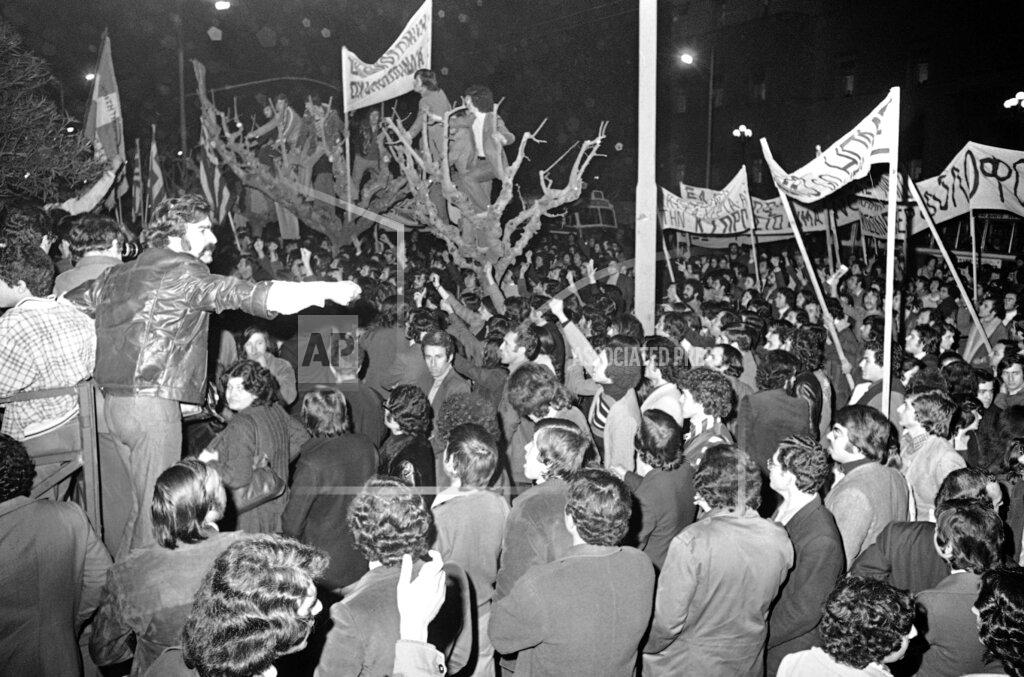
President Makarios of Cyprus denounced the Turkish Cypriote proclamation of a separate state in northern Cyprus and said Greek Cypriots were prepared to resist and if necessary to sacrifice themselves to prevent partition. He spoke to 2,000 student demonstrators who gathered outside the presidential office in Nicosia. The Archbishop, who is President of Cyprus, spoke to 2,000 cheering student demonstrators who had gathered outside the presidential office after marching through the streets to protest the proclamation that Turkish Cypriot leaders had issued here yesterday. Waving blue and white Greek flags and a few yellow and white Cyprus flags, the demonstrators chanted: “One Cyprus for all Cypriots!” “The refugees to their homes!” “Makarios to Moscow! Russia will save us!”
Leonid I. Brezhnev, who emerged yesterday after more than seven weeks out of official view, reaffirmed the Kremlin’s position today on an array of international issues, indicating that no major policy shifts had occurred during his absence. In particular, the Soviet leader characterized the step‐bystep peace measures in the Middle East as “useful” only if they led quickly to real peace. He renewed the Soviet call for speedy resumption of the Geneva peace conference. The Soviet party chief made his remarks two days before Foreign Minister Andrei A. Gromyko was to meet Mr. Kissinger for brief talks in Geneva.
The Irish Government refused tonight to make any further concessions to 12 jailed I.R.A. Provisional members who are on a hunger strike. One is dangerously ill. The government had acceded to one of the men’s demands, that they be separated from other prisoners, but not to demands for political-prisoner status. At a news conference today, Joseph Cahill, a spokesman for the Provisionals, said the Irish Republican Army was insisting that its prisoners be provided with radios, newspapers and books, and that these were not new demands. The government rejected this, noting that Mr. Cahill had said last week segregation of I.R.A. prisoners would end the hunger strike.
A bomb explodes at an annex of the Amsterdam metro station.
Princess Maria Christina of the Netherlands, 27 years old, who has been teaching French and music in New York, will marry Jorge Guillermo, a 29-year-old Cuban who teaches at a center for preschool children in Harlem. The engagement was announced by Queen Juliana and Prince Bernhard at the Soestdijk Palace in The Hague. The Princess is the youngest of their four daughters. The marriage will take place in the Netherlands “probably within five months.” The couple plan to live in New York.
Major differences over terms of a new interim agreement still separate Israel and Egypt after Secretary of State Kissinger’s preliminary round of talks, but Israeli officials believe there is a good chance that they can be overcome. “Neither the Egyptians nor we really conceded anything in this opening round,” a senior Israeli official said today. “The hard bargaining remains to be done.” Mr. Kissinger has agreed to return in mid‐March for an intensive effort at bridging the differences between Jerusalem and Cairo and to conclude a new interim agreement. During this preliminary round both sides reportedly outlined their general positions to the Secretary but avoided detailed negotiation. According to Israeli officials, Mr. Kissinger kept the talks deliberately general. “He obviously wanted to take our temperature and that of the Egyptians,” one government official said. “We’ll get down to the nittygritty when he comes back.”
Adm. Elmo R. Zumwalt Jr., retired, a former Chief of Naval Operations, says that one solution to the Middle East turmoil could be to make Israel a dominion of the United States and to place troops there. Admiral Zumwalt, who is how a visiting professor at Vanderbilt University in Tennessee, made a speech to students at the University of North Carolina last night. Later, he was asked what the United States could do to resolve the problems between the Arab states and Israel. “I believe that forces could be stationed in parts of Israel to insure that they were neither invaded nor did they invade,” he said, adding that this would “defuse the situation.” He also suggested that Israel might be given the status of a dominion, similar to the status of Puerto Rico, to “insure that it was recognized as U.S. sovereign territory by the Arabs and, alternatively, to give us the responsbility that the Israelis did not spill across the border.”
[Ed: HOLY SHIT. In the history of Bad Ideas, Elmo holds a place of special (dis)honor. What a maroon.]
Two explosions rocked an empty lot today less than a mile from the King David Hotel, where Secretary of State Kissinger stayed during his latest Middle East peace mission, the police said. Two persons believed to be Arab guerrillas were killed by the blasts. The bombs were probably being prepared to be planted elsewhere in the city, police sources said. The Jerusalem police said that the explosions went off at 7:30 AM, about an hour before Mr. Kissinger left for his last meeting with Premier Yitzhak Rabin before leaving for Jordan.
Park Chung Hee of South Korea announced that he would release all political prisoners except those he said were Communists. Among those to be released are a Roman Catholic bishop, a Protestant minister, a poet, two university professors and a lawyer who defended many of the political prisoners. They are among the 203 persons who were accused last winter and spring of advocating amendments to the Constitution, which gives President Park unlimited power for as long as he likes. In effect, the Government said, they were trying to overthrow President Park. Many were students who tried to instigate anti-Government demonstrations last April. The President’s spokesman, Kim Sung Jin, said today that all students would be released.
50,000 members of the Iglesia Ni Cristo held a protest march against martial law human rights abuses in the Philippines.
Representatives of the United States and the Marianas Islands will sign an agreement on Saipan tomorrow to establish a commonwealth of the northern Marianas Islands under the United States.
Delegates to the Andean Pact’s political council meeting reportedly agreed today that the new United States trade law hurts the pact’s six member nations and strains ties with Latin America. Venezuela and Ecuador, leading members of the Andean Pact and accused by the United States of trade restrictions as members of the Organization of Petroleum Exporting Countries, have already publicly declared their opposilion to the new law, which suspends trade preferences and other advantages for countries that discriminate or restrict trade. Government spokesmen from both countries called it coercive. Chile, Bolivia, Peru and Colombia — the four other member nations — back Ecuador and Venezuela.
About 1,000 political prisoners reportedly escaped from two jails in the northern province of Eritrea last night with the help of secessionist guerrillas. According to telephone interviews with residents of Asmara, the capital of Eritrea, guerrillas of the Eritrean Liberation Front, dressed in Ethiopian Army uniforms and driving captured army trucks, convinced prison officials that the political detainees were to be transferred for their safety. Some 730 prisoners were reported to have been loaded onto the trucks and taken away. It was also reported that about 70 guards, supporters of the guerrillas, left with them. Ethiopian Army soldiers guarding the prison were said to have been distracted during the escape by explosive devices planted nearby.
Troops loyal to the Government of Madagascar today overcame the last resistance from insurgents blamed for the assassination of the head of state, Col. Richard Ratsimandrava. The four‐day test of strength between the military authorities and rebellious police officers ended as troops occupied the battered headquarters of the Madagascar Socialist party in the central part of Tananarive, the capital. The Malagasy rebels made their desperate last stand at the party headquarters after they were flushed out of armed camp on the outskirts of Tananarive yesterday morning. The party’s Secretary General, Andre Resampa, surrendered with about 20 others last night, and pro-Government forces overran the badly burned party building today. The military immediately began a mopping‐up operation and calm reportedly returned to the capital.
Labor Department statistics showed that inflation in the United States continued to abate in January, keeping pace with steep declines in production and employment. The Wholesale Price Index declined three-tenths of 1 percent after adjustment for normal seasonal changes in some prices. This was the second consecutive monthly drop following a sustained period in 1973 and 1974 when the index rose on an average by more than 1.5 percent a month. The dramatic reversal of the inflation rate was attributed to improvement in agriculture and industry. The index covers all transactions in the economy except final sales to consumers. Thus, the lower inflation rate will not have an immediate effect on consumer prices, but its effect should eventually be felt.
Frank Zarb, the Federal Energy Administrator, criticized congressional Democrats for what he called a “do nothing” attitude toward oil imports in remarks about energy problems at a luncheon at the National Press Club in Washington. He said that to permit oil imports to rise would tend to give oil-exporting countries leverage with which to influence United States foreign and domestic policies. He indicated that President Ford would be willing to compromise with the Democrats on his energy proposals, and expressed a guarded interest in gradual application of the oil and natural gas taxes that Mr. Ford has asked Congress to enact by April 1.
“None of the defendants have shown that a new trial would be in the interest of justice,” Federal Judge John Sirica said in a decision refusing to set aside or change in any way the guilty verdicts returned in the Watergate cover-up trial against four Nixon administration officials. He ordered the defendants, John Mitchell, H. R. Haldeman, John Ehrlichman and Robert Mardian, to report next Friday for sentencing.
The United States Court of Appeals in Washington provided today that a panel of three Federal judges should take up legal issues surrounding the ownership of former President Richard M. Nixon’s tapes and documents without being bound by the precedent-making decision by a Federal district judge that almost all the materials belonged to the Government.
Discussion of a third party dominated the formal programs and conversations in the corridors today at the second annual Conservative Political Action Conference. Even those who opposed that idea had little good to say about President Ford, who was known as a true‐blue conservative throughout his quartercentury in Congress. M. Stanton Evans, chairman of the American Conservative Union, one of the sponsoring organizations, urged that work begin soon on the formation of a national conservative party for the 1976 election, modeled on the New York Conservative party. He was applauded heartily. Describing himself as disenchanted with the Republican party, and with Mr. Ford and Vice President Rockefeller in particular, Mr. Evans predicted that “one or the other of those gentlemen” will be the Republican Presidential nominee next year.
Congress will vote to block President Ford’s oil import tariff of $3 per barrel even if it means overriding a Presidential veto, Senator Henry M. Jackson said tonight.
Two influential United States Senators said yesterday that an attempt by Arab interests to extend their economic boycott to banking houses with Jewish members was contrary to United States policy. They called for a prompt investigation by the Ford Administration. Senator Jacob K. Javits, Republican of New York, and Senator Harrison A. Williams Jr., Democrat of New Jersey, in a letter to Treasury Secretary William E. Simon, asked the Administration to determine whether, as a result of the boycott, there had been religious discrimination against “Jewish or any other Americans” by Arab interests, and whether any United States laws had been violated. Enforcement of an Arab blacklist of some Jewish investment banking houses has caused a furor in international banking circles in recent days and has been widely discussed on Wall Street.
Five large commercial banks announced yesterday that they were lowering their prime interest rates the rate they charge on loans to corporations with the best credit rating to 8¾ percent from 9 percent.
Carrying his own baggage and handing out his own publicity releases, former Senator Fred R. Harris of Oklahoma opened the New York phase of his low-budget Presidential campaign yesterday by telling 150 supporters that he would enter the New York primary next year.
The case of Boston’s Dr. Kenneth Edelin, who is charged with the death of a baby boy fetus in a legal abortion, went to the jury at 12:30 PM today after six weeks of testimony.
About 50 black high school students in Boston hijacked a school bus today, beating and threatening the white driver, the police said. Paul Goode, 50 year old, of Dorchester, was released without serious injury after he was assaulted by students from the racially troubled Hyde Park High School, the officers said. Fourteen arrests were made at the school earlier in the day following fighting between black and white students.
New York Fire Commissioner John T. O’Hagan said yesterday that he would make a vigorous effort to have a sprinkler system installed in the World Trade Center towers as a consequence of the fire that burned for three hours in one of them early yesterday morning.
Scientists at Bell Laboratories predict that glass fibers will be useful some day in transmitting light beams carrying vast amounts of telephone messages, business data and computer information. This week Bell Labs received a patent for a method of using a powerful, invisible laser beam to melt a glass rod so that it can be drawn into a hair‐thin fiber about a mile long. Patent 3,865,564 was granted to Raymond E. Jaeger and Walter Logan, members of the technical staff at Murray Hill, New Jersey.
P.G. Wodehouse, one of this century’s most prolific, popular and durable writers of light fiction, died of a heart attack in the Southampton, Long Island Hospital. He was 93 years old and lived in nearby Remsenburg, a village on Long Island’s South Shore.
Sir Julian Huxley, the British scientist, humanist and writer, died at his home in London at the age of 87. He was the grandson of Thomas Henry Huxley, the biologist, and the elder brother of the late novelist, Aldous Huxley. Sir Julian was a frequent radio and television panelist and lecturer, gaining wide popularity for his ability to explain scientific topics in simple terms. He became a world figure in 1946 with his appointment as the first director general of UNESCO.
Sal Bando, the Oakland A’s third baseman, withdrew today from his scheduled salary arbitration hearing and revealed he would test baseball’s reserve clause if he cannot agree on a nonarbitrated contract with the club owner, Charles O. Finley.
Sid Gillman, the Houston Oiler’s general manager who stepped down as head coach three weeks ago, also resigned as general manager tonight, according to the Oilers’ owner, K.S. (Bud) Adams.
The highest scoring professional basketball game, up to that time, took place in San Diego as the San Diego Conquistadors beat the New York Nets, 176-166, in an American Basketball Association contest. The “Qs” tied the Nets, 129-129, when Travis Grant scored at the buzzer. With seven seconds left in overtime, Julius “Dr. J” Erving of the Nets tied the game again, 144-144. Bill Melchionni of the Nets tied the score 152-152 with 22 seconds left in the second overtime, and the Nets’ Brian Taylor closed the third overtime with the score at 161-161. When the game ended after four overtimes, and more than 3 hours of real time, a record 342 points had been scored. The record would later be broken in an NBA game on December 13, 1983, when the Detroit Pistons beat the Denver Nuggets, a former ABA team, 186-184 in three overtimes.
The stock market, buoyed by signs that inflation and interest rates were continuing to ease, moved higher yesterday in slower but still heavy trading.
Dow Jones Industrial Average: 734.20 (+7.28, +1.00%)
Born:
Dámaso Marté, Dominican MLB pitcher (World Series Champions, 2005-White Sox, 2009-Yankees; Seattle Mariners, Pittsburgh Pirates, Chicago White Sox, New York Yankees), in Santo Domingo, Dominican Republic.
Viktor Kozlov, Russian National Team and NHL centre, right wing, and left wing (Olympics, 2006, 2010; NHL All-Star, 2000; San Jose Sharks, Florida Panthers, New Jersey Devils, New York Islanders, Washiington Capitals), in Toglliatti, Soviet Union.
Yul Kwon, American lawyer and television host and reality show personality (“Survivor: Cook Islands”), in Flushing, New York.
Died:
P. G. Wodehouse (Sir Pelham Grenville Wodehouse), 93, English humorist and novelist known for creating the character of the quintessential butler and servant, “Jeeves”, in a series of short stories and novels, starting in 1915.
Julian Huxley, 87, English biologist and eugenicist, first director-general of UNESCO.
Jerry Pettis, 58, U.S. Congressman from California since 1967, and deputy minority whip for the Republican Party in Congress, was killed while flying his own private plane from Palm Springs, California toward San Bernardino, where he was to hold a press conference at a meeting of the state Public Utilities Commission. Midway through a 30-minute flight, Pettis encountered strong winds and his Beechwood Bonanza plane struck a hillside at the San Gorgonio Pass near Beaumont. His wife, Shirley Neil Pettis, who had been waiting at San Bernardino to meet his plane, would later win a special election to fill the vacant seat for California’ 37th District, and would serve until 1979.
Khfaf Lasuria, Soviet centenarian whom the TASS News Agency claimed to have lived to age 139. Nine years earlier (and reportedly only 125 years old), Mrs. Khfaf had been profiled in LIFE magazine.








 History Diaries