On the Karelian Isthmus, Finns try to retake the lost main defensive line in the Lähde sector but are pushed back by Soviet tanks. Instead, Red Army enlarges its breakthrough but still does not mount a decisive thrust. Finnish troops retake the Kirvesmäki stronghold on the River Taipale, overrun by Soviet troops yesterday. Soviet 123rd Rifle Division breaks through the main Mannerheim Line.
In the Merkki sector, the two sides are battling over the Finnish trenches, possession of which swings back and forth. The Soviets were sending chemical tanks and BHM flame-thrower tanks against the Finns in the trenches. The Finns knocked out several Soviet tanks and held the trenches throughout the day.
At Lähde, the Soviets continue fighting off Finnish counterattacks. While giving up ground grudgingly, the Soviets have enough firepower to slowly hack away at the Finnish strong points, none of which can be recovered by the Finns for good once they are taken.
The Kirvesmäki stronghold on the Taipale River continues changing hands, as both sides realize it is the key to the defense.
At 6.30 AM the 5th Division’s 14th Infantry Regiment launches a counterattack to retake the lost main defensive line in Summa. By noon the Finnish troops have managed to advance a few kilometres, but then come up against enemy tanks and are forced to withdraw. The counterattack is ultimately unsuccessful.
Just after noon Soviet troops break through the support line in the Lähde sector. Despite a fierce Finnish counterattack, the enemy continues to advance and approaches the Lähde crossroads.
In Taipale, Finnish troops succeed in retaking the Kirvesmäki stronghold overrun by Soviet troops in yesterday’s fighting.
General Headquarters orders the 23rd Division to move onto the Isthmus.
Another Soviet flanking attack across the frozen Gulf of Viipuri is driven back.
Squadron 26 shoots down 9 Soviet aircraft over the Isthmus.
Viipuri is suffering an endless barrage of enemy bombs.
On the home front, Lahti, Heinola and Porvoo are also bombed.
The Finnish Parliament introduces draft legislation to leave the taxes of fallen servicemen uncollected.
A benefit bandy international between Norway and Finland at the Bislet ice rink in Oslo ends in a 2-1 victory for Finland. The event was organized by sports journalists in the Norwegian capital, and the proceeds of 300,000 marks will be donated to help the families of Finnish sportsmen killed at the front.
Georg Gripenberg, Finland’s diplomatic representative in London, and Lieutenant-General Enckell, who is currently on a visit to the British capital, appeal to Lord Halifax, the British Foreign Secretary, to send military aid to Finland. Halifax promises to raise the matter in the War Cabinet.
A fully equipped force of Hungarian volunteers has travelled to Scandinavia via France to help in the defence of Finland.
In Sweden, Finnish Foreign Minister Tanner asks Swedish Government to send troops to Finland. The Swedes decline, being too concerned with Allied plans to ‘aid Finland’ via the Swedish iron ore fields, and the likely German intervention this will provoke.
By a vote of 49 to 27 the United States Senate passed the Roosevelt Administration’s bill to provide additional government loans to Finland, China and other countries. The bill went on to the House.
On the Western Front, raids and patrols by both sides continue in the bitter cold, with prisoners taken and small numbers of casualties suffered by both sides.
It was reported reliably today that all Jews in Stettin, totaling between 800 and 900, were rounded up early today and were being transported by railroad to an unknown destination, possibly the Lublin district of Poland.
Prime Minister Neville Chamberlain, before the House of Commons, told a questioning member that the government, in welcoming United States Undersecretary of State Sumner Welles, would “take him fully into their confidence” so that President Roosevelt can get a clear estimate of the British side of the war. Welles is leaving for Europe on February 17, to visit London, Berlin, Rome and Paris, on an information gathering tour for Mr. Roosevelt.
The British government imposes strict controls over the railway network but continues to allow private ownership and operation of the railways. A Labour Party proposal to nationalize all forms of inland and coastal transport is defeated in a House of Commons vote.
American Undersecretary of State Summer Welles will talk with Premier Mussolini as well as Count Ciano, the Italian Foreign Minister, during his forthcoming visit to Rome.
Rumania, it was learned today, has assured the British Minister there, Sir Reginald Hoare, that her valuable military exports of oil will not be affected by diplomatic pressure from Germany or any other country.
His journey to Belgrade, Yugoslavia, and Sofia, Bulgaria, has greatly increased the confidence of Turkish Foreign Minister Shukru Saracoglu that the war front will not shift to the Balkans.
A warning to the Latvian nation from President Karl Ulmanis to be prepared for a possible call to arms was followed tonight by a denial that fresh demands had been received from Soviet Russia.
The Second Australian Imperial Force, part of General Freyberg’s command, arrives in Palestine.
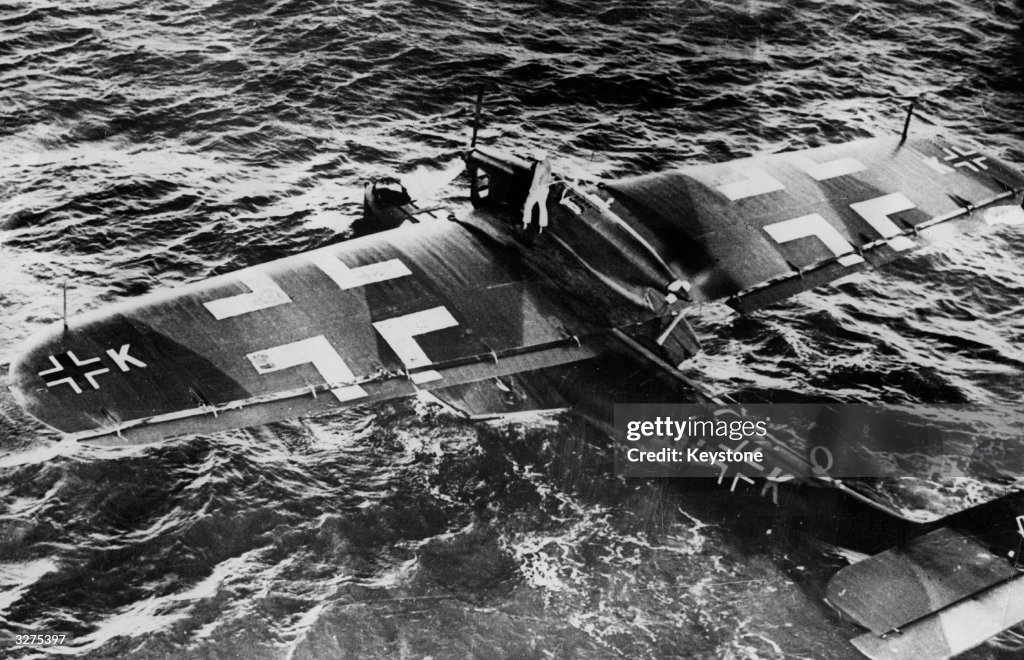
RAF interceptors engage Luftwaffe bombers attacking shipping along British coast.
The German U-boat U-50, commanded by Kapitänleutnant Max-Hermann Bauer, fired several torpedoes at Norwegian tanker Albert L. Ellsworth at 0200 hours, missing with all of them. The crew of the tanker panicked and abandoned the ship, with 2 survivors of merchant vessel Snestad (rescued on 11 Feb 1940) drowning in the process. After realizing the ship was not harmed, 42 men reboarded Albert L. Ellsworth and continued on with their journey to Bergen, Norway.
The German U-boat U-25, commanded by Korvettenkapitän Viktor Schütze, sank the Danish cargo ship Chastine Mærsk in the North Sea, 70 nautical miles (130 km) west of Norway (61°30′N 2°00′E). At 0716 hours on 13 February 1940, U-25 fired a shot across the bow of the neutral Chastine Mærsk, but it took two more shots until she stopped. The Germans then ordered the crew to abandon ship in 10 minutes and shelled and sank the ship from 0836 to 0845 hours. The survivors were picked up by the Norwegian steam merchant Hilda. U-25 had spotted the ship at 1630 hours the day before and fired a stern torpedo that missed at 2010 hours. 19 minutes later Schütze fired his last torpedo and observed a hit aft without effect, but the torpedo probably detonated prematurely without damaging the ship. The U-boat then chased the ship on the surface during the night and attacked with the deck gun at dawn. The 5,177-ton Chastine Mærsk was carrying phosphate fertilizer from Safi, Morocco to Kalundborg, Denmark.
The Swedish steam merchant Norna was torpedoed and sunk in the Atlantic Ocean, west of Ireland (55°30′N 11°00′W) by the German U-boat U-52, commanded by Korvettenkapitän Harald Grosse, with the loss of all 18 of her crew.The 1,022-ton Norna had been carrying a cargo of salt to Stockholm, Sweden.
The British tanker British Triumph in Convoy FS.93 struck a mine and was damaged in the North Sea off Cromer, Norfolk (53°06′N, 1°25′E) with the loss of four of her 47 crew. The survivors were rescued by the ships British Officer and HMS Stork. British Officer attempted to tow British Triumph. The British tug Irishman was sent out, but British Triumph sank before she arrived.
U.S. freighter SS Exford, detained at Gibraltar by British authorities since 5 February, is released.
Convoy OA.91 departs Southend.
Convoy OB.90 departs Liverpool.
Convoy OB.91 departs Liverpool.
The War at Sea, Tuesday, 13 February 1940 (naval-history.net)
Destroyers KELVIN, KINGSTON, KANDAHAR, and KHARTOUM departed the Clyde on the 13th to participate in Operation WR, and rendezvoused with armed merchant cruiser CIRCASSIA.
Anti-aircraft cruiser CAIRO arrived at Scapa Flow.
Submarine TARPON was carrying out trials in Gare Loch.
Convoy ON.12 of ten British, eight Norwegian, two Swedish, two Danish, four Finnish and one Panamanian ship departed Methil escorted by destroyers INGLEFIELD, ILEX, IMPERIAL, and DELIGHT, and submarine THISTLE. Light cruisers ARETHUSA and PENELOPE were originally to provide close cover, but had been assigned to Operation DT, and light cruiser EDINBURGH sailed from Rosyth to take over. Four ships were detached before making the North Sea crossing, including Norwegian steamer FERNMOOR (4268grt) which IMOGEN took into Scapa Flow on the 14th. IMOGEN left again on the 15th and joined anti-aircraft cruiser CALCUTTA which had departed Sullom Voe the same day to provide anti-aircraft protection. ON.12 arrived safely at Bergen on the 16th.
Convoy OA.91 departed Southend escorted by destroyer VERITY from the 13th to 16th, when it dispersed.
Convoy OB.91 departed Liverpool escorted by destroyers WALPOLE and VIMY from the 13th to 16th, and dispersed on the 17th.
Convoy FN.93 departed Southend, escorted by destroyers WHITLEY and JACKAL, and sloop EGRET, and arrived in the Tyne on the 15th.
Convoy FS.95 departed the Tyne, escorted by destroyers WOOLSTON and JANUS, and sloop GRIMSBY, and arrived at Southend on the 15th.
Convoy MT.10 departed Methil, escorted by anti-submarine trawlers of the 19th Anti-Submarine Group, and arrived in the Tyne later that day.
U-25 sank Danish tanker CHASTINE MAERSK (5177grt) in 61 30N, 02 00E. Survivors were rescued by Norwegian steamer HILDA (1237grt).
U-50 attacked Norwegian tanker ALBERT L. ELLSWORTH (8309grt) in the North Sea, NW of the Shetlands in 61-10N, 07-15W, but the attack failed due to torpedo malfunctions.
German steamer NAHALT (5870grt) was damaged in a collision in the North Sea, and was assisted by German steamer KONIGSBERG PREUSSEN (2530grt).
Heavy cruiser DORSETSHIRE’s seaplane sighted German steamer WAKAMA (3771grt) off Cape Frio at 1615/12th. DORSETSHIRE intercepted her next day in 22 42S, 41 38W, and WAKAMA which had departed Rio de Janeiro on the 11th scuttled herself rather than be captured.
ALLIED HUNTING GROUPS
Allied Hunting Groups were reorganized as follows:
Force G – Heavy cruisers HAWKINS and DORSETSHIRE
Force H – Heavy cruisers CORNWALL and CUMBERLAND
Force I – Aircraft carrier EAGLE, heavy cruiser SUSSEX, Australian light cruiser HMAS HOBART
Force M – Heavy cruiser KENT and the French SUFFREN
Force X – French heavy cruisers FOCH and DUPLEIX
Force Y – French battleship PROVENCE, heavy cruisers COLBERT and DUQUESNE, and light cruiser EMILE BERTIN
Destroyer DEFENDER departed Gibraltar for Freetown.
President Roosevelt conferred with Joseph P. Kennedy, Ambassador to Great Britain, and with Paul V. McNutt, Federal Security Administrator, signed two deficiency bills to provide additional funds for the army and navy during the current fiscal year, and vetoed a bill increasing compensation for various classifications of letter-carriers. He announced he would start tomorrow on a tenday vacation cruise.
The Senate passed a bill adding $100,000,000 to the revolving fund of the Export-Import Bank and adjourned at 5:27 PM until noon tomorrow. The Monopoly Committee heard John A. Stevenson of the Penn Mutual Life Insurance Company in connection with its insurance investigation.
The House received and debated the $966,722,878 Navy Supply Bill, debated the American Youth Congress and communism and recessed at 4 PM until noon tomorrow.
The U.S. Senate approved in principle, by a vote of 49 to 27, a loan of $20,000,000 to be made to Finland, with restriction that none of it to be used for “arms, ammunition or implements of war”. A further two weeks however would elapse before the bill would be passed. By then it is largely a moot point. Despite strong vocal opposition, which blew up at the last minute, the Senate. passed today by a vote of 49 to 27 the bill under which it is proposed to advance up to $20,000,000 in new export credits to the Republic of Finland and perhaps as much as $20,000,000 additional to China. The measure, which on its face merely increases the lending authority of the Export-Import Bank from $100,000,000 to $200,000,000, now goes to the House, whose leaders were planning tonight to give it preferred status.
Shortly before the credit aid proposal started on its last mile through the Senate, the Capitol was notified that the Administration had no thought of invoking the Neutrality Act either in the conflict between Finland and Russia or in the one between China and Japan. The intimation came through a letter from Secretary of State Cordell Hull to the Senate Foreign Relations Committee, in which he commented adversely on resolutions by Senators Guy M. Gillette of Iowa and John A. Danaher of Connecticut seeking to make our neutrality policies operate in relation to these undeclared wars.
Mr. Hull wrote that enactment of either resolution would not be in accord with the State Department’s program and sought to reassure the committee that the department was keeping close watch on the European situation and believed it could handle the matter without involving the United States. The Senate’s action this afternoon on the so-called Finnish Aid. Bill-it is called that despite its technical terms-saw thirty-eight Democrats, nine Republicans, one Progressive, and one Farmer-Laborite line up for it. Against the measure were sixteen Democrats, nine Republicans, one Independent, and one Farmer-Laborite. The division was one of the strangest and most mixed the Senate has witnessed on a major issue for the last ten years.
After the result was announced, several Senators made their way to the diplomatic gallery to congratulate Hjalmar Procope, Finnish Minister, who had sat there for several hours, watching the proceedings, consulting documents and making notes. Participating in the last-minute attack on the measure were Senators Walter F. George and Richard B. Russell of Georgia, Alva B. Adams of Colorado, Hiram W. Johnson of California, Robert A. Taft of Ohio, and Robert R. Reynolds of North Carolina, while Senators William H. King of Utah, Prentiss M. Brown of Michigan, and Alben W. Barkley of Kentucky, the majority leader, went to its defense.
A bill providing $966,772,878 for the U.S. Navy — a record peacetime appropriation despite a slash of $111,699,6999 below President Roosevelt’s recommendations — started through the house today amid warning that to guard its wealth the United States must have greater naval power than any other nation. While cutting deeply into estimates for ship construction, ordnance and naval aircraft, the appropriations committee urged that the projected battleships and new cruisers be restudied with a view to making them the most powerful in the world. The committee also recommended a one million dollar start on a harbor project for the Pacific outpost of Guam, near Japan. The navy’s proposed development of the Island aroused a storm of controversy last year. Of $28,628,021 lopped from the shipbuilding program, all but $5,522,521 was for four 45,000 ton battleships and four new cruisers. First funds for two of the capital ships which would be the, navy’s biggest and two of the cruisers were provided last year. The committee said plans for all eight still could be changed to make them bigger, adding that under present plans they would be practically the same as to speed, armor and guns as ships now being built abroad. President Roosevelt told his press conference he hoped the battleship funds would be restored.
President Roosevelt made plans today to leave tomorrow for an unnamed Southern port to board a navy cruiser for a ten-day cruise during which official business would be kept to a minimum. Mr. Roosevelt appeared weary as he told his press conference of his plan to get away on his “annual vacation.” He refused to discuss conversations on the European situation with Sumner Welles, Under-Secretary of State, and William C. Bullitt and Joseph P. Kennedy, Ambassadors to France and Great Britain, respectively. It was from Ambassador Kennedy that reporters learned that the President planned to leave tomorrow.
On the details of his trip Mr. Roosevelt spoke in vaguest fashion. He will leave the city on a special train. Although the USS Tuscaloosa, on which he is expected to travel, left Norfolk with sealed orders early this week, Mr. Roosevelt said he did not know where he would board his vessel. He will be accompanied by three press association reporters while at sea. These reporters will follow the President on a destroyer convoy and their dispatches will be censored, as usual, by Mr. Roosevelt himself. Neither from the President or other White House sources was there any explanation for the unusual secrecy with which his movements are being surrounded.
Joseph P. Kennedy flatly refused tonight to enter the presidential race, declaring that his job of ambassador to England in these times of strife “involves matters so precious to the American people” that his energies should not be diverted. Only a short time before, friends of the Bostonian had announced that a slate of delegates pledged to him would be entered In the Massachusetts Democratic presidential primary on April 30th.
A State Trooper is badly injured in Maryland as he and others rescued two African-American women from a mob which dragged them away from the Worchester county jail at Snow Hill tonight. The women had been arrested with a man who was wanted for a murder in the town of Stockton. When the mob ascertained that the man had been moved for his protection, they seized the women and headed for Stockton, intending to lynch them.
Mrs. Eleanor Roosevelt and Mayor La Guardia were among the five white persons and Marian Anderson and Joe Louis were among the ten Blacks chosen for distinguished achievement in the improvement of race relations during 1939 in a nation-wide poll.
Officials of the American Youth Congress and Labor’s Nonpartisan League reached a working arrangement today for future cooperation on mutual objectives in their respective legislative programs.
An agreement by General Motors Corporation and four unions ended a National Labor Relations Board hearing tonight and paved the way for calling elections in fifty-nine plants to determine collective bargaining agents.
A majority of voters sounded out by the American Institute of Public Opinion favor the stopping of war shipments to Japan, it was announced yesterday.
American actress Lana Turner (19) weds American bandleader Artie Shaw (29) in a Las Vegas elopement; they divorce after 4 months.
The Detroit Tigers sign George Metkovich, one of four players they ink from the Tigers’ minor league system who were granted free agency last month. Metkovich was granted free agency a month ago. His arrival in spring training camp will be delayed five days after he steps on a catfish and the fin penetrates the crepe sole of his left shoe. Since catfish are poisonous, he is given an injection as a preventive measure.
The British cruiser HMS Dorsetshire intercepts the German blockade runner Wakama which is scuttled off Cape Frio, Brazil (22°42′S 41°38′W) near Rio de Janeiro. Her 46 crew were rescued by HMS Dorsetshire. The Brazilian government formally protests the British action.
Three Curtiss Hawk 75M fighters of the Chinese 18th Squadron intercepted 27 Japanese bombers en route to bomb the bridge on the Xi River near Xiaolongtan, Yunnan, China. One bomber was claimed to be destroyed. Japanese planes raided the Frenchowned Yunnan Railway again today and one of them was shot down by Chinese pilots, the provincial Air Defense Headquarters announced tonight at Kunming.
Additional losses are asserted to have been administered to the Japanese by the Chinese forces at Pinyang and in and around the Pinyang area northeast of Nanning. The Chinese have carried out mopping-up operations in and around the former city yesterday and today. Pinyang was retaken from the Japanese on Sunday night. The Japanese casualties are said to number several thousand. Heavy fighting is reported to be continuing between Nanning and Wuming.
The Chinese in Chungking refute the Japanese assertion that they are making a triumphant return to their Nanning base after dealing a heavy blow to the Chinese forces. The military spokesman stated that the Chinese had anticipated the Japanese attack and by disposing the defenders advantageously had allowed the Japanese to penetrate terrain favorable to the Chinese and had then launched a successful counter-blow. The Daily China Times, in commenting on the “enemy formula for covering up defeats,” remarked that the time would come when the Japanese would announce that their “forces in China were triumphantly returning to Tokyo.”
Meanwhile fighting in sub-zero weather is reported to be proceeding on the snow-covered Mongolian plains of Western Suiyuan, where the Japanese are striking at Ningsia. Chinese forces based on Wolf Mountain, northwest of Wuyuan, are attacking the Japanese at Wuyuan and Linho.
The Japanese Army on the Northern Front began withdrawing toward Paotow today, and Chinese troops poured into the Suiyuan Province regions which they had given up in the face of a Japanese attack. The Chinese termed the withdrawal a sweeping Chinese victory similar to that claimed early this week in the reoccupation of Pinyang. Both operations were regarded as additional evidence of the Japanese lack of men and materials for further extension of lines into the interior.
Outright criticism of the army broke out in the Japanese Diet today, with a member of the House Budget Committee assailing bitterly the secrecy surrounding the military expense account and demanding a detailed explanation.
Japan’s abrogation of her arbitration treaty with the Netherlands has no political significance and does not connote any new development in Japan’s South Seas policy, according to Yakichiro Suma, Foreign Office spokesman.
Dow Jones Industrial Average: 148.78 (-0.06)
Born:
André Pierre Louis Dupuy, French prelate and archbishop, in Soustons, Landes, France.
Bob Mitinger, AFL linebacker (AFL Champions-Chargers, 1963; San Diego Chargers), in Greensburg, Pennsylvania (d. 2004).
Naval Construction:
The Royal Navy Bar-class boom defense vessel boom defense vessel HMS Barwell (Z 46) is launched by Lobnitz & Co. Ltd. (Renfrew, Scotland).
The Royal Navy Hunt-class (Type I) escort destroyer HMS Pytchley (L 92) is launched by the Scotts Shipbuilding & Engineering Co. (Greenock, Scotland).




 History Diaries