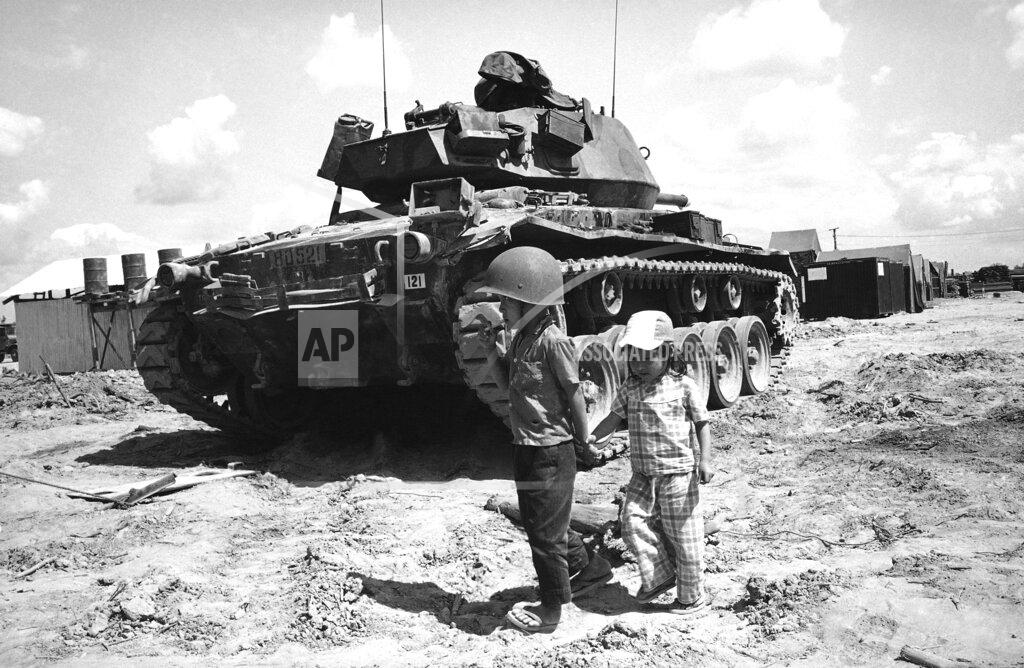
The world reacts to the U.S. role in the war over this weekend. The National Liberation Front threatens to launch an all-out attack; the Communist Chinese threaten to send ‘volunteers’ to aid the Việt Cộng; there are anti-U.S. demonstrations in various cities — including a break-in at the U.S. Embassy in Budapest, Hungary, by some 200 Asian and African students. U Thant, Secretary-General of the United Nations, calls for peace talks inside or outside the UN.
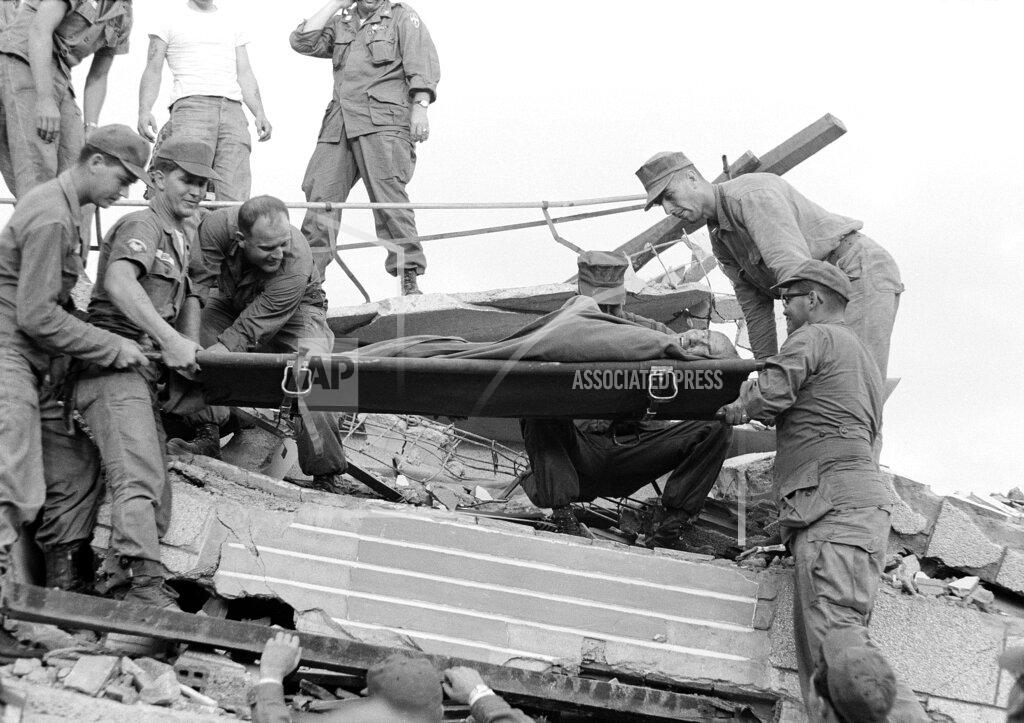
The Việt Cộng responded today to bombing raids on North Vietnam with a call for stronger attacks against United States forces, to compel them to “pay more blood debts.” The Liberation Front, parent organization of the Việt Cộng, declared in a radio broadcast that “the United States must know that any aggression against our heroic Vietnam will be punished appropriately. United States officials indicated that no further air strikes were impending, but they declined to lay down criteria for what might inspire further action against North Vietnam or, in their view, justify it. The Việt Cộng broadcast greeted the demolition of the United States Army barracks in Quy Nhơn as “the “heaviest blow” against the United States. In the terrorist blast, the four-story hotel for enlisted men was reduced to a rubble pile 30 feet high. Four Americans are now known to have been killed and 22 wounded. Eighteen remain unaccounted for as rescue workers continue to dig in the debris. The demolition of the barracks led to two air strikes Thursday against North Vietnam by 160 United States and South Vietnamese fighter-bombers.
Recent Việt Cộng broadcasts have spoken of United States “blood debts,” but analysts of the Vietnam situation found the tone of the new commentary sharper and more belligerent. “Fight the enemy with all means and weapons,” the broadcast ordered. “Weaken their forces as much as possible. Disintegrate their forces. Destroy the strategic hamlets, and force United States imperialists to pay more blood debts.” Nothing in the broadcast indicated that the Việt Cộng intended to slacken attacks on United States installations or on South Vietnamese forces to spare North Vietnam from further bombing attacks.
At a news conference in the afternoon, a United States pilot who participated in the Thursday attack against North Vietnamese targets provided information suggesting that Hanoi had not been prepared for a retaliatory raid. The pilot — Major Robert F. Ronca of Norristown Pennsylvania, commander of the 613th Tactical Fighter Squadron — said his group of 24 fighters had encountered only small-arms fire over their targets.
The fighters directed suppressive fire against the North Vietnamese defenders before propeller-driven South Vietnamese Skyraider fighter-bombers hit military installations in the area of Chap Le, 40 miles north of the 17th Parallel, which separates North and South Vietnam. Major Ronca said that his men had been able to spot defined anti-aircraft gun positions but that some had been unmanned and others had held no guns. Ground fire came almost entirely from .30-caliber rifles and machine guns, which inflicted only minor damage on a wing of one United States F-100 fighter. Major Ronca and Captain John B. Cutler of Washington, North Carolina, flew over the target area in reconnaissance aircraft afterward to assess the bomb damage. They agreed that United States planes had come within range of MIG fighter planes stationed in the North Vietnamese capital.
After the clash in the Gulf of Tonkin last August between North Vietnamese units and United States naval forces, Communist China delivered to the Hanoi area about 34 MIG-15’s and MIG-17’s. Apparently, the major said, the North Vietnamese or Chinese Communist aircraft commanders decided against engaging the attacking force, although it was over the target area about 20 minutes. Captain Cutler said considerable damage had been spotted among burning buildings and barracks when he led the reconnaissance planes over the area.
United States officials said that another squadron would be added to the South Vietnamese Air Force, which totals about 80 fighter-bombers. Six of the Skyraiders were damaged in the latest raid. A United States military spokesman also announced that 42 Việt Cộng guerrillas had been killed and 13 captured 12 miles south of the air base at Đà Nẵng. Many Communist weapons were seized. Government losses were put at one killed and two wounded. A battalion of Vietnamese marines and a ranger company were airlifted into the area by 18 United States Marine Corps helicopters.
Defenders of Đà Nẵng air base smashed a Việt Cộng band found dug in near the sector border today. Vietnamese planes bombed the band, and then a ranger unit closed in. Five guerrillas were killed and 10 captured.
The United States Ambassador, Maxwell D. Taylor, flew to Nha Trang today, on the South China Sea 180 miles northeast of Saigon, to visit American servicemen who were wounded in the attack on Pleiku last weekend. He also stopped at Quy Nhơn, 100 miles up the coast, to check on casualties from the barracks bombing. He was accompanied by General William C. Westmoreland, commander of United States forces in Vietnam.
Communist guerrillas shelled a Vietnamese military airstrip at Bồng Sơn, 300 miles northeast of Saigon, last night, United States military sources said today. The guerrillas lobbed seven mortar shells on the airstrip, but there were no casualties. The sources said no Americans were at the airstrip when the shelling occurred.
Premier Aleksei N. Kosygin warned today that the United States could not hope to improve its relations with the Soviet Union while subjecting other Socialist countries to attack.
A virulent “Hate America” campaign spread throughout Communist China today. Millions of people pledged support for North Vietnam’s “Struggle against United States aggression.”
About 1,000 chanting youth supporters of the left-wing Socialist Front paraded through Kuala Lumpur, Malaysia today and smashed plate-glass windows of the United States Information Service building.
About 500 Indonesians staged a demonstration outside the United States Embassy here today and shouted for Americans to get out of Vietnam and Laos. It was the second anti-American demonstration in two days. Embassy officials received three separate delegations who were protesting American air action in Vietnam.
The Secretary General, U Thant. called today on the parties to the conflict in Vietnam to move “from the field of battle to the conference table” inside or outside the United Nations. In a written statement that he read later on television, Mr. Thant said it was a matter of urgency to get talks started between the principals and to pave the way for wider and more formal negotiations. Meanwhile, he appealed to all the parties to show restraint and to refrain from any new acts that could lead to a further expansion of the conflict. The Secretary General did not identify the parties he addressed. But his words seemed to be directed at the United States, North and South Vietnam, Communist China, and the Soviet Union.
Mr. Thant stepped into the Vietnamese situation after another day of consultations during which he talked with both the President of the General Assembly, Alex Quaison-Sackey of Ghana, and the President of the Security Council for this month, Roger Seydoux of France. The United States delegation withheld immediate comment on Mr. Thant’s appeal but said his statement was under close study. Washington has shown no sign of interest in various calls for negotiations made previously, particularly by President de Gaulle. In Washington, the Presidential press secretary, George E. Reedy, said in reply to a question that there was no White House reaction to the proposal. Asked whether President Johnson had seen it, Mr. Reedy said that to his knowledge he had not.
The Administration left undefined today its intentions about further air attacks against North Vietnam, but they were the subject of a continuing debate behind the scenes. President Johnson was said to have scheduled several meetings with his closest advisers this weekend to hear arguments about the extent to which the bombings should continue and about the purposes and risks of future raids. Thus far, the Administration. has shown no interest in any of the appeals for negotiation that have been arriving from the United Nations, India, France, and elsewhere. Through a State Department spokesman, it said: “We see no purpose to be served until there is evidence that the Communists are willing to abide by their previous commitments to leave their neighbors alone.”
American policy in South Vietnam is again undergoing a reappraisal as officials move toward a hands-off approach to political rulers of the central government.
About 75 members of the Young Americans for Freedom demonstrated in front of the United Nations yesterday to urge increased action to win the war in Vietnam.
President Johnson said today that the United States had not asked for the task of protecting freedom around the world “but we welcome it.”
Pro-Communist Pathet Lao forces have begun a new offensive in Samneua Province and are threatening the right-wing area headquarters at Hua Muong, a spokesman for the Laotian Armys’ high command said today. Samneua, in northeastern Laos, borders on North Vietnam. The spokesman said all civilians and army dependents had been evacuated from Hua Muong, 165 miles northeast of Vientiane. The town, with its vital airstrip, appeared to be in danger of falling to pro-Communist forces, which were driving on Hua Muong from the direction of Samneua, the provincial capital, 35 miles to the northeast. The capital is held by the Pathet Lao. The offensive was regarded here as a continuation of attempts by the Pathet Lao to wipe out right-wing pockets in Communist-held territory. It was believed to have nothing to do with the United States retaliatory raids on North Vietnam.
West Germany demanded that the scheduled Cairo visit of East German Communist chief Walter Ulbricht be canceled or postponed. West Germany confirmed today that it had cut off military aid to Israel under a threat by the United Arab Republic to recognize Communist East Germany. The government denied, however, that it had promised Cairo not to recognize Israel. Chancellor Ludwig Erhard and a Government spokesman, speaking separately, coupled the admission to Bonn’s surrender to Egyptian demands, with a warning to the United Arab Republic not to go through with its invitation to Walter Ulbricht, East German chief of state. Dr. Erhard, speaking at a luncheon meeting of the Foreign Press Association, said that if “the most hated man in Germany” was received in the Egyptian capital, this could not fail to affect the political and economic relations of West Germany and the United Arab Republic.
The United States and Britain announced today an agreement on a 10-year cooperative research program for developing an advanced type of atomic power plant that produces more nuclear fuel than it consumes. The agreement lays the basis for a coordinated effort within the Atlantic community in developing the fast-breeder reactor. The United States already has a similar exchange agreement with Euratom, the six-nation European Atomic Energy Community. Because of its potential for conserving uranium resources, the fast-breeder is receiving increasing research attention among the nuclear powers. Atomic power plants of the present generation are relatively wasteful in their use of atomic fuel, and it is expected that they will be largely supplanted within 20 years by the still undeveloped fast-breeder reactors.
Eastern Europe is showing greatly increased interest in building atomic power stations to help overcome the area’s deficit in conventional fuels as sources of power, diplomatic sources report.
France plans to cash in another $350 million unwanted dollars for U.S. gold and is considering paying in advance some of its debt to the United States.
Philippine President Diosdado Macapagal, showing concern over Indonesian infiltration in the southern Philippines, has ordered the Defense Department to establish a naval base on Mindanao Island. Mr. Macapagal ordered the Foreign Secretary to study the country’s border and trade agreements with Indonesia “in the light of security requirements.”
Foreign Minister Subandrio of Indonesia is reported to have indicated hee today that Jakarta might halt guerrilla warfare against Malaysia pending mediation of the dispute between the two countries. This would be a reversal of Jakarta’s previous stand. Dr. Subandrio said that the situation “has now changed” and that the question of withdrawing Indonesian guerrillas from the Malaysian states of Sabah and Sarawak was “less serious” than before, according to a Japanese official source.
Prime Minister Lal Bahadur Shastri’s Cabinet, weakened by the resignation last night of two South Indian ministers, met twice in emergency session today as reports of death and violence from the south increased.
Turkey’s international and internal political life is undergoing subtle changes that suggest far-reaching consequences. The trigger for the change is Turkey’s anger over the attitude of the United States on the Cyprus issue and her search for an alternate source of support for Turkish aims. The alliance with the United States and the West in general remains technically unaltered, but the United States is exposed to a variety of slights while the Soviet Union basks in official and unofficial favor. At the same time, the political left, which for decades was fiercely suppressed, finds that it can speak up on the domestic political scene with relative impunity.
Yaroslav Golovanov, the science editor for the Soviet youth newspaper Komsomolskaya Pravda, was approved for cosmonaut training for the Soviet space program, along with two other journalists with engineering backgrounds, Mikhail Rebrov of the Defense Ministry newspaper Krasnaya Zvezda and Yuri Letunov of Gosteleradio, the government-owned radio network. After the death a year later of their mentor, Soviet space program chief Sergei Korolev, the three were dropped from the program. It would not be until 25 years later, in 1990, that a member of the press, Toyohiro Akiyama of the Tokyo Broadcasting System, would become the first journalist to be launched into outer space.
OCAM (Organization Commune Africaine et Malgache), the African and Malagasy Common Organization, was formed at Nouakchott, Mauritania, as a successor to the Afro-Malagasy Union for Economic Cooperation (Union Africaine et Malgache de Coopération Économique; UAMCE), formerly the African and Malagasy Union (Union Africaine et Malgache; UAM)). The 13 initial members were all former French colonies (Cameroon, the Central African Republic, Congo-Brazzaville, Dahomey, Gabon, the Ivory Coast, Madagascar, Mauritania, Niger, Senegal, Togo and Upper Volta).
The refueling reactor on the Soviet nuclear submarine K-11 became overheated and exploded, causing radiation contamination but no deaths. A furfurol-based polymer would be used to seal the reactor, which would then be dumped into the Abrosimova fjord in the Kara Sea within the Arctic Ocean, at a depth of 20 metres (66 ft).
A Cuban refugee from Weehawken, New Jersey, smashed a jar of red paint against the black marble entrance of the Soviet mission to the United Nations yesterday while an associate took his picture. Both men were arrested by the patrolman on duty in front of the 13-story building.
Premier Moise Tshombe’s Congo Government is moving toward a rapprochment with some French-speaking states of West Africa.
Queen Elizabeth, wearing a mink coat against the chill of the English winter, returned today to London from a 12-day visit to tropical Africa.
Twenty-nine activists set out on the Aboriginal Freedom Ride to protest against racial discrimination in Australia.
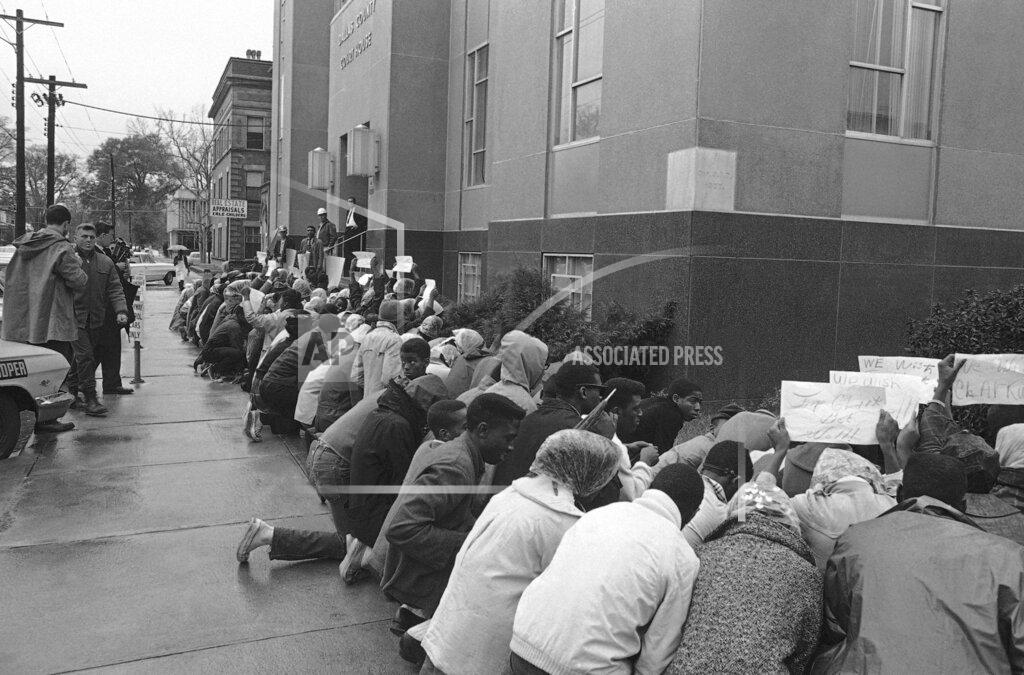
In Selma, Alabama, Sheriff James G. Clark Jr. was hospitalized with exhaustion today after four weeks of dealing with Black demonstrators. About 200 Black teenagers, most of whom had been on a forced march with the sheriff two days before, knelt in the rain in front of the Dallas County courthouse and prayed for his recovery “in mind and in body.” A handful of deputies looked on with puzzled frowns but made no attempt to arrest them. It was the first time the hefty sheriff had not been on hand when the demonstrators arrived. “It just wasn’t the same without Jim Clark fussing and fuming,” one of the demonstrators said later. “We honestly miss him.” The 220-pound officer was admitted to the new Vaughan Memorial Hospital here at 6 AM.
“Sheriff Clark was admitted to the hospital for chest pains and is being kept for observation and rest,” his physician said. “He is doing fine.” The sheriff’s wife told a reporter her husband was suffering from exhaustion and she expected him to recover in a couple of days. She said she awoke at 3 AM and found him reading a newspaper. She said he had not been to sleep and was upset about something he had read about himself in the paper. Sheriff Clark had been up a good part of the night receiving complaints about the chaining of a civil rights worker to his hospital bed and keeping an armed guard outside his door.
The Rev. James Bevel, a field worker for the Southern Christian Leadership Conference, was arrested by the sheriff Monday and convicted of contempt of court for demonstrating in the vicinity of the courthouse in violation of an order issued by Circuit Judge James A. Hare. He was fined $50 and sentenced to five days in jail. Mr. Bevel became ill in jail and was transferred last night to Burwell Infirmary, a small Black-owned hospital. Ace Anderson, administrator of the hospital, said Mr. Bevel’s leg was chained to the bedpost and an armed member of the volunteer Dallas County Sheriff’s Posse was stationed outside his door.
The physician who examined Mr. Bevel said he was suffering from a viral respiratory infection and had a fever of 102. Sheriff Clark ordered him unshackled after he had been in the hospital about five hours and after his physician had submitted a written request to the sheriff requesting that the chain be removed. A spokesman for the sheriff’s office denied that Mr. Bevel had been chained to the bed. The spokesman said he had been sent to the hospital in leg irons, as is customary. “The rules are the same for all offenders, whether the prisoner is a murderer or is being held for some minor offense.” the spokesman said, “putting the leg irons on is standard procedure.” Mr. Anderson. however, insisted that Mr. Bevel had been chained to the bedpost. He also said it was not customary for prisoners to be hospitalized in leg irons, even those charged with murder. “They send a guard out, but no leg irons,” Mr. Anderson said.
The teen-agers were meeting at Browns Chapel Methodist Church preparing for their daily demonstration when they heard about the sheriff’s illness. They printed large signs, one of which said, “Sheriff Clark, get well in mind and body,” and marched on the courthouse. A gentle but chilling rain fell as the group lined up facing the door to the sheriff’s offices. As they knelt and held up their cards for the sheriff’s staff to see, about 50 other Blacks, watched from across the street. Richard Boone, an associate of Mr. Bevel, prayed, “We ask a speedy recovery for Sheriff Clark and for the Rev. Bevel and we ask that somehow we may get together and work out our differences.” Thus ended the fourth week of street demonstrations protesting barriers against Black voting in Alabama. No further demonstrations are expected until Monday when the Board of Registrar office will be open.
The Rev. Dr. Martin Luther King Jr. will return Sunday night to lead the campaign, which has seen almost 3,400 arrested in the Selma area. About 65 demonstrators, mostly adults, remained in jail today. The majority of the prisoners are confined to Camp Selma, a facility built by the State Highway Department seven miles west of town for housing convict labor. The Federal Bureau of Investigation has been conducting investigations of conditions at the camp, which has been used to house an overflow of prisoners from the County Jail. Demonstrators released from the camp have complained that they were crowded together in wooden barracks which have inadequate plumbing. They said everyone drank from a tub of water placed in the center of the room and food consisted of black eyed peas and poorly cooked corn bread.
As the legal barriers to racial equality disappear, President Johnson declared, the nation’s next task is to admit 20 million Blacks as “complete and full members of American society.”
New York and other North Atlantic ports will go back into action early tomorrow after a 33-day paralysis. Striking longshoremen rejected today a Presidential panel’s formula for a full solution of the long walkout, but agreed to order men back to work in all ports where agreements had been reached.
Plans for the U.S. Head Start program, for early education for underprivileged children, were given massive publicity by Lady Bird Johnson, the First Lady, when she hosted prominent women as guests for a tea party at the White House. Women from business and entertainment were invited, along with the wives of high-ranking federal government officials, the wives of some state governors, and a few men, “primarily church leaders.” Mrs. Johnson addressed the need for early education for all preschoolers, and the reporting of her party on the “society pages” of newspapers brought a favorable response for Head Start and for the War on Poverty.
A Federal advisory body has split bitterly over issues of high public policy concerning the development of the rich oil shale reserves on public lands in Western states.
The President announced that Thomas C. Mann will succeed Averell Harriman as Undersecretary of State, and made other changes.
A gigantic snowstorm described — even in winterwise Minnesota as the worst in many years — completed its wind-whipped diagonal course across the nation’s midsection,
The New York City police were asked by the N.A.A.C.P. last night to reopen all of the cases in which confessions had been obtained by a detective involved in the interrogation of George Whitmore Jr. in the murders of Janice Wylie and Emily Hoffert.
Director of Flight Operations Christopher C. Kraft, Jr., told the Manned Spacecraft Center senior staff that the Gemini 3 mission might be flown between March 22 and 25, although it was officially scheduled for the second quarter of 1965. In addition, the Houston control center was being considered for use in the GT-4 mission.
Dean Chance, the Cy Young Award winner for 1964, quickly came to terms with the Los Angeles Angels today for a salary estimated at $42,000.
The stock market recovered partially from sharp losses taken earlier in the week over the Vietnam crisis.
Dow Jones Industrial Average: 888.47 (+6.59)
Born:
Brett Kavanaugh, American lawyer and U.S. Supreme Court Justice (2018-), in Washington, District of Columbia.
Rubén Amaro Jr., MLB outfielder and pinch hitter (California Angels, Philadelphia Phillies, Cleveland Indians), in Philadelphia, Pennsylvania.
Dennis Springer, MLB pitcher (Philadelphia Phillies, California-Anaheim Angels, Tampa Bay Devil Rays, Florida Marlins, New York Mets, Los Angeles Dodgers), in Fresno, California.
Stan Fansler, MLB pitcher (Pittsburgh Pirates), in Elkins, West Virginia.
Sammy Lilly, NFL cornerback (Philadelphia Eagles, San Diego Chargers, Los Angeles Rams), in Anchorage, Alaska.
Gary Lee, NFL wide receiver (Detroit Lions), in Albany, Georgia.
Alvin Blount, NFL running back (Dallas Cowboys), in Washington, District of Columbia.
Christine Elise [McCarthy], American actress (“Beverly Hills, 90210”, “ER”), in Boston, Massachusetts.
Mia Frye, American choregraphic dancer; in New York, New York.
Died:
Henry Kulky [Kulakowich], 53, American actor (“Voyage to the Bottom of the Sea”), from a heart attack.
John Hays Hammond Jr., 76, American electrical engineer and inventor of radio control for remote guidance of missiles, unmanned combat vehicles, drones and other “RC” devices.





 History Diaries