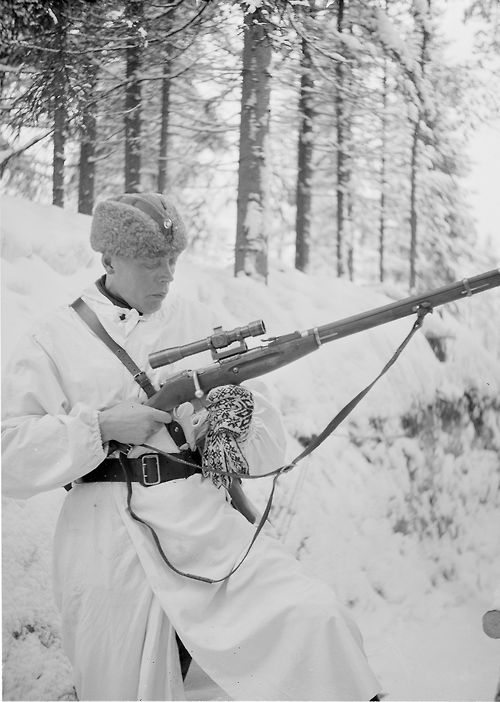
Time’s up for Finland.
Intense fighting on the Karelian front begins as the Red Army launches what is to become the decisive assault on the Mannerheim Line.
The Finns have fought magnificently. They never ran out of courage. But in the end, they ran out of men and time. Timoshenko has come, and the Soviets are no longer screwing around.
On the Karelian Isthmus the day begins foggy, but brightens up during the course of the morning. The temperature remains at around 20 below zero throughout the day. The frost returns to Europe on 11 February 1940. It is possible to walk across the Kattegat from Jutland to Sweden. The Finnish command summarizes Soviet losses to date as 327 airplanes, 594 tanks, and 206 guns captured.
After a month of retraining, reinforcement, bombardment, and probing attacks, the Soviet Army launches a major attack on the Karelian Isthmus to break through the Mannerheim Line. The Soviets have about 460,000 men, over 3,350 artillery pieces, about 3,000 tanks and about 1,300 aircraft deployed on the Karelian Isthmus. In the front line, they dispose of 120,000 men. All told, the Soviets have available about 7 men per yard of the 12-mile front.
Opposing them, the Finns have 150,000 men in total, organized into 8 Divisions. The Finns are deficient in each weapon category by vast margins. Superior mastery of the terrain and weather does little to help them in a brutal frontal assault.
Finnish troops are forced to withdraw to secondary defensive positions as the Red Army pierces the Mannerheim Line. With the Mannerheim Line weakening, Timoshenko opens his main attack. From 9:30 to noon he conducts a massive artillery barrage (heard 100 miles away), then 120,000 Soviet troops attack into the 12-mile Summa gap. The 123rd Soviet Rifle Division penetrates the Lähde sector and 245th Rifle Regiment under Colonel Rosly takes Fort Poppius at 1.30 PM by parking armored cars in front of the machinegun ports. Finns try to plug the gap but are cut down by Soviet tanks. Strangely, Soviets do not send in reinforcements to exploit this gap. This breakthrough was the beginning of the end of Finnish resistance. Fighting goes on around Millionaire Fort all night.
At 8:40 in the morning, the Soviet artillery begins drumfire across the entire breadth of the 3rd Division’s defensive position in Summa, continuing the bombardment for four hours. Four Soviet artillery regiments fire at the Finns near Summa. The 24th Corps Artillery Regiment alone fires 14,769 shells. The Finns attempt counter-fire, but it is quickly silenced. A little before midday the enemy infantry begins its assault with massive air and tank support. The defending Finnish forces take out 72 enemy assault tanks.
At 11:00, the 245th Rifle Regiment of the Soviet 123rd Division, 7th Army, supported by heavy T-28 and light T-26 tanks, attacks the Poppius bunker in the center of the line at Lähde. While the bunker has been destroyed previously, it still constitutes a rallying point for the Finns. The Soviet troops capture the bunker, using armored cars parked in front of the bunker to block machine-gun fire from the Finns inside. By the end of the day, the Finnish company defending the bunker has just 16 men left out of the 100 with which they started. The 2nd Battalion, 9th Infantry Regiment which defends the sector loses control of the situation. The Soviets, having made their first real breach in force of the entire campaign, dig in for the night, but fighting continues around the Millionaire bunker.
The Finnish counterattack runs out of steam before midnight. In all other parts of Summa the enemy assault is successfully repulsed. By midnight Finnish reserves have restored the lines. The three Finnish divisions in the main defensive position successfully repulse attempted breakthroughs by at least six Soviet divisions.
On the Eastern Isthmus, during the course of the day between 40,000 and 50,000 mortars of varying types rain down on the front line and reserve positions in Taipale.
In Kirvesmäki every single soldier in stronghold no.1 is either killed or wounded.
Reserve Lieutenant Gunnar Höckert is killed on the Isthmus. Höckert won the gold medal in the men’s 5,000 metres at the 1936 Berlin Olympics and ran three world record times during the course of his athletic career.
A Soviet flanking operation across the ice of the Gulf of Viipuri in support of main assault fails.
In Northern Finland at Löytövaara in Kuhmo, the Finnish Battalion Arponen launches an assault with shock troops at 7 o’clock in the morning. A volunteer detachment of shock troops crawls through deep snow to take the enemy dugouts by surprise. The ploy is a success, and the shock troops begin to systematically take out the Russian defences with piled-up charges, petrol bombs and machine pistols. By evening the area is in Finnish hands, with only a few of the enemy managing to escape across Lake Löytöjärvi to Riihivaara.
Teams representing Sweden and Finland play an international bandy match in biting temperatures of 15 below zero in the Olympic Stadium in Stockholm. The proceeds are to be donated to the Finnish war effort. Listeners to Swedish radio can also contribute to the collection. Before the match begins the actress Ella Eronen recites the words of the Finnish national anthem in Finnish and Swedish. The game ends in a Swedish victory by 2 goals to 1. The official proceeds from the match are 475,000 krona.
The Indianapolis Symphony Orchestra has sent 1,200 dollars to the great Finnish composer Jean Sibelius, and Sibelius has decided the money should be used to help the needy families of fallen reservists.
The French belief that this country cannot be beaten, however terrible and however long the war may be, has been strengthened by Yesterday’s unanimous support of the government in the Chamber of Deputies and all that it connotes.
The German–Soviet Commercial Agreement was signed. A comprehensive trade agreement was signed between Germany and the USSR in which Soviet raw materials and food would be exchanged for German machinery and military equipment.
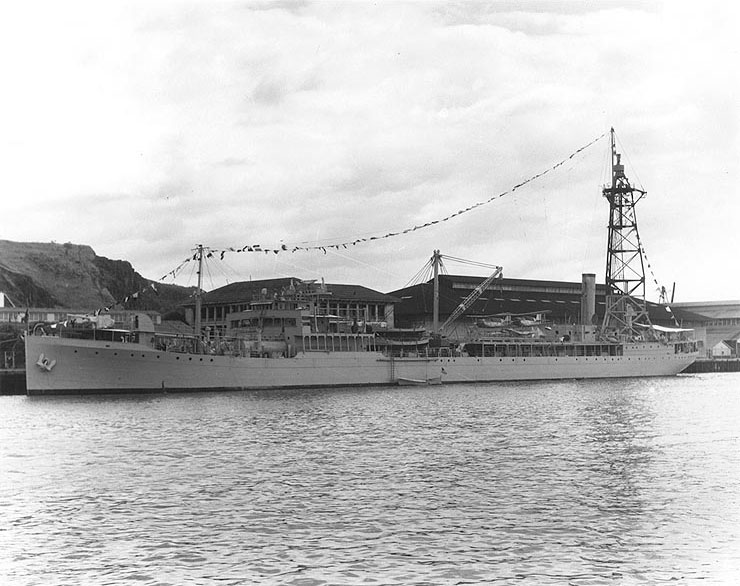
The unfinished German cruiser Lützow was sold to the Soviet Navy.
Trud, official organ of the Russian trade unions, Sunday criticized William Green for aiding Finland in its war against the Soviet Union. The president of the American Federation of Labor, said the publication, was a “fierce enemy of the U.S.S.R. and a faithful hireling of the reactionary bourgeoisie, who are helping (former President Herbert) Hoover organize aid for Finland, who is drawing the United States into a second imperialistic war.”
Police charged a crowd of about 1,000 Irish Republican Army sympathizers Sunday, precipitating street fighting that lasted for an hour. Showers of bottles, stones, bricks and other missiles rained on the club wielding policemen. About 20 persons were arrested before order was restored. Scores of minor injuries were inflicted in the melee. The IRA sympathizers were attempting to hold a meeting in the Falls road area of Belfast. A band of men identified as extremist Irish Republican Army members raided the Ballykinlar military camp in County Down Saturday night. They seized 30 rifles and kidnaped one soldier. The kidnapers motored into Belfast, freed their captive in the heart of the city and escaped during a blackout. Armored cars patrolled the streets after the raid while police made a house to house search for suspects and arms. One account said the loot included 100 rifles and several Bren machine guns, of the type used by the British army.
Flight-Lieutenants John Noel Dowland (1914-42) and Leonard Henry Harrison (1906-89) defused a bomb aboard the grain ship SS Kildare in Immingham, Lincolnshire. For that they will both receive the George Cross but not until 1941.
At 0458 hours, the British steam fishing trawler Togimo was shelled and sunk in the Atlantic Ocean west of Cornwall (50°40′N 11°02′W) by the German submarine U-37 with the loss of one of her 11 crew. At 0330 hours, U-37 spotted a light of a fishing trawler 68 miles southwest of Milford Haven and fired a warning shot. The Togimo (Master James Gale) put out the lights, turned away and tried to escape so the U-boat opened fire with the deck gun at 0458 hours. The trawler sank after 26 rounds were fired. The survivors were rescued by the Spanish steam merchant Monte Navajo.
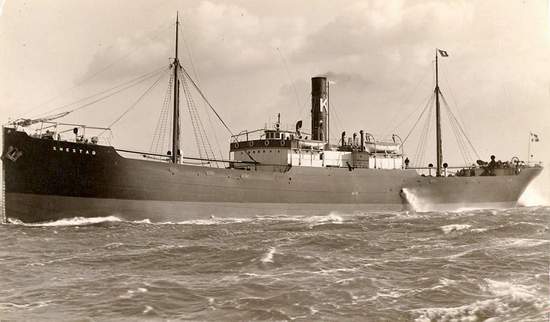
At 1100, the Norwegian motor merchant Snestad was torpedoed and sunk in the Atlantic Ocean about 100 miles west of the Hebrides, United Kingdom (58°40′N, 13°40′W) by the German submarine U-52. After the crew abandoned ship in three lifeboats, the ship was hit by a coup de grâce and sank within 3 minutes. Because one of the boats was damaged, the survivors were distributed among the other two lifeboats. All hands were rescued after 22 hours by the Norwegian Albert L. Ellsworth, but two of her 36 crew subsequently drowned when the Albert L. Ellsworth herself was attacked and temporarily abandoned two nights later. The 4,114-ton Snestad was carrying ballast, en route to Philadelphia.
At 1820, the Estonian steam merchant Linda was torpedoed and sunk in the North Sea 100 nautical miles (190 km) west of Utsira, Norway (58°15′N 1°54′E) by the German submarine U-9 with the loss of one of her 15 crew. She broke in two, and the forepart sank immediately and the stern followed four minutes later. The survivors were rescued by the Swedish ship Birgitta. The 1,213-ton Linda had been bound for Gothenburg, Sweden with a cargo of coal.
At 2230 hours the unescorted British motor tanker Imperial Transport was torpedoed and damaged in the Atlantic Ocean northwest of the Outer Hebrides (approximately 59°N, 12°W) by the German submarine U-53, commanded by Korvettenkapitän Harald Grosse. Imperial Transport (Master Walter Smail) was hit on port side in the empty #6 tank by one torpedo from U-53 (Grosse) while steaming at 12 knots on a non-evasive course en route from Scapa Flow to Trinidad in ballast about 200 miles west-northwest of Butt of Lewis in position 59°00N/12°00W. The tanker immediately began to break in two and the forward part broke off completely within 5 minutes after the hit. The last two men had to jump over a gap of 2 feet to get to the stern section. All 43 crew members and gunners (the ship was armed with one 4.7 gun) then abandoned ship in both aft lifeboats in the very dark night, but two crewmen fell overboard and drowned during the launch of the port boat. Later the master and the other occupants of his boat reboarded the ship and tried to attract the attention of an illuminated neutral vessel sighted during the night, but to no avail. The remaining crew members also returned to the ship after 17 hours when it became clear that the stern section will not sink. They could not send distress signals because the wireless station had been destroyed, so they painted “SEND HELP URGENT” on deck in case if they were spotted by an aircraft. As the sea was rather choppy at that time they waited for the weather to improve until raising steam and sailing off with not more than 4 knots during the morning of 13 February, passing the still drifting bow section which was about 45 feet out of the water.
Just before dusk on 14 February and after sailing the stern section more than 130 miles they met four British destroyers of which HMS Kingston (F 64) (LtCdr P. Somerville, RN) remained with Imperial Transport to escort her. The next morning the weather was deteriorating and the tanker had to stop to examine the forward bulkhead and then tried to sail by the stern, but just went round in circles. After an unsuccessful attempt to take her in tow, the destroyer took all men off the ship for the night. On 16 February, the tug HMS Buccaneer (W 49) and HMS Forester (H 74) (LtCdr E.B. Tancock, RN) arrived and the master asked to be returned to the tanker for the salvage operation, but the weather was too bad so during the afternoon he and his crew were all transferred to HMS Forester which landed them at Scapa Flow on 17 February. The tug made three fruitless attempts to tow the stern section, but it could only be moved after the tugs HMS St. Martin (W 27) and HMS Englishman arrived and were escorted to the Clyde by HMS Gleaner (J 83) (LtCdr H.P. Price, RN). HMS Mohawk (F 31) (Cdr J.W.M. Eaton, RN) screened the salvage operation from 20 to 23 February. On 26 February, the remains of the tanker were beached on the Isle of Bute in Kilchattan Bay. Of the ship’s complement, all 51 survived and were rescued by the HMS Forester (H 74). The 8,022 ton Imperial Transport was carrying ballast and was bound for Curaçao, Lesser Antilles. The Imperial Transport broke in two. The bow section sank. The stern section was taken in tow by the British tugs Englishman and St Martin and beached at Kilchattan Bay, Bute on 26 February. A new bow section was constructed and the ship was repaired and re-entered service in 1941.
U-53 also attacked the Albert L. Ellsworth at the same spot a few hours later. The ship was rescuing the men from the Snestad. Grosse fired a torpedo which detonated prematurely but looked like it had hit. The men of the freighter abandoned it in a great rush. Grosse then fired another torpedo to finish off the freighter, but it also was a dud. A third torpedo ran underneath the ship and exploded beyond. Grosse then thought the ship was finished and left. However, the ship remained afloat, and the survivors re-boarded it the next morning. The ship was completely intact, so they resumed their voyage to Bergen and arrived there safely.
At 2354, the Swedish steam merchant Orania was torpedoed and sunk in the North Sea 60 nautical miles (110 km) north east of the Shetland Islands United Kingdom by the German submarine U-50 with the loss of 14 of the 24 people aboard. Orania was hit by one torpedo from U-50 and sank within three minutes 65 miles north-northeast of Flugga Lightvessel, Shetland Islands. The U-boat had spotted the illuminated vessel at 2240 hours, but was not able to identify her as neutral. The wife of the master was also aboard. All hands on board abandoned ship in two lifeboats, but one of them with 14 occupants was never seen again. The survivors were rescued by HMS Fearless (Royal Navy). The 1,854-ton Orania had been en route from Buenos Aires to Malmö and Åhus, Sweden with a cargo of maize, bran and oil cake.
The British trawler Halifax struck a mine and sank in the North Sea off Aldeburgh, Suffolk (52°06′30″N, 1°59′40″E). All crew were rescued by the British ship Ipswich.
The Greek cargo ship Aghia Zoni P. ran aground near Kyparissia. She was raised in April but was declared a total loss.
Convoy OG.18F forms at sea for Gibraltar.
The War at Sea, Sunday, 11 February 1940 (naval-history.net)
Convoy HN.10B with twenty Norwegian, seven Swedish and two Finnish ships departed Bergen on the 11th, escorted by destroyers COSSACK, SIKH, MOHAWK, and TARTAR, with twelve of the ships being detached down the west coast of Britain. Next day, HN.11 with one British, fifteen Norwegian, ten Swedish and one Finnish ship left Bergen and were escorted by the same warships from HN.10B, but in this case, none of the ships were bound for west coast ports. Still on the 12th, COSSACK and GURKHA attacked a submarine contact northeast of Sumburgh Head in 60-12N, 00-22W, and on the 13th SIKH also attacked a contact, off Aberdeen in 57-15. 7N, 1-47W. That same day, the 13th, destroyer DIANA departed Rosyth to relieve destroyers COSSACK and GURKHA for operation DT. They reached Rosyth later in the day, as did the east bound section of HN.10B. Light cruisers EDINBURGH and ARETHUSA also arrived in Rosyth, on the 14th, and the later convoy, HN.11 safely reached Methil on the 15th.
Destroyer GALLANT, leaving Aberdeen, damaged her propellers on a submerged object, and was docked for examination.
Heavy cruiser NORFOLK arrived at Scapa Flow from Northern Patrol.
Armed merchant cruiser ASTURIAS departed the Clyde on Northern Patrol.
Heavy cruiser DEVONSHIRE intercepted Norwegian steamer BORGLAND (3636grt) and requested a trawler to take her in to Kirkwall.
Destroyer EXPRESS attacked a submarine contact off Flamborough Head in 54 13N, 00 08E.
Destroyer KINGSTON was submarine hunting 22 miles west by south of Dubh Artch.
Destroyer GREYHOUND lost Acting S/Lt R A S. Brown RNR, a petty officer and five ratings when her boat capsized in the Humber.
During the night of the 11th/12th, minelayer PRINCESS VICTORIA with destroyers EXPRESS and ESK laid the 52 mines in minefield LD 3 (first half). After the operation, the minelayer anchored in Yarmouth Roads.
Anti-submarine trawler HUDDERSFIELD TOWN (399grt), escorting a convoy, attacked a submarine contact off the Smalls in 51-38N, 5-57W. Destroyer WINCHELSEA joined in the hunt.
Convoy OA.88GF departed Southend on the 8th, escorted by destroyer BROKE which was relieved on the 10th by sloop BIDEFORD and destroyer VETERAN, while OB.88GF sailed from Liverpool, also on the 8th with 29 ships escorted by sloop LEITH and destroyer VERSATILE. On the 11th, they merged as OG.18F. Destroyer VERSATILE escorted the convoy on the 11th before detaching to HG.18F, sloops LEITH and BIDEFORD were with the convoy from the 11th to 17th, and destroyer ACTIVE joined it in the Gibraltar approaches out of Gibraltar, where OG.18F arrived on the 17th.
Convoy FN.92 departed Southend, escorted by destroyers JUPITER and VIVIEN, and sloop PELICAN, and arrived in the Tyne on the 13th.
Convoy FS.93 departed the Tyne at 2300 escorted by destroyers VEGA and JAGUAR, and sloop STORK, and arrived at Southend on the 13th.
U-9 sank Estonian steamer LINDA (1213grt) 100 miles west of Utsire in 58 51N, 01 54E. One member of the crew was lost, and the survivors rescued by Swedish steamer BIRGITTA (1363grt).
U-37 sank trawler TOGIMO (290grt) in 50 40N, 11 02W with the loss of one crewman. Survivors were picked up by Spanish steamer MONTE NAVAJO (5754grt).
U-50 sank Swedish steamer ORANIA (1854grt) 60 miles NE of the Shetlands. Fourteen crew were lost and ten survivors picked up by destroyer FEARLESS and transferred to FOXHOUND, which landed them at Lerwick. Four destroyers were searching in the area for the submarine.
U-53 sank Norwegian steamer SNESTAD (4114grt) with the loss of two crew in 58 40N, 13 40W and badly damaged British tanker IMPERIAL TRANSPORT (8022grt) in 59N, 12W. The tanker broke in two, the forward section sank and destroyer KINGSTON tried unsuccessfully to tow the stern section, after which she stood by until tug BUCCANEER arrived. She tried three times, then other tugs arrived. On the 15th, destroyer FORESTER was detailed to join the damaged ship. She was relieved by destroyer MOHAWK, which departed the Clyde on the 20th, and she in turn was relieved by escort vessel GLEANER. FORESTER and BUCCANEER arrived in the Clyde on the 22nd and four more days later, on the 26th, under the tow of tugs ST MARTIN and ENGLISHMAN and escorted by escort vessel GLEANER, IMPERIAL TRANSPORT also reached the Clyde. She was beached in Kilchattan Bay on the Isle of Bute and later rebuilt.
Trade negotiations between Germany and Russia which began in the latter part of 1939 were signed in Moscow. As part of the treaty, German handed over the incomplete heavy cruiser LUTZOW, plans for battleship BISMARCK, heavy naval guns, and about thirty aircraft including ME.109 fighters, ME.110 fighter bombers and JU-88 bombers. The sale of incomplete heavy cruisers SEYDLITZ and PRINZ EUGEN and turrets of two of the Z-programme battleships had also been discussed during the negotiations, but had been vetoed by Hitler on 8 December.
Aircraft carrier ARK ROYAL, battlecruiser RENOWN, and destroyers HASTY and HERO, which departed Gibraltar on the 10th to return to England, searched for the German ships which had escaped from Vigo (Operation VO). Other ships taking part included aircraft carrier HERMES which left Freetown at 1200/11th, light cruiser GALATEA from Gibraltar at 1800/12th, and French destroyers TRIOMPHANT and FOUGUEUX on patrol in 43-00N between 13 and 11W. Destroyer departures from Plymouth were KEITH, WAKEFUL and VETERAN on the 9th, ANTELOPE on the 10th to join ARK ROYAL at 0900/12th in 45-00N, 15-00W, ACASTA, WHITSHED, and VESPER at 1430/11th with ARDENT to sail as soon as possible, and WREN, WOLVERINE, and HEARTY at 0830/12th. Aircraft from ARK ROYAL sighted several of the German steamers, leading to the capture of ROSTOCK and MOREA.
German steamer ROSTOCK (2542grt), which left Vigo on the 9th/10th, was captured off the Spanish coast by French sloop ELAN. A prize crew was put aboard and she was taken into Brest arriving on the 14th. Renamed SAINT MAURICE for French service, she reverted to German service after the fall of France.
Light cruiser GLOUCESTER departed Mombasa and arrived at Durban on the 21st.
A test of whether Congress is saving here, in order to spend there, will come this week, when the Senate Appropriations Committee reports the $407,855,600 Rivers and Harbors Bill, resurrected from last session, and the House considers the 1941 Navy Supply Bill, reportedly cut more than $100,000,000 from the $954,000,000 Bureau of the Budget estimates. The House Appropriations Committee, which is scheduled to send the navy bill to the House floor Tuesday, has reportedly stuck to its aim of reducing budget estimates by $460,000,000 for this session. The navy bill is said to have been trimmed by slightly more than $100,000,000, which would bring committee savings since January to a quarter of a billion dollars.
While adhering to the cuts made by the Appropriations Committee, some House groups have indicated their aim was not entirely to prevent new taxes being levied, but to gain benefits for their constituents by taking it out of national defense, relief and other items. So, while the House decides how much it will take from national defense, the Senate is scheduled to deliberate on how big a pork barrel the Rivers and Harbors Bill will become.
In the closing days of the last regular session the Senate sidetracked this bill after the Senate Commerce Committee loaded it with projects so costly that, in the economy move then in vogue in the House, it seemed futile to pass it. As the bill left the House last May it carried $83,848,100 in projects, but it was raised to $407,855,600 in the Senate, with other amendments pending which, if adopted, would greatly expand its scope and cost. The Senate Finance Committee also is expected to start hearings on the House-approved Agriculture Department Bill, which was trimmed so drastically that President Roosevelt, who omitted from his budget estimates some of the items greatly desired by the farm group, criticized the House’s action.
Senator Russell of Georgia, one of the Senate farm leaders, termed the House cuts too drastic and served notice on the Senate and on President Roosevelt that his group would seek to include $212,000,000 in parity payments to farmers, $25,000,000 for farm tenant loans and $72,000,000 for surplus crop disposal, which includes the food-stamp plan. Mr. Roosevelt was said to have made no objection to the aim of the Senate farm leaders, although he has never assented to the parity payments unless they were financed through new taxes. Secretary Wallace, who advocates the certificate plan of financing parity payments, will be a witness before the committee and he is expected to renew with vigor his fight for the AAA program.
Bids for the construction of the cruisers USS Cleveland and USS Columbia will be opened by the Navy Department on Thursday and all combatant ships for which funds have been appropriated by Congress since 1933 then will be in commission, under construction or ready for final contractual action. This means that under the current expansion program, the navy will have expended on new combatant construction alone about $1,335,000,000 by the end of this fiscal year on June 30.
The books, as of June 30, will show that in the current fiscal year construction expenditures attained an all-time high of $255,000,000, of which $148,000,000 was for battleships, $61,000,000 for destroyers, $21,000,000 for submarines, $10,000,000 for aircraft carriers, and $15,000,000 for cruisers. The total, after auxiliary construction is included, would be many millions more. The most significant item in the construction picture involves the battleships, which are eight in number, six of 35,000 tons each and two of 45,000 tons each, a total of 300,000 tons. The completed cost of this great first line battle fleet is estimated at $631,000,000.
These ships will have all been completed before the end of the fiscal year 1944. Two of them, the USS North Carolina and USS Washington, will be finished in 1942 and four others, the USS Massachusetts, USS Indiana, USS Alabama, and USS South Dakota in 1943. The fiscal year 1944 is scheduled to go into history as the first commissioned year of the new 45,000ton dreadnoughts, the USS Iowa and USS New Jersey. Two other battleships of the 45,000-ton class are carried in the regular appropriation bill now pending before the House Committee on Appropriations, but are not included in the construction picture as of June 30, this year. The fighting units authorized in the expansion bill of 1940 soon to come up for action in the House, also are not included.
On June 30, next, based on official navy estimates, there will be under construction in navy yards and private shipbuilding plants fifty-one fighting units, which will include eight battleships, one aircraft carrier, six cruisers, twenty-three destroyers, and thirteen submarines of an aggregate tonnage of 419,000 and a completed cost of $1,082,000,000. All of these ships are to be in commission before the end of the fiscal year 1944, while the aircraft carrier and most of the cruisers, destroyers and submarines are to be commissioned in the calendar years 1941 and 1942. Assuming the passage of the regular appropriation bill, as approved by the President and the Budget Bureau, and the 1940 expansion authorization bill, the picture will be much more impressive as to tonnage, types, and cost after July 1, 1940.
Tornado-damaged Albany, Georgia sifted its ruins Sunday, revised its death list to 17, and set about rebuilding devastated property valued at from five million to nine million dollars. Red Cross Field Director James W. Cullens announced the revised death list He said estimates in excess of 20 Saturday night resulted from duplication of reports. More than 300 persons were treated for injuries, he said. Meanwhile national guardsmen with bayonets looked on as more than 500 workers started systematic checkup of damaged buildings in the downtown area and undertook the task of removing tons of twisted steel and crumbling masonry. Sixty trucks were assigned to the cleanup job after tractors jerked down tottering walls. The citizens were encouraged, however, by a telegram from President Roosevelt sent to Francis Shurling of the national emergency council. “Please extend every assistance within your power to the stricken community of Albany, and ask Mayor Haley to convey to all sufferers from the tornado my heartfelt sympathy as their friend and neighbor,” the telegram read. The President’s Georgia home at Warm Springs is within 100 miles of the storm damaged area.
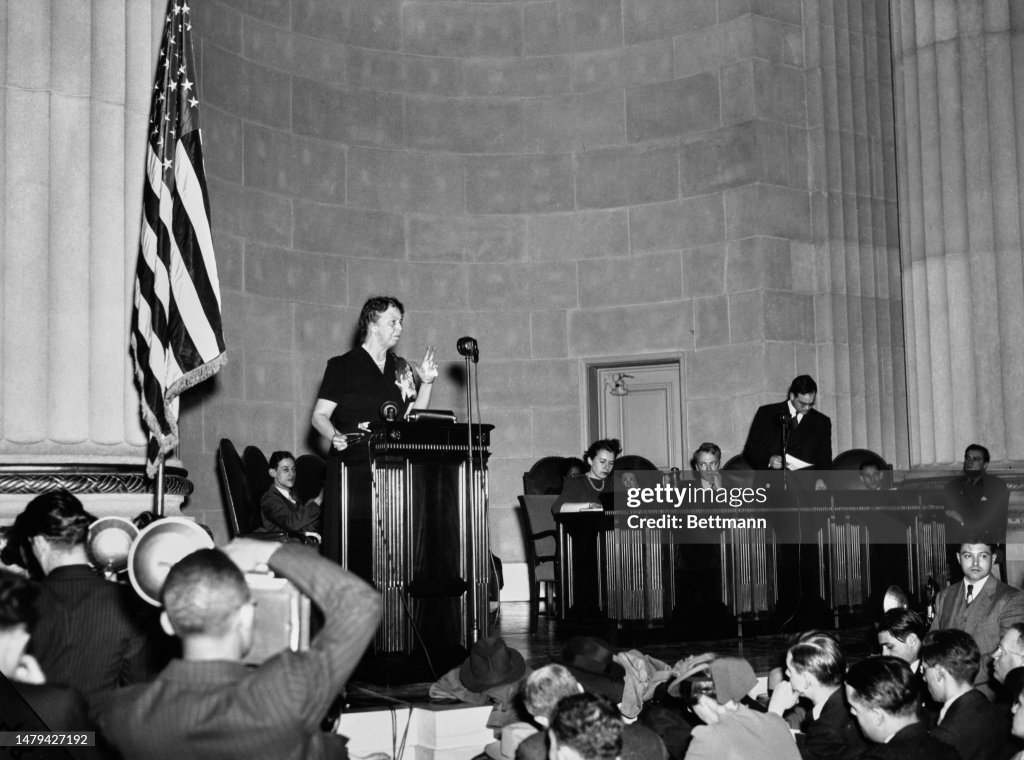
Answering a written question sent up to her by her cousin, Archibald Roosevelt Jr., Mrs. Franklin D. Roosevelt tonight upheld the American Youth Congress in its unwillingness to adopt a resolution condemning the Soviet invasion of Finland. Although she made very clear her own warm sympathy for Finland, and her belief that that country was the victim of brutal aggression, Mrs. Roosevelt assured more than 2,000 members of the Youth Congress who jammed the departmental auditorium that they should not “go on record for anything they do not believe in.” Then for almost an hour Mrs. Roosevelt proceeded to make a moving defense of the efforts of the President to keep this country out of war and to do everything that he considered possible for the people of this country.
Leaders of the American Youth congress planned Sunday to confer with CIO leaders this week on prospects for a political alliance between the congress and Labor’s Non-Partisan league.” The congress cheered a renewed Invitation to take the 4,500,000 young men and women it claims to represent into the CIO political fold while plainly displaying resentment over remarks which President Roosevelt made to the delegates Saturday. John L. Lewis, chairman of the league, was thunderously applauded when he extended the original invitation Saturday for the congress “to become affiliated with or come to a working agreement” with the non-partisan league, coupling his bid with an extended attack on the President.
John L. Lewis’s peace offer calling for a merger of the A.F.L. and the C.I.O. was regarded as “insincere” today among leaders of the federation.
Dr. Stephen S. Wise told the American Jewish congress that “liberation of the Jew can come only if the democracies succeed in beating back the invading hordes of Nazism.” In his annual report as president, Dr. Wise termed the present “the bitterest hour of Jewish history” and described the German treatment of Jews in Poland as “a tale of horrors from which future generations will shrink with the same amazement and sense of shame as that with which he read of the scourge of Attila.”
The second Vultee Model 48 Vanguard prototype aircraft took its first flight.
Lt. Julian Knox Morrison died accidentally when he was cleaning a target weapon aboard the USS Sealion (SS-195). Lt.Cdr. Richard G. Voge took command of Sealion until her destruction during the opening of the Pacific phase of the war.
U.S. Antarctic Service West Base main building is completed sufficiently to permit occupation. Over the next two months, the base, comprised of three buildings connected to an elaborate system of tunnels and caches, is finished by the time the sun sets for the winter on 21 April.
The Governor-General of Canada, Sir John Buchan, 1st Baron Tweedsmuir of Elsfield, (well-known as the author John Buchan) dies in Montreal, Quebec, after surgery for head injuries suffered during a stroke five days ago. He was 64. His suspense novel “Thirty-Nine Steps” later became famous when Alfred Hitchcock made it into a movie released in 1935. New versions of the film were made in 1959 and 1978.
General elections were held in Costa Rica. Rafael Ángel Calderón Guardia was elected president.
Battle of South Kwangsi: Japanese 22nd Army forces around Wuning begin withdrawing south toward Nanning.
hrough freight traffic on the railway between French Indo-China and Yunnan Province in China, until recent China’s main channel of imports and exports, will be impossible for several months as the result of recent Japanese bombings of the line.
The Australian launch Erna burned after an engine explosion off Shark Island in Sydney Harbour. All six occupants were rescued.
Born:
Calvin Fowler, Team USA and ABA point guard (Olympic gold medal, 1968, co-captain; ABA: Carolina Cougars), in Pittsburgh, Pennsylvania (d. 2013).
Dennis Gaubatz, NFL linebacker (NFL Champions-Colts, 1968 [lost Super Bowl III]; Detroit Lions, Baltimore Colts), in Needville, Texas.
Died:
John Buchan, Lord Tweedsmuir, 64, Scottish novelist, historian and 15th Governor General of Canada.
Gunnar Höckert, 29, Finnish athlete (Olympic gold medal, 5,000m, 1936), of war wounds.

 History Diaries