Việt Cộng guerrillas blow up the U.S. barracks at Quy Nhơn (75 miles east of Pleiku, on the central coast) tonight by planting a 100-lb explosive charge under the building. Three days after their attack on the U.S. Army barracks at Pleiku, the Viet Cong staged an attack on another barracks at Quy Nhơn, killing 23 American soldiers, two Việt Cộng, and seven civilians, leading to even heavier U.S. air strikes against North Vietnam. McGeorge Bundy would tell a reporter later, “Pleikus are like streetcars”, in that it could be expected that after each incident, the U.S. could expect that another one would arrive when the time was right.
Major engagements were reported at two points near the strategic air base at Đà Nẵng today after a battle 50 miles east of Saigon cost the life of one American and wounded 12 others. Among those wounded yesterday in the engagement east of Saigon was the son of the deputy commander of the United States forces in Vietnam. As Vietnamese soldiers and Communist troops clashed near Đà Nẵng, forces at the base began throwing up sandbags around the newly installed battery of United States Hawk anti-aircraft missiles. Authorities feared a Việt Cộng onslaught on Đà Nẵng, cornerstone of United States air operations against Communist strongholds in Laos and North Vietnam. The base is 80 miles south of the North Vietnamese border and 380 miles north of Saigon.
South Vietnamese troops made a helicopter attack on one Việt Cộng force near the base and caught another group of about 200 out in the open. No detailed results were available. United States officials said that any future air strikes against North Vietnam might be ordered in response to raids on South Vietnamese forces as well as for those on United States installations. Communist guerrillas pressed attacks throughout the country in an apparent attempt to take vengeance for the retaliatory air raids on North Vietnam Sunday and Monday. A Hanoi broadcast urged the Việt Cộng to “strike hard, very hard at the enemy on all battlefields.” Captain Thomas B. Throckmorton, son of General John L. Throckmorton, was wounded in heavy fighting in which the Vietcong downed four helicopters. At least one burst into flames on crashing.
Captain Throckmorton, whose father is deputy to General William C. Westmoreland, United States Commander in Vietnam, was wounded as his mother prepared to leave Saigon as part of the evacuation of all United States dependents ordered by President Johnson. The captain underwent an operation in Saigon for a bullet wound. He was reported in good condition. He had been with a task force lifted by helicopter yesterday to an area near Bình Giã, where the Việt Cộng inflicted heavy casualties on government troops six weeks ago. The fighting continued this morning with a mortar barrage. In addition to the American casualties, South Vietnamese forces lost nine dead and 38 wounded as they hacked through foliage toward the Việt Cộng positions. The Saigon Government said 32 guerrillas had been killed and a number of enemy weapons seized.
Another battle broke out in Vĩnh Bình Province, in the Mekong River Delta south of Saigon, and there was heavy fighting in Bình Định Province, 260 miles northeast of Saigon. The South Vietnamese forces were reported to have suffered heavy losses in the Bình Định engagement. Air raid sirens shrieked in Saigon in a test ordered by city officials as a precaution against possible air strikes by North Vietnam.
Communist units were reported to have shattered five companies of Government troops — about 500 men — in a running battle that began shortly after the bombing of North Vietnam by United States and South Vietnamese planes on Sunday. Military observers said that the trap sprung by the Việt Cộng along a coastal highway near Phú Mỹ in Bình Định Province, about 300 miles northeast of Saigon, had resulted in one of the most severe government defeats of the war.
Việt Cộng guerrilla forces were on the offensive yesterday in several sectors. Heavy fighting raged near the Đà Nẵng air base and in an area east of Saigon. A Việt Cộng band overran Đức Phong, a district capital 80 miles north of Saigon, and four United States Army advisers based there were reported missing. In a battle in Phước Tuy Province, 50 miles east of Saigon, the Việt Cộng surprised charging government paratroops. They first hit the troops with fire from foxholes as they landed from helicopters. Then, as the paratroops charged, the Việt Cộng threw bottles of gasoline into the brush, setting it afire. The Việt Cộng fired through the smokescreen.
Many of the Communist actions seemed to be a response to a broadcast on Monday, in which the Việt Cộng’s clandestine radio called for “repeated attacks against the enemy on all fronts.” With skirmishing going on in hills nine miles away, United States marines put up sandbag parapets to protect a battery of 36 Hawk anti-aircraft missiles newly installed at Đà Nẵng. The third Vietnamese Marine Battalion reinforced the airbase guard there. A number of American Jet fighters left Đà Nẵng for another base, unannounced, apparently to be out of the way in case Đà Nẵng came under Việt Cộng mortar attack.
A joint announcement by the United States Embassy and the United States armed forces in Saigon two hours after the terrorist attack in Quy Nhơn said that the evacuation of more than 1,800 American dependents in South Vietnam would be completed by 10 o’clock tonight. Earlier, it was announced that the evacuation was to end by Sunday.
President Johnson summoned the National Security Council today to discuss new Communist military successes against American and South Vietnamese troops, but gave no hint whether the United States would respond. On Sunday and Monday United States and South Vietnamese planes raided bases in North Vietnam in retaliation for an attack by Việt Cộng forces at Pleiku in South Vietnam. Eight Americans were killed and more than 100 wounded in the Pleiku attack.
Tight secrecy was imposed at the White House on the question whether Mr. Johnson would respond to the new Việt Cộng onslaughts with air strikes on North Vietnam. Some usually informed sources said that they strongly doubted there would be any announcement of United States intentions until tomorrow at the earliest. At the State Department, however, officials said that the new Việt Cộng attack was regarded here just as gravely as last weekend’s.
The President was informed this morning that a United States Army barracks at the seacoast town of Quy Nhơn had been attacked by Việt Cộng terrorists. He was also told that South Vietnamese forces had been badly defeated in a clash in Bình Định Province. Mr. Johnson summoned his top military and diplomatic advisers to the National Security Council meeting in the Cabinet room at 2 PM. The meeting lasted about an hour and 45 minutes.
A few minutes after it had ended Mr. Johnson unexpectedly walked through the lobby of the west wing of the White House and onto the driveway leading toward the northwest gate. He was accompanied by Marvin Watson, who reported to work February 1 as a special assistant to the President. Scores of newsmen and photographers tumbled excitedly after him, and pursued him to a point near the gate, where Mr. Johnson turned and followed the main drive toward the White House proper. Asked by a reporter what he would do about Vietnam, the President said: “I think I’ll just walk up to the house.”
More than 50 persons have been arrested in the last week in Thailand’s northeastern provinces on suspicion of being Communist agents.
The United States warned the Soviet Union today that continued failure to protect the American Embassy in Moscow against mob demonstrations could damage diplomatic relations between the two nations.
Several hundred Indian Communists demonstrated today in front of the United States Embassy in New Delhi. They carried placards reading “American aggressors quit Vietnam.” There was no violence.
French President de Gaulle appealed again today for the end of foreign intervention and a negotiated peace in South Vietnam. France’s objective is an international agreement barring outside interference and covering North and South Vietnam, Laos, and Cambodia, according to a government statement. The statement was issued by Alain Peyrefitte, Minister of Information, after General de Gaulle and the Cabinet had discussed the United States alr strikes against North Vietnam and the Việt Cộng’s attacks on United States installations in the south.
A West German agreement with U.A.R. President Nasser halted German shipments of arms to Israel in exchange for a U.A.R. pledge not to recognize East Germany. Sources in Bonn said that a final decision on West Germany’s $80 million military aid program to Israel would be made in the light of the United Arab Republic’s reception of Walter Ulbricht, the East German chief of state. He is scheduled to arrive in Cairo on February 26. The West German Government was reported to be determined to insure, in any event, that Israel’s security needs would be met. The government declined any comment on the reported decision. But Eugen Gerstenmaier, president of the Bundestag, the lower house of Parliament, confirmed that the Government had stopped arms deliveries to Israel.
It was disclosed in Cairo Monday that President Gamal Abdel Nasser had demanded that the shipments cease. If not, he warned, Cairo would grant diplomatic recognition to Communist East Germany. The threat was made by Mr. Nasser in a talk with the West German Ambassador, Georg Federer, last week, according to authoritative Cairo newspaper reports. Chancellor Erhard discussed the situation Monday and yesterday with his Cabinet and with leaders of the Government coalition in Parliament. At stake was Bonn’s commitment to support Israel’s security with military assistance, which was begun in 1960 by former Chancellor Konrad Adenauer.
A news report in Jerusalem on the Sabry announcement prompted this caustic remark from an Israeli official: “We have become accustomed recently to seeing Cairo dictate Bonn’s policy, but not to the extent of announcing it first.”
Premier Levi Eshkol disclosed tonight that the army’s Hawk ground-to-air missiles were about to become operational at their defensive stations in Israel. The Premier spoke at a Mapal party rally at Ashkelon, south of Tel Aviv. He also told the rally that, apart from the! Hawks, “great things” were being done to increase the operational strength of Israel’s defense forces. He did not elaborate on this point. The United States agreed in 1962 to supply Israel with Hawk missiles to counter the delivery by the Soviet Union of TU-16 bombers to Iraq and the United Arab Republic. Israeli soldiers went to the United States for training in operating the missiles. How many Hawks Israel received from the United States has not been disclosed.
Congress yielded today to President Johnson’s appeal for a free hand to use surplus food shipments to the United Arab Republic as an instrument of United States foreign policy.
The West German Social Democratic Opposition in Bonn accused President de Gaulle in Parliament today of trying to drive the United States out of Europe. In a short, sharp televised foreign-policy debate in the Bundestag, or lower house, Socialist leaders staked out a position for the Opposition party as the champion of a continued intimate alliance between West Germany and the United States. Chancellor Ludwig Erhard rose twice to assert with ill-concealed irritation that his newly strengthened relations with the French leader did not run at cross-purposes to West Germany’s continuing ties to the United States. The Government’s embarrassment was compounded by the appearance of a new statement by former Chancellor Konrad Adenauer sharply critical of the United States. In an interview reported by C. L. Sulzberger, foreign affairs columnist, in The New York Times today Dr. Adenauer asserted that “there is no more American interest, no more leadership” in Europe.
Soviet Premier Aleksei N. Kosygin of the Soviet Union flew to Peking after a warm farewell in Hanoi today. He was accorded the same lukewarm reception that the Chinese Communists gave him last Friday on a stopover on his way to North Vietnam. Premier Kosygin then headed for North Korea in an apparent move to build a Communist united front in Asia.
Britain dispatched more warships and troops to Southeast Asia today to bolster Malaysia’s defenses in its conflict with Indonesia. A Defense Ministry spokesman said the buildup was precautionary and preventive. It has brought Britain’s Far Eastern forces to their highest level since the Korean War nearly 15 years ago. About 1,000 men of the 19th Infantry Brigade will start Friday for Singapore. An Admiralty announcement said the radar ship HMS Agincourt and the escort destroyer HMS Carysfort had been ordered from the Mediterranean to Singapore. They will follow the converted carrier HMS Triumph and the commando ship HMS Albion, already dispatched to join the more than 70 warships of the Far Eastern Fleet.
The United Nations General Assembly held a 35-minute non-voting session today and put off major decisions until Tuesday. India’s representative, B. N. Chakravarty, told the meeting, “The situation continues to deteriorate and today the very future of the United Nations appears to be in danger.” A number of points were settled by the “no objection” procedure that has enabled the Assembly to dispose of a small amount of business without having to vote. Three important matters had to be carried over to Tuesday afternoon. They are: a provision to meet operating expenses of the United Nations, the composition of a committee to review the basic questions of peacekeeping operations and assessments that have caused the current crisis, and the filling of a seat in the Economic and Social Council.
A Cuban boat reported via radio that it had captured an American shrimp boat with three men aboard. The United States shrimp boat with three crewmen aboard was apparently captured by Cuban vessels today off the Cuban coast.
The leader of Turkey’s principal Opposition party has begun a campaign to “bring down” the Government. The People’s Republican party under İsmet İnönü has governed most of the time since the revolution of May, 1960.
Mounted Sudanese policemen spurred their horses into a thick crowd today and lashed out with whips to push it back only a few feet from Britain’s Queen Elizabeth II, bringing momentary panic while sheiks and tribesmen paraded.
Riot policemen in Tokyo scuffled for three hours today with students who had gathered to deliver a protest to Parliament against the use of Japanese ports by United States nuclear submarines. Sixty students and policemen were hurt.
The Indian Army moved into four towns in the State of Madras tonight after a day of violence that left at least 21 persons dead and hundreds injured.
A white paper on relations between the Vatican and Nazi Germany will be published by the Vatican.
A British aircraft company that lost two multi-million-dollar projects to American builders began today laying off the first of the thousands of workers it said would lose their jobs because of the Government decision.
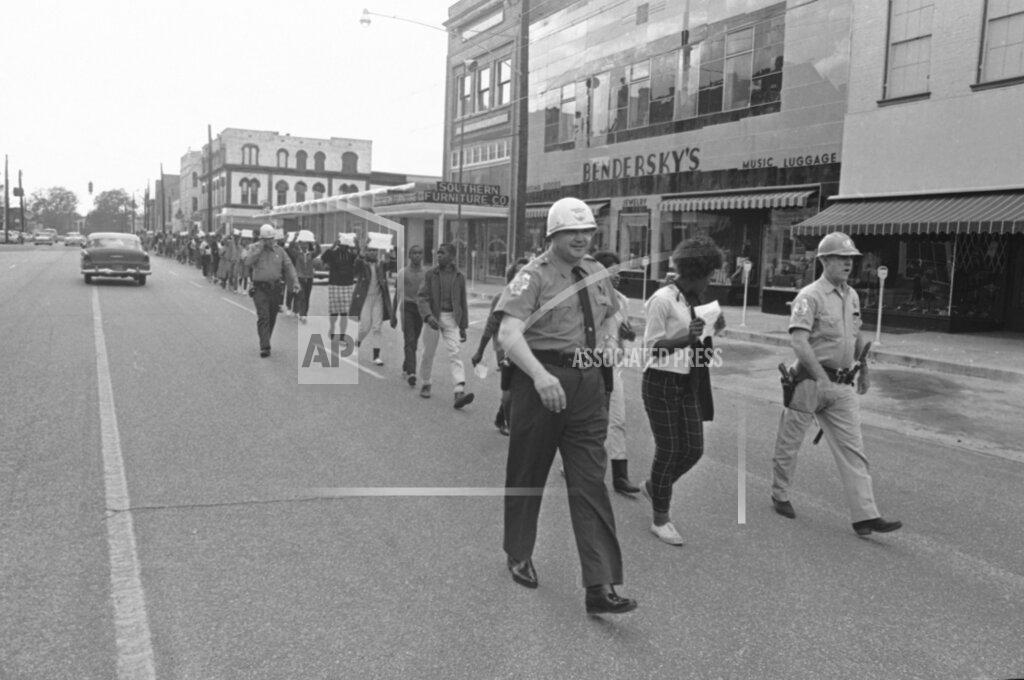
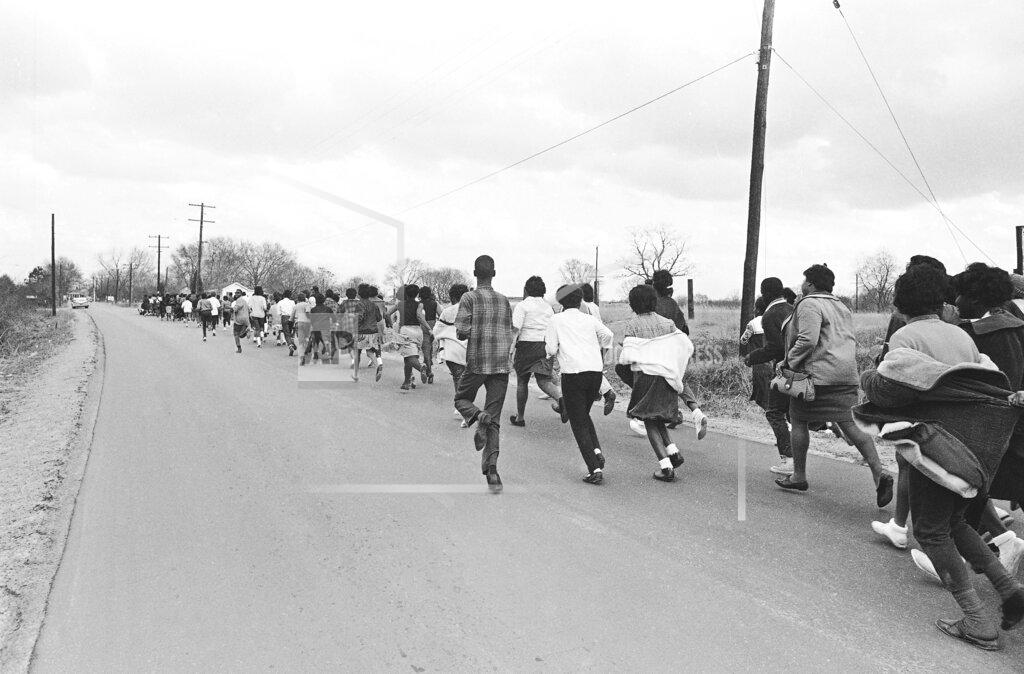
In Selma, Alabama, Sheriff James G. Clark and a group of deputies with night sticks and electric cattle prods led 165 Black demonstrators, all children and teenagers, on a forced march into the Dallas County countryside today. The youngsters were marched at a pace alternating between a run and a rapid walk while the sheriff and members of the Dallas County sheriff’s posse rode in cars and spelled each other at the task of drill master. Several youngsters told newsmen later that the sheriff’s men had used night sticks and electric cattle prods on them. The sheriff said he had not seen anything like that. “You’ve been wanting to march, now let’s go,” the possemen yelled as they trotted beside the Blacks. “Close up the ranks back there. Come on, close it up, close it up.”
After 2.3 miles the exhausted youngsters rebelled and fled into a private yard beside the road. The sheriff and his men tried to herd them back on the road, but the Blacks refused to leave the yard. Many went into the house at the invitation of one of the Black marchers who lived there. The sheriff gave up after a few minutes and took his men back to Selma. Sheriff Clark said later that he had arrested the Blacks for truancy and that he was taking them to the Fraternal Order of Police Lodge to lock them up, because the jail at Selma was not large enough to hold them. “They escaped,” he said with a small grin. A few of the Blacks dropped out of the march because of exhaustion. One girl was reported to have become ill. The Federal Bureau of Investigation said it was investigating to determine whether any federal law had been violated.
A mile and a half from town, the sheriff’s men blocked a bridge with a car and refused to let newsmen follow the march any farther. Agents of the FBI and a carload of Selma policemen were permitted to pass the barricade. The youngsters were demonstrating by standing silently outside the courthouse when the sheriff led them off on the march. They were displaying crayoned signs urging voting rights for Blacks. Dallas County Blacks have been demonstrating for increased voter registration for three and a half weeks and the campaign has repeatedly been enlivened by Sheriff Clark’s mass arrests. The weather was warm here today, as it has been for several days. Daffodils are blooming in the yards.
Sheriff Clark walked from the courthouse in shirt sleeves and helmet at 2:50 PM after the Blacks had been standing for about half an hour. Fifteen or 20 possemen similarly dressed walked behind him. The sheriff went to one end of the line of Blacks and said, “Come on.” They followed him down Alabama Avenue. No one in command would tell newsmen or the Blacks where they were going. They were headed in the direction of Browns Chapel Methodist Church on Sylvan Street, where many of the Black demonstrations and marches have originated. But when the line reached Sylvan Street the sheriff turned east instead of west and headed toward the edge of town. The sheriff and his men forced the marchers. along at a fast clip, first walking, then running.
The procession went to the end of Sylvan Street and entered River Road, winding through a slum at the edge of town. Well into the countryside, at Beech Creek, a member of the sheriff’s group waited for the marchers and the posse to walk onto the bridge, then he drove a car across the bridge entrance and refused to let newsmen and cameramen go any farther. Half an hour later, after the march had broken up and the posse had left, the Blacks were found singing freedom songs in the yard where they had taken refuge, more than half a mile past the bridge. One girl was crying and could not stop. Another showed a lump on her head and said one of the possemen had put it there with a cattle prod. The excited youngsters told of a girl who already had been taken back to the church, ill.
A teen-age boy said the girl had stopped along the way, unable to go on. He said a posseman jabbed her with his club and said: “March, dammit. She’s going to march.” A 9-year-old boy stood in the yard with dried tears staining his face. He had made the march barefoot. Clarence Carson, 15. stood rubbing his lips. He said that he had told one of the possemen, “God sees you.” and that the man had hit him in the mouth with his club. The Rev. Dr. Martin Luther King Jr., who had been to Washington to see President Johnson, returned to Selma tonight and found the Dallas County civil rights movement revived.
The Black voting drive, which had resulted in the arrest of nearly 3,400 persons in Dallas and Perry Counties since midJanuary, seemed to be losing its spark until Sheriff Clark’s forced march today. Two Black churches on Sylvan Street were packed tonight and the throngs heard one speaker after another berate Sheriff Clark. Dr. King spoke at both places. He told the crowd at Browns Chapel Methodist Church. “Selma will never get right and Dallas County will never get right until we get rid of Jim Clark.” “We are disgusted with brutality, and with terroristic methods, and with Jim Clark’s downright meanness in the handling of the boys and girls in our! community,” he said. A voters’ march tentatively scheduled for Monday in Birmingham has been postponed. All the Black leaders in the area are expected to be in Setma Monday when the Dallas County Board of Registrars will be open to receive voter applicants. Dr. King urged the Blacks to turn out en masse to register.
Mississippi’s attorney general gave the United States Civil Rights Commission assurances here today that state leaders were trying to cope with the civil rights issue, “free from demagoguery.” Attorney General Joe T. Patterson told the opening of a 10-day Mississippi investigation by the Civil Rights Commission that he had nothing to hide, nothing to cover up.” Mr. Patterson was the only witness to be heard today by the commission in open session. He came before the body to volunteer his testimony and said he would not have to be subpoenaed to make an appearance. The commission is holding closed hearings this week and will begin full-scale open hearings next Tuesday.
President Johnson took action yesterday in the month-long waterfront strike. He named an informal committee of three men to make quick recommendations in the stalemate in South Atlantic and Gulf ports and set a deadline for noon tomorrow for the disputing parties to make up their minds on acceptance of the panel’s settlement formula. Sharply criticizing the International Longshoremen’s Association for “unjustified” continuation of the strike in many ports where settlement has been reached, Mr. Johnson said. the injury to the national economy had reached “staggering proportions.” The President named to his “informal” committee Secretary of Labor W. Willard Wirtz and Secretary of Commerce John T. Connor. He asked Senator Wayne Morse, Democrat of Oregon, to be the third member. Senator Morse is familiar with the dispute because he was chairman of a panel named by President Kennedy to settle the last coastwide dock strike in the winter of 1962-63.
President Johnson called on American business and banking today for a broad new voluntary effort to cut down their lending and investing abroad to eliminate the deficit in the nation’s international payments. President Johnson acted to curb the dollar drain by proposing a series of legal and voluntary restraints on spending abroad by tourists and businessmen.
A House subcommittee approved a bill to prevent the gerrymandering of congressional districts. A bill requiring Congressional districts to be compact and nearly equal in population was approved today by a House Judiciary subcommittee.
The Administration’s $1.1 billion Appalachia bill easily cleared a House committee today despite the outraged cries of Republican critics. The measure now faces a final test in the House, possibly next week. It could become the first of the Great Society legislation passed by Congress. The bill emerged from the House Public Works Committee in exactly the same form as that in which it passed the Senate on February 1. Not so much as a comma was changed.
The Senate confirmed by voice vote today President Johnson’s nomination of Nicholas deB. Katzenbach to be Attorney General.
The Administration opened its Capitol Hill drive today for a new immigration law, with Senate sponsors of the bill protesting that “scarecrows and red herrings” had been raised against it.
The spat between President Johnson and Congress over planned closings of federal installations simmered down, resulting in legislation postponing any shutdowns until May 1.
The Joint Congressional Atomic Energy Committee continued today to attack what one member called “wasteful, irresponsible vacillation” in developing nuclear power systems for use in space.
I.W. Abel clung to a narrow lead over David J. McDonald today as the vote count continued in the election battle for the presidency of the United Steelworkers of America.
Available on the market Wednesday was a new one-shot, live-virus vaccine against common measles which is reportedly 99% effective in children. The first “one-shot” vaccine against the measles was made available to American physicians, the day after its approval by the U.S. Food and Drug Administration. Although vaccinations against the measles had first been introduced in the U.S. in 1963, they had required children to receive several injections in order for immunity against the virus to be obtained. The new measles shot, using a greatly-weakened strain of the measles virus, was 99% effective in providing a lifelong immunity to the illness.
Admiral Thomas H. Moorer, now commander of the United States Pacific Fleet, was named Supreme Allied Commander in the Atlantic today.
Dow Jones Industrial Average: 892.92 (-8.32)
Born:
Lenny Webster, MLB catcher (Minnesota Twins, Montreal Expos, Philadelphia Phillies, Baltimore Orioles, Boston Red Sox), in New Orleans, Louisiana.
William Harris, NFL tight end (St. Louis Cardinals, Tampa Bay Buccaneers, Green Bay Packers), in Houston, Texas (d. 2014, from ALS [Lou Gehrig’s disease]).
Norm Foster, Canadian NHL goaltender (Boston Bruins, Edmonton Oilers), in Vancouver, British Columbia, Canada.
Mario Jean, French-Canadian comedian and television actor, in Chicoutmi, Quebec, Canada.
Marjolein Macrander, Dutch actress (“Drowned”), in Zutphen, Netherlands.
Died:
Admiral Arthur C. Davis, 71, naval aviation pioneer who perfected dive bombing techniques.



 History Diaries