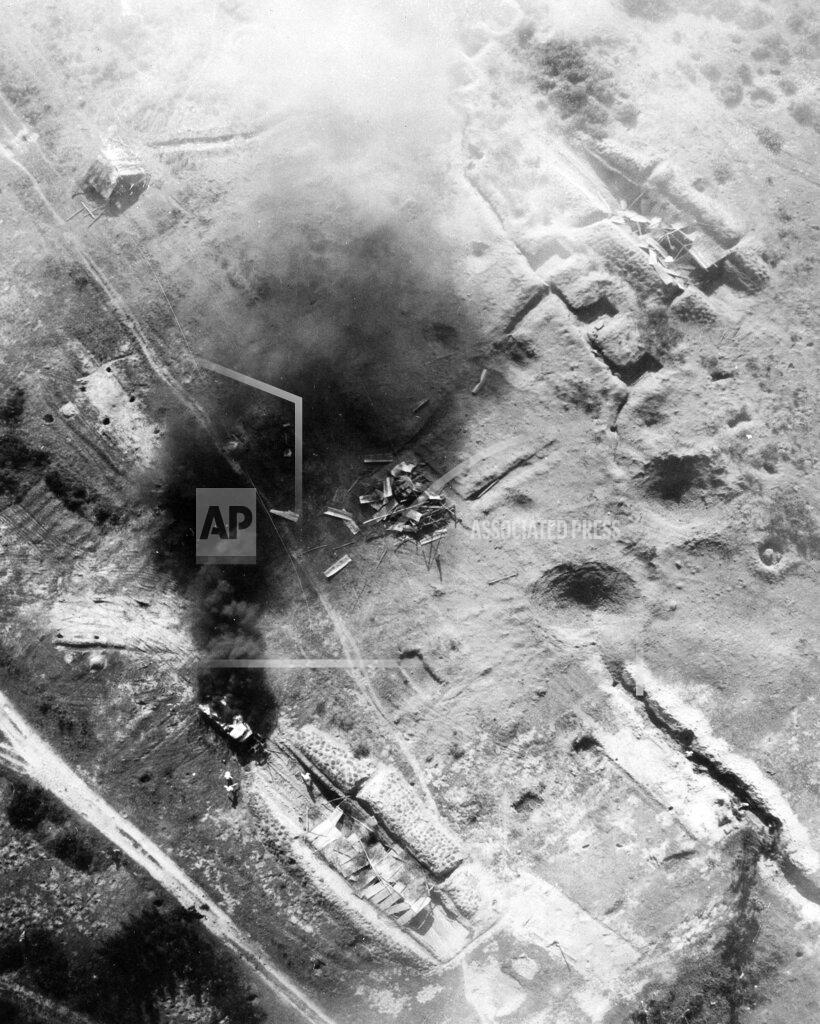
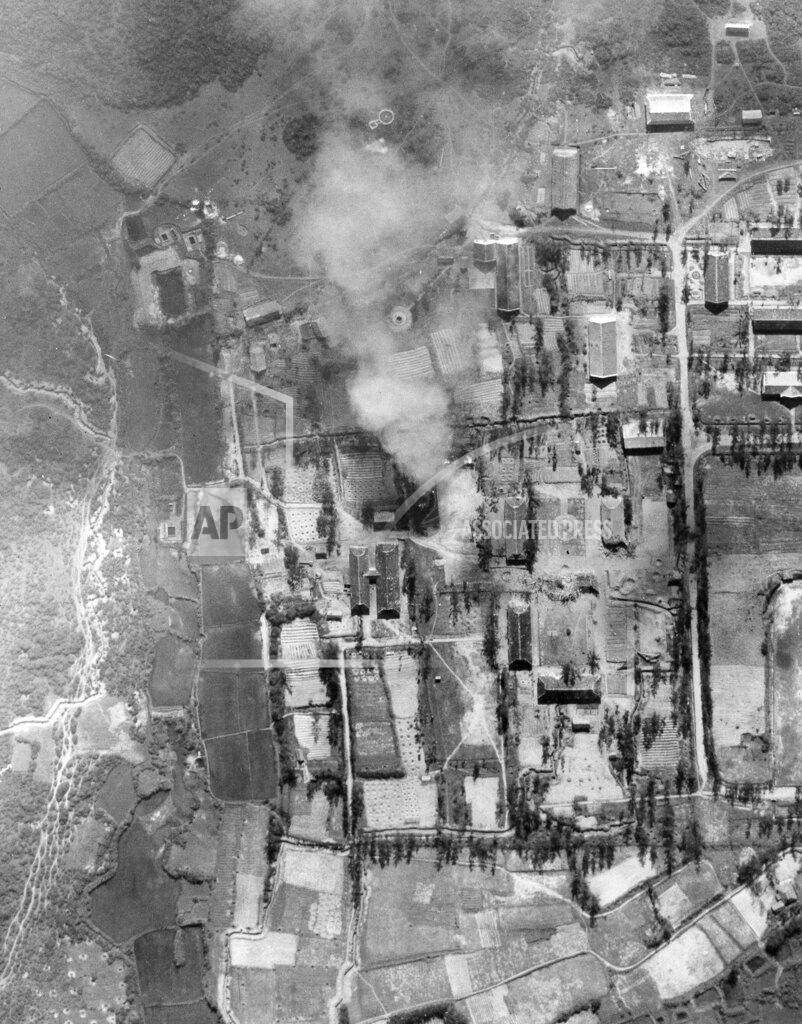
A follow-up raid by South Vietnamese planes — led by Air Vice-Marshal Nguyễn Cao Kỳ, and escorted by U.S. jets — bombs a North Vietnamese military communications center at Vĩnh Linh. (It will later be revealed that Kỳ dropped his flight’s bombloads on an unassigned target; he claimed it was to avoid colliding with U.S. Air Force planes.) Twenty-four Republic of Vietnam Air Force bombers, personally led by General Nguyễn Cao Kỳ, crossed from South Vietnam and struck targets in and around the Quảng Bình Province of North Vietnam, and the crews returned to a heroes’ welcome.
The act became symbolic of South Vietnam’s determination to fight for its own defense against Communism, and contributed to President Johnson’s decision at a meeting of his National Security Council later that day. Thereafter, sustained bombing of North Vietnam would become a “continuing action” rather than one of occasional reprisals. Support in the United States for an increased fight in Vietnam was evident from newspapers reporting on Operation Flaming Dart. The Washington Post said in an editorial the next day, “withdrawal from South Vietnam would not gain peace, but only lead to another war”, and added, “The United States Government has taken the only course available to it, if it does not wish to surrender.”
The United States called a halt to air strikes against North Vietnam today to assess the military and diplomatic reactions of several Communist nations, especially the Soviet Union. President Johnson and his advisers refused. however, to rule out further retaliatory raids or to define the circumstances under which they would be resumed. In a brief public comment Mr. Johnson expressed hope that no one would misjudge the character, strength and fortitude of the United States. “We love peace.” the President said. “We shall do all that we can in honor to preserve it — for ourselves and for all mankind. But we love liberty the more and we shall take up any challenge, we shall answer any threat, we shall pay any price to make certain that freedom shall not perish from this earth.”
After reporting to the National Security Council, McGeorge Bundy, the President’s special assistant for security affairs, voiced optimism on South Vietnamese efforts to achieve a stable government. Mr. Bundy returned to the capital last night after four days in South Vietnam. Administration sources said there would be no further comment on the raids for the time being, especially no guarantee that the strikes against North Vietnam had been concluded. But they also disclosed a decision to pause to await the Communist response.
After studying reports of the second air attack in two days, President Johnson and his closest aides were said to have concluded that they had “made their point” in demonstrating Washington’s resolve to fulfill its commitments to South Vietnam. The raids by United States and South Vietnamese aircraft struck two of the four target areas originally marked for simultaneous attack in reprisal for a Vietcong raid upon American forces in South Vietnam. The targets were in southern North Vietnam, out of range of the MIG fighter planes stationed near Hanoi. All the installations were said to be important to the flow of supplies from North Vietnam through Laos to South Vietnam.
Poor weather frustrated some of the missions and led to the second attack early today. Although some military advisers had hoped to use the present situation to damage all four regions, the Administration chose to wait and see whether the Communist countries had properly understood its warning “signal.” Defense officials denied a report that another raid had been carried out on Đồng Hới, yesterday’s target in North Vietnam. Planes from the aircraft carrier USS Hancock, it was said, made a photo reconnaissance mission over the area this morning and “expended some suppressive fire” when they met anti-aircraft fire. The Pentagon also announced that eight carrier-borne jets. including the one announced yesterday as having gone down at sea, were damaged in yesterday’s raids.
The responses from Moscow and Peking today were read in Washington as largely defensive. The Soviet Union’s pledge to strengthen the “defense capability” of North Vietnam. officials said, appeared to be an effort to represent a previously scheduled increase in military assistance as a response to this weekend’s air attacks. Communist China, it was noted, was careful not to suggest that the United States had now expanded the war in Southeast Asia. Peking is committed to help North Vietnam in some unspecified manner if the war is expanded. Without major assistance from Peking or Moscow, North Vietnam is thought to be capable only of guerrilla raids in South Vietnam. The threat of further air attacks was intended partly to curb such raids on American forces. Administration officials remained alert, however, to the difficult diplomatic situation that the raids had created for the Soviet Union.
The Soviet Government warned early today that it would be “forced, together with its allies and friends, to take further measures” to aid North Vietnam’s defense against United States air attacks. A Government statement said: “No one should doubt that the Soviet Union will do this, that the Soviet people will fulfill its international duty to the fraternal Socialist country.” Communist China called the United States action an “undisguised war provocation” and said its people would “definitely not stand idly by.” The North Vietnamese Government termed Sunday’s air attack a “new and utterly grave act of war” but said nothing could save the United States “from failure in South Vietnam.”
The Soviet statement, made public shortly after midnight by Tass, the official press agency, was the first formal Government reaction to two days of United States and South Vietnamese air raids against North Vietnam. The raids followed an attack by South Vietnamese guerrillas against a United States base early Sunday. In a speech yesterday at a Soviet Embassy reception in Hanoi, the North Vietnamese capital, Premier Aleksei N. Kosygin said that the situation created by the United States attacks was “fraught with serious complications.” The Soviet Government said in its statement that United States planes over North Vietnam had “bombed and strafed many houses and even a hospital.”
“There is loss of human life,” it added. Referring to the American “military actions” against North Vietnam and to the build-up of “armed forces and weapons in South Vietnam,” the Moscow statement said: “In the face of the abovementioned actions of the United States, the Soviet Union will be forced, together with its allies and friends, to take further measures to safeguard the security and strengthen the defense capability of the Democratic Republic of Vietnam.”
Former Secretary of Defense Thomas S. Gates has proposed negotiations and compromise with Communist China on “a whole package of problems” once peace in Southeast Asia is attained.
Bundy, back from Vietnam, defends the air raids as ‘right and necessary.’ President Johnson received the full support of Congressional leaders of both parties today for the retaliatory air strikes he ordered against North Vietnam. Senate Majority Leader Mansfield (D-Montana) and GOP leader Everett Dirksen (Illinois) support the President’s decision, but Senators Wayne Morse (D-Oregon) and Ernest Gruening (D-Alaska) attack the action. Mr. Morse called it “a black page in American history.” He said that the Administration should call for joint action, either under the United Nations Charter or the 1954 Geneva accords, “to enforce the peace and negotiate an international settlement of this threat to world peace.” Senator Gruening said the United States had no business in South Vietnam. and “the war there should be brought to the conference table, the sooner the better.”
Qualified French sources tonight said that the step-up of war in Vietnam is a powerful argument for negotiations with Communist China and North Vietnam to avert the widening of the conflict.
The Labor Government in Great Britain brushed aside complaints from the left wing of its own party today and came down firmly on the side of United States policy in Vietnam. British Foreign Secretary Michael Stewart said that the British government accepts the American air strikes against North Vietnam as justified retaliation for attacks against U.S. bases in South Vietnam.
Thailand gave her full backing today to United States air strikes against North Vietnam. Thanat Khoman, the Foreign Minister, said the action by the United States yesterday was “essential.” “This is an act of self-defense, an attempt to stop aggression and to prevent the expansion of the war by the Communists,” he said in a statement.
India’s External Affairs Ministry called today for a “Geneva-type conference for Vietnam” and said it was “essential for a peaceful and enduring solution to the problem.”
A prearranged plan for evacuating U.S. dependents goes into effect as wives and children are airlifted out in case North Vietnam, or another Communist power, decides to retaliate for the U.S. raid. “Not only do we have to leave school, but we have to leave Daddy behind when we go,” said Marilyn Neese. 13-year-old daughter of a United States. aid mission employee from Indianapolis, yesterday as 1,819 American dependents in South Vietnam prepared to leave the country. “If Dad can stay, why can’t I?” she asked. The school for American children in Saigon closed today. Tomorrow the first group of dependents will leave the country by air. President Johnson ordered the withdrawal of wives and children of diplomatic, military, and aid mission personnel after United States planes struck North Vietnam Sunday.
Some wives talked about organizing “exile colonies” rather than going back to the United States. They want to move to Bangkok, Thailand, or to Hong Kong. “A couple of hours away is better than 20 hours away,” said one wife. The wives are organizing baby-sitting “cooperatives” so that they can take turns in visiting their husbands. Civilian agency dependents will be given their choice as to where they will go. But military dependents must return to the United States.
Prince Boun Oum, the autocratic former Premier of Laos. is receiving both Western and Laotian support as the successor to General Phoumi Nosavan in Laos’s coalition Government. American diplomats here would welcome his selection as Deputy Premier because they believe the Prince is better known and more popular than any other rightist political figure. Laotian sources agree that Prince Boun Oum has a sure political touch in dealing with the Laotian citizenry, but they are more inclined than are the Americans to stress the harsh aspects of his ebullient nature. In Champassak Province the Prince rules his southern Laotian domain like a fiefdom, dispensing favors and punishment without restraint. If the Prince should reject the post, Westerners who favor him expect that he would have the decisive voice in naming an alternative candidate.
The House of Representatives reversed its earlier position against shipping surplus food to the United Arab Republic and is expected to agree to a Senate compromise. House Democrats gave President Johnson an overwhelming vote of confidence today and a free hand to permit or prevent continued surplus-food shipments to the United Arab Republic (Egypt) in the national interest. The party-line vote of 241 to 165 rejected a Republican move to instruct House negotiators to stand firm on an earlier ban on such shipments in conference with the Senate. The effect of the vote was to enable House managers to accept a milder Senate amendment, which would leave the matter for the President to decide. Both legislative branches will have another opportunity to vote on the question when the conference negotiators report back to their respective bodies with their recommendations on Wednesday. But the margin of the President’s victory today and the appeals for party loyalty on which it was based left no uncertainty about the final outcome.
The Secretary General, U Thant, recommended today that the General Assembly “urge” the members to pay amounts equal to 80 percent of their 1964 assessments to meet expenses of the organization during 1965. Since assessments for the 1964 regular budget totaled $91,853,932, against total appropriations of $101,327,600, a 20 percent reduction would seriously reduce the income of the United Nations. The organization is already threatened with having to borrow to meet its payrolls. Mr. Thant asked the Assembly to authorize him to spend the same amount — $101,327,600 — in 1965. He had proposed spending of $104,693,750 before the financial crisis disrupted the Assembly’s proceedings. According to reliable sources, the Secretary General proposed that the Assembly ask only for the voluntary payment of “not less” than 80 percent of the 1964 rate of assessments to meet objections of the Soviet-bloc nations.
The West German Government said today that its troubles with the United Arab Republic were caused by Cairo’s invitation to the East German Communist leader, Walter Ulbricht, not by West German arms aid to Israel. But the West German government is expected to have Parliament debate in the near future on bills to forbid West Germany to sell, ship or give arms to countries in highly “sensitive areas.” Four Western powers have expressed their hope to the Government that a break with Bonn and recognition of East Germany will be avoided.
Agricultural production accounted for 5 percent of West Germany’s gross national product last year, down from 5.2 percent in 1963, according to the annual “green report” issued today by Werner Schwarz, the Minister of Agriculture.
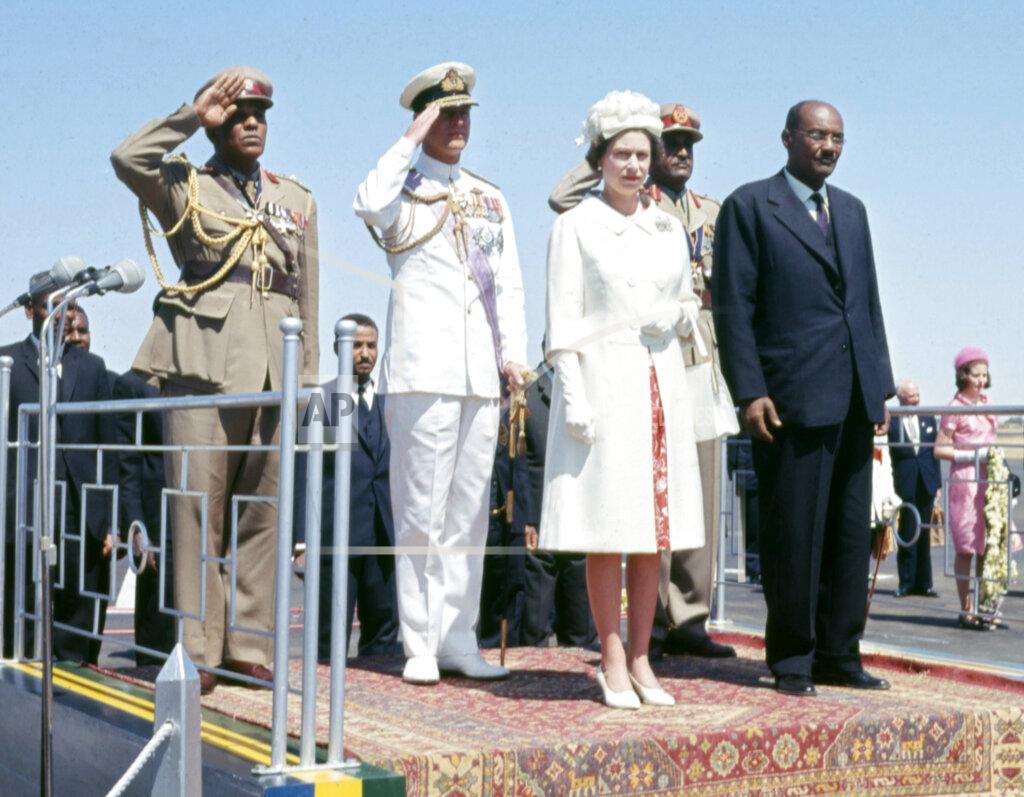
Queen Elizabeth II of the United Kingdom continued her African state visit, moving on from Ethiopia, where her host was Emperor Haile Selassie, to Sudan, where she was greeted by President al-Mahi.
The British Government said today it would ban cigarette advertising on television “as soon as practicable” because of the danger of smoking to health.
An Algerian Government spokesman announced today that the second, African-Asian chiefs of state conference had been postponed until June 29. It had been scheduled for early March. then was put off until late May. The delays are principally a result of problems in housing the 65 heads of state — and their delegations — expected to attend. Egyptian engineers and 2,000 Algerian laborers are working day and night to complete a huge conference hall and 65 identical two-story villas at a former French beach resort, Club des Pins, 13 miles west of here. The conference is referred to as the “Second Bandung.” The first African-Asian heads-of-state parley was held in April, 1955, in Bandung, Indonesia.
Premier Moise Tshombe returned to the Congo today from financial talks in Brussels brandishing a leather briefcase reputed to be worth millions of dollars but certainly worth thousands of votes.
The Most Rev. Josef Beran, who expressed hope last month that he would attend ceremonies in Rome this month elevating him to a cardinalate is again being held in close confinement by the Czech Communists.
A Scandinavian Airlines DC-7 burst into flames as it was attempting to take off from Tenerife in the Canary Islands on a flight to Copenhagen. The DC-7 sank down on the runway during takeoff. The aircraft caught fire. All 91 people aboard were evacuated, 84 of them uninjured, just prior to the plane being consumed by flames. The probable cause was determined to be the premature retraction of the landing gear before the aircraft was airborne, due to pilot error.
Syria and Iraq exchanged threats today to overthrow each other as they marked the second anniversary of their joint revolution against Iraq’s pro-Communist dictator, the late Abdul Karim Kasim.
Blacks boycotting a voter registration waiting list provided at their own request demonstrated at the courthouse in Selma, Alabama. Fifty-seven were arrested. The Dallas County Board of Registrars offered a concession today to the Blacks who have been campaigning for voting rights here since January, but Black leaders rejected it and renewed demonstrations. By the end of the day, Sheriff James G. Clark had arrested 50 more persons, bringing to nearly 3,400 the number arrested here since the campaign began.
Sheriff Clark roughed up the Rev. James Bevel, Alabama leader of the Southern Christian Leadership Conference, with a billy club when he was leaving the courthouse after the registrars’ offer had been turned down. The sheriff rushed outside, shaking with anger. Mr. Bevel was the first Black he encountered. The sheriff began jabbing him in the abdomen with his billy club, then grabbed his shoulders and forced him backward down the steps. “You’re making a mockery out of justice,” Sheriff Clark told him, his voice so tense it was barely audible. “I have a constitutional right,” Mr. Bevel began. “You get out of here,” Sheriff Clark said, punching him repeatedly with his club. When Mr. Bevel refused to retreat further, the sheriff called two deputies and told them, “Lock him up.”
At the same moment, Ivanhoe Donaldson, a staff worker for the Student Nonviolent Coordinating Committee, was singled out at the end of the line by another deputy and chased away with jabs of a billy club. Neither Mr. Bevel nor Mr. Donaldson appeared to be injured after the incident. The concession offered by the board of registrars was the first such action by county officials since the voter drive began. Federal District Judge Daniel H. Thomas issued an injunction last week ordering the registrars to stop using a difficult literacy test and to speed Black registration. More than 500 Blacks were arrested by Sheriff Clark last Friday when they tried to petition the board to open its office and let them sign their names and pick up numbers, the first step in registering.
Today, when Mr. Bevel and a much smaller group of Blacks appeared, Sheriff Clark let them enter the courthouse without trouble. They found the registrars’ office open. Virgil T. Atkins, Sr., the board chairman, told the Blacks that they were free to sign the sheet and get priority numbers, as they had asked to do Friday. But the Blacks had changed their minds. They told Mr. Atkins they wanted to go through the entire registration process.
Mr. Atkins told them they could not register until next Monday, the next official registration day under Alabama law. The Blacks walked out the front door of the court house, returned to the end of a waiting line outside and started to go past the registrar’s office again. It was at this point that Sheriff Clark confronted Mr. Bevel and made the arrests. Later, some 200 students returned to the courthouse carrying signs protesting the arrests. They were dispersed by the city police after demonstrating quietly for a half-hour.
All 84 people on board Eastern Air Lines Flight 663 were killed when the plane crashed into the Atlantic Ocean, moments after taking off from New York’s John F. Kennedy International Airport. The Eastern Airlines flight was forced to make an unusually steep turn in order to avoid a collision with an incoming airliner, Pan Am Flight 212. The doomed plane, a Douglas DC-7B, went down approximately 7 miles (11 km) away off the coast of Long Island’s Jones Beach State Park. Take-off proceeded normally, and the airport control tower prepared to hand over control to the New York Air Route Traffic Control Center (ARTCC) on Long Island, noting that Flight 663 was executing a “Dutch seven departure”, a routine takeoff procedure that required a series of turns over the Atlantic Ocean to avoid flying over New York City. The New York ARTCC responded with the information that Pan American World Airways (PA) Flight 212, a Boeing 707, was descending to 4,000 feet (1,200 m) in the same airspace.
Though the control tower responded that EA 663 was at a higher altitude than PA 212, it was, in fact, lower. Subsequently, the control tower radioed the Pan Am flight that there was traffic in his airspace at 11 o’clock, six miles away traveling southeast of Pan Am’s position, climbing above 3,000 feet (910 m). Pan Am 212 acknowledged. Air traffic control then radioed Flight 663 a similar advisory: at 2 o’clock, five miles away traveling, below Flight 663’s position. In reality, the traffic, Pan Am 212, was above Flight 663, descending from 5,000 feet (1,500 m). Captain Carson acknowledged that he saw the traffic, that he was beginning to turn into the Dutch seven departure, and signed off, saying, “good night”. Flight 663’s radioed “good night” at 6:25 p.m. was the last transmission received from the flight.
The night of February 8 was dark, with no visible moon or stars and no visible horizon. As the two airliners approached similar positions, their pilots had no points of reference with which to determine the actual separation distance or position. Flight 663’s departure turn, and Pan Am’s subsequent turn left to its assigned heading, had placed the two aircraft on an apparent collision course. The Boeing rolled right and initiated a descent in an attempt to avoid a collision. In response, Eastern 663 began an extreme right turn to pass safely. The captain of Pan Am 212 later estimated that the two aircraft had passed between 200 and 500 feet (60 and 150 m) of each other, while the first officer estimated that the distance was only 200 to 300 feet (60 to 90 m). Flight 663 could not recover from its unusually steep bank and plunged into the icy waters of the Atlantic Ocean, where it exploded with bright orange flames. The Pan American 707 was the first to relay news of the crash, as it was receiving permission to land. Air Canada Flight 627, which had departed a few minutes before Flight 663, also radioed news of an explosion in the water.
The Civil Aeronautics Board (CAB) investigated the accident. The DC-7 was not required to be equipped with a flight recorder, which would have automatically recorded the pilots’ every control input. Thus, the CAB was forced to rely on witness testimony, radio recordings, and a best guess based on experience. Nevertheless, the CAB determined that the evasive maneuvers taken by the pilot of Flight 663 to avoid the oncoming Pan Am jet caused spatial disorientation. The disorientation, coupled with the extreme maneuver, made it impossible for the pilot to recover from the roll in the few seconds before the DC-7 crashed into the Atlantic Ocean. The CAB also determined that Captain Carson had neither the time nor adequate information to assess Flight 663’s position relative to Pan Am 212 and, given the illusion of a collision course, he had acted appropriately in initiating evasive maneuvers. The CAB made no recommendations in the final accident report. Although early news reports reported the near miss of Flights 663 and 212, the FAA denied that there was ever any danger of a collision.
President Johnson took several steps today toward new Federal enforcement powers to clean up the nation’s water supplies, air and countryside. His Special Message to Congress on Natural Beauty proposed permitting the Federal Government to set standards to halt water pollution at its source and to prevent air pollution. Administration officials viewed these steps as the beginning of a new enforcement program that would first summon a national effort to combat “ugly America” and then would back it up with broadened Federal power at a later stage if necessary.
The President’s message ranged over a wide variety of beautification projects for cities and rural areas, including more) recreation areas and parks and the cleaning up of junkyards along highways. He singled out the Hudson River for mention as an urban river that could best be preserved by the same sort of cooperative state and local program planned for the Potomac River. Thus, Mr. Johnson appeared to have doomed for the immediate future proposals now before Congress to create a national scenic riverway along the lower Hudson, a plan also opposed by Governor Rockefeller of New York as a Federal intrusion. The Administration does not, however, favor construction of the $162 million Hudson River power plant near Cornwall, sought by the Consolidated Edison Company.
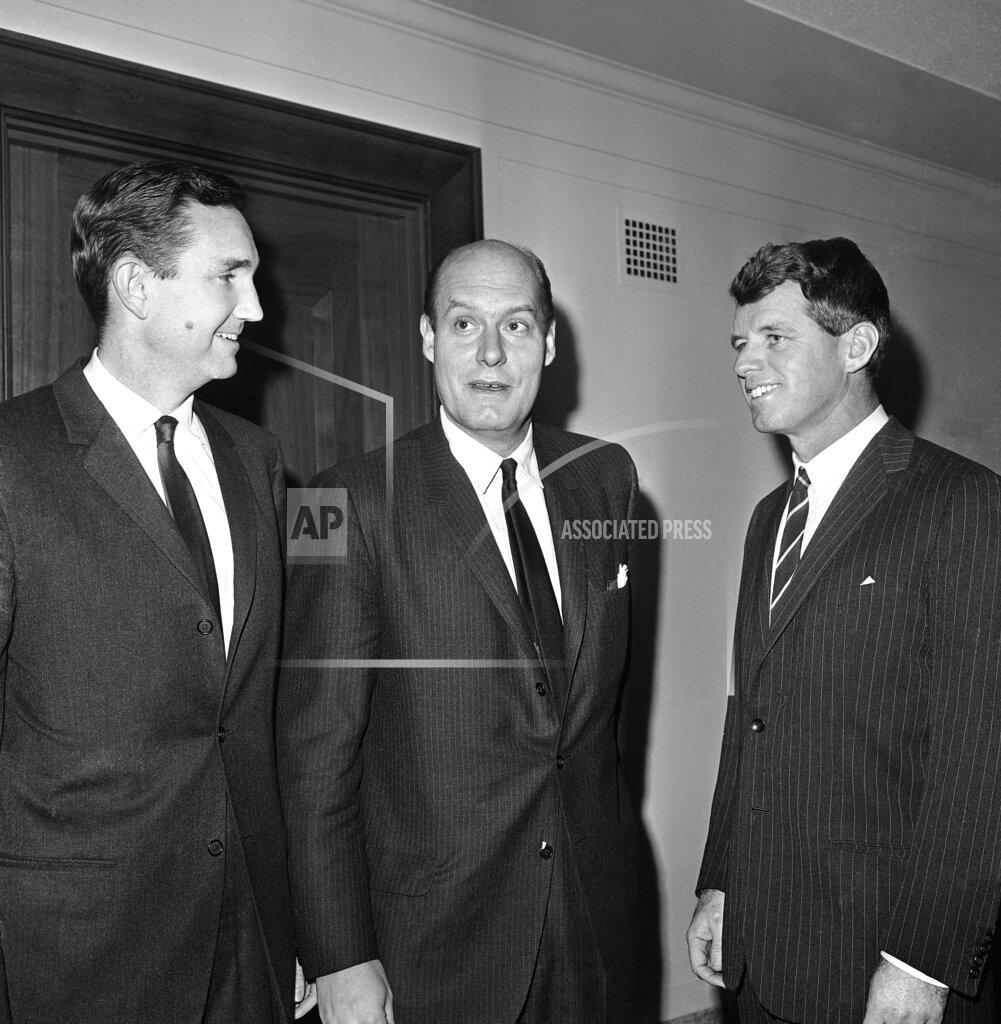
The Senate Rules Committee decided that former White House aide Walter Jenkins does not have to make a personal appearance in the Bobby Baker investigation. The Senate Rules Committee voted today to submit written questions to Walter W. Jenkins, a former White House aide, rather than compel him to testify at this time in the investigation of Robert G. Baker.
Attorney General-designate Nicholas deB. Katzenbach said today that the government was barely keeping its head above water in the fight against organized crime.
Republican leaders agreed today to enlarge the new Republican Coordinating Committee and will try to hold its first meeting in the first week of March.
A spokesman for television personality John (Fritz) Johnson said there is an “inescapable conclusion” that he is an Ohio man missing since 1957 and declared legally dead.
Congressional delegations from California and Arizona promised massive support of legislation to develop the Lower Colorado River Basin but influential Senator Carl Hayden (D-Arizona) did not take an active part.
President Johnson asked Congress today for $1,770,000 to finance construction near the grave of President Kennedy in Arlington National Cemetery.
The city of Empire, Oregon, population 3,917, ceased to exist and became part of Coos Bay, making Coos Bay the largest city on the Oregon coast. Voters in Empire had approved the merger and the surrender of their city charter on December 7, 1964, by a vote of 463 to 387, while Coos Bay residents had approved the merger overwhelmingly on January 8, 1965, by a margin of 1,329 to 181.
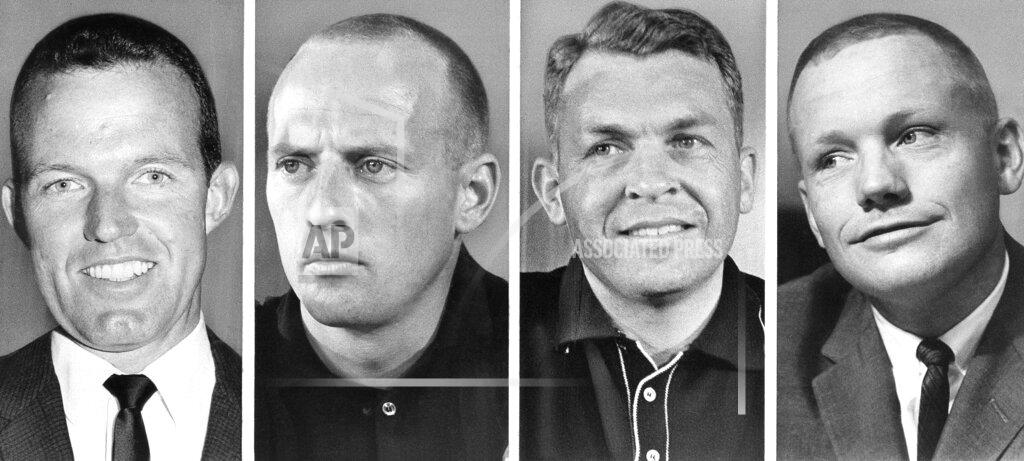
Major L. Gordon Cooper Jr., whose 34-hour space flight was the longest of the Project Mercury missions, was named yesterday to be spacecraft commander for the seven-day Gemini flight late this year. His companion in the cramped, two-man capsule will be Lieutenant Commander Charles Conrad Jr. He is the smallest of the astronauts — 5 feet, 6½ inches tall and weighing 138 pounds — and the only Ivy-Leaguer. He graduated from Princeton in 1953. The flight will be the third in the Gemini series, which is expected to get under way in late March or in April. The first flight will last three orbits. The backup crew was announced as Neil A. Armstrong and Elliot M. See, Jr. The longest Soviet space flight to date was the five-day flight of Lieutenant Colonel Valery F. Bykovsky in June, 1963. The announcement of the crew for the seven-day trip was made at the Manned Spaceflight Center near Houston.
22nd Golden Globes: “Becket”, Peter O’Toole, & Anne Bancroft win.
Motown Records release The Supremes’ single “Stop In the Name of Love.”
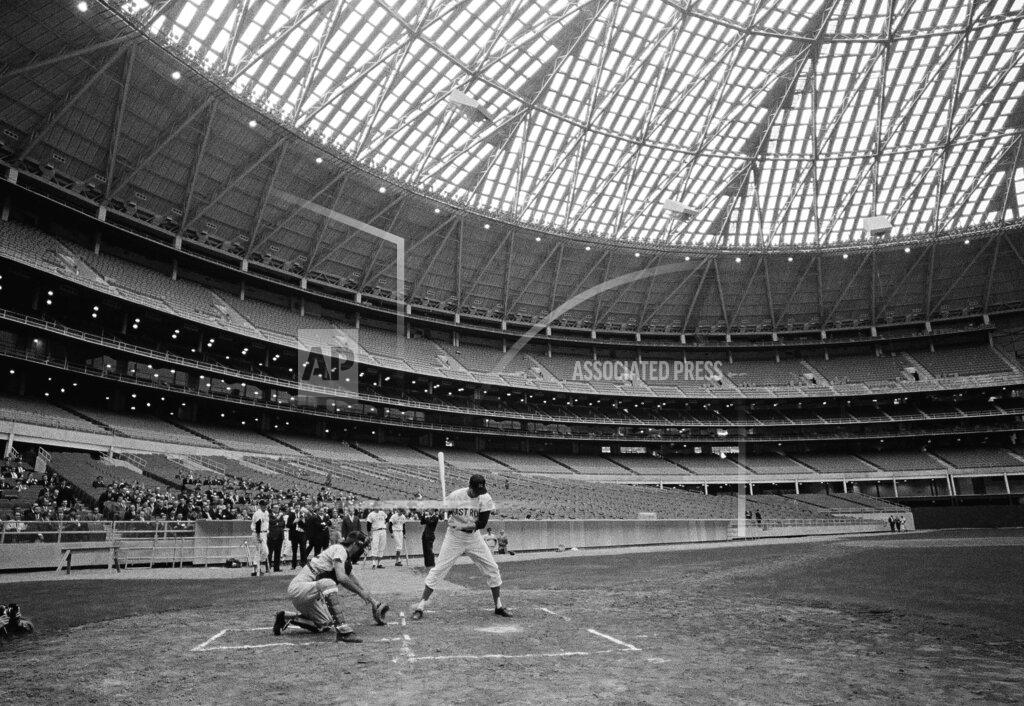
A few Houston Astros take the field for the first practice inside the new Astrodome. Rusty Staub is the only player to swat a ball over the fence as 250 members of the press look on. Pitchers are relieved to discover that breaking pitches still break indoors. Singer Anita Bryant is on hand to deliver a ceremonial first pitch.
Dow Jones Industrial Average: 897.89 (-3.68)
Born:
Mathilda May, French actress (Lifeforce), in Paris, France.
Terry McDaniel, NFL cornerback (Pro Bowl 1992-1996; Los Angeles-Oakland Raiders, Seattle Seahawks), in Saginaw, Michigan.
Rod Bernstine, NFL running back and tight end (San Diego Chargers, Denver Broncos), in Fairfield, California.
James Thornton, NFL tight end (Chicago Bears, New York Jets, Houston Oilers), in Santa Rosa, California.
Dicky Cheung (stage name for Cheung Wai-kin), Cantopop singer and actor; in British Hong Kong.
Died:
Ray Brown, 56, American Baseball HOF pitcher (Negro League World Series 1943, 1944; Triple Crown 1938; Homestead Grays)
Wayne Estes, 21, American college basketball star for Utah State University, was killed in a freak accident less than two hours after leading a 91–62 win over Denver University and scoring 48 points (including the 2000th point of his career). As he walked back to campus, he brushed against a high voltage wire that had been knocked down by a car, and was electrocuted. At the time of his death, Estes was the second-most prolific scorer in major college basketball, averaging 33.7 points a game behind Rick Barry but head of Bill Bradley, and was considered to be a likely first round NBA draft pick.
 History Diaries