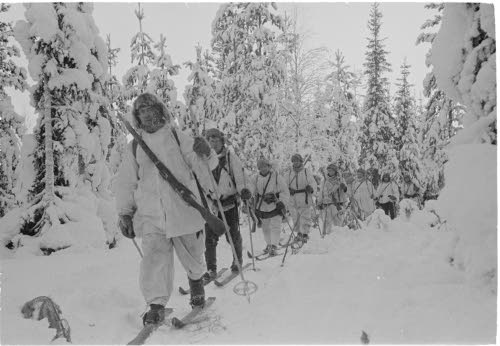
Red Army attacks the Summa gap for the 7th consecutive day. The daily artillery bombardment and tank/infantry attacks, followed by Finnish counterattacks, weakens the Mannerheim Line fortifications, exhausts the defenders and sucks in the Finnish reserves. The pressure on the Isthmus continues to grow. The non-stop Soviet artillery bombardment, bombing and tank and infantry assaults are now into their seventh day in the area defended by the Finnish 3rd Division.
On the Central Isthmus, Red Army tanks and infantry mount two separate assaults in Summa village, both of which are successfully repulsed.
A dugout belonging to the Finnish 9th Infantry Regiment takes a direct hit from a heavy enemy mortar; 18 soldiers are killed and 11 wounded.
In the Aittojoki sector, Detachment Pajari is attempting to strike the enemy troops to the west of the River Kuukkausjoki. The Finnish attack grinds to a halt in the evening in the face of heavy enemy fire.
In the Suomussalmi sector an enemy detachment which had entered Finnish territory to the south of Raate is pushed back across the border.
Thirty-three enemy aircraft carry out a surprise bombing raid on Kajaani, where the headquarters of the North Finland Group are situated. Four people are killed in the raid, including one doctor, and two civilians are injured. Several buildings are destroyed, the worst hit being the town hospital.
The enemy takes advantage of the resulting confusion to send in reconnaissance parachutists. Those picked up are wearing Finnish military uniforms.
The Finnish government now believes that every town in Finland has been bombed by Soviet planes.
In Helsinki, the city court sentences 12 people to pay fines for infringing the blackout regulations.
In Copenhagen a new civilian labour agency has attracted 1,250 volunteers for Finland in its first two days of operation.
An article in Leningradskaya Pravda tells of the first executions in Leningrad for hoarding food and profiteering. The official grounds for the convictions are counter-revolutionary activities and serving as a Finnish agent.
The United States’ House of Representatives rejects by 108 votes to 105 a motion to withdraw the U.S. Ambassador from Moscow in protest over the war in Finland.
The American trade union movement is today holding a special day to express its support for Finland.
Information regarding Allied Supreme War Council’s decision to send aid to Finland was leaked to British and French newspapers. Disregarding security concerns, British and French newspapers published the Anglo French Supreme War Council’s decision to send aid to Finland. These reports raised Finnish expectations of reinforcement, alarmed Norway and Sweden (both of which reaffirmed their neutrality) and further alerted Germany to threats to vital Swedish iron ore supplies. Popular support for action to save Finland grew in Britain and especially France.
The Finnish government disapproves of Anglo-French plans to land forces at Petsamo.
Authorized German sources today disclaimed the existence of any German-Russian military agreement and emphasized that the Soviet Government had neither asked for nor received military or technical aid in its war against Finland.
The Manstein Plan was tested in a war game at Koblenz.
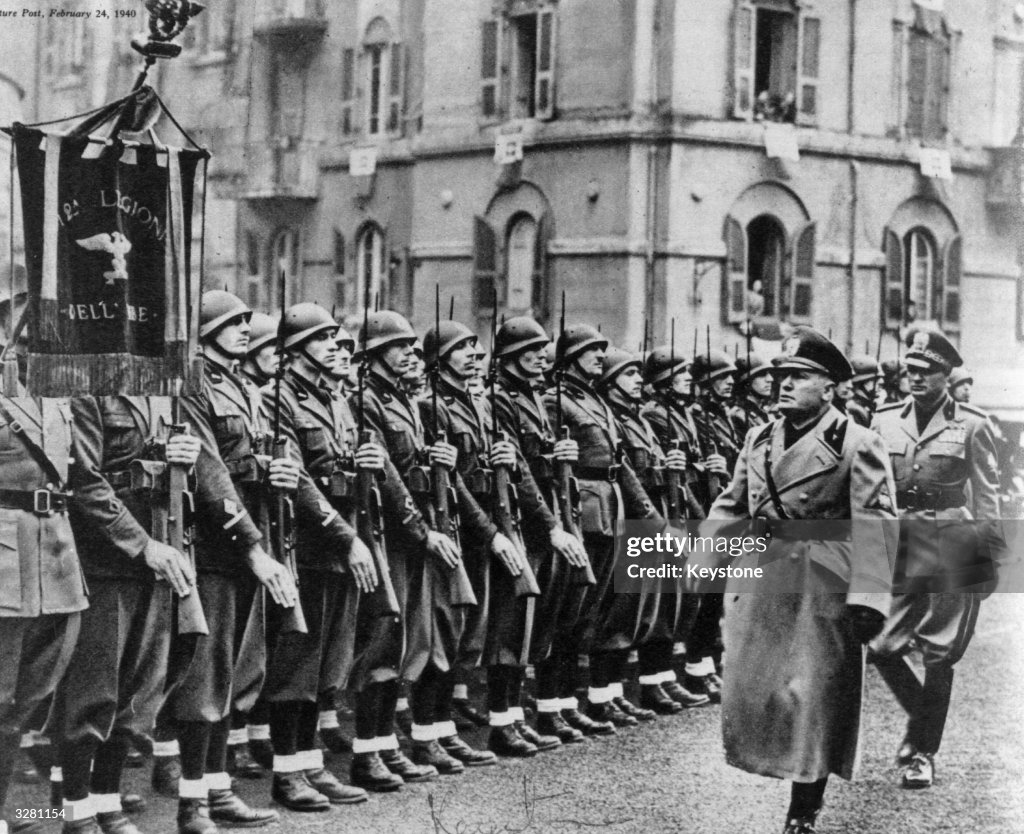
Mussolini refuses to sell war material to the UK. Mussolini exercises his veto of arms sales to the UK. He usually tries to appear as neutral as possible, so this comes as a bit of shock, especially considering that the British Purchasing Commission led by Lord Hardwick had just placed a large order for Italian fighter planes (Caproni-Reggiane Re.2000 Falco I).
Convicted IRA terrorists Peter Barnes and James Richards were executed at Wilson Green prison, Birmingham, England for their part in a street bombing in Coventry which killed five innocent passers-by.
Carrying black flags marked with skulls and crossbones, about 1,000 members of the Unemployed Workers Rights Association demonstrated today in protest against the Birmingham executions of Peter Barnes and James Richards, Irish Republican Army terrorists. Approaching the offices of Sir John Maffey, British representative to Eire, the marchers were halted by strong police detachments. They offered no resistance, but turned and marched on government building, where they demanded an interview with Premier Eamon de Valera. They were told that De Valera was in conference.
Paris accuses the Germans of executing two Americans in Poland.
Generals Weygand and Wavell being four days of planning in Cairo.
Douglas Bader joined the British RAF No. 19 Squadron flying Spitfire fighters.
Soviet submarine ShCh-311 received the Red Banner Award (Orden Krasnogo Znameni).
The German Kriegsmarine conducts defensive minelaying operations off Borkum.
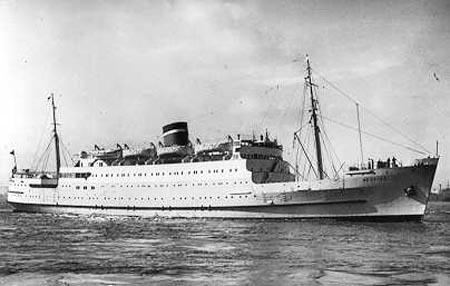
At about 0600 hours, the British motor passenger ship Munster (Belfast-Liverpool ferry) struck a mine laid on January 6, 1940 by the U-30, commanded by Fritz-Julius Lemp, in the Queens Channel and sank near Mersey Light in the Irish Sea at 53° 36’N, 3° 24’W. Of the ship’s complement and passengers, all 235 survived and were picked up by the British coaster Ringwall and landed at Liverpool. In addition to its passengers, the 4,305 ton Munster was carrying general cargo, including eggs, animal gut, poultry, thread and textiles and was bound for Liverpool, England.
The British ship Eldonpark ran aground and was wrecked near Port Eynon, Glamorgan. Her 37 crew were rescued by the Mumbles Lifeboat.
Convoy OA.87 departs Southend.
Convoy OB.86 departs Liverpool.
Convoy OB.87 departs Liverpool.
Convoy HX.19 departs Halifax for Liverpool.
The War at Sea, Wednesday, 7 February 1940 (naval-history.net)
Heavy cruisers DEVONSHIRE and BERWICK departed the Clyde for Northern Patrol and relieved sister ships NORFOLK and SUFFOLK.
Armed merchant cruisers DERBYSHIRE and CIRCASSIA departed the Clyde on Northern Patrol.
Destroyers COSSACK and SIKH were submarine hunting from Scapa Flow.
Destroyer JANUS brushed destroyer JUPITER while berthing in the Humber. The damage to JANUS required 48 hours to repair.
Minelayer PRINCESS VICTORIA and minelaying destroyers ESK and EXPRESS, escorted by destroyers BRAZEN and BOREAS, departed Aberdeen for minelay LD 2 in the North Sea. The minelay was successfully completed and the ships arrived at Rosyth on the 8th.
Submarine H.43 and destroyer VETERAN collided in Plymouth Sound. VETERAN was not damaged, but H.43 required three days to repair.
Convoy OA.87 departed Southend escorted by destroyers VANESSA and WREN. VANESSA was replaced on the 8th by sloop WELLINGTON, and on the 9th, the convoy dispersed.
Convoy OB.86 departed Liverpool escorted by destroyers WITHERINGTON and WALPOLE. WALPOLE detached on the 8th, WITHERINGTON on the 9th, and the convoy dispersed on the 10th.
Convoy OB.87 departed Liverpool escorted by sloop ROCHESTER and destroyer WALKER from the 7th to 10th, when it dispersed.
Convoy FN.86 departed Southend, escorted by destroyer WHITLEY and sloop EGRET. In heavy fog, the convoy anchored for the night, and arrived in the Tyne on the 9th.
Convoy FN.87 departed Southend escorted by destroyer VEGA, sloop STORK, destroyer JUPITER, and also arrived in the Tyne on the 9th. There was no convoy FN.88.
Convoy FS.90 departed the Tyne, escorted by destroyers JAGUAR, WESTMINSTER and sloop LONDONDERRY, and arrived at Southend on the 9th.
Convoy MT.5 departed Methil, escorted by destroyers VIVIEN, JAVELIN, sloop PELICAN, and anti-submarine trawlers of the 1st A/S Group, and arrived in the Tyne on the 8th.
Steamer CYPRIAN PRINCE (1988grt) departed Aberdeen, but due to an error, destroyers KIMBERLEY and KIPLING did not join her as escorts until later.
Light cruiser AURORA arrived at Rosyth from Scapa Flow for repairs to her propellers and to undergo degaussing.
Light cruiser CERES completed her refit at Belfast, and then proceeded to the Mediterranean for duty with the Mediterranean Fleet, arriving at Malta on the 22nd.
Armed boarding vessel KINGSTON TURQUOISE (358grt), which had just left Kirkwall for the North Rona patrol, attacked a submarine contact off Sule Skerry in 59-15N, 4-40W. Destroyer SIKH joined her and tried to remake contact.
Destroyers JAVELIN and VIVIEN patrolled in the vicinity of Farne Island during the night of the 6th/7th.
Patrol sloop MALLARD collided with sister ship PINTAIL off Harwich. PINTAIL’s damage was slight and she was able to continue on patrol, but MALLARD required docking. Temporarily repaired at Harwich on the 8th and 9th, she went on to Lowestoft to repair from the 10th to 22nd.
Steamer MUNSTER (4305grt) was sunk near Mersey Light in 53 56N, 03 24W on a mine laid by U-30 on 9 January. All on board, 134 survivors in total, were rescued by steamer RINGWALL (407grt).
Steamer ELDONPARK (5184grt) went ashore at Elwick.
Polish steamer BUG went ashore at Rosehearty.
German minelayer COBRA laid an anti-submarine mine barrier off Borkum.
Convoy HX.19 departed Halifax at 0900 escorted by Canadian destroyers HMCS SAGUENAY, HMCS SKEENA, and HMCS RESTIGOUCHE until detached on the 8th. Ocean escort was battleship REVENGE, which was in collision with tanker APPALACHEE (8826grt) of the convoy on the 7th. The tanker was extensively damaged, and REVENGE required ten days to repair, although she was able to continue and did not detach until the 14th. The convoy was joined in Home Waters by destroyers WOLVERINE and VANOC from convoy OB.92 and destroyer VANESSA from OA.9 between the 19th to 22nd, when HX.19 arrived at Liverpool.
French sloop COMMANDANTE RIVIERE with submarines RUBIS, SAPHIR and NAUTILUS departed Oran, and passed Gibraltar on the 8th en route for repairs to the submarines at Brest. These ships joined convoy 9R of eight steamers, escorted by sloop SAVORGNAN DE BRAZZA, which left Oran on the 6th. The convoy passed Gibraltar on the 8th, and in the Atlantic, joined convoy 63 KS for the passage to Brest. 63 KS of eight steamers departed Casablanca on the 8th, escorted by destroyer CYCLONE, patrol vessel GROENLAND and submarine PASCAL.
French light cruiser EMILE BERTIN departed Dakar to return to France in preparation for allied operations in Finland. She arrived at Casablanca on the 11th, left on the 15th, and reached Brest on the 17th. For the operations, the cruiser would be the flagship of Contre Amiral Derrien, Commander Force Z.
Today in Washington, President Roosevelt sent to the Senate the nomination of George H. Earle, former Governor of Pennsylvania, to be Minister to Bulgaria, and other nominations. He discussed further government reorganization plans with Secretary Ickes, Budget Director Smith and Democratic Representatives, and New York World’s Fair plans. with Edward J. Flynn.
The Senate considered the Independent Offices Appropriation Bill, heard Senator Barbour urge immediate financial aid to Finland and recessed at 5:10 PM to noon tomorrow. The Foreign Relations Committee approved the bill to expand the capital of the Export-Import Bank by $100,000,000.
The House considered the State, Justice and Commerce Departments appropriation bill, elected Representative Rayburn Speaker pro tem and adjourned at 5:18 PM to noon tomorrow. The Dies Committee questioned William Dudley Pelley about activities of the Silver Shirts.
Pro-Finnish and anti-Russian feeling reached a new high pitch at the capitol today as the Senate Foreign Relations Committee approved a bill making possible a further $20,000,000 credit advance to Finland, and the House came within three votes of ordering practical severance of diplomatic relations with the Soviet Union. The action in the House, which took place in the most tense session of the year, came on an amendment proposed by Representative John W. McCormack of Massachusetts to the State Department Supply Bill, cutting out the $17,500 annual salary for the American Ambassador to Russia. On a teller vote, and after the Administration leadership had brought its heaviest oratorical artillery into play against it, the amendment was defeated 108 to 105.
A later amendment by the same Representative to delete all expenditures for the American Embassy in Moscow was defeated 95 to 38, whereupon Mr. McCormack was urged by friends to submit his proposal tomorrow in a motion to recommit the State Department bill, when a roll call would be in order and every member could be “put on the record” as to his stand. Interest in the Finnish-Russian matter shifted abruptly to the House after the Senate Committee had voted 12 to 6 to report favorably the Administration bill to expand the lending authorization of the Export-Import Bank by $100,000,000, already approved by the Banking and Currency Committee, and thus to pave the way for a further credit of $20,000,000 to Finland and a similar additional amount to China.
Jesse H. Jones, Federal Loan Administrator, on whose advice the committee largely acted, told the Foreign Relations body that the government also was considering credits, for civilian non-military supplies, to Norway, Sweden, and Colombia. The committee rejected by a division of 13 to 5 a motion to limit the increased Export-Import Bank authorization to $50,000,000. It endorsed unanimously, however, the proposal of Senator Pat Harrison to put Congress on record as favoring expeditious handling by the Securities and Exchange Commission of any Finnish government bond issue offered to private investors in this country.
Representative Sam Rayburn of Texas, the majority leader, was formally designated today by the House of Representatives to act as Speaker during the absence of Speaker Bankhead, who is ill with influenza. Representative McCormack of Massachusetts offered the resolution, which was adopted unanimously. He explained that, while Mr. Bankhead could appoint a Speaker pro tempore, some question might arise as to the signing of enrolled bills and other legal technicalities. Mr. Bankhead was said by his physician to be still confined to his bed, but probably could return to his duties within a few days.
The economy wave in the Senate receded today a bit faster than it rose yesterday. New money, $39,000,000, was added to the Independent Offices Appropriation Bill as passed by the House. Another $1,000,000, which had been cut by the Appropriations Committee from the House bill, was restored. These additions followed two roll-calls yesterday in which Vice President Garner broke one tie vote to assist the economizers, with a net. result that reductions of about $165,000 were sustained. On a roll-call the Senate voted. today, 37 to 34, to give to the Civil Aeronautics Authority a total of $12,000,000 for maintenance and operation of air-navigation facilities, although the Appropriations Committee had recommended that this figure be cut to $11,000,000. The CAA previously had sustained a reduction of $165,000 in the House.
The seventeen men arrested on January 15 by agents of the Federal Bureau of Investigation on charges of conspiring to overthrow by force the United States Government were indicted yesterday by the Federal Grand Jury in Brooklyn. Later they were arraigned before Judge Matthew T. Abruzzo and after pleading not guilty were held on bail ranging from $5,000 to $20,000. The indictment charged the men had conspired “to overthrow, put down and destroy by force the Government of the United States.” A second count alleged they also conspired to commit an offense against the United States by stealing munitions and other personal property belonging to the United States.” The indictment listed fifteen overt acts, but not all the defendants were specifically linked to them.
Documents in support of his charge that William Green, president; Joseph A. Padway, general counsel, and other leaders of the American Federation of Labor, were in collusion with attorneys for alleged anti-labor corporations in preparing amendments to the National Labor Relations Act were put in the records of the Senate Committee on Education and Labor today on behalf of John L. Lewis. Philip Murray, vice president of the Congress of Industrial Organizations, finishing his testimony before the committee, handed to Senator Thomas of Utah, the chairman, a bulky document and said it related to “conspiracies between certain associations and individuals to emasculate the Wagner act.” He said he was offering the data to the committee for an investigation, if it wished to make one, on behalf of the C.I.O.’s president. Recalling that on April 29, 1939, he had written to the committee alleging that certain amendments sponsored by Mr. Green had been prepared with the assistance of counsel for the National Association of Manufacturers and “several of the most reactionary and anti-labor corporations of the country,” Mr. Lewis declared that the documents proved his allegations.
The Republic Steel Corporation petitioned the Supreme Court today to set aside a lower court order that the company reinstate with back pay workers it did not take back after the 1937 “Little Steel” strike as directed by the National Labor Relations Board. The Labor Board’s findings were affirmed by the Third Circuit Court of Appeals in November. The corporation challenged the propriety of the hearing on which the NLRB based its order, contending that “a ‘hearing’ before a board which has already made up its mind as to every question of law and fact involved in the case is not a hearing which amounts to due process of law.” Although the board had said that the strike was attributable to unfair labor practices on the part of Republic Steel subsidiaries, the petition contended that “the undisputed evidence disclosed that the sole cause of the strike was the company’s lawful refusal to sign a written collective bargaining contract with the Steel Workers Organizing Committee, as a step in the drive of the C.I.O. to organize the nation’s steel industry.”
Russian gold, $5,600,000 of it in bars, was unloaded from the Soviet freighter Kim at her San Francisco berth today under the protection of machine guns in the hands of Coast Guardsmen.
The American tanker Poling Brothers No. 2 sank without loss of life in 65 feet (20 m) of water in Long Island Sound north of Glen Cove, Long Island, New York, and 1.5 nautical miles (2.8 km; 1.7 mi) south of Great Captain Island off Greenwich, Connecticut, at 40°57.350′N 073°37.500′W after striking pack ice.
Walt Disney’s 2nd feature-length animated movie, “Pinocchio,” premiered in New York at the Center Theater.
Shangtung Operation: Japanese 21st Infantry Division, 32nd Infantry Division, and 5th Independent Mixed Brigade open sweep through Shangtung peninsula.
Battle of South Kwangsi: Japanese forces attacking Wuning.
During the fighting east of Nanning between January 28 and yesterday the Chinese force of 300,000 men abandoned 46,800 dead, according to an announcement tonight by the Japanese Army spokesman in Shanghai. The Japanese estimate the Chinese wounded at 80,000. The spokesman said this was a low estimate, because in the thirty-one months of fighting in China there had been three wounded to each man killed. The rapid encirclement strategy of the Japanese was said to have so shattered the 300,000 Chinese that they had lost all organization. The survivors were reported to be aimless wanderers, no longer of military importance.
At the beginning of the ten-day battle the Chinese had massed 400,000 men, intending to capture Nanning, but, with numerous strategic points in Japanese hands, the remaining Chinese force of 100,000 is powerless to counter-attack, according to the Japanese. If the slaughter was as large as estimated, it evidently was the result of airplane bombings and machine-gunnings against massed infantry, for the Japanese held mastery of the air and could not have had heavy artillery in a mountainous area that has few highways. Foreign military experts in Shanghai, while not disputing the Japanese reports of Chinese losses, laughed at the official Japanese report that their killed in this ten-day conflict numbered only 205 and that only 785 had been wounded.
The battle east of Nanning ranks. as the greatest military effort in South China. The Japanese spokesman said the battles preceding the capture of Hankow were Japan’s greatest military effort in China, that the battles preceding the capture of Suchow, junction of the Tientsin-Pukow and Lunghai railways, were second in importance. and that the battles preceding the capture of Nanking were third. The spokesman said the Nanning battles resulted in the capture of only 2,500 Chinese, but listed the booty taken in nineteen days at 63 motor vehicles, 25 mountain and field guns, 16 rapid-fire anti-tank guns, 68 trench mortars, 110 heavy machine guns, 144 light machine guns and vast quantities of munitions.
“The Japanese forces,” he said, “are now concentrated for the next stage of the Kwangsi campaign, the objective of which is not territory but the destruction of Chinese concentrations. Doubtless the Chinese will claim the recapture of many towns in this area, but the Japanese, while maintaining mobile movement, will not abandon any captured towns except those strategically valueless.” The spokesman said that in the lower Yangtze area, roughly the Shanghai-Hangchow-Foochow triangle, Japanese forces during January fought 295 engagements with a total of 76,000 Chinese, who lost 4,897 killed. The Japanese losses were put at 244 killed in these contacts.
Chinese guerrilla forces were causing serious trouble to the Japanese in the Shanghai area today, the official Chinese Central News Agency reported, and other guerrillas were attacking Japanese detachments in Sulyuan Province, Northwestern China. The Chinese dispatches said that the Japanese were being attacked. on the Yangtze delta at Woosung, Yanghang and Liuhang.
The Japanese Government told Parliament today that it was preparing for “anticipated difficulties” in its economic relations with the United States. and was considering the question of abrogating the Nine-Power Treaty of 1922. These statements were made in a session marked by pointed remarks concerning the present relations between the United States and Japan, with one member raising the question of withdrawal of Americans from China and Premier Admiral Mitsumasa Yonai stating that Japan would reconsider her attitude toward the United States if that country “continues its oppression and interference with Japan.”
Discussion centered on the expiration of the Japanese-American trade treaty of 1911 last January 26 after its denunciation by Washington. Answering a declaration by Yoshimichi Kuboi, member of the Seiyukai, a major political party, that the ending of the trade pact was “an insult,” Foreign Minister Hachiro Arita said that the act was irreproachable legally but that the manner had caused dissatisfaction to Japan. Tadao Matsumoto of Japan’s second major party, the Minseito, asked “what does the United States request from Japan for readjustment of relations?” with Japan, and Mr. Arita replied that the United States “requests the security of the lives and property of American residents in China.”
“Has the government any intention to advise the American Government to withdraw its nationals from China?” Mr. Matsumoto asked. “It is a grave question,” answered Mr. Arita, “and I am not in a position to answer that here.”
“I suggest,” continued Mr. Matsumoto, “that the Premier issue a statement of warning to America, thereby reassuring the Japanese people.” Admiral Yonai responded: “I do not want to regard the American attitude with ill feeling, but I will reconsider if the United States continues its oppression and interference with Japan.”
Mr. Arita said that the government was “weighing the advantages and disadvantages of abrogation” of the Nine-Power Pact. By this treaty Japan, the United States, Belgium, Britain, France, Italy, the Netherlands and Portugal agreed “to respect the sovereignty, the independence and the territorial and administrative integrity of China,” and these nations and China agreed upon the Open Door principle of “equality of opportunity” for trade in China. Mr. Arita said of the treaty that “some of its provisions obviously are incongruous.” Although technically the pact still is in force, the Japanese invasion. has closed much of China to thirdpower trade. This fact has caused friction with both the United States and Great Britain.
Dow Jones Industrial Average: 146.63 (+0.7)
Born:
Tony Tan, Singaporean academic and politician, 7th President of Singapore, in Singapore, Straits Settlements.
Gary Bond, English actor (“Outback”, “Zulu”, “Anne of Thousand Days”), in Liss, Hampshire, England, United Kingdom.
Naval Construction:
The Royal Canadian Navy Flower-class corvettes HMCS Napanee (K 118), HMCS Prescott (K 161), and HMCS Sudbury (K 162) are ordered from Kingston Shipbuilding Ltd. (Kingston, Canada).
The Kriegsmarine (German Navy) Type VIIC U-boat U-562 is laid down by Blohm & Voss, Hamburg (werk 538).
The Royal Australian Navy Bar-class boom defence vessel HMAS Koala (Z 69, later A 315) is commissioned.
 History Diaries