

During the early hours of February 7, 1965, an attack occurred on Camp Holloway, a helicopter facility constructed by the United States Army near Pleiku, RVN. At around 11:00 PM on February 6, 1965, about 300 Việt Cộng soldiers of the 30th Company, 409th Battalion, assembled at positions outside Camp Holloway where they began breaking through the wire fences. The Việt Cộng’s mission nearly turned into a disaster when their combat engineers accidentally tripped an electrical wire after breaking through the third fence barrier, but the U.S. Military Police patrolling the area did not detect it. At 1:50 AM on February 7th, the Việt Cộng attackers opened fire with their AK-47 rifles, having successfully penetrated Camp Holloway. Shortly afterwards, the Việt Cộng mortared the airfield and the U.S. advisory compound, while sections of the 30th Company attacked their respective targets with small arms fire. In a raid that lasted only five minutes, the Việt Cộng quickly began retreating from the facility. Later that morning, they claimed victory, having caused the death of nine U.S. soldiers, and leaving another 125 wounded. In addition, ten aircraft were destroyed and 15 more were damaged. The lost U.S. personnel included PFC Joseph K. L. Belanger, SP4 Ralph W. Broughman, SP5 David Craig III, SP5 Gerald D. Founds, PFC Theodore Lamb, CPT George Markos, and PFC Alvin G. Parker. PVT Norman R. Garrett was evacuated to Fort Sam Houston, TX, for treatment of a severe head injury from which he died February 15, 1965. MAJ Sayward N. Hall Jr. died in the Philippines where he was flown after being critically injured in the attack. He died April 21, 1965.
Joseph is buried at Bingham Village Cemetery, Somerset County, Maine. He is honored on the Wall at Panel 1E, line 84.
The Việt Cộng attack the U.S. helicopter base at Camp Halloway and simultaneously blow up the barracks of the U.S. military advisers near Pleiku, in the Central Highlands; the Việt Cộng also destroyed part of a fuel depot in Phú Yên Province. Nine Americans are killed, 126 are wounded, and nine helicopters are destroyed along with one transport plane; another 15 planes are damaged. Early in the morning, while it is still dark, approximately ten Viet Cong insurgents breach the fenced perimeter of the U.S. Army advisory facility near Pleiku, in the South Vietnamese Central Highlands. The infiltrators place demolition charges against several structures, detonate them, and begin throwing additional charges and mortar rounds through windows and damaged walls. The attack lasts for about ten minutes.
At the same time, a few kilometers away, two five-man Việt Cộng mortar teams enter the aircraft parking area of Camp Holloway, an Army helicopter base and headquarters for the 52d Aviation Battalion. Over the course of ten minutes, the Việt Cộng teams fire mortar rounds and detonate charges against parked aircraft and barracks buildings.
The attacks ultimately kill nine Americans (seven outright; two later in hospitals) and wound over 100 others. Over a dozen aircraft are destroyed or damaged. The attackers escape both the advisory base and Camp Holloway with no casualties.
Seven minutes after the attacks began two armed United States helicopters got into the air and, with illumination provided by a transport plane dropping flares, put suppressive fire on the attacking guerrillas. It was not known if there were any Việt Cộng casualties. Việt Cộng forces also attacked a large fuel dump in Phú Yên Province, also in the II Corps area, with mortar fire. Part of the dump was reported destroyed. About 1,000 United States military men are attached to Vietnamese units in the Pleiku area.
The Việt Cộng struck about two hours after the end of a seven-day cease-fire they had declared for the Lunar New Year celebration. The attacks occurred less than 24 hours after McGeorge Bundy, President Johnson’s special assistant for national security affairs, warned that foreign supporters of the Việt Cộng movement must be induced to discontinue aggression against South Vietnam. Mr. Bundy, here on a fact-finding mission for the President, indicated at a news conference that United States policy planners were still intent on discouraging North Vietnamese assistance to the guerrillas.
One topic he has reviewed here with United States military officers is the advisability of bombing North Vietnamese targets to impede the flow of men and supplies. Mr. Bundy declined, however, to say what recommendations might be made in his report to the president. After four days of discussions with United! States officials and Vietnamese leaders, Mr. Bundy is scheduled to leave by air today for Washington. Asked about the prospect of ending the war, Mr. Bundy replied that it was essential to end “aggression and violent pressure on the whole fabric of South Vietnamese society that is governed and directed from the outside.”
When word of the Pleiku attacks arrived; McGeorge Bundy joins Westmoreland and Taylor at the Saigon military headquarters, then telephones President Johnson to urge immediate retaliatory air raids against North Vietnam. Government President Johnson convenes his top advisers and says he is ordering retaliatory raids, and all present except Senator Mike Mansfield (D-Montana) and Vice President Hubert Humphrey concur. (Humphrey will be kept out of Johnson’s Vietnam planning for about a year, until he satisfies Johnson that he will support presidential policies.)
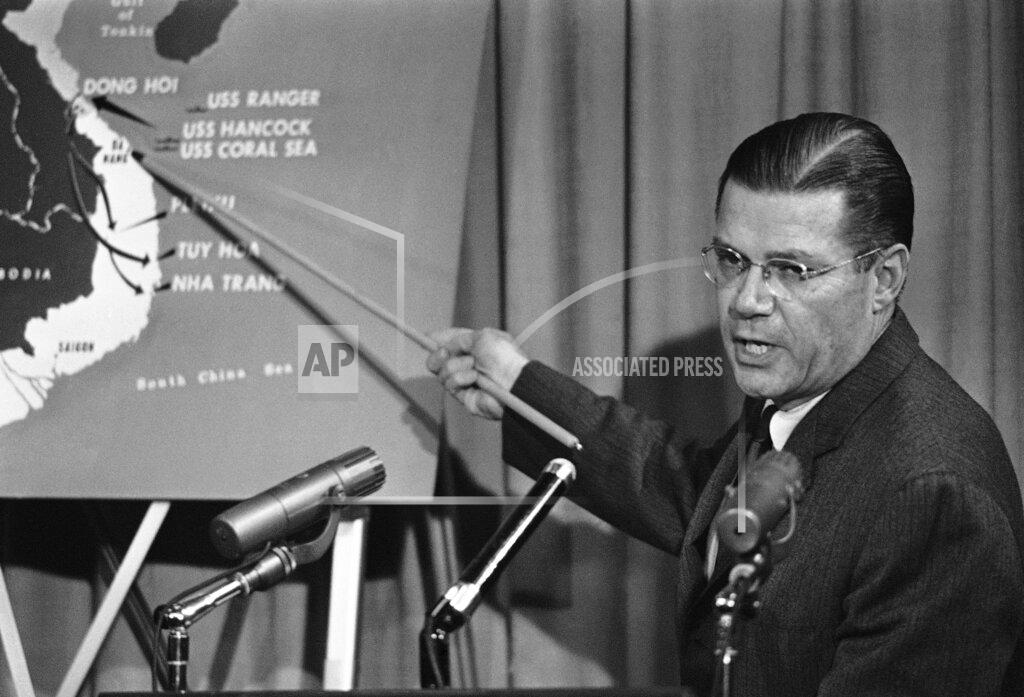
President Johnson responded by launching Operation Flaming Dart, sending 49 U.S. Navy bombers to bomb North Vietnamese army barracks in Đồng Hới and other targets around North Vietnam’s Gulf of Tonkin. Forty-nine U.S. Navy jets — A-4 Skyhawks and F-8 Crusaders — from the 7th Fleet carriers Coral Sea and Hancock, drop bombs and rockets on the barracks and staging areas at Đồng Hới, a guerrilla training camp 40 miles north of the 17th parallel — in North Vietnam. There will be speculation that the Việt Cộng deliberately timed their attacks at Pleiku to force just such a response by the United States, thus compelling Kosygin to give absolute support. This is never proven, but shipments of Soviet surface-to-air missiles will begin to arrive at Haiphong within two weeks.
Forty-nine retaliatory sorties were flown for Flaming Dart I on 7 February 1965. Flaming Dart I targeted North Vietnamese army bases near Đồng Hới, while the second wave targeted Việt Cộng logistics and communications near the Vietnamese Demilitarized Zone (DMZ). Among the pilots was Republic of Vietnam Air Force (RVNAF) Air Marshal Nguyễn Cao Kỳ, then a member of Vietnam’s ruling junta.
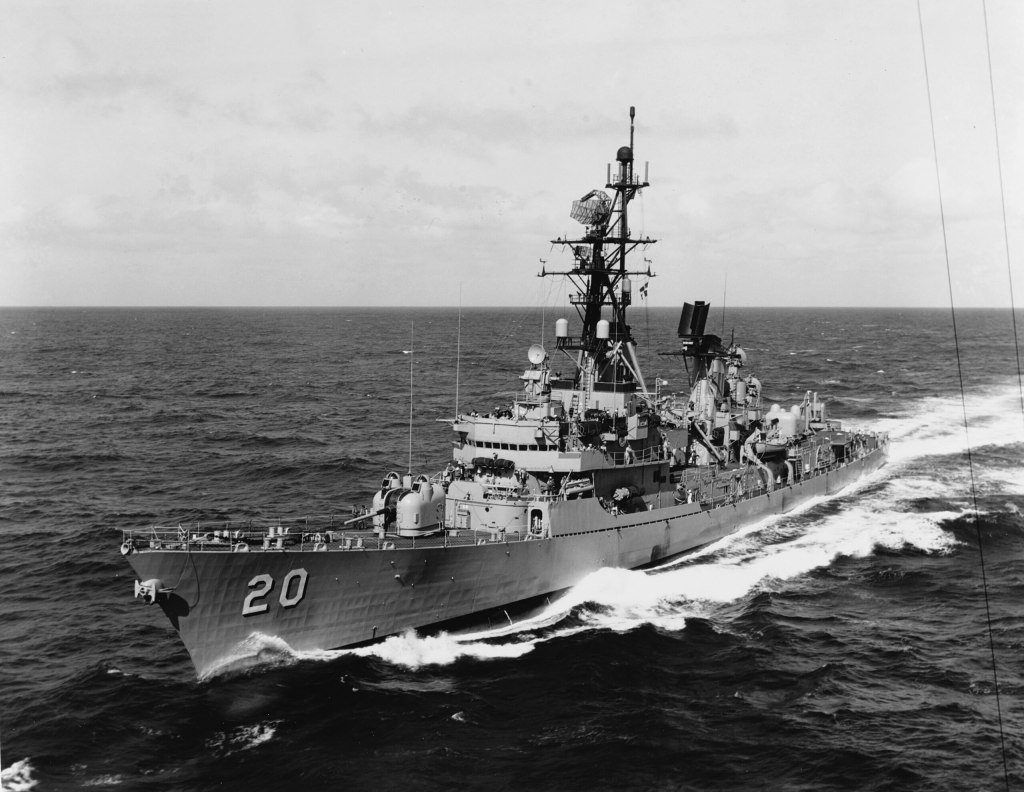
U.S. Navy aircraft carriers launched aircraft for strikes on the barracks at Vit Thù Lù and Đồng Hới, both just north of the DMZ. The attack on Vit Thù Lù was cancelled because of heavy clouds over the target. The weather was little better at Đồng Hới, home of the People’s Army of Vietnam (PAVN) 325th Infantry Division. A 29-plane strike formation from USS Coral Sea approached the target under a low cloud ceiling at 500 knots. The A-4 Skyhawks of attack squadrons VA-153 and VA-155 hit the barracks with rockets and 250-pound bombs. Prepared as they had not been during Operation Pierce Arrow, North Vietnamese antiaircraft gunners threw up a curtain of fire from 37-millimeter guns, automatic weapons and small arms ashore and from Swatow gunboats in the Kien River. Some of this fire hit Lieutenant Edward A. Dickson’s A-4 but he continued his attack before ejecting from his crippled plane, however his parachute failed to open and he plunged to his death. Right behind Coral Seas formation came 17 A-4s of VA-212 and VA-216 from the USS Hancock which dropped their ordnance on already burning and smoking camp facilities as F-8 Crusaders suppressed fire from antiaircraft sites. Completing the mission, RF-8A reconnaissance aircraft rolled in to photograph the scene for naval intelligence analysis. The results were unimpressive. The attack had destroyed or damaged only 22 of the 275 buildings in the camp.
The Administration ordered the strike against North Vietnam today in the belief that it faced the most serious test so far of its will to help resist aggression in South Vietnam. Informed sources said the United States had acted on the assumption that North Vietnam’s Communist Government organized that test without warning Soviet Premier Aleksei N. Kosygin, its guest in Hanoi at the moment. Sensing that the Soviet leader might find himself in an awkward position there, the Administration sent a special message to Moscow to explain its raid as an act of retaliation rather than as a move to expand the war in Southeast Asia.
President Johnson and his leading advisers were said to have had no doubt they were being tested. They were described as confident that a failure to respond would have been interpreted as a defeatist position in several Communist capitals. Their sense of challenge as they met at the White House last night to plan the response was said to have been based on the following factors:
- The severity of the Việt Cộng attack on a United States military compound in South Vietnam, in which nine Americans died. That attack, presumably coordinated with two other major Việt Cộng strikes, was interpreted here as an effort to demonstrate American vulnerability.
- Secret but “clear” evidence that North Vietnam not only knew of this test but also participated in its planning. The Administration was persuaded by this evidence that Hanoi wanted to see how much punishment Washington was willing to absorb.
- The presence in Hanoi of Premier Kosygin. Officials felt the North Vietnamese surprised him with the challenge to Washington either to prove that the United States, in Communist China’s phrase, is a “paper tiger” or to draw a response and thus to demand of him, greater military assistance and commitments.
- The presence in Saigon of McGeorge Bundy, the President’s special adviser for national security affairs. His presence was said to have made the Việt Cộng attacks “a kind of additional affront” to expose Washington’s “lack of will.” Mr. Bundy was ordered to hurry home to give a first-hand report.
- The increasing talk in many places, including Congress, that the war in South Vietnam is lost and that the Administration is preparing to negotiate a face-saving withdrawal of American forces. Such talk was said to have heightened the feeling here that the Việt Cộng attack could not go unanswered.
- The failure of Washington to retaliate for a similar attack on a United States Air Force base at Biên Hòa, near Saigon. on October 31. Officials were said to have felt that they could not let two such serious assaults pass unnoticed, especially since acceptance of the first might have encouraged the second.
With all these factors before him, President Johnson was described as “very determined” to show that there was a limit to United States patience. None of his advisers, it was said, doubted that some response was called for. Having decided to retaliate, the President and his advisers then chose to strike at a target that some Americans have long wished to hit in any case. Attacks upon the Đồng Hới region of southern North Vietnam had been suggested as one of the few effective ways of inhibiting the flow of arms and men from that region through Laos into South Vietnam. While clearly advertising its move as retaliatory, the Administration decided it might as well use the occasion to inflict some real damage on the enemy. This and other targets far from Hanoi were said to have been chosen also so that no possibility of harm to the Soviet delegation could occur.
McGeorge Bundy, National Security Advisor to U.S. President Lyndon B. Johnson, delivered a memorandum, “Re: A Policy of Sustained Reprisal”, that followed up on his January 27 recommendation that the United States begin the bombing of North Vietnam. In the second statement, Bundy told the President, “We believe that the best available way of increasing our chance of success in Vietnam is the development and execution of a policy of sustained reprisal against North Vietnam… Once a program of reprisals is clearly underway, it should not be necessary to connect each specific act against North Vietnam to a particular outrage in the South…” Although Bundy conceded the odds of success “may be somewhere between 25% and 75%”, he added, “What we can say is that even if it fails, the policy will be worth it. At a minimum it will damp down the charge that we did not do all that we could have done, and this charge will be important in many countries, including our own.” Author Charles Lemert would later comment, “Bundy’s sustained reprisal memorandum defined Johnson’s fatal policy. By December 1965, 200,000 troops had replaced the 20,000 or so advisers in Vietnam at the beginning of the year. And by 1968 Johnson’s presidency and his Great Society program would be in ruins…”
The Chinese Communists said today that the United States air strikes into North Vietnam were an “extremely serious provocation.”
The Soviet government gave no official indication of its reaction to the air attack on North Vietnam by U.S. and South Vietnamese aircraft.
The approximately 2,000 American dependents in South Vietnam were ordered evacuated by President Johnson today as a precaution against the more aggressive actions of the Communist forces.
The United States told the U.N. Security Council that its air strike against North Vietnam was “defensive action” against “a politically timed effort” to intensify Communist aggression in South Vietnam.
American officers blamed “appalling lack of security” in Vietnamese army installations for the success of the Việt Cộng mortar barrage which destroyed U.S. aircraft, killed eight U.S. soldiers and wounded 108 Americans.
Hostilities in Vietnam over the weekend have increased the danger of a widening war in Asia, the Los Angeles Times reports.
Congressional leaders, Democrats and Republicans alike, generally agreed that President Johnson took the only proper course when he ordered the air strike on North Vietnam.
376 Americans have died in Vietnam as of today.
Ed: We’re stuck in now. God help us.
The Laotian Government will keep General Phoumi Nosavan’s wife and family in custody until the right-wing leader, who led an unsuccessful revolt last week, pledges to give up all plans for a military comeback, diplomatic sources said today. The sources also said Prince Souvanna Phouma’s neutralist Government would demand that General Phoumi Nosavan and his colleague, General Siho Lamphouthacoul, leave Thailand for more distant political asylum. The two generals and their aides are believed to be in Bangkok. The Laotian Government apparently intends to assure the comfort of the generals’ families. However, General Phoumi Nosavan’s foes plan to use the detention of his relatives as a bargaining point. Government officials would like to see General Phoumi Nosavan, whose political acumen is much respected, exiled at least to Taiwan and preferably to Europe. Well-informed observers here doubted that Washington would agree to receive either General Phoumi Nosavan or General Siho Lamphouthacoul if they sought asylum in the United States.
The United Arab Republic threatened to break diplomatic relations with West Germany if Bonn continues to ship arms to Israel. The official Middle East News Agency said the decision had been made at a meeting of the executive committee of the Arab Socialist Union, which is headed by President Gamal Abdel Nasser. The Arab Socialist Union is President Nasser’s mass party organization. He has proclaimed its executive committee the highest policy-making body in the country. Earlier today the semi-official newspaper Al Ahram reported that President Nasser had personally warned the West German Ambassador, Georg Federer, that continued arms shipments to Israel would oblige the United Arab Republic to recognize East Germany.
President Johnson’s freedom to set foreign policy faces a major challenge in the House tomorrow. At issue is his request, made last Thursday, for flexibility in deciding whether or not to suspend shipments of surplus foods and other agricultural commodities to the United Arab Republic. A ban on such shipments was voted by the House on January 26 in the form of an amendment to a routine supplemental agricultural appropriations bills. The Senate deleted the ban last week and voted instead to allow the President a free hand in the matter. The differing versions must be ironed out in a House-Senate conference. Administration leaders, hopeful that the House ban would be dropped, planned to send the bill to conference last week. But Republicans served notice they would seek a vote to instruct House conferees to stand firm on the ban. With many members absent, House Democratic leaders decided to put the test off until tomorrow.
Premier Moise Tshombe of the Congo received a check for $1.8 million today as the first benefit of a treaty signed last night giving his Government shares in Belgian enterprises in the Congo.
Japanese diplomacy is taking an increasingly active role in efforts to end the dispute between Indonesia and Malaysia.
Asoka Mehta, India’s chief economic planner, said this weekend that he hoped and believed that the birth rate in this country could be halved in the next decade.
For the first time since the general election last October, Britain’s Conservative Party has edged ahead of Labor in a public opinion poll.
After renouncing all rights of succession to the Greek throne for himself and his descendants, Prince Michael of Greece and Denmark (26) weds Greek artist Marina Karella (25); they remain married until his death in 2024.
The armed forces of Bermuda will unload a grain ship tomorrow because dock workers, in sympathy with a strike by electric company employes, have refused to do it. The effects of the strike have spread steadily since the labor dispute began January 19.
Plans were announced today to recruit 150 volunteers from the leading law firms of the nation to represent civil rights workers in Mississippi. The plan has the approval of the Mississippi Bar Association. Bernard G. Segal, a corporate lawyer of Philadelphia, Pennsylvania, who is co-chairman of the Lawyers Committee for Civil Rights Under Law, announced that the committee would establish a law office in Jackson, Mississippi, before the expected influx of civil rights workers occurs this summer. Efforts are under way to raise $200,000 to cover expenses for the first year of operation. The office in Jackson is expected to consist of three full-time staff attorneys, secretarial help and a law library. A second office in another Mississippi city may be opened later, Mr. Segal said.
Leading law firms across the nation will make available the services of experienced lawyers for periods of at least one month. The committee will pay expenses, and will provide a training course in Mississippi law and procedure. Lawyers will be available for duty in Mississippi on a year-round basis, although most of them will be used in the summer. Last month the committee sent 18 volunteer lawyers to Mississippi to represent members of the National Council of Churches. Mississippi law allows out-of-state lawyers to practice unless they are challenged by two members of the local bar. Pending a decision by the State Bar Association’s Admissions Committee, the challenged lawyers cannot practice in the state courts.
Mr. Segal said he had been assured that the Mississippi Committee on Admissions would cooperate with the new program. He made the announcement to a meeting of state and city bar association presidents that was enlivened by a defense of Mississippi lawyers by a former American Bar Association president, John C. Satterfield of Yazoo City, Mississippi. “There is a great difference in representing individuals in unpopular causes and representing paid agitators who have been sent to Mississippi to get arrested and are assured that their legal fees will be paid.” Mr. Satterfield said. He said Mississippi lawyers refused to defend these individuals because this would amount to representing the organizations themselves.
Mr. Satterfield did not oppose the committee’s plan, but said that there had been a series of murders in Boston, and that no group had seen fit to set up a law office there. Mr. Segal said the Supreme Court case of Gideon v. Wainwright, in which the conviction of Clarence Earl Gideon was overturned because he was tried without a lawyer, emphasizes the difficulties created by the reluctance of Mississippi lawyers to defend civil rights workers.
“The Supreme Court has made it clear that defendants must have adequate legal counsel,” Mr. Segal said. “I don’t read Gideon v. Wainwright to mean that a member of N.A.A.C.P. or CORE need not be represented in court; and if legal counsel is not provided, all of these cases will be thrown out by the Federal courts.” In his statement to the bar presidents, Mr. Segal mentioned only criminal-defense work. Later, he disclosed that the committee had voted to extend representation “to include the defense of persons in criminal and civil cases and the institution of civil actions to secure human and civil rights.”
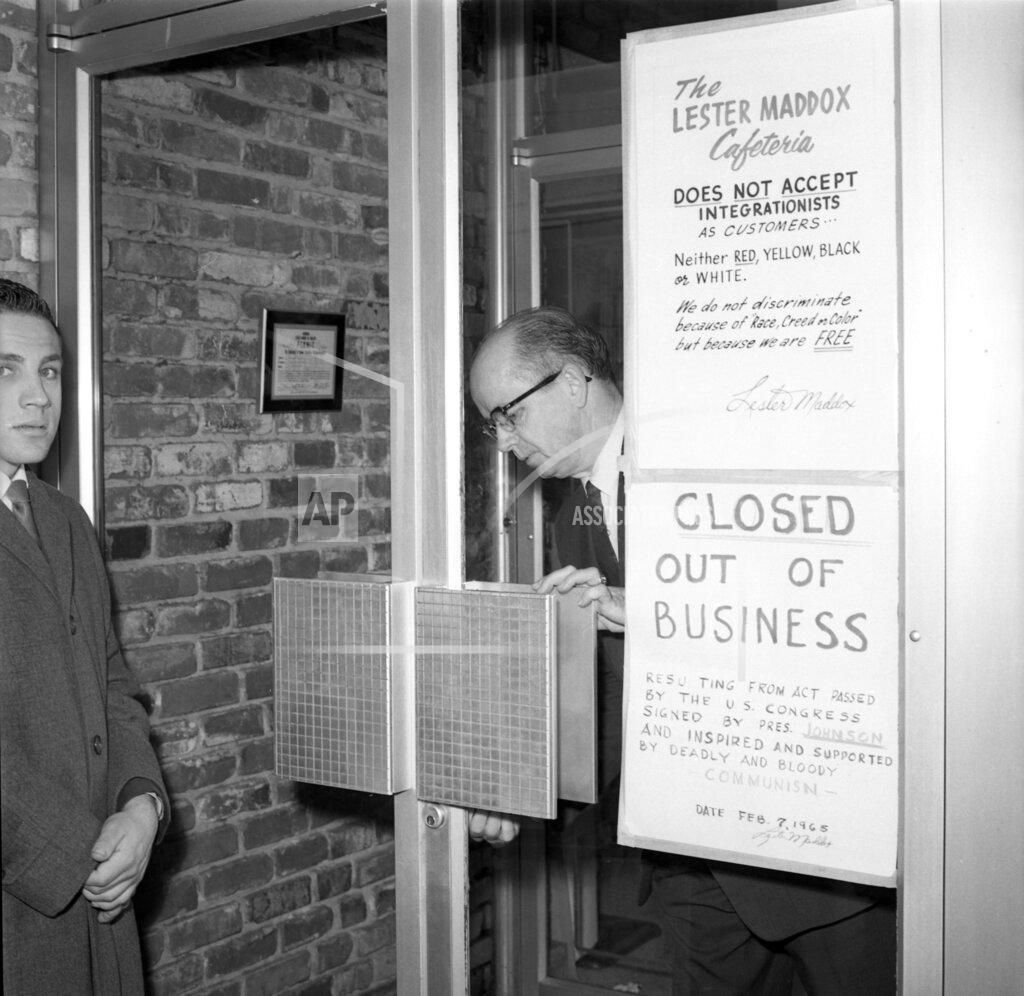
Lester Maddox closed his popular Pickrick Restaurant in Atlanta, one day after he had begrudgingly announced that he would relent to a court order and serve African-American customers, rather than face a daily $200 fine for contempt of court. At noon, when a young Black man named Jack Googer arrived to be the first customer, Maddox announced that he was closing the business. “I cannot betray my vow to my God” (to not serve Black customers), he told reporters. “Dollars are unimportant to me.” Maddox then placed a sign on the door, announcing that the Pickrick was “out of business, resulting from an act passed by the U.S. Congress, signed by President Johnson and inspired and supported by deadly and bloody Communism.”
The Rev. Dr. Martin Luther King Jr. said tonight that he would confer in Washington Tuesday with Vice President Humphrey and Acting Attorney General Nicholas deB. Katzenbach on measures to gain voting privileges for Blacks.
A survey in the current issue of Newsweek magazine finds that Blacks are now more hopeful on civil rights and less inclined to violence to achieve new goals.
The American Medical Association’s House of Delegates set the stage today for a campaign to defeat the Johnson Administration’s medicare bill with its own “eldercare” plan. The House passed a resolution endorsing and “enthusiastically supporting the A.M.A. proposal, which will be promoted by a large-scale national “educational program.” The eldercare bill would expand the present Kerr-Mills state administered plans by subsidizing private health insurance plans with Federal and state funds for the poor of age 65 and older. The medicare bill would provide hospital and nursing home benefits under Social Security for persons 65 and older.
A tentative agreement was reached between shippers and Philadelphia longshoremen to end a 28-day dock strike, apparently paving the way for a complete ending of the strike on the East and Gulf Coasts.
Two groups, including a Presidential task force, have urged the creation of an independent Department of Education in the Cabinet.
Constitutional doubts raised against parts of President Johnson’s $1.25 billion school aid bill seem unlikely to prevail over political realities.
An Omaha television announcer said fingerprints that have identified him as a missing resident of Akron, Ohio, are wrong, but two Ohioans are sure he is their brother who disappeared in 1957.
The Labor Department reported today that 61 persons were convicted in the last fiscal year of violating the embezzlement or related provisions of the Labor Management Reporting and Disclosure Act of 1959.
The Publishers Association of New York City has offered the printers on its seven affiliated newspapers an increase of $3.50 a week in each year of a proposed three-year contract. The offer was rejected.
The Broadway musical “Kelly,” with lyrics by Eddie Lawrence and music by Mark Charlap, had its opening night performance at the Broadhurst Theatre and then closed, making history as the most expensive Broadway failure up to that time. The loss to investors in 1965 was $650,000, equivalent to almost $4.9 million fifty years later.
George Harrison’s tonsils are removed.
On February 7, 1965, Some two months before the Astrodome’s grand opening in 1965 (then known as the Harris County Domed Stadium), Satchel Paige was in town to coach a basketball team in a game versus the Harlem Globetrotters. Aware of his visit, Houston management contacted Paige on the morning of February 7 and asked the spry 58-year-old if he would come down and throw a few pitches off the mound. Eager to see the newfangled ballpark, Satch agreed and arrived sometime before noon.
This wasn’t the last time Paige took the mound in 1965. On September 25, two months after celebrating his 59th birthday, he was coaxed out of retirement by Kansas City Athletics owner Charlie Finley, who offered the legendary hurler a one-day contract worth $3,500. Asked if he could go three innings, Satch quipped: “That depends. How many times a day?”
Despite his braggadocio, most dismissed the event as a cheesy gimmick and expected to see a broken-down old man trying to relive his youth. Paige, however, had other ideas. Amazingly, Satch hurled three scoreless frames versus the Boston Red Sox—he allowed one hit, a double by Carl Yastrzemski, and even struck out a batter. “I never expected to see what I saw that day,” declared Diego Segui, who relived Paige in the fourth inning. “You don’t think a guy that age, he’s got all this gray hair, and he’s getting everybody out? You don’t expect that.”
Born:
Chris Rock, African-American comedian (“Saturday Night Live”, 1990-1993; “Everybody Hates Chris”); in Andrews, South Carolina.
Jason Gedrick, American actor (“Heavenly Kid”, “Class of ’96”), in Chicago, Illinois.
Larry Smith, NFL linebacker (Houston Oilers), in Marion County, Kentucky.
Died:
Lee Hoi-chuen, 64, Chinese opera singer and film actor; father of Hong Kong-American martial artist and actor Bruce Lee.
Nance O’Neil, 90, American stage and silent film actress (“Cimarron”, “Royal Bed”, “Rogue Song”) nicknamed “the American Bernhardt.”
Viola Desmond, Canadian businesswoman and civil rights activist (first woman on a Canadian banknote).



 History Diaries