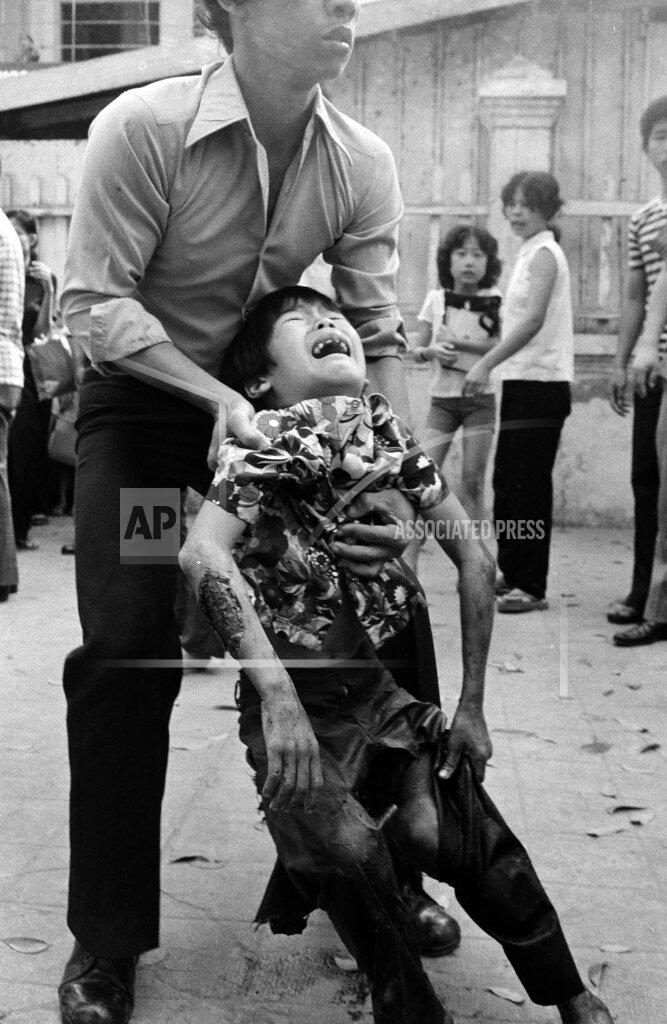
One of the rockets that the Cambodian insurgents have been firing daily into Phnom Penh struck the classroom of a crowded primary school today and 14 children, all under 12 years old, were killed. At least 25 others were wounded. The Chinese‐made 107‐mm. rocket struck shortly after 9:30 AM while the 30 children in the classroom were studying French. It deflected off a tree on the sidewalk outside and its shrapnel fragments rained on the children through the thin corrugated tin roof. The Wat Phnom School is in the heart of Phnom Penh, so the noise drew scores of people within minutes. In the small schoolyard, children were running everywhere — bleeding, shrieking uncontrollably and sobbing in shock. Weeping teachers tried to help the wounded and calm the others. Blood was over everything, including across the blackboard, where French nouns were chalked. On the floor of the classroom lay bodies in pools of blood.
The military police arrived with ambulances and began carrying out the wounded. Sometimes they unknowingly picked up a dead child and someone would shout: “He’s dead, he’s dead, don’t put him in the ambulance.” Within a few minutes word spread through the city and frantic parents began arriving at the school in cars and rickshas. The police tried to hold them back, but they pushed into the schoolyard in a frenzied search for their children. There were many tearful reunions, but, for others there was grief. “Where is my son? Where is my son?” a terrified man kept calling as he ran through the school. Children whose parents had not arrived stood immobilized, some bleeding and some trying to scream but unable to make a noise.
Meanwhile, 500 other pupils in the private school, operated for the upper middle class, poured out of their classrooms in various states of hysteria. Eventually the crowds dispersed and the gates were closed and locked. Janitors began washing away the blood. Eight children had been killed instantly and six died later in the hospital. On the sidewalk outside, young woman — a noodle vendor — had also been killed. A few hundred yards away, another rocket landed within moments of the one at the school. This one exploded near the central market, killing four persons and wounding about 15 others. It was not the worst rocket attack the capital had suffered in this war, which is nearly five years old. But it was the first time an insurgent shell had fallen on a classroom full of children. In a statement, the Phnom Penh Government called it “a massacre of innocents” and called on the world to condemn the Communists.
The rate of shelling casualties this year has been about the same as it was a year ago. But there is concern that heavier barrages are to come. Approximately 500 shells have landed in and about the city and airport since the current insurgent offensive began more than five weeks ago, and nearly 500 civilians have been killed or wounded. The rockets that fall on the city almost never land on military targets, and Western military observers believe the purpose is almost entirely psychological rather than strategic. Most of the rockets fall on the edges of the city. Phnom Penh is under no immediate threat of a major ground assault, but almost all supply routes to the city are cut and there are few outgoing international flights. The French Embassy cited the flight situation in recommending that French women and children leave, saying that quick evacuation of such a large community — 2,000 in all — would be difficult if the military situation deteriorated suddenly. The city has more than month’s supply of food and fuel, but the last main supply route to the outside world, the Mekong River, is blockaded by the insurgents, who have begun to lay mines in it.
President Ford has asked for $497‐million in military aid for Cambodia, but figures obtained in Phnom Penh and from the Administration’s own estimates show that as recently as a few weeks ago American officials believed a far lower amount would be sufficient. Information gathered from Western diplomats and military analysts, as well as from officials at the United States Embassy, indicates that the President’s request last week for supplemental military aid — an extra $222 million, which would bring the total to the $497‐million figure — may be more than the government needs for this fiscal year, which ends June 30. The analysts feel that this raises serious questions whether the Ford Administraion is trying to extablish a buffer arms stock for next year, when a war‐weary Congress can bc expected to provide even less aid to Indochina than this year.
The Saigon Government held a long news conference today in which it presented what it called “live evidence” that it had cracked a ring of Communist agents who had infiltrated the press here. The two‐and‐a‐half‐hour conference, presided over by the commander of the national police, the Interior Minister and the Information Minister, featured two men who said they were former Communist agents who had specialized in subverting Saigon’s press. Vietnamese and foreign reporters were not permitted to question the two after they had spoken. After the news conference, an editor of Điện Tín, one of five opposition newspapers closed by the Government earlier this week, denounced one of the two men as a police agent. The crackdown on the press followed the publication Sunday by nine dailies of a political “indictment” of President Nguyễn Văn Thiệu by the Roman Catholic‐led People’s Anticorruption Movement. Arrests of journalists began over the weekend and continued into early this week.
Information Minister Hồ Văn Châm vehemently denied that there was any connection between the political attack on Mr. Thiệu and the arrests and newspaper closures. “There is no — absolutely no — relationship,” he asserted. Major General Nguyễn Khắc Bình, commander of the national police, said that 18 “confirmed Communist agents” had been arrested in the cracking of the ring. A list of 18 names supplied to the press did not include that of Võ Trọng Lượng, who told today’s gathering that he had infiltrated Điện Tín on Communist orders. The list included some well known and some relatively obscure figures on the Saigon press and intellectual scene.
The U.S. Defense Department is proposing to add a new dimension to its strategic arsenal by giving future submarine‐launched missiles a capability to attack Soviet inter‐continental missiles in their silos. In some Congressional circles, there is concern that the Pentagon’s proposal would drastically change the character of the submarine — based deterrent force and introduce new instabilities into the strategic arms competition with the Soviet Union. The Pentagon’s proposal was contained in secret portions of the research and development budget presented to the Senate and House Armed Services Committee this week, according to committee sources. The Defense Department requested funds to develop a “good, hard target capability” for the Trident 2 missile, the sources said. The Trident 2 is the advanced, 5,000‐mile‐range missile being developed for the 10 Trident submarines planned by the Defense Department as partial replacements for the pres. ent Polaris and Poseidon submarines.
Until now, the submarinebased missiles have been viewed primarily as an inherently invulnerable deterrent force that could be used to retaliate against Soviet cities and industrial centers, even if the United States land‐based missile and bomber forces were destroyed in a Soviet attack. Partly because of the problem of pinpointing the location of submarine, the submarinelaunched missiles were not regarded as having sufficient accuracy to attack a “hard target,” such as an underground missile silo. Now, however, with the new development program, the Pentagon is moving in the direction of making the submarine missiles capable of attacking Soviet missiles in their silos.
Soviet leader Leonid I. Brezhnev reportedly has recovered from his recent illness and is expected to receive British Prime Minister Harold Wilson in Moscow next week. Soviet sources indicated that Brezhnev — who has not been seen in public since Dec. 24 — had not yet resumed his full work program but would do so within the next few days.
The Soviet fisheries minister called off a trip to Portugal following reports that Moscow was pressing Lisbon for port facilities for Russia’s Atlantic fishing fleet. Alexander A. Ishkov had been expected this week for talks with Mario de Oliveira Ruivo, Portuguese secretary of state for fisheries, official sources said. Explanation for the sudden cancellation was that Ruivo had a “very busy schedule.”
With five candidates contesting the party, leadership in the second‐round elections next week, Britain’s Conservatives find themselves in an unfamiliar and unwelcome state of public disarray. Since Margaret Thatcher won her first‐ballot victory on Tuesday, knocking former Prime Minister Edward Heath out of the race, four more candidates have joined in. They are William Whitelaw, the party chairman, and three other senior party members: James Prior, John Peyton and Sir Geoffrey Howe. There is a suspicion in the House of Commons, however, that all four are really the same candidate, and his name is Whitelaw. Mrs. Thatcher, who is calling for the party to move back to its old principles and away from its compromises with the Socialist themes of postwar Britain, led a startlingly successful revolt against Mr. Heath and the party leadership.
Turkey has accepted in principle a Greek proposal to refer their dispute over oil exploration rights in the Aegean Sea to the World Court in The Hague, it was announced in Athens. A statement issued by the Greek Information Ministry said the two countries now would open talks to draft a document pledging to accept the ruling of the court. Such a pledge is a prerequisite for discussion in The Hague.
Greek judicial authorities remanded Lieutenant Colonel Petros Goros into custody for his activities during the period of the military dictatorship. He was the first officer on active duty to be imprisoned for such actions. Goros, who for several years commanded the military prison at Boyati near Athens, was accused of maltreatment of prisoners there, including both military and civilians opposed to the dictatorship which ruled Greece for seven years.
The Irish Republican Army flatly denied that it had threatened to assassinate two Irish cabinet ministers if any of 15 imprisoned IRA hunger strikers died. The government said that the threat had been relayed by clergymen and was genuine. The IRA, in a Dublin statement, called the alleged threat a “red herring” designed to divert attention from the hunger strikers. In Northern Ireland, the West Belfast Ulster Defense Assn. leader, Charles Harding, was wounded by a gunman in the second attempt on the life of a militant Protestant leader in two days.
Thieves in Italy broke into the Ducal Palace art museum at Urbino, and stole the paintings La Muta by Raphael, and the masterpieces The Flagellation of Christ and Madonna di Senigallia, by Piero della Francesca, considered to be three of the ten most famous Italian paintings from the Renaissance. Three invaluable Renaissance paintings — one by Raphael and two by Piero della Francesca — were stolen from the national gallery in Urbino, Italy. The paintings are Raphael’s portrait of a noblewoman, known as “The Mute One,” and della Francesca’s “The Flagellation of Christ,” and “Madonna of Senigallia.” Italy’s minister for the nation’s cultural patrimony linked the thefts with “the industry of blackmail.” The works were recovered, unharmed, on March 24, 1976, from a hotel room in Locarno, Switzerland.
British commercial diver John Martin drowned when his diving helmet slipped off during his ascent from a surface-orientated dive in the Stavanger fjord in Norway. There was some evidence that he had experienced nitrogen narcosis. Martin’s body was never recovered.
On the same day, a Dutch commercial diver reportedly disappeared while about to conduct a welding job in the North Sea at a depth of 14 metres (46 ft); his body was never recovered. This death appears in the records of the British Health and Safety Executive (HSE), but not in those of the Staatstoezicht op de Mijnen (SodM) in the Netherlands.
DDT, the insecticide, has been officially banned in Sweden. Swedish farmers stopped using DDT in 1969, but forestry firms are expected to appeal the ban because they use the chemical to protect young trees.
World Bank President Robert S. McNamara said that hundreds of thousands of persons around the world probably were going to die in the next five to 10 years because of neglect not only by the wealthy nations but by their own governments. He said in an interview in Washington that he was encouraged by the expanded aid effort of the oil-producing countries but sharply criticized the decline in assistance from traditional donor countries.”
Arab commentators and Western diplomats have begun talking about a possibility that a political settlement in the Middle East might be achieved through combined United States and Soviet intercession.
U.S. Secretary of State Kissinger has decided that if his coming efforts to bring about an Egyptian-Israeli agreement fail, he will give up his step-by-step mediation approach, State Department officials said today.
A crucial by-election was held in Kankesanthurai, Sri Lanka. Tamil independence advocate S. J. V. Chelvanayakam retained his seat in the National State Assembly and cited the victory as a mandate for Tamil sovereignty.
Prime Minister Zulfikar Ali Bhutto of Pakistan discussed his country’s security needs with Secretary of State Henry A. Kissinger and Defense Secretary James R. Schlesinger as the United States actively considered lifting its 10-year ban on arms supplies to Pakistan. Bhutto’s request for arms may run into some difficulty in Congress, however, because of his country’s support for the Palestine Liberation Organization. Bhutto was in Washington for a two-day visit.
Thailand’s new National Assembly elected a Speaker and Deputy Speaker today in its first working session since the Jan. 26 general election.
The official Chinese news agency, Hsinhua, indicated that the epicenter of a major earthquake in southern Manchuria this week was in a heavily populated industrial area and 35 miles from Anshan, the country’s leading iron and steel complex. It gave no casualty figures or damage estimates.
Military authorities have clamped a news blackout on the Muslim rebellion in the southern Philippines. The Manila statement came amid unofficial reports of an intensive rebel offensive in the predominantly Muslim Mindanao-Sulu region, where government forces were reported to have suffered severe casualties.
The Peruvian military Government declared a holiday for all businesses and employes today and extended the suspension of constitutional guarantees for 30 days in an attempt to quell public disorders. But the pillaging, brought on by an army assault yesterday on the garrison of policemen striking for higher wages, continued sporadically in downtown Lima. There were no reports of disorders elsewhere in the country. Large‐scale rioting yesterday against the leftist government may have left more than 50 civilians dead, in addition to the policemen reported killed during the army assault.
The Brazilian Government today disclaimed any knowledge of the whereabouts of 19 political prisoners reported to have disappeared while under detention in the last 17 months. The Minister of Justice, Armando Ribeiro Falcão, issued brief announcement in Brasilia declaring that one of the 19 was believed to have been killed in Bolivia and the others had either been freed, fled justice or were in hiding. Relatives of the missing men said they were “shocked” by the minister’s declaration. “We know that they were arrested and we know they haven’t been freed or escaped, and so we want to know what’s happened to them,” the daughter of one said.
Reliable Ethiopian sources said today that seven days of fighting between secessionist guerrillas and Ethiopian troops had left at least 1,200 dead in the northern province of Eritrea. The sources refused to disclose the proportion of civilian guerrilla and government losses since the 13‐year conflict erupted into what amounts to a civil war last Friday. Mines placed by the secessionists on roads leading to Asmara from the south are said to have caused heavy government casualties. Street fighting in Asmara over the weekend was followed by clashes between guerrillas and troops outside the Eritrean capital. Fighter‐bombers then pounded suspected guerrilla strongholds north of the city, flattening at least three villages. Reliable sources said earlier that the guerrillas had used rockets and mortars against Ethiopian troops trying to storm rebel strongholds north of Asmara.
An Australian visitor to South Africa became the first victim of a new outbreak of the Marburg virus, thought to have been eradicated eight years earlier, after being stung by an unknown arthropod near Hwange. He would die on February 19 in Johannesburg.
The House Ways and Means Committee gave all-but-final approval to an antirecession tax-cut bill that would give almost everyone a cash rebate of $100 to $200 this spring. The bill would provide $8 billion in cash rebates of 1974 taxes to individuals; $8.4 billion in reductions of 1975 taxes for individuals, mainly those in the low and lower-middle-income brackets, and $3.8 billion in business-tax reductions.
President Ford spoke harshly of Congress, accusing it through his press secretary of inaction on his energy and economic programs and of doing “basically nothing” in the last month. Ron Nessen, the press secretary, said that so far “all they’ve done is stop action.” The President’s attack was regarded as one of the more striking manifestations of the widening gulf between the White House and a Congress dominated by the Democratic party.
Even as Congress is chalenging President Ford’s power to increase fees on imported oil, homeowners, motorists and businessmen across the nation are expressing their anger and frustration over the prospect of higher fuel prices.
Senators Jacob K. Javits, Republican of New York, and Harrison A. Williams Jr., Democrat of New Jersey, announced today that they would introduce dipartisan legislation tomorrow to expand the public service employment program by one million jobs.
Senator Henry Jackson of Washington announced his candidacy for the Democratic presidential nomination, betting that his traditional liberalism would prove popular in hard times. His declaration was contained in a five-minute television commercial over the CBS-TV network.
Because of opposition from residents of surrounding neighborhoods, the John F. Kennedy Library Corporation dropped its plans for a museum honoring the late president near Harvard Square in Cambridge, Massachusetts. Stephen E. Smith, the corporation’s president, said that the Kennedy archives might remain in Cambridge, or the entire complex might be moved elsewhere. The $27 million library/museum was projected to open in 1976 but it has aroused considerable opposition from residents of the congested Harvard Square area. Designed by architect LM. Pei as a seven-story, glass-walled pyramid, it was to be built on the site of a subway yard near the square and Harvard’s campus. The project, also planned to house Harvard’s Kennedy School of Government and Institute of Politics, later was scaled down in design.
Initial claims for unemployment insurance benefits eased somewhat during the week ending January 25 but still remained well above normal, the Labor Department reported. It said 731,600 workers filed initial claims during the week ending January 25, a decrease of 118,900 from the previous week and down substantially from the peak of 920,000 during the first full week of 1975. In all, about 25 million persons applied for unemployment insurance benefits during the first three weeks of the year, the department said. In a separate report, it said 4.733 million persons collected unemployment checks during the week ending January 18, an increase of 169,400 over the previous week.
Vice President Nelson A. Rockefeller is suggesting names to head the White House Domestic Council but President Ford has not yet decided whom to appoint to the key advisory posts, a White House spokesman said. Press Secretary Ron Nessen said he did not know if Mr. Rockefeller had proposed that two of his top assistants be put in charge of the council. as reported by the New York Times. But he denied suggestions that there was friction between the President and Vice President. “Absolutely not -there really isn’t,” he said.
The Senate Intelligence Committee held its first organizational meeting and warned that any staff member who leaked information to the press would be fired. Chairman Frank Church (D-Idaho) announced that William Miller, 43, a Senate staff member specializing in defense and foreign policy issues, was approved unanimously to be the new select committee’s staff director. Senator Charles McC. Mathias Jr. (R-Maryland), a committee member, said the mission of the investigation would be to write a new charter for the intelligence community rather than to concentrate on a hunt for wrongdoers.
Former Governor Ronald Reagan of California, said today that he had offered to resign from the Presidential commission investigating the Central Intelligence Agency, because he has been too busy to go to its meetings.
A woman, her lawyer son, and her sister were charged with arson in New York City. Authorities say, all are suspected of involvement in a ring that set more than 400 fires to profit from insurance. The indictment named Rose Shiffman, 73, her son, Abraham, 46, of Lawrence, New York, and the sister, Sylvia Goldberg. The two sisters live near each other in Rockaway, Queens. They were charged with conspiracy to commit arson and soliciting an undercover man to commit arson. Queens District Attorney Nicholas said the operation began 10 years ago when the three defendants started buying houses, obtained high insurance and had the unoccupied buildings burned down.
Chicago’s Field newspapers-the Chicago Sun-Times and the Chicago Daily News-ended a long string of past endorsements of Mayor Richard Daley by backing a rival in the Democratic mayoral primary February 25. They are backing Alderman William S. Singer, one of three Democrats challenging Daley for the job he has held for 20 years. “The best interests of Chicago, so well served by the resourcefulness of Mayor Daley in the past, now requires a change of political leadership,” the Sun-Times said. It named three factors — his age (72), his health (he recently suffered a minor stroke) and his lengthy tenure.
Radioactivity in California air last year was about the same as the average level of the last 10 years, the state Department of Health said. However, the 1974 level was more than twice as high as the 1973 level, the department said. But a spokesman said 1973 was an unusually low year for radiation. He said although last year’s readings were higher, they were about the same as the years since the signing of the atmospheric nuclear test ban treaty a decade ago.
The U.S. performs a nuclear test at the Nevada Test Site.
Dow Jones Industrial Average: 714.17 (-3.68, -0.51%)
Born:
Chad Allen, Team USA and MLB outfielder (Olympics, bronze medal, 1996; Minnesota Twins, Cleveland Indians, Florida Marlins, Texas Rangers), in Dallas, Texas.
Tomoko Kawase, Japanese singer with The Brilliant Green, in Kyoto, Japan.
Died:
Sir Keith Park, 82, New Zealand born Air Chief Marshal of the Royal Air Force, nicknamed “The Defender of London” for his work during the Battle of Britain.





 History Diaries