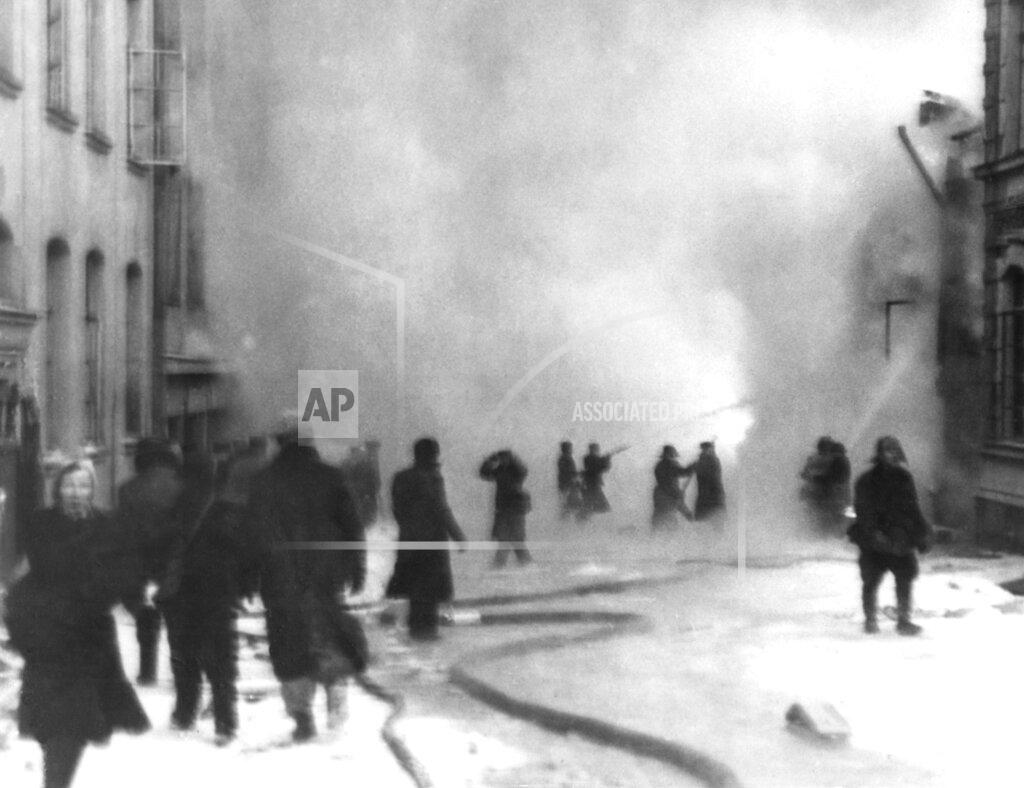
The Soviet 7th Army and 13th Army continue ‘demonstration operations’ against the Mannerheim Line. The Soviets are not really advancing, but they are not trying very hard yet. For now, they are weakening the Finnish Mannerheim line in aid of a breakthrough at a later point.
Karelian Isthmus: following a preliminary artillery bombardment, the enemy launches heavy assaults in the morning in the areas of Summa, Marjapellonmäki and Lake Hatjalahti with the support of over one hundred assault tanks. Despite overwhelming numerical superiority the attack becomes bogged down and ends in the destruction of 22 assault tanks.
In Ladoga Karelia, the Finnish counterattack in the Pitkäranta area is unsuccessful.
Soviet air raids continue. The monastery of Valamo on Lake Ladoga is among the places hit, as well as churches.
In Northern Finland, the Red Air Force drops a number of parachutists, but the Finnish defences are able to locate where they land.
In the early hours of the morning Finnish aircraft bomb the enemy troops bivouaced around their campfire.
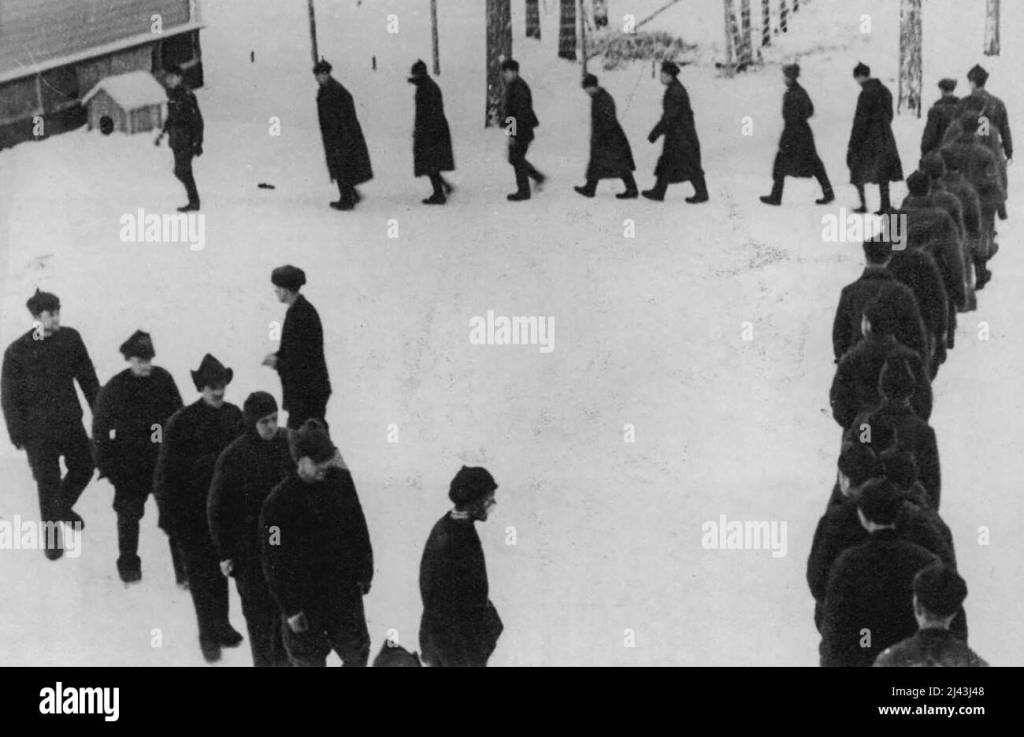
Ladoga Karelia, the Russians begin to take Karelians from the border villages in the municipality of Suojärvi over the border into Soviet Karelia.
Over 1,500 are transferred to two transit camps. Those moved are mainly from Suojärvi but a few are from border villages in the municipality of Salmi. Old people, women and children are transported in lorries to forest labour centers almost 200 kilometers away in Interposolka and Kaimaoja. A number of children die on the cold journey. Over 50 children and old people die in the camps due to a lack of proper food.
In Northern Finland, a battalion of the enemy’s Dolin ski brigade tries to get behind the Finnish troops at Haukkajärvi, but is pushed back across the border by Detachment Kekkonen.
Supreme Allied Command in Paris decides to help Finland. An allied unit of at least two brigades in strength is to be sent to Finland in the middle of March.
The Finnish Red Cross receives a donation from the Belgian Red Cross.
The great Finnish runners Paavo Nurmi and Taisto Mäki travel to Washington, where they are received by U.S. President Franklin D. Roosevelt.
The Finnish Foreign Minister meets in Stockholm with intermediaries for secret peace talks to end the Winter War against Soviet Union. Foreign Minister Väinö Tanner confers with his Swedish counterpart, Christian Günther, before proceeding to Hella Wuolijoki’s room in the Grand Hotel to hold a meeting at 11 a.m. with the Soviet Ambassador in Stockholm, Madame Alexandra Kollontai.
Tanner is told the Soviet Union cannot accept Finland’s terms for opening talks, and Tanner then suggests one of the islands in the Gulf of Finland as an alternative site for a Soviet base instead of Hanko. Ambassador Kollontai promises to pass the proposal on to her government for consideration.
The Anglo-French Supreme War Council met again in Paris with Neville Chamberlain and Winston Churchill in attendance. Franco-British plans for intervention in the Winter War were discussed. The Allied Supreme War Council, meeting in Paris, made a final decision to send a British expeditionary corps of 100,000 and a French force of 50,000 men, to Finland. Also at the meeting it was decided that in sending an expeditionary force to Finland, the Swedish iron ore mines and the port of Luleå should be occupied by troops landed at Narvik, Norway, which was a short distance from the iron ore fields. Churchill remarked at the meeting that it was decided “incidentally to get control of the Gullivare ore-field.” This was in spite of Sweden’s proclamation of neutrality in the war. A flow of arms and ammunition from the West would pour into Finland. Britain provided Finland with 101 planes, 214 guns, ammunition and other military hardware; and France provided 179 planes, 472 heavy guns, 5,100 machine-guns, 795,000 shells, and several thousand sets of accoutrement. Armaments and “volunteers” likewise came from the United States, Sweden, Norway, Germany, and Italy.
By comparison with the contemporary, meticulous German plans, these Allied preparations are vague and irresolute. The pretext of going to help Finland is unconvincing and it is the obvious intention to devote most effort to stopping the Swedish iron ore reaching Germany.
However, the operation is assigned only two British divisions, which only exist on paper and will have to be diverted from BEF in France. British Chief of Staff General Sir Edmund Ironside notes in his diary “everyone purring with pleasure”, unaware of detailed German plans to invade Norway with much larger forces.
BEF’s Chief of Staff General Henry Pownall is furious, recording in his diary “For five months we have been struggling to make fit for action in the spring a force that was dangerously under-equipped and untrained. There were signs that we were getting some reasonable way to our goal. If this business [the invasion of Norway] goes through, we shall be cut by 30%. Of all the harebrained projects I have heard of, this is the most foolish.”
Dutch armed forces commander-in-chief General Reijnders resigns over lack of government support for increased defense preparations. He is replaced by General Henri Winkelman. Reynders was disgraced by his intemperate reaction to the Mechelen Incident.
General Percival takes command of the British 43rd Infantry Division.
Forty-five people were reported killed and scores injured in an earthquake during Saturday night which destroyed two villages in Erzincan, northeastern Turkey. The Erzincan region bore the brunt of last December’s earth quake disasters in which tremblors, severe weather and subsequent floods killed more than 30,000 persons.
The Kriegsmarine (German Navy) Type IX U-boat U-41, commanded by Kapitänleutnant Gustav-Adolf Mugler, damaged Dutch motor tanker Ceronia at 0330 hours in the Western Approaches (49° 14’N, 8° 34’W). The 8,096-ton Ceronia made it to Rotterdam, Netherlands under her own power. Subsequently repaired and returned to service.
At 1310 hours, U-41 also torpedoed and sank British steam merchant Beaverburn (9,874 GRT) of the Canadian Pacific Steamships Line, commanded by Captain Thomas Jones, Master, in the Western Approaches, in position 49.20N, 010.07W, 150 miles south of Ireland, killing 1, with the remaining 76 rescued by British tanker Narragansett. Beaverburn had been en route to St. John, New Brunswick.
Shortly after, U-41 was sunk by depth charges from the British destroyer HMS Antelope which was escorting Convoy OA-84, killing all 49 aboard; it was the first time a lone British destroyer destroyed a German submarine, and Lieutenant Commander White of Antelope was awarded the DSO award. During its career under Kapitänleutnant Mugler the U-41 sank 5 ships for a total of 22,815 tons, captured 2 merchant ships for a total of 2,073 tons, and damaged 1 merchant ship for a total of 8,096 tons.
The Danish schooner Karen was sunk in the North Sea off Methil, Fife, United Kingdom by an accidental engine explosion. Two crew were killed, seven survived.
The U.S. freighter Exford was detained at Gibraltar by British authorities.
The U.S. Maritime Commission announced that Britain and France would buy 113,000 tons of old American cargo ships.
Convoy OA.86 departs Southend.
Convoy SL.19F departs Freetown for Liverpool.
The War at Sea, Monday, 5 February 1940 (naval-history.net)
U-41, on her third war patrol, attacked convoy OB.84 south of Ireland and sank British steamer BEAVERBURN (9874grt) in 49 20N, 10 07W and badly damaged Dutch tanker CERONIA (8096grt) in 49 14N, 08 34W. One member of crew was lost on BEAVERBURN and American tanker NARRAGANSET (10,389grt) rescued the 39 survivors. Destroyer ANTELOPE escorting the convoy was able to sink U-41 in 49 21N, 10 04W at 1313 with the loss of all 49 crew, and also claimed to have sunk a second submarine, although U-41 was the only one in the area. The second attack was at 1125 and was later determined to be the wreck of tanker SAN ALBERTO lost in December in 49-18N, 9-50W.
Destroyer VANOC attacked a submarine contact near Morecambe Light Vessel in 53-53N, 2-29W.
Armed patrol yacht SHEMARA (588grt) made an attack on a submarine contact off Portland Bill in 50-25N, 2-29W.
Convoy ON.10 of seven British, ten Norwegian, seven Swedish, four Finnish and one Estonian ship departed Methil escorted by destroyers IMOGEN, IMPERIAL, ILEX, DELIGHT, and TARTAR and submarine NARWHAL. DELIGHT was ordered to Scapa Flow with dispatch on the 6th, and TARTAR was relieved by destroyer KIMBERLEY at sea. On the 7th February, DELIGHT attacked a contact east of South Ronaldsay in 58-55N, 2-09E, and was joined by destroyers GALLANT and GRIFFIN. ON.10 arrived safely at Bergen on the 8th.
Convoy FS.88 departed the Tyne, escorted by destroyer WOOLSTON and sloop GRIMSBY, but before arrival, WOOLSTON was detached to Sheerness to refuel. The convoy arrived at Southend on the 9th with FS.86 after being considerably delayed by heavy fog. Convoy FS.89 was cancelled.
Convoy MT.4 departed Methil, escorted by destroyers JACKAL and JAGUAR, sloop LONDONDERRY, and anti-submarine trawlers of the 3rd Anti-Submarine Group, and arrived in the Tyne on the 6th.
Minelayer PRINCESS VICTORIA, escorted by destroyers ECHO and ECLIPSE, was to have departed Aberdeen on the 4th for minelaying operation LD 1 during the night of the 4th/5th, but was delayed by fog. The operation was finally conducted on the 6th/7th when 48 mines were laid.
Convoy OA.86 departed Southend and was dispersed on the 8th. No escorts are listed.
Anti-aircraft cruiser CARLISLE arrived at Gibraltar from Devonport to work up after conversion to anti-aircraft ship, departed on the 8th for Malta, and arrived on the 10th.
Sloop FOLKESTONE arrived at Gibraltar from Malta.
Minesweeper FERMOY departed Port Said to relieve minesweeper GOSSAMER at Gibraltar.
French heavy cruiser TOURVILLE and destroyers VAUBAN and AIGLE departed Malta for Toulon.
French armed merchant cruiser EL D’JEZAIR stopped Portuguese steamer GUINE (2648grt) in the North Atlantic and removed a German citizen.
Steamer OREGON (6008grt), which had broken down on the 2nd with boiler problems, was located off Caesces, Portugal by destroyer DEFENDER. She had been attacked on 30 January in 45-40N, 11-36W while sailing with convoy SL.17. DEFENDER stood by and Danish salvage tug VALKYRIAN arrived to take her in tow. DEFENDER was relieved by destroyer VORTIGERN on the 8th, and OREGON arrived at Lisbon on the 10th.
Convoy SLF.19 departed Freetown escorted by armed merchant cruiser MOOLTAN. Convoys SL.19 and SLF.19 merged on the 16th and SL.19’s escort, armed merchant cruiser PRETORIA CASTLE joined MOOLTAN. Destroyers VERITY, VIMY, and WALPOLE and sloop SANDWICH relieved the armed merchant cruisers on the 17th and took the convoys on to their destination on the 20th.
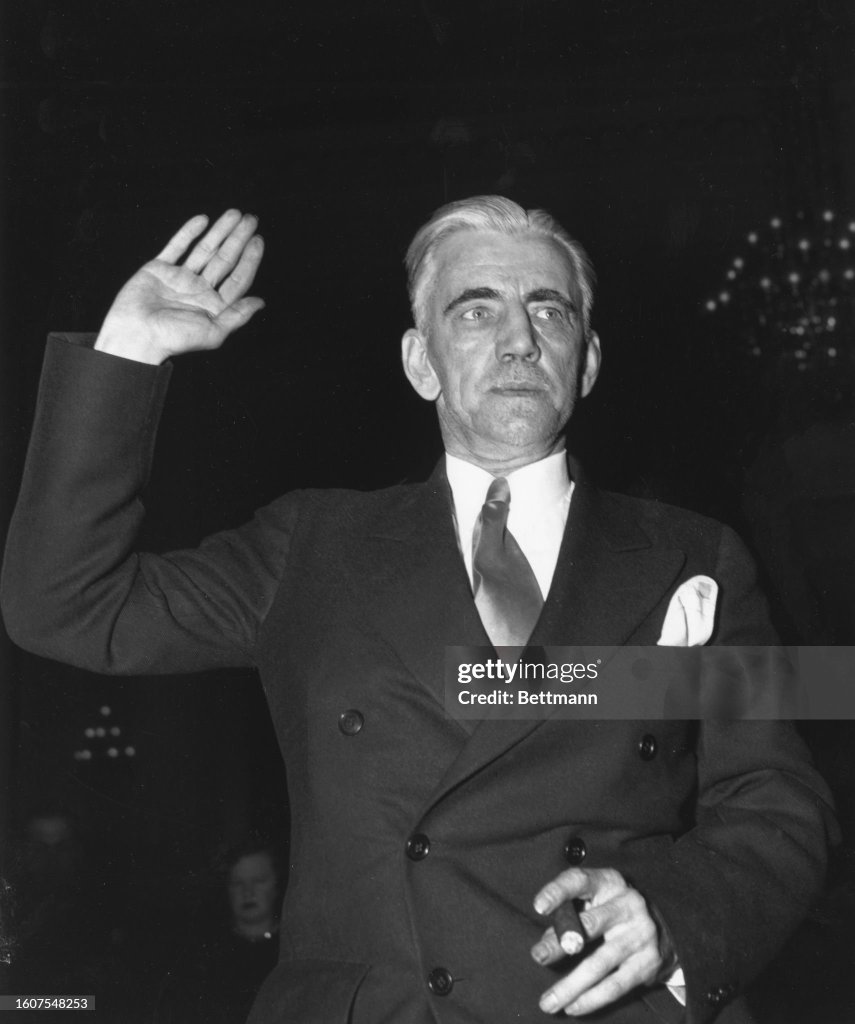
President Roosevelt’s fifth appointee to the supreme court, Frank Murphy of Michigan, began service on the tribunal after taking an oath to administer justice impartially. Justices appointed by Mr. Roosevelt thus constitute a majority of the nine man tribunal. The oath was given in open court by Charles Elmore Cropley, the clerk, after Murphy had marched into the chamber with his colleagues. Murphy, former Recorder’s Judge in Detroit, Mayor of his home city, Governor General of the Philippine Islands, Governor of Michigan and Attorney General of the United States, today reached a still higher rung on the ladder of public service. He was sworn in as Associate Justice of the Supreme Court. Robed in black and solemn in the extreme, Mr. Murphy stood before Cropley, Clerk of the Court, and promised to perform his duties under the Constitution. Every seat in the court room was filled. Present were lawyers who had come to try cases, friends and well-wishers of Mr. Justice Murphy. and associates of his in the New Deal who had left no stone unturned to advance him in official circles in Washington.
Chicago is selected as the site for the coming summer’s Democratic National Convention as speculation continues to swirl around the possibility of a run for a third term by President Roosevelt. Chicago, the birthplace of the New Deal as the scene of President Roosevelt’s nomination in 1932, was selected today for the 1940 Democratic National Convention by the Democratic National Committee, which met with the third-term issue overshadowing the routine proceedings. Chairman James A. Farley was authorized to fix the date of the convention. This action made it possible for him to set the time after the Republican National Committee decides on a date at a meeting here February 16. The Democrats want to continue their custom of nominating the Presidential ticket after the Republican candidates have been chosen. President Roosevelt has expressed the wish for a late convention and a short campaign.
Most of the Democratic leaders at today’s meeting appeared to favor renomination of Mr. Roosevelt. Only clever manipulation and promises to Roosevelt admirers that resolutions praising the President would be adopted prevented a move to draft the President for a third term. While none of the sentiment to put the party on record for the renomination of Mr. Roosevelt came to the surface, committeemen did not hesitate to say privately that the President was the “outstanding” candidate. Canvassers reported that fully 90 percent of the leaders either favored or were not opposed to the President’s renomination. A resolution to draft him would have been adopted almost unanimously, it was indicated.
The Senate was in recess today in Washington. The monopoly Committee discussed plans for resumption of its study of insurance company systems.
The House met briefly and adjourned at 12:09 PM until noon tomorrow out of respect to the late Representative Cassius Dowell. The Naval Affairs Committee heard representatives of the National Council for the Prevention of War oppose the Naval Expansion Bill; the Rules Committee held a hearing on the resolution to expunge from the record remarks of Representative Hook about Representative Dies and the Committee Investigating Un-American Activities, and the Committee Investigating the Labor Relations Board heard Edwin S. Smith on NLRB procedure.
In his first answer to pre-campaign criticism of his Administration, President Roosevelt today recited substantial gains in various segments of the national economy since he entered the White House in 1933. He defied political foes to prove that “the country is going bust.” With his remarks on gains in the income of farm and factory workers since the low point in 1932 Mr. Roosevelt coupled substantial increases in employment, dividends paid by corporations, commodity exports and a reduction in interest rates. He then asserted that the total indebtedness of the Federal, State and local governments had not increased during the seven-year period, and predicted that after a year of an $80,000,000,000 national income the Federal budget would be brought into balance.
Before producing his statistics on New Deal gains, gleaned from various government departments, the President told his press conference. that the country probably had become very tired of talk and speculation about the question of a third term. Efforts to draw him out on the subject were all very silly, he said, because the time of disposing of the issue would be of his own choosing rather than that of the curious. After pointing out a 71 percent increase in the national income from $40,089,000,000 in 1932 to $68,500,000,000 last year, the President said it was still the Administration’s hope to bring national income to the $90,000,000,000 level. He conceded, however, that for the present he was thinking of $80,000,000,000.
Implicit in Mr. Roosevelt’s remarks was the idea that no attempt should be made to balance the Federal budget through a horizontal reduction of expenditures, and that it would be time enough to think about balancing when the national income had been raised to the neighborhood of $80,000,000,000. Any sudden and drastic curtailment of Federal spending at this time would certainly be followed by unfortunate results, the President stated. He recalled the economic recession in the latter half of 1937, attributing it directly to a sharp and sudden reduction in government spending a few months before.
Although the President told reporters that no particular implication was to be drawn from his long statistical review, it was the conclusion of all present that it was intended as a reply to recent criticism of his Administration’s policies by Thomas E. Dewey, Senator Robert A. Taft and Frank E. Gannett, Republican Presidential aspirants.
Mrs. Franklin D. Roosevelt took issue today with John D. M. Hamilton, chairman of the Republican National Committee, on the question of the advisability of “purging” the American Youth Congress of Communists and on the alleged dominance of the organization by Communists. She discussed at her press conference Mr. Hamilton’s letter of yesterday to Joseph Cadden, executive secretary of the National Youth Congress, refusing to send a representative of the Republican party to a meeting of the congress. She declared that that part of Mr. Hamilton’s letter which cited the Dies committee represented a “slight misunderstanding” because the Dies report “did not say” the Youth Congress was dominated by its communist elements.
After a stormy three-hour debate at a closed meeting of its governing committees, the American Civil Liberties Union voted yesterday to bar henceforth from office or committee membership within the organization either Communists, supporters of Fascist régimes, or avowed sympathizers of any of the “native organizations with obvious anti-democratic objectives or practices.” The new statement of policy was embodied in a resolution adopted by the national committee by a vote of thirty to ten, with three members not voting, and by the board of directors by thirteen to seven, with two not voting. The dissenters issued a strongly-worded statement of their own laying the resolution to the “hysteria which has been aroused by recent international events.” “This resolution,” said the minority statement, “will disappoint all those who feel that the Civil Liberties Union is the last organization in the world to start a species of Red hunt, which is precisely what this carefully dressed-up resolution aims to do. There is and has been. no public clamor to purge the A.C.L.U.”
The Department of Justice will be asked to investigate and take “appropriate action” on the charges made by Representative Hook, Democrat, of Michigan, against Representative Dies, chairman of the Committee to Investigate Un-American Activities.
Vice President Garner consented today to enter the Wisconsin primaries and contest for the twenty-four delegates to be selected at the April 2 election. He is the only Democrat thus far to seek delegates from that state.
The U.S. Maritime Commission announces that Britain and France are buying 113,000 tonnes of old American cargo ships.
New York Mayor LaGuardia was a big disappointment to a lot of boys and girls Sunday. To a Bronx lad who wrote happily that, because of the city’s water shortage, he had convinced his mother that he should forego baths, the mayor replied: “Whatever happens, we want all our little boys and girls to take their daily baths, so tell mother now to be sure to give you a bath and plenty of scrubbing with it.”
The Ford Motor Company agreed today to comply with an order of the National Labor Relations Board to refrain from “disparaging” or “criticizing” labor organizations, but at the same time challenged the validity of the order, contending that it was an infringement on the right of free speeech.
Representative Cassius C. Dowell, Iowa Republican, died Sunday after a 10 day illness. He was 75 and was serving his 12th term from the sixth Iowa district. Associates said heart disease was the cause of his death. Dowell’s death was the 23rd among members of the 76th congress.
The Mississippi river’s worst ice jam this century unloosed its frigid grasp on steamer traffic and freight laden boats moved for the first time in 16 days. Vessels traveled cautiously, warily dodging floes whose white caps bobbed in the swift current. A ribbon of jagged ice, deposited as the broken jam moved southward, lined both shores from St. Louis, Missouri, to Friar Point, Mississippi.
Glenn Miller and his orchestra recorded “Tuxedo Junction” for RCA Victor’s “Bluebird” label.
Hope that today’s meeting between the Viceroy and Mohandas K. Gandhi, whose outcome was eagerly awaited, might lead to settlement of the Indian constitutional struggle faded today following the sudden breaking off of the talks and Mr. Gandhi’s decision to leave New Delhi tomorrow.
Battle of South Kwangsi: Japanese forces attacking Wuning.
Japanese planes bombed the French-owned Yunnan Railway again Saturday and stopped communications on additional sections of the railway, according to dispatches last night from Kunming, the Yunnan capital. Twenty-seven planes participated in the raid, dropping most of their bombs on the railway line and yards at Kaiyuan, about 100 miles from. the border of French Indo-China. Chinese pursuit planes engaged the bombers and it was believed that some of them were “damaged.” Earlier raids on the line, in which a number of persons were killed and others wounded, were reported to have brought informal protests from the United States on the ground that continued operation of the railway was essential to Chinese-American commerce.
Japanese described the raids as part of a general offensive in South China and said the line would be bombed continuously so long as the French authorities permitted military supplies for the Chinese to pass over it. The Chinese said that more than 200 Japanese planes were operating from the former Chinese airdrome at Nanning, which the Japanese have enlarged and improved since they captured the former Kwangsi capital.
Japanese officials said today that in Kwangsi Province their forces had surrounded 50,000 Chinese troops attempting to recapture Nanning and inflicted “heavy losses” on them. Japanese dispatches said the Chinese had lost more than 20,000 men in fighting between Nanning and Pinyang, to the north. The Chinese admitted Japanese advances there but said the invaders’ gains had been made at the expense of huge losses. The Chinese made no mention of their own losses and said their troops were maintaining a stiff resistance. The Chinese also reported fighting on a lesser scale near Siashunchwang, in Honan Province, where they claimed to have razed Japanese barracks and a supply depot. Another Chinese column was said to have blown up three bridges on the Taokow-Shinghua Railway, also in Honan Province.
Chinese military dispatches today report continued severe fighting in Kwangsi Province. The fall of Pinyang is not admitted in these dispatches, which assert that Japanese attacking Pinyang have been cut up by Chinese enveloping and flanking attacks and that a heavy engagement is under way at Lungshu, a few miles south of Pinyang. Fighting continues in the vicinity of Pinyang, according to military reports from South China. Dispatches said “intense hostilities” raged at Shihlungshu, twenty miles southwest of Pinyang. The Chinese were said to be enveloping the invaders.
A food shortage reached acute proportions in Peiping as Chinese attempted to stock up for New Year’s celebrations despite scarcities created by war, floods, blockade and unstable currency conditions. Fifty pound sacks of flour are selling for $18 compared with the $4 they cost a few months ago. Substitute grains like corn and mil let also are scarce and their prices prohibitive for the poor.
Britain has agreed to release nine of the twenty-one German passengers seized from the Japanese liner Asama Maru on January 21, but Japan has rejected the offer, Foreign Minister Hachiro Arita told the House of Peers today. “This government is not satisfied with the British offer, and negotiations are continuing in an effort to obtain release of the entire group of Germans,” Mr. Arita said. The government had instructed Japanese shipping companies not to book as passengers nationals of belligerents who are in military service or who might be subject to such service, Mr. Arita stated.
Dow Jones Industrial Average: 145 (-0.59)
Born:
H. R. Giger, surrealist artist and Oscar-winning special effects designer (“Alien”), in Chur, Switzerland (d. 2014).
Bob Taylor, NFL defensive end (New York Giants), in Columbia, South Carolina (d. 2006).
Naval Construction:
The Royal Canadian Navy armed merchant cruiser HMCS Prince Robert (F 56) is purchased for $738,310.
The U.S. Navy Cimarron-class oiler USS Salamonie (AO-26) is laid down as SS Esso Columbia, a Maritime Commission type (T3-S2-A1) tanker hull, by the Newport News Shipbuilding and Dry Dock Co. (Newport News, Virginia, U.S.A.).
The Kriegsmarine (German Navy) Type VIIC U-boat U-652 is laid down by Howaldtswerke Hamburg AG, Hamburg (werk 801).
 History Diaries