
McGeorge Bundy, special assistant to President Johnson, pleaded with South Vietnamese leaders today to take reasoned attitudes in the country’s political crisis. Mr. Bundy, who arrived yesterday for a four-day fact-finding mission, met with Lieutenant General Nguyễn Khánh and other leaders. He asked for a common effort to form a stable government capable of waging war effectively against the Communist guerrillas. At the same time Brigadier General Nguyễn Chánh Thi, commander of the army’s I Corps area, met privately with other military leaders to consider moving against General Khánh, who is commander in chief of the armed forces and leader of the junta that seized power from Premier Trần Văn Hương on January 27. General Thi, an ambitious officer, expressed dissatisfaction with the manner in which General Khánh has exercised governmental power.
In other military meetings, General Khánh was unable to persuade competing factions to join in the military civilian council, a 20-man group that is to advise the new Government and act as a temporary legislature. The formation of the council is being held up by power maneuvering; General Khánh is seeking to dominate the council, and militant Buddhist and Roman Catholic groups are demanding a strong voice. A national congress is scheduled to convene March 21 after an election. United States officials hope this will provide a more constructive forum for political dissent than have the upheavals and maneuvering that have plagued Saigon for a year and a half. The congress is to have the tasks of drafting a constitution and acting as an interim legislature.
Some United States officials say they take comfort in the fact that the day-to-day administration of the country does not appear affected by the disarray in Saigon. The political situation in the capital restricts the anti-Communist military effort, but in January — a period of several political upheavals — the army recorded its most successful month of the war in operations against the guerrillas. Discussing Mr. Bundy’s appeal to the Saigon leaders, qualified sources compared it to the advice sent here from Washington in recent weeks for Ambassador Maxwell D. Taylor. “Reason with them” was Washington’s plea before the January 27 coup, when Buddhist demonstrations were embroiling major cities throughout Vietnam.
When the Hương Government fell despite the intervention of Ambassador Taylor, a subtle change in thinking became apparent among United States officials here. Officials say they then conceded that there were limits to United States influence, due to differences between Vietnamese logic and Western politics There is more acceptance of what some diplomats describe as “the theory of permanent political crisis.” This theory holds that political fragmentation is unavoidable in Saigon, not because of Communist inroads into the people’s loyalty but because of the divisive character of South Vietnamese society. Sects, religious factionalism, regionalism and a lack of traditional national unity are cited. In part, these diplomats say, this is a heritage of the recent colonial past under French control.
The discipline exhibited by the Communists is instilled by cadres, or leadership units, trained in North Vietnam. There are no significant political parties in South Vietnam apart from the Liberation Front, parent organization of the Việt Cộng guerrillas. In Saigon, these sources add, elements of political responsibility must be welded together from the armed forces, religious factions and the emerging labor movement. There is no strong middle class with economic interests to produce strong support for political stability.
An American military spokesman disclosed today that at least two companies of Việt Cộng had inflicted a costly defeat on a government military force just before a Việt Cộng cease-fire went into effect over the lunar new year period. The spokesman said the Communists had killed 19 militiamen, wounded 10 and scattered or captured 87 others in an action January 29 and 30 about 250 miles northeast of Saigon. Twenty-two of the Việt Cộng were killed, he added.
The spokesman also identified two United States Air Force pilots killed in the crash of a T-28 fighter bomber November 19. Their bodies were recovered from a rugged mountain slope January 28. The men were identified as Captain George Halbrecht of Fort Walton Beach, Florida, and First Lieutenant Leonard P. Hudson of Sacramento, California.
Former Prime Minister Trần Văn Hương of South Vietnam has taken refuge in the British Embassy in Saigon because he fears arrest or assassination.
Hereditary hostility among north, central and South Vietnamese, a major factor in Saigon’s political upheavals of the past year, may have begun cracking the unity of the Việt Cộng itself. Leaflets turning up lately in Việt Cộng-controlled territory have indicated that regional rivalries may be dividing the Communist guerrilla movement. The leaflets purport to be from a new faction of the Việt Cộng, essentially opposed to North Vietnam. “If they are authentic,” a Western intelligence aide said. today, “it looks as if our side is not alone in having troubles. If this thing catches hold within Việt Cộng ranks, it could spell real trouble for them.”
McGeorge Bundy is to meet tomorrow with leaders of South Vietnam’s main religious groups — Buddhists, Roman Catholics, the Hòa Hảo and the Cao Đài. The Hòa Hảo and the Cao Đài are political-religious sects with a combined following near five million.
A giant procession was scheduled today by Buddhists in the central coastal city of Huế, 400 miles north of Saigon. It is to take place tomorrow night, and 15,000 marchers are expected. Many Buddhists began arriving in the city tonight. Euddhists leaders guaranteed that the march would be nonpolitical, but previous Buddhist gatherings in Huế have erupted into violence. The procession is intended to commemorate the protest suicide of a 17-year-old Buddhist girl, who set herself afire last month in the city of Nha Trang. The girl’s suicide helped to undermine the civilian government. Huế’s Buddhists plan to march for four hours, from Dieu De Pagoda to Từ Đàm Pagoda, on the opposite side of the town. The route goes through nearly every neighborhood in Huế.
Ambassador William H. Sullivan of the United States pledged full American support today to the Laotian coalition Government headed by Premier Souvanna Phouma in the face of a revolt by his Deputy Premier, General Phoumi Nosavan. Ambassador Sullivan said the right-wing general, who is trying to take over power from Prince Souvanna Phouma, would receive no aid if he raised a force large enough to attack Vientiane again. “The right-wing elements are reconstituting themselves,” Mr. Sullivan said. “I have every confidence that they will play a loyal role in support of the national union government.”
The right-wing elements he referred to included army generals. A group of army officers staged a short-lived rebellion in Vientiane Sunday night, allegedly in an effort to strengthen the army. Meanwhile, the military situation remained confused following Wednesday’s day-long battle for control of Vientiane between the Government army under General Kouprasith Abhay and forces backing General Phoumi Nosavan. Both generals are rightists.
General Kouprasith Abhay’s forces continued to pursue General Phoumi Nosavan and the police chief, General Siho Lamphouthacoul, who had headed for the latter’s headquarters at Phou Khoaokhouai, 35 miles northwest of Vientiane. There was no reply from General Khamkong Bouddavong, the rebellious commander in Paksane, to a message from Vientiane urging him not to move in support of General Phoumi Nosavan. But reliable sources said the Paksane commander had withdrawn his troops to Tha Deua, a Mekong River port 12 miles east of Vientiane, at the Government’s request. Life in Vientiane was slowly returning to normal and 50 per cent of the city’s merchants reopened for business. Despite fuel shortages, traffic functioned smoothly.
The Soviet Union has called for the urgent convocation of a new international conference on Laos, Pravda, the Soviet Communist party newspaper, reported today. The newspaper accused the United States of obstructing efforts aimed at Laotian unity and of trying to use Laotian territory to step up the war in Vietnam. The newspaper published the text of a Soviet-proposed draft message, calling for a new meeting. On Tuesday, the message was handed to the British Ambassador, Sir Humphrey Trevelyan. Britain and the Soviet Union are co-chairmen of the 1962 Geneva conference on Laotian neutrality.
Prime Minister Chou En-lai (Zhou Enlai) of the People’s Republic of China hosted Prime Minister Alexei N. Kosygin of the Soviet Union at a banquet, in the first visit by a Soviet leader to China since a rift had developed between the two Communist nations. Kosygin then departed Beijing the next day for a visit to North Vietnam. Premier Kosygin of the Soviet Union flew on to Hanoi today after an overnight stop in Peking, during which he held what the Chinese Communists described as a “convertion” with Premier Chou En-lai.
Mr. Chou and Marshal Chen Yi, Peking’s Foreign Minister, who yesterday greeted the Soviet Premier at the airport, were on hand there again this morning for the departure, but again there was no ceremony. No prior announcement of the visit of Mr. Kosygin and his party had appeared. Western analysts in Hong Kong said that while Mr. Kosygin’s reception by the Chinese Communist leaders could be described as correct and courteous, it was hardly in keeping with his stature or the fact that this was the first visit to Peking by a leading Soviet official since that of Nikita S. Khrushchev in 1959. The lack of honors appeared to reflect the low ebb of Peking’s relations with Moscow.
Communist China announced today that a “patriotic front” had been formed to overthrow the Government in Thailand and to eradicate American influence there.
French officials declared today that the responsibility of the United States, Britain, France and the Soviet Union for the reunification of Germany remained unchanged despite President de Gaulle’s remarks at his news conference yesterday. Officials made this view known in the form of a “clarification” circulated by Agence France-Presse. It was confirmed later that the clarification came from responsible authorities at Elysée Palace, which is General de Gaulle’s office, and the Foreign Ministry.
The official text of the President’s replies to questions, issued today, also includes a paragraph of material he did not utter. This praises “the wisdom of the present Secretary General” of the United Nations, U Thant, and emphasizes that France will refuse to pay her share of the peacekeeping operation in the Congo, which is criticized as “an unjustified enterprise.” Observers here could not remember an occasion when Elysée Palace had found it necessary to add to the text of General de Gaulle’s remarks. There was no official explanation. The explanation favored by diplomats was that President de Gaulle, who memorizes his replies to questions on various areas of French policy, forgot to include the comment on this aspect of the United Nations.
In his news conference, General de Gaulle also advocated a return to the gold standard as the basis for the world monetary system, a policy that, like his other major proposals, runs directly counter to the course advocated by Washington. Bonn also opposes the idea. The second thoughts on the German issue were prompted, officials said, by interpretations that gave the impression that French policy had changed. Last night and today diplomats from allied missions and from Central and Eastern European states queried General. de Gaulle’s statement that France believed that the issue of reunification could not be resolved except “by Europe herself.”
This passage followed one in which he stressed the role that the six powers of the European Common Market — in addition to France they are West Germany, Italy, Belgium, the Netherlands and Luxembourg — would play in reorganizing European “equilibrium” through a settlement of the German problem. General de Gaulle did not mention in this passage or elsewhere the part the United States, Britain and the Soviet Union have agreed to play with France in reunifying Germany. Only last month, after what was called by the French a successful meeting with Chancellor Ludwig Erhard, President de Gaulle agreed to support the West German proposal for new four-power talks with the Soviet Union on unity. The French leader’s emphasis on a European solution understandably raised doubts about his enthusiasm for the four-power talks.
President de Gaulle’s proposals for reforming the United Nations and a return to the gold standard in international finance found little support today in British Government circles. A Foreign Office spokesman declined comment on the call for a five-power conference, including China, to discuss United Nations reform. Authoritative informants said the proposal “is not helpful at this time.” They also took a dim view of a return to the gold standard. They said this would restrict world trade since there is not enough gold to finance it at its present rapid rate of expansion.
Asian countries, outnumbered and overwhelmed politically by newcomers from Africa, have begun to re-establish their own identity in the United Nations. They report that they have no intention of bolting from the larger, powerful African-Asian group. But they feel that the time has come to try to recover their position as an entity apart from it. Asian diplomats who discuss their opinions candidly say that they must remain solidly in the African-Asian group because of its influence and power. The 59 members of the group have more than half the votes in the General Assembly, and they speak for more than a billion people. Fifty-eight of the total — Japan is the exception — are economically retarded but they hold a wealth of resources sought by the industrial world. Increasingly, the 35 African delegations have found it expedient to meet as a separate group without the Asians, Turkey, Cyprus and the Arab states. The smaller the group, the franker the talks, they say.
The Soviet Union plans to attend a series of African-Asian conferences despite Chinese Communist opposition, the Soviet press agency Tass said today.
The United States hopes by the end of the year to obtain two, or possibly three, treaties to regulate the construction and operation of a sea-level canal linking the Atlantic and Pacific Oceans. These treaties would permit the start of detailed studies of selected routes. The United States Congress has agreed to appropriate $17 million for the studies. This and other information about plans for a canal have been learned reliably from persons familiar with conversations between United States officials and representatives of the four countries being considered as a site for the canal — Nicaragua, Costa Rica, Panama and Colombia.
President Johnson is expected to name later this month a high-ranking five-man commission to begin negotiating treaties with Nicaragua, Panama, Costa Rica and Colombia for a sea-level canal between the Atlantic and the Pacific.
An unvarnished, expose of life in the Soviet Union by a Yugoslav scholar has stirred the ire of the Soviet Embassy here. A Yugoslav familiar with his country’s literary scene said today that “Moscow Summer” went far beyond anything published in Yugoslavia since World War II in describing the tragedies of Soviet concentration camps and the shortcomings in everyday Russian live. In the second part of the series Dr. Mihajlov dealt almost entirely with literature emerging from Soviet concentration camps. He wrote: The first death camps were not formed by the Germans, but by Russians in the year 1921. “Even as far as genocide is concerned, Hitler was not the first. Before World War II numerous small nations of the frontier regions next to Turkey and Iran were deported to northern Siberia where, unused to the climate, they died like flies.”
Aleksei I. Adzhubei, Nikita S. Khruschev’s son-in-law and one-time editor of the Government newspaper Izvestia, has lost his final honorary post, Tass reported today.
Adlai E. Stevenson, summing up his views for his 65th birthday said some nations “don’t even perceive what’s involved” in the U.N. financial crisis and some don’t care.
Karl-Gunther von Hase, West German press chief, said today that Chancellor Ludwig Erhard was outvoted in the Cabinet last November in its decision not to extend the statute of limitations on Nazi crimes.
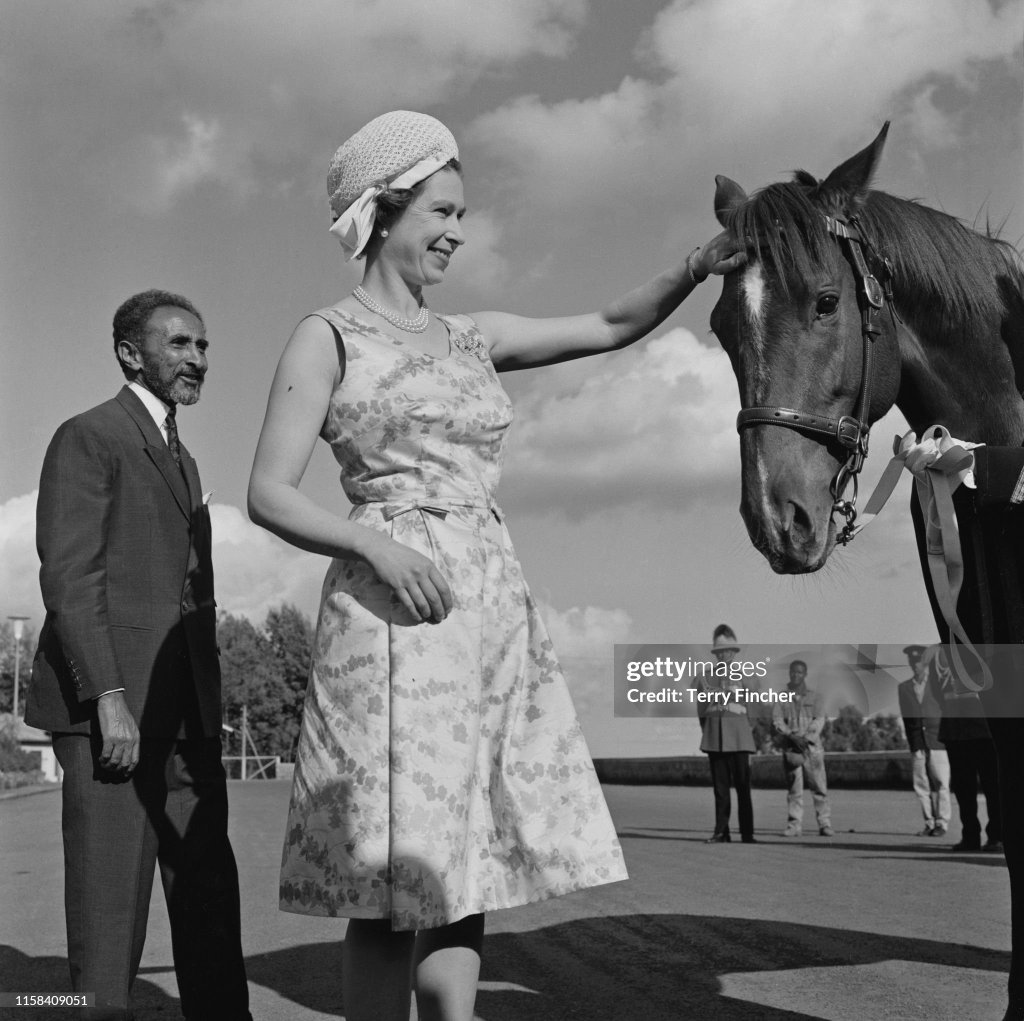
Queen Elizabeth stood in awe like any tourist today as she viewed Ethiopia’s Roaring Rainbow falls on the source of the Blue Nile. The Queen stood beside Emperor Haile Selassie under a wild fig tree next to a marquee perched on a mountainside. She reached the vantage point, where the green waters of Lake Tana fall hundreds of feet into a rocky gorge, after a half-mile walk in flat-heeled shoes. The British monarch and the Emperor spent more than an hour watching the falls and ate lunch under the marquee, which was laid over a rich Persian rug.
In Athens, the Greek parliament voted to order former Premier Konstantine Karamanlis and two former Cabinet ministers before a special court on charges of abuses and negligence damaging to the state.
Peter N. Landerman, virtually unchanged except for a new mustache, arrived in New York on his way to Riverside, California, from a jail cell in the Soviet Union.
parliament voted early today to order former Premier Constantine Caramanlis and two former Cabinet ministers before a special court on charges of abuses and negligence damaging to the state.
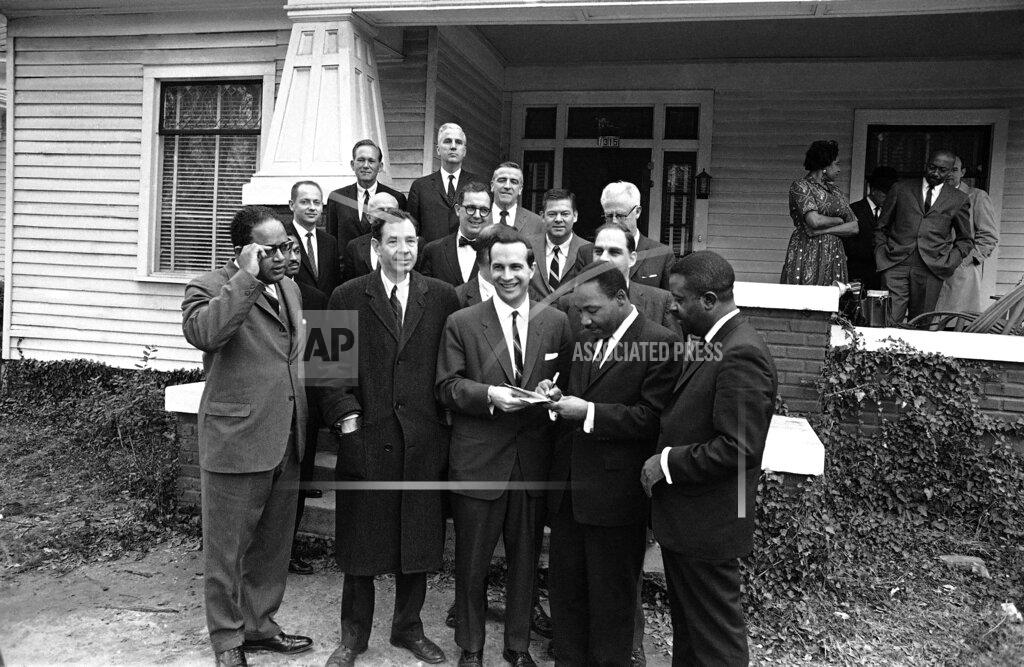
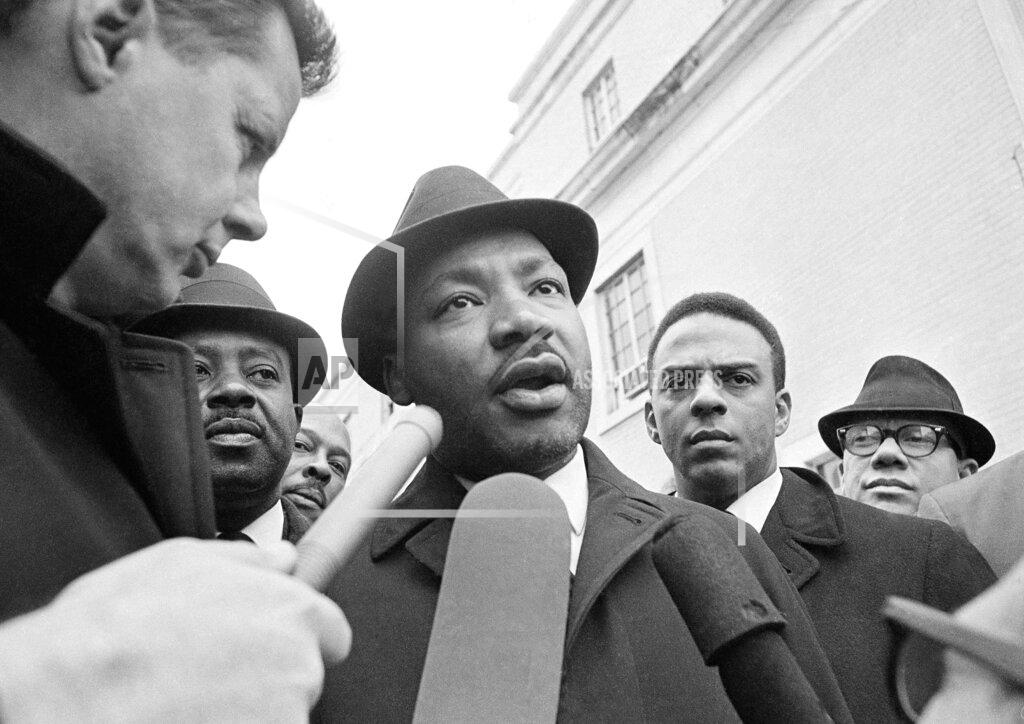
Dr. Martin Luther King Jr. emerged from jail in Selma, Alabama, and announced he would seek a conference Monday with President Johnson on the seething racial situation. King was released from jail today and announced that he would fly to Washington Monday to ask President Johnson and Congress for new legislation to guarantee the voting rights of Blacks. At the same time, he announced an acceleration of the voter registration drive that he and other Black leaders began in this city almost three weeks ago. He said the campaign was ready to spread to other Black Belt counties and to the large cities of Alabama. Dr. King said he would go from Washington to Montgomery Monday night to speak at a mass meeting opening a drive to register Blacks there. More than 500 Negroes were arrested in Selma today as they marched on the Dallas County Courthouse to urge the county board of registrars to open its doors and start processing applicants.
Federal District Judge Daniel H. Thomas ordered the board yesterday to relax its literacy test and to speed the registration of Blacks. The board meets two days a month. The judge said he would name a Federal referee to oversee registration if the board did not process by July all who were eligible and desired to register. Dr. King said the Blacks wanted the office to be open every day and some evenings to handle a backlog of Black applicants. The arrests today brought to more than 3,300 the total in the campaign so far. The Blacks, young and old, have been flooding nearby prison work camps. All but about 200 had been released before the arrests today, Sheriff James G. Clark said. Nineteen United States Representatives were in Selma today making two separate Alabama investigations. Four Representatives were here to draw attention to what they consider the plight of Selma, which they see as being invaded and maligned by “agitators” and out-of-state news media. Fifteen Northern and Western Representatives, including some Blacks, were here to look into voting practices and draw attention to what they consider the plight of Selma’s Blacks.
The Representatives took a back seat to Dr. King and his emergence from jail. He had been in jail since he took part in a demonstration Monday, refusing to post bond and leave. He said his purpose in remaining in jail was to dramatize the voter drive. His reception by a throng of newsmen and photographers outside the jail demonstrated that his imprisonment had reached the point where it was more dramatic to come out than to stay in. The Nobel Peace Prize winner was carefully turned out in suit and tie but he had obviously not shaved for several days. His stubble on one cheek was smudged with lipstick from a kiss by a woman admirer as he felt the City Hall. He told reporters that his jailers had treated him courteously.
Dr. King said aides were trying to get an appointment with President Johnson and Congressional leaders for Monday. He said he would urge new laws and perhaps recommend a constitutional amendment to strengthen Black voters’ rights. He suggested legislation establishing Federal voting registrars and requiring state voting laws to conform to Federal law. Dr. King said the voter drive would continue to concentrate on Selma until the board of registrars opened its office often enough to accommodate all applicants and until Blacks could demonstrate publicly for their rights without what he called “the brutal and harassing methods” of Sheriff Clark.
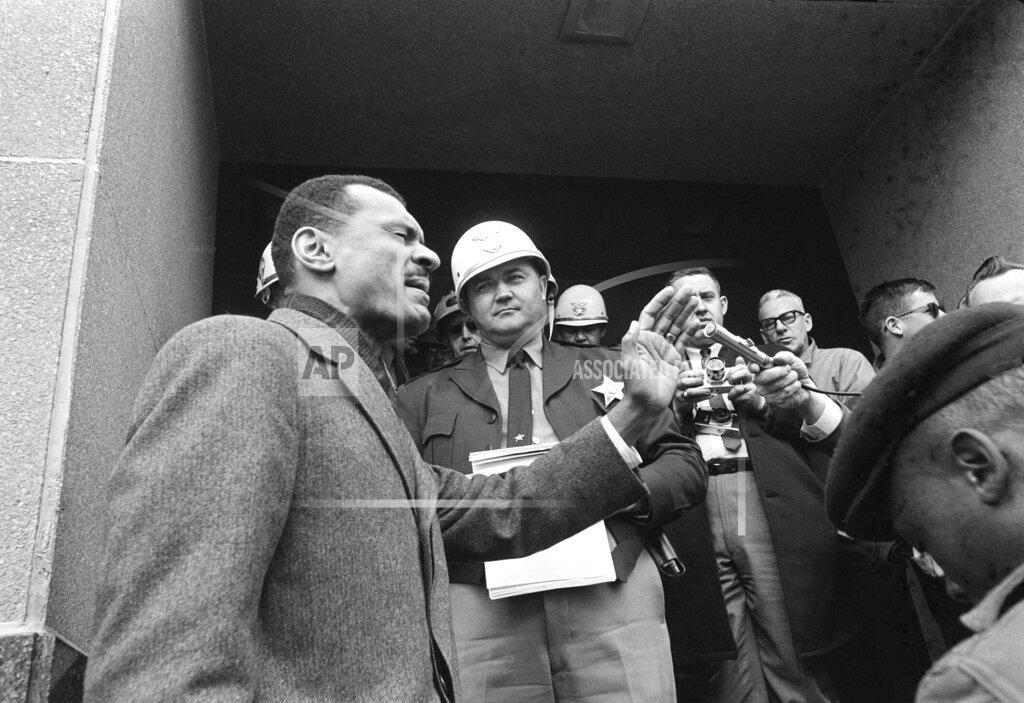
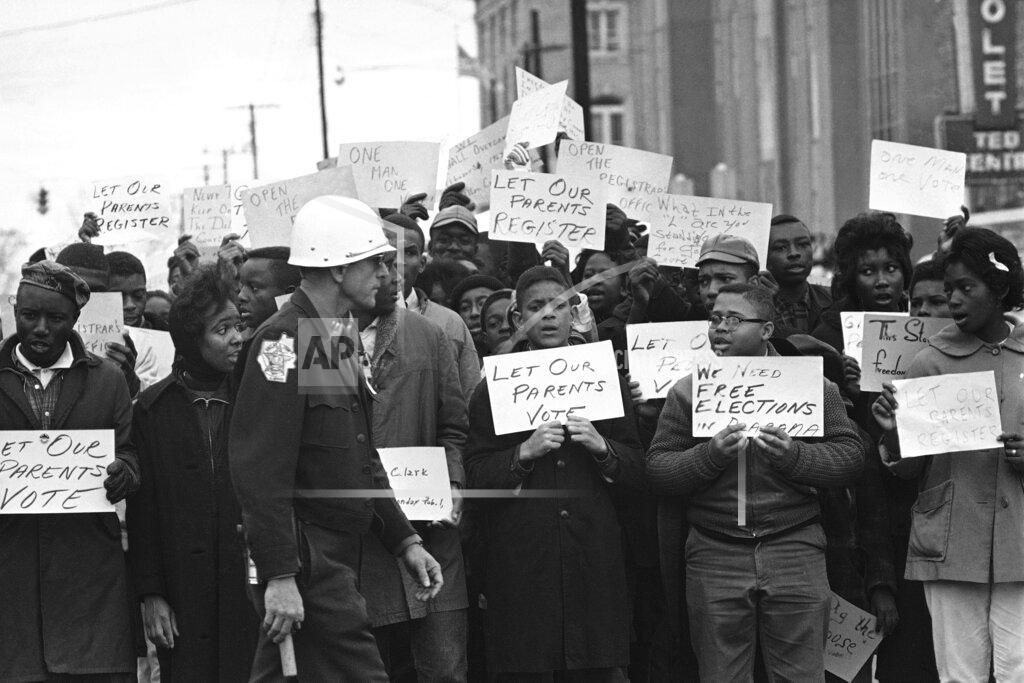
Once again it was Sheriff Clark who arrested the demonstrators today in Selma, which calls itself the Queen of the Black Belt. A small delegation of Blacks asked a member of the board of registrars early today to open the office more than two days a month. He refused. When word of his refusal reached the Browns Chapel Methodist Church, the Blacks’ main gathering place, about 70 adults marched to the courthouse to present a petition to the board asking that it open its doors and start processing applicants. The office was closed today.
Sheriff Clark blocked the courthouse door and read aloud a two-day-old Circuit Court order prohibiting demonstrations outside the courthouse while the court was in session, When the Blacks refused to disperse, he arrested them. The arrest of the adults touched off a march by about 475 youngsters who had been waiting at the First Baptist Church, down the street from Browns Chapel. They were also arrested upon reaching the courthouse.
Representatives Mathias and Reid, returning from Selma, said tonight that new legislation was needed to protect Black voting rights. They said they had been told of cattle prods being used on Blacks, both in the streets and In the jails, after they had been arrested in voting demonstrations in Selma. “There is a clear need for new civil rights legislation, particularly in regard to federal registrars,” Mr. Reid said. Representative Adam Clayton Powell, Democrat of Manhattan, in a change of plans, did not join the group of 15 Representatives in the trip to Selma. He had joined the others yesterday at a news conference announcing the Selma mission. But he was not on the plane this morning. A spokesman at Mr. Powell’s office said he had not talked with Mr. Powell today but understood “there was a conflict with a conference” Mr. Powell had scheduled for tonight in Washington.
Lester Maddox was convicted of contempt of Federal Court today for refusing to accept Black customers in his Atlanta, Georgia restaurant. He was ordered to pay a fine of $200 every day until he obeys. Mr. Maddox said he would appeal the decision, which was handed down by United States District Judge Frank A. Hooper. Judge Hooper ruled that Mr. Maddox could purge himself of civil contempt only by agreeing to accept all customers. Mr. Maddox could also purge himself by closing down his restaurant. Mr. Maddox was in Alabama today. His restaurant opened an hour late and remained open for three hours. His wife said she was “under orders from Lester” to repulse Blacks, but no Blacks appeared.
The contempt charges were brought by four Blacks after Judge Hooper ordered Mr. Maddox to desegregate in compliance with the Civil Rights Law of 1964. The Blacks said Mr. Maddox had refused to serve them despite the court order. The contempt trial, conducted without a jury, ended last Wednesday. In his ruling Judge Hooper said he would start tallying the $200-a-day fine today. Mr. Maddox, owner of a fried-chicken restaurant on Atlanta’s northwest side, closed his Pickrick Restaurant to avoid having to integrate. He subsequently opened a cafeteria at the same location, but under personal rather than corporate management. In this way he hoped to escape the contempt action.
Fifteen fighting and flailing young pickets tried to crash into the United States Court House at Foley Square in New York and were repulsed by deputy marshals in a wild battle on the building’s steps. They were protesting in support of the integrationists in Selma, Alabama.
The Mississippi Association of Methodist Ministers and Laymen said today that it had started action to present grievances against Methodist integration policies to Bishop Edward Pendergrass.
The shipping industry has again urged President Johnson to act in the 27-day-old longshore strike, which it described as “senseless, suicidal and unjustified.”
The United States, as a symbolic step toward curbing the spread of atomic weapons, will shortly place one of its plutonium production reactors under international inspection, officials disclosed today. The reactor that will probably be selected is a 20-year-old atomic pile at Hanford, Washington, which is scheduled to be shut down before the end of June. It is one of four reactors that is being closed as the Atomic Energy Commission curtails the production of plutonium for fabrication of atomic weapons. The United States offered a year ago at the 18-nation disarmament conference in Geneva to place one of the four reactors under international inspection, presumably by the International Atomic Energy Agency. The offer was put forward as an example and a precedent of a step that could be taken to verify a halt in the production of fissionable materials for atomic weapons.
Several reporters and columnists who cover the nation’s capital wrote that they have been baffled and betrayed and perhaps even “bugged” by President Johnson.
Senator Mike Mansfield (D-Montana) accused gossips of spawning an “indecent and shameful” furor over President Johnson’s failure to send Vice President Humphrey to Sir Winston Churchill’s rites.
The Senate Rules Committee, continuing its inquiries into the business affairs of Robert G. Baker, today questioned Clint Murchison Jr., of Dallas, Tex., and other officials of the Sweet Water Development Company in closed session.
Democrats zipped President Johnson’s $1.25-billion school aid bill past its first congressional screening.
President Johnson said today that after he left the Presidency he would like to visit schools and colleges and talk to students about government.
[Ed: By 1968, Mr. Johnson, none of them will be willing to listen to you. The Generation Gap is about to split wide open.]
The World’s Fair issued an audited financial report yesterday showing a deficit of $17,540,100 at the end of 1964, instead of the large surplus that had been predicted at the start of the fair season.
The Walt Disney studio bought the Disneyland theme park along with the WED Enterprises name.
Joe Namath, who underwent surgery on his right knee 12 days ago, will be released from Lenox Hill Hospital today, much to his gratification. The New York Jets’ $400,000 quarterback prospect intends to return to classes at the University of Alabama and hopes to be playing golf by the end of this month.
The stock market registered its first definite loss in 11 trading sessions. Trading was fairly active.
Dow Jones Industrial Average: 901.57 (-2.49)
Born:
Gheorghe Hagi, Romanian soccer football midfielder, Romanian national team starter from 1983 to 2000 and participant in three World Cups; in Săcele, Romania.
Benny Lee, American badminton player (Olympics, 1992), in Rangoon (now Yangon), Burma.
Carl Parker, NFL wide receiver (Cincinnati Bengals), in Columbus, Georgia.
Kevin Dean, NFL linebacker (San Francisco 49ers), in Newton, Texas.
Died:
Irving Bacon, 71, American character actor in 509 films and 33 television series over a 50-year period.





 History Diaries