
Dương Văn Minh, the titular leader of much of the non‐Communist opposition, denounced the government of President Nguyễn Văn Thiệu yesterday as “nothing but a tyranny.” At a gathering at his Saigon villa, attended by a broad cross‐section of opposition leaders, the retired general attacked the regime for its sadden crackdown on the press, its closing of five newspapers and its reported arrest of 17 journalists as ‘’Communist infiltrators.” This is not only an act of arrogance and arbitrariness,” the soft‐spoken politician said, “but also an act of contempt of the people, contempt of world opinion, an act of contempt toward all those who struggle for peace and who love peace and conciliation. By this action, the government is now nothing but a tyranny.” “The people can no longer react with words,” he said. “The tyrannical government has pushed the people into reaction by deeds.”
As the general spoke, the government was reported planning to display some of the arrested journalists with “proof” of their guilt at a news conference to he given by the commander of the national police, Major General Nguyễn Khắc Bình. The police commander was promoted from brigadier general yesterday by Mr. Thiệu. At the reception at General Minh’s villa, held annually to celebrate the Lunar New Year holiday, opposition leaders milled about and exchanged views on the tough course Mr. Thiệu has apparently set. Several noted that the President was fond of springing political surprises at the Tết holiday, when people are traditiontally occupied with domestic concerns. Last year at Tết his political lieutenants rammed through an amendment to the Constitution in the National Assembly permitting him to run for a third term next October. Võ Long Triều, publisher of the opposition daily Đại Dân Tộc, reasoned that Mr. Thiệu, knowing his crackdown would do him no good with the American Congress, must have “despaired” of getting the $300‐million in supplemental military aid that the Ford Administrator has requested for South Vietnam. “Now that he is no longer tied to the Americans,” said Mr. Trieu, whose paper has not been closed, “he can do what he wants.”
Senator Vũ Văn Mẫu, a courtly leader of the Buddhist opposition movement, predicted that Mr. Thiệu is “going to follow Park Chung Hee,” the South Korean President. and clamp down completely on his domestic opponents. This idea was expressed by many at the gathering, but it has been heard before. Mr. Thiệu has always stopped short of all‐out repression of his opponents. The regime’s assault on the press — and charges of Communists in its midst — followed the publication Sunday by nine newspapers of a new political “indictment” of Mr. Thiệu penned by the Rev. Trần Hữu Thành, the conservative leader of the People’s Anticorruption Movement. Father Thành too was among those who strolled in General Minh’s orchid‐hung garden. He said that he and other Roman Catholic priests would be organizing “talking newspaper” sessions in churches throughout the city, to fill the void left by the five banned newspapers. The priest and several others said they believed the government was planning to start several pseudo‐opposition newspapers after a new press law is enacted at the end of this month.
A rocket fired by insurgent forces hit a tree alongside an elementary school in Phnom Penh today, killing at least 10 children and wounding more than 30, policemen reported from the scene. A second rocket hit close to the central market a block away, killing three persons and seriously wounding 10. It was the heaviest rocket toll in Phnom Penh since the insurgents mounted a drive around the Cambodian capital on New Year’s Day. Since then, some 500 rockets have been fired into the city and its airport, killing about 75 and wounding more than 300. The elementary school hit today, the Watt Phnom College, is a private school whose pupils come mostly from wealthy Chinese and Vietnamese families. Its staff includes French teachers as well as Cambodians.
Defense Secretary James R. Schlesinger opened his case before Congress today for a $92.8‐billion defense budget with the principal argument that the United States must increase its military spending if it is to maintain a global balance with the Soviet Union. In the annual “defense posture statement” presented by the Secretary of Defense, Mr. Schleainger found that in strategic, conventional and naval forces thee was a relative military balance at present between the United States and the Soviet Union. His concern, expressed in testimony before the Senate Armed Services Committee, was that the balance would be upset in the future if the United States, because of inflation and Congressional budget cuts, continued its trend of a declining investment in defense while the Soviet Union continued to increase its defense spending at a rate of 3 to 5 percent a year.
President Ford urged Congress to reconsider its cutoff of military aid to Turkey. He said the congressional action might trigger far-reaching and damaging consequences for Western security in the eastern Mediterranean and was likely to impede the negotiation of a just Cyprus settlement. Turkey’s response to the cutoff was to threaten to revise her security arrangements with the United States. Turkey’s Foreign Minister, Melih Esenbel, canceled a meeting in Brussels with Secretary of State Kissinger and with Foreign Minister Dimitrios Bitsios of Greece.
Irish Republican Army extremists have threatened to kill two cabinet members if any of 15 hunger striking IRA prisoners should die, government sources said in Dublin. One of the extremists was reported near death. The Dublin sources said the assassination threat was relayed to the government 10 days ago by two Roman Catholic bishops and a group of Protestant clergymen contacted by the militant Provisional wing of the IRA.
Greek shipping magnate Aristotle Onassis showed improvement from the potentially dangerous combination of myasthenia, or muscular debility, and influenza. Onassis’ private secretary said in Athens that the 69-year-old magnate was feeling better and that he spent most of the time sleeping. Newsmen saw cardiographic and oxygen equipment being taken out of Onassis’ villa.
The Central Committee of the Soviet Communist Youth League gave its 220,000-member Armenian section until March 1 to clear its ranks of ideologically undesirable elements. Among other gross mistakes, a resolution published in Komsomolskaya Pravda said, the section had been slow to implement the exchange of membership cards called for by the 17th Komsomol congress in Moscow last year, and had failed to expel members who broke the organization’s rules.
Premier Yitzhak Rabin, addressing the Assembly of the World Jewish Congress in Jerusalem, said tonight that recent assertions by President Anwar el‐Sadat of Egypt that his country and Syria did not intend to attack Israel could open the way to peace if the Egyptian leader would commit himself formally. “If he really means it, it’s a serious opening,” Mr. Rabin said. if the President of Egypt is ready to commit hemself in writing to Israel, he added, “it could open a great prospect. But it must be done in writing in the framework of an agreement with Israel,” the Premier said. “This can be the basis for talks.”
Foreign Minister Yigal Allon of Israel, in an interview published in Rome today, invited the Soviet Union to resume diplomatic relations with Israel to help the search for peace in the Middle East. “If the Soviet Union is in favor of resuming relations with us, then we are ready to do so,” Mr. Alton was quoted as having said to an Italian left‐wing newspaper, Paese Sera. Asked about a possibility of returning to the Geneva peace conference, Mr. Allon said: “If I was certain that Geneva was today a valid location for obtaining a lasting peace, would prefer to go there immediately rather than follow the road of partial accords.”
Foreign Minister Andrei A. Gromyko of the Soviet Union left Egypt today after two days of talks that “improved the atmosphere” between the two countries but failed to bring full agreement either on strategy for peace negotiations with Israel or on Egypt’s demands for greater quantities of modern Soviet weapons. High Egyptian officials, summing up the results of the talks, hinted that Mr. Gromyko had given limited satisfaction to President Anwar el‐Sadat’s requests for arms but that a complete settlement of the arms issue had to await the arrival of Leonid I. Brezhnev, the Soviet Communist party leader, at an unspecified date later this year. Egypt has begun to diversify arms supplies by placing orders for planes and radar in France and for other military equipment in Britain. But after having relied almost exclusively on the Soviet Union for arms for nearly 20 years, the country will remain heavily dependent on Soviet weapons for a long time, according to Western specialists here.
President Ford in his first round of talks with Zulfikar Ali Bhutto, the visiting Prime Minister of Pakistan, promised active consideration to lifting the arms embargo on sales of military equipment. The White House left the impression that it was moving toward modifying the embargo despite Indian pressure to keep it on. Prior to the arrival of Mr. Bhutto in Washington yesterday, Administration officials had said that various options had been forwarded to Secretary of State Kissinger for a decision. At a news conference late in the afternoon, Mr. Bhutto said he did not want to amplify the White House statement for fear of “complicating the situation.” But he seemed confident that he would receive permission to buy arms. The Pakistanis claim a need for American weapons to modernize their armed forces for limited defensive purposes against India and Afghanistan, both of whom get military aid from the Soviet Union. India also has developed her own arms industry.
Indian officials said today that a resumption of American arms supplies to Pakistan would seriously damage India’s relations with the United States.
An Indian businessman has confessed that he started a fire in a lavatory aboard a Pan American World Airways jumbo jet this week in an attempt to kill himself so his family could collect $50,000 insurance, an airlines official said. He said Thai authorities were holding Gobind Ram Dang, 44, of New Delhi, and that the airline was asking the U.S. Embassy to seek the man’s extradition to the United States for prosecution.
The Soviet Union denounced the new Chinese Constitution today as a document designed to perpetuate the ideology of Mao Tse‐tung. The denunciation, in an analysis in Pravda, the Communist party daily, asserted that the Constitution reflected the antiSoviet attitudes of Chairman Mao and that it was an attempt to replace Marxism with Maoism. The analysis castigated the document, almost article by article, in an apparent attempt to prove that the new basic law was intended to enslave the Chinese people and enhance the power of Mr. Mao and his supporters. The Pravda analysis, signed by I. Aleksandrov — a pseudonym often appearing on articles expressing the Kremlin view on important issues — was the first Soviet comment on the Constitution. Changes in the Chinese leadership are expected to be covered in a future analysis.
The Philippine Government of President Ferdinand E. Marcos decided today to proceed with construction of the Chico River dam despite opposition from minority tribes that stand to be displaced.
The Army of Peru suppressed a two-day strike by the Lima police department. At least 100 people died in Lima during the national emergency. Peruvian troops and tanks crushed a revolt by policemen demanding wage increases in Lima, the capital. This set off rioting by civilians that led the leftist military government to declare a national state of emergency under which all constitutional guarantees were suspended. Lima is under curfew. There were unconfirmed reports of police strikes in other cities. Residents who witnessed the assault on the red‐brick garrison not far from the city’s center said an undetermined number of policemen were killed. A Government announcement, however, put the police casualties at only six wounded. After the shooting ended, hundreds of policemen could be seen being led out of the garrison to be driven away in army trucks. As news of the army assault spread, thousands of youths massed in the streets downtown. After overturning buses, cars and trucks, they sacked and set fire to the army officers club in the central plaza.
The Brazilian Democratic Movement, the country’s only legal opposition party, is putting new pressure on the military government to account for missing political prisoners. The party announced today that its first act when Congress reconvenes on March 1 will be to call on the Minister of Justice to give information about those prisoners who are said to have disappeared. A list of 22 persons who have been detained by security services and now cannot be accounted for was presented to the Government by Roman Catholic Church leaders several months ago. The government promised an investigation, but so far has made no statement on the matter.
The Ethiopian government poured thousands of troop reinforcements into action against Eritrean rebels around Asmara, as the exodus of foreign nationals from the beleaguered city picked up speed. The fighting moved away from Asmara, where the Ethiopian government declared that peace was restored, into scrubland north of the provincial capital, where the rebels are entrenched. Five tanks of an Ethiopian armored column held for two days when secessionist rebels blew up a bridge reached the beleaguered Eritrean capital of Asmara tonight, reliable sources said.
Colonel Richard Ratsimandrava was sworn in as President of the Malagasy Republic, succeeding Gabriel Ramanantsoa. He would serve for only six days before being assassinated. Major General Gabriel Ramanantsoa, head of state of the Malagasy Republic on the island of Madagascar, resigned and handed over full executive powers to the interior minister, Lieutenant Colonel Richard Ratsimandrava who immediately formed a new government. Ramanantsoa dissolved his government January 25 after a reported coup attempt by one of his military advisers, but continued to govern as caretaker. Ratsimandrava is considered a tough disciplinarian and a staunch socialist. He appealed for unity and a fight against agitators.
Developing nations, squabbling over how far to push Western industrial countries for higher prices on raw material exports, set up a special commission at Dakar, Senegal, to define their demands. The 110 nations, meeting for the second day to map out plans to force the West into more equitable global trade agreements, also voted by acclamation to accept North Korea.
Kenneth McIntosh, a bank employe sentenced to 16 years in prison last October for re vealing some of the methods by which Rhodesia circumvents international economic sanctions, has escaped from prison.
President Ford plans to seek election to a full term next year regardless of the nation’s economic conditions at that time, his spokesman said today. Ron Nessen, the White House press secretary, told reporters that the President “does expect the economy to be better than it is now” next year but that his decision to seek election “is unrelated to the state of the economy.” Mr. Nessen volunteered his remarks at his daily news briefing to counteract what he said had been the impression that “has gotten around” that if the economy is good Mr. Ford will run but that if the economy worsens he will not seek election. “That is not true,” Mr. Nessen said.
The House of Representatives voted 309 to 114 to suspend for 90 days President Ford’s power to increase fees on imported oil. It acted despite Mr. Ford’s major lobbying effort to persuade members from both parties that he must act immediately to push up the price of petroleum products to force a cut in their use. The measure goes to the Senate where passage is certain but a two-thirds majority to override a veto or silence a filibuster is not.
Edward Hirsch Levi was routinely confirmed as the Attorney General of the United States by the Senate today on a voice vote and without debate. Mr. Levi may be the first man to hold that office in modern political history who had never met the President who appointed him.
The Senate voted 76 to 8 to freeze the price of food stamps for the rest of the year. The measure, identical with one passed by the House, is the first to go from the new Congress to the President’s desk. A White House aide said the President would “reflect on the vote and the alternatives.” The overwhelming vote in both houses indicated that a veto would not stand.
The House of Representatives, which has been in session a little more than three weeks, plans a 10-day recess at the end of business today. Speaker Carl Albert of Oklahoma said that despite pressure to press on with legislation, he had promised the recess and newly elected members had booked speaking engagements and other events in their districts.
House Democrats may face an internal struggle over the chairmanship of a new committee that will investigate the conduct of Government intelligence agencies.
John T. Dunlop, Harvard economics professor and former director of the old Cost of Living Council, is expected to return to government as secretary of labor, Administration sources said. Dunlop, 60, was said to be President Ford’s choice to succeed Peter J. Brennan, a move that is expected to restore the Labor Department’s role in the economic policy-making process.
The federal government has approved a settlement of $37,500 for each survivor of a government-sponsored syphilis experiment in Macon County, Alabama, court records showed. The out-of-court settlement apparently terminated a $1.8 billion suit filed on behalf of participants in a 40-year-old study, halted in 1972, of untreated syphilis among black males. An order filed in federal court in Montgomery disclosed the approval of the US attorney general to the settlement. It also provided $15,000 each to living participants of the experiment who did not have syphilis.
A federal appeals court said Richard M. Nixon’s nonpresidential papers and memorabilia were cleared for shipment to his home in San Clemente. The materials had become entangled in a broader dispute over about 42 million documents and the White House tapes accumulated while Mr. Nixon was President. The presidential papers and tapes remain stored in Washington pending a final judicial decision over whether they belong to the government or to Mr. Nixon.
Convicted Watergate burglar E Howard Hunt Jr. denied that he was part of an alleged CIA plot to assassinate President John F. Kennedy. A spokesman for Frank Sturgis, also a convicted Watergate conspirator.. said he was not in a photo said to show him and Hunt near the assassination scene in Dallas on Nov. 22. 1963. The spokesman would not confirm or deny if Sturgis was in Dallas on the day of Kennedy’s death. Dick Gregory, the activist and comedian. and two associates turned over evidence to the Rockefeller Commission on Tuesday that they claimed showed that Kennedy’s death was planned by the Central Intelligence Agency.
The Federal Bureau of Investigation has admitted that it covertly monitored 40 conversations of a Detroit lawyer and extensively questioned his associates although he himself was not under criminal investigation, an official of the American Civil Liberties Union said last night. Melvin Wulf, the right group’s legal director, said the FBI surveillance had been disclosed in legal papers filed by the bureau in United States District Court in Detroit in response to a civil suit. brought by the lawyer, Abdeen M. Jabara. The A.C.L.U. has joined in the suit. Mr. Jabara has charged the FBI with violating his constitutional rights of free speech and assembly by investigating him without having any reason to believe that he had engaged in criminal activity. A spokesman for the bureau in Washington said he could not comment because the matter was under litigation.
The Environmental Protection Agency has urged the Interior Department to postpone for a least two years the opening of untouched offshore areas for oil and gas leasing, an to bar leasing off the Alaska coast indefinitely. The agency also sharply criticized the Interior Department’s preliminary study of the environmental impacts of exploring and developing these new “frontier areas” off the Atlantic coast and the coasts of California and Alaska. The agency’s comments on the Interior Department’s environmental study were placed on file without publicity January 10 and were made available upon request.
Vice President Rockefeller has proposed that two of his top assistants be put in charge of the White House Domestic Council and reorganize its functions, but the suggestion has run into resistance on the President’s staff.
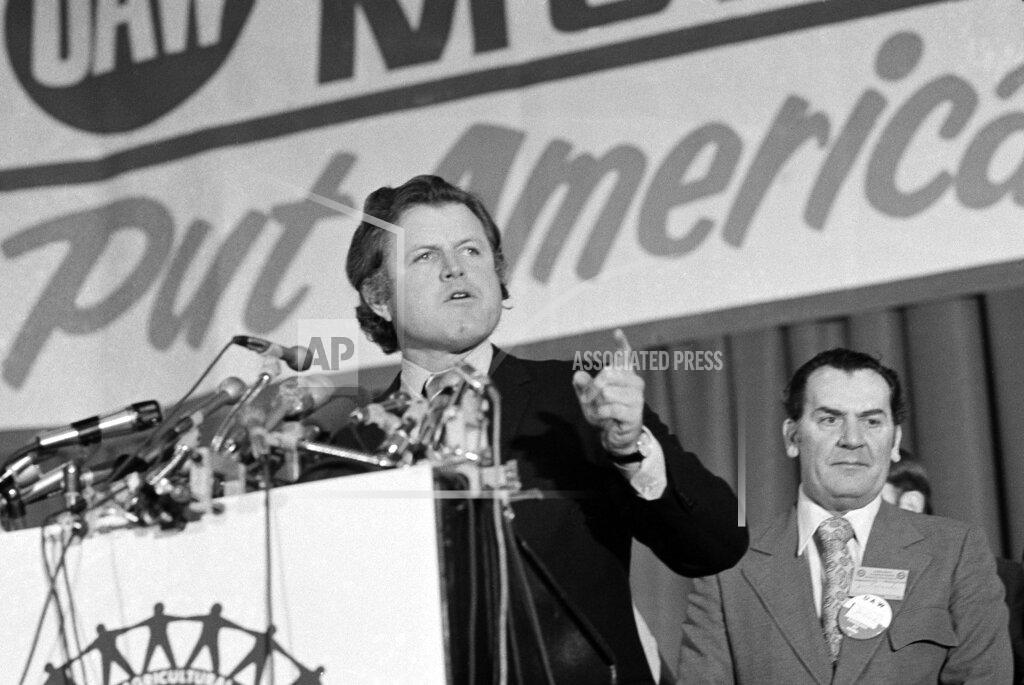
Nearly 10,000 members of the United Automobile Workers met in the District of Columbia Armory to demand action by the President and Congress to end the recession and provide jobs. Leaders of the union and Democratic politicians addressed them. They lustily cheered those who attacked tax advantages for the rich and Vietnam spending — and also those who promised to run the Republicans out of office unless more jobs are provided. The rally, sponsored by the United Automobile Workers Union, drew a shouting, placard‐waving, foot‐stamping crowd of black and white unemployed workers. They repeatedly chanted “we want jobs” as a score of U.A.W. leaders and Democratic politicians spoke. It was the first such labor rally in a time of recession since 7,000 people came to Washington in 1959 for a rally by the American Federation of Labor and Congress of Industrial Organizations. The mere mention of President Kennedy, and the appearance of his brother, Senator Edward M. Kennedy, Democrat of Massachusetts, touched off roaring approval.
Robert Schmerts, who used a construction fortune to buy a share of the champion Boston Celtics basketball team, and another man were indicted in Trenton, New Jersey on bribery charges by a state grand jury. The indictment stems from an alleged attempt to obtain local approval for a multimillion dollar Ocean County senior citizens project. Indicted with Schmertz, president of Leisure Technology Corp, was Donald Safran, an insurance consultant who now lives in Florida. They were charged with paying $31,730 to Ocean County Freeholder Joseph S. Portash.
The dollar declined today against most continental European currencies following the half‐point cut in the United States discount rate to 63.4 percent.
The most far-flung storm of winter touched off snow, freezing rain and drizzle from the Rockies to the Eastern Seaboard. Up to 8 inches of snow blanketed the Washington-Baltimore area, up to 5 inches fell in parts of New York City and 6 inches covered Boston. Morning rush-hour traffic was snarled and many schools were closed. During the day, rising temperatures brought some rain and much of the snow turned to slush as city workers headed home. Snow kept falling, however, from the northern and central Rockies through the Central Plains, changing to rain in the upper Midwest then returning to snow in the Northeast.
Dow Jones Industrial Average: 717.85 (+9.78, +1.38%)
Born:
Adam Carson, American musician and drummer (AFI), in Ukiah, California.
Myndy Crist, American actress (“Dark Skies”), in Detroit, Michigan.
Alison Hammond, English TV presenter (“Great British Bake Off”), in Birmingham, England, United Kingdom.
Derrick Gibson, MLB outfielder (Colorado Rockies), in Winter Haven, Florida.
Died:
Åke Persson, 42, Swedish bebop jazz trombonist (Kenny Clarke-Francy Boland Big Band, 1963–71).



 History Diaries