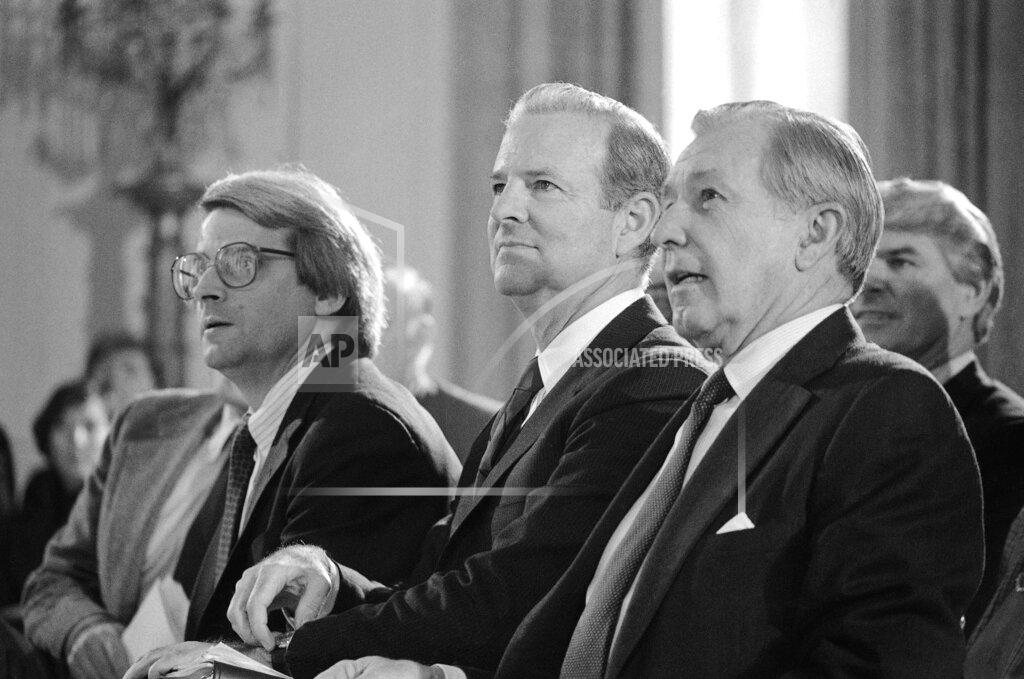
Defense Secretary Caspar W. Weinberger admitted he was “in error” last week when he said the Soviet Union had shot down one of its own missiles after it went astray over Norway and Finland. He told the Senate Armed Services Committee that he “mixed up two reports” in discussing the crash of the unarmed target missile last December during a Soviet military exercise. Weinberger’s original statement had contradicted a Pentagon report, which said the missile crashed of its own accord.
Twenty countries (but not the United States) sign a UN treaty outlawing torture. The document is titled “Convention Against Torture and Other Cruel, Inhuman or Degrading Treatment or Punishment.” The United States supports the pact, but its signature has been held up by legal review of the contents. It will go into effect after ratification by 20 countries. The United States cannot ratify it unless the Senate approves. In addition to an investigatory mechanism under the United Nations, the treaty, seven years in preparation, also accepts the principle of “universal jurisdiction,” which requires that torturers must be either prosecuted in whatever country they are found or extradited for trial elsewhere.
Spain lifted its blockade of Gibraltar, ending 16 years of isolation from the rest of Europe for the people of Britain’s tiny colony at the western entrance to the Mediterranean. Hundreds of people gathered on both sides of the frontier to witness a midnight ceremony at which Spanish officials unlocked 10-foot-high, green iron gates that had blocked the road linking Gibraltar to the Spanish mainland. Negotiations are to begin in Geneva today between Britain, which governs Gibraltar, and Spain, which claims it, over the political status of the territory.
Three Belgrade dissidents were convicted on charges of disseminating “hostile propaganda” against the state in the most significant political trial in post-Tito Yugoslavia. In a verdict that was watched as a possible harbinger of a sterner line, the judge sentenced one defendant to two years in prison, another to 18 months, and a third to one year. All three men are free pending appeal. Milovan Djilas, the prominent dissident, who was not on trial, said in an interview after the sentencing that he interpreted the verdict “as a bad sign for the development of Yugoslavia.”
A Hebrew teacher who had attracted a wide following among Soviet Jews has been sentenced to an 18-month term in a labor camp on a charge of possessing a weapon, his friends say. The sentencing last Friday of the teacher, Aleksandr Kholmyansky, a 32- year-old computer scientist in the Estonian city of Voru, was the latest in a series of cases authorities have brought against leaders of unofficial Jewish cultural life. Mr. Kholmyansky was also fined 100 rubles, or about $120, for mailbox tampering, his friends said. Jewish activists who reported the results of the two-day trial said a pistol and cartridges had been planted in Mr. Kholmyansky’s apartment in Moscow during a search. According to the activists, what they called the fabrication of charges against Mr. Kholmyansky followed a pattern seen in other recent cases brought against Hebrew teachers.
Mehmet Ali Ağca, who tried to kill Pope John Paul II, said in an interview broadcast today that the Pope’s visit to the prison to forgive him more than two years later was “the most beautiful, the most significant moment” of his life. Mr. Ağca also said in the taped 21- minute television interview that he thought that a kidnapped teenager, Emanuela Orlandi, whose self-proclaimed abductors have demanded Mr. Ağca’s release, was still alive. He condemned terrorism and said he had never killed anyone.
Survivors of Dr. Josef Mengele’s pseudo-medical experiments at Auschwitz recalled how the Nazi death-camp doctor chose his victims. “We were selected like potatoes.” Zerah Taub said during the first of three days of testimony before a Jerusalem conference organized by former camp inmates. Mengele, seeking ways of manipulating genes to create blue-eyed blondes for a Nazi “super race,” would stand like Napoleon as he selected his victims — one hand on his chest and the other brushing a stick across his boots, Taub, now an Israeli resident, recalled.
Prime Minister Shimon Peres expressed disappointment today with what he described as Egypt’s failure to respond to his efforts to improve relations between the two countries. Mr. Peres added that if Egypt’s cool attitude toward Israel continued, there was a danger that the forces for peace in Israel would become discouraged and question the value of efforts to normalize relations with Arab neighbors. Mr. Peres’s remarks about Egypt came during an hourlong interview in his Jerusalem office and were his first public criticism of the Government of President Hosni Mubarak since becoming Prime Minister last September.
While Mr. Peres has expressed admiration for Mr. Mubarak, his statements today reflected the mounting frustration in his administration over the continued absence of normal relations between Egypt and Israel, despite what Mr. Peres sees as genuine efforts on his part to satisfy Egypt’s conditions for returning an ambassador to Tel Aviv and warming up the so-called cold peace. Asked if he was satisfied with the state of Egyptian-Israeli relations in light of the recent deadlocked talks in Beersheba over the tiny disputed Taba border strip, Mr. Peres said: “Frankly, I wish it could go a little bit further than it does. You see some Israelis can say, rightly, ‘Look, the Arabs want land for peace.’ In the case of Egypt, 99.999 percent of the land was returned and many Israelis are asking, ‘Did we get 99.999 percent of peace?’ “
An Israeli soldier was fatally shot by a lone gunman in an ambush today in the occupied West Bank, the authorities said.
The Lebanese pound, its exchange value buffeted by the country’s continuing security and economic problems, plunged to a record low against the U.S. dollar. It opened the day’s trading at about 13 to the dollar on Lebanese exchanges, and by closing time, it had fallen to a range of 15.15-15.20 to the dollar. Nonetheless, Labor and Education Minister Salim Hoss said, there will no radical changes in “the free enterprise system the country now has.”
Libya postponed for at least 24 hours today the release of four Britons detained in Libya for nine months. Libya gave no official explanation. But a British television reporter in Tripoli said the Libyans were angry at Prime Minister Margaret Thatcher for unveiling a memorial Friday to a London policewoman killed by shots fired from the Libyan Embassy last April at a crowd of Libyan exiles. Libyan officials in Tripoli said the release had been delayed because of “unforeseen circumstances.” According to Brent Sadler, a reporter for Independent Television News, the Libyans were also upset about the opening in Britain today of a trial of four Libyans on bomb charges. The four Britons are Alan Russell, 49 years old, an English teacher; Malcolm Anderson, 27, an engineer with the Arabian Gulf Oil Company; Robin Plummer, a British Telecom engineer, and Michael Berdinner, a lecturer at the University of Tripoli.
Iraqi planes severely damaged an empty Greek tanker heading for the Iranian oil terminal on Kharg Island, Persian Gulf shipping officials said. The 131,654-ton Fairship I was reported hit as it headed toward the oil depot from the United Arab Emirates. It was the seventh confirmed maritime casualty this year as a result of air strikes in the waterway.
A spy scandal widened in India as a businessman was quoted as having told a closed hearing that he had passed government secrets to diplomats from East Germany, Poland, and France. The businessman described as a key figure in a widening espionage scandal was quoted today as having said at a closed hearing that he had passed Government secrets to diplomats from East Germany, Poland and France. The statement by the businessman, Coomar Narain, was described to reporters by a court official. It was the first specific reference linking Soviet- bloc governments to the spy case, the existence of which was confirmed last month by Prime Minister Rajiv Gandhi. The court official said Mr. Narain had confessed to “a 25-year involvement” in industrial, military and political espionage.
Six people, including two priests, were stabbed to death in a Sikh temple in the worst incident of violence in India’s Punjab state since the army raided the religion’s Golden Temple last summer, the Press Trust of India reported. It said the bodies were discovered after the six apparently were slain Sunday night in the Bhatinda district of Punjab, about 150 miles north of New Delhi. One of the dead priests was in charge of the temple. Punjab Police Director General K.S. Dhillon was quoted as saying that a possible motive was “personal enmity.”
Kim Dae Jung, the exiled South Korean opposition leader, said yesterday that the South Korean Government had taken a “reasonable attitude” by announcing he would not be imprisoned when he returns home from the United States on Friday. But he insisted that the promise was “not enough.” “Fundamentally, I have been an innocent victim,” said Mr. Kim, who has been living near Washington for more than two years. “It is time for the Korean Government to completely change its attitude and give me amnesty, to give me my civil rights.”
In Taipei, Taiwan, Justice Ministry investigators filed preliminary charges today against two reputed gangsters suspected in connection with the killing last October of a Chinese-American writer at his California home, the government said in a statement. The writer, Henry Liu, 52 years old, a critic of the Taiwan Government, was shot to death October 15 in Daly City, California. The Government Information Office said in a statement that Justice Ministry investigators had filed preliminary charges of murder, illegal possession of firearms and violating public order against Chen Chi-li, 39, and Wu Tun, 34, reputed members of Taiwan’s largest underworld organization.
The United States said today that New Zealand had “definitively turned down” an American request for a port visit by a Navy destroyer because Washington would not say if it carried nuclear arms. American officials said the move, announced today by Prime Minister David Lange, threatened the future of the South Pacific alliance of the United States, New Zealand and Australia. The State Department said tonight that naval exercises planned next month by the three countries had been canceled because of New Zealand’s action. The Reagan Administration had made the proposed port call a test case of New Zealand’s seven-month-old anti-nuclear policy and had indicated that a rejection would lead to a reap praisal of the alliance, known as Anzus.
Thousands of Bolivian trade unionists called off a hunger strike, and factory workers ended a 17-day stoppage after the nation’s Supreme Court ruled that employers must pay a 200% wage increase decreed by the government. The dispute prompted a brief general strike, and about 150 industrialists were held hostage in their factories for three days by protesting workers. Taxi, bus and truck owners said they will keep their vehicles off the roads until substantial fare increases are authorized.
Power was cut off in Lima, Peru, when electrical lines outside the capital were dynamited as Pope John Paul II arrived there from northern Peru, according to police sources. The Pope was not hurt. The sources said that lanterns in the form of a hammer and sickle — the symbols often used by Shining Path insurgents — appeared on a hill overlooking Lima. The Pope went safely to the Vatican diplomatic headquarters, which is equipped with its own electrical generator, and spoke to crowds outside.
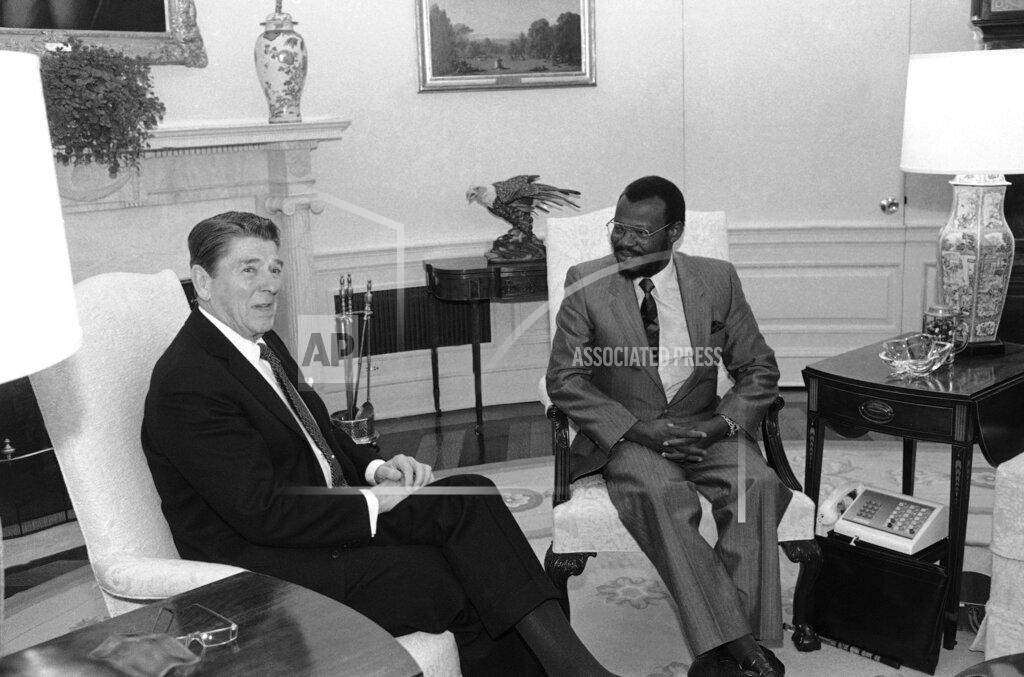
President Reagan meets with Zulu Chief of South Africa Gatsha Buthelezi. A key South African tribal chief and American leaders of the protest movement against apartheid differed sharply today over the issue of economic sanctions against the Pretoria Government. The remarks, made separately, came after the chief, Mangosuthu G. Buthelezi, met with President Reagan at the White House. Mr. Buthelezi, emerging from the 25-minute session with Mr. Reagan, said he opposed economic sanctions, as does Mr. Reagan. Leaders of the protest movement favor such sanctions. Chief Buthelezi called economic sanctions a “double edged” knife that would hurt blacks in South Africa. “Economic sanctions are a stick I think people want to use to rap the white South Africans or the Government over the knuckles,” he said. “My people would actually suffer more if it were to apply than the people who are oppressing us.”
President Reagan presents copies of the 1986 budget to the House and Senate Leadership. Major cuts in domestic programs were formally proposed to Congress by President Reagan. Opening a drive for a $973.7 billion budget for the next fiscal year, Mr. Reagan struck a note of urgency for the need to reduce the deficit and defended his proposed buildup of the military and reductions in many programs benefiting middle-class Americans.
A $2.3 billion cut in financial aid for college students was urged in President Reagan’s budget. The plan called for the elimination of Federally-subsidized loans to students from families whose gross income is more than $32,500 a year.
Wide new restraints on Medicare and Medicaid were proposed in President Reagan’s budget. Various interest groups issued a torrent of statements assailing his priorities.
Military research would rise 21 percent and civilian research would decline under President Reagan’s proposed budget. Federal financing for research and development would increase to a record $59.7 billion from $53.2 billion this year.
The rationales behind proposals in President Reagan’s budget for saving money in 40 areas were described in a 155-page document distributed by the Office of Management and Budget. The article presents excerpts from that document.
The space-based defense plan envisioned by President Reagan is set to be the biggest research project ever. The proposed 5-year, $26 billion effort is said by officials to dwarf research for the Manhattan Project and the Apollo moon program.
President Reagan plans to recall to duty three veteran political operatives with roots in the Richard M. Nixon Administration for key White House assignments, sources said. The sources, insisting on anonymity, said Reagan would name Patrick J. Buchanan, now a television commentator and newspaper columnist, as chief of White House communications, in charge of speech-writing and media planning. Edward J. Rollins, director of the President’s 1984 reelection campaign, would head an office dealing with politics and intergovernmental relations between Washington and state and local governments. And Max L. Friedersdorf, the White House’s chief congressional lobbyist in the first year of the Reagan Administration, would again have a similar position.
The Justice Department, maintaining that a federal court misinterpreted a 1984 Supreme Court reverse-discrimination decision, filed a brief on behalf of five white Massachusetts police officers seeking to challenge the promotion of a black. In the latest of a series of attempts to broaden the application of the high court’s decision, the department’s civil rights division urged the U.S. 1st Circuit Court of Appeals in Boston to reverse a lower court’s ruling denying the challenge by the white policemen.
Former Secretary of State Cyrus R. Vance, testifying before the Senate Foreign Relations Committee, warned today against the deployment of weapons in space. He said he supported a program of limited research to find defenses against nuclear attack, but Mr. Vance added that “once we cross the line from basic research to deployment, we have very radically changed the basic strategic doctrine.” Mr. Vance, Secretary of State under President Carter, spoke on the second day of hearings on the direction of American foreign policy. Only a few senators attended today’s session.
Senator Gary Hart (D-Colorado), in a Boston speech that he insisted was not a prelude to a presidential bid, urged Democrats to denounce the “selfishness” of the Republican right wing and foster a “new patriotism.” Speaking to 400 persons, Hart, who ran unsuccessfully last year for his party’s presidential nomination, also called for a new “national service” for all young Americans that would include both military and non-military opportunities. “A new system of national service… will ask young Americans to return some of the advantages and investments they have received from our society,” he said.
Three black churches were burned to the ground last July in a rural area in South Carolina and, hours later, two white men were arrested in the burnings. The authorities feared retaliation. But instead, both blacks and whites pressed a statewide campaign that, over the last seven months, has raised nearly $200,000 in donations to help rebuild the churches.
A federal appeals court ordered a one-day stay of execution for Carl Ray Songer, scheduled to die this morning in Florida’s electric chair for the 1973 killing of a Florida state trooper. The three-judge panel granted Songer a stay until 7 AM Wednesday to allow the court to deliberate on his case. Under Songer’s death warrant, his third, he could be executed any time before noon Wednesday.
Great Adventure Inc. and Six Flags Corp. must stand trial on aggravated manslaughter charges in connection with a fire last year at an amusement park in Toms River, New Jersey, that killed eight teenagers, a judge ruled. Superior Court Judge Arthur Blake denied the companies’ entry into a pretrial intervention program that allows some first-time offenders to avoid trial and perform community service. The judge also said the firms showed no remorse over the fire on May 11 in the Haunted Castle attraction.
Artificial heart recipient William J. Schroeder has been running a fever since last week, with his temperature fluctuating between a normal 98.6 degrees and 102 degrees, a spokesman said. Dr. William C. DeVries, who implanted the artificial heart Nov. 25, believes that Schroeder’s fever was caused by a reaction to medication. Because of the fever, doctors decided to discontinue drugs for depression, neurological circulation and a minor urinary tract infection, said Robert Irvine, spokesman at Humana Hospital Audubon in Louisville, Kentucky.
Trial began in Cincinnati in a nationwide case pitting a pharmaceutical company against hundreds of claims that its anti-nausea drug Bendectin caused birth defects in the children of women who took the drug during pregnancy. Nearly 1,000 lawsuits against Merrell Dow Inc., a Reading, Ohio, drug manufacturer, have been consolidated in the federal court trial.
Financial support for art shows has shifted from wealthy patrons to corporations in perhaps the most significant and controversial trend among art museums in the last decade. Many people warn that the trend has eroded the quality of art shown in American museums.
Former Philadelphia Phillies slugger Greg Luzinski announces his retirement. Known for his mammoth home runs, The Bull was one of the best sluggers in MLB from the mid 1970s – early 1980s. He was a 4-time All-Star, twice finished runner-up (1975, 1977) to the NL MVP Award, was on the 1980 World Series champion Philadelphia Phillies, and is a member of the Phillies Wall of Fame. In his 15-year career (1970-1984), Greg had 1795 hits, 307 home runs, 1128 runs batted in, a .276 batting average, a .363 on-base percentage, and a .478 Slugging percentage.
Dow Jones Industrial Average: 1290.08 (+12.36)
Born:
Brad Richardson, Canadian NHL centre and right wing (NHL Champions, Stanley Cup-Kings, 2012; Colorado Avalanche, Los Angeles Kings, Vancouver Canucks, Arizona Coyotes, Nashville Predators, Calgary Flames), in Belleville, Ontario, Canada.
Mark Letestu, Canadian NHL centre (Pittsburgh Penguins, Columbus Blue Jackets, Edmonton Oilers, Winnipeg Jets), in Elk Point, Alberta, Canada.
Bug Hall, American actor (“The Stupids”), in Fort Worth, Texas.





 History Diaries