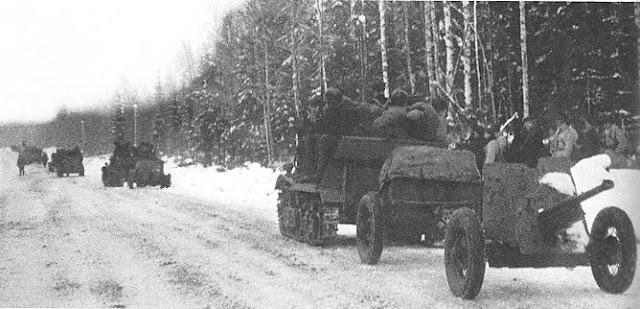
With adverse weather conditions limiting activity on the West on land, in the air and at sea, attention again turns to Finland, where the Russians attacks now in progress dominate the entire military situation in Europe.
Final Stavka approval is granted for the new Soviet plan for breaking through the Finnish Mannerheim Line.
Soviet 7th Army and 13th Army continue ‘demonstration operations’ against the Mannerheim Line.
Finnish defenders successfully repulse enemy attacks on the Mannerheim Line in Summa, Suokanta and Oinaala.
The Soviets form an assault party to capture and destroy a particularly vexing bunker known as bunker No. 2. The men are riflemen of the 5th Company, 355th Rifle Regiment, along with two T-26 tanks and two squads of sappers. Fighting hand-to-hand through Finnish trenches, they make their way to the bunker and plant 3,500 kg of explosives on its roof during the night, along with other charges totaling 5,300 kg. The men of the 5th company blow the bunker up. It is the first large bunker occupied even temporarily by the Soviet troops, and the 100th Rifle Division commander, Yernakov, focuses his attack in this direction. The Finns, though, hold fast in the forest north of the bunker and prevent any further incursion.
In Ladoga Karelia, detachments of enemy troops which had advanced from the south on skis are surrounded in a ‘motti’ at Lavajärvi.
Battalion Mankonen completes destruction of the enemy ski battalion at Löytöjärvi. In three days the enemy death toll reaches around 400.
Soviet aircraft bomb a number of localities across the country: in Kuopio the air raid leaves 34 dead and 38 injured.
Around Viipuri, enemy bombers hit hard in and around Torkkelinkatu, Punaisenlähteentori square, the market square, the old town and the district of Havi. The Lutheran cathedral is partly destroyed in the raid.
At Kotka the woodyard at the Enso Gutzeit sawmill is set ablaze and almost totally destroyed.
The Finns claim in a communiqué that they have brought down another 13 Soviet planes over the scene of the fighting on the Karelian Isthmus.
Over the Eastern Isthmus, a Russian fire control aircraft is in the air all day over Taipale directing the enemy artillery fire.
A captured enemy map contains accurate details of the position of the Finnish command post in the Taipale sector.
The International Labour Office announces that the Soviet Union has been expelled from the International Labour Organization (ILO).
Marshall Mannerheim’s sister, Countess Eva Sparre arrives in New York to begin a series of lectures in the USA on Finland.
The great Finnish runners Paavo Nurmi and Taisto Mäki receive a hero’s welcome on arrival in New York. Thousands of people and dozens of reporters come to the harbour to welcome them.
The permanent council of the Balkan Entente concluded the second day of its conferences this evening in an atmosphere of good-will that surprised the most optimistic diplomats in Belgrade.
Italy has recently been the target for many Soviet criticisms, and today the conference of the Balkan Entente in Belgrade inspires the official newspaper Pravda to comment that Rome is “trying to restore its tottering position in the Balkans and to utilize the situation caused by the war.” Italy’s position, Pravda declares, has complicated the “intrigues” of the French and the British to involve the Balkans in the hostilities.
History, as generally understood in Occidental nations, is subjected to another startling revision appearing in Heinrich Himmler’s newspaper, the Schwarze Korps. In a leading editorial this official National Socialist party organ declares the English to be a nation of “white Jews,” and Protestantism, as practiced in England, to be a modern version of the ancient Jewish law book, and abolishes “once for all the schoolteachers’ myth of ancestral Germanic ties between Germany and England.”
The war in Europe has caused one of the worst economic depressions that the Mandate of Palestine has experienced in many a year. Not even during the last three years of riots and other disturbances, which brought most business almost to a standstill, did Palestine as a whole seem to feel the twinge to such a marked degree as today, when every one, from factory or plantation owner to the lowliest laborer or farmhand, is desperate. The reason for this sudden acute turn in Palestine’s economic affairs is mainly the heavy blow struck at the citrus industry by the European war. Citrus exports are the backbone of Palestine’s industrial life and when that industry suffers so does everything else.
The British Air Ministry issued specification E.28/39 to the Gloster Aircraft Company to prepare an airframe for flight testing the pioneering W.1 gas turbine designed by Frank Whittle and built by Power Jets Ltd.
Off the eastern coast of Britain, about 20 German bombers attack shipping, sinking 2 ships and losing 3 aircraft.
The first German Luftwaffe aircraft to crash in England was a Heinkel He 111 aircraft shot down near Whitby, North Yorkshire by Flight Lieutenant Peter Townsend flying a Hurricane fighter of 43 Squadron. Two of the four German crewmen were killed. After the war Townsend became a household name for his ill-fated romance with Princess Margaret.
The Norwegian cargo ship Tempo was bombed and sunk in the North Sea off St Abb’s Head, Berwickshire, United Kingdom (55°59′N, 1°35′W) by Heinkel He 111 aircraft of KG26, Luftwaffe, with the loss of five of her 15 crew. All fifteen crew left the ship safely in two lifeboats. The nine men in the first were rescued by the lifeboat Frank and William Oates, but the other capsized in the breakers while trying to reach land at Berwick upon Tweed, Northumberland with the loss of five of the six men aboard.
The British cargo ship Beechwood was bombed and shelled in the North Sea 3 nautical miles (5.6 km) east of the Smith’s Knoll Lightship by Luftwaffe aircraft. Beechwood was on a voyage from the River Tyne to Gibraltar. She became waterlogged and put in to the River Thames in a sinking condition. Subsequently repaired and returned to service.
German bombers attacked the Royal Navy minesweepers HMS Sphinx, Speedwell, and Skipjack at 0930 hours near the mouth of the Moray Firth in northern Scotland. The Halcyon-class minesweeper HMS Sphinx (J 69), commanded by Commander John R. N. Taylor, was sweeping an area about 15 nautical miles north of Kinnairds Head, near Fraserburgh, Scotland when it was attacked by enemy aircraft. A bomb pierced the fo’c’sle deck and exploded destroying the fore part of the ship. She remained afloat and was taken in tow by the minesweeper HMS Halcyon but steadily flooded and capsized and sank. The commanding officer and forty of the men were killed in the explosion. She was taken in tow by HMS Speedwell but the tow parted. HMS Speedwell and HMS Harrier then attempted to take HMS Sphinx in tow but were unsuccessful. The survivors were rescued by HMS Boreas. HMS Sphinx capsized the next day and drifted ashore north of Lybster. She was declared a total loss and was sold for scrap.
At 0936 hours, the Estonian steam merchant Reet was hit by one torpedo from U-58, commanded by Kapitänleutnant Herbert Kuppisch, and sank within four minutes in the North Sea (58° 45’N, 0° 36’E). Reet was hit on the starboard side by one G7e torpedo. The U-58 chased the Reet for 13 hours. The ship had been first spotted at 2035 hours the day before & was chased by the U-boat, which had missed with the first two torpedoes at 0215 & 0452 hours. All of the ship’s complement of 18 died. The 815-ton Reet was bound for Gothenburg, Sweden.
Sailing with Convoy OG.16, the British steam merchant Armanistan was torpedoed and sunk by the U-25, commanded by Korvettenkapitän Viktor Schütze, west of the River Tagus, Portugal (38° 15’N, 11° 15’W) at 1432 hours. All of the ship’s complement survived and were picked up by the Spanish merchant Monte Abril. The 6,805-ton Armanistan was carrying general cargo, including sugar, zinc, chemical products and iron rails and was bound for Basrah, Iraq.
The Belgian cargo ship Charles was driven ashore at Whitby Yorkshire, United Kingdom (54°29′24″N, 0°35′00″W) with the loss of six of her ten crew.
The Norwegian coaster Pallas collided in the North Sea off Haugesund, Rogaland with the Finnish ship Wipunen and sank. All seventeen people aboard were rescued by Wipunen.
Convoy OA.85G departs Southend.
Convoy OG.17F forms at sea for Gibraltar.
The U.S. passenger liner Manhattan was detained at Gibraltar by British authorities.
The War at Sea, Saturday, 3 February 1940 (naval-history.net)
Minesweeper SPHINX (Cdr J R N Taylor, SO 5th Minesweeping Flotilla), sweeping with minesweeper SPEEDWELL, was bombed and badly damaged at 1030 by He111’s of KG26 (X Air Corps) 15 miles north of Kinnaird Head. Three ratings were killed, forty-five were missing, and one died of wounds. Three crew members were rescued with serious wounds. Those lost were Lt Cdr Taylor, Lt A H Nicholls, Temporary Lt A L Tessier RNR, Probationary Temporary S/Lt J S G Comfort RNVR, Commissioned Engineer F A Braham and forty-one ratings. SPEEDWELL took SPHINX in tow, which parted at 1045, and she was unable to regain the tow for a time. After an unsuccessful attempt to tow was made by minesweepers SPEEDWELL and HARRIER, destroyer BOREAS went alongside and took off survivors but sustained damage to her hull forward in the process. SPHINX capsized in heavy weather early on the 4th and went ashore a total loss. Destroyers BOREAS and BRAZEN, minesweepers SKIPJACK, SPEEDWELL, HARRIER and tug WATERMEYER arrived at Invergordon on the 4th. The damage to BOREAS was repaired at Aberdeen completing on the 7th.
Light cruiser PENELOPE departed Portland for Rosyth to arrive on the 5th, but was delayed by fog and did not arrive until the 7th.
Destroyers KHARTOUM and KASHMIR arrived in the Clyde.
Destroyer JAGUAR arrived at Rosyth from Scapa Flow.
Destroyer ISIS departed Rosyth for the Clyde. Destroyer KANDAHAR was to have sailed in company, but had so many sick cases on board she was unable to leave.
Armed merchant cruisers DERBYSHIRE and CIRCASSIA arrived in the Clyde from Northern Patrol.
Minesweeping trawler FIREFLY (392grt) was damaged when a mine being hoisted inboard exploded near Dundee. Temporary Lt D B Johnstone RNVR (SO), Temporary S/Lt C Dodson RNVR, Temporary S/Lt N F Peat RNVR, Temporary S/Lt G W Vaughn RNVR and seven ratings were killed. Chief Skipper A Finlayson RNR, Temporary Lt A. M Maclean RNVR (who died of wounds on the 18th), and thirteen ratings were wounded. She was towed to Leith by minesweeping trawler WARDOUR (335grt) and arrived at Rosyth on the 4th.
Convoy OA.83GF sailed from Southend on 30 January, escorted by destroyers WHITEHALL and BROKE, and OB.83GF from Liverpool on the 1st with destroyers VERSATILE and WINCHELSEA. On the 3rd, they merged as OG.17F with thirty ships, escorted by BROKE, VERSATILE, WINCHELSEA on the 3rd and sloop ENCHANTRESS from the 3rd to 7th. All four escorts detached to convoy HG.17F. OG.17F was escorted by destroyer VELOX from the 5th to 8th, and destroyer HERO from the 7th to 8th, on which day it arrived at Gibraltar.
Convoy ON.10 was to have sailed, but was delayed 24 hours and then another 24, and did not sail until the 5th.
Convoy TM, with an escort of the 1st Anti-Submarine Group, departed Newcastle, and arrived at Methil on the 4th escorted by the trawlers and destroyers ESCAPADE and JACKAL.
Convoy FS.86, escorted by sloops FLAMINGO and WESTON, departed the Tyne supported by destroyer JUNO, but was forced to anchor in heavy fog. Convoy FS.88 joined them, FLAMINGO and WESTON proceeded to Rosyth and left destroyer WOOLSTON and sloop GRIMSBY to escort both convoys. WOOLSTON later had to detach to Sheerness as she was short of fuel. Both convoys arrived at Southend on the 9th. Convoy FS.87 was cancelled.
Sloop DEPTFORD, escorting convoy OB.84, collided with American steamer ANTIGUA (6982grt). Other sources show the merchant ship as British steamer ANTIGONE (4545grt). The sloop sustained only slight damage.
U-26 made an unsuccessful attack on a steamer in the North Sea.
U-58 sank Estonian steamer REET (815grt), which departed Methil on 31 January for Gotenberg, in the North Sea. There were no survivors.
Norwegian steamer TEMPO (629grt) was bombed and sunk by He111’s of German KG26 (X Air Corps) off Longstone Light, Farne Island in 55-59N, 1-35W. Five crew were lost, and the survivors rescued by tug BRAHMAM.
Dutch steamer LAERTES (5825grt) was damaged by mining off Royal Sovereign Light Vessel in 50 43N, 00 35E, and tug BUCCANEER was to sent to assist.
Steamer KILDALE (3877grt) was bombed and damaged by He111’s of German KG26 (X Air Corps) in 53 47N, 00 34E. Destroyer JACKAL was able to drive off further attacks, minesweeper trawler ST DONATS (349grt) took off the crew and she was towed to the Humber by tug YORKSHIREMAN.
Steamer YEWDALE (823grt) was bombed and damaged by aircraft of German X Air Corps (He111’s of KG26 or Ju88’s of KG30) four miles NNE of Scarborough.
Steamer BEECHWOOD (4897grt) was bombed and damaged by He111’s of German KG26 (X Air Corps) three miles east of Smiths Knoll Light Vessel.
Steamer HARLEY (400grt) was bombed and damaged by aircraft of German X Air Corps (He111’s of KG26 or Ju88’s of KG30) eight miles SSE of Flamborough Head.
Steamer NEW MINSTER (967grt) was damaged by German bombing in 54 49N, 01 03E.
Trawler ROSE OF ENGLAND (223grt) was bombed and damaged by aircraft of German X Air Corps (He111’s of KG26 or Ju88’s of KG30) five to six miles east of Scarborough Castle.
Trawler NAIRANA (225grt) was bombed and damaged by aircraft of German X Air Corps (He111’s of KG26 or Ju88’s of KG30) in 54 00N, 02 20E.
Greek steamer ALEXANDRA (4355grt) was attacked and bombed by aircraft of German X Air Corps (He111’s of KG26 or Ju88’s of KG30) six miles off Longstone, but was not damaged.
Greek steamer NICOLAOU ZOGRAFIA (7050grt) was bombed and attacked by aircraft of German X Air Corps (He111’s of KG26 or Ju88’s of KG30) in 55-25N, 1-23W, but not damaged.
U-25 sank steamer ARMANISTAN (6805grt) from convoy OG.16 west of the mouth of the Tagus River in 38 15N, 11 15W. The entire crew were picked up by Spanish steamer MONTE ABRIL (2955grt).
Light cruiser DELHI arrived at Gibraltar from Portsmouth to join the Mediterranean Fleet, and departed on the 4th, arriving at Malta on the 6th to relieve light cruiser GALATEA as flagship Vice Admiral Destroyers, Mediterranean. The flag was shifted on the 8th.
Destroyers DECOY and DEFENDER departed Gibraltar to carry out an anti-submarine patrol off the Portuguese coast. At 2310, DEFENDER was detached to stand by steamer OREGON which had broken down in 40-57N, 10-42W. DECOY arrived back at Gibraltar on the 8th.
French heavy cruiser TOURVILLE and destroyers VAUBAN and AIGLE arrived at Malta at 0700 from Beirut carrying out a contraband patrol in the Aegean en route, and departed Malta the next day for Toulon.
French destroyers FORTUNE, SIMOUN and submarine PROTÉE departed Oran for Casablanca, passed Gibraltar on the 4th, and were sent to investigate an explosion near the Danish steamer JAVA (8681grt) in 36-34N, 8-55W.
The Senate farm bloc was organizing today for an attempt to add hundreds of millions to the House-approved $722,001,084 farm bill, and Senator Glass, a leading economy advocate, said it was unlikely that the House figure could be retained. Besides restoring some House reductions, the Senate farm group wants to add at least $200,000,000 for parity payments. The House measure, providing money for the fiscal year beginning July 1, was $66,928,435 under the President’s budget estimate and $579,339,231 below the funds available for this fiscal year.
Despite pressure from farm leaders, the House stood by many cuts suggested by its Appropriations Committee. Before approving the bill late last night it added about $89,000,000 for sugar benefit payments and for activities of the Rural Electrification Administration. Deep cuts have been made in President Roosevelt’s spending requests, but Senator Glass declared that there was little chance for “any substantial reduction in the total budget.”
The 82-year-old Virginian, chairman of the Senate Appropriations Committee, told reporters that “people like to spend money too well — specially when they are spending other people’s money.”
An increase of 1.1 percent in national unemployment during December is reported by the National Industrial Conference Board. The number of jobless persons rose by 93,000 from 8,335,000 in November to 8,428,000 the following month. A heavier than seasonal drop of 6 percent in farm employment was responsible for the rise in unemployment, according to the board’s report. Workers displaced from agricultural jobs totaled 619,000, the board said. General industrial employment continued to go up, with 49,000 persons added to payrolls in manufacturing and 17,000 in construction. Both gains were contra-seasonal, the report said. Trade, distribution and finance showed a rise of 413,000 workers, or 5.4 percent, and employment in the service industries advanced 161,000, or 1.6 percent. Mining, transportation and public utilities declined slightly.
The Pennsylvania Democratic State Committee tonight endorsed President Roosevelt for a third term, but, in order to avoid a party split, did not recommend Joseph F. Guffey for reelection as Senator. Instead the committee ordered a “free and open” primary for the Senatorship and State offices. The Democrats, by a rising vote, adopted a resolution “insisting” that President Roosevelt run for a third term and pledging the support of the committee. Cheers for the Chief Executive accompanied this action, which virtually assured Mr. Roosevelt of Pennsylvania’s seventy-two delegates, if he wants them.
Senator Guffey, with three-fourths of the committee reportedly opposed to his being renominated for a second term, out-generaled his opponents, chief of whom were State. Chairman David L. Lawrence and John B. Kelly, Democratic city chairman of Philadelphia. In an allnight conference Mr. Guffey threatened to go into the primaries whether he was approved by the committee or not. He also served notice on Federal officeholders that he was still in command of patronage and a power in national politics.
Temporary White House circles at Hyde Park were officially silent today on Vice President Garner’s invasion of President Roosevelt’s two home States of New York and Georgia and heard without noticeable reaction of the movement in Illinois to place the President’s name on the Presidential primary ballot.
New Deal methods, tried for seven years, have failed to produce recovery, and the new Administration must reverse the present policy, Senator Robert A. Taft of Ohio told a mass meeting tonight at Bay Front Park in Miami. Unless this were done, he said, the inevitable result would be increased government regulation and activity, “and the gradual absorption of all industry into a collectivized state.” An audience which included voters from many States heard the Republican candidate for the Presidential nomination stress the importance of little business; attack policies revealed by the inquiry of the Temporary National Economic Committee; assert that the SEC had gone far beyond its original purpose of protecting investors against fraud; denounce the “strangling” effects of taxation on private industry, and condemn particularly the operations of the NLRB, the Wages-Hours administration and the Walsh-Healey administration.
Saying that no emergency, not even a war emergency, could justify continuance of an administration that has been a failure, Frank E. Gannett, Rochester newspaper publisher, declared yesterday that the Roosevelt New Deal was leading America “straight into collectivism.”
Declaring that labor, industry and the American public “have lost confidence” in the present National Labor Relations Board, the executive council of the American Federation of Labor today reaffirmed its demand that the present board be abolished, that there be a “complete house cleaning of its staff” and that a new Labor Board of five members be created. The council demanded that Congress enact at this session the Walsh-Barden bill amending the National Labor Relations Act.
With the hardships caused by war affecting civilian populations increasingly and the number of Americans making voluntary contributions growing, serious consideration is being given in high official circles in Washington to means of organizing and coordinating all foreign relief work.
Immediate help of all kinds to Finland from the United States will save “thousands and thousands” of lives, the Countess Eva Sparre, sister of Baron Carl Gustav Mannerheim, commander in chief of the Finnish armies, said yesterday when she arrived aboard the Norwegian America liner Bergensfjord.
Chairman Key Pittman of the Senate Foreign Relations Committee said today that only by the sale of bonds in the United States could Finland obtain the arms she needed to defend herself against the Russians.
With only five dissenting votes, 1,000 delegates attending a meeting yesterday sponsored by the New York City Council of the American Youth Congress took a decisive stand against the granting of loans to Finland, holding that this was an attempt to force America into the “imperialistic war.”
A large percentage of the Black voters in the United States continue to favor the Democratic party, according to a survey made by the American Institute of Public Opinion, of which Dr. George Gallup is director.
Early agreement between the United States and Canada for construction of a 2,000-mile international highway linking the Pacific Northwest with Alaska appeared in prospect today.
President Roosevelt pledged his support to the movement to raise $1,000,000 to perpetuate the Metropolitan Opera in its historic home in New York at Broadway and Thirty-ninth Street in a letter read yesterday afternoon during the first intermission in “Lucia di Lammer moor.”
Advancing more than twenty-five miles in one day, the Japanese forces in Kwangsi Province captured the strategic city of Pinyang yesterday afternoon, thus almost completely encircling a huge Chinese concentration, according to the Japanese military spokesman in Shanghai. The invaders were said to have left an opening of less than fifteen miles through which the demoralized Chinese were streaming under constant field-artillery and machine-gun fire and bombing by planes. Pinyang had been the main base of the Chinese forces that had massed for an attempt to recapture Nanning. Two surprise Japanese thrusts to the northeast and east of Nanning were said to have demoralized at least 140,000 of the 400,000 Chinese massed for the attack on Nanning. The victories were said to have destroyed the possibility of an offensive by General Pai Chung-hsi.
At dawn last Sunday the Japanese made their first thrust northward and won mountain passes, then turned sharply eastward. On Tuesday at dawn another Japanese contingent made a surprise crossing of the West River thirty-seven miles east of Nanning and advanced rapidly eastward, flanking the Chinese positions in the Sutang and Chitang areas. The Japanese declared that Chinese regulars and guerrillas in Shansi Province, weary of continuous pounding and also bitter over the failure to receive supplies, had begun “surrendering in solid blocks.” The spokesman listed six contingents totaling nearly 2,500 men who had given up their arms in the last week.
The navy spokesman said the Chinese were placing anti-aircraft guns along the Hanoi-Kunming Railway. Summarizing minesweeping activities in the Yangtze River, hé said that last year 1,021 mines had been destroyed and that an additional thirty-seven had been destroyed last month.
From Nanning in the far south where there is a semi-tropical climate to the Paotow-Wuyuan sector in Suiyuan Province where below zero temperatures prevail the Japanese report a series of major and minor victories. The official spokesman said Chinese resistance had been shattered in the Hangchow-Siaoshan area south of Shanghai and in western. Hupeh, Shansi and southern Hopel. In Suiyuan Chinese forces said to total more than 50,000 were declared to be crushed and fleeing disorganized over the Ordos plains. southwest of Wuyuan. Several small towns north and south of Wuyuan were declared to have been captured by the Japanese. They also were said to have crossed the frozen Yellow River northwest of Kueisu.
Several large flights of Japanese bombers roared over Southern Kwangsi Province yesterday, bombing and machine-gunning Chinese forces that were said to be in a pell-mell retreat from the PinyangNanning sector. The Japanese Army said a mechanized Chinese detachment of more than 150 tanks and other motor vehicles had been destroyed and that Chinese artillery had been silenced. The Japanese seemingly have drawn a circle around about 140,000 Chinese troops in an area bounded by Nanning on the west, Pinyang on the north and Wingshun on the south, thereby threatening to scatter huge Chinese forces concentrated for a counter-attack on Nanning, captured by the Japanese last November.
First Battle of Wuyuan: Japanese 26th Division drives back Chinese 8th War Area and captures Wuyuan, Suiyuan Province, China.
Battle of South Kwangsi: Japanese forces capture Tsouhsu and attacking Wuning.
Chinese counterattack captures Kantang and Kula, threatening to cut off Japanese spearheads from base at Nanning.
Informal representations have been made by the United States to Japan and France in a move to assure traffic over the vital railroad running from Haiphong, Indo-China, to Kunming, China, it was learned authoritatively today. Japan has been informed that this country is concerned over bombing during the past two months by Japanese planes of what is said here to be the last railroad line over which United States exports for China and Chinese products bound for the United States can travel. This information was transmitted to the Tokyo government by Ambassador Joseph C. Grew. Coincidentally, the French Government was informed that Chinese shipments for this country have been delayed in Indo-China for what are held to be unnecessary long periods of time. The representations did not constitute a protest, it was held in Washington. Apparently, they consisted of conversations over a period of two weeks, intended to assure the continued operation of the line, rather than mere complaints.
The interest of this government in the railroad as an artery of normal commercial transportation used by American citizens and officials in carrying on legitimate activities and in traveling was stressed. Despite Japanese bombing, the rail line is still operating, according to information here. Should service be completely interrupted, only the Burma highway would be open for shipments to China in an area unaffected by Japanese direct control, it was said. Political quarters in Washington said continued Japanese infringement upon American rights in China was likely to have an effect on a resolution introduced in Congress to impose embargoes on Japan’s trade with the United States.
Japanese interference with American rights in China and the failure of the Japanese officials to act effectively upon American protests were considered the chief motives for denunciation by the United States of the 1911 commercial treaty with Japan, which expired January 26. Attempts by the Japanese Government to start negotiations for a new commercial treaty or a formal modus vivendi have failed. These attempts are held to have failed because of the indifference of the Japanese Army authorities to American rights in China and the inability of the Japanese civilian authorities to force a change of view. The United States Government has refused to recognize the “new order” proclaimed by Japan for Asia.
French officials expressed great surprise today at reports that twenty-seven Japanese planes had bombed a train on the French-owned Haiphong-Kunming railway Thursday just when a settlement had been expected in negotiations on a bombing of the railway several weeks ago.
Dow Jones Industrial Average: 145.59 (+0.26)
Born:
Fran Tarkenton, NFL quarterback (Pro Football Hall of Fame, inducted, 1986; NFL Champions, 1969 [lost Super Bowl IV]; Pro Bowl, 1964, 1965, 1967-1970, 1974-1976; Minnesota Vikings, New York Giants) and television personality, in Richmond, Virginia.
Jim Hartz, American journalist and newscaster (NBC-TV “Today”, 1974-77; PBS – “Innovations”), in Tulsa, Oklahoma (d. 2022).
Naval Construction:
The Kriegsmarine (German Navy) Type 35 torpedo boat T3 is completed.



 History Diaries