
The United States Military Assistance Command reported today that South Vietnamese troops killed 2,210 Việt Cộng guerrillas in January, described as the most successful month of government military operations to date.
In another development, the United States Embassy announced the disappearance yesterday of Gustav C. Hertz, chief of the public administration division of the American aid mission. The 46-year-old official is an adviser to the South Vietnamese Government on local administration and the training of administrators. Vietnamese and American officials were unable to say whether Mr. Hertz had been kidnapped by Việt Cộng agents. (Gustav C. Hertz was captured by Vietnamese communist forces while riding a bicycle outside of Saigon, South Vietnam. Hertz, a senior American aid official in Vietnam, would later die of malaria in 1967 while he was held prisoner by the Việt Cộng. His remains were repatriated in 1989 and identified by forensic means around 2000.)
The report on Việt Cộng casualties in January was given by Brigadier General William E. DePuy at a news conference. He said that government victories in eight clashes with enemy troops in battalion strength should have discouraged the Việt Cộng from attempting to stand up to government forces in conventional battle.
United States officers believe that the guerrillas may have begun experimenting in December with frontal combat. At Bình Giã, where the Việt Cộng achieved a major victory in holding positions against persistent government attacks, and in at least three other actions there had been indications of a new phase of warfare. General DePuy, who is assistant chief of staff for operations, said Việt Cộng losses in January exceeded the previous high, set in November, 1961. At that time the Việt Cộng made a large-scale push after the Government of President Ngô Đình Diệm was overthrown.
In 11 January actions in which first-line troops collided, Việt Cộng losses were 477 killed and 15 captured. Việt Cộng weapons losses were put at 133. Government casualties were said to be 37 killed, and 122 wounded. One weapon was reported lost. In the overall January casualty totals, which include local actions, the government dead totaled 975, compared with the, 2.210 guerrilla dead. General Depuy said that 455 Việt Cộng defected in January. the largest number for any month in the last 12.
An American Army spokesman said the recent Saigon Government successes had been attributed to good intelligence, quick reactions by large units to contacts with Việt Cộng and good support by armed United States helicopters and Vietnamese fighter-bombers. Air attacks have accounted for a large proportion of Việt Cộng casualties.
Unofficial representatives of South Vietnam and of the North Vietnamese President, Hồ Chí Minh, are holding discussions in Paris and Saigon, well-informed sources said tonight. A leading Gaullist member of the National Assembly was reported observing the talks for President de Gaulle. He was also said to be keeping United States authorities informed. The French view is that there can be no solution of the war in Vietnam without an agreement with Hanoi and the Chinese Communist Government to guarantee the neutrality of Indochina.
Just about everyone in South Vietnam is on holiday, including the practitioners of war and politics. It is Tết, the uproarious days when Vietnamese celebrate the onset of the new lunar year with much feasting, drinking and prayers for the dead who have made the passage to another promised world. The customary frenetic activity on the tree-lined boulevards and streets of Saigon has abated with the suddenness of ballet dancers who strike a tableau. Political demonstrations have been suspended. The jam of motor scooters, three-wheeled bicycle rickshaws, bug-like taxis and G.I. military trucks have thinned out. International telephone connections have been suspended for the last four days. During the official holiday, from Tuesday to Friday, Government offices, banks, most shops and market stalls have shut down. It happens only once a year.
Vietnamese are gathering at home, calling on friends and relatives, or consulting astrologers and fortune tellers about the wisdom of their plans. Some have spread powdered lime around their houses and drawn pictures of a bow and arrow on their walls to keep demons away. Old-fashioned men are exchanging such greetings as “May you have more wives and concubines.” Giggling matrons are told: “I wish that you have a boy at the beginning of the year and a girl at the end of the year.” The Vietnamese are wearing their newest clothes. The women usually put on ao-dais, the high-necked, slit gowns worn over silken pantaloons. The men wear Western-style garb. The children, dressed in the brightest possible colors, are spoiled with money and with freedom from any kind of scolding. Tếtt is the season of absolute tolerance. There is excessive eating of Bánh chưng, a pudding of glutinous rice and sweetenings. Much guzzling is done of rice brandy and of drinks imported from the West. In presenting gifts, the custom is to bestow two bottles, not just one.
When a firecracker explodes on the streets of Saigon, few people duck these days. This is a sure sign that a population afflicted by terrorism at other times of the year is confident that the Việt Cộng will abide by the usual Tết cease-fire. The clandestine radio of the Việt Cộng has promised to refrain from attacks throughout the country during the first seven days of the month. On the roads where Việt Cộng guerrillas halt buses and cars to check identities of occupants and to collect taxes, Government servicemen going home for visits are allowed to pass unmolested.
Hundreds of Laotian refugees, including the family of General Kouprasith Abhay and several of his aides, fled across the Mekong River into Thailand yesterday, reports from the town of Nongkhai, directly across the river from Vientiane, said today. Most of the Laotians were women, children and old people, the reports said.
Fighting raged in the streets today between rival troops battling for control of Vientiane, the administrative capital of Laos. Casualties on both sides and among the civilian population were thought to be heavy. When night fell, the pro-Government army troops of General Kouprasith Abhay were reported to be in virtual control of Vientiane. But his forces were braced for possible counter attacks by troops loyal to General Phoumi Nosavan. Government reinforcements were reported to be flying in from the royal capital of Luang Prabang.
The battle for control of Vientiane pitted General Kouprasith’s Abhay’s troops against the national police force and rebellious right-wing soldiers. Both sides used artillery, machine guns and tanks. Artillery shells crashed around the United States, British and Thai embassies. One shell hit the United States Embassy’s Marine Guard barracks, but caused no casualties. Chote Pornsophon, Thailand’s Second Secretary, was killed when an artillery shell exploded in the embassy compound.
United States embassy officials said no injuries had been reported among the almost 1,000 Americans and dependents living in Vientiane. The fighting erupted at 10:30 AM, when artillery of General Kouprasith Abhay, the Vientiane governor heading the forces of the Army High Command, opened fire on troops brought up by General Khamkao Khamkong, the rebellious commander of the 2nd Military District. One hospital reported receiving the bodies of eight dead and another received 30 wounded. Bodies of civilians caught in the battle lay in the streets for hours.
Civilians were among the victims of indiscriminate artillery fire that sent thousands of Laotians fleeing across the Mekong River to Thailand, Thailand’s armed forces were placed on alert after it was reported that pro-Communist Pathet Lao forces were taking advantage of the fighting between the right-wing factions to attack Laotian border villages. The fighting caused a further disintegration in the Government of the Premier, Prince Souvanna Phouma, leader of Laos’s neutralist faction. He called a meeting of his Cabinet today, but several of the ministers were said to have cast their lot with General Phoumi Nosavan and to have left town.
The State Department said this evening that the fighting in Laos had apparently ended with loyal government forces in control of Vientiane. The scale of the fighting, officials said, could be judged from reports that no more than 1,000 troops participated in hostilities. Each of the rival sides has about 2,000 soldiers available in the Vientiane area, but only several hundred exchanged fire in the city and 300 to 400 were engaged in hostilities south of the capital.
Huot Sambath, Cambodia’s new chief delegate, said his government would retaliate “in kind with reprisals” to any border violations by South Vietnamese or United States military forces. Mr. Sambath’s remarks were made after he had paid his first official call on the Secretary General, U Thant, and presented his credentials. He is a former Cambodian foreign minister.
A poll of some 600 prominent Americans, conducted by the Foreign Relations Council, reveals that most (80%) approve of U.S. aims in Vietnam but 90 percent feel the policy is failing; many advocate immediate withdrawal, but some call for widening the war.
Soviet Premier Aleksei N. Kosygin is to leave tomorrow morning for Hanoi, North Vietnam, apparently by way of Peking. Soviet officials announced his departure time today but said they did not know the route over which his party would fly. Informed unofficial sources said the Premier’s airplane would make two stops — one at Irkutsk, Siberia, and one in the Chinese Communist capital. Mr. Kosygin is expected to confer with Chinese officials. Western observers here have gained the impression that the Kremlin may be less firm than it was a few weeks ago in its determination to go through with a meeting of world Communist representatives scheduled for March 1 — a plan bitterly opposed by the Chinese leadership. A Kosygin visit to Peking would be the first Chinese-Soviet talks since Premier Chou En-lai came to Moscow last November for a week-long visit. Talks at that time failed to bring the Communist camps closer together. Mr. Kosygin’s trip comes at a time of intense diplomatic activity within the Communist movement. For three weeks Soviet party leaders have been consulting here and in several other capitals with representatives of many Communist parties. The talks are believed to have centered on the conference plan.
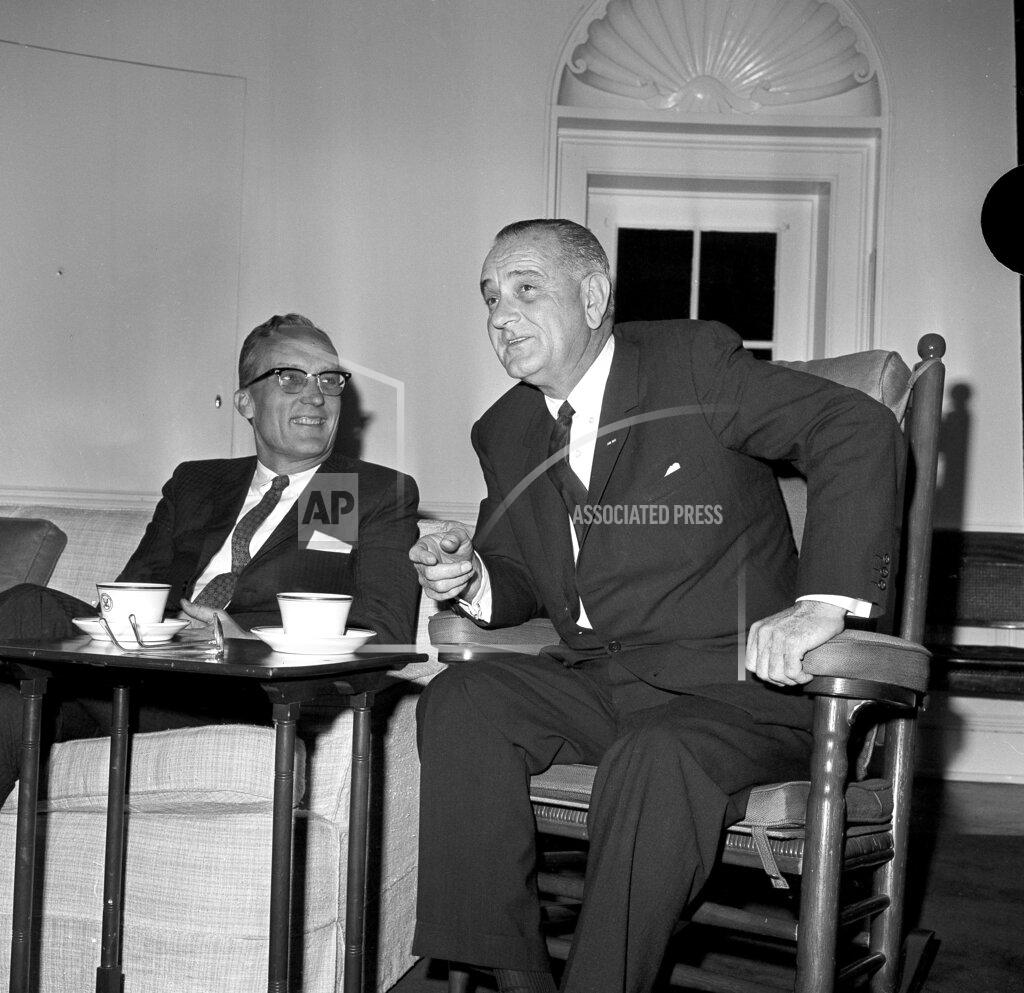
U.S. President Lyndon B. Johnson said tonight that he hoped to exchange visits with the new Soviet leaders this year. The President said that he would be glad to travel to the Soviet Union and that he had “reason to believe” he would be welcome there. Without disclosing the basis of this belief, he again invited the Soviet leaders to the United States and warmly endorsed an exchange of visits “before the year is out.” He said, “I believe such visits would reassure an anxious world that our two nations are each striving toward the goal of peace.”
Because of uncertainty over the future meetings of the United Nations General Assembly, which Prime Minister Harold Wilson was to have addressed next week, the British leader put off his scheduled trip to the United States. During that trip, he was to have paid a call on President Johnson.
The United States and Britain are ready to accept a plan drafted by the Secretary General and the President of the General Assembly as a basis for negotiations on the crisis produced by the failure of some members to pay assessments. There was no indication whether the plan, drawn up by U Thant and Alex Quaison-Sackey, would be acceptable to the Soviet Union or France, both of which have withheld payments for peacekeeping operations. A few weeks ago the Soviet delegation issued a statement that it accepted an African-Asian plan for settlement that the proposal is said to modify in some respects.
Reliable sources said today that both the United States and Britain were favorably impressed by the plan because it called for negotiations on financing past, present and future peacekeeping interventions. As a remedy for the immediate crisis, the plan calls for voluntary contributions by all United Nations members without prejudice to the positions they hold regarding the validity of existing assessments. Since the financial crisis became acute a year ago, there have been separate negotiations on this problem and on methods of paying for future interventions. Neither has proved successful, and Washington and London believe that combined discussions will be more fruitful. Adlai E. Stevenson of the United States had a talk with the Secretary General, and it was understood that they discussed both the plan and a possible framework for negotiations.
The Senate voted today, 44 to 38, to give President Johnson discretionary authority to permit further shipments of surplus food to the United Arab Republic (Egypt). The narrow margin of victory for the Administration contrasted with the House vote last week, 204 to 177, prohibiting the shipments. Some $37 million in shipments to which Washington has agreed have not yet been delivered. Under the Senate version; the President would have to find that “the financing of such exports is in the national interest.” The House acted in the wake of a public statement by President Gamal Abdel Nasser of the United Arab Republic that the United States could “go jump in the lake” if it did not like his foreign policy. In the same address, he boasted of providing arms to the Congo rebels. The Senate vote came after more than six hours of spirited and sometimes bitter debate.
The Danikils, a mainly nomadic people in Northeastern Ethiopia, saw Queen Elizabeth II and Prince Philip, the Duke of Edinburgh, today. The royal visitors and Emperor Haile Selassie flew 250 miles from Addis Ababa into the desert to see a joint British-Ethiopian cotton-growing project at Tendaho. Men of the Danikil tribe stamped their bare feet and clapped as first the Emperor and then the Queen arrived in their separate aircraft.
Australia has neither sought nor received any new United States commitment under the ANZUS pact in connection with her decision to send combat troops to Malaysian Borneo. She would nevertheless expect United States assistance under the treaty if serious hostilities with Indonesia resulted. The service of Australian troops in Borneo entails the risk of fighting between Australian and Indonesian forces, since Indonesia has deployed troops in Indonesian Borneo for a possible attack across the frontier of Sarawak. John McEwen, Acting Prime Minister, disclosed the decision to shift Australian combat units to Malaysian Borneo in a statement in Canberra. He made no mention of the implications of the move for the ANZUS treaty, which is for mutual defense between Australia, New Zealand and the United States. But a responsible source explained Australia’s view of the implications. The source indicated that Australia was proceeding on the basis that Borneo is in the Pacific area covered by the ANZUS treaty and that Article 4 is clear with regard to the responsibility of pact members to “act to meet common danger” in case of an armed attack on territories, armed forces, and public vessels in the Pacific.
President Sukarno of Indonesia asserted today that the Indonesian and Chinese Communist revolutions shared the aim of defeating Western “imperialism” and that a joining of the movements would bring stability to Asia. He made the assertion in his annual speech on Lebaran Day, the principal Muslim holiday marking the end of Ramadan, a month-long period of daily fasting from dawn to sunset. While he did not say that Indonesia intended to ally herself formally with Communist China, diplomatic observers believed that his remarks reflected a growing mutuality of interest between the two countries. This has been strengthened by Peking’s support for Indonesia’s decision to withdraw from the United Nations and by the visit to Peking last week by Foreign Minister Subandrio.
An influenza epidemic, which erupted in Leningrad and has been spreading rapidly throughout the northwest Soviet Union, reportedly has hit 92,000 Muscovites
An important oil depot on Cuba’s south shore was shelled Tuesday night by an anti-Castro gunboat.
Abdul Kahar Muzakkar, the 44-year-old leader of the Darul Islam rebellion against the Indonesian government in South Sulawesi, was tracked down and killed by an Indonesian Army patrol, bringing an end to the rebellion.
A new national party was formed in Congo today to rally electoral support for Premier Moïse Tshombe.
The visit of the Greek Premier George Papandreou to Belgrade was marred today by quarrels over Macedonia and Cyprus. Dusan Kveder, Yugoslavian Assistant Secretary for Foreign Affairs, said in a briefing that the subject of Macedonia had been broached to Mr. Papandreou and that “we put forward our well-known position.” This was an allusion to the Yugoslav argument that the 40,000 Slav-speaking residents of northern Greece are in fact Macedonians and that they have been denied minority rights to use their language, attend Macedonian schools and read Macedonian newspapers. Disagreement on the Cyprus issue arose in attempts to formulate a joint communiqué dealing with this and other matters under discussion.
Racial tensions increased in Alabama with the arrest of more than 1,000 Blacks in Selma and nearby Marion, and a state court judge issued an injunction prohibiting further demonstrations at the courthouse in Selma. More than 1,000 Black schoolchildren were arrested today here and in the nearby town of Marion, to which the Rev. Dr. Martin Luther King Jr.’s voter-registration campaign has spread in recent days. State troopers took about 700 demonstrators into custody as they marched on the Perry County Courthouse in Marion, a town of 3,800. They were charged with either unlawful assembly or disobeying an officer, hauled off to a work camp 60 miles away and held under bonds of $100 each. More than 300 were arrested for truancy in front of the Dallas County Courthouse here after they serenaded Sheriff James G. Clark and a special posse for 30 minutes with civil rights songs.
A deputy and two policemen led them in a large and noisy parade through the downtown. streets to an old armory, where they were turned over to a juvenile judge. Today’s arrests brought to more than 2,600 the number made in the Selma area since Dr. King came here early in January and announced that his nonviolent campaign would plague Dallas County until Blacks in the Alabama Black Belt were permitted to vote in greater numbers. Dr. King, president of the Atlanta-based Southern Christian Leadership Conference, spent his third day in jail. He directed the campaign from his cell by sending out letters of instruction to his staff.
The Marion students boycotted school for the first day today, in protest of the arrests of 16 Blacks on trespass charges last night. The 16 were arrested when they attempted to enter a restaurant as a test of the Public Accommodations Section of the Civil Rights Act of 1964. The owner said he had closed for the day. The students assembled in a church under the direction of adult civil rights leaders and planned to picket the jail. They assembled in front of the jail and began singing freedom songs when a trooper said: “Sing one more song and you are under arrest.” James Orange, a member of Dr. King’s Alabama staff, turned to the students and said: “Sing another song.” They did, and the troopers held them under arrest and loaded them into school buses.
In Selma, a city of 28,000, several hundred students boycotted the high school for the third consecutive day. Scores were still in jail from the mass arrests made Monday and yesterday. Those who were not met at the Browns Chapel Methodist Church and heard a leader. Charles Mauldin, a 17-year-old Hudson High School student, say:
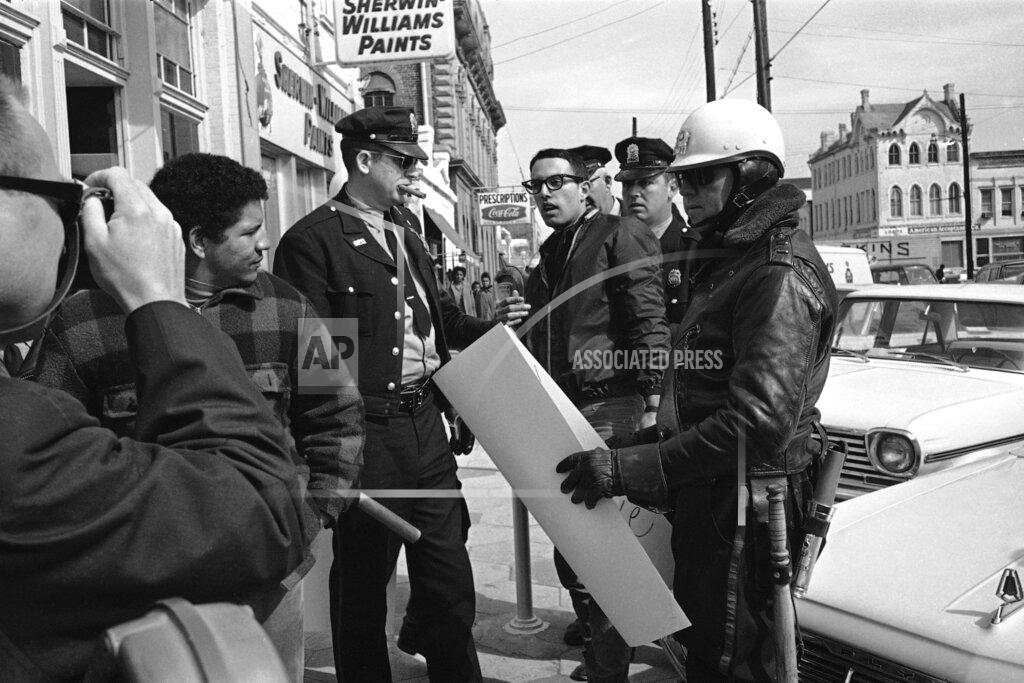
They don’t want to arrest us. We want to make them arrest us. We’ll lock arms in front of the courthouse.” He led them down in small groups and they stood along the sidewalk in front of the Lauderdale Street entrance. Facing the street, they clapped and sang. They changed the words of their songs to include the sheriff’s name: “Ain’t gonna let Jim Clark turn me round.” and “I love Jim Clark in my heart.” Sheriff James G. Clark smiled, paced the street and talked to his six deputies, 15 to 20 special posse men and several city policemen and state troopers.
Until the police chased them away, about 300 whites and Blacks lined the sidewalk across the street and watched. The mechanics at the Ted Gentry Chevrolet Company came out and looked. “There’s going to be some n****rs killed here before this is over,” one of them said. “They’ll be killed like flies.” Almost everyone else seemed; in good humor, however. Wilson Baker, Selma’s director of public safety, was asked what would be done this time. “The sheriff is in charge of the courthouse,” he said, “but I understand the juveniles will be arrested for vagrancy and the adults for contempt, but if any of them try to escape we’re going to let them.”
The demonstration was aimed at the County Board of Registrars, which has not met since Monday and is normally in session only two days a month. During January it was in session for 13 days to process the applications of about 113 Blacks. On Monday, more clerks were hired and the applications of about 60 Blacks and nine whites were processed. Most of those who have applied since January 1, however, have not been! informed whether they passed the test prescribed by state law. It is both the slow procedure and the difficult test that Black leaders want to eliminate, through both the courts and direct-action campaigns. In Dallas County, about 300 of the 15,000 Blacks of voting age are registered.
Sheriff Clark let the students sing until they started to parade. Then he thundered through a portable loudspeaker: “All of you under age are under arrest for truancy and the others for contempt of court, Turn that line around and let’s go.” The students, still singing, followed three officers through busy streets, but no one tried to escape. Three hundred and thirty were counted entering the armory. These included a Black adult whom the posse men had forced into the line with cattle prods, despite his protest that he did not belong there.
In Washington, President Johnson discussed the developments in Alabama with Nicholas deB. Katzenbach, the Acting Attorney General. Six House Democrats announced plans to go to Selma Friday to observe the registration efforts. Justice Department officials said it was still undecided whether the Federal Government could or should intervene. It was noted that past interventions by the Federal Government had normally been to enforce court orders, and that no court order exists in the present case. Some form of Federal action, however, was not ruled out. The question is further complicated in that six federal court cases are pending in Dallas County, of which Selma is the county seat. and several, of them are against Sheriff James G. Clark. Five of the cases involve voting rights and one involves public accommodations.
A federal judge in Mobile, Alabama denied a motion today for an order to require the Dallas County voter registrars to expand their registration activities. District Judge Daniel H. Thomas denied without comment the motion by attorneys for Dr. Martin Luther King Jr. The same motion filed earlier today had sought a new restraining order barring the Selma public safety director from interfering with the Black registration drive. The same denial covered this request. The restraining order asked against the public safety director, Wilson Baker, was similar to one granted by the court against Sheriff James G. Clark and other Dallas County officials January 23. Attorneys for Sheriff Clark and the other officials requested today that Judge Thomas dismiss the restraining order against them.
Senator James O. Eastland told the Senate today that Communist forces inside and outside the United States “are pressing for a Black revolution in this country.” The Mississippi Democrat, who heads the Senate Internal Security subcommittee, said in a speech that the focal point for attack was Mississippi. He said that the Communists long had hoped to “fan the fires of racial hatred, to use and pervert the racial and individual aspirations of Blacks and Black groups, to manipulate Black and racial organizations so as to bring them into the Communist sphere.”
Senator John C. Stennis, who is also a Democrat from Mississippi, joined Senator Eastland in the charge that the Communist party and its workers had infiltrated civil rights demonstrations in Mississippi. Both Senators said that most Blacks in the state had rejected efforts of outside agitators to mix the races and stir up trouble. The better type of colored people did not like this conduct,” Senator Stennis said, adding that they had refused to take the white agitators into their homes or to join in the disorders. Both Senators quoted J. Edgar Hoover, Director of the Federal Bureau of Investigation, as saying that Communists had infiltrated racial relations in an attempt to foment disorder. “It’s an attempt to take over the state of Mississippi by the Communist party,” Senator Eastland said. He added that efforts of the Freedom Democratic party, a predominantly Black group, to unseat the state’s Democratic House members was “a Communist-planned attempt to influence the Congress of the United States.”
A Federal district judge took under advisement today contempt charges against Lester A. Maddox, described by his attorneys as “a man confused by Congress and the United States.”
Mississippi’s largest organization of businessmen declared in Jackson today that the state must “adjust” to the Civil Rights Act, restore interracial communications and extend voting rights impartially.
The Senate voted today to block two Administration economy moves involving veterans’ hospitals and agricultural research. Without taking a roll-call vote, the Senate added two amendments to an otherwise noncontroversial $1.6 billion supplemental appropriations for the Agriculture Department. They would bar the use of any funds for the closing of 15 veterans’ hospitals and rest homes and 20 small farm research stations. It was a standing vote on the V.A. issue and a voice vote on the agriculture measure.
The U.S. unemployment rate for January will show a drop for the second month in a row. The rate will go from 5 percent to 4.8. Employment will show a healthy rise, according to competent sources. This rise will be the third in a row. A jobless rate of 4.8 percent would be the lowest since October, 1957, when the rate was 4.7 percent. The number of unemployed persons normally rises in January because of layoffs of extra holiday help, and this probably happened last month. However, the unemployment rates are seasonally adjusted figures that discount such layoffs.
The very issue that President Johnson had sought to avoid — the separation of church and state — has emerged as the major point of dispute in his $1.25 billion measure on aid to education.
U.S. President Lyndon B. Johnson received the “America’s Democratic Legacy” award from the Anti-Defamation League of B’nai B’rith.
An 8.7 magnitude earthquake struck Alaska’s Rat Islands at 7:01 p.m. local time (0501 UTC on 4 February 1965) in the western Aleutian Islands of the U.S., and would prove to be the last of the major Pacific quakes of the 20th century. Its epicenter was at 51.3° N, 178.6° E, 20 miles (32 km) south of the uninhabited Amchitka Island, and there were no fatalities despite its large magnitude.
Vice President Hubert H. Humphrey assured the United States Chamber of Commerce today that the Johnson Administration had confidence in business, but declared it was “terribly important that businessmen themselves have confidence in business.”
Former White House aide Walter Jenkins is not expected to appear today before the Senate Rules Committee investigating the Bobby Baker case. The scheduled appearance of Walter W. Jenkins, a former Special Assistant to President Johnson, before the Senate Rules Committee tomorrow in connection with an investigation of Robert G. Baker, former secretary of the Senate Democratic majority, appeared to be in doubt today.
The U.S. Army has recommended to the Joint Chiefs of Staff the creation of an air assault force, equipped with more than four times as many aircraft as existing combat units. The Army suggested converting one of its 16 divisions into an air assault division of 15,000 men. It also proposed other alternatives such as forming an air “cavalry” regiment, an air assault brigade or mixing air assault elements in existing divisions. The air assault concept was based on the results of tests with a special experimental air assault division that has been maintained for two years but which now will be liquidated. With the formal tests over, the Army is urging that the idea of air mobile army units be adapted in the war plans.
The air assault division would have 459 aircraft helicopters and small planes, compared with 101 in an existing division. But it would have only 1,100 ground vehicles, and no tanks, compared with the standard division which has 3,000 vehicles. Much of the firepower would be furnished in armed helicopters, such as those used in the fighting in South Vietnam. The air assault division is believed to be especially useful for jungle warfare.
Responding to pressure for a press conference, President Johnson replied through press secretary George Reedy that he had “no new information to impart.”
Congressional leaders warned that labor’s drive to repeal state laws which bar the union shop may boomerang if labor-management problems unsettle the economy.
A total of 105 cadets, including 29 football players, have resigned as the U.S. Air Force Academy concluded its probe of examination cheating.
Three gunmen held up an armored car in East Los Angeles, California today and disappeared with $110,000. The police called it the largest cash robbery in the history of Los Angeles County.
A “sunshine satellite,” OSO-2, was launched from Cape Kennedy to probe secrets of the sun’s thermonuclear energy and its effects on the earth. Orbiting Solar Observatory 2 launches into Earth orbit (552/636 km).
Geraldine McCullough wins the Widener Gold Medal for Sculpture.
Renny Ottolina launched his new show, “Renny Presenta…”, on Venezuelan television.
Braves officials propose a $500,000 payment to county officials if the club’s lease to play in Milwaukee can be terminated a year early. The offer is refused.
Dow Jones Industrial Average: 906.30 (+2.53)
Born:
Maura Tierney, American film and TV actress (Lisa – “Newsradio”); in Boston, Massachusetts.
Kathleen Kimont, actress (“Fraternity Vacation”, “Renegade”), in Los Angeles, California.
Rich Scheid, MLB pitcher (Houston Astros, Florida Marlins), in Staten Island, New York.
Chris Gaines, NFL linebacker (Miami Dolphins), in Nashville, Tennessee.
Russell Evans, NFL wide receiver (Seattle Seahawks), in Rolla, Missouri.
Mark Hanson, NFL guard (Minnesota Vikings), in Faribault, Minnesota.








 History Diaries