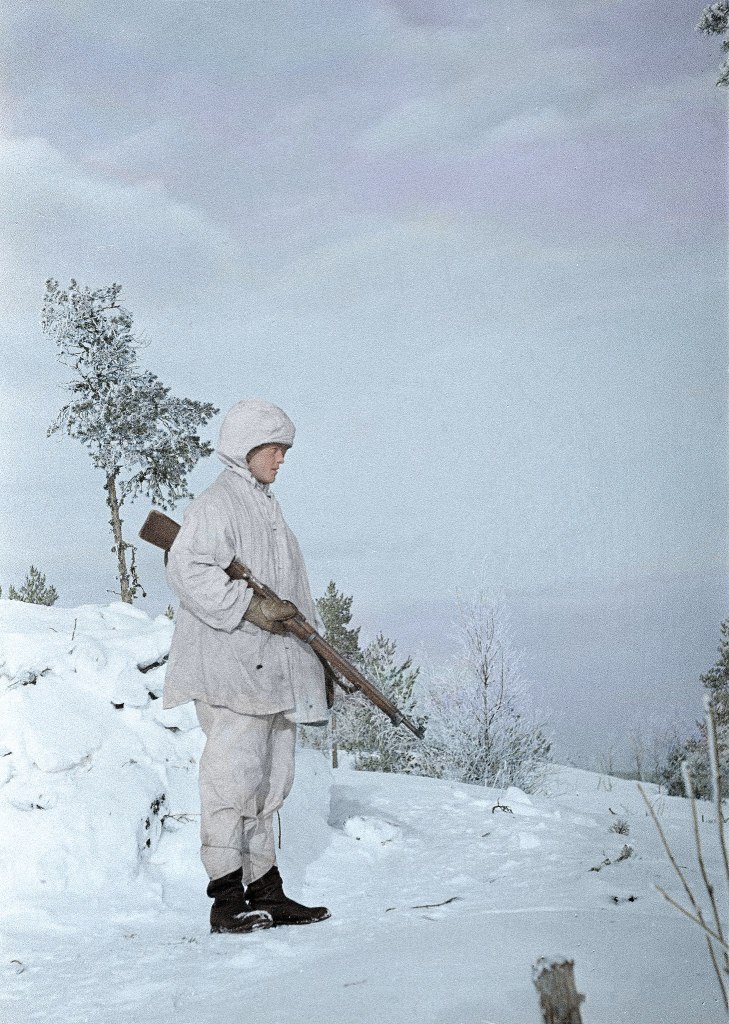
The 2nd Battle of Summa began. Soviet forces launched an all-out assault on the Karelian Isthmus. At 1050 in the morning the Russian artillery begins shelling the main defensive position of the Finnish 3rd Division in Summa, and later on also shells positions further back. Soviets open a massive artillery bombardment against Mannerheim Line. Red Army begins the first phase of its renewed attack on the Summa sector of the Karelian Isthmus, where Timoshenko has concentrated most of his forces. This 12-mile stretch of open land, unencumbered by lakes and rivers, leads directly to Viipuri, Finland’s second city. The artillery barrage ramps up to 300,000 shells in 24 hours, more than has been fired at Summa since the start of the campaign. This offensive was confined to the Karelian Isthmus and began with blanket bombing and an intense artillery barrage.
The Soviets had amassed 600,000 men using 14 divisions and six tank brigades from the Soviet 7th and 13th Armies for the operation. However, only regiment-sized probing forces are sent forward to test the effectiveness of new Soviet tank/infantry close-support tactics. The Soviet infantry follow the tanks, either by running or by creeping along behind armoured shields drawn by the tanks. The tanks come in smaller numbers and with more infantry support, making them harder to destroy. A rarity in warfare up to this point, they also use tank flamethrowers. The Soviets escalate their artillery and air bombards, and attacks are screened with smoke. Unconcerned about losses, the Soviet Generals send their troops straight at the fortifications in dense masses in the distinctive attack known as à la russe. During this round of attacks (which continues until February 8th) there is no attempt at a breakthrough by the Soviets but almost continuous heavy pressure is maintained. This is only a dress-rehearsal of the expected main assault by the Soviets. The Finnish 3rd Division, held the line in the Summa area.
The Finnish defense is complicated due to troop rotations they recently have made. The Finnish 2nd Battalion, 9th Infantry Regiment has been brought to the area of the attack. While capable troops, the 9th Infantry Regiment happens to be completely Swedish-speaking. This is not unusual in Finland – some 6% of all Finns speak Swedish – but it creates communications issues.
While the Mannerheim Line has been battered by weeks of artillery barrages, the ruins serve as effective firing positions. The Finns hold the line for the time being. This first day is just an appetizer.
12 Squadron locates about 100 Soviet artillery batteries in the Kuolemanjärvi-Kaukjärvi-Muolaanjärvi-Summa area of the Isthmus.
Soviet aircraft strafe the area around Pyhäjärvi railway station.
The Taipale sector is bombed by at first 50, and then 80 Soviet aircraft. At the same time another 30 aircraft bomb Haparainen village.
The Soviet air force also bombs the southern coastal towns of Hamina, Loviisa, Porvoo, Hanko, Karjaa and Tammisaari.
The Finns have both aircraft now from several nations, including the Americans and the British. Swedish volunteers are flying off of a frozen lake at Kemi.
In Southern Ostrobothnia, the 1940 session of Parliament opens in Kauhajoki.
Finland’s President Kyosti Kallio voiced tonight another offer from his valiantly struggling nation to conclude “an honorable peace” with Soviet Russia and end this “barbaric, senseless attack.”
The Board of the Swedish Red Cross urges the International Committee of the Red Cross to investigate attacks on Finnish civilians by the Soviet Air Force and to consider possible countermeasures.
The Soviet news agency Tass claims Sweden has emptied its prisons to allow convicts to go off to Finland as volunteers.
In London, prayers are said on behalf of Finland in St Paul’s Cathedral. Those present include the Archbishop of Canterbury and all the Nordic ambassadors.
General Erich von Manstein, chief of staff to Army Group A, is transferred to command of German XXXVIII Korps. This is done by his superiors partly in an effort to get him away from the center of power, as his innovative ideas about Fall Gelb are not appreciated. However, Hitler has heard about them and is intrigued. The Generals’ plan backfires when Hitler manages to meet with Manstein at a formal reception honoring his (and other Korps commanders’) appointment, where the two chat about how to attack in the West.
SS-Reichsführer Himmler ordered inspections of potential sites for a planned concentration camp. Among those inspected was the camp at Oswiecim, Poland, known in German as Auschwitz.
German Foreign Minister Joachim von Ribbentrop today disclaimed any intention on the part of Germany and Soviet Russia to draw the Balkans into the Allied-German war.
Nine pairs of railway stations on the New German-Russian frontier will hum soon with activity through the reloading of Russian raw materials and German industrial goods from wide to standard gauge Freight cars and vice versa, if Nazi expectations are fulfilled.
Details of executions of Poles by Germans in which it is said 15,000 of the conquered nation’s leaders have fallen were cited in Rome today in the form of a diplomatic report on political, social, and economic conditions among the Polish civil population. This was issued by the Polish embassies to the Vatican and Italy. Copies were presented to the Vatican and to all members of the diplomatic corps in Rome except the German. In the following paragraphs some of the material contained in the report is given, it being understood that in every case the Polish document is authority for the statements.
With the cold becoming less bitter on the Rhine-Moselle front, more activity is developing. The French in particular have been sending out scouting parties far into enemy lines to obtain information inaccessible to aerial observation.
In Russia the noted stage director, Vsevolod Meyerhold, having been tortured into confessing that he was the leader of an anti-soviet Trotskyite, was convicted in camera, and was executed on the following day.
In the British House of Commons, Prime Minister Neville Chamberlain declined to accept a suggestion by Herbert Morrison that a Minister of War Economy should be appointed on the grounds that such a post would do nothing which was not already being done.
In Britain, the Admiralty took over the responsibility for the building and repair of merchant shipping and concluded an arrangement to buy old cargo ships from the United States.
The Lord Mayor’s Red Cross and St. John’s Fund passes the £1,000,000 level.
General Claude Auchinleck takes command of the British Army IV Corps.
Italy, which largely keeps its distance from the German holocaust agenda, enacts its own Employment laws imposing constraints upon Jews.
The Ministry of the Interior in Bucharest has forbidden the activities of all Zionist organizations in Rumania. The police have ordered the closing of all their offices. A delegation of Jewish leaders asked the Interior Minister for an audience. He is to receive them tomorrow. The reason for the move is not known.
The Swedish steam merchant Fram, lying at anchor, sinks after being torpedoed by the U-13, commanded by Max-Martin Schulte, off Rosehearty Buoy in Aberdour Bay, Scotland (57° 43’N, 2° 06’W). At 0143 hours the Fram, lying at anchor, was hit by one G7e torpedo from U-13 and sank. Of the ship’s complement, 9 died and 14 survivors were picked up by the destroyer HMS Khartoum (F 45) and the British armed trawler HMS Viking Deeps. The 2,491-ton Fram was carrying ballast.
The unescorted British coaler MS Ellen M was torpedoed & sunk by U-59, commanded by Kapitänleutnant Harald Jürst, Northeast of Lowestoft (52° 33’N, 2° 15’E). At 2044 hours the unescorted Ellen M. (Master Kenneth Mann) was hit in the foreship by one G7e torpedo from U-59 and sank in a few minutes. All of the ship’s complement of 9 died. The 498-ton Ellen M. was carrying coal and was bound for London, England.
The French tanker Picardie struck a submerged object in the Atlantic Ocean 450 nautical miles (830 km) northwest of the Azores, Portugal and broke in two. The bow section sank. Seven crew and five gunners were lost. There were 28 survivors. The stern section was towed to Oran, Algeria in April 1940. Surviving wartime damage, it was sold to Norway in 1949, a new bow section was built and she returned to service as Sirefjell.
U-10 had to abort patrol due to some technical problems & reached the German base at Heligoland.
Convoy OB.83 departs Liverpool.
Convoy HG.17 departs Gibraltar for Liverpool.
Convoy SL.19 departs Freetown for Liverpool.
U.S. freighter Exminster is detained by British authorities at Gibraltar (see 9 February); freighters Exochorda (detained since 30 January) and Jomar (detained since 31 January) are released.
The War at Sea, Thursday, 1 February 1940 (naval-history.net)
The Northern Patrol sighted 49 eastbound merchant ships from the 1st to 14th and sent 21 into Kirkwall for inspection.
Destroyers were transferred to the Rosyth Command to assist in anti-submarine patrols. BRAZEN and BOREAS of the 19th Destroyer Flotilla arrived at Rosyth from Harwich on the 1st. GRIFFIN was delayed in her departure due to DG fitting, but both she and GALLANT of the 1st Flotilla departed Harwich on the 2nd and arrived at Rosyth on the 3rd. INTREPID and IVANHOE of the 20th Flotilla arrived on the 8th.
Destroyer BASILISK departed Dover for Boulogne with Lord Gort, and came back later that day carrying the Chief of Naval Staff, Chief of Imperial General Staff and other staff members.
Destroyer JACKAL and JAVELIN arrived at Rosyth escorting tanker ATHOLLKNIGHT (8940grt).
Light cruiser SOUTHAMPTON departed the Tyne for Scapa Flow after her refitting.
Sloop FLAMINGO arrived at Rosyth escorting minelayer PRINCESS VICTORIA, which had departed Immingham at 0200/1st and joined convoy FN.83, escorted by FLAMINGO and sloop WESTON.
Destroyers KASHMIR and KHARTOUM departed Rosyth, escorting A.S.I.S. SARDIS (970grt) to Aberdeen, where steamer CYPRIAN PRINCE was to join for the passage to Scapa Flow. However, because of bad weather, CYPRIAN PRINCE was unable to join.
Destroyer JUNO, escorting convoy HN.9B, made an attack on a submarine contact.
Heavy cruiser BERWICK and armed merchant cruisers TRANSYLVANIA and CARINTHIA arrived at the Clyde after Northern Patrol duties.
Submarines URSULA and H.34 departed Rosyth for Blyth and were escorted as far as the Longstones by destroyer ENCOUNTER. The submarines arrived at Blyth on the 2nd and ENCOUNTER back at Rosyth also on the 2nd.
Two Royal Marines were lost at sea in light cruiser CARLISLE, en route to Gibraltar to work up.
French destroyer OURAGAN was damaged in a collision with French patrol vessel/trawler LOUISE MARIE which was lightly damaged. OURAGAN was temporarily repaired at Boulogne, departed on the 14th, and arrived at Brest on the 25th for completion of work.
Convoy FN.84 departed Southend, escorted by destroyer VIVIEN and sloop PELICAN, and arrived in the Tyne on the 2nd.
Convoy FS.84 departed Methil for the Thames escorted by escort vessel/destroyer WHITLEY and sloop EGRET. The convoy consisted of 27 ships, but two more joined at Middlesborough and nine more in the Humber. Off Blea Wyke Point on the 2nd, a submarine contact was made at 0820 by EGRET. WHITLEY dropped depth charges and was later relieved at the scene by destroyer GLOWWORM and escort vessel/destroyer WESTMINSTER, both of which attacked the contact. Destroyer GREYHOUND also joined the hunt, but the search was abandoned at 1400. The convoy arrived at Southend on the 3rd.
Convoy MT.1 departed Methil, escorted by escort vessel/destroyer WESTMINSTER and sloop STORK, and arrived in the Tyne on the 2nd.
Destroyers VETERAN and VESPER, on an anti-submarine sweep, attacked a submarine contact west of Scilly Island, in 49 56N, 08 07W.
U-48 departed Wilhelmshaven for, during which she laid mines off Weymouth. No shipping was sunk or damaged in this minefield.
U-13 sank Swedish steamer FRAM (2491grt) in 57 43N, 02 06W off Rosehearty Buoy in Aberdour Bay with the loss of six crew. The thirteen survivors were picked up by destroyer KHARTOUM and armed patrol trawler VIKING DEEPS (226grt).
U-59 sank steamer ELLEN M. (498grt) in 52 33N, 02 15E.
Convoy HG.17 departed Gibraltar with 20 ships, escorted by destroyers VIDETTE, the French CHACAL and French patrol vessel CAPITAINE ARMANDE. CHACAL later detached and arrived in Brest on the 9th and the patrol vessel on the 10th. The convoy was escorted in Home Waters by destroyer VIMY from the 8th to 11th when the convoy arrived.
Convoy SL.19 departed Freetown escorted by armed merchant cruiser PRETORIA CASTLE from the 1st to 16th, merged with SLF.19 on the 16th, and the two convoys arrived at Liverpool on the 20th.
Today in Washington, President Franklin D. Roosevelt sent to the Senate the nominations of Marriner S. Eccles and Chester C. Davis for reappointment as members of the Federal Reserve Board, Claude Wickard to be Under-Secretary of Agriculture, and Grosvenor Jones and Bruce Berckmans to be assistant directors of the Bureau of Foreign and Domestic Commerce.
The Senate passed the House bill extending the lending authority of the Land Bank Commissioner, approved and sent back to the House the $57,541,300 urgent deficiency bill trimmed $961,300 below House figures, and adjourned at 3:14 PM, until noon tomorrow.
The House debated the Agriculture Appropriation Bill, discussed the request of Representative Hook for permission to expunge from the record allegedly forged letters reflecting on the Dies Committee and adjourned at 5:51 PM, until noon tomorrow.
The 150th anniversary of the first meeting of the Supreme Court was observed with ceremonies in the court chamber.
President Roosevelt writes to the British First Lord of the Admiralty Winston S. Churchill, concerning the detention of U.S. merchantmen, and frankly informs him of adverse American reaction to the British policy. “The general feeling is,” Roosevelt informs Churchill, “that the net benefit to your people and the French is hardly worth the definite annoyance caused to us.”
A bill to create a foreign trade board, modeled after the British Board of Trade, to deal with foreign financial and commercial activities of the government was introduced by Senator Vandenberg today. The proposal was regarded as part of the Michigan Senator’s campaign against extension of the Reciprocal Trade Agreements Act to June 12, 1943, which the Administration seeks. The Tariff Commission would be abolished under Mr. Vandenberg’s plan, which he is expected to point to in the Senate later as a constructive suggestion offering a way to avoid reversion to the old “logrolling” methods of tariff legislation which Secretary Hull has condemned. The functions now exercised by the commission would be vested. in the new independent agency, together with other activities “now scattered through fifty different bureaus and departments of Federal Government,” the Senator explained.
“The board would have power to control imports for the purpose of protecting our domestic economy,” he said. “It would have power to encourage exports through barter arrangements and otherwise. It would have power to lower tariffs, as well as increase them, under explicit Congressional criteria. It would have power to take direct action in connection with the troublesome problem of blocked exchange. It would, for the first time, bring into government possession authentic information regarding transactions in foreign exchange, in the export or import of securities, and in the export or import of gold and silver coin, bullion or currency. It would be charged with the responsibility of coordinating our foreign trade and financial statistics in order that we may have a true picture of our relationship with each country in the world: Thus facts would take precedence over theories in the conduct of our commercial and financial activities with other countries.”
Mr. Vandenberg declared the principal value of such an agency would be that “our foreign trade policy should be consistent within itself and should not present a constant quarrel between different policies pursued by different branches of the same government.”
The 150th anniversary of the first sitting of the Supreme Court of the United States was celebrated today in a ceremony attended by representatives of the Senate and House, the executive branch of the government and the American Bar Association. The ceremony, held in the spacious chambers of the court’s magnificent white marble building, commemorated the first meeting of the tribunal in a small room in the Exchange Building in New York City in 1790, over which Chief Justice John Jay presided.
The first meeting in 1790 was on the first Monday in February. The court adjourned for lack of a quorum until the following day, when Justice John Blair arrived. The members then met, adopted. rules of procedure, chose a seal of court and took oaths of office. Chief Justice Charles Evans Hughes, speaking at the ceremony, observed that after a century and a half the Supreme Court “still stands as an embodiment of the ideal of the independence of the judicial function.”
The executive council of the American Federation of Labor declared today. that the federation in 1940 “will refrain from giving a blanket endorsement to any political party,” and called upon both major parties to nominate candidates sympathetic and friendly to labor and its interests. Meeting in Miami in its midwinter session, the executive council adopted a political declaration of policy for the AFL in the forthcoming Presidential campaign. The council cautioned aspirants for office against what it termed the CIO “kiss of death,” in the form of endorsement. The council said that no Presidential candidate hostile to labor could hope to win and at the same time stated that no individual could “deliver” the votes of labor, as was demonstrated in the 1938 elections in Pennsylvania, Michigan and Ohio. This last statement was taken as a thrust at John L. Lewis, president of the Congress of Industrial Organizations.
While ignoring the third-term issue as affecting President Roosevelt, the executive council, speaking for 4,000,000 members, said that any candidate who “seeks and accepts” the support of the CIO “and places himself in bondage to its leader (Mr. Lewis), is doomed to certain defeat.” The statement also assailed Labor’s Non-Partisan League, the political arm of Mr. Lewis’s organization, as “a sham,” “a paper organization” and “a puppet of the CIO” The political influence of Labor’s Non-Partisan League was characterized as “nil.” The executive council declared that the AFL would exert its influence to obtain the adoption of progressive candidates and programs by the Democratic and Republican parties, and to this end would send delegations to the two political conventions next Summer.
The two national executive bodies of the American League for Peace and Democracy secretly went into voluntary dissolution at a meeting held yesterday afternoon in a downtown cafeteria, and thus paved the way for the immediate disbanding of 14,000 members of its branches in 117 communities in all parts of the country. The “coming of the war,” which created the need for a “different program and type of organization” to preserve democratic rights in wartime and “to keep the United States out of war,” was the reason embodied in the executive resolution for the dissolution of the organization, which was founded in 1933 as the American League Against War and Fascism.
However, in an hour-long address, delivered before 500 members in a testimonial ceremony in his honor at the New School for Social Research last night, the retiring president, Dr. Harry F. Ward, professor of Christian Ethics at Union Theological Seminary, mentioned the breaking up of the “united front” as a contributing factor. He denied bitterly charges that the league was “Communist-controlled”; he warmly defended Communist participation in the organization; he excoriated the Dies committee for “creating the Communist myth” concerning the league; he denounced the press for its “garbled reporting,” and in an impassioned plea in behalf of democratic institutions he hit out at President Roosevelt, the Rev. Charles E. Coughlin, and the movement to aid Finland.
The controversy over the allegedly forged letters of William Dudley Pelley, Silver Shirt leader, which were put in the Congressional Record by Representative Hook of Michigan, virtually displaced consideration of the Agriculture Supply Bill in the House today. Mr. Hook asked unanimous consent to expunge from the Record the letters, which allegedly sought to establish collusion between Mr. Pelley and Representative Dies, chairman of the Committee to Investigate Un-American Activities, and were made public in an effort to prevent the continuation of the Dies committee.
For the first time in history the Commerce Department is attempting to get a month-by-month picture of conditions in the entire American manufacturing industry by sending questionnaires to 1,800 companies held to be a cross-section of the productive enterprise of the United States.
President Roosevelt today reappointed Marriner S. Eccles to the Federal Reserve Board to fill the unexpired term of Chester C. Davis, who resigned.
NBC performs the first inter-city television broadcast from its station in New York City to another in Schenectady, New York by General Electric relay antennas.
Capt. G. E. Price, USAAF, flew the XP-39 Bell Airacobra through flight tests. The Airacobra has potential but its high altitude performance is wrecked by changes mandated by the USAAF. The type will be used sparingly by the US, but will find its niche as a medium altitude fighter (not a ground attack aircraft as the myth goes) in the skies over the Soviet Union.
Russia has made it clear to the Chungking government that the Soviet is unwilling to continue aid to China to support civil war in the latter country, reliable sources here in touch with Chungking revealed today.
Chinese Winter Offensive: With Japanese forces still holding Changtze, Chinese 2nd War Area halts operations and begins withdrawing from the field.
Battle of South Kwangsi: Japanese forces attacking around Pinyang.
Japanese columns advancing in Western and Southern Suiyuan have been checked by Chinese ‘troops, the Chinese military spokesman declared today in his weekly review of the military situation. The spokesman said two columns that had crossed the Yellow River from the Peiping-Suiyuan railway southwestward had been halted not far from the south bank of the river and were now being engaged by the Chinese in heavy fighting. The Japanese objective, he said, was the strategic southern Suiyuan city of Tungsheng. He declared a third invading column, pushing westward from Paotow toward Wuyuan, had been held up short of its objective, about forty miles west of Paotow. That column, he said, is now facing strong Chinese resistance south of the Wula Mountains.
The spokesman believed the objective of Japan’s new Suiyuan operations was consolidated control of Paotow, which was recently subjected to a. Chinese attack that proved costly to the Japanese, and at the same time occupation of bases for further attacks in North Shensi and South Ningsia. He stated that 35,000 troops were engaged in the offensive.”
Referring to the new minor Japanese drive south of Hangchow, the spokesman asserted that the Chinese were holding the invaders at Hsiaoshan, just south of the Chientang River, pointing out that the Japanese had failed to push on to Ningpo. He gave it as his opinion that the Japanese would attempt to hold Hsiaoshan as a point of attack upon Chinese guerrillas and to safeguard workmen rebuilding the Chientang railroad bridge, for which task the Japanese have impressed 2,000 peasants from the Hsiaoshan neighborhood.
Japanese aircraft begin offensive against airfields around Chinhua, Yushan, and Chushien approximately this date.
The Chinese Communist Mao Tse-tung calls for the U.S. to stand firm against Japan.
Japan makes a diplomatic protest to the British government concerning the removal of 21 German nationals from the Japanese liner SS Asama Maru by cruiser HMS Gloucester. Japan formally demanded tonight that Britain return the twenty-one German seamen removed from the liner Asama Maru. The demand was made in a note handed to Sir Robert Leslie Craigle, the British Ambassador. The Japanese note was in reply to the one received from the British several days ago. With the legal position of both sides now on record, efforts are being concentrated on finding a political solution that will satisfy national dignity and assure Japan against a repetition of British naval activities in her “front garden” and satisfy Britain that German engineers will not be transported by Japanese ships. A solution presents both practical and political difficulties, but both sides are working for an agreement.
The Japanese Diet announced a record high budget with over half its expenditures being devoted to the military. Japan passed a massive budget devoting unprecedented sums to weapons and training. The new government embarks upon a five-year rearmament program.
Dow Jones Industrial Average: 145.23 (-0.10)
Born:
Bibi Besch, Austrian-American actress (“Star Trek 2: The Wrath of Khan”, “Beast Within”), in Vienna, Austria.
Hervé Filion, Canadian harness racing driver (World Driving C’ship 1970; Harness Tracks of America Driver of the Year 1969-74, 1976, 1978, 1981, 1989), in Angers, Quebec, Canada (d. 2017).
Mark Fleischman, American businessman and nightclub owner, in New York, New York (d. 2022).
Ajmer Singh, sprinter, in Kup Kalan, Sangrur district, Punjab, India (d. 2010).
Died:
Philip Francis Nowlan, 51, American science fiction writer and creator of Buck Rogers.
The Royal Canadian Navy Flower-class corvettes HMCS Orillia (K 119), HMCS Barrie (K 138), HMCS Galt (K 163), HMCS Moose Jaw (K 164), HMCS Battleford (K 165), HMCS Drumheller (K 167), HMCS The Pas (K 168), and HMCS Collingwood (K 180) are ordered from Collingwood Shipyards Ltd. (Collingwood, Ontario, Canada).
The Royal Canadian Navy Flower-class corvettes HMCS Cobalt (K 124), HMCS Kenogami (K 125), HMCS Algoma (K 127), HMCS Rosthern (K 169), HMCS Morden (K 170), HMCS Kamsack (K 171), HMCS Weyburn (K 173), and HMCS Oakville (K 178) are ordered from the Port Arthur Shipbuilding Company (Port Arthur, Ontario, Canada).
The refrigerated cargo ship Telemachus is laid down by Caledon Shipbuilding & Engineering Co. Ltd. (Dundee, Scotland); completed by Kincaid. This will become the Royal Navy escort carrier HMS Activity (D 94).
The Kriegsmarine (German Navy) Type IXB U-boat U-110 is laid down by AG Weser, Bremen (werk 973).
The Kriegsmarine (German Navy) Type VIIC U-boats U-559, U-560 are laid down by Blohm & Voss, Hamburg (werk 535 and 536).
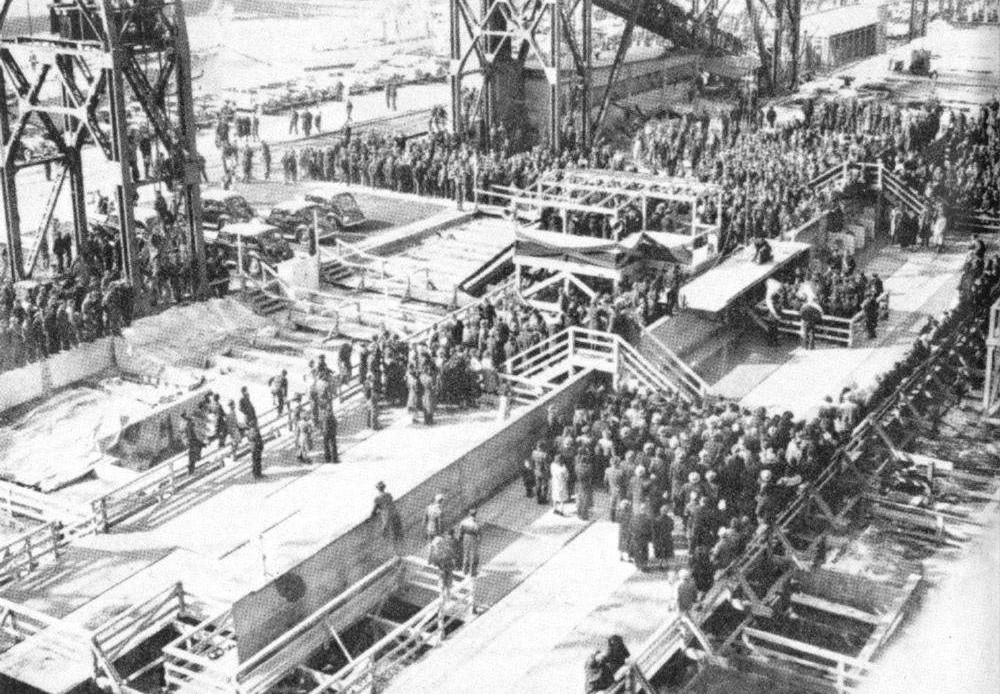
The U.S. Navy South Dakota-class battleship USS Alabama (BB-60) is laid down by the Norfolk Naval Shipyard (Portsmouth, Virginia, U.S.A.).
 History Diaries