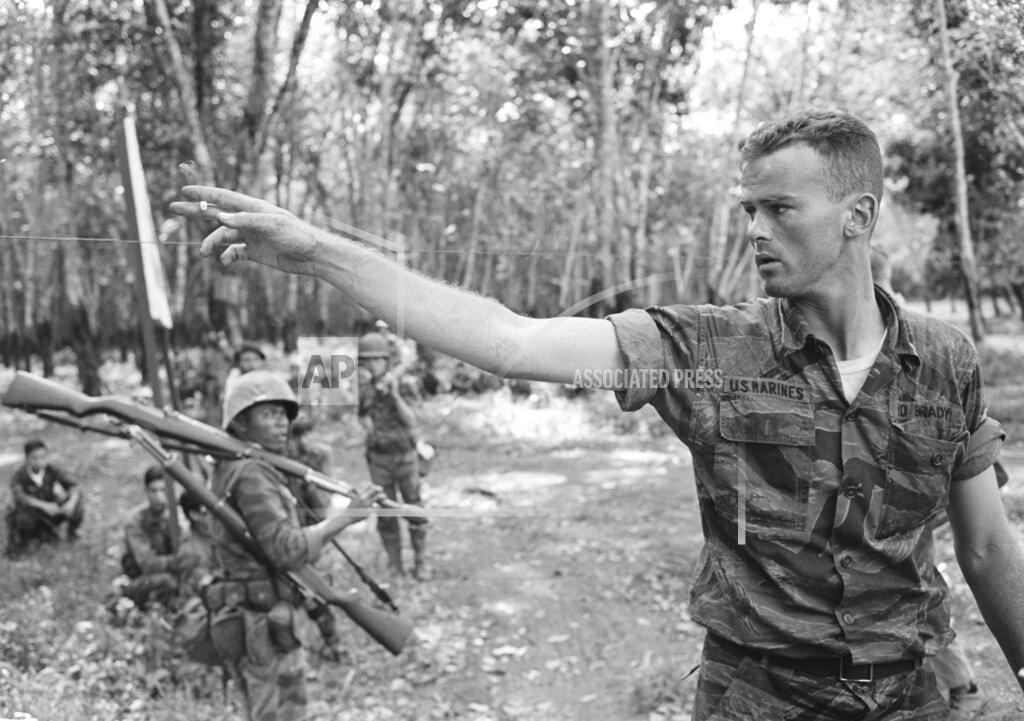
Operation Open Arms (Chiêu Hồi), the South Vietnamese government’s plan to win over defectors from the Việt Cộng, is now underway and will report some success in ensuing months; at the same time, there are reliable reports of the ‘shadow government’ operated by the Việt Cộng — a stable, orderly political control over much of South Vietnam’s territory.
The White House announced today that President Johnson was sending McGeorge Bundy, his special assistant for international security affairs, to Saigon for consultations on the situation in South Vietnam. Administration officials said there was no urgent crisis. The consultations were ordered in the light of the continuing political problems in Vietnam. George E. Reedy, White House press secretary, said that Mr. Bundy would leave tomorrow night for talks with Ambassador Maxwell D. Taylor and other American officials, but that any meetings with South Vietnamese officials would be incidental to the mission. Mr. Bundy, who is expected to return at the end of the week, will be accompanied by John T. McNaughton, Assistant Secretary of Defense for International Security Affairs, and Leonard Unger, Deputy Assistant Secretary of State for Far Eastern Affairs.
Mr. Reedy described the conference as a continuation of regular consultations with Mr. Taylor, who has returned here twice since his appointment last August — once in September and again in November — to report to the President on developments in Vietnam. He said that “in view of the situation in Saigon it was felt that it was preferable for the Ambassador to stay there.” Officials emphasized that the trip was not related in any way to Saturday’s announcement that Premier Aleksei N. Kosygin of the Soviet Union is to visit Hanoi, the North Vietnamese capital. North Vietnam is the chief supporter of the Việt Cộng rebellion. Mr. Reedy said Mr. Bundy and Mr. Taylor would review the “events and the general trend” in South Vietnam. The trend in South Vietnam that is of overriding concern to the United States is the manner in which political stability there has been progressively breaking down in the last months.
A civilian regime, strongly supported by Washington, was ousted in the latest military coup last week. Mr. Bundy’s trip was apparently planned as a result of the most recent political upheaval, which placed in power Lieutenant General Nguyễn Khánh, with whom Mr. Taylor had found himself at odds. It is because of this delicate relationship in Saigon that the White House made a point of stating that Mr. Bundy would not seek to meet with the South Vietnamese leadership, obviously including General Khánh. However, Mr. Reedy said, Mr. Bundy’s trip has been “cleared” with the Saigon Government.
Officials said Mr. Bundy’s assignment would be to study with Mr. Taylor the political outlook in Vietnam so that President Johnson could have a better basis upon which to formulate further policy decisions in the deteriorating Vietnamese situation. The announcement of the new Saigon mission followed daylong White House meetings, attended by Under Secretary of State George W. Ball; General Earle Wheeler, Chairman of the Joint Chiefs of Staff; Acting Secretary of Defense Cyrus R. Vance; Mr. Bundy and his brother William P. Bundy, who is Assistant Secretary of State for Far Eastern Affairs. Secretary of State Dean Rusk was at home in bed with a cold. Secretary of Defense Robert S. McNamara was in a hospital with pneumonia.
Late in the afternoon, President Johnson held a meeting of the National Security Council to discuss Mr. Bundy’s trip and the situation in Southeast Asia. In his White House position, Mr. Bundy has been one of the framers of the United States policy on Vietnam since President Kennedy’s decision in 1961 to commit this country actively to the support of the war against the Communist Việt Cộng guerrillas, In Saigon, therefore, he will be the eyes and ears of President Johnson.
On the subject of Mr. Kosygin’s trip, the State Department said the United States was not “apprehensive” about it. However, Robert J. McCloskey, the department’s spokesman, stressed that “the United States will watch the visit with considerable interest.” This careful official reaction was tied, among other factors, to the developing speculation in the Administration and among informed diplomats that Mr. Kosygin’s trip might be the opening move in a broad Soviet attempt to mediate between the United States and the Hanol regime for a settlement of the Vietnamese war.
Premier Aleksei N. Kosygin’s trip to Hanoi appeared imminent tonight as the Soviet press published new charges of United States “violation” of North Vietnam territory.
The USS Hancock and the USS Coral Sea are ordered to leave their duty station off Vietnam and rejoin the 7th Fleet, as there is an apparent reduction in the number of aggressive actions.
The tactics taught to Communist guerrillas in South Vietnam to shoot down United States planes are being countered successfully by saturation, rocket and machine-gun firing plus a bit of deception military experts said today.
American Navy personnel supervising ship unloadings in Saigon have been held at gunpoint when they tried to stop South Vietnamese soldiers from looting cargoes on the docks.
A Cuban publication admits that Cubans are helping to train Việt Cộng.
A group of Laotian Army officers seized a radio station in Vientiane last night and announced that they had staged a coup d’état. The announcement said troops led by Colonel Bounleut Sykosy, a Washington-trained staff officer in the Army Headquarters in Vientiane and one of the coup leaders, were facing Royal army units under the command of General Kouprasith Abhay a few miles outside the southeast Asian capital. Colonel Bounieut, who made the announcement, said the coup leaders “wanted to make some changes” in the Army High Command, but did not intend to remove Premier Souvanna Phouma.
Two soldiers were killed about two miles from Vientiane when coup supporters clashed with General Kouprasith’s troops at a roadblock. The coup supporters erected five roadblocks within 100 yards of each other. Two hundred yards away General Kouprasith’s troops watched from the roadside backed by two tanks. The officers associated with Colonel Bounleut announced their move in a news broadcast at 8:30 PM [8:30 AM, Sunday, New York time]. “We only want to make the army stronger,” Colonel Bounleut said in his broadcast. General Kouprasith and General Siho Lamphouthacoul staged a right-wing coup last April. The following month, the Defense Ministry announced that the Laotian rightist and neutralist forces had merged under an 11-man command, including General Kouprasith. The army supported Prince Souvanna Phouma.
Two weeks ago, a Defense Ministry communiqué here said the Royal Laotian Army’s high command was to be reshuffled in a bid to end discord between rightist factions in Vientiane and to strengthen the coalition Government. The decision was stated to have been taken at a meeting of the high command presided over by Prince Souvanna Phouma and attended by all generals, including the rightwing leader, General Phoumi Nosavan.
Explosions wrecked part of the military airport at Vientiane and destroyed 10 aircraft there eight days ago. A military statement then said the explosions were caused by the short circuit firing of a machine gun. The present coup attempt followed reports that pro-Communist positions were being reinforced all over Laos. Government forces had to abandon some positions in Samneua Province in northeastern Laos January 27 under pressure from Pathet Lao troops supported by elements from North Vietnam. United States planes recently bombed Communist supply routes in Laos that form part of the Ho Chi Minh trail which runs from North Vietnam through southern Laos to South Vietnam. Prince Souvanna Phouma has appealed to the Pathet Lao to take part in national elections scheduled for April.
A group of young officers attempted a coup against the shaky Government of Premier Souvanna Phouma overnight. Government troops rushed toward the capital from a nearby garrison early today. There have been recent hints that General Kouprasith Abhay might take overall command of the armed forces. The troops heading for the capital came from the garrison at Chaianamo, nine miles outside Vientiane. In recent weeks General Kouprasith had been reported feuding with a co-conspirator in the 1964 coup, General Siho Lamphoutacoul, head of the National Police. The coup garnered no support from the military and soon collapsed. The brief and unsuccessful military coup d’état was regarded by some sources today as an attempt by General Phoumi Nosavan, a rightist leader, to regain his power in the army.
The U.S. Senate Appropriations Committee voted today to let President Johnson complete a surplus food sales agreement with the United Arab Republic if he finds it in the national interest. Last Tuesday the House of Representatives, by a vote of 204 to 177, declared that no part of a $1.6 billion supplemental appropriation for the Commodity Credit Corporation could be used to finance food exports to the U.A.R. The House action would have meant that $37 million worth of commodities — all that remains of $431.8 million worth that the United States agreed three years ago to sell to the U.A.R. for local currency — would not have been delivered.
American Ambassador Lucius D. Battle met with President Nasser tonight to outline the Administration’s efforts to continue American food shipments to Egypt and to discuss the future of the aid program.
U Thant has proposed a restudy of the U.N. peace-keeping problem, a move which may lead to the total collapse of this Assembly session. The United Nations General Assembly took another recess today to avoid a showdown between the United States and the Soviet Union on the question of unpaid assessments. This time, however, the recess will also be used to prepare to break off the Assembly session if the deadlock on funds continues.
Former Premier Edgar Faure of France said tonight that financial difficulties and “procedural casuistries” were threatening the existence of the United Nations even though it is more vigorous and more successful than the League of Nations.
Leonid A. Brezhnev, leader of the Soviet Communist Party, paid a secret, three-day visit to Hungary last week. Leonid I. Brezhnev, First Secretary of the Communist party, and Nikolai V. Podgorny, widely assumed to be the second most powerful man in the Soviet party hierarchy have spent three days in secret talks with Hungarian Communist leaders in Budapest.
British Prime Minister Harold Wilson told the nation his Labor government rejects recent indications it is losing ground and will carry on with the job it promised upon being elected last October.
Britain’s highest court cleared the way today for mass Government distribution of drugs imported at low cost from abroad. The ruling was made against the wishes of the patent-holders.
Sir Winston Churchill’s last words to his family were, “I am bored with it all.”
West Germany ordered its ambassador in Cairo to return home and report on the crisis in its relations with the United Arab Republic. A government spokesman said he did not know when the Ambassador, Dr. Georg Federer, would return. Dr. Federer tried without success yesterday to persuade the Egyptian President, Gamal Abdel Nasser, to call off his invitation to Walter Ulbricht, the East German Communist chief, to visit Cairo late this month. Chancellor Ludwig Erhard summoned the Parliamentary heads of the three parties represented in the Bundestag, or Lower House, to his office. He hopes to shape a solid nonpartisan position on the Egyptian challenge to Bonn’s diplomatic boycott of Mr. Ulbricht. It was evident that Dr. Erhard wanted to react sharply if the Ulbricht visit, scheduled to begin February 26, went through.
A special United Nations mission to study “a serious deterioration” in the situation along the Israeli-Jordanian border began consultations today with local officials of the world body. The mission was sent here by the Secretary General, U Thant, at the request of the Jordanian Government. Jordan has charged that Israel is turning her enclave on Mount Scopus, in the Jordanian Sector of Jerusalem. into an excessively fortified stronghold. The border with Jordan, particularly in the Jerusalem area, has been troubled by sporadic incidents since Christmas. Israeli officials seemed nettled by the Jordanian initiative, although they said they favored any move that would stop the Jordanians from shooting at Israelis.
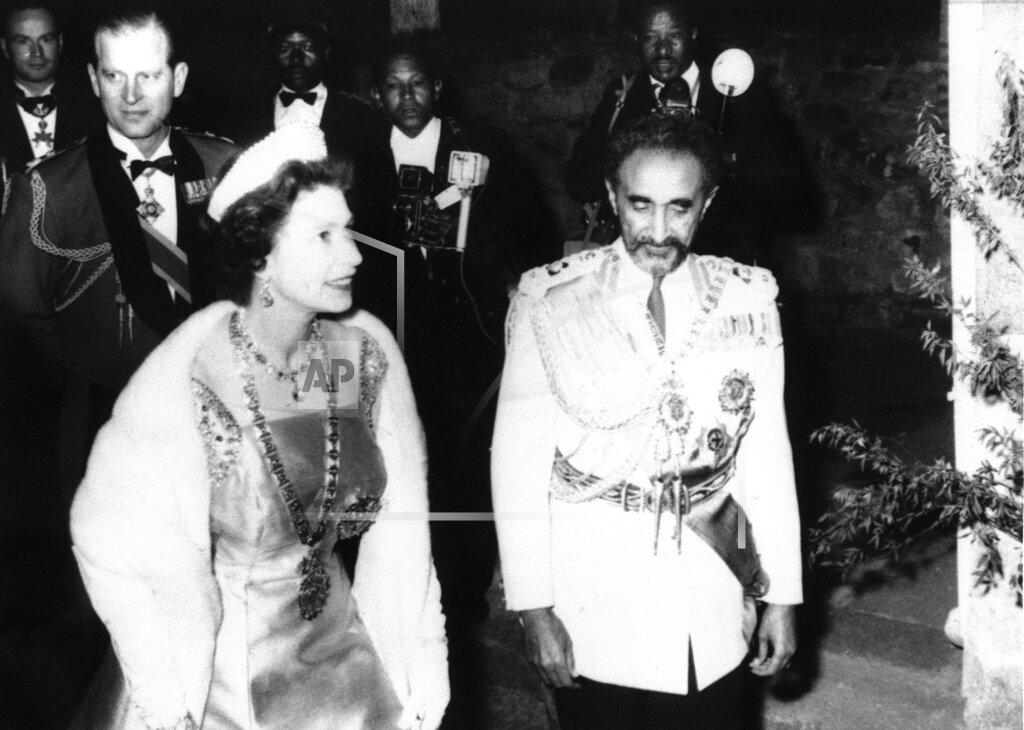
Emperor Haile Selassie and thousands of his subjects welcomed Queen Elizabeth II of Britain today for a state visit to the ancient African kingdom of Ethiopia. Elizabeth flew from London on a four-engine jet for the first formal call on Ethiopia by any British monarch. Her eight-day visit is expected to help focus attention on Ethiopia as a unifying center for Africa’s emerging nations. The smiling Queen wore a pink floral dress, a yellow silk coat and a petaled hat for her entry into Addis Ababa. She found the sprawling capital a city of contrasts — modern buildings flanked by thatched huts; streets newly cleared of roving livestock by a royal order, and pet lions, freshly washed and cleansed of fleas, chained in the gardens of the Emperor’s white marble palace. Haile Selassie, who has ruled for 34 of his 72 years, greeted the Queen at the airport. He wore a dark blue field marshal’s uniform and a hat crowned with a lion’s-mane plume. Ethiopians packed the airport grounds and sometimes 100 deeplined the new highway leading into the city.
Among young mainland Chinese, a new heresy is gaining ground. It shows that significant numbers of young scientists and other intellectuals deeply resent the political pressures that are part of their everyday life. They resent the political meetings that take up many hours each week. They deplore the ideological straitjacket that stifles pure research and free expression. They regret their loss of status, their low wages and their “voluntary” physical labor in factories and farms. They are not counterrevolutionaries. Most of them honor and support the Communist regime for its achievements and for its goal of making China into a strong and respected power. But after 15 years of stringent and severe Communist discipline, they feel that by relaxing political demands the regime could free their creative energies toward a speedier attainment of that goal.
The United States nuclear submarine USS Seadragon arrived at the southern Japanese port of Sasebo early today, and 600 Socialists and Communists massed in Sasebo’s main square to protest the four-day visit.
The new Kremlin leadership is attempting to restore balance in the Government’s industrial investment policy by scaling down the rate of chemical expansion and channeling more funds into steel mills.
A Communist youth newspaper in Warsaw accused Stefan Cardinal Wyszynski, the Roman Catholic Primate of Poland, today of “primitive demagoguery.”
Premier George Papandreou of Greece flew to Belgrade today for a four-day official visit to Yugoslavia in what can be described as a new era of good feeling in the Balkans.
Premier Moïse Tshombe of the Congo and Foreign Minister Paul-Henri Spaak of Belgium began negotiations today toward settling the financial disputes between their countries.
Dutch Queen Juliana opens Brienenoord Bridge in Rotterdam.
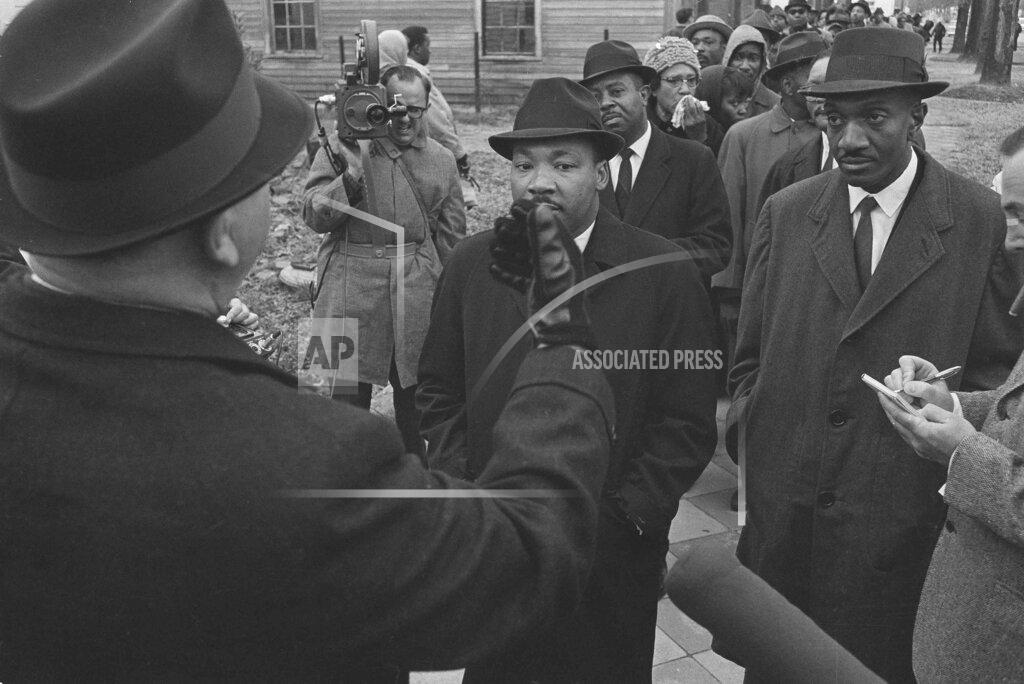
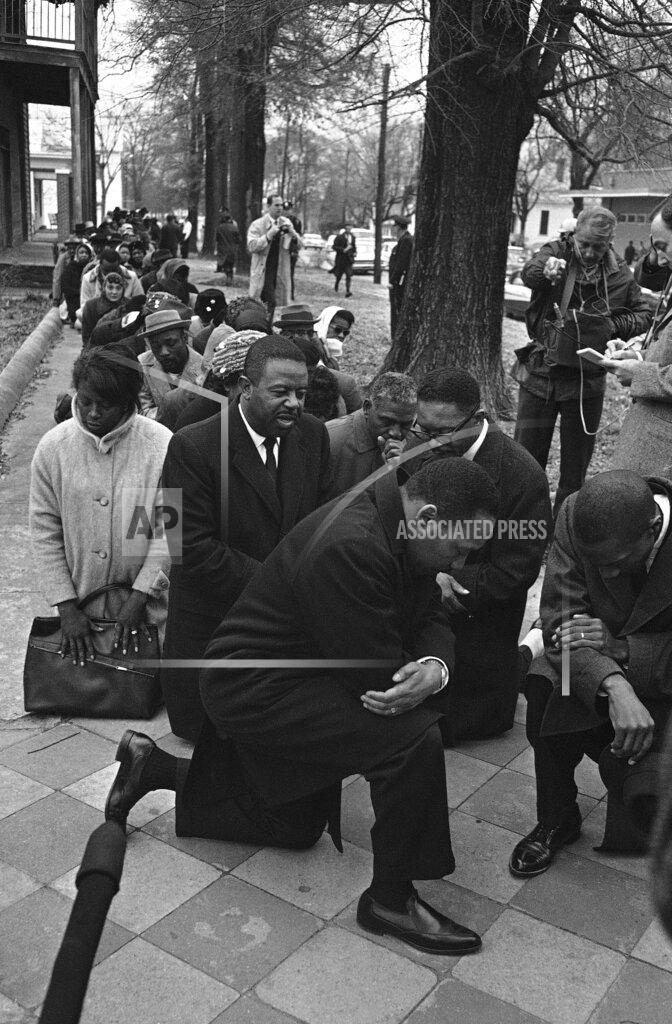
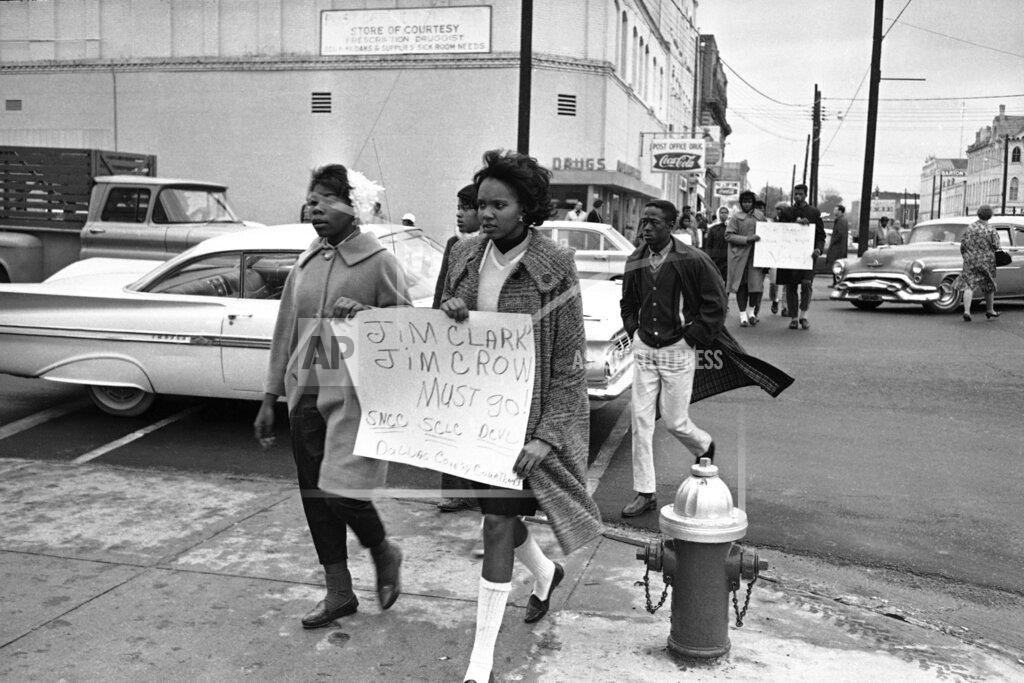
Law enforcement officers in Selma, Alabama, arrested 768 people (nearly all of them African-Americans, including Martin Luther King Jr.) who were marching to protest the impediments to voter registration within Selma and Dallas County. Sheriff Jim Clark charged the group with “parading without permit.” Sheriff Clark would arrest another 150 marchers, mostly high school students, later in the week. After six hours in jail, the adults who were residents of Selma were released without bail pending arraignment later in the month. Dr. King, however, declined to post the $200 bond required of nonresident defendants and remained in jail. “If Negroes could vote,” Dr. King told a rally shortly before the march, “there would be no Jim Clarks, there would be no oppressive poverty directed against Negroes, our children would not be crippled by segregated schools, and the whole community might live together in harmony.”
“This is our intention,” he said, “to declare war on the evils of demagoguery. The entire community will join in this protest and we will not relent until there is a change in the voting process and the establishment of democracy.” This was to have been the big day in Dr. King’s four-week-old campaign to speed up the rate of Black registrations in Alabama by focusing attention on discrimination and injustices in Selma, a city of 28,000, which has become a symbol of resistance to the Black movement. It was a cold overcast day when Dr. King and almost 300 adults in coats, caps and muffs lined up outside the Browns Chapel Methodist Church and began a march to the courthouse.
Similar marches had been held before, but the marchers had proceeded downtown in groups of about 20 to get around a city ordinance that requires a permit for parading. Today, under Dr. King’s instructions, the Blacks stayed close together. Wilson Baker, Director of Public Safety for the city, stopped them after three blocks. “This is a deliberate attempt to violate the city’s parade ordinance,” Mr. Baker said. “You will have to break up in small groups.” Dr. King replied: “We don’t feel that we’re disobeying any law. We feel that we have a constitutional right to walk down to the courthouse.” After permitting the group to walk two more blocks, Mr. Baker said: “Each and every one of you is under arrest for parading without a permit.” They were led to the city hall and charged.
It was the first mass arrest made by the city since the campaign opened. A new administration has been trying to pursue a more moderate course in dealing with the Black protests. Meanwhile, John Love, director of the Student Nonviolent Coordinating Committee in Selma, met with the students in a second church and organized small groups of pickets. The first to arrive at the courthouse consisted of 11 boys and four girls, By this time a cold drizzle had begun to fall, and for a while Sheriff Clark let them march in front of the courthouse carrying placards that said. “One Man, One Vote.” In a few minutes, however, he came out, stopped the line and read them an order from Circuit Judge James A. Hare, saying the court was then in session and if they did not disperse at once they would be held in contempt. He acted under a law prohibiting demonstrations while a court is in session.
The Blacks’ answer was to sing one verse of “Ain’t Gonna Let Nobody Turn Me Round.” Sheriff Clark, backed up by 15 armed posse men, led them into the second-floor courtroom still singing. Judge Hare immediately found them in contempt, sentenced each to five days in jail and fined them each $50. As waves of demonstrators arrived, Sheriff Clark stopped 20 others whom he declared to be non-students and took them before Judge Hare. They also were convicted of contempt and given the same sentence and fine. The 474 other demonstrators were removed to an old armory and turned over to Juvenile Judge B. A. Reynolds, who admonished them and asked them to sign slips giving their names and addresses. Most of them refused to do so and were confined overnight in three separate penal camps in the area.
The U.S. Senate passed the Administration’s $1.1 billion Appalachia bill today after opening the way for possible inclusion of New York State in the program. The vote was 62 to 22. It was a major victory for President Johnson, who had placed the measure at the top of his priority list this year. The bill now goes to the House, which failed to act last year on a similar program of economic aid for the depressed 11-state region known as Appalachia. President. Johnson hailed the Senate action and said he was hopeful of prompt action in the House. The legislation, he said, would benefit not only Appalachia but “the entire nation.” Administration leaders successfully fought off strong efforts to use the Appalachia bill as a vehicle for establishment of other regional development programs in New England, the Ozarks, the Great Plains and the Upper Great Lakes area.
The Senate majority leader, Mike Mansfield of Montana, said he had been assured by President Johnson that other economically depressed regions would not be forgotten. The President plans to recommend regional development programs under the revised Area Redevelopment Administration program to be sent to Congress in the next few weeks, Mr. Mansfield reported. The move to expand Appalachia to include 13 New York counties was made by Senator Robert F. Kennedy, Democrat of New York, who was making his maiden speech on the Senate floor. He offered an amendment, adopted by voice vote, to allow the inclusion of the New York counties subject to approval of the Appalachian Regional Commission and the Governor of New York.
A Senate subcommittee paved the way today for a constitutional) amendment providing for continuity of Federal executive power in event of Presidential disability and for filling the office of Vice President whenever a vacancy occurs. The group headed by Senator Birch Bayh, Democrat of Indiana, voted unanimously to report without change to the full Judiciary Committee the. same amendment resolution that the Senate approved last year without a dissenting vote. The subcommittee chairman said he hoped the committee would take up the measure later this week. While correcting the present constitutional void on Presidential disability and succession the resolution does not incorporate President Johnson’s recent proposal that the Electoral College as such be abolished. The President’s plan would retain the electoral system but make it impossible for the electors to substitute their will for that of the public in Presidential elections,
Senator Bayh said the President’s proposals would be covered in a second amendment resolution that he would introduce in a few days. He said the Electoral College proposal had been deliberately omitted to expedite consideration of the disability measure. Given its prompt approval by the full Judiciary Committee, Senate leaders plan to bring the disability resolution to a passing vote by the middle of the month. On both sides of the Capitol the effort is to complete Congressional action at the earliest possible date so that the disability amendment can be ratified by as many state legislatures as possible. Some 47 legislatures will be in session until April 30 and it is possible that the required three-fourths could act by that time.
The House Banking Committee, with unusual speed and little controversy, approved today the Administration’s request for the partial repeal of the gold backing for United States money. The committee approved the proposal, following a day of hearings, by a vote of 25 to 3. The three dissenters were all Republicans, but the measure also had some Republican support. The committee acted after hearing Douglas Dillon, the Secretary of the Treasury, and William McChesney Martin, the chairman of the Federal Reserve Board, argue that the move was necessary to permit the orderly growth of the American economy and to as sure that there was adequate gold, free of restrictions, to meet the foreseeable foreign demand.
Attorneys defending Atlanta restauranteur Lester G. Maddox in a contempt of court action contended today that he had refused to serve Negroes at his restaurant because of political belief, not because of racial origin. “His policy is not to serve integrationists. regardless of race, color, religion or national origin,” one of the attorneys, William G. McRae, argued. This policy is directed at all persons who hold such political belief.” The defense was presented at the opening of a hearing before United States District Court Judge Frank A. Hooper, who had ordered Mr. Maddox to show why he should not be held in contempt for violating an injunction.
President Johnson urged longshore leaders yesterday to ease the effects of the 22-day strike that has tied up shipping from Maine to Texas by sending their men back to work at some ports where settlements had been reached. Union leaders declined, however, to comply immediately. President Johnson’s request was delivered to the union headquarters in New York. The union leadership, after a conference with Assistant Secretary of Labor James J. Reynolds, deferred action pending the outcome of continuing bargaining at Philadelphia, the major holdout port. The strike will continue today, Thomas W. Gleason, president of the International Longshoremen’s Association, said.
Nine more cadets have resigned from the Air Force Academy as a result of the examination cheating scandal, it was announced today. This brought the total of resignations to 102.
Two members of President Johnson’s Cabinet were confined to bed today with respiratory ailments. Secretary of Defense Robert S. McNamara had a moderate case of viral pneumonia and Secretary of State Dean Rusk had a cold.
John P. McConnell replaced Curtis LeMay as Chief of Staff of the United States Air Force.
President Johnson made his first official appearance since recovering from a cold to award a Distinguished Service Medal to General Curtis E. LeMay, retiring U.S. Air Force chief of staff.
Manned Spacecraft Center (MSC) received the first qualification configuration extravehicular life-support system (ELSS) chest pack. Tests of this unit and the ELSS umbilical assembly were being conducted at MSC. Meanwhile, AiResearch was preparing for systems qualification tests. Zero-gravity flight tests of the ELSS had shown that egress and ingress while wearing a chest pack could readily be done by properly trained astronauts.
Television commercials were shown by the Swiss Broadcasting Corporation for the first time. Initially, the government limited total TV advertising to a maximum of 12 minutes per day.
Peter Jennings, 26, becomes anchor of ABC’s nightly news
Rod Laver won the Western Australian Professional Championships for the second time, at Perth, defeating Pancho Gonzales 7–5, 11–9.
Australian Championship Men’s Tennis: Roy Emerson wins 3rd consecutive Australian title; beats fellow Australian Fred Stolle 7–9, 2–6, 6–4, 7–5, 6–1.
Australian Championships Women’s Tennis: Australian Margaret Smith wins 6th straight home singles title; beats Maria Bueno of Brazil 5–7, 6–4, 5–2; Bueno retired injured.
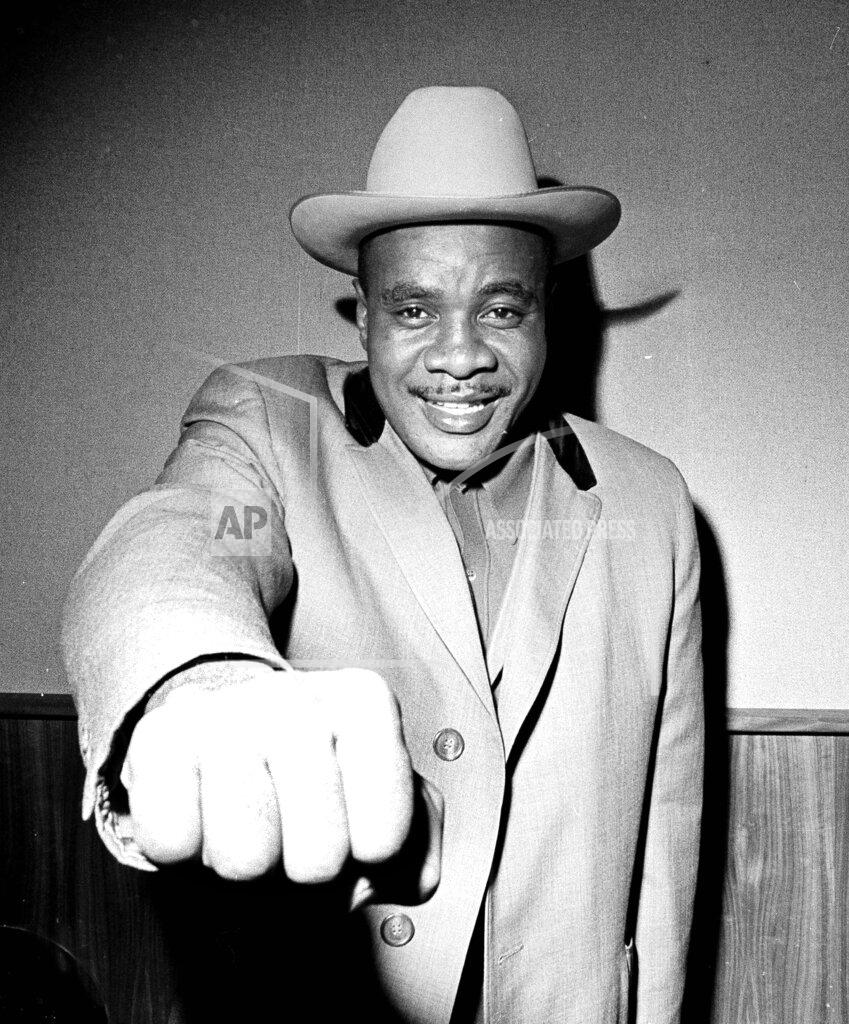
Former world heavyweight boxing champion Floyd Patterson beats Canadian George Chuvalo by unanimous decision in a 12-round non-title clash at New York’s Madison Square Garden; ‘The Ring’ names the bout the Fight of the Year.
The National League clubs adopt an emergency team replacement plan to restock any club struck by disaster.
Catcher Ed Bailey is traded from the Milwaukee Braves to the San Francisco Giants for pitcher Billy O’Dell.
Dow Jones Industrial Average: 903.68 (+0.82)
Born:
Princess Stéphanie of Monaco, daughter of Prince Rainier III and Princess Grace; in Monte Carlo.
Brandon Lee, Chinese-American actor (“Showdown in Little Tokyo”), son of Bruce Lee and Linda Lee Cadwell; in Oakland, California (died in on-set accident, 1993).
Sherilyn Fenn, American film and TV actress (“2 Moon Junction”, “Twin Peaks”); in Detroit, Michigan.
Chris Mandeville, NFL defensive back (Green Bay Packers, Washingotn Redskins), in Santa Barbara, California.

 History Diaries