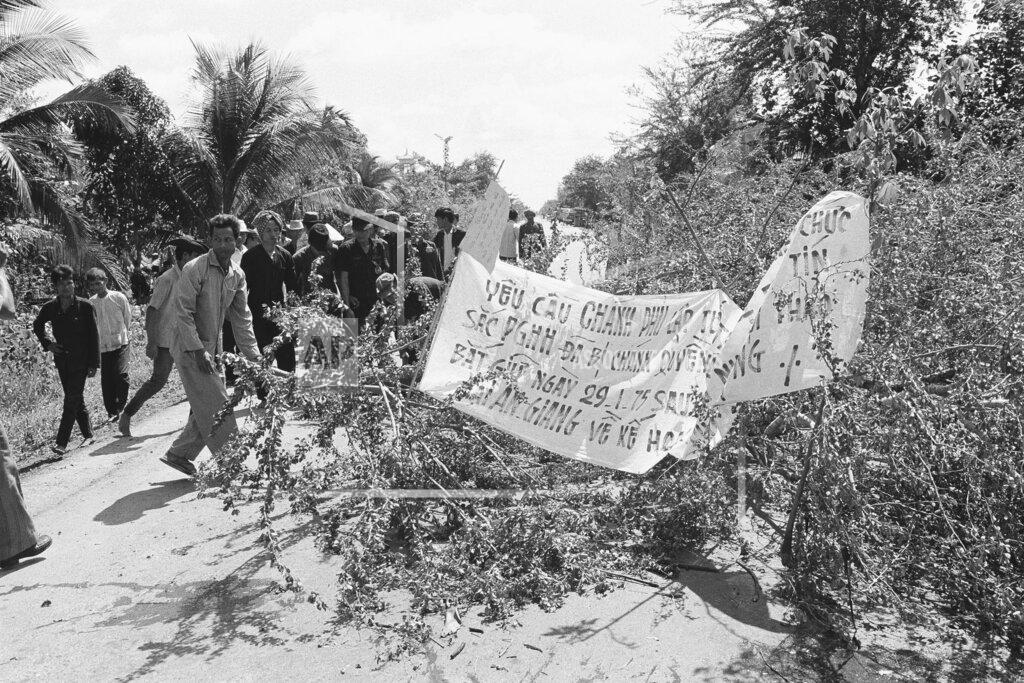
Scores of teenaged guards belonging to the Hòa Hảo Buddhist sect’s private army rebelled in the Mekong Delta against a South Vietnamese order disbanding their force. The guards, mostly in their early teens and armed with carbines, M-1 rifles and grenades, set up roadblocks along a five-mile stretch of highway near the district town of Phong Phú, 90 miles southwest of Saigon. The roadblocks, bearing banners demanding the release of two top leaders of the sect who have been arrested by the government, forced military truck convoys and civilian traffic to a halt, according to reports from the scene.
The passion over Vietnam seems mostly gone, drained in the interminable argument. But the old politics and attitudes remain behind the scar tissue; the American soldiers are gone, but the war won’t go away, and therefore neither will the issue. President Ford formally asked Congress last week for $300‐million in supplemental military aid for South Vietnam and $222‐million more for Cambodia. When asked, Senators and Congressmen simply said he won’t get it. Last weekend, there was an antiwar rally — almost a reunion — followed by visits to legislators offices. Relatives of those still missing in action also came to Capitol Hill. But it was all a pale shadow of the past. Vietnam is almost — but not quite — just another issue. What keeps Vietnam in a special category is that it remains a moral issue both to the Administration and to its strongest critics. There are those who still feel compelled to argue whether American aid to Saigon is right or wrong, and not merely whether the aid is “working.”
Two more cargo vessels reached the Cambodian capital of Phnom Penh with badly needed rice yesterday, having made it through the gantlet of cannon and rockets that the Cambodian insurgents maintain along the banks of the Mekong River. The arrival of the ships — after the arrival of a dozen other supply vessels over the last week and after nearly a month of no convoys because of the insurgent guns — showed that the “blockade” is breachable, despite the loss of some ships, and that the Phnom Penh Government will probably survive as long as the United States keeps providing it with food, fuel and ammunition. This year’s dry‐season offensive by the Communist‐led insurgents, begun on New Year’s Day, is a month old now, and like all similar offensives before it in this nearly five‐year‐old war, it has been inconclusive. Both Cambodian and American military sources say that they expect the insurgents — whose arms and logistics support come from North Vietnam and China — to regroup, call in their reserves and mount a second phase of the offensive within the next few weeks. But most military analysts here expect the outcome to be as inconclusive as the first phase.
But there is one crucial unknown factor hanging over the Phnom Penh Government’s future — the question of American aid. Aid to Cambodia was cut by Congress this year by $200‐million — from about $650‐million to $450 million — and now President Ford has asked Congress, which has grown weary of supporting unending wars in Indochina, for an additional $222‐million in military aid and an unspecified amount in new food aid. Without that aid, there is little doubt that the Phnom Penh Government’s ability to defend itself will begin to diminish. In the meantime, the fighting continues—a mirror reflection of the fighting last year and the years before. The government continues to defy all the predictions of its imminent collapse, predictions that have accompanied every offensive since the war began in 1970. The war has killed or wounded at least 700,000 people, or one tenth of the population.
The insurgents are always close to the capital, but they can never quite break into it. This year the insurgents have seized control of most of the lower Mekong River, the 60 miles from Phnom Perth southeast to the South Vietnamese border. The river is the last remaining surface supply route to the capital. The 14 vessels that have reached Phnom Penh over the last week were the first supply ships to arrive since Dec. 28. Their cargo represented about two weeks’ supply of food, fuel and ammunition. To conserve fuel, the government has cut Phnom Penh’s power supply by 80 percent and has banned gasoline for private vehicles. Rice stocks are fairly low, and the black market price has started climbing.
The offensive has taken a heavy toll in casualties apparently on both sides. The government is now having its hardest time ever in replacing its front‐line losses. It has therefore raised the maximum eligible age for compulsory service from 35 to 50. It is rounding up peasant refugees when they flee into the countryside. It has even freed for military service several hundred convicts held for minor crimes. A determined band of insurgents is still entrenched just opposite the capital, on the eastern bank of the Mekong. A few miles to the northwest of Phnom Penh, another insurgent force is heavily dug in.
From these two positions, the rebels fire Chinese‐made rockets and shells into the city and the airport west of the city — inflicting a dozen or so casualties every day. Those that fall into Phnom Penh proper seem to be aimed only at demoralizing the population. Many people in the rocket‐prone areas now sleep and eat and spend almost their entire day in home‐made dirt bunkers beneath their houses. The government’s inability to dislodge the enemy troops shelling the city is testimony to how depleted the government’s ranks are. “They’re stretched about as far as they can stretch,” said one Western military observer here. “What saves them is that the other side is stretched just as thin or maybe thinner.”
United States and Soviet representatives opened top-level discussions in Geneva, Switzerland, on terms of a new treaty to limit offensive nuclear weapons. The talks will build on the accord reached on November 23 at Vladivostok by President Ford and Soviet leader Leonid I. Brezhnev, limiting numbers of missiles and bombers.
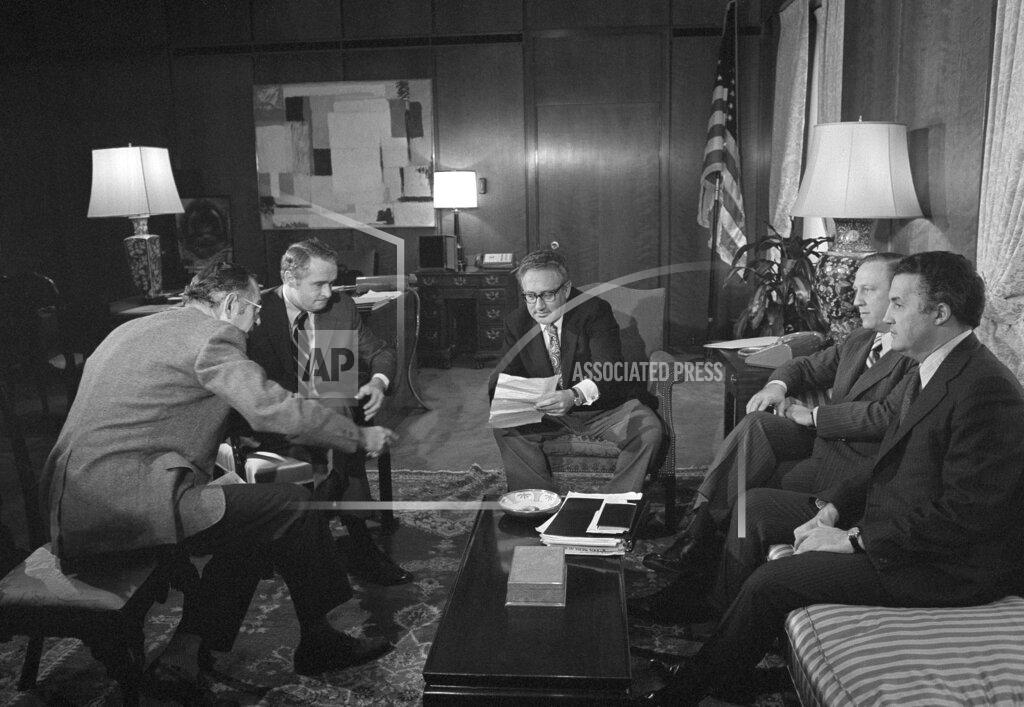
Secretary of State Kissinger failed to persuade key members of Congress to continue military aid to Turkey beyond Tuesday night’s cutoff time. After an hour-and-a-quarter meeting at the State Department, Senator Thomas Eagleton, spokesman for the group, said that Mr. Kissinger could only report “slight progress” toward a Cyprus settlement, less than the “substantial progress” demanded by Congress to keep aid flowing. “We have no alternative but to cut off aid to Turkey,” Mr. Eagleton said. In what both sides described as an “amicable” meeting, Mr. Kissinger was reported by his spokesman to have stressed that “it is his profound conviction that the United States provides military assistance to Turkey in the interest of the United States and Western security. And if this is cut, it will be a serious setback for our security interests and possibly counterproductive in the negotiations,” the spokesman said Mr. Kissinger had told the four members of Congress.
Heavy firing broke out tonight between Greek Cypriot and Turkish Army troops stationed around Nicosia International Airport. Residents of northern Nicosia were abandoning their homes tonight, fearing that the Turkish Army might advance to take over other areas of the Greek‐occupied part of the island and strengthen its stand in negotiations.
Representatives of the European Common Market countries and 46 African, Caribbean and Pacific nations agreed today on a five‐year program of aid and trade. The deal was believed to be the most far‐reaching mixture of aid and trade between an industrialized bloc and a group of developing nations. The agreement is tentatively scheduled to be signed February 28 in Lomé Togo. The negotiations have stretched over three weeks and concluded with a 25‐hour session that ended after breakfast today. A key problem was a five‐year Common Market fund for aid, with the poorer countries asking that the amount be set at $10‐billion. The Europeans successfully insisted that the fund be limited to $4‐billion. The trade deal included a wide sweep of products, many of them raw materials on which the developing countries depend, and special arrangements to protect exports.
The British Army today carried out its toughest security operations in two months with a series of predawn raids on Irish Republican Army strongholds. The army said that six suspects were seized in the raids, which came less than 12 hours after I.R.A. members shot and killed a policeman and injured another in a machine‐gun attack from an ambush at Donaghmore, 35 miles west of Belfast. British Army officials said the security raids in Belfast’s New Lodge area, a center of activity of the I.R.A. Provisionals, were aimed at countering a further increase in violence. They were the first such army raids in Northern Ireland since the Irish Republican Army began a Christmas cease‐fire and the army eased its operations in a reciprocal bid to halt the killing.
About 2,500 banner-waving protesters marched on Prime Minister Harold Wilson’s Downing St. residence in London, chanting “Remember Bloody Sunday” and “Troops Out of Ireland.” No injuries were reported. Several hundred demonstrators also marched in Belfast, capital of Northern Ireland to commemorate the Sunday three years ago when British troops shot and killed 13 persons in Londonderry.
British Prime Minister Harold Wilson met with U.N. Secretary General Kurt Waldheim and discussed the Middle East, Cyprus and world economic problems before ending his American visit and returning to London.
Despite a formal government denial, official Portuguese sources reaffirmed their report that the Soviet Union had requested seaport facilities in Portugal for its Atlantic fishing fleet. After the intial reports, the Foreign Ministry in Lisbon issued a statement that they were “completely lacking in foundation.” The sources, which asked that they remain anonymous, explained that no official Soviet note had been received in Lisbon, and that consequently the ministry’s denial was technically correct. The Soviet overtures were understood to have been made in the form of a sounding‐out, presented in an urgent manner and with some preparation, in the form of a draft agreement.
A power struggle between moderates in Portugal and the Communists has reached a crisis stage over the last two weeks, with the Communists making progress in extending their power and influence. There has, however, been a reaction to these advances on the part of political groups and elements within the armed forces who fear a Communist-backed seizure of dictatorial power and the spread of Soviet influence here. This concern is shared in Washington and other allied capitals, and in NATO headquarters in Brussels. The concern was believed to have been expressed to Lisbon following publication of the reports of the Soviet fishing problem. The government, headed by Brigadier General Vasco dos Santos Goncalves, who has been identified with the left wing of the Armed Forces Movement, was believed to have responded to allied inquiries with the same denial that the Foreign Ministry made public.
The French Socialist party struggled here today with the problem of keeping harmony on the left without losing its appeal to moderates. It was the party’s first congress since its leader, Francois Mitterrand, came within 1.4 percent of winning the French presidential elections last May. The Socialists have continued to gain in support. The latest polls give them 34 per cent of the electorate, putting them slightly ahead of the Gaullists and far in front of their Communist allies, who dropped to 18 percent. “There is no longer any question; we are, the first party of France,” said Mayor Gaston Defferre of Marseilles, a prominent member of the Socialist leadership.
France is planning a huge increase in her output of nuclear‐generated energy by 1985, while cutting oil consumption by more than 12 percent, the Government announced today. A presidential spokesman said that France’s oil consumption would be cut from the present 770 million barrels a year to about 672 million barrels. The announcement was made after a meeting on energy, headed by President Valéry Giscard d’Estaing. The measures will reduce French reliance on oil from 66 percent to 40 percent of total energy requirements, the spokesman said, while the use of nuclear energy will increase from 3 to 25 percent.
Vatican spokesman Federico Alessandrini said the Vatican bank never speculated in foreign currency, although it held interests in two Sindona group banks which reportedly did. In a statement to newsmen, Alessandrini denied for the fifth time in five months that the Vatican’s losses in the collapse of Sicilian financier Michele Sindona’s international banking empire were as bad as reported by news media. One report claimed the Vatican’s loss was $750 million. A Vatican banker called this “really absurd.”
Foreign Minister Andrei Gromyko of the Soviet Union, who left today for an official visit to Syria and Egypt, is apparently traveling with enhanced authority that some Soviet insiders say is closer to the power enjoyed by Secretary of State Kissinger. Knowledgeable Russians have confirmed that Mr. Gromyko has assumed broadened diplomatic responsibilities as a result of Leonid Brezhnev’s six-week absence from public view, which has been attributed to illness. The Foreign Minister’s trip is generally viewed in Moscow as a substitute for the Middle East tour that Mr. Brezhnev was to have taken last month, but was canceled.
There is little hope for a decrease or stabilization of oil costs despite the Organization of Petroleum Exporting Countries’ freeze on prices this year, the United Nations ambassador from oil-rich Kuwait said at a news conference in Los Angeles “You cannot bring down the price of oil, you cannot keep it frozen, while the prices of other manufactured goods are skyrocketing. Abdulla Bishara said. He said President Ford’s idea to curb oil imports by means of an import tax increase was a good idea. This would help stem “the unjustifiable extravagance and waste of energy by American consumers, Bishara said. He addressed the International College of Surgeons.
Syria and the Palestine Liberation Organization regard with a great deal of suspicion Secretary of State Kissinger’s plan to visit the Middle East in about the middle of this month. Syrian officials and Western diplomats in Damascus are not sure what Mr. Kissinger’s objective is. “Is he trying to pressure Egypt into a separate agreement for the purpose of splitting the ranks of the Arabs?” they ask. If this is so, his policy would be regarded by Syria as “a hostile action,” the Syrian Information Minister, Ahmed Iskander, said in an interview.
The Soviet Union has delivered surface-to-surface missiles with conventional warheads to Iraq in a new escalation of the arms race in the Persian Gulf, according to Arab sources and Western intelligence reports. The move is expected to increase the tension between Iraq and Iran, who have clashed periodically across their frontier in the past two years. Iran is buying billions of dollars worth of arms from the United States.
The world food situation has improved sharply in the last two months, most notably for India. This was indicated in interviews with government officials and other experts in Washington and by data from United States and United Nations sources. The food gap in the deficit nations will still amount to millions of tons between now and June 30, the end of the current crop year, and untold numbers of lives continue to be threatened by malnutrition. Still, several countries that faced the most serious problems when the World Food Conference met in Rome in November have succeeded in contracting for large parts of needed food supplies.
Senate Majority Leader Mike Mansfield reported that Chinese leaders are not satisfied with progress in U.S.-Chinese relations. The Montana Democrat spent three weeks there last December and in a report to the Senate Foreign Relations Committee said that the United States so far has failed to implement the intent of the 1972 U.S.-Chinese communique calling for U.S. military disengagement from Taiwan.
The Philippine Supreme Court today endorsed the martial-law regime of President Ferdinand E. Marcos by ruling that he was President in fact as well as by law. The challenge to Mr. Marcos’s office and legislative powers was filed by 14 citizens led by the detained former Senator Benigno Aquino. Former Senator Lorenzo Tanada argued the case in lengthy hearings before the court. on Thursday. The 11‐man court, with only one justice dissenting on part of the ruling, found there was constitutional support for President Marcos’s continued one‐man rule and his power to legislate as well as to conduct the national referendum he has scheduled for February 27.
The Philippine Government denied this week a report by field commanders that its air force was dropping napalm bombs in the fight against Muslim rebels in the southern Philippines. Defense Secretary Juan Ponce Enrile said in a letter to Foreign Secretary Carlos P. Romulo: “The Department of Defense officially denies that the Philippine Air Force has ever used or does it intend ever to use napalm or any other incendiary weapons in its bombing missions against insurgent strongholds or supply bases in Mindanao or for that matter anywhere in the country.” The denial was made Thursday following a report January 24 by The Associated Press from central Mindanao that commanders said the Air Force used napalm near a suspected rebel stronghold called Tumbao, 16 miles south of Cotabato City.
The Intercontinental Broadcasting Corporation was launched in the Philippines.
A newspaper publisher, an editor and a reporter were fined a total of $6,750 in the Ontario Court for printing testimony from a court hearing that a judge banned for publication. Publisher J. P. O’Callaghan of the Southam Press Star of Ontario, Editor Robert M. Pearson and reporter Michael J. Frezell were found guilty Jan. 24 of the charges stemming from a preliminary hearing of a murder case.
Three more American tuna boats have been seized by Ecuador, a tuna industry spokesman says. Radio operators here reported they had picked up conversations indicating that the boats had been intercepted by vessels of the Ecuadorian Coast Guard, Clifton Payne, controller of the American Tunaboat Association, said yesterday. Only one of the boats was identified: it is the Caribbean, owned by the Del Monte Corporation of San Francisco. Del Monte officials and State Department officials in Washington could not confirm the reported seizures. Ecuador exercises a 200‐mile fishing limit off her coast. The United States recognizes a 12‐mile limit.
Peruvian President Juan Velasco Alvarado today appointed a new Premier who is considered a strong favorite to succeed him eventually at the helm of the left-leaning military government. General Francisco Morales Bermúdez, who assumed the second‐ranking government post, also took over as the Commander in Chief of the army and Minister of War. The former Premier, Edgardo Mercado Jarrin, relinquished the three posts when he reached military retirement age.
Ethiopian troops pushed secessionist guerrillas toward the outskirts of Asmara today after at least 20 persons were reported killed by snipers and by mortar, rocket and grenade explosions along the main streets, residents of the provincial capital said. The battle in Asmara, the capital of Eritrea province, at one point raged next to the United States Consulate, but no Americans were reported injured. Foreigners in Asmara, including nearly 300 Americans, were advised to stay indoors. Shops and offices were closed. Ethiopian authorities closed Asmara’s airport and imposed a 7 PM curfew.
U.S. President Ford announced that the 1976 fiscal year budget would reflect a deficit of 52 billion dollars. At the time, it was “the largest peacetime deficit in the nation’s history.” President Ford announced that he would send a $349 billion budget to Congress today, under which federal spending will amount to “almost $1 billion a day.” There will also be a deficit in the coming fiscal year of $52 billion — $5-billion higher than the administration estimated just over two weeks ago. Mr. Ford said that the deficit, “large as it is, would increase by $17 billion to nearly $70 billion if the Congress does not agree to all of the reductions I have requested in this budget,” for the fiscal year starting July 1.
According to previously unpublished testimony, Richard Helms, while Director of Central Intelligence, ordered a high official of the agency to withhold Watergate information and deny the Justice Department access to a key witness in the first six weeks after the break-in on June 17, 1972. The official was Howard Osborne, who was director of security for the CIA before he retired In 1973.
The American Telephone & Telegraph Co. confirmed that it had monitored and taped long-distance telephone calls made by customers from the end of 1965 to the beginning of 1970. “We believe that what we did was necessary to protect the integrity of our network and to keep people from cheating.” William Mullane, press relations director, said in New York. The St. Louis Post-Dispatch had reported that parts of at least 1.5 million calls from Los Angeles, St. Louis, New York, Detroit, Miami, and Newark, New Jersey, had been recorded to detect toll-call frauds. The newspaper said that fewer than 500 of the 1.5 million calls were found to involve fraud.
A Saudi Arabian financier has placed a bid to buy 40% of Michigan’s sixth largest bank. If the deal goes through, the Bank of the Commonwealth in Detroit would be the. largest U.S. bank controlled by Arab interests. The bank’s management. would stay the same under the tentative purchase agreement, which must be endorsed by the Federal Deposit Insurance Corp., which holds a $35 million note on the bank. Ghaith Pharaon, the financier, reportedly has close ties to the Saudi Arabian ruling family.
Secret Service funds have been improperly used to pay for protecting Treasury Secretary William E. Simon, in the opinion of the General Accounting Office. A Treasury official said, however, that the opinion by GAO, the auditing arm of Congress, did not question Simon’s right to such protection but said only that it should not be paid for by the Secret Service. The GAO opinion was issued at the request of Rep. John E. Moss (D-California). About $530,000 is spent annually to protect Simon, according to Paul G. Dembling, general GAO counsel.
Americans are divided on whether inflation or unemployment should receive greater attention from the government, a Gallup Poll indicated. A telephone survey of 1.038 adults taken in mid-January showed 46% thought inflation should be given priority and 44% thought unemployment should. The 10% remaining was undecided.
Although the 94th Congress is hardly a month old, its legislative hoppers are being flooded with bills both serious and curious, dealing with, among other things, the interests of the desert pupfish, the Royal Army of Yugoslavia and Polecat Bench, Wyoming. To date, more than 3,000 pieces of legislation have been introduced in the Senate and House, both as measures that may become law and resolutions that may express intent. At least 104 of the bills and resolutions thus far introduced deal in some ways with energy, ranging in importance from the bill reported out by the House Ways and Means Committee to freeze for 90 days the President’s ability to raise the oil import tax, to a measure that would seek to conserve gasoline by reducing air drag on trucks. In the areas of food, nutrition and agriculture, 98 bills and resolutions have been introduced. The House Agridulture Committee has already rushed through a bill to prevent cuts in the Federal food stamp pOgram while another measure calls for Federal inspection of rabbits raised for food.
Flu-related deaths last week were above epidemic levels for the third consecutive week, the Center for Disease Control reported in Atlanta. Flu-related illness in the Pacific states was described as moderate, with deaths slightly above the epidemic threshold. Flu remained widespread in the Southeast and Midwest, although it continued to decline somewhat in the Southeast. Areas showing the sharpest increases were Minnesota, Iowa, Kansas, Missouri. Nebraska, Texas, Louisiana, Arkansas and Oklahoma.
Wisconsin Governor Patrick J. Lucey today ordered an unspecified number of armored personnel carriers to gird the area around a Roman Catholic abbey, which has been occupied by armed Menominee Indians since January 1.
James E. Beardsley, 22, of Lincoln, Nebraska, was charged with kidnapping after he had released two women hostages he had abducted in St. Joseph, Missouri, and threatened to kill. Police said Beardsley had taken over a bus in St. Joseph after fleeing from a tavern brawl, held the women at gunpoint and demanded a getaway car. A policeman agreed to drive Beardsley and the women to Kansas City, where the car was stopped at a roadblock and Beardsley was seized. No one was hurt.
An unemployed laborer was charged with murder in Houston in the shooting death of Joseph Chamberlain, 34, great-nephew of former British Prime Minister Neville Chamberlain. Police said that two friends of Chamberlain had seen the laborer, Paul Clifton Green, 27, cleaning a bloody carpet in Chamberlain’s apartment the day before the body was found. Chamberlain, a data systems analyst, came to the United States from England in September.
The American Medical Association’s national political arm gave about $100,000 in the last eight days of the November election campaign to 43 House and Senate candidates, official figures show. In addition, it gave $22,000 to 14 victorious candidates after the November 5 election, the data show, The last-minute donations, reported to the secretary of the Senate and the clerk of the House of Representatives, brought the American Medical Political Action Committee’s 1974 expenditures to $1,017,834.
“It looks like we’ve postponed the famine,” a grain dealer on the Kansas City Board of Trade commented this week. He did not mean that the hungry in Bangladesh and India were now being adequately fed. Rather he was saying that world demand for grain and soybean supplies from this country was easing, for the moment at least, and that it appeared more likely that reserves of wheat, corn and soybeans would be at safe levels when the new crops were harvested this summer and fall. A combination of declining exports and sharp cutbacks in livestock breeding has brought’ wheat, corn, and soybean prices down again this week.
The energy shortage-inspired driving drop appears to have ended in California, state highway officials said. The Department of Transportation said in Sacramento that the 5.56 billion miles driven in December was up 3% over the December, 1973, figure of 5.4 billion miles. The 12-month slump was triggered by last winter’s gasoline shortage and resultant increase in fuel prices.
A committee formed by the Food and Drug Administration to study the possible harmful effects of the dye known as Red No. 2 has recommended that the artificial coloring be restricted in food use and has “strongly urged” that further tests be conducted to determine its safety.
A 25-year-old woman was thrown to her death in front of an onrushing subway train in Brooklyn yesterday evening by a man who apparently was a total stranger to her, the police reported.
Calling her “sweet lady” in German and dangling a slab of raw meat, an animal trainer coaxed a 3‐year‐old, 300‐pound Bengal tiger back into her cage aboard a cargo plane early yesterday morning, nearly 10 hours after startled freight handlers unloading the plane found her roaming loose in the plane’s cargo area. The tiger, named Sheridan, was found perched on top of her cage at 1 AM when employes began unloading Pan American World AirWays Flight 3161 at the airline’s cargo terminal at Kennedy International Airport. The tiger was one of five Bengals en route on the 707 from Munich, Germany, to a zoo in Santo Domingo, Dominican Republic. The other tigers, two males and two females, remained asleep in their cages.
“I just kept saying very softly, ‘Bitte schön, meine liebe Dame, gehen Sie herein,’” said Joseph Marcan, the trainer who was accompanying the animals. He translated this as: “Please, sweet lady, go inside.” “I had to speak in German because Sheridan doesn’t understand English very well,” he said with a grin. “But I knew she’d come inside — she’s very well‐behaved.” Mr. Marcan, who has transported elephants, lions and other dangerous animals for more than 20 years, said that the chances of a tiger escaping from its cage were “one in a thousand.” The trainer said Sheridan had bent apart the bars on her cage and had slipped through the opening into the cargo area, which was filled mostly with mail sacks.
The tiger was found by Joseph Butta, a Pan American cargo supervisor, and three other employes when they opened the narrow door to the plane and saw Sheridan sitting on top of her cage, “curled up like a nice big cat.” “We shut that door in two seconds flat and just took off down the runway,” Mr. Butta said. “You just can’t imagine what it’s like to open the door of a cargo plane and find a tiger staring up at you. It’s unreal.”
John Phillips’ musical “Man on the Moon”, produced by Andy Warhol, closes at the Little Theater, NYC, after 5 performances.
Born:
Big Boi (Antwan Patton), American rapper with OutKast; in Savannah, Georgia.
Tomáš Vlasák, Czech NHL centre and left wing (Los Angeles Kings), in Prague, Czechoslovakia.
Died:
Richard Wattis, British actor (“Hobson’s Choice”, “Prince & Showgirl”, “The Man Who Knew Too Much”), from a heart attack.






 History Diaries