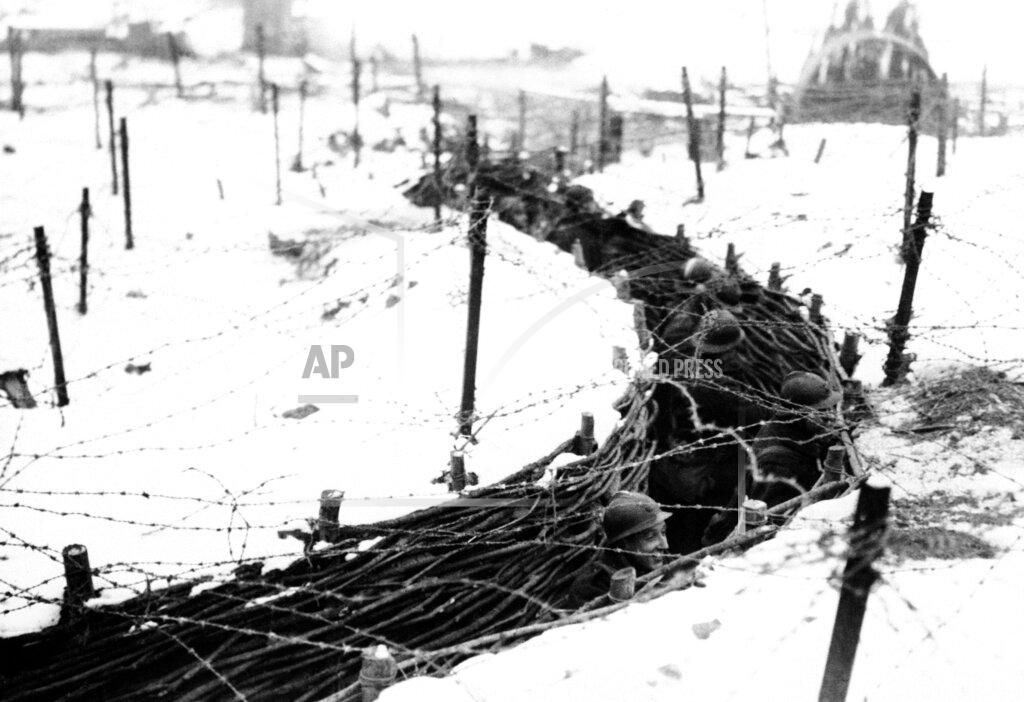
Soviet forces prepare to launch their new offensive against the Finnish Mannerheim Line. Commander Timoshenko has spent 3 weeks preparing to assault the Mannerheim Line. He has 12 fresh divisions on the Karelian Isthmus and artillery lined up wheel by wheel. Opposite the Summa gap alone, he has 400 heavy artillery pieces (of 200 mm caliber or more) and innumerable smaller 75 & 45 mm guns, which are not camouflaged since the Finns lack artillery and attack aircraft. Soviet artillery has been pulverizing Finnish forts all month. Timoshenko is ready.
Soviet dispositions are aided by the lack of an effective Finnish bomber force, though that has been slightly remedied by the actions of a volunteer Swedish air group. Basically, the Soviets plan to swing an ax right at the heart of the Finnish defenses and then just keep going. To do it, they have brought a mass of men and weapons to overpower the crafty but thinly stretched Finnish forces and blast through the Mannerheim Line.
Prime Minister Ryti sends Finland’s response to continuing contacts with the Soviet Union to Chargé d’Affaires Erkko in Stockholm.
In Northern Finland, the Finnish defences repulse a massive Soviet offensive at Saija in the Kuhmo sector.
On Lake Ladoga, the Soviets carry out a number of assaults on islands in the lake.
Finnish troops defeat a Russian ski battalion at Silmälampi and Löytövaara. The enemy loses 160 men and a large amount of automatic weapons.
The township of Rovaniemi suffers five dead in heavy bombing. The Finns claim to have brought down 5 Soviet planes during the raid on Rovaniemi in which at least 150 bombs were dropped. The enemy is increasingly selecting civilian targets.
A ship carrying children to Sweden is attacked by Soviet submarines.
Another staffed field ambulance leaves Stockholm for Finland.
In Southern Ostrobothnia, the closing ceremonies for the 1939 session of Parliament begin in Kauhajoki with a church service at 4 o’clock in the afternoon. The ceremonies end with the evacuee Parliament giving three cheers for Finland’s freedom.
Official figures suggest the USSR has conducted 643 air raids over Finland since the outbreak of the war, dropping over 20,000 bombs on a total of 207 different localities.
The Finnish pavilion at the New York World’s Fair is also to be kept open for the 1940 exhibition.
South African wine growers gift Finland 14,000 litres of wine and 7,000 litres of brandy.
Prime Minister Winston Chamberlain makes a speech lauding the “rising might” of Great Britain.
The first RAF casualty list of the World War 2 was released and listed 758 personnel killed, with 210 aircraft losses.
Desperately short of aircraft, the British made a secret approach to Italy (not yet in the war) to buy fighters. A secret British military mission orders 300 Caproni Re2000 fighters. Germany would ensure that no such deal would be made. British attempts to obtain the fighters through a Portuguese intermediary fail with the Italian declaration of war on June 10th.
The Barlow Report on the “Distribution of Industrial Population” is published, recommending the building of new towns in Great Britain.
Sir John Simon of Britain announced that food subsidies were running at £1,000,000 per week.
A relief train bucking deep snowdrifts today reached the isolated town of Crawford, Scotland, to rescue 400 persons facing starvation in a small hotel, where they had been stranded since Saturday.
Germany’s way of ruling occupied Poland is in the best interest of the Polish population but the Poles must recognize Greater Germany’s right as a warring nation of 80,000,000 to eliminate enemies on her flank, Dr. Arthur Seyss-Inquart, Deputy Governor of the area, told correspondents today.
By the end of January, the Germans have driven 78,000 Jews out of their homes in Poland.
The Schwarze Korps, organ of the Hitler Elite Guard, reminded childless German couples today of the possibility of artificial insemination, and cited silk stockings and flimsy lingerie as a cause of sterility.
Italy, which has been buying nearly 20 percent of Rumania’s oil exports, yesterday suspended a large proportion of her orders pending new arrangements with the government regarding a ratio between cash payments and payment in goods.
Premier Mussolini’s newspaper, the Popolo d’Italia — and quite possibly the Premier himself, who usually writes its editorials — warns Italians not to be softened by fair words from France.
The official schedule of the Balkan Entente meeting was given out today. Premier and Foreign Minister John Metaxas of Greece and Foreign Minister Shukru Saragoglu of Turkey will arrive tomorrow evening, journeying from Nish, a town near the Bulgarian frontier.
First flight of the I-26, prototype of the Yakovlev Yak-1.
German submarine U-13, commanded by Max-Martin Schulte, torpedoed and sank Norwegian steamer Start about halfway between Stavanger, Norway and Aberdeen, Scotland ( 57° 45’N, 1° 48’W), killing the entire crew of 16. At 0043 hours U-13 fired one G7a torpedo at a steamer of about 4000 grt in bad weather about 7 miles east-northeast of Kinnaird Head and reported that the vessel sank after being hit on starboard side just ahead of the funnel and breaking in two. The U-boat had spotted at least three steamers and seven escorts and after this attack unsuccessfully fired two G7e torpedoes on an unknown Danish steamer at 00.54 and 01.14 hours. Start was carrying coal from Sunderland, northern England, bound for Oslo, Norway.
German submarine U-21 fired two torpedoes at Danish ship Vidar, but both malfunctioned. A third torpedoed, however, struck Vidar 25 miles east of Aberdeen, Scotland, killing 16 and rendering her dead in the water. At 1954 hours the unescorted and neutral Vidar was hit aft by a G7e torpedo from U-21 about 100 miles east of the Moray Firth and sank the next day. At 1948 hours, the U-boat had fired a G7a torpedo that became a surface runner and detonated near the ship, which stopped. A second torpedo had been fired two minutes later, but did not run due to an operating error. The Danish steam merchant Disko, which picked up the 18 survivors from Vidar, was attacked with a G7e torpedo at 2011 hours, but it also became a surface runner that detonated without damaging the ship. Vidar would remain afloat until the next day, finally sinking at 58.39 N, 02.00 E. Of the ship’s complement, 16 died. The 1,353-ton Vidar was carrying steel bars and was bound for Esbjerg, Denmark.
Convoy OA.83GF departs Southend.
Convoy OG.16 forms at sea for Gibraltar.
Convoy HX.18 departs Halifax for Liverpool .
U.S. passenger liner SS Washington is detained for several hours at Gibraltar by British authorities, but is allowed to proceed the same day; the freighter SS Jomar is also detained there.
For the month of January 1940, German U-boats sank 56 Allied ships (173,996 tons) and damaged 2 ships (13,959 tons).
The War at Sea, Wednesday, 31 January 1940 (naval-history.net)
Battleship RODNEY, battlecruiser REPULSE and their escorts arrived back in the Clyde after exercises.
Light cruisers GLASGOW and EDINBURGH departed Rosyth.
Destroyer DARING arrived in the Clyde.
Armed merchant cruiser ASCANIA arrived at the Clyde.
Destroyer SIKH arrived at Scapa Flow.
Destroyers ESCAPADE and ENCOUNTER arrived at Rosyth.
Destroyer MOHAWK departed Sullom Voe for Scapa Flow.
Submarine STURGEON arrived at Blyth after patrol.
Submarine TRIDENT departed Rosyth on patrol.
Destroyer WAKEFUL attacked a submarine contact off Bull Point in 51-20N, 4-09W.
Anti-aircraft cruiser CAIRO departed Immingham on patrol.
Light cruiser DELHI left Portsmouth for the Mediterranean, arrived at Gibraltar on 3 February, departed next day and reached Malta on the 8th.
Convoy OA.80G departed Southend on the 27th with destroyer WHITSHED and sloop FOWEY, and OB.80G left Liverpool on the 28th with destroyers WALPOLE and WITHERINGTON. They merged as convoy OG.16 on the 31st with 37 ships, escorts:
31st — Destroyers WALPOLE and WITHERINGTON (both continued), WHITSHED, French destroyer VALMY and patrol ship VIKING joined. WALPOLE detached to convoy HG.16
4th — Destroyer WISHART joined.
5th — VALMY and VIKING detached.
The convoy arrived at Gibraltar on 5th
Convoy FN.83 departed Southend, escorted by sloops FLAMINGO and WESTON, accompanied by minelayer PRINCESS VICTORIA, and arrived in the Tyne on 1 February. The sloops then escorted the minelayer to Rosyth.
Norwegian steamer START (1168grt) departed Sunderland for Oslo on the 29th, and was sunk on the 31st, northeast of Kinnaird Head with all hands.
U-21 sank Danish steamer VIDAR (1353grt) in 58 39N, 02 00E with the loss of 16 crew. Eighteen were rescued, and the wreck sank on 1 February.
Light cruiser AJAX, escorted by destroyers WHITSHED, ARDENT and ACASTA arrived at Plymouth.
Convoy HX.18 departed Halifax at 0800 escorted by Canadian destroyers HMCS SAGUENAY and HMCS SKEENA, which detached on 1 February. Ocean escort was battleship ROYAL SOVEREIGN which left on the 8th. Escort consisted of destroyer WINCHELSEA and sloop ROCHESTER from convoy OB.89 from the 13th to 16th, when the convoy arrived in Liverpool.
Light cruiser GLOUCESTER departed Colombo after refitting, called at Mogadishu on 8 February and was at Mombasa from the 9th to 11th.
At the end of January, the following destroyers were under repair – ACHERON at Portsmouth, AFRIDI at Hartlepool, ANTHONY at Portsmouth, ARDENT at Plymouth, ASHANTI at Cowes, BEDOUIN at Wallsend, BOADICEA at Dover, BULLDOG at Malta, DELIGHT at Portsmouth, DUNCAN at Cromarty damaged, ELECTRA at Falmouth, ESCORT at Falmouth, ESKIMO at Southampton, GARLAND at Malta, GRENADE at Tilbury damaged, HARDY at Plymouth with defects, HAVOCK at Chatham, HEREWARD at Halifax, HOSTILE at Plymouth with defects, HOTSPUR at Chatham, HYPERION at Portsmouth, ISIS at Falmouth, JERSEY at Hull, KELLY at Tyne, KELVIN at Clyde, KIMBERLEY at Clyde, KIPLING at Tyne, MALCOLM at Cardiff, MAORI at Clyde with defects, MASHONA at Chatham refitting, PUNJABI at Clyde, SOMALI at Middlesbrough, VALOROUS at Rosyth, WALLACE at Rosyth, WHITEHALL at Plymouth, WITCH at Plymouth damaged, WITHERINGTON at Liverpool, Polish ORP GROM at Chatham.
President Roosevelt in Washington today transacted executive business, held a press conference and announced plans to leave Washington tomorrow night for a weekend visit to Hyde Park.
With the Senate in recess, the Foreign Relations Committee questioned Jesse H. Jones, Federal Loan Administrator, on proposed aid to Finland, and the Appropriations Committee approved the $1,138,693,000 Independent Offices Appropriation Bill.
The House considered the Agriculture Appropriation Bill, passed a bill increasing allowances for hiring clerks at third-class post offices, received the Jenkins bill for payment to Ohio of October, 1938, Social Security funds, heard a defense of Representative Dies and the Committee to Investigate Un-American Activities, and adjourned at 6:33 PM until 11 AM tomorrow. The Smith committee heard J. Warren Madden defend the administration of the National Labor Relations Act, and the Naval Affairs Committee reached an agreement to report out a $655,000,000 Naval Expansion Bill.
The Naval Expansion Bill of 1940 will go to the House of Representatives, probably within a week or ten days, carrying authorizations for naval and aviation construction totaling $655,000,000, or about half the amount which the Navy Department estimated as the cost of ships and airplanes necessary to bring the navy to the strength required for adequate protection. The House Committee on Naval Affairs by practically unanimous votes approved today all amendments involving radical tonnage reductions and halving the cost of the program.
As amended, the total combatant tonnage provided is 167,000, a reduction of about 233,000 tons. For cruisers the bill provides for new construction amounting to 66,500 tons, instead of the 192,000 tons recommended. Submarine tonnage was reduced from the navy estimate of 45,000 to 21,000 tons, while destroyers were completely eliminated. The navy had asked for 60,000 tons of destroyers.
Only in the case of aircraft carriers was the tonnage increased. The carrier increase was from 75,000 to 79,500 tons. The aviation cut was from a minimum of 6,000 to 4,500 planes, of which 500, under the amended bill, will be for the Naval Aviation Reserve. The original bill provided for 125,000 tons of naval auxiliary ships. This was reduced to 75,000 tons.
The committee speaking through Representative Vinson, its chairman, explained that it was not abandoning the $1,300,000,000 program recommended by the navy. If world conditions grow worse, or continue as they are, the committee will go right ahead next year and authorize the rest of the program, and today’s action, Mr. Vinson said, provides for the laying down in the fiscal years 1941 and 1942 of all the ships that can possibly be taken care of by the navy. yards and the private shipbuilding industry.
In other words, the committee provided a maximum two-year program, instead of a five-year program as asked by the navy. Mr. Vinson stated that the estimated cost of the combatant units provided for in the bill as amended would be $372,000,000. The auxiliaries will cost about $183,000,000 and aircraft about $100,000,000, putting the aggregate cost of all authorizations $645,000,000 under the total in the bill originally proposed.
The request of the navy for additional building ways at the Philadelphia, Norfolk and Portsmouth Navy Yards was approved and motions by Pacific Coast members of the committee to include the Bremerton and Mare Island Yards were voted down. Suggested provisions which would have authorized the government to aid in the financing of improvements at privately owned shipbuilding yards were left out of the bill. After approval of the amendments, Chairman Vinson stated the vote on the completed bill would be had probably on Monday, following testimony in opposition by representatives of anti-war and peace societies.
President Roosevelt today dodged three more chances to tell the nation whether the political tom-toms now are beating third-term music.
Senate Administration leaders found some encouragement today for plans to enact a proposed law intended to open new credit channels for Finland through the Export-Import Bank. This was a result of two hours of testimony by Jesse H. Jones, Federal Loan Administrator, before the Foreign Relations Committee.
Agriculture Secretary Henry Wallace today warned those members of Congress whom he accused of attempting “to scuttle” the farm program that they would have to take the “political consequences” in this year’s elections.
Two House members called upon their colleague, Representative Hook of Michigan, today to withdraw from the Congressional Record letters alleged to have been written by William Dudley Pelley, head of the Silver Shirts, which, they charged, were forgeries.
Increasing industrial activity still is outdistanced by unemployment, which after increasing in November for the first time during the calendar year continued unchanged through December and remained in excess of 9,000,000 during both months, Colonel F.C. Harrington, Works Projects Commissioner, announced today.
The Justice Department has received large numbers of complaints concerning the Rev. Father Coughlin and his activities, but is not making a special investigation in response to the complaint of any particular organization, it formally announced today.
Speaking for 4,000,000 organized workers, the executive council of the American Federation of Labor, meeting in Miami in its midwinter session, called upon the Roosevelt Administration today to give business “a breathing spell” as a step toward restoring business confidence and putting the nation’s millions of unemployed to work. By unanimous vote, the council adopted a declaration characterizing unemployment as still “the most acute problem of the nation” and charging that, while billions have been spent for relief, the study of means to reduce and end unemployment has been neglected.
The council called upon both major political parties to incorporate in their forthcoming platforms a “constructive program” for the solution of unemployment and not to deal with it as a partisan or political issue.
The council reaffirmed the demand of the A.F.L. for a five-day week and six-hour day, asserting that the thirty-hour week provides a practical means of reducing joblessness attributable to continued technological development. The council urged that a census be taken of the actual number of unemployed, which the A.F.L. estimates at 9,000,000, and that a scientific study be made showing how various communities and classes, including youth and the middle-aged, are affected by unemployment.
The council recommended establishment of a national advisory council on unemployment, to consist of representatives of government, business, labor, farmers and consumers. It opposed any move to affect government economy at the expense of relief for the unemployed. Until the unemployment problem is solved, the nation cannot relinquish the relief burden, the council declared.
“We have sought to suggest proper remedies,” said Mr. Green. “Unlike some who have carped and criticized, we have offered a constructive program.” Asked whether his statement was to be considered an allusion to John L. Lewis, president of the Congress of Industrial Organizations, and his recent attack on the Administration, Mr. Green replied: “You can say so if you wish.”
Delegates to the golden jubilee convention of the United Mine Workers of America formally empowered John L. Lewis, president, and the executive board today to formulate the policy for the Presidential campaign. In speeches from the floor, however, members made it plain that they expected the board to support President Roosevelt if he should choose to run again. If Mr. Roosevelt runs and the executive board picks someone else, delegates declared, “we shall have to make a split and go down for Roosevelt.”
Coupling unstinted praise of Mr. Lewis with regard for Mr. Roosevelt, the delegates extolled the New Deal for improving the lot of the miners and their families. The resolution adopted today, as written by the resolutions committee, was a substitute for seventy-two political resolutions, forty-seven of which called for a pledge favoring a third term for the President.
J. Warren Madden, chairman of the National Labor Relations Board, defended it today against charges from many sources, particularly the accusations of American Federation of Labor officials that it has been partial to the Congress of Industrial Organizations. The House committee investigating the board was told by Mr. Madden that statistics which he presented “refute beyond any possibility. of doubt whatsoever any claim that there has been any discrimination in the handling of cases as between the A.F.L. and the C.I.O. The federation “has not suffered in any way,” he added. Any one charging otherwise, he asserted, “is looking at some particular case and not at all of the operations of the board.”
The board, he agreed, has taken much longer than it should in settling cases. The reason, he added, was that it has been unable to struggle out from under the tremendous backlog of cases which piled up soon after the Supreme Court validated the Labor Relations Act in April, 1937. Among other serious problems confronting the board, he said, was the intense opposition of business and industry, an opposition, he stated, which began before the law was enacted.
General Walter Krueger takes command of the U.S. IX Corps.
C. Turney & J. Horwin’s “My Dear Children” premieres in NYC
Official admission from Tokyo that the Japan-Manchukuo-Soviet conferences held at Harbin in an attempt to effect a border agreement had hopelessly broken down is interpreted in Shanghai as confirmation of a long held belief that the Kwantung Army and the Soviet never will be able to reach a settlement, despite Tokyo’s desire to compose its relations with Moscow.
This breakdown of the Harbin talks effectually explodes the propaganda that suggests that, if the United States puts too much pressure on Japan, the result would be a Japanese-Soviet rapprochement. It is believed in Shanghai that Moscow’s delegates must have been fully informed of the secret talks between the Kwantung Army and General Gregory Semenov with a view to having White Russians largely join the Japanese army organizations in Manchukuo, as well as the Japanese Army’s intention to organize several regiments of White Russians in Central China as a nucleus of the proposed army for Wang Ching-wei’s projected puppet government for the occupied areas. The Japanese Army continues to be violently anti-comintern and actually violently anti-Soviet, so that it always has been considered a foregone conclusion here that the Harbin and Chita talks eventually would terminate without a border agreement.
Chinese Winter Offensive: Chinese 5th War Area ends its offensive operations approximately this date.
Flying low enough to machine-gun Chinese cavalry and infantry floundering in deep snow, Japanese airplanes today assisted-artillery and infantry attacks in which the Japanese say they scattered and decimated 25,000 Chinese troops fleeing southward across a plain in Southwest Suiyuan.
A blizzard strikes northern Japan and kills 78.
Although disclaiming any intention on the part of Japan to eliminate “legitimate rights and interests” of the United States and other third powers in China, Foreign Minister Hachiro Arita said today that “it is inevitable that trade and other economic activities of the third powers should be affected at times by military operations.” Mr. Arita, making the address on foreign policy at the reopening of the Diet, made this assertion in discussing the situation arising from denunciation by the United States of the 1911 Japanese-American Trade Treaty, which expired last Friday.
Referring to this treaty as “a pledge of friendship between Japan and America,” Mr. Arita said the reason for its denunciation “is believed to be that by so doing it would serve in the solution of various questions which have arisen between Japan and America in connection with the China affair.”
“I firmly believe,” he went on, “that with the establishment and development of the new order” America will come to learn the absence of a desire on our part for either exclusion or monopoly in both economic and commercial fields.” Mr. Arita said “drastic changes” would be brought about by the war in Europe which probably would have a “tremendous” effect on “the China affair and the stabilization of East Asia. International peace fails to be maintained for various reasons. But, after all, is this not largely due to the fact that some nations insist upon trying to maintain an irrational and unjust international status quo relative to race, religion, territory, resources, trade, immigration and other matters by adopting exclusionist policies or by abusing their superior positions?”
The speech failed to evoke the slightest audible reaction, contrasting sharply with last year, when the Diet broke into wild applause over delineation of Japan’s plans to establish a “new order” in East Asia. With one notable absence — United States Ambassador Joseph C. Grew — the gallery was packed with the corps of foreign diplomats, accompanied in some cases by military and naval attachés. An attack of bronchitis kept Ambassador Grew away.
Dow Jones Industrial Average: 145.33 (-0.30)
Born:
Stuart Margolin, American actor (Angel-“The Rockford Files”), in Davenport, Iowa (d. 2022).
Died:
Candelaria of San José, 76, Venezuelan founder of the Hermanas Carmelitas de Madre Candelaria.
René Schickele, 56, German-French writer, essayist and translator.

 History Diaries