The South Vietnamese Government published today a law convening a 145-seat national legislature in March. The congress will write a constitution and serve as a provisional legislature. Elections will be held March 21 in the big cities. Provincial representatives will be chosen by an electoral college whose members will be picked by village chiefs and government representatives. Publication of the law came five days after a bloodless military coup that toppled the Government of Premier Trần Văn Hương. In sharp contrast with the political strife, Saigon teemed with merrymakers ushering in the lunar new year. The Việt Cộng guerrillas are observing a seven-day cease-fire. The head of the coup, Lieutenant General Nguyễn Khánh, is believed to have nearly completed the formation of the Army and People’s Council of 20 members, which will choose a new provisional chief of state and a premier.
North and South Vietnam have declared a three-day truce starting Tuesday to celebrate the lunar new year, Tết, a common holiday for both nations.
North Vietnam denied today United States intelligence estimates that the Hanoi Communist regime had been sending North Vietnamese troops into South Vietnam. United States agencies in Saigon said last week that North Vietnamese infiltration into South Vietnam reached new highs in 1964. It said at least 4,000 North Vietnamese troops had entered South Vietnam in the January-to-July period alone. While most of the Việt Cộng are South Vietnamese, many of whom received training in the North, the United States reports said about 19,300 North Vietnamese troops officers, specialists and combat soldiers had entered South Vietnam since 1959. Hanoi, in a broadcast monitored here, said the reports were “groundless and slanderous.”
The North Vietnamese press agency said today that two warships, one a United States ship and the other South Vietnamese, were driven away by coastal defense batteries when they intruded into North Vietnamese waters yesterday.
South Vietnam has reported to the International Control Commission an attempted landing of North Vietnamese troops on the south bank of the Bến Hải River, which divides North and South Vietnam, Saigon’s press agency said today. It said 10 Northerners were repulsed.
The first two members of the United States Women’s Army Corps to serve in Saigon have become veterans in a hurry. They have already lived through a coup d’état and witnessed an anti-American riot. This has happened in just two weeks to Sgt. 1st Class Betty L. Adams of Queens, New York, and Major Kathleen Wilkes of Collins, Georgia. The two were sent here as advisers to the newly organized Women’s Army Corps of South Vietnam. The first confirmation that the women could expect unusual experiences came on their ride into Saigon from the airport January 15. “A horse stuck its head through the window of the car and looked around,” Major Wilkes recalled. “You should have seen the traffic jam on that road — bicycles, people, cars, trucks and water buffalo.”
Life has been rushed since for the Wacs, who have plunged into their mission of establishing a training center for Vietnamese Wacs on the American pattern. Since a recruiting campaign was begun about three weeks ago, more than 600 applications have been processed in Saigon alone. Requirements for admission to the corps are the same as those in the United States. Six-week basic-training courses start March 1. Vietnamese women are being trained to free soldiers who are now doing medical, clerical and other non-combat work. The Wacs are not to participate directly in combat against the Việt Cộng guerrillas. Sergeant Adams and Major Wilkes will also begin one-week refresher courses February 8 for 700 women already in the corps. The Vietnamese officers they advise have been trained in the United States and speak English. Three of them received basic officers’ training at Fort McClellan, Alabama, where Major Wilkes was an instructor.
Their introduction to Vietnamese political demonstrations came only four days after the American Wacs arrived. Sergeant Adams was visiting the hotel apartment of Major Wilkes, overlooking a pleasant tree-lined square on which the United States Information Service building is situated, when a group of youths ran into the square from the scene of a Buddhist demonstration in front of the United States Embassy. As they watched the youths stored and smashed windows of the Information Service building until they were frightened off by the police. “We had a ringside seat for our first riot,” Sergeant Adams said.
The Soviet Union issued a hopeful reappraisal today of President Johnson’s State of the Union Message, in which the President had said he would welcome a visit by the Soviet leaders or an exchange of television appearances. The new evaluation of the message, parts of which Moscow had previously sharply criticized, came a few hours after an announcement that a delegation headed by Premier Aleksei N. Kosygin would soon fly to North Vietnam. The close timing of the two developments indicated to some diplomatic observers that the Kremlin was trying to soften the impact on the United States of the disclosure of the Kosygin mission.
In a commentary under the authoritative signature of “Observer,” Pravda cited Mr. Johnson’s appeal for closer contacts and better understanding and said the President’s statement had found a “positive response in the Soviet Union.” The Communist party newspaper added that the Soviet Union had always sought understanding with the United States. The article did not go beyond a guarded expression of general goodwill. But it was in sharp contrast with previous Soviet press comments.
These comments had accused the President, in effect, of paying lip service to the cause of peace while supporting “aggressive wars” in Vietnam and the Congo. Pravda mentioned the President’s suggestion of a visit to the United States by Soviet leaders and said the Soviet Union had “invariably been for contacts with other states for the solution of important international problems.”
“Such contacts between statesmen of the Soviet Union and the United States can provide an opportunity for an exchange of opinions on the key problems of our time,” the article added. This meant, it was thought, that the Kremlin wished to erase the impression, based on the earlier press comments, that it had rejected out of hand the President’s suggestion of a visit by Soviet leaders to the United States. Whether it meant that the Soviet leaders had formed an active interest in such a visit was impossible to judge, in the view of diplomatic observers.
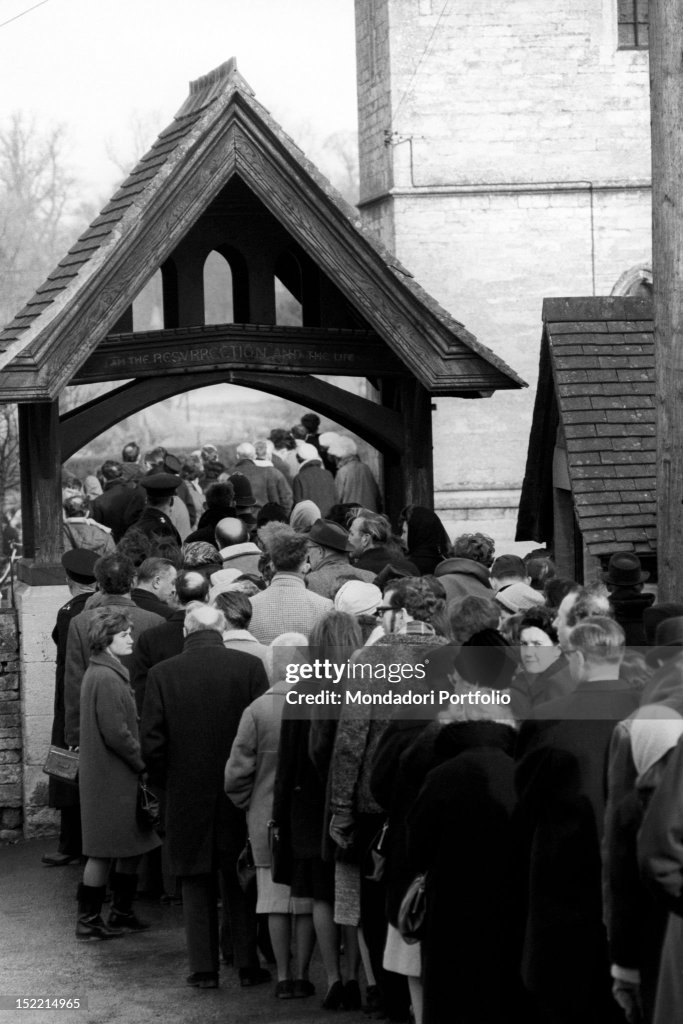
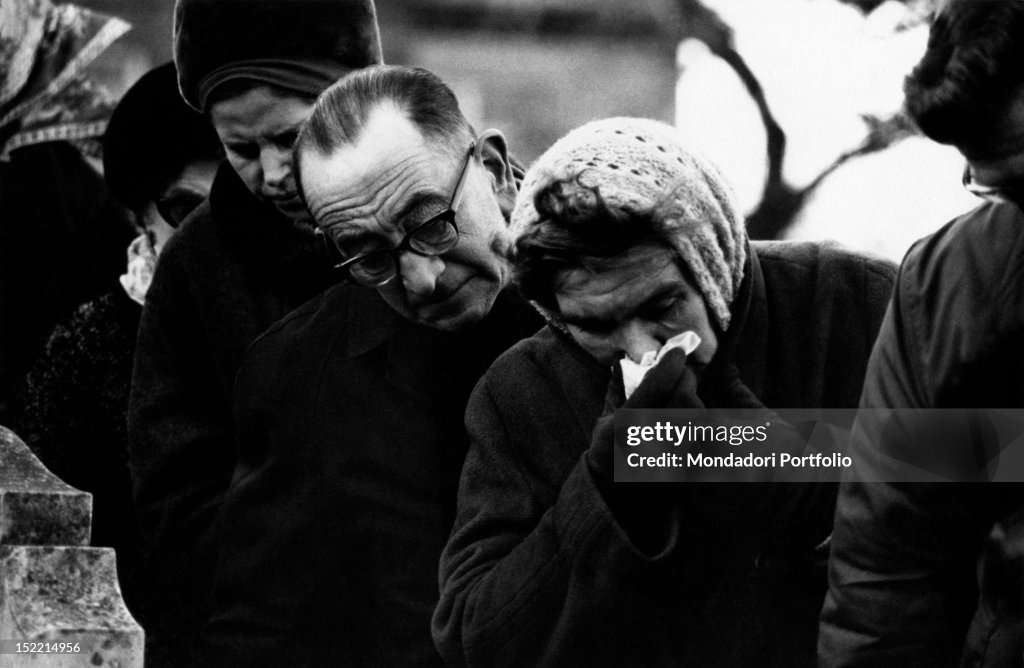
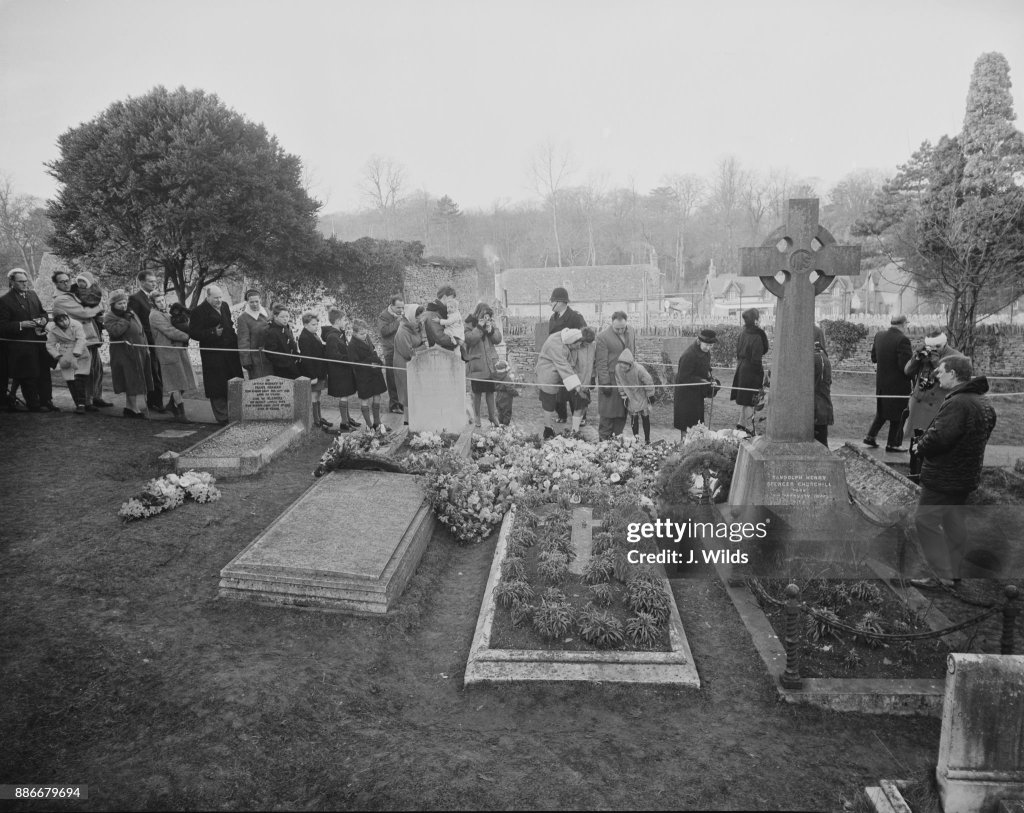
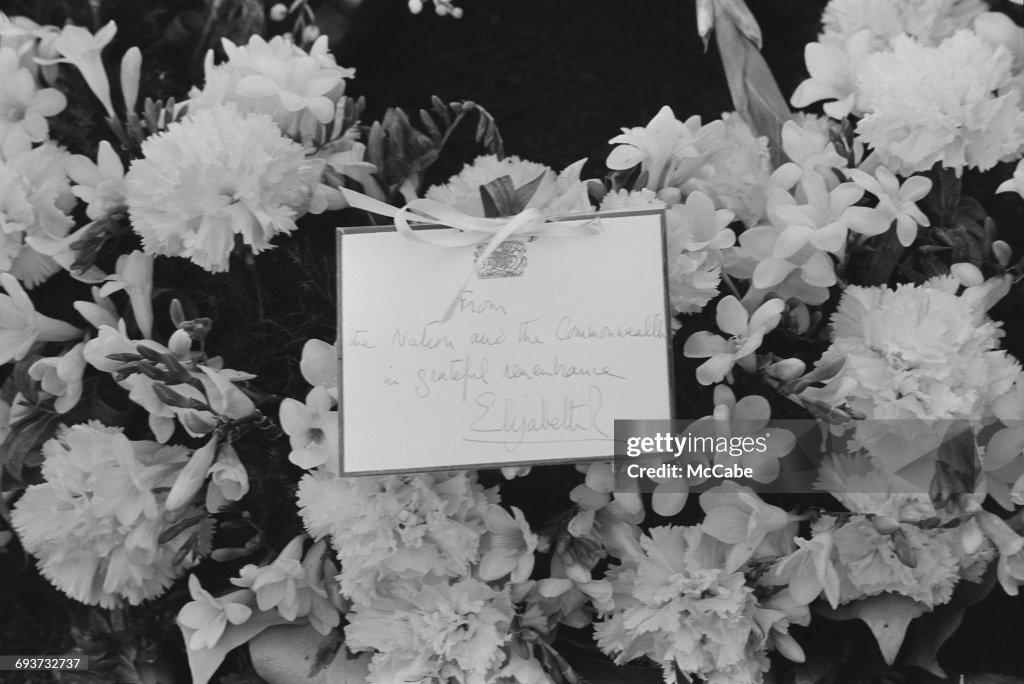
A rectangle of freshly turned earth in Bladon’s country churchyard has become a national shrine as thousands arrive for a glimpse of the last resting place of England’s great statesman, Sir Winston Churchill. Tens of thousands of saddened Britons crammed into the little village of Bladon today to pay their respects to Sir Winston Churchill in the simple country churchyard where he lies buried. The eulogies were still being spoken, but the pageantry was over. After yesterday’s memorable funeral, inextricably woven through with pomp and history and public remembrances, the gathered heads of state and other dignitaries from over the world were quietly going home. In St. Paul’s Cathedral the Dean, the Very Rev. Walter Matthews, who read the lesson at the funeral service yesterday, spoke of Sir Winston’s life and work in his sermon today. The four hymns from yesterday’s service were sung again. There were other services over the country, and solemn processions, but no procession so great as that to the hilltop churchyard where Sir Winston is buried. Three long, silent queues wound down the hillside and out of the village for more than two miles. Tonight the road that leads from the highway, to Bladon was closed to traffic and people still arriving were, told by the police that they could stand in line but had little chance of reaching the churchyard before tomorrow. Not everyone turned back.
R.A. Butler, former Foreign Secretary, who reshaped the Conservative party after World War II and twice nearly became Prime Minister, has bowed out of politics to become a life peer and master of Trinity College, Cambridge.
Peking ordered a massive five-year build-up of its armed forces, including jets and missiles.
Peking announced today that it had lodged a “serious protest” against the Burundi Government’s action in suspending diplomatic relations with Communist China.
Queen Elizabeth received her Government ministers and foreign diplomatic representatives at Buckingham Palace tonight so that she can leave for Ethiopia tomorrow with as little pomp and formality as possible.
Some 300 Cuban exiles are reported fighting rebels in the Congo for the government of Premier Moïse Tshombe, an activity they consider target practice for Fidel Castro.
The United Arab Republic, which is supplying the Congo rebels with arms, has ordered the Congolese Government to close its embassy here and withdraw its staff as soon as possible.
West Germany officially expressed “serious concern” tonight over the coming visit to Egypt of President Walter Ulbricht of East Germany.
Exploration of expanded contracts with Communist East Europe and a limited increase in trade with the Soviet Union and its satellites were proposed by a House study mission.
A Gurkha patrol and Indonesian troops waged a fierce battle yesterday in the defense jungle area of Sarawak, a military spokesman said today. Several Indonesian soldiers were killed and many were wounded in the mist-shrouded clash along the mountainous border between Sarawak and Indonesian Borneo, the spokesman said. He said one Gurkha had been killed and two wounded in the fighting. The Gurkhas, Nepalese troops serving in the British Army, encountered about 60 Indonesian troops in a heavy mist that had settled over the lush tropical area. The exact number of Indonesian casualties was not determined because the Indonesians took their dead and wounded when they retreated over the border, the spokesman said.
President Sukarno of Indonesia told the United States again “to go to hell with your aid, implying it has strings attached.
Stefan Cardinal Wyszynski said the papal encyclical “Peace on Earth” can no longer guide the church in relations with Communist Poland.
In Guadalajara in Mexico, 25 people, many of them children, were killed when members of a crowd panicked at an entrance to a stage show. There were 50,000 available seats at the El Progresso stadium, and the people who were trampled had been caught when the crowd leaving the first show encountered another crowd trying to get into the second one.
A United States airman, Larry D. Cole of Marshall, Michigan, will stand trial by general court martial for the slaying of a Philippine youth, Clark Air Base authorities announced today.
The Johnson Administration is expected to score a major domestic victory and will seek to reverse a foreign affairs defeat as Congress speeds up its pace tomorrow.The victory is scheduled in the Senate, where a mid-afternoon vote is to be taken on the nearly $1.1 billion bill to bolster the economy of the 11-state Appalachia region. Backers of the measure are predicting a wide margin of victory, perhaps even larger than the 45-to-13 vote by which the bill cleared the Senate last year. The House has never acted on the bill.
This would mark the second big Administration measure to win the Senate’s approval this year. By a vote of 68 to 8, it passed a bill last week to broaden the Government’s authority in combating water pollution. Although happy over the generally favorable outlook for domestic legislation, Administration leaders are concerned over prospects in the field of foreign affairs. The Administration suffered two setbacks in this field last week. First, the House voted to suspend surplus-food sales to the United Arab Republic. Then J. W. Fulbright of Arkansas, chairman of the Senate Foreign Relations Committee, announced he would not be floor manager and chief defender of the Administration’s $3.38 billion foreign-aid bill.
In an effort to reverse the House action on food sales to the Cairo Government, President Johnson will send Secretary of State Dean Rusk to Capitol Hill tomorrow to plead with members of the Senate Appropriations Committee. Mr. Rusk is still suffering from a cold he picked up while in London for the funeral rites for Sir Winston Churchill. However, an aide said today that the Secretary hoped to be well enough to testify tomorrow. With the Appalachia bill out of the way by late afternoon, the Senate is expected to take up legislation to implement United States participation in the International Coffee Agreement.
The Senate is also scheduled to act on the nomination of William J. Driver as director of the Veterans Administration. This would be a routine matter except that Mr. Driver has come under heavy fire for ordering the closing of various V.A. hospitals.
Elsewhere on Capitol Hill this week, committees will hold hearings on a variety of Administration programs. A House subcommittee is expected to wind up nine days of hearings on President Johnson’s $1.25 billion program of aid to elementary and secondary schools. A Senate subcommittee will continue hearings on the bill through February 11. Another House subcommittee will open hearings tomorrow on the Administration’s program of $260 million in Federal aid to higher education.
The Senate Banking and Currency Committee will open two weeks of hearings Tuesday on the President’s proposal for partial repeal of the statutory requirement for a 25 percent gold cover for the nation’s money supply. Other committees will work on an assortment of appropriations bills, a measure to increase Social Security benefits and provide health insurance for the elderly, and a bill dealing with the presidential succession and disability, and filling a vice-presidential vacancy.
The U.S. Air Force’s Tactical Air Command, until five years ago the stepchild of the services, has expanded to a force of about 136,000 men and 1,800 aircraft. The command, which has concentrated much of its effort in recent years on the development of weapons and techniques for non-nuclear and limited war, is charged with the interdiction of enemy supply lines, the winning of air superiority over battle areas, air reconnaissance, and close air support of surface forces and the tactical or assault airlift of Army troops and equipment. The emphasis placed by the Kennedy-Johnson Administrations on strengthening the nation’s limited-war capability is perhaps more graphically demonstrated at Langley Air Force Base than in any other military command.
The command is being modernized with the substitution of new fighter planes like the McDonnell F-4C, and of its total personnel 79,000 are regular Air Force personnel, the rest from the Air National Guard and Air Force Reserve. Four years ago the regulars numbered less than 54,000. All the tactical fighters in the entire Air Force totaled about 1,200 planes four to five years ago. Today, the Tactical Air Command alone operates about 55 fighter squadrons totaling 1,400 planes, exclusive of those permanently assigned overseas theaters.
It also operates 21 Lockheed C-120 Hercules assault-transport squadrons with a total of more than 330 aircraft, four tactical reconnaissance squadrons, a few helicopters and some special air-warfare planes. The total, more than 1,800 planes, rose from about 1,300 in 1961. About 16 squadrons of the McDonnell F-4C are now programmed, and more may be added. The plane can also carry 16 750-pound bombs.
The Rev. Dr. Martin Luther King Jr. urged cheering Blacks tonight to march by the hundreds on the courthouse in Selma in a voter-registration drive tomorrow. He told an overflow crowd in a Black church that he would lead the procession, choosing to remain in Selma while members of his staff begin a similar campaign in neighboring Perry County. He reminded his followers that a week-old injunction prohibiting sheriff’s deputies from interfering with the campaign in Selma had been modified to clarify the Blacks’ right to assemble in unlimited numbers.
Federal District Judge Daniel Thomas, in amending the injunction, limited to 100 the number who could actually apply for registration on any one day, as he had earlier, but specified that other Blacks also could assemble peacefully, joining the end of the registration line if they chose. Last week, sheriff’s deputies arrested those who insisted on getting in line after the allotted number of 100 had been reached. Dr. King told his audience tonight that Alabama had “systematically, consciously, brutally and inhumanly denied the Black the right to vote.”
President Johnson, showing no signs of his recent cold, attended the “Red Mass” in Washington which invokes the blessing of the Lord on those who make and administer laws.
The sequence of events that led to the uncovering of the large-scale examination cheating at the Air Force Academy goes back to May, when a junior cadet first thought up a plan to steal test papers.
The Brotherhood of Railroad Trainmen has agreed to stop fighting repeal of state laws which require full train crews.
Revolutionary political and industrial changes are facing the State of Washington — the result of the election of a Republican governor and new developments in nuclear power.
On the eve of his retirement after 35 years of service, General Curtis E. LeMay asserted that unless the United States becomes capable of using military weapons in space it leaves itself open to enemy attack
The federal government shortly will insist that local, mushrooming communities cooperate and plan with it before receiving aid from Washington.
The two top economic men in the Johnson administration agreed again that 1965 will be a good year providing inflationary patterns can be avoided.
New York City Welfare Department workers voted last night to end their 28-day-old walkout and to return to work today.
A mammoth earth slide in a deep canyon blocked the Wilson River in Oregon, forming a lake four miles long that threatened homes on both sides of the slide
The weather cleared and officials started to evacuate about 300 persons from an avalanche-threatened Utah ski resort.
Pud Galvin is chosen for Hall of Fame induction by the Special Veterans Committee. 19th century pitcher James ‘Pud’ Galvin is elected to the Baseball Hall of Fame.
Masanori Murakami, the first Japanese player in the major leagues, says he will not return to the San Francisco Giants in 1965.
18-year-old catcher Bob Watson signs as a free agent. Watson would eventually play left field and first base, becoming one of the best hitters in franchise history. Watson will also score the one-millionth run in MLB history.
Born:
Bobby Dollas, Canadian NHL defenseman (Winnipeg Jets, Quebec Nordiques, Detroit Red Wings, Mighty Ducks of Anaheim, Edmonton Oilers, Pittsburgh Penguins, Ottawa Senators, Calgary Flames, San Jose Sharks), in Montreal, Quebec, Canada.
Peter Bakovic, Canadian NHL right wing (Vancouver Canucks), in Port Arthur, Ontario, Canada.
Stan Clayton, NFL guard and tackle (Atlanta Falcons, New England Patriots), in Philadelphia, Pennsylvania.
Diána Igaly, Hungarian sport shooter (Olympic gold medal, women’s skeet 2004; bronze 2000), in Budapest, Hungary (d. 2021).
Kim Clarke, American team women’s handball back court (Olympics, 1988, 1992, 1996), in Tulsa, Oklahoma.
 History Diaries