Soviet Premier Aleksei N. Kosygin will fly to North Vietnam in the near future at the head of a strong government and party delegation. The impending visit, which appears to signify an important deepening of Soviet commitments in Southeast Asia, was announced by Tass, the official press agency, early today. The delegation will include Yuri V. Andropov, a member of the secretariat of the Central Committee of the party; Minister of Aviation Yevgeny F. Loginov, First Deputy Foreign Minister Vasily V. Kuznetsov and Colonel General Georgi Sidorovich, deputy chairman of the State Committee for Foreign Economic Relations. Mr. Sidorovich is the official who has signed Soviet military assistance agreements with such countries as India and Indonesia.
Tass did not name a date for Mr. Kosygin’s departure, but said the Premier would leave for Hanoi “shortly.” It said he would make the trip at the invitation of the Government of North Vietnam. The announcement came after a period during which the Soviet press had stepped up its attacks on the United States over both Vietnam and Laos, and during which Soviet leaders had made repeated statements assuring the North Vietnamese Communists of their support. The latest such assurance made publicly was contained in a letter sent on December 30 by Foreign Minister Andrei A. Gromyko to Xuân Thủy, the North Vietnamese Foreign Minister. He declared the Soviet Union’s support and complete solidarity with North Vietnam in the face of what he described as “aggressive action” by the United States.
United States military authorities reported today that 88 Việt Cộng guerrillas were killed and 6 captured Thursday and yesterday in a battle near Tuy Hòa, about 230 miles northeast of Saigon. Two United States Army officers were seriously wounded on Thursday, and 7 government soldiers were killed and 14 wounded over the two days. Vietnamese Air Force strikes accounted for 30 of the Việt Cộng losses. Villagers said 60 additional Communist bodies had been transported across a river in sampans.
South Vietnam turned its back on the war today and began a week-long New Year’s holiday. Tết, the lunar new year celebrated by the Vietnamese, does not officially begin until Tuesday. But anybody in Saigon who dialed for information on his telephone today found that the operators had already left town and that there would be no more information service until February 8. International telephone service also went dead as technicians left town to visit their families. That service will remain inoperative at least until Friday.
The United States bowed reluctantly today to the reality of the military seizure of power that occurred Wednesday. Embassy officials began doing business with the Government of Acting Premier Nguyễn Xuân Oánh. A day after exploratory talks between Ambassador Maxwell D. Taylor and Lieutenant General Nguyễn Khánh, the military commander, American officials called at various ministries. “We are having normal day-to-day contacts with the government,” an embassy spokesman said. Nevertheless the embassy still refrained from issuing any public statement that could be construed as an expression of approval for the military takeover. Pending the emergence of a more complete government structure, it is also apparent that the United States will hesitate to transact more than routine business with the caretaker leadership.
Ambassador Taylor is remaining aloof from the efforts of General Khánh to consolidate his position of dominance in South Vietnam. It is understood, however, that the United States intends to avoid the kind of intervention that was undertaken in December after military leaders overthrew the civilian legislature. At that time, Washington suspended discussions of increases in the ald program until authority was returned to Premier Trần Văn Hương. Mr. Hương remained in power for several weeks afterward. American officials maintain that they do not feel that the war against the communist guerrillas is lost, and they are pressing as vigorously as possible in supporting the campaign. But the feeling is that reverses in the attempts to foster stable government in Saigon are more serious than any recent battlefield setbacks.
As political tensions eased in Saigon, the city appeared more relaxed. Vietnamese shoppers hurried down tree-lined boulevards and across sunny squares to make last-minute purchases at sidewalk stalls for the celebration of Tết, the Vietnamese lunar new year. Officially Tết begins on Tuesday and extends through Friday, but already a holiday spirit prevails. The violent Buddhist demonstrations of the last few days were looked upon now as a passing fever. Visitors to Buddhist pagodas were told by the monks that this was the season of peaceful mediation. Thích Tâm Châu, head of the politically ambitious Secular Institute, told his followers, “Let us pray for an early end of fratricidal warfare.” The Việt Cộng have let it be known that they will respect a seven-day holiday cease-fire, beginning Sunday.
Despite an endorsement from President Johnson, Ambassador Maxwell D. Taylor is now expected to be eased out of South Vietnam, perhaps to succeed the director of the CIA.
South Vietnam’s Buddhist Monks are rumoted to be working for an end to fighting by an “accommodation” with Hanoi.
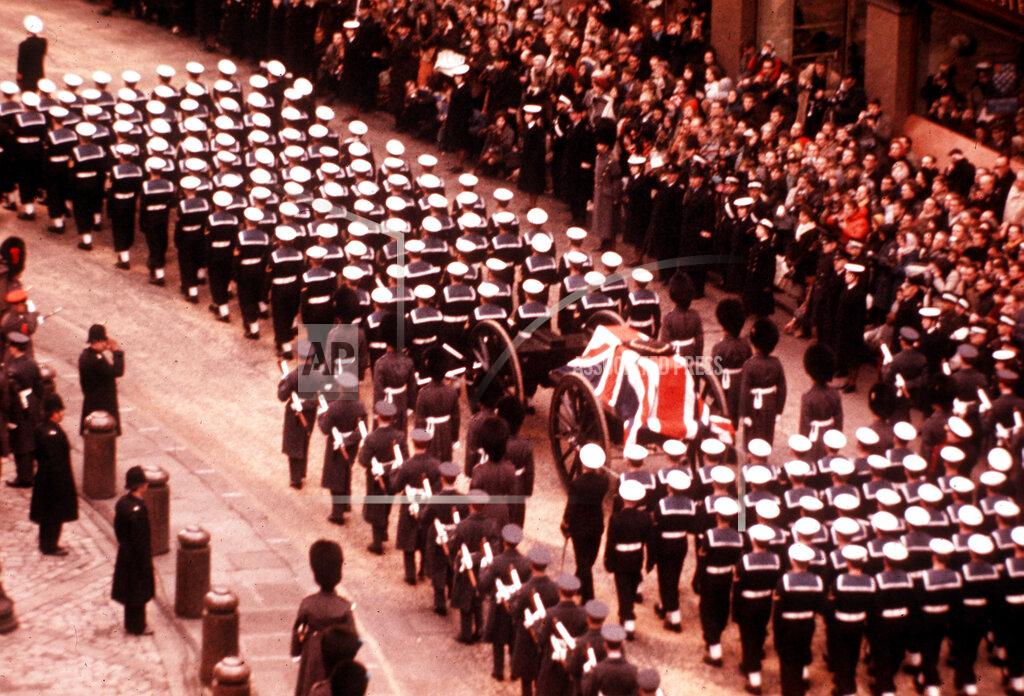
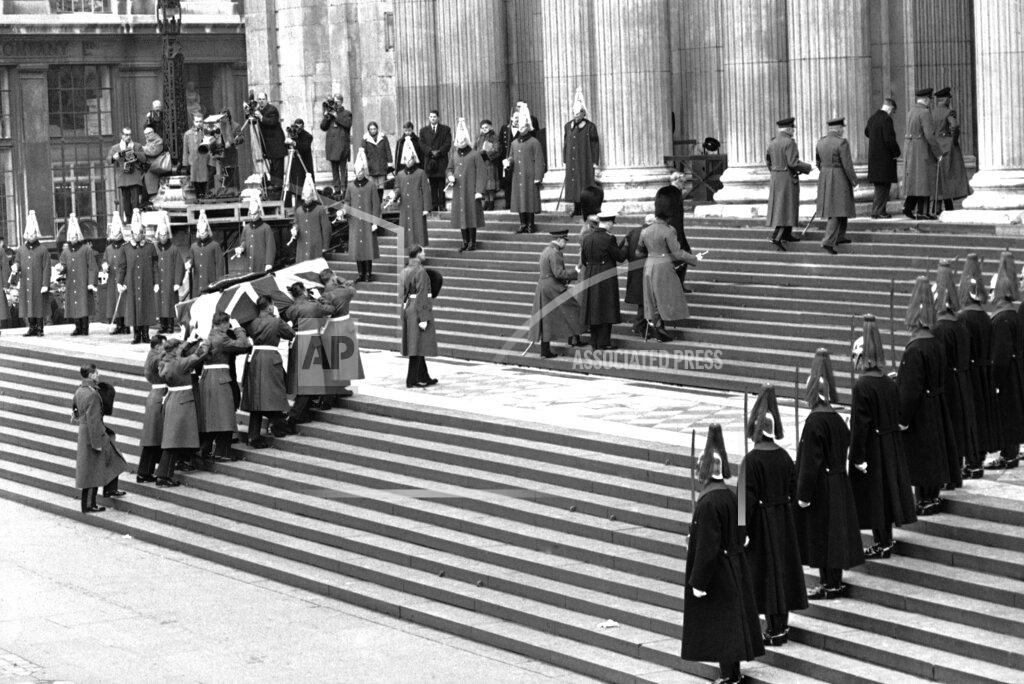
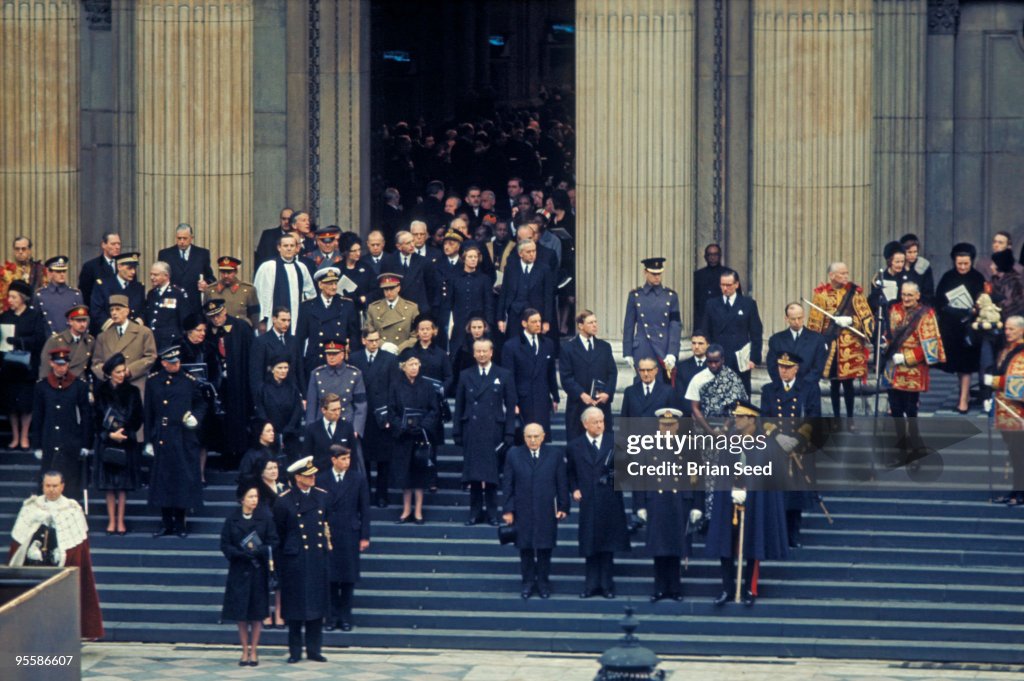
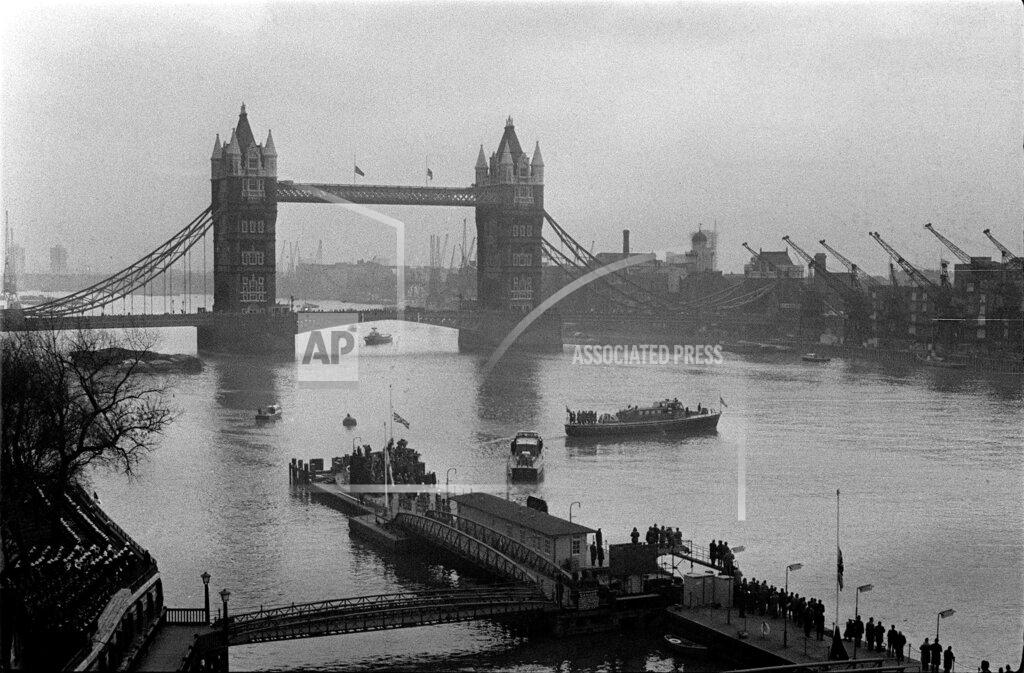
The state funeral of Sir Winston Churchill took place with the largest assembly of statesmen in the world until the 2005 funeral of Pope John Paul II. Guests from 110 of the world’s nations included “five presidents, plus one former president; four kings, two queens, [and] 11 prime ministers.” The ceremony was televised worldwide, with an estimated audience of 350,000,000 people watching (including 45,000,000 in the United States, where NBC, CBS and ABC televised it), and one million gathered on the streets of London to watch the funeral procession, which included 7,000 marching soldiers and nine military bands. Churchill’s casket was then transported from St. Paul’s Cathedral in London to his birthplace, the village of Bladon, where he was buried at the St. Martin’s Church graveyard.
Sir Winston Churchill was laid to rest today after an extraordinary state funeral. Britain and the world joined in homage to the man who had marshaled the spirit of freedom for his age. It was a day of ceremony, pride and grief. There was rich pageantry — heralds and muffled drums, royalty and red silks, lines of soldiers in dress uniform. There was also private sorrow. Sir Winston, who died last Sunday at the age of 90, was buried this afternoon in a small village churchyard at Bladon, near his family’s ancestral home, Blenheim Palace. So private was the service that the public did not know exactly when it ended. When visitors began to file through the churchyard this evening, they found at the head of the new grave a wreath of red roses, tulips and carnations from Lady Churchill. It bore this inscription: “To my darling Winston. Clemmie.”
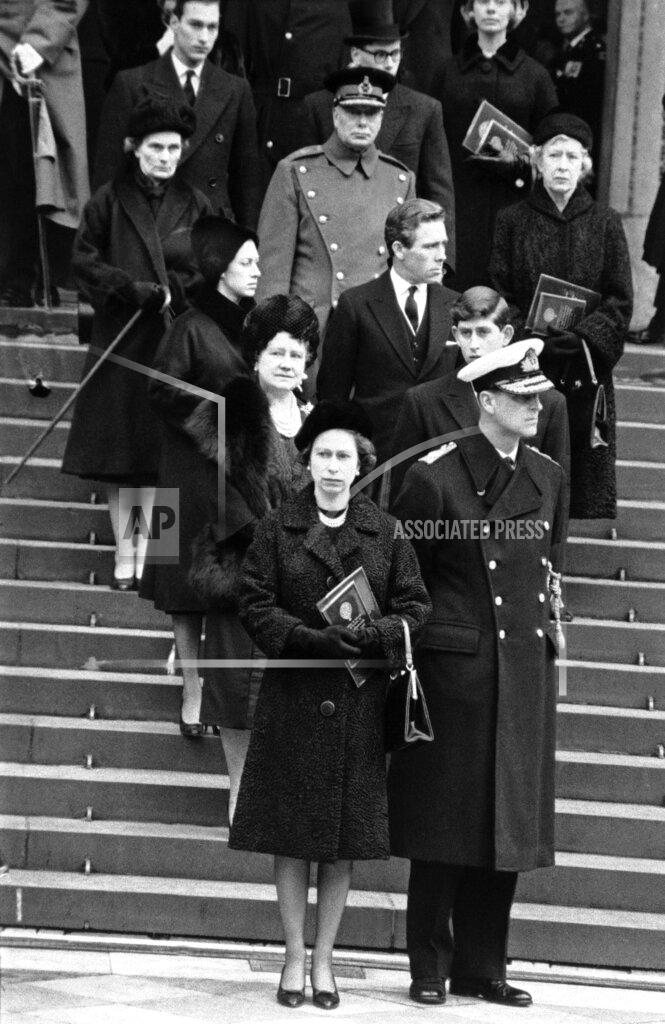
The great procession through the streets of London this morning and the service that followed in St. Paul’s Cathedral went beyond any funeral ever provided for a commoner in Britain. Queen Elizabeth was in the cathedral — the first reigning British sovereign to attend a commoner’s funeral. The thousands who watched at street corners and the millions who watched on television knew they were seeing a moment of history. The banners and the trumpets and the robes might have been taken from a scene by Shakespeare. But it was more than a British occasion. A hundred and ten nations were represented — six by sovereigns, five by other heads of state, sixteen by prime ministers. The commanding figure was that of French President Charles de Gaulle, tall and somber in a plain khaki uniform.
Sir Winston Churchill was a leader whom the United States was glad to honor as its own, Dwight D. Eisenhower said in London after the funeral of his wartime comrade.
President Johnson, still recuperating from a cold, watched the Churchill funeral rites on TV after drawing a shroud of silence around the White House in final homage to the late British hero.
Magnificently detailed and moving television pictures of Sir Winston Churchill’s funeral were watched by millions of Americans yesterday as network coverage of the solemn pageantry continued from the early morning until late afternoon.
The United States and the Soviet Union have agreed on an expanded cultural-exchange program for the coming year, the State Department announced today. “Greater efforts” are to be made to increase scientific, educational, technical and artistic exchanges. The department said the accord had been reached during “friendly and frank” talks reviewing the two-year agreement signed in 1964. The successful outcome of the talks provided evidence of a desire of the new Kremlin leadership to continue the policy of “peaceful coexistence” with the United States. The talks dealt primarily with means of carrying out the 1965 phase of the existing agreement.
Frol R. Kozlov, a leading Soviet political figure of the Khrushchev era, died here today at the age of 56. Once regarded as the heir apparent to Nikita S. Khrushchev, Mr. Kozlov dropped out of political life in April, 1963, when he was felled by a brain hemorrhage that resulted in partial paralysis. Thereafter, he was generally regarded as no longer a factor in the maneuverings within the Kremlin. Despite his illness, he was retained by Mr. Khrushchev as a nominal member of the Communist party’s ruling Presidium and as one of the party’s national secretaries. After Mr. Khrushchev’s removal last October as Premier and as First Secretary of the party, his successors removed Mr. Kozlov from his key posts in November. They gave him “a leave of absence for treatment.”
Possibility of an East-West Big Four foreign ministers meeting in Vienna this May was raised by U.S. officials in Washington.
The Soviet Union, for the second straight year, has decided to keep its official report on the nation’s grain harvest a secret.
The Johnson Administration secretly gave permission to the West German Government for the recent transfer of a number of American-made tanks to Israel, officials disclosed today. Because of a concern that the move could accelerate the arms race in the Middle East and have adverse diplomatic effects, the permission was granted with considerable reluctance and under conditions of strict secrecy. The motivating factor behind the Administration’s decision apparently was a concern that continuing Soviet arms shipments, particularly to the United Arab Republic, could upset the tenuous military balance now existing between Israel and the Arab states. The M-48 medium tanks, which were purchased from the United States in the late 1950’s, are included in the $80 million worth of modern arms that West Germany, in cooperation with other European countries, is now giving Israel.
Israel permitted American inspectors to make a ten-hour tour of its Negev nuclear research facility near Dimona. Though the Americans were “not given as comprehensive and intensive a tour as they wanted, they came to the conclusion that it was sufficient to allow them to determine the nature of the Dimona reactor”, and that Israel had no intention of developing nuclear capability, although its production capacity was at a high enough level to make it possible in the future. The New York Times would reveal the details two months later, on March 14.
The Lockheed Starfighter, currently the subject of hot political controversy in Bonn, is flying in the air defense of the North Atlantic Treaty Organization’s central front, and the West German Air Force thinks it is doing fine. “The F-104G is the best all-around military aircraft flying in Europe today.” says Major General Johannes Steinhoff, commander of the Luftwaffe’s Fourth Air Division. “We could not have chosen better.” About one-third of West Germany’s operational Starfighters now fly off the snow-swept North German airfields of the Fourth Division command.
The $1 billion-bet that the Bonn Defense Ministry placed on the Lockheed F-104G in 1959 is the object of current second-guessing by West German politicians. The criticism has been fed by leaks of technical data that have started talk in United States business circles of a deliberate campaign to blame American industry in Western Europe. The charges against the Lockheed plane are that it cost too much and that it has “bugs” — notably a faulty inertial navigation system — that have made it of limited value to NATO’s air defense effort.
Sudan is reported to have halted the direct supply of arms through its territory to rebels in the northeastern Congo. Military sources here said today that no arms are believed to have crossed the Sudanese border into the Congo for the last two weeks. Instead, arms shipments have apparently been channeled through Uganda. The Sudanese route was abandoned, the sources added, because Khartoum feared the arms would fall into the hands of Sudanese rebels operating in the south.
Cristophe Gbenye, the left-wing Congolese rebel chief, left Algiers for Cairo today with President Ahmed Ben Bella’s political endorsement.
In the last two years an army of 10,000 Iranian high school graduates has taught 400,000 Iranian village children to read and write. This “literacy corps” is now being supplemented by a health corps in which 300 high school graduates and 160 graduates of schools of medicine, dentistry, veterinary science and pharmacology have been enrolled. In addition, a “development corps” is planned to take on a wide variety of tasks in agricultural extension work and general village improvement.
Jacques Nevard, Pakistan correspondent of The New York Times, was ordered today by a High Court judge to file a reply to a contempt-of-court accusation made by Gohar Ayub Khan, industrialist son of President Mohammad Ayub Khan.
Biren Mitra, Chief Minister of Orissa State in eastern India, resigned today under charges of “improper conduct.”
Communist China reported today that its diplomats had been expelled from the African Kingdom of Burundi. Burundi, a tiny landlocked country adjoining the Congo, has been generally regarded as one of the chief centers of Chinese Communist intrigue in Africa.
Pope Paul VI renewed today his appeal for Roman Catholic unity and hinted that the Ecumenical Council would deal with Communism in its fourth and last session next fall.
The Ministry of Culture of the People’s Republic of China and its Language Reform Committee issued The Table of the Typeface of the Currently Used Chinese Characters, setting the 6,196 Chinese characters that would be used in printed documents. Two days earlier, the Department of State Affairs had issued The Plan for Chinese Character Simplification to outline the 569 simplified Chinese characters.
Railroad negotiators and representatives of five nonoperating unions reached agreement on a major job security issue, a Labor Department spokesman said. Negotiators for most of the nation’s railroads and five non-operating rail unions agreed today on the attrition principle as the basis for settlement of their year-and-a-half-old dispute over job security in the face of automation and reduction of service.
A committee of financial and economic advisers urged that private pension plans now covering 25 million U.S. workers be subjected to tighter federal controls. A Presidential committee made far-reaching recommendations today regarding the country’s rapidly growing private pension plans, which cover millions of workers and have billions of dollars in assets.
A struggle for President Johnson’s mind is under way within the government over measures to improve the nation’s balance of international payments. The Treasury Department and the Federal Reserve Board are deeply concerned over the problem, which has been the underlying cause of the nation’s loss of gold to other countries. The deficit in the balance of payments worsened in the last month of 1964 after earlier improvement, and the President has pledged a message to Congress proposing remedies. The balance of payments measures the nation’s transactions with foreign countries. A deficit results when more dollars flow out than in. As dollars pile up in foreign central banks, some are converted into gold at the United States Treasury.
A federal judge ruled today that civil rights workers could not be arrested for standing around voter registration lines and encouraging Blacks to vote. District Judge Daniel H. Thomas of Mobile issued the clarification of the restraining order he placed against Sheriff Jim Clark of Dallas County last Saturday. The order was vague, on the limit to the number of persons who could be in line, and a conflict of interpretations resulted in a number of arrests this week. Integrationist attorneys had asked for the definitive ruling. The judge said nobody could stand in the registration lines, except those wishing to register. However, he said, people can get at the end of the line or stand nearby to encourage others, so long as they remain “peaceful and orderly.”
The applicant for voter registration in Selma, Alabama was a Black with a substandard sixth-grade education, obtained under considerable difficulty between the cotton-picking and the cotton-chopping seasons each year. In the Board of Registrars office, he found himself confronted with questions like these: “If no national candidate for Vice President receives a majority of the electoral vote, how is a Vice President chosen? In such cases how many votes must a person receive to become Vice President?” The answers are the Senate and 51 votes.
It was no surprise to the applicant when in three weeks he received notice from the board that he failed to pass the test and would not be able to vote in Dallas County. This example contains the central issue in the drive by the Rev. Dr. Martin Luther King Jr., and other Black leaders to extend the ballot to the masses of Blacks here and in other Alabama “black belt” counties, and the determination of whites to bar fully educated Blacks from the electorate.
A Freedom Radio station is being established in Mississippi by a group of civil rights adherents.
Washingotn, D.C., which President Johnson has pledged to make a model metropolis of the Great Society, was shocked and embarrassed this week to learn that lavatories in at least one public school building attended largely by Blacks had been without hot water for 45 years.
The Smithsonian Institution has disclosed detailed architectural designs for a national air and space museum. It would be built on the Washington Mall opposite the National Gallery of Art. The building will be 784 feet long and 250 feet wide. It will be 97 feet high, but one portion of the floor is sunk below street level, leaving a space 110 feet high for such vehicles as the Atlas space launcher. The institution hopes to receive approval from Congress soon to build the museum at a cost of about $42 million. An authorizing construction bill passed the Senate last year but died in the House late in the session.
The total number of cadets who will eventually be separated from the Air Force Academy for cheating in examinations will be about 120, it was reliably reported today.
John T. Connor, newly appointed secretary of commerce, hopes to improve relations between the government and businessmen.
Representative Gerald R. Ford Jr., the newly elected House minority leader, outlined yesterday the framework within which he believes the Republican party should make constructive bipartisan support available for the Johnson Administration’s foreign policy.
Negotiators for shippers and striking dock workers reached agreement on new contracts in Baltimore, Hampton Roads, Virginia, and Baton Rouge, Louisiana.
In his hunt for talent to man the Great Society, President Johnson has set the most ponderous pace since film producer David O. Selznick scoured the world in search of Scarlett O’Hara.
A rain-weakened cliff fell into Oregon’s Columbia River, causing a wave that rolled 1,000 feet across the southwest end of Puget Island and killed a man.
By doing nothing but fight among themselves, Democrats who won both houses of the New York legislature in November may be helping Republicans out of a bad corner.
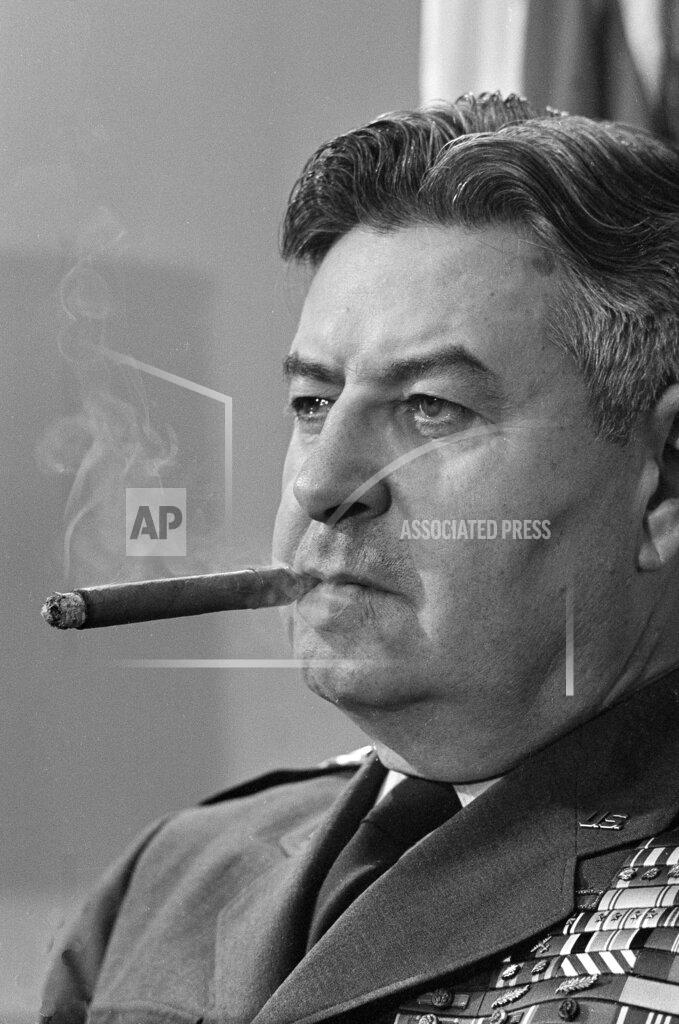
General Curtis Emerson LeMay, last of an illustrious breed of wartime air commanders, steps out of uniform on Monday and into the pages of Air Force history.
“The Name Game” by Shirley Ellis hits #3.
In one of the most famous high school basketball games in history, the 71-game winning streak of the Power Memorial Academy Panthers (from New York City) was brought to an end in a 46–43 upset by the DeMatha Catholic High School Stags (from Hyattsville, Maryland, a suburb of Washington, D.C.) at a game played in College Park, Maryland. The Panthers’ Lew Alcindor (who would change his name to Kareem Abdul-Jabbar) was held to only 16 points, less than half of his average.
Born:
Julie McCullough, American actress (“Growing Pains”) & Playboy playmate (February 86), in Honolulu, Hawaii.
Joel Davis, MLB pitcher (Chicago White Sox), in Jacksonville, Florida.
Mike Kovaleski, NFL linebacker (Cleveland Browns), in Union City, New Jersey.
Died:
Frol Kozlov, 56, former deputy prime minister of the Soviet Union who had once been viewed as a likely successor to Communist Party First Secretary Nikita Khrushchev.


 History Diaries