The Administration opened an uphill battle in Congress today for additional military aid for the Saigon Government with a claim that North Vietnam was moving one and perhaps two other combat divisions into South Vietnam. The suggestion by State and Defense Department officials was that North Vietnam might be getting into position for a major offensive, which South Vietnam would be unable to counter without additional military aid from the United States. Until now it had been the generally accepted appraisal within the Administration that North Vietnam, while intensifying its military pressure, was not preparing for a large‐scale, countrywide offensive like those in 1968 and 1972. In large measure, this appraisal rested on the fact that the Hanoi Government had not committed any divisions in its strategic reserve in Laos and North Vietnam.
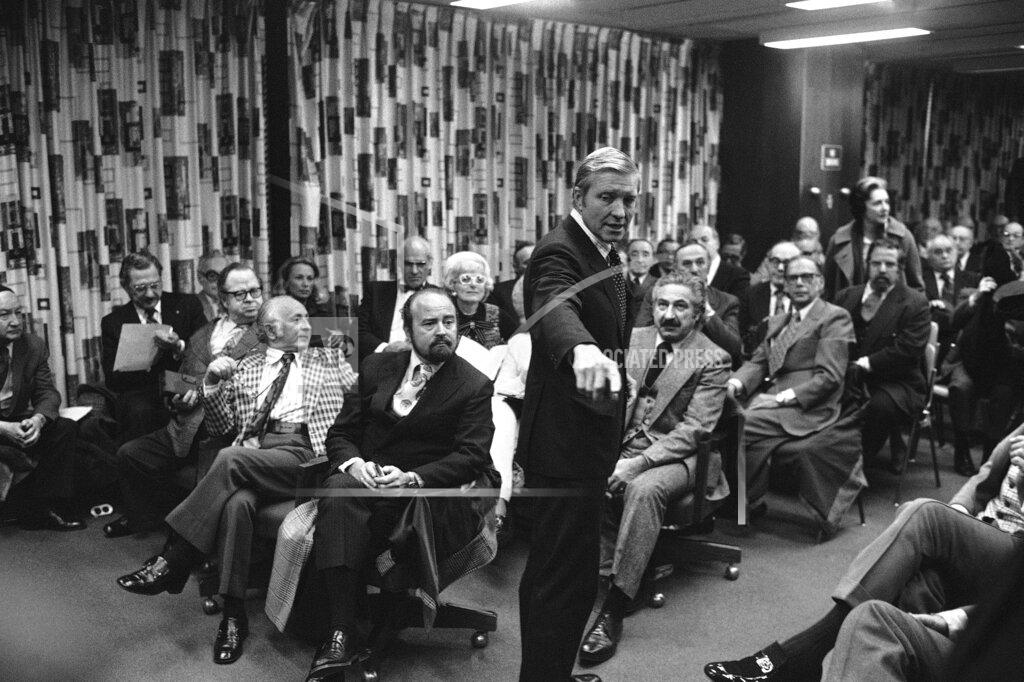
Defense and State Department officials told a House Appropriations subcommittee that the Administration believed North Vietnam would not carry out a major offensive in the next six months. But, according to officials, the recent movement of divisions in North Vietnam’s strategic reserve has thrown a new and confusing factor into Administration calculations. Lieut. Gen. Daniel O. Graham in an unusual public briefing on the military situation in Vietnam, testified that a North Vietnamese division had “moved out of Laos into South Vietnam.” He said the division, identified by the Pentagon as the 968th, began the movement about 10 days ago. General Graham said there was “tentative information” that two other divisions were moving from North Vietnam into South Vietnam. Philip C. Habib. Assistant Secetary of State for East Asian and Pacific Affairs, told a reporter after the day‐long hearing that the movement of the North Vietnamese divisions was being watched “with some concern” but that the significance remained unclear.
Among the possible explanations offered by Mr. Habib and General Graham were that the movement of the divisions represented a “feint” by North Vietnam, that the divisions would be used to reinforce expanded military activities in South Vietnam and, finally, that North Vietnam was preparing for a major offensive. Whatever the North Vietnamese intentions, it was apparent that the movement of the divisions would become an important element in the Administration’s argument to a reluctant Congress to provide $300‐million in military assistance to South Vietnam in addition to the $700‐million already approved. The Defense and State Department officials rested their case for additional military aid largely on what they described as the need to prepare ‘South Vietnam for a major North Vietnamese attack.
At no point during the hearing did they contend that with $700‐ million in assistance South Vietnam would have insufficient ammunition and supplies to deal with the current or even an intensified level of fighting. Rather, their expressed concern was that if the fighting intensified over the next six months, South Vietnam’s supplies would drop to level at which Saigon would not be able to counter an all-out offensive. “A major drawdown in stocks must be anticipated as combat intensifies,” Eric F. von Marbod, a Deputy Assistant Secretary of Defense, testified. “Continuation of the strict conservation measures will further erode the capability and willingness of the South Vietnamese to defend against enemy initiatives. The ensuing loss of territory and resources will undoubtedly encourage enemy aggression, and could encourage an attempt to launch an all‐out offensive at a time when South Vietnamese stocks would be insufficient to counter such attack.”
In the face of stiff Congressional opposition to the Administration request, the Defense’ Department went to unusual’ lengths in making public normally confidential intelligence information to support its case. In addition to the briefing by General Graham, Mr. von Marbod presented aerial reconnaissance photographs of North Vietnamese positions obviously taken by American planes over South Vietnam. He also described an “intercepted message” sent last November by the Communists in South Vietnam. The message, which was described as “COSVN Resolution 75,” was interpreted by Mr. von Marbod as “positive evidence” that the North Vietnamese intended to step up their offensive operations during the com ing months. The message as translated by the Defense Department, read in part: “Enemy air and artillery capability now limited as a result of reductions in U.S. aid. In short the enemy is declining militarily and has no chance of regaining the position they held in 1973. On the ether hand, our position is improving. We are now stronger than we were during the Tet offensive in 1968 and the summer of 1972. We now have ample amounts of money, weapons and equipment which makes it possible for us to initiate a sustained attack on wide front.”
From the questioning it was obvious that the predominantly conservative subcommittee was troubled and divided over the Administration’s request. Representative George H. Mahon of Texas, the subcommittee chairman, said the issue seemed to boil, down to a question of whether the United States was “honor bound” to provide additional military aid to South Vietnam. Mr. Habib, who helped negotiate the 1973 Paris peace agreements for Southeast Asia, said Congressional failure to provide additional funds would not “breach any legal or written agreement” with South Vietnam. But he argued that the United States had “a moral obligation” to provide South Vietnam with military equipment to defend itself.
South Vietnamese President Nguyễn Văn Thiệu said today that the $300‐million in additional aid requested for his Government by the Ford Administration was “the minimum” that his forces needed to defend themselves from stepped‐up North Vietnamese and Việt Cộng attacks. Asked at a breakfast interview with a group of foreign journalists whether his side might “collapse” in 1975 if the United States Congress refused the extra assistance, Mr. Thiệu said that “certainly ‘75 is too fast.” But he added that “the situation will be very dangerous in 1975” if enough military aid is not provided. Earlier this week, Mr. Thiệu began granting interviews to foreign journalists, starting with those whose organizations have taken sympathetic editorial positions on the question of aid to South Vietnam. Though he did not say so today, the quite evident intention of this renewed visibility is to improve the chances for the Ford Administration’s $300‐million supplemental military apppropriation request for Mr. Thiệu’s Government.
President Thiệu said that after the American Congress last year halved the Ford Administration’s $1.4‐billion request for military assistance to Saigon, the morale of trcops in South Vietnam began to drop.“Every time I go into the field to visit the field commanders,” he said, “the only complaint is not to have enough ammunition, not to have enough mobility, not enough air support. We are fighting now a more cruel war,” he said at another point, “with no B‐52, with no tactical air, with no heavy artillery like we have before. We have consequently more wounded.” Mr. Thieu said “it is not yet time” to say that the United States has ‘betrayed” South Vietnam. But he said that “most of the people of South Vietnam” were beginning to believe that the Americans, who “lured” them into the struggle, were now abandoning them.
The January 31 deadline for amnesty for draft dodgers who fled from the United States during the Vietnam War was extended to March 1. To that time, about 7,400 of 137,000 eligible had participated in the program, which required one year of volunteer service to avoid prosecution. President Ford extended to March 1 his clemency offer to Vietnam war draft evaders and deserters. His clemency program had been scheduled to expire today. In a statement issued by the White House, Mr. Ford said that he had reviewed the program, and “I believe that many of these who could benefit from it are only now learning of its application to their cases.”
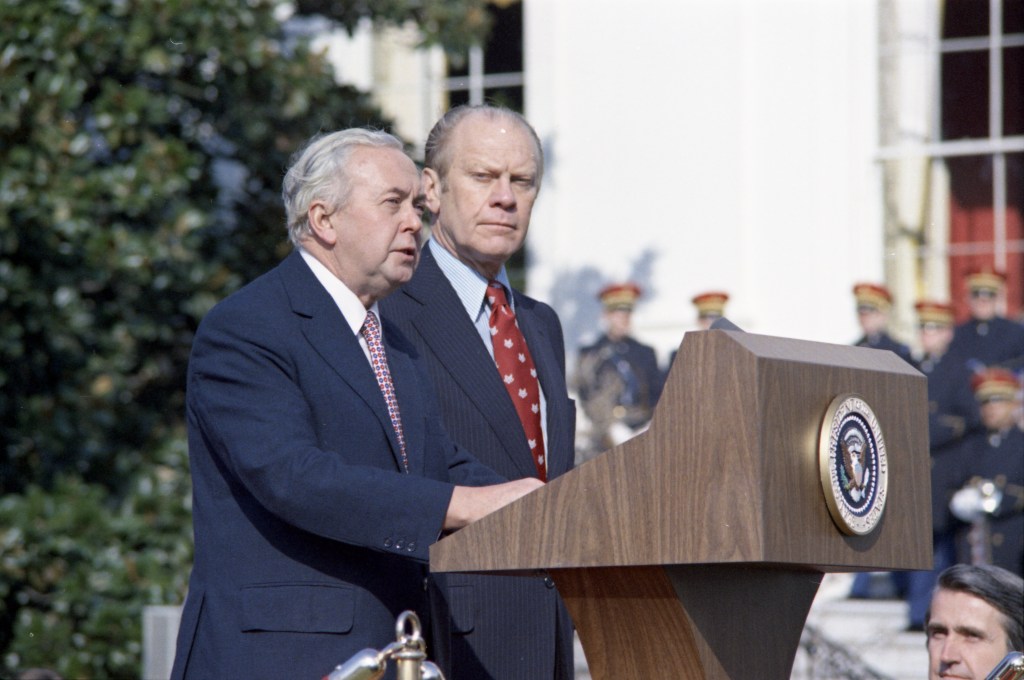
Prime Minister Harold Wilson of Britain conferred with President Ford at some length today on international energy and economic problems on the first day of the British leader’s get-acquainted visit with the new Administration. It was Mr. Ford’s fifth meeting with the head of a major industrial power since November, following talks with leaders of Japan, the Soviet Union, West Germany and France. In a cordial welcoming statement on the south lawn of the White House, Mr. Ford spoke of “a new dimension of challenges” confronting Western industrial countries hardly less “perilous” than the security crisis of the cold war. “What is at stake is the future of industrialized democracies,” Mr. Ford said. “The problems of recession, inflation and of assuring equitable access to fairly priced resources threaten the stability of every economy and the welfare of people in developed as well as developing nations alike.”
A four-year austerity program for Britain was announced by the Labor government, which warned of “increases in the burden of taxation” for the country’s workforce, and outlined measures to reduce dependence on imported sources of energy. Electricity in particular is to be priced “realistically”-meaning higher-to reduce demand and produce capital needed for investment. The austerity plan, announced in a white paper on public expenditures, is aimed at reducing the balance of payments deficit.
U.S. Secretary of State Kissinger is expected to inform key members of Congress Saturday that some progress is being made in the Cyprus negotiations, in the hope that this will lead to continued military aid to Turkey beyond next week’s cutoff date for such aid.
Turkish Airlines Flight 345 fell into the Sea of Marmara while coming in for a landing in Istanbul. Electric power at the airport failed as the plane, arriving from İzmir, was descending, and the pilot abandoned the landing and was circling when the jet fell from the sky. All 38 passengers and the crew of 4 were killed.
Six of Denmark’s 10 political parties showed their willingness to explore ways to break the nation’s political stalemate and forge a stable coalition. Their views were made known in talks with parliamentary Speaker Karl Skytte, a moderate Social-Liberal appointed by Queen Margrete to help form a new government after the resignation Tuesday of the minority Liberal administration.
Authorities in Spain moved against a wave of student unrest by stepping up police control of campuses and temporarily closing some of them. Thousands of Spanish students have been holding assemblies and staging demonstrations to demand increased freedom, to back striking industrial workers or to protest police action on their campus. Other protests concerned education reform.
Portugal’s military regime banned rival street demonstrations by Socialists, Communists, and Maoists today. saying they could disturb the effort to build democracy.
Victoria Fyodorova, the 29-year-old Soviet actress born of an international love affair, told an American interpreter that she will get a visa to visit her American father within three months. She talked by telephone with Dr. Irene Kirk of the University of Connecticut. Dr. Kirk found the actress’ father in 1963 after a four-year search and carried letters back and forth to Moscow since then. Victoria was conceived in 1945 during a love affair between Soviet actress Zoya Fyodorova and a Navy officer stationed in Moscow, Jackson R. Tate, now living in Orange Park, Florida.
An official Israeli commission investigating the October, 1973, war between Israel and the Arabs said today that Israel’s initial setbacks resulted from a series of command, control and communication failures in the face of unexpected assaults on two fronts. Submitting a 1,512‐page final report to the Government, the commission also cited faulty intelligence, lax discipline and inadequate performance by top commanders in the field as contributing factors to Israel’s defeats in the early days of the war. The five‐member commission, which included two former Chiefs of Staff, held 156 meetings over the last 14‐months. It heard testimony by 90 witnesses and received depositions from 188 other army officers and men. It issued two interim reports before today in which it cited major failures on the part of Israeli Intelligence in analyzing he information it had collected on Egyptian and Syrian preparations for the attack.
French sources said today that Egypt had ordered a total of 44 Mirage fighters from France. Half of them are to be the new F-1 plane, which went into service with the French Air Force last year. The other 22 planes, the sources said, will be the F-1E, which has an air frame similar to the F-1 with a new M‐53 engine, The F-1E is the French entry in the international competition to replace the aging Starfighters of the Dutch Belgian, Norwegian and Danish Air Forces. The United States has proposed the YF-16 being developed by General Dynamics. The French Government refused comment on the arms sales to Egypt and would not confirm or deny widespread reports that the arms sought here by President Anwar el-Sadat of Egypt were worth between $2‐billion and $2.5‐billion.
United States analysts say that Israeli air superiority, key element in the last two Middle East wars, may be jeopardized by Egypt’s acquisition of French Mirage fighter-bombers and fighters. The balance of air power between the Arabs and the Israelis could tip in favor of the Arabs, these sources said, when the aircraft ordered in Paris this week by President Anwar el‐Sadat of Egypt are added to Soviet‐built MIG‐21’s in the Egyptian Air Force and the MIG‐23’s in the Syrian Air Force. Reports from Paris said that Mr. Sadat had ordered a total of 44 Mirages. American analysts said they expected that, as a result, Israel would intensify her efforts to purchase an American fighter aircraft more modern than the Phantom F‐4, now the main plane of the Israeli Air Force. The Israelis’ preference is for the United States Air’ Force’s F‐15 Eagle. The F‐15 is an air‐superiority fighter, a plane that is intended to win control of the air over hostile fighters.
India’s Food and Agriculture Minister expressed optimism today about the crucial spring harvest. At the same time the Minister, Jagjivan Ram, said that the Government was hoping for an increase in assistance from the developed and oil‐producing nations to cope with India’s needs. In recent years India has been somewhat reluctant to ask for aid, especially from the United States, viewing such assistance as a source of some embarrassment. “It would be more graceful if some countries offered — instead of us asking for — help,” Mr. Ram said.
In the presence of a crowd that overflowed to the street, and amid high emotions, the Philippine Supreme Court heard a petition today filed by 14 persons who charged that President Ferdinand Marcos was not in office legally and could not legally call a referendum. The suit to prohibit the February 27 referendum on continuance of Mr. Marcos’s martial‐law powers was filed by eight private individuals, five Roman Catholic bishops and Senator Benigno Aquino, the President’s old political foe, who is under military detention. Some had expected that Mr. Aquino would be escorted to court by military guards, but he did not attend. He and other petitioners were represented by members of their families. The government was represented by Cabinet members and officials of the Justice Department.
Senator John V. Tunney (D-California) urged Secretary of State Henry A. Kissinger to begin personal negotiations with South American governments to prevent further seizure of U.S. fishing boats. Tunney made his request after the recent seizure of five American tuna boats by Ecuador, which claimed the boats were within the 200-mile fishing zone the country claims. The United States and most other countries recognize only a 12-mile limit.
The Argentine left-wing People’s Revolutionary Army gave authorities 72 hours to release 19 detained guerrillas or face a murder campaign against government and Perónist Party leaders across the country. The Marxist group said the 19 militants were seized during recent anti-guerrilla sweeps carried out under the orders of Jose Lopez Rega, who is both private secretary to President Maria Estela Perón and minister of social welfare.
A $15 million Cape Town opera house previously opened to whites only will allow all races in its audience as part of a South African government move to eliminate racial discrimination, officials said. The Nico Malan theater complex was built by black and white labor with financing from black and white taxpayers but had been reserved for white audiences since it opened four years ago. Many Cape Town residents boycotted the theater in opposition to the country’s rigid apartheid laws.
President Ford asked Congress today to rescind or defer another $2.6-billion in Federal spending, including proposed cutbacks for the National Cancer Institute and some other health research programs.
Secretary of the Treasury William Simon told Congress that the buildup of petrodollars in the oil-exporting countries would be much less in the years ahead than had been estimated last year after the sharp increase in the price of oil. He said that new estimates, based on a new Treasury analysis, “support the view that the international financial aspects of the oil situation are manageable.”
A multi-billion-dollar program of emergency aid for city and state governments was urged on Congress by a delegation from the United States Conference of Mayors, who said that President Ford’s economic program could not cope with the financial crisis facing the nation’s cities. Mayor Beame of New York said that “the impact of the national recession on New York City and other large cities is so severe that only strong, quick and massive federal initiatives will be able to turn us around this year.”
Arthur Burns, chairman of the Federal Reserve Board, told the House Ways and Means Committee that inflation was still a major problem, and that he was adamantly opposed to a permanent tax cut — though, he said, he supported President Ford’s proposed one-time $12 billion individual tax rebate. He indicated that the board would not quickly ease credit to bolster the economy.
The government tightened security at federal buildings across the nation in the wake of bomb incidents at the State Department and the Oakland induction center. Especially stringent measures were taken for entry to all government buildings in the nation’s capital and throughout California. Only certain guarded entrances were open and all packages were searched. Police patrol of buildings and parking areas also was increased. At the same time the FBI stepped up its investigation of the Weather Underground, the left-wing terrorist group that claimed responsibility for the Oakland attempt and the State Department blast that caused $350.000 damage
The first major reorganization of the massive Social Security Administration in 10 years was announced, prompted in part by rising congressional criticism of a relatively new welfare program. Commissioner James B. Cardwell said creation of four associate commissioner positions would help pinpoint accountability within the agency and improve the operation of the controversial Supplemental Security Income program. Cardwell said the need for change became apparent shortly after the SSI program became operational a year ago with state welfare programs for nearly 4 million aged, blind and disabled persons.
The House Agriculture Committee approved overwhelmingly a bill that would freeze the price of food stamps at their January 1 level for the rest of the year. The bill, set for floor action next week, would kill a Ford Administration plan to hike the price to roughly 30% of the net income of the recipient.
Declaring “If we don’t care about our past we cannot hope for our future,” Jacqueline Kennedy Onassis joined the battle to save Grand Central Terminal. At a crowded news conference in the Oyster Bar, the former First Lady and leading arts figures launched a committee to save the 61-year-old New York City landmark.
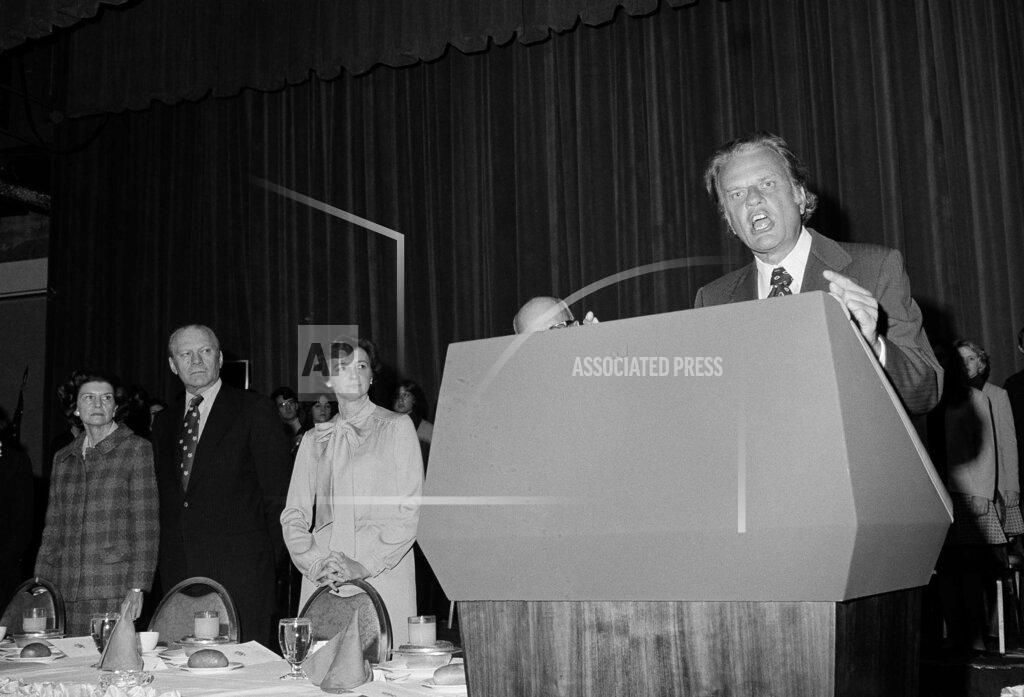
Addressing the 23rd annual National Prayer Breakfast in Washington, President Ford said he found prayers “infinitely more rewarding than votes.” He told the 3,000 persons of all faiths that assurances from letters and from people he met in his travels saying they were praying for him had been a great help. “None of us can go it alone,” he said.
Two Senate committees will hold a hearing next Wednesday on the Government’s order that the emergency cooling systems of almost half the nation’s reactors be closed down and inspected for cracks.
The radar controller who gave landing clearance to TWA Flight 514 last December 1 said it was not his responsibility to keep the plane above the mountain it hit while trying to land at Dulles International Airport. Controller Merle W. Dameron said he was not providing the type of radar protection that would require him to “tell the pilot every single move to make. Other pilots maintain Dameron should have been providing radar navigation and should have helped the plane avoid the mountain All 92 persons aboard died in the crash. A central issue in the investigation of the accident is the apparently widespread misunderstanding between pilots and controllers over who is responsible for terrain clearance during certain instrument landings.
President Ford sought to spur the economy by ordering a speedup in dividend payments for more than 27 million ex-GIs holding Veterans Administration life insurance policies. The early dividends will average $69 for 23 million World War II veterans, $168 for 111,000 who served in World War 1 and $9 for 345,000 veterans of the Korean conflict, Press Secretary Ron Nessen said. At the accelerated pace, Nessen said a total of $335.6 million in dividends would be paid within the next 45 days rather than spread out from March through December.
“This is a sad anniversary for us, said Randolph A. Hearst as the first anniversary of the kidnaping of his daughter, Patricia, approached. “The hardest thing Mrs. Hearst and I have to bear is not knowing whether Patty is alive and well. We believe she is alive and in this country. But since the last tape we have no word of any kind.” Miss Hearst, now 20, was kidnaped last February 4 from her Berkeley apartment by members of the Symbionese Liberation Army. In a tape sent to a Los Angeles radio station last June 7, Miss Hearst, wanted on charges of bank robbery and violation of federal firearms laws because of her alleged participation in SLA activities, told her parents she would never return to her family.
Pacific Gas & Electric Co. withheld 1 billion cubic feet of natural gas from major industrial customers in an effort to assure adequate home heating supplies in frostbitten Northern and Central California, where temperatures dipped to as low as 17 degrees in some areas. All affected industries are required to have contingency plans, such as the use of standby fuels, according to a PG&E spokesman. Included in the natural gas cutback were some of the utility company’s own generating plants.
An explosion ripped through an oil tanker as its cargo of crude was being unloaded at the British Petroleum plant dock on the Delaware River in Marcus Hook, a suburb of Philadelphia. Police said there were “quite a few injuries.” The explosion. which could be felt by residents a mile or more from the plant, touched off a fire. A guard at the BP plant said the blast caused a “lot of damage to the dock.”
The Smithsonian Institution in Washington, D.C., said if oil spills from tankers keep pace with world petroleum production, as much as 5 million metric tons of oil will be added to the marine environments of the world by 1985. Robert Citron, director of the Smithsonian’s Center for Short-Lived Phenomena, said his projection was based on testimony before a U.S. Senate panel surveying environmental damage. Citron said that of the 5 million tons, “approximately 85% is estimated to result from tanker operations, the remainder from collisions, groundings, breakdowns, explosions, fires, rammings and structural failure.”
It looks like the ordinary citizen is going to be paying for Watergate for some time. The latest details indicate that audiences are going to dispense at least $175,000 over the next nine weeks to hear the lectures of John W. Dean III, late of prison after serving four months for his role in the coverup. Others touched by Watergate-related scandals also will tap the public’s purse for revelatory books, articles, interviews and speeches.
Salvatore Bonanno, son of reputed Mafia figure Joseph (Joe Bananas) Bonanno, will speak on criminal justice and prison reform February 12 at the University of Arizona in Tucson. Salvatore, 41, released from prison 10 months ago after serving 38 months for mail fraud and tax evasion, will be paid $1,500 by the student body.
Singer Elvis Presley was reported in good spirits at Baptist Hospital in Memphis after having been admitted for an undisclosed ailment. Although a liver condition was rumored, his physician said he would withhold comment until tests were completed. But the 40-year-old rock singer was not suffering from lack of charisma. Security is tight to guard his solitude but, said a hospital official, “We have the same problems with our staff that we do with the public in terms of his privacy.”
The area around the wreckage of the gunboat USS Monitor, which had sunk in 1862 off of Cape Hatteras, North Carolina, was designated as the first National Marine Sanctuary in the United States. The ship, which had fought the CSS Virginia (better known as Merrimack) in the most famous naval battle of the American Civil War, had become an artificial reef over 110 years prior to its location on August 27, 1973.
A professor of architecture in Budapest applied to the patent office in Hungary for his invention, which he called Terbeli logikai jatek (“Spatial logic game”) Bűvös Kocka (“Magic Cube”), later to be known as a Rubik’s cube. Patent #HU 170,062 was granted on March 28, 1977, to Ernő Rubik.
Dow Jones Industrial Average: 696.42 (-9.54, -1.35%)
Born:
Yumi Yoshimura, Japanese singer (Puffy Amiyumi), in Osaka Prefecture, Japan.
Yasir Qadhi, Pakistani-American theologian and preacher; in Houston, Texas.
Died:
Boris Blacher, 72, German composer (Purloined Letter).





 History Diaries