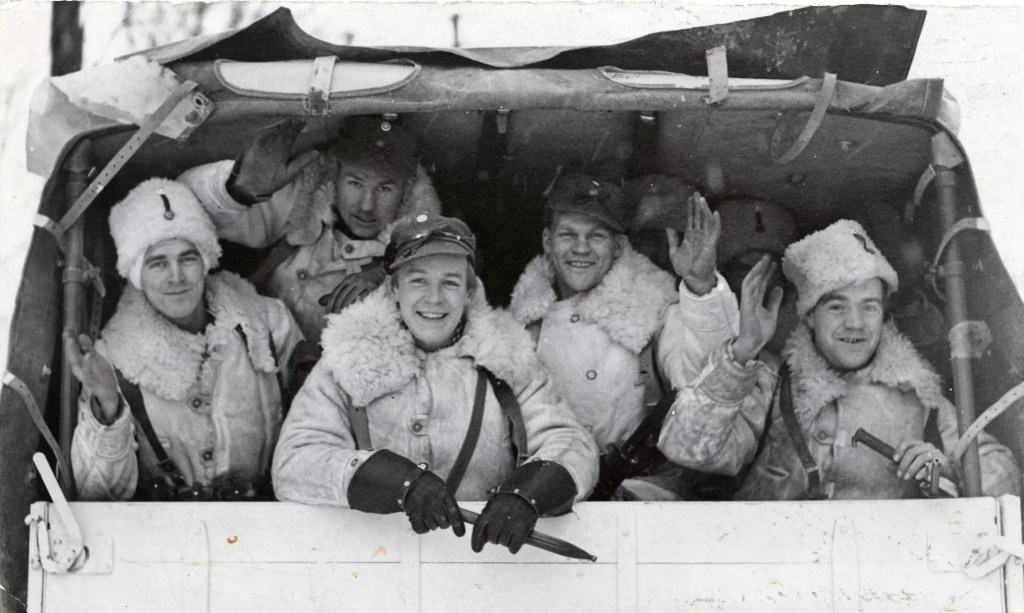
The battle of Kuhmo begins. Finns encircle the Soviet 54th Division at Kuhmo, in the “waist” of the front. Heavy Soviet air raids target Finnish ports. At 5 AM, Colonel Siilasvuo’s 9th Finnish division attacks Soviet 54th division, which has been moving slowly towards the road junction at Kuhmo. 54th division is stopped dead in its tracks, to be cut into mottis. The Soviets had been moving forward slowly, but now the division is immobile. In any event, the division has no authority to retreat. Airdrops now are the Soviets’ only means of supply. The Soviet government is turning its attention further south and leaving the operations above Lake Ladoga in abeyance.
In Summa, the Soviets carry out a probing assault preceded by heavy preparatory artillery fire in the Hanhiojansuu sector. The Finnish defences repulse the assault.
On the Eastern Isthmus in Taipale, the Soviet break through in the Terenttilä area. Intense fighting is still going on.
In Ladoga Karelia, Finnish troops continue their attacks on the West Lemetti ‘motti’. Six Blenheim bombers from 10 Squadron bomb enemy transports at the mouth of the River Taipaleenjoki. When one of the aircraft has to make a forced landing, the others land on the ice and rescue the crew.
The Soviet minesweeper M-32 was sunk by Finnish Air Force Fokker C.X aircraft at Saunasaari in the Lake Ladoga. The attack also damaged another minesweeper and killed two Soviet sailors.
Over the Karelian Isthmus: Finnish fighters shoot down two Soviet fire control planes.
At Häme, a Soviet bomber makes a forced landing on Lake Iso Roinevesi in the municipality of Hauho. The Finnish air Force inherits a completely undamaged Russian DB-3 bomber.
Soviet aircraft bomb Mantsi Fort in Ladoga Karelia.
The Soviets launch sharp air raids along the coastal towns on the Gulf of Bothnia. At Hango and Turku, two of their favorite targets, they cause extensive damage. At Hango, 50 perish and 200 are injured. In addition, the Soviet bombers, perhaps mistakenly, bomb the Red Cross hospital on the Karelian Isthmus, killing 23. Russian fliers violently bombed many Finnish cities and towns today, and it is unofficially reported that more than fifty persons were killed and many more wounded. The air raids included one that destroyed a hospital in the Viborg district, killing twenty-three, of whom seven were nurses and the rest patients.
At Turku, a late air-raid warning allows Soviet bombers to catch the city by surprise and 36 people are killed on their way to the air-raid shelters; most of the victims are hit in front of the main post office.
The Germans release Italian aircraft destined for Finland that they had detained.
Finland’s Minister of Social Affairs K.-A. Fagerholm travels to Oslo to appeal to Norway to send troops and fighter aircraft to Finland.
Tickets for the bandy match between Finland and Sweden to raise funds for Finland are sold out. King Gustav V of Sweden is among those who have bought a ticket.
A Soviet diplomatic note to the government of Sweden through Alexandra Kollontai, their ambassador in Stockholm, suggests that the Soviets are prepared to negotiate with the legitimate Finnish government and, implicitly, to abandon support for the puppet communist regime. The Soviets began negotiating with Finland by sending a note stating “Soviet Union has no objection in principle to a possible agreement with the Ryti government” to Sweden.
This appears to end the Soviet pretense that their puppet government staffed by former Comintern members is the “legitimate” Finnish government, which nobody took seriously anyway. The Soviets are preparing a major offensive, so the sincerity of this offer is highly suspect – unless the Soviets consider it to be a prelude to surrender negotiations.
French Prime Minister Édouard Daladier made a radio address to the people of France titled “The Nazis’ Aim is Slavery”. “For us, there is more to do than merely win the war,” Daladier said. “We shall win it, but we must also win a victory far greater than that of arms. In this world of masters and slaves, which those madmen who rule at Berlin are seeking to forge, we must also save liberty and human dignity.” He also says, “Germany hopes to encompass our downfall by exploiting weakness at home…”
After a two-day thaw which caused immense flooding more snow and sleet fell today all over Eastern and Northern France, reducing war activity to some artillery and rifle fire and a few air reconnaissances.
Admiral Raeder, who is leading the planning for Weserubung, declares the Friesian Islands as military security districts. All local inhabitants are removed.
Adolf Hitler issued a decree establishing the “Hohe Schule” as a center for national-socialistic research and education after World War II. The decree also ordered Reichsleiter Alfred Rosenberg to continue preparations for the school, including research and library development.
Germany renamed Reichsgau Posen, in occupied Poland, to Reichsgau Wartheland.
The Polish government-in-exile in France claims that the Nazis have killed 18,000 prominent Poles during their occupation of Poland.
Ambassador Bergen reports to Berlin that the Papal Secretary of State has ordered the immediate cessation of all broadcasts about atrocities in Poland.
The Soviet press warned Italy today against joining the Anglo-French war bloc and predicted that, if Italy broke her alliance with Germany, her richest provinces would be devastated.
The Rumanian interest in the weekend meeting of the Balkan Entente at Belgrade centers in the attitude of Yugoslavia. That country is regarded here as the uncertain quantity in the conference, which has for its real object not merely the discussion of Balkan problems, but the adoption, if possible, of a common front toward the war.
British Admiralty orders that no American ships should, under any circumstances, be diverted into the war zone delineated by U.S. President Franklin D. Roosevelt in the provisions of the Neutrality Act
Actress Jill Esmond won a divorce from her husband Laurence Olivier. Vivien Leigh was named as co-respondent and Olivier did not contest the proceedings.
German Luftwaffe Heinkel He 111 aircraft of X Fliegerkorps attacked the unarmed British lightship East Dudgeon; 7 of her 8 crew members died as their lifeboat capsized later.
The British cargo ship Stanburn was bombed and sunk off the coast of Yorkshire by Heinkel He 111 aircraft of X Fliegerkorps, Luftwaffe with the loss of 25 of her 28 crew.
The British cargo ship Gripfast was bombed and damaged in the North Sea by Luftwaffe aircraft off the coast of Yorkshire and beached at the mouth of Bridlington Harbour with the loss of one crew member. She was later repaired and returned to service.
The British cargo ship High Wave was bombed and sunk in the North Sea north of Margate, Kent with by a Heinkel He 111 aircraft of X Fliegerkorps. 18 survivors were rescued by the Dutch trawler Rian.
At 1530, the Norwegian cargo ship Eika (Master Kristian Sofus Klausen) broke in two and sank after she was hit on the port side by one G7e torpedo from U-51, commanded by Kapitänleutnant Dietrich Knorr, in St George’s Channel (50°00′N 10°35′W). Of the ship’s complement, 14 died and 2 survivors were taken prisoner by the U-51 and landed at Wilhelmshaven, Germany on February 8, 1940. The 1,503-ton Eika was carrying salt and was bound for Aalesund, Norway. The two survivors were Harald Støle (age 16) and stoker Alfred Johansen. Both were later picked up by the U-boat and were taken to Germany. Harald Støle was together with his brother Arne on board, who died in the sinking. On 4 February, Harald had his 17th Birthday and on this occasion CO Knorr gave him a drink & some chocolate. The two survivors were sent home to Norway one week after arriving in Germany.
The German Government sends the Norwegian Department of foreign affairs a note stating: “The circumstances leading to the torpedoing of the steamship Eika is a typical example of what the consequences can be for neutral ships when they do not pay heed to the German Government’s repeated warnings against un-neutral or suspicious behaviour.”
U-51 had to abort patrol due to technical difficulties.
The British cargo ship Badjestan ran aground off Clachaig Point, Isle of Arran, Bute. All crew were rescued by HMS Maori.
The Dutch coaster Nora struck a mine in The Downs, off Deal, Kent and was severely damaged. All six crew survived, several being wounded. Salvage tugs took her in tow and beached hear close to Deal pier, but the rising tide lifted her and the wreck crashed into the pier until it collapsed. Nora was a total loss and the remains of the pier were blown up later that year.
The Norwegian coaster Skude sprang a leak and sank in the North Sea off the Shipwash Lightship. Her crew were rescued by the Belgian merchant ship Eminent.
U.S. freighter SS Exochorda is detained at Gibraltar by British authorities
U.S. freighter SS Exochorda is detained at Gibraltar by British authorities
Convoy OA.82 departs Southend.
Convoy OB.82 departs Liverpool.
Convoy HG.17F departs Gibraltar for Liverpool.
The War at Sea, Monday, 29 January 1940 (naval-history.net)
Light cruisers AURORA, ARETHUSA and NEWCASTLE arrived at Scapa Flow.
Armed merchant cruiser LETITIA and heavy cruiser SUFFOLK departed the Clyde on Northern Patrol, the latter to relieve sister ship BERWICK.
Destroyer ILEX, repairs completed, departed Liverpool for Rosyth.
Destroyers KANDAHAR and KASHMIR departed Rosyth for the Clyde.
Destroyer MAORI took off the crew of steamer BADJESTAN (5573grt) which had gone ashore off Clachaig Point, Arran, and arrived in the Clyde on the 29th.
Convoy HN.9B of three British, eight Norwegian, ten Swedish, four Finnish and four Estonian ships, delayed a day because of bad weather, departed Bergen escorted by destroyers JERVIS, JUNO and JUPITER. Destroyer IMPERIAL departed Rosyth on the 27th to join the escort. There was no west coast section and the convoy, less ships separated in a storm, arrived safely at Methil on 2 February.
Convoy OA.82 departed Southend escorted by destroyers VANESSA and WINDSOR from the 29th to 30th.
Convoy OB.82 departed Liverpool escorted by destroyers MACKAY until the 30th and WARWICK to 1 February.
Convoy FS.83A departed the Tyne, escorted by sloops BITTERN and FLEETWOOD and was attacked by German bombers on the 30th. One rating on minesweeper NIGER was killed by a near miss and steamer HIGH WAVE (1178grt) sunk one mile NNE of Kentish Knock. Eighteen survivors were picked up by Dutch trawler RIAN (232grt), and the convoy arrived at Southend on the 31st.
Dutch steamer NORA (298grt) hit a mine one miles east of the Deal Coast Guard Station, and went ashore at Deal.
Steamer STANBURN (2981grt) was bombed and sunk by He111’s of German X Air Corps, 10 miles SE by E, one half mile south of Flamborough Head. Twenty five crew were lost and three saved.
Latvian steamer TAUTMILA (3724grt) was bombed and damaged by He111’s of German KG26 five miles NW of Smiths Knoll Light Vessel.
Steamer IMPERIAL MONARCH (5831grt) was bombed and damaged by He111’s of German KG26, 10 miles 62° from Scurdyness.
Steamer GRIPFAST (1109grt) was bombed and damaged by He111’s of German X Air Corps, 10 miles SE by E, one quarter mile south of Flamborough Head.
U-51 sank Norwegian steamer EIKA (1503grt) in 50N, 10-35W. Fourteen crew were lost and two rescued by U-51.
Convoy HG.17F departed Gibraltar with 25 ships on the 29th, escorts:
29th — Destroyer WOLSEY and sloop LOWESTOFT joined.
31st — Sloop SANDWICH joined.
4th — Destroyers BROKE, WINCHELSEA joined from convoy OG.17F
5th — SANDWICH detached.
6th — BROKE detached.
7th — WOLSEY, LOWESTOFT, and WINCHELSEA detached.
The convoy arrived at Liverpool on 7 February.
Light cruiser DURBAN departed Singapore.
Cruiser HAWKINS relieved New Zealand light cruiser ACHILLES as flagship of the South America Station. HMNZS ACHILLES departed Montevideo for the Falklands where she arrived on 1 February, leaving there on the 2nd to return to New Zealand. Arriving at Auckland on 23 February, she was refitting and repairing until early June, and carried out trials in Hauraki Bay on 14 June.
Destroyers DECOY and DEFENDER departed Gibraltar on escort duties returning on 7 February. Both then sailed on the 8th for Freetown, arriving on the 15th and 18th respectively.
Monitor TERROR departed Singapore on the 29th, proceeded via Penang, Colombo, Bombay and Aden, and arrived at Alexandria on 11 March and Malta on 4 April. She was to have gone on to Devonport to arrive in mid-April, but was retained in the Mediterranean.
In Washington, President Roosevelt conferred with Congressional leaders, John H. Devaney of Minnesota, Myron C. Taylor, recently appointed as his personal representative to the Vatican; Surgeon General Thomas Parran, Captain T. Beiber of the Texas Oil Company and Marriner S. Eccles of the Federal Reserve Board. He received Prince Bertil of Sweden. He sent to Congress a request for $34,267,381 for supplemental appropriations for sixteen government agencies.
The Senate considered bills on its consent calendar and adjourned at 2:01 PM until noon on Thursday.
The House considered minor bills and omnibus claims and adjourned at 4:33 PM until noon tomorrow.
Admiral H. R. Stark, Chief of Naval Operations, speaking for the Navy Department before the House Committee on Naval Affairs today, expressed the navy’s regret that the pending expansion bill was not to be enacted in the original form sponsored by the department. Originally the measure proposed the construction of 400,000 tons of combatant ships. It has been reduced to about 165,000 tons of aircraft carriers, cruisers and submarines. All destroyer tonnage has been eliminated. The bill as it stands is a step in the right direction, Admiral Stark said, but as it was presented he considered it a much better bill. In the original form the authorizations called for the expenditure of about $1,300,000,000. Admiral Stark said it contained clauses which the department considered highly desirable if the program was to be finished by 1945.
With more than 5,000 men and women from other parts of Kansas in Topeka as visitors for the Kansas Day Celebration, Representative Joseph W. Martin Jr., minority leader of the House, said today that only victory of the Republican party in the coming Presidential election could. bring back sane and constitutional government to the United States. He also asserted that the people of the country must see to it that the nation was not led unwittingly into war.
In speeches before the Republican Men’s Ex-Service Club and at the dinner of the Kansas Day Club, the Massachusetts Representative, a possible “dark horse” candidate. for the Presidential nomination, predicted that the Roosevelt Administration would not dare either to increase the nation’s debt limit from $45,000,000,000 to $50,000,000,000 or to impose new taxes in a Presidential year. He warned, however, that the Democratic party, if continued in power in both executive and legislative branches of the Federal Government, might do so in 1941. He declared that it was important that the Republican party not only elect its national candidates but elect a majority of the House of Representatives. He asserted that, with a will to win, this could be done.
Expressing belief that the American people would not vote for the continuance of a policy of unbridled spending which left more than 9,000,000 men and women unemployed and resulted in a situation whereby there were 4,000,000 young persons between 20 and 25 who never have had a job, Mr. Martin declared that the war in Europe must not be permitted to distract the American people from their first objective solution of our domestic problems. “We must put our 9,000,000 of unemployed men and women back to work,” he said. “The gravest danger to the peace and security of the United States is not from some foreign invasion but from allowing pressing home problems to go unsolved.”
Former Governor Alf M. Landon, Republican nominee for President in 1936, declared that the Roosevelt Administration, instead of increasing taxes at this time, probably would borrow billions through government corporations, thus indirectly raising money for its spending program. He characterized the Roosevelt Administration. as the most “butter-fingered” in American history. In predicting a revolt against the New Deal at the polls next November he said: “The American people no longer are mesmerized by the golden voice from the White House. No longer do the fireside chats cover up the failure of seven years.”
After considerable “plain talk” in which President Roosevelt was criticized for failing to call a conference of labor, industry, agriculture and government to solve unemployment, the nation’s “No. 1 economic problem,” 2,400 delegates to the golden jubilee convention of the United Mine Workers of America unanimously adopted today a resolution appealing for White House leadership in initiating such a conference. Addressing the delegates on the resolution, President John L. Lewis, Vice President Philip Murray and Van A. Bittner, district president, recalled the repeated but unavailing efforts made in the last two years to have the President call a conference on unemployment.
Two years ago when President Roosevelt was asked to call a national conference on unemployment, added Mr. Lewis, the President remarked, “very interesting, send me a memorandum.” “We sent him a memorandum and that’s all on that subject up to the present day,” he continued. “Why? Why? I ask why? Let someone in this country answer why. I do not know what the explanation of that inaction is.”
Mr. Lewis said that a committee of miners spent two and a half hours with Secretary Perkins only to be told that their fears of the consequences of unemployment were “exaggerated.” The committee, he said, left the conference “woozy in the head just like the good woman who is Secretary of Labor.” He referred to the secretary as “a nice lady” who would “make an excellent housekeeper, but I do not think she knows as much about economics as a Hottentot knows about the moral law.” Later Mr. Lewis warned lest any politician or statesman “believe he could solve unemployment by dragging the United States into war.” That was a solution taken by despairing statesmen throughout history, he said.
The speakers united in declarations that American institutions were in far greater danger from failure to solve the unemployment problem than from military invasion from Europe or Asia, and they warned that rulers have sometimes taken their peoples into war when they failed to solve their domestic internal problems. Mr. Murray was particularly emphatic in his discussion of the effect of improved technology on unemployment. The new continuous process for making steel, he said, will have resulted in the permanent idleness of nearly 90,000 steel makers in the near future. He did not oppose but welcomed the introduction of new machinery, but insisted that the new devices must not result in additions to the ranks of the jobless.
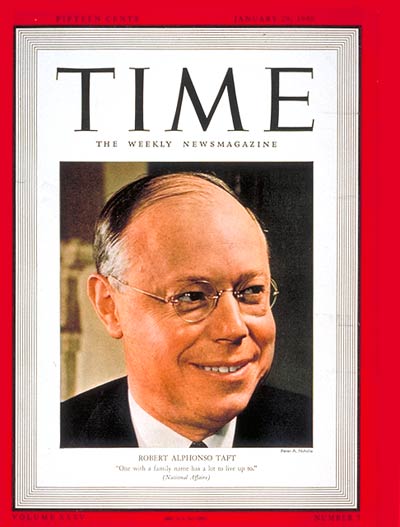
Governor John W. Bricker of Ohio, a dark horse Republican Presidential possibility, made his campaign year bow here today with the promise to do all in his power “to secure the nomination for Senator Robert Taft.” At the same time he said Ohio would sue the Federal Government for $1,338,000 of withheld Social Security funds which Congress failed to grant over President Roosevelt’s veto.
Subzero temperatures began a retreat from the South today, but left behind much suffering, more than a hundred dead and damages estimated is the millions in Florida’s citrus and vegetable growing area alone.
The Communist party of Mexico is seeking a strong “popular front” to fight “Yankee imperialism” and advocates an armed reserve to thwart the danger of a reactionary rebellion in connection with this year’s Presidential election, it was revealed tonight.
U.S. Navy light cruiser Helena (CL-50) steams from Buenos Aires, Argentina, to Montevideo, Uruguay, on her shakedown cruise (see 2 February)
The highest Japanese Army circles in Shanghai deny reports from Paris and London to the effect that the SovietJapanese border negotiations, recently held in Harbin, have broken down.
Electrically charged barbed wire barriers and Japanese sentries today retightened the blockade around the British and French concessions, creating a severe food shortage in the foreign-controlled areas. Japanese military authorities electrified the wires and imposed other measures that first went into effect last June but had been relaxed gradually to permit the passage of food supplies and some trade. Military spokesmen said the tightening this time was due to “activities of anti-Japanese elements within the concessions who increasingly were passing through the barricades to the Japanese-controlled region outside.” They denied that expiration of the Japanese-United States trade treaty was a factor. Additional sentries were posted to halt the recently thriving business of Chinese gardeners who threw vegetables and other food supplies to agents inside to evade Japanese guards at concession entrances.
Markets inside the concessions were depleted and prices rose. The poor were particularly hard hit. Imports of all food were banned regardless of the nationality of those attempting to take it through the barriers. The tightening of the blockade came shortly after British-Japanese relations were strained over Britain’s seizure of twenty-one Germans from the Japanese liner Asama Maru January 21. The Japanese began their blockade last June in an effort to force the British to meet demands for the surrender of four Chinese alleged terrorists and the granting of concessions. The Chinese were given up but the remaining points at issue never were settled. Japanese newspapers in Shanghai said an anti-British campaign probably would be started in Nanking “where there is much ill feeling against the British.”
Japanese military planes roaring low over the blockaded British and French Concessions today aggravated tension of the foreign zone. Resuming their activities after an interval of several months, the Japanese aircraft swooped only a few hundred feet above the zone, where the newly tightened Japanese blockade brought a serious shortage of food supplies. Military authorities declined to comment on the sudden aerial activity. The food import ban had been imposed after Japanese-British friction arose over the seizure of twenty-one German seamen from a Japanese liner thirty-five miles off Yokohama. Chinese-language newspapers controlled by the Japanese Army meanwhile launched attacks on the United States over its abrogation of the trade treaty with Japan.
One paper declared the action had resulted from “American envy of Japan’s growing intimacy with China” and it declared of the Open Door policy that there was “no greater insult imaginable, showing clearly the lack of respect for China’s sovereignty and the common policy of all white men to keep China an economic colony forever and the Chinese international slaves.” The blockade continued to create incidents at the barricade entrances, where sentries prevented all persons from taking in food. Only the barest necessities were available within the foreign areas. Housewives and servants thronged markets in an effort to buy stocks. Flour was again available, however, after the British Council had rescinded a regulation fixing the price at a level that holders had refused previously to accept. Flour sellers had maintained the price was so low they could not replace their stocks.
Lieutenant General Masaharu Homma, Japanese commander at Tientsin, today again warned Americans that it was necessary to improve relations between Japan and the United States. “If all our efforts to improve relations with America fail,” he said, “the Japanese will see no further reasons to extend special privileges to American citizens.” General Homma was discussing the possible connection between expiration of the trade treaty with the United States and the abrupt tightening of barrier restrictions at Tientsin’s British Concession. He said: “Consider the sacrifices that Japan has made in the present incident [the war in China]. If you were in our shoes, would you go so far as to nullify all that has been accomplished because another country pressed you to do so?”
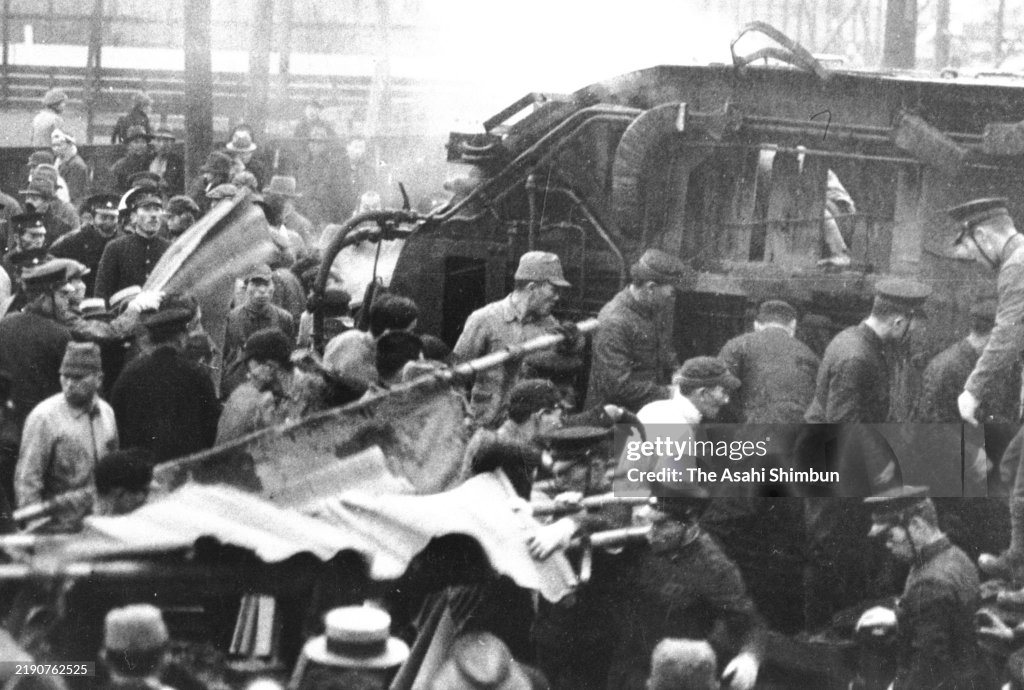
A train derailment and fire at Ajikawaguchi Station in Osaka, Japan killed almost 200 people. Two hundred persons were reported today to have been burned to death and 100 injured in a train wreck at Osaka. Domei, Japanese news agency, said that an early check indicated that about 180 persons were trapped inside the cars when the train was derailed 250 miles southwest of Tokyo, and that twenty-one others died before reaching a hospital. Domei said that all who were trapped were killed. [The final official death toll was 181, with 92 injured.]
Australian Championships men’s Tennis: Australian Adrian Quist beats countryman Jack Crawford 6-3, 6-1, 6-2 for his 2nd Australian title.
Australian Championships Women’s Tennis: Nancye Wynne Bolton wins her 2nd Australian singles titles; beats Thelma Coyne 5-7, 6-4, 6-0.
Dow Jones Industrial Average: 146.26 (-0.25)
Born:
Katharine Ross, actress (“The Graduate”, “Butch Cassidy and the Sundance Kid”), in Los Angeles, California.
Fred Hansen, American pole vaulter (Olympics, gold medal, 1964), in Cuero, Texas.
Kunimitsu Takahashi, Japanese motorcycle racer (1st Japanese rider to win GP race 1961) and auto racer (4 x All-Japan Sports Prototype C’ship), in Tokyo, Japan (d. 2022).
Justino Díaz, Puerto Rican opera singer, in San Juan, Puerto Rico.
Died:
Edward Harkness, 66, American philanthropist (America’s 6th richest person in 1918).
Naval Construction:
The Royal Navy “T”-class (First Group) submarine HMS Talisman (N 78) is launched by the Cammell Laird Shipyard (Birkenhead, U.K.).
The Royal Navy Hunt-class (Type I) escort destroyer HMS Berkeley (L 17) is launched by the Cammell Laird Shipyard (Birkenhead, U.K.).

 History Diaries