
The Soviet Union opened a 35-nation conference on reducing the risk of war in Europe by proposing a treaty committing East and West not to be the first to use military force, either nuclear or conventional. Soviet delegate Oleg A. Grinevsky told the Stockholm conference that while the treaty would oblige North Atlantic Treaty Organization and Warsaw Pact nations not to be the first to use force, and to consult at any risk of war, it would not limit the “inalienable right” of defense. Western delegates reacted coolly to the idea, saying Moscow had made similar proposals before. The United States and Canada and all European nations except Albania are attending the conference.
President Reagan attends a National Security Council meeting to discuss the Soviet violations of the SALT II treaty.
The Government today demanded the death penalty for the key defendant in the trial of four state security men accused of having slain a pro-Solidarity priest. In a three-hour summation, the prosecutor, Leszek Pietrasinski, also asked 25-year prison terms for the three others. But, as the courtroom hushed in apparent shock, the prosecutor linked the victim’s attitudes to those of his killers. He castigated the slain priest, the Rev. Jerzy Popiełuszko, for having “taken extreme positions that gave rise to no less an extremism culminating in the crime.”
Britain announced that it is willing to participate in the proposed U.S. manned space station, and it urged other European countries to join in the $10-billion project. President Reagan last year invited European participation in a space station in 1992. West Germany has said it will contribute $875 million. Britain’s information technology minister, Geoffrey Pattie, said he will urge participation in the venture during a two-day meeting of the 11-nation European Space Agency starting today in Rome.
Oxford University refuses to award Prime Minister Margaret Thatcher an honorary degree. Oxford University refused to grant Prime Minister Margaret Thatcher an honorary degree today because her Government has cut funds for education and research. The 738-to-319 vote by the Congregation, Oxford’s parliament of professors, tutors, fellows and administrators, makes Mrs. Thatcher the first Oxford-educated Prime Minister in postwar years to be refused an honorary degree. Mrs. Thatcher’s office said she was honored that the university where she once studied chemistry had considered her for the degree in civil law, but “if they don’t wish to confer the honor, she is the last person to wish to receive it.”
The Austrian Defense Minister publicly apologized today for having met with an Austrian Nazi war criminal who was released from an Italian prison last week. The Defense Minister, Friedhelm Frischenschlager, who is a member of the right-wing Freedom Party, met with the man, Walter Reder, a former major in the SS, in Graz, where Mr. Reder was flown after being freed by the Italians on Thursday. Mr. Reder was convicted in 1951 of responsibility in the deaths of 600 people in the mouintain village of Marzabotto, near Bologna, in September 1944.
Israeli convoys, sometimes 30 and 40 vehicles long, have been rumbling through the closed-off streets of Sidon, Lebanon, for days. The tension in the port has been high as the residents fearfully await the departure of the Israeli Army, which is to be completed by February 18. The trucks carry the paraphernalia of occupation: steel cots, prefabricated sheds, even the huge concrete blocks set in the roads to stop suicide car-bombers. The convoys are closely guarded by tanks and by jittery foot soldiers happy to be leaving. It is the first of three steps of what Israel has said will be the ending of its occupation of southern Lebanon.
Defense Minister Yitzhak Rabin said today that massacres might occur next month in southern Lebanon after Israel completes its withdrawal of troops from the area around the city of Sidon. Expressing concern over the possibility that with Israeli troops gone from the area, civil strife among the Druse, Palestinians, and Shiite and Sunni Moslems may resume, Mr. Rabin blamed the Syrian and Lebanese Governments for failing to negotiate an accord with Israel allowing the United Nations forces to replace the Israelis and maintain security. “We would like to prevent havoc and massacres in the area that will be vacated by us,” he said in an interview. “We have warned the Lebanese Government and the United Nations: ‘Don’t blame us if there will be massacres as the result of our evacuation.’ “
Israel and Egypt said that after three days of talks, they have narrowed their differences but have failed to end their territorial dispute over a small strip of beach claimed by both countries. Taba, a four-acre strip of land in the Sinai Peninsula, is now the site of an Israeli resort. The talks attempted to decide on interim security arrangements pending settlement of the larger issue of sovereignty, but there was no accord on a role for the multinational peacekeeping force that is stationed elsewhere in the Sinai. The communique emphasized that the talks were conducted in a “constructive and friendly spirit” and added that the two sides would meet again for further negotiations on the Taba issue, but they set no date.
Libya has decided to free four Britons held since last May, the British Foreign Office said, quoting Italian diplomats in Tripoli, the Libyan capital. The release of the four men is expected in two or three days, said a spokesman for the Italian government, which represents British interests in Libya. The four were arrested after Britain broke relations with Libya over violence at the Libyan Embassy in London, in which a gunIman within the embassy shot and killed a British policewoman.
Iraqi gunners scored “direct and effective hits” on “defeated” Iranian soldiers today along a 120-mile stretch of desert separating the two warring countries, according to an Iraqi war communique. It said Iraqi forces also shelled Iranian “positions and forces” in other sectors of the front line, killing eight Iranian soldiers. The daily communique reports on combat action in the 52- month-old Iran-Iraq war. The fighting came a day after Iraq announced that 40,000 soldiers of its armed forces, supported by air and artillery cover, launched its first attack in 31 months and “occupied enemy positions.” In other fighting today, Iran shelled suburbs of the Iraqi provincial capital of Basra, the communique said.
Iran, Turkey and Pakistan have revived the moribund Regional Cooperation for Development pact, Tehran radio said. The organization has been inactive since Iran suspended its membership after its revolution six years ago. At the time, Iran denounced the pactconsidered to be the non-military arm of the defunct Central Treaty Organization-as an imperialist body. The broadcast said the three countries will rename their alliance the Economic Cooperation Organization.
Iranian authorities executed 29 convicted drug dealers in Teheran and in Meshed, the semi-official newspaper Kayhan of Teheran said Monday. A total of 258 people in Iran have been put to death for drug offenses since February 1984.
The leak of methyl isocyanate at the Union Carbide pesticide plant in Bhopal, India, on December 3 was discussed publicly for the first time by a dozen workers and supervisors who were at the plant before and after the worst industrial accident in history, which killed at least 2,000 people and disabled 200,000. None of the workers said they knew that methyl isocyanate, which is more toxic than cyanide, could kill many people quickly.
Prime Minister Rajiv Gandhi’s Congress Party won a parliamentary seat in Bhopal, where more than 2,000 people were killed last month by a gas leak, but it lost three out of four other elections, according to results released today. Balloting was held in five parliamentary constituencies on Monday. The elections were originally scheduled for December, as part of nationwide voting, but were postponed in Bhopal because of the gas leak and in the other four districts because of the death of candidates.
Secretary General Javier Perez de Cuellar held another round of talks with Vietnam’s Foreign Minister today that were believed to have centered on Cambodia and other problems in Southeast Asia. United Nations officials described the conversations between Mr. Perez de Cuellar and Foreign Minister Nguyễn Cơ Thạch as “frank and useful,” and there were indications that the two men had had some blunt exchanges concerning the Cambodian situation. This afternoon, Mr. Perez de Cuellar also met with Prime Minister Phạm Văn Đồng at Vietnam’s Presidential Palace. The Secretary General told him that the encounter was a “very important opportunity for an evaluation of so many problems.” Mr. Perez de Cuellar, aides suggested, has been delivering messages to the Vietnamese from the Thai Government.
State Department officials have urged Kim Dae Jung, the South Korean opposition leader, to accept a confidential guarantee from the Seoul Government that he would not be arrested if he delayed until May his return from exile in this country, Reagan Administration officials and associates of Mr. Kim said today. But Mr. Kim said in an interview that it was too late for him to change his plans. He is scheduled to leave here on February 6 and fly to South Korea, stopping overnight in Tokyo. An entourage of some 20 Americans is accompanying him to insure that he is not assassinated as was Benigno S. Aquino Jr., the Philippine opposition leader who was murdered when he returned to Manila in 1983. Mr. Kim said he did not know whether he would be arrested upon his arrival in Seoul on February 8, as did State Department officials. The South Korean Government also has been unclear on what it would do if he returns next week as he plans. Seeking a delay in his arrival, the South Koreans sent Mr. Kim an offer not to arrest him if he waited until May to return, Administration officials and friends of Mr. Kim said.
A high-ranking Administration spokesman on Latin America engaged in a sharp debate today with Congressional critics over covert United States aid to rebels fighting the Government of Nicaragua. Langhorne A. Motley, the Assistant Secretary of State for Inter-American Affairs, told a House hearing that it would be a “serious mistake” for Congress to continue its ban on aid to the rebels, known as “contras.” Without the pressure of armed rebellion, Mr. Motley argued, the Sandinistas would “have no reason to compromise” in any negotiations over Nicaragua’s foreign or domestic policies.
Pope John Paul II issued a ringing defense of the rights of workers today, warning that the individual must not become “the slave of the machine.” The Pope, speaking to a crowd of up to 200,000 in the industrial city of Ciudad Guayana, Venezuela, before traveling here, also asserted the “priority of labor over capital.” His listeners, gathered in a dusty red clay field in searing 95-degree heat, included thousands of industrial workers.
The Reagan Administration plans to ask Congress to double military aid to Peru next year, which would make that country the largest recipient of United States military aid in South America, State Department officials said today. With the increased aid, an Administation official said, “we want to encourage the Peruvians to be in a position to fight their own, significant internal difficultiess.” While struggling with crushing economic problems, Peru’s democratic Government has also been battling the Shining Path guerrilla movement, which has terrorized parts of the country for several years.
An American businesswoman accused of illegally conspiring to export petroleum products from Nigeria testified in Lagos yesterday that she had never bought or sold oil but has made commissions by linking buyers and sellers, according to accounts of the trial reaching the United States. The businesswoman, Marie L. McBroom, a 59-year-old commodities trader from Jersey City, pleaded not guilty to charges that she had tried to export 1.4 million barrels of oil and a large amount of gasoline without a Government license, a capital offense. The trial before a military tribunal was postponed until February 7. Mrs. McBroom asserted that she had been duped into thinking that the commodities dealers she worked with had proper Government licenses. The prosecution has charged that Mrs. McBroom conspired with three Nigerians. The purported co-conspirators have not been arrested and have testified for the prosecution.
Declaring that U.S. companies have played an “important, positive role in encouraging change away from apartheid,” the State Department expressed renewed opposition to proposals that would require U.S. firms to pull out of South Africa. Department spokesman Bernard Kalb, reporting that American companies have spent more than $100 million on projects outside the workplace designed to assist South African blacks, said, “This type of activity needs to be encouraged, not punished.” During a recent visit to South Africa, Senator Edward M. Kennedy (D-Massachusetts) recommended corporate disinvestment there.
A smaller military budget than the Pentagon has proposed must be accepted by Defense Secretary Caspar W. Weinberger, according to the chairman of the Senate Appropriations Committee, Mark O. Hatfield. Senator Hatfield, an Oregon Republican, said he would seek a freeze in the military budget next year. The chairman of the Senate Appropriations Committee asserted today that Defense Secretary Caspar W. Weinberger “cannot be a draft dodger” and must accept a Pentagon budget smaller than he requested. The committee chairman, Senator Mark O. Hatfield, said he would strive to freeze next year’s military spending at this year’s level. That statement, and his comment about Mr. Weinberger, appeared to deepen the rift between Senate Republicans and the White House over a legislative package to reduce the deficit for the fiscal year 1986, which starts October 1. Senator Hatfield, an Oregon Republican, said that without a freeze in the military budget, a tax increase would be inevitable. He also said he thought the Senate would approve a freeze.
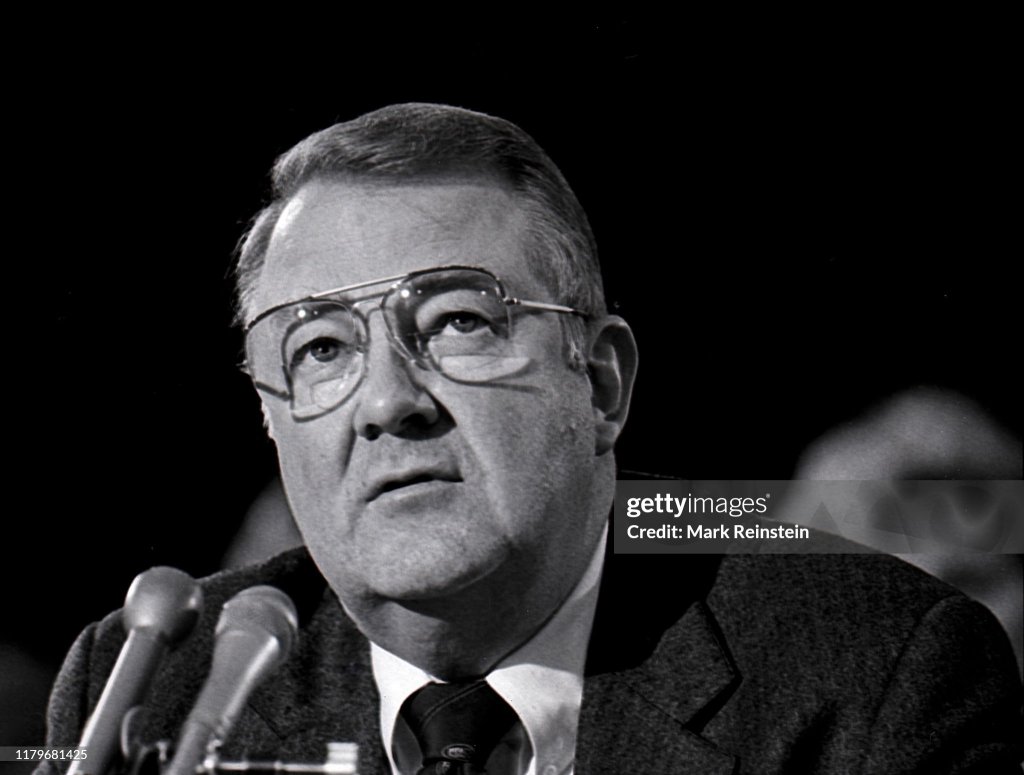
Edwin Meese 3d, testifying at a hearing on his nomination to be Attorney General, said he had met “ethical as well as legal” standards of conduct for public officials. But he said he would do some things differently in the future to avoid creating “the appearance of impropriety.”
The President and the First Lady host a dinner for Freshmen Members of Congress.
A White House security breach occurred on January 20 when an unarmed man wandered one floor below President Reagan’s living quarters and escaped detection for 15 minutes. Mr. Reagan was at a church service when the man, Robert Latta, of Denver, slipped into the White House with 33 members of the United States Marine Band. Mr. Latta, a 45-year-old water meter reader, said he had meant no harm and “just wanted to see how far I could get.”
The Defense Department confirmed today the space shuttle Discovery was brought home a day early after completing its secret military mission because of bad weather expected at the landing site at Cape Canaveral. Michael Burch, a Pentagon spokesman, said the mission was cut short when forecasters predicted unfavorable weather Monday at the landing site.
President Reagan, seeking to clear the way for confirmation of his nominee for Secretary of Education, assured a Senate panel today that he would not ask Congress to abolish the Education Department “at this time.” Mr. Reagan, in a letter to Senator Orrin G. Hatch, Republican of Utah, who is chairman of the Senate Labor and Human Resources Committee, said he still believed that abolishing the department would be best. But he said: “That proposal has received very little support in the Congress. I have no intention of recommending abolition of the department to the Congress at this time.”
Numerical quotas are “dead” as a device for remedying the effects of discrimination, according to the United States Commission on Civil Rights. President Reagan, meeting today for the first time with his top appointees to the United States Commission on Civil Rights, was told that numerical quotas were “a dead issue” as a device for remedying the effects of discrimination. The assessment was offered at a White House meeting in which the President, who has appointed four of the commission’s eight members, received assurances that his attempt to redirect the focus of the independent, bipartisan panel had succeeded. The commission chairman, Clarence M. Pendleton Jr., said later that Mr. Reagan was “encouraged” by the panel’s new direction.
A 30-million-acre land transfer in the West is planned by two Federal agencies to improve management efficiency and eliminate overlapping functions. Forest lands managed by the Interior Department’s Bureau of Land Management would be transferred to the Agriculture Department’s Forest Service. In return, the Interior Department would receive range land now managed by the Forest Service.
The U.S. Supreme Court refused to halt the execution of James David Raulerson, set for this morning, but a second condemned killer got an indefinite reprieve from Florida’s electric chair. By a 6–2 vote, the nation’s high court denied Raulerson, 33, a stay of execution for the 1975 killing of a Jacksonville policeman. Larry Joe Johnson, who murdered a Florida gas station attendant in 1979, got an indefinite stay of execution from the U.S. 11th Circuit Court of Appeals in Atlanta.
Fugitive financier Robert L. Vesco is smuggling high technology computer and communications equipment to Cuba, Nicaragua and East Bloc countries in exchange for sanctuary in Cuba, NBC News said. “In the 12 years on the run, Robert Vesco has gone from Wall Street millionaire to alleged master swindler, drug smuggler and suspected Soviet Bloc agent, now highly valued for his ability to open up new routes for the smuggling of American high technology,” the report said. It added that Cuba has given Vesco sanctuary on the island of Cayo Largo and, in return, “Vesco has gone to work for the Cubans as an agent.”
Albert Shanker, president of the American Federation of Teachers, called for creation of a tough national examination that all new teachers would have to pass, just as doctors and lawyers must pass licensing tests. Shanker, in an address at the National Press Club in Washington, said his 600,000-member union would eventually ban new teachers from membership unless they passed such an exam.
A Mexican couple who attracted the attention of authorities when they won a house in a drawing in Kansas City have lost their final round of immigration appeals and have been ordered to leave the country. The U.S. Board of Immigration Appeals last week dismissed an appeal of an August 14th ruling that Jose and Silvia Carmona leave or be deported, said Ron Sanders, district director of the U.S. Immigration and Naturalization Service in Kansas City. The Carmonas have no further recourse with the immigration service, Sanders said, but they can take the decision to court.
Five astronauts, a U.S. senator and a French spaceman will blast off next month aboard the shuttle Challenger for an action-packed four-day mission to launch two costly communications satellites, National Aeronautics and Space Administration officials said in Houston. The flight tentatively is scheduled to take off February 20. Senator Jake Garn (R-Utah), a former fighter pilot and the chairman of a space subcommittee, will be aboard as a “payload specialist.” He will conduct various weightlessness experiments on himself.
The Supreme Court refused today to halt the execution of James David Raulerson early Wednesday, but a second condemned killer got an indefinite reprieve from Florida’s electric chair. The Court denied Mr. Raulerson a stay by a 6-to-2 vote, clearing the way for his execution at the Florida State Prison near Starke for killing a Jacksonville policeman in a 1975 robbery. Larry Joe Johnson got an indefinite stay of execution from the United States Circuit Court of Appeals for the 11th District in Atlanta. Mr. Johnson’s attorneys argued that he was suffering a psychological disorder related to his service in Vietnam when he committed a robbery and murder in 1979.
Three residents of Institute, West Virginia, where Union Carbide Corp. operates a pesticide plant, filed a $3-billion federal class-action lawsuit against the company, contending that it knowingly allowed leaks of the toxic chemical methyl isocyanate. A leak of the chemical from a Carbide plant in Bhopal, India, on December 3 killed more than 2,000 persons and injured thousands of others. The Environmental Protection Agency said last week that the company had failed to report 28 leaks from the Institute plant in the last five years.
A Galaxy Airlines cargo plane carrying hazardous materials was forced to make a crash landing today, eight days after the same type of plane, also owned by Galaxy, crashed in Reno, killing 68 people and injuring three. The Lockheed L-188 Electra turboprop plane was flying from Philadelphia to Atlanta when it was diverted to Dobbins Air Force Base 25 miles away because its right landing gear failed to lower. None of the three crew members aboard were hurt. The plane had been inspected by the Federal Aviation Administration after the January 21 crash. One of the survivors of that crash in Reno, George Lamson Sr., 41 years old, died today, bringing the death toll to 69. Mr. Lamson’s son, George Jr., 17, also survived and is expected to leave the hospital Wednesday. The third survivor, Robert Miggins, 45, remained in critical condition.
An oral drug for treating herpes of the genitals was approved by the Food and Drug Administration. The approved drug, which relieves symptoms of the sexually-transmitted disease, is acyclovir. The agency previously approved use of the drug in herpes treatment as an intravenous solution administered in a hospital or as an ointment for the treatment of initial herpes infections.
A drive to save a huge blast furnace and other facilities of the United States Steel Corporation’s works in Duquesne, Pa., possibly as an employee-owned company, is gaining considerable support. An industrial consultant, Michael Locher, said the furnace and a related steel-making shop could be operated profitably provided operating costs were reduced significantly.
A fire inspector said today he expected to arrest an arsonist who set the biggest of 239 separate fires that burned through thousands of acres of dry woods in southeast Florida. Ed Jones, an inspector for the state Division of Forestry, said he had a suspect in the fire that began Saturday night and destroyed 11,000 acres of woods in the Everglades. Altogether, more than 21,000 acres burned over the weekend. Firefighters reported today that all the fires were under control.
A Vermont State Senator has announced the formation of a volunteer service corps to bring relief to the drought-stricken nations of Africa. State Senator Edgar May, a former Peace Corps administrator, said the Vermont Service Corps had been established “to train, recruit and send to Africa Vermonters to work in agriculture, health care and other technical assistance efforts.” Mr. May said the Corps would try to recruit 50 to 100 volunteers to serve overseas for three to six months at a time with relief organizations such as Save The Children. The University of Vermont will serve as the main source of volunteers, Mr. May said.
Jari Kurri of the Edmonton Oilers scores his 100th point of the season in game 39.
Dow Jones Industrial Average: 1292.62.
Born:
Marc Gasol, Spanish NBA center (NBA Champions-Raptors, 2019; NBA All-Star, 2012, 2015, 2017; NBA Defensive Player of the Year, 2013; Memphis Grizzlies, Toronto Raptors, Los Angeles Lakers), in Barcelona, Spain.
Denis Tolpeko, Russian NHL centre and right wing (Philadelphia Flyers), in Moscow, Russian SFSR, Soviet Union.
Rag’n’Bone Man [Rory Charles Graham], English singer-songwriter (Human), in Uckfield, England, United Kingdom.
Isabel Lucas, Australian actress (“Home and Away”), in Melbourne, Victoria, Australia.







 History Diaries