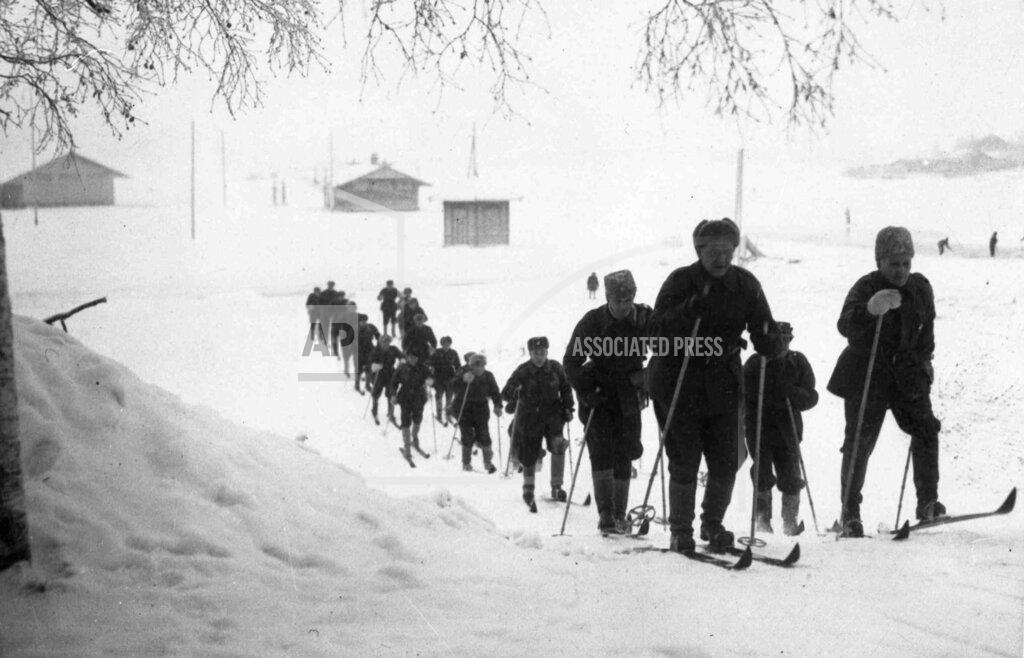
The Finnish 9th Division attacks the Soviet 54th Division near Kuhmo and succeeds in splitting the Soviet force into three separate groups. The Finns are not able to press their attacks home. They are further distracted by relief attempts by the Soviet 23rd Division.
Finnish troops eliminated Soviet forces encircled in the Pieni-Kelivaara pocket on the north shore of Lake Ladoga. On the North shore of Lake Lagoda, Finns destroy the Pieni-Kelivaara motti in one day, capturing 2 field guns, 2 antitank guns, 9 mortars, 9 machineguns and 100 rifles. Dug in Soviet troops in the nearby West Lemetti motti resist a similar attack, leading to new tactics to gradually reduce mottis.
Soviet shelling of Finnish defensive positions on the Karelian Isthmus continues, with increasing intensity. Fort Poppius and Millionaire Fort in the Lähde sector near Summa have been badly damaged by the bombardment, leading to defensive weakness in the Mannerheim Line.
At Lahde on 28 January 1940, the artillery of the 24th Corps Artillery Regiment, having destroyed the “Millionaire bunker” on the 27th, switches targets. The next most-prominent bunker is the “Poppius bunker.” While not as elaborate as the other one, the Poppius bunker lies in the middle of the Finnish defenses of the Mannerheim Line and is/now was an anchor of the defense. The Soviets’ two 152 mm guns open fire at 12:00, and they quickly destroy the bunker’s western casemate, killing four men inside. The two bunkers remain usable, but their defensibility is impaired.
Nearby at Summa, the 7,000 shells/day artillery barrage continues, with an increase in tempo.
At Salla, small advance Soviet forces remain surrounded.
Karelian Isthmus: a reconnaissance patrol from the Finnish 1st Division has returned from a successful two-day mission along the railway line to Raivola and back along the frozen Gulf of Finland.
In Ladoga Karelia, Detachment Pajari repulses the Soviet offensive on the River Aittojoki.
During the afternoon, the Soviet troops in Vieksinki voluntarily withdraw from the village, leaving behind over 200 fallen comrades.
In the Ilomantsi sector the Soviets make several attempts to take Petkelniemi.
Major Soviet air raids are conducted on Finnish targets, particularly on the Karelian Isthmus. Soviet bombers hit a field hospital marked with a red cross in a vicarage in Johannes. The bomb kills 20 patients, two members of the women’s auxiliary defence forces and two nurses. Several others are wounded in the attack.
The enemy also bombs the coastal towns of Kotka, Loviisa, Hanko and Rauma.
29 fallen servicemen are buried in a joint service in Uurainen church.
The crew of a Blenheim bomber on a transfer flight from Tampere to Luonetjärvi are killed when the plane crashes in Siikakangas
‘Père Clément’, the renowned French general Clément Grandcourt arrives in Helsinki to enlist as a volunteer in the Finnish Army.
K.J. Ståhlberg, independent Finland’s first President, turns 75.
Italian Foreign minister Count Ciano urges the formation of a new Anti-Comintern Pact that excludes Germany. A new anti-Comintern pact grouping, omitting Germany, was suggested by Count Ciano, Italian Foreign Minister, in a recent conversation with Eiji Amau, the Japanese Ambassador, in Rome, according to a dispatch from Budapest to the newspaper Asahi. The Amau-Ciano conversation preceded Mr. Amau’s departure for Budapest to attend the con-ference the Japanese Ambassadors to Eastern Europe and Southern Europe are holding in the Hungarian capital. Mr. Amau was said to have told Count Ciano that in Japan’s view the German-Soviet rapprochement had destroyed the meaning of the original anti-Communist agreements. Count Ciano replied, according to Asahi, that a new group of anti-Comintern pact powers might be formed.
It was not disclosed whether the Japanese diplomats in Budapest sent recommendations to Tokyo regarding Count Clano’s reported suggestion. Informed circles in Tokyo believe it will not appeal to Japan, which can receive little if any assistance from South European countries in the event of a Soviet-Japanese dispute. Those circles hold that when Germany made her agreement with Russia, which till then had been a potential common enemy, the anti-Comintern pact lost its meaning and that a revival among the group of minor European States who now fear Soviet aggression would merely involve Japan in European quarrels without any compensating advantage.
Details of mass shootings, manhunts by German Gestapo [Secret Police] agents, plundering and persecutions conducted with cold-blooded brutality and ferocity are contained in a memorandum published today describing what is held to be the situation of the Catholic Church and of the Polish people in the archdioceses of Gniezno and Poznan.
Germany denies Vatican charges of persecuting Polish Catholics and closing of churches.
A hint was conveyed today to the Balkan Entente conference opening here Friday, that Germany would not tolerate any departure from the neutral policy to which the Entente had adhered so far and that she likewise would oppose any efforts to create a more far-reaching Southeastern bloc.
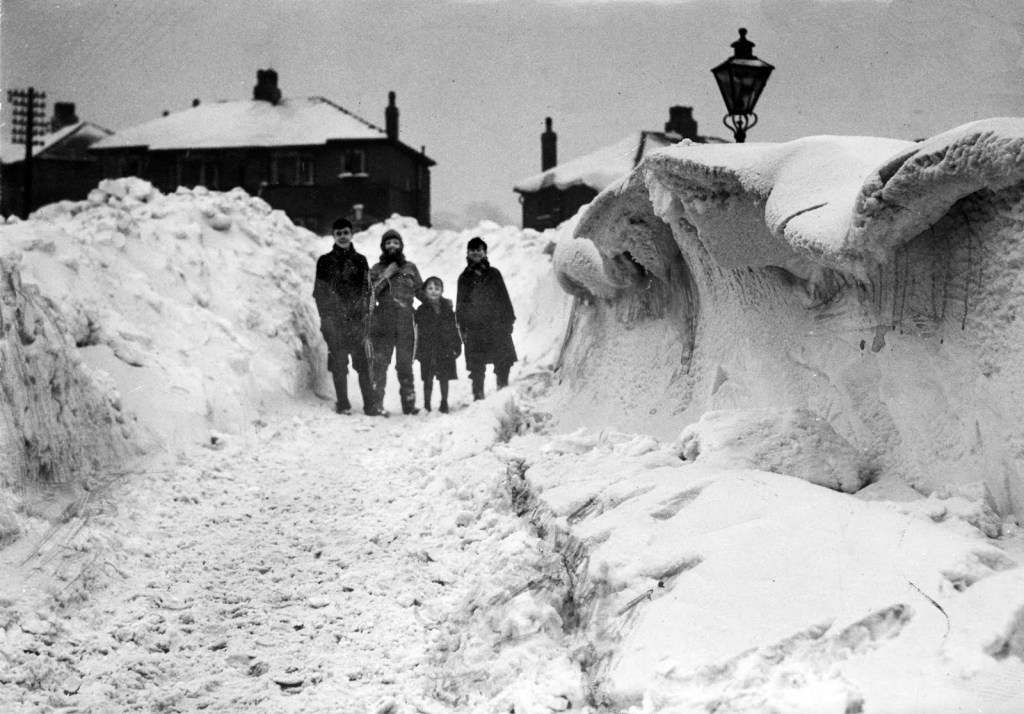
The Director of Censorship in Great Britain has been preventing publication of the details of the severe winter weather. Today, though, it allows publication. It is the coldest winter since 1894, and both the River Thames (at Kingston and between Teddington and Sunbury) and Southampton Docks have frozen over. The sea has frozen over at various points on the coast as well. London’s reservoirs have a foot of ice. At Buxton, there is 18°C (33°F) of frost. Of course, the rest of Europe is suffering, too.
The British Isles are still in the grip of a cold wave. Thousands of people were stranded throughout the country this morning. Three trains from Scotland were unreported since their departure yesterday morning. Nearly every train throughout the country was delayed from 3 to 13 hours. Hundreds of persons arriving at the London terminus had been without food for twenty-four hours. Telephone service was suspended in many sections. Roads were lined with stranded cars.
Snow and ice mantled the countryside and it was still snowing heavily in some parts of the country, including London, where the fall in the center of the city was three inches, a near record. A bad traffic jam during the morning rush hour of job-bound workers was threatened in the city. Hundreds of soldiers and civilians who had gone into the country for the week-end were unable to get back.
King George announces that his court will not be held this year due to the war.
At 0421, the unescorted Greek cargo ship Eleni Stathatou was torpedoed & sunk by U-34, commanded by Kapitänleutnant Wilhelm Rollmann, about 200 miles west of the Isles of Scilly and Cornwall, England in the Atlantic Ocean (48° 49’N, 8° 34’W). At 0252 hours the Eleni Stathatou (Master Dimitri Gratsos) was hit near the bridge by one stern torpedo from U-34 about 200 miles west of the Scilly Isles. Because the U-boat had only one torpedo left they waited nearby for the stopped vessel to sink, but after one hour the ship moved again. At 0421 hours, the last torpedo was fired that hit in the forward part and caused the ship to sink slowly. 12 of the ship’s complement died. The 5,625-ton Eleni Stathatou was carrying ballast.
The British cargo ship Eston (Master Herbert Roser Harris), a straggler from Convoy FN.81, struck a mine laid by U-22 on 20 Dec 1939 and sunk near Blyth (55° 03’N, 1° 24’W). The master and all 17 crewmembers were lost. The 1,487-ton Eston was carrying ballast and was bound for Blyth, England.
The Greek cargo ship Flora was last seen in The Downs and was reported missing thereafter. At 2000, U-44 fired one G7e from a stern torpedo tube at a southbound Greek steamer in clear weather and reported that the ship sank by the stern within nine minutes after being hit aft, about 200 miles west of Figueira da Foz at 40° 15’N, 13° 18’W. This must have been the Flora. All of the ship’s complement of 25 died. The 2,980-ton Flora was carrying coal and was bound for Rosario, Portugal.
The Norwegian cargo ship Bauta collided with the Swedish ship Mälaren in Oslofjord and sank in shallow water. There were no casualties. She was raised in 1942, repaired and returned to service in September 1943.
U.S. freighter Sarcoxic is detained temporarily at Gibraltar for several hours by British authorities; freighter Waban, bound for Italy and Greece, is also held there briefly but is allowed to proceed after one item of cargo is seized as contraband and 34 detained for investigation.
Convoy OA.81 departs Southend.
Convoy OB.81 departs Liverpool.
Convoy SL.18F departs Freetown, Sierra Leone for UK.
Convoy HXF.18 departs Halifax for Liverpool.
The War at Sea, Sunday, 28 January 1940 (naval-history.net)
Destroyer WHITSHED arrived at Plymouth on the 26th after escorting convoy SL.16 to Dover. She and destroyers ACASTA and ARDENT then left Plymouth on the 27th to escort battleship REVENGE, which was carrying £10,000,000 sterling of gold, art treasures, and some passengers, from there to Halifax. Just after midnight on the 28th, the destroyers met REVENGE off Plymouth and escorted her to 14W where they detached and were ordered to meet light cruiser AJAX arriving from the South Atlantic.
Heavy cruiser NORFOLK departed the Clyde on Northern Patrol to relieve heavy cruiser DEVONSHIRE, and arrived back at Greenock on 29 February
Anti-aircraft cruiser CALCUTTA departed the Humber, and arrived back at Immingham on the 31st.
Light cruiser COLOMBO departed Devonport for Belfast where she arrived on the 29th, and then proceeded to the Mediterranean Fleet.
Destroyers ESCAPADE and ENCOUNTER with cable ship ROYAL SCOT returned to Rosyth after once again being frustrated by bad weather.
Destroyer JACKAL departed Rosyth to relieve destroyer JAGUAR, which then sailed for Scapa Flow to relieve destroyer JAVELIN. JAGUAR arrived at Scapa on the 29th
Destroyers KEITH and WAKEFUL, patrolling at the mouth to Bristol Channel, attacked a submarine contact south of Milford Haven in 51-27.5N, 5-09.5W.
Convoy OA.81 departed Southend escorted by sloop ROCHESTER and destroyer WREN from the 28th to 30th, when the convoy dispersed.
Convoy OB.81 departed Liverpool escorted by destroyers VISCOUNT and WALKER until the 31st, when they detached to SL.17.
Convoy FS.83 departed the Tyne, escorted by destroyer VIVIEN and sloop PELICAN, and was attacked by German bombers off Cromer and later in the day off Whitby. There was no damage from either attack on the 29th, but on the 30th steamer VOREDA (7216grt) was hit in 52 59N, 01 59E by He111’s of German X Air Corps. The whole crew was saved by VIVIEN. VOREDA went ashore on Winkerton Shoal, and the wreck was sunk on 5 February. The convoy arrived at Southend on the 30th.
Note: German X Air Corps flew He111’s of KG26, Ju88’s of KG30, and two reconnaissance squadrons flying He59’s or Do17’s.
Steamer ESTON (1487grt) in convoy FN.81 was sunk off Blyth on a mine laid by U-22 on 20 December. There were no survivors.
U-34 sank Greek steamer ELENI STATHATOU (5625grt) 200 miles west of the Scillies with the loss of twelve crew.
U-44 sank Greek steamer FLORA NOMICOS (1783grt) west of Figuerra la Foz.
Convoy HXF.18 departed Halifax at 0800 escorted by Canadian destroyers HMCS SAGUENAY and HMCS SKEENA until the 29th and with ocean escort provided by armed merchant cruiser ALAUNIA, which left on 6 February. The convoy was joined in Home Waters by destroyer ANTELOPE from convoy OA.84 and sloop DEPTFORD from OB.84, and arrived at Liverpool on the 8th.
Convoy SLF.18 departed Freetown escorted by armed merchant cruiser DUNVEGAN CASTLE, joined convoy SL.18 at sea on 8 February and arrived at Liverpool on the 12th.
Light cruiser LIVERPOOL arrived at Hong Kong for repairs.
A move to sidetrack legislation to impose an embargo on exports to Japan but extend additional financial aid to China is gaining some headway in the Senate. It had its inception in apparently authentic reports that Secretary of State Cordell Hull had advised legislative leaders informally that the State Department would prefer that no embargo be imposed at this time. Mr. Hull’s reported attitude seemed to preclude the possibility of definite action on two embargo resolutions — one by Senator Key Pittman and the other by Senator Lewis B. Schwellenbach — when the Senate Foreign Relations Committee considers them this week.
The Secretary’s position was reported to be that expiration of the commercial treaty with Japan last week had put that country on notice that she must respect American rights if she was to continue trading with the United States. Mr. Hull was represented as opposing complication of this situation by Congressional consideration of a matter involving many controversial phases.
With the economy drive in the balance, the House this week faces the decision of denying parity payments to farmers in an election year or granting them in the face of no provision to meet their cost and thus bringing nearer the politically evil day when new taxes must be provided and the debt limit raised. The fight, scheduled to begin when the House Appropriations Committee reports the 1941 Agriculture Department Supply Bill next Tuesday, is certain to be one of the most spirited of the session, with each side claiming victory in advance.
The appropriations subcommittee on agriculture is reported to have lashed the Agriculture Department Pill by $75,000,000 or more, and further cuts are expected when the whole committee, under the leadership of Representative Woodrum of Virginia, gets its chance at the measure at a meeting Tuesday morning. Representative Cannon of Missouri, agriculture subcommittee chairman, was prevented from attaching unbudgeted farm parity payments to the bill in subcommittee because of a committee action earlier in the session forbidding a subcommittee to bring in a bill the amount of which was in excess of Bureau of the Budget Estimates.
District Attorney Thomas E. Dewey and his supporters decided yesterday to enter the Illinois Presidential preference primary on April 9 in hope of winning the support of that State’s fifty-eight delegates to the Republican National Convention.
Members of the executive council of the American Federation of Labor, arriving for the council’s quarterly meeting opening in Miami tomorrow, declared today that organized labor would take a “strictly independent”: attitude in the coming Presidential campaign and that no candidate would receive a “blank check” from the A. F. of L. From statements made by members of the council it appeared that a majority would not endorse President Roosevelt for a third term. They also showed opposition to the possible candidacy of Senator Burton K. Wheeler, Democrat, of Montana, toward whom John L. Lewis, president of the Congress of Industrial Organizations, is known to be friendly.
“We can’t take a chance,” said one leading member of the council. “While we like Mr. Wheeler and think well of him because of his record, we have had one administration in the White House that was partial to Mr. Lewis. We don’t want another one. Each of us is studying the situation in his own mind. I dare say none of us has come to a really final conclusion. But few of us, I think, will support Mr. Wheeler because of his apparent close association with Mr. Lewis.” Mr. Wheeler, it was believed, would not be without some support among members of the A. F. L. council, however. George M. Harrison, president of the Brotherhood of Railway Clerks, and Daniel J. Tobin, president of the International Brotherhood of Teamsters, are considered among those likely to endorse the Senator if President Roosevelt decides not to be a candidate.
While defending labor’s collective bargaining rights against the opposition of a small minority of “social illiterate” employers, the Rev. Dr. John P. Boland, New York State Labor Relations Board chairman, speaking yesterday at Fordham University also voiced strong condemnation of communistic, dictatorial and “racketeering” elements of which labor now is trying to clean its own house.
The American Federation of Labor reported today that 1,358,000 more persons were at work last December than in December, 1938, thus reducing unemployment rolls about 800,000 and providing for the 550,000 youths who were added to the country’s working population during the year.
The Rev. Charles E. Coughlin suggested today that “those who sit in the seats of the mighty” were responsible for a movement to investigate his activities, possibly “to rid the world of a troublesome priest.”
Secondary climax of some ten days of festivities in honor of President Roosevelt’s birthday, the President and Mrs. Roosevelt tonight made one of their rare joint appearances at the theatre to see a request performance of “Life With Father.”
A new musical quiz show called “Beat the Band” premiered on NBC Radio. The audience sent in riddles to the house band in which the answer was always the title of a song. Listeners earned $10 if their question was used and an additional $10 if their question stumped the band.
In NHL action, the Chicago Black Hawk’s Les Cunningham scores 5 points in one period to set an NHL record that stands until 1978; he records 2 goals & 3 assists in a 10:04 span during the 3rd period of an 8–1 win over the Montreal Canadiens.
Chinese 2nd War Area troops captured Lucheng, Shanxi Province, China.
Chinese 3rd War Area concludes its role in the winter offensive.
Japanese 26th Division attacked Wuyuan, Suiyuan Province, China.
The American Chamber of Commerce of Tientsin disclosed today that it was planning some action, presumably a new appeal to Washington, unless conditions were remedied immediately. The chamber said that the enforcement of the “blockade” and the restrictions on Americans had been intensified, and added that there had been numerous minor incidents. Details of the alleged incidents were not disclosed, but it was said that one American had been forced to submit to examination, despite his credentials, and had been allowed “reluctantly” to take a few small parcels of food inside the concession. Only Italians and anti-Soviet Russians are permitted to take food into the concession. Even Germans are blocked in their attempts to enter the area with food.
Born:
Carlos Slim, Mexican business magnate (América Móvil) once ranked as the richest person in the world, in Mexico City, Mexico.
Bill Winter, NFL linebacker (New York Giants), in Milbank, South Dakota (d. 1995).
Naval Construction:
The Вое́нно-морско́й флот СССР (ВМФ) (Soviet Navy) “M” (Malyutka)-class (3rd group, Type XII) submarine M-120 is laid down by Krasnoye Sormovo (Gorkiy, U.S.S.R) / Yard 112; completed by Marti Yard (Nikolayev, U.S.S.R.) / Yard 198.
The Royal Navy “L”-class destroyer HMS Lively (G 40) is launched by the Cammell Laird Shipyard (Birkenhead, U.K.).
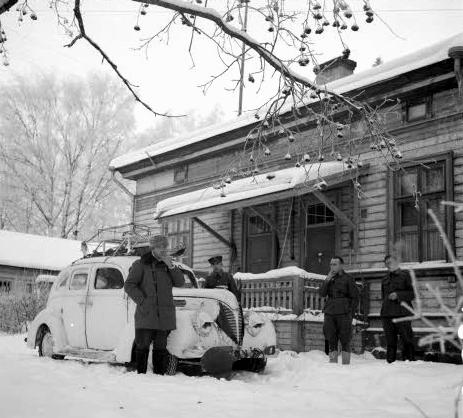
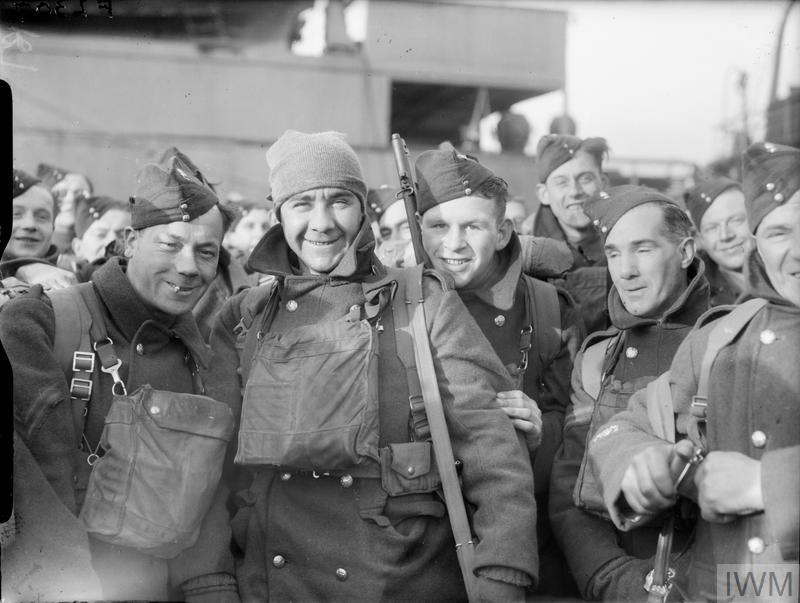
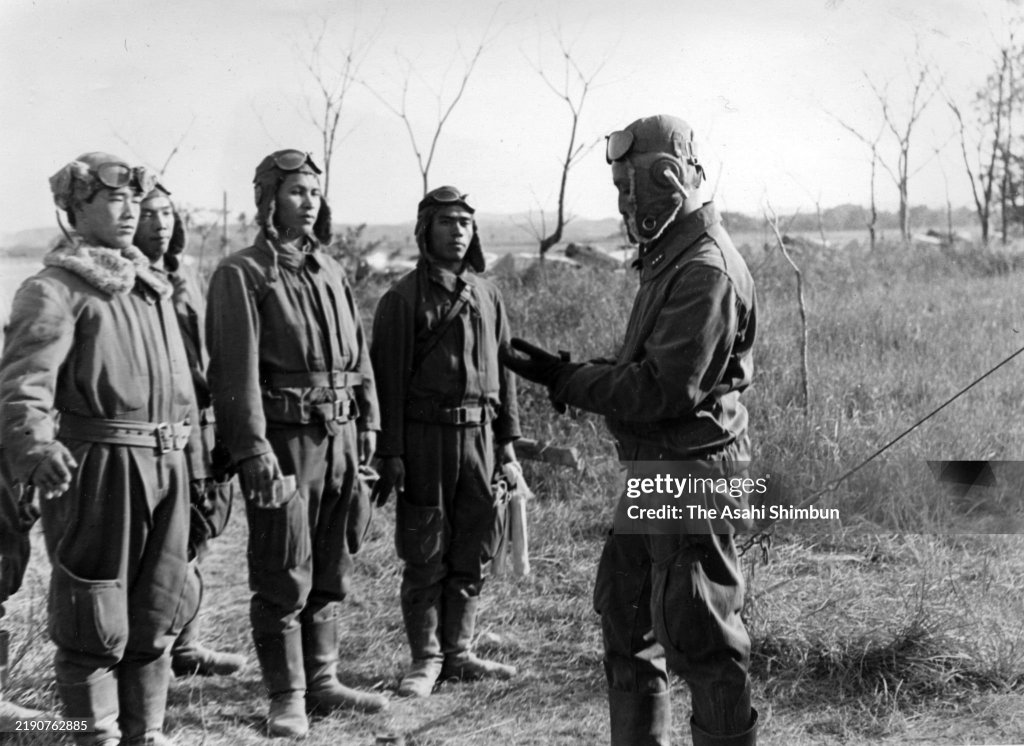
[Original Caption; I think these are airmen.]
 History Diaries