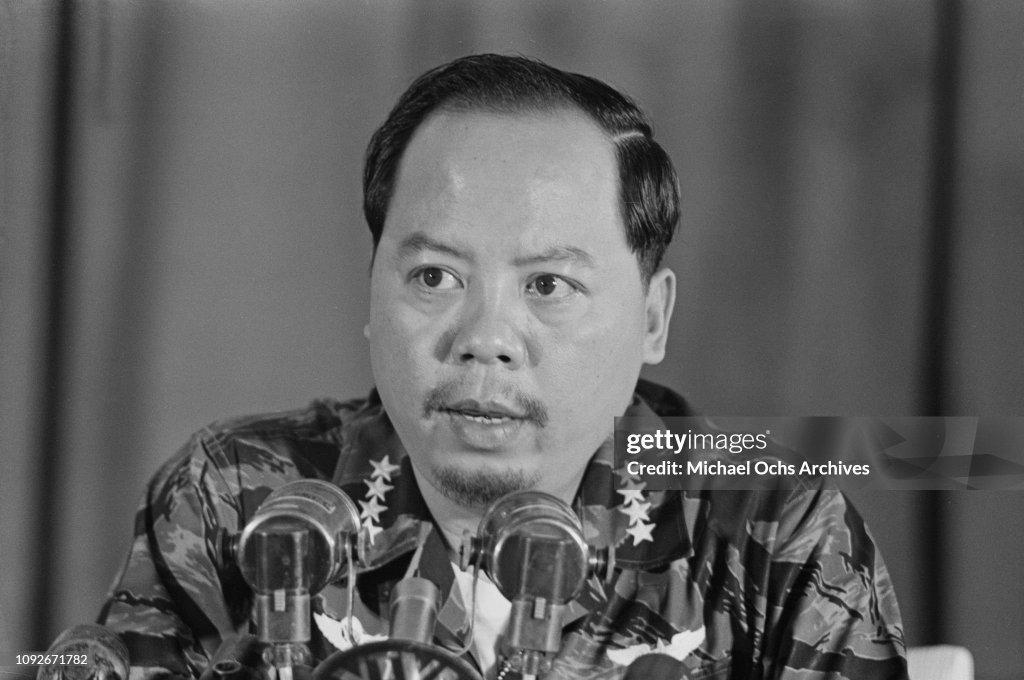
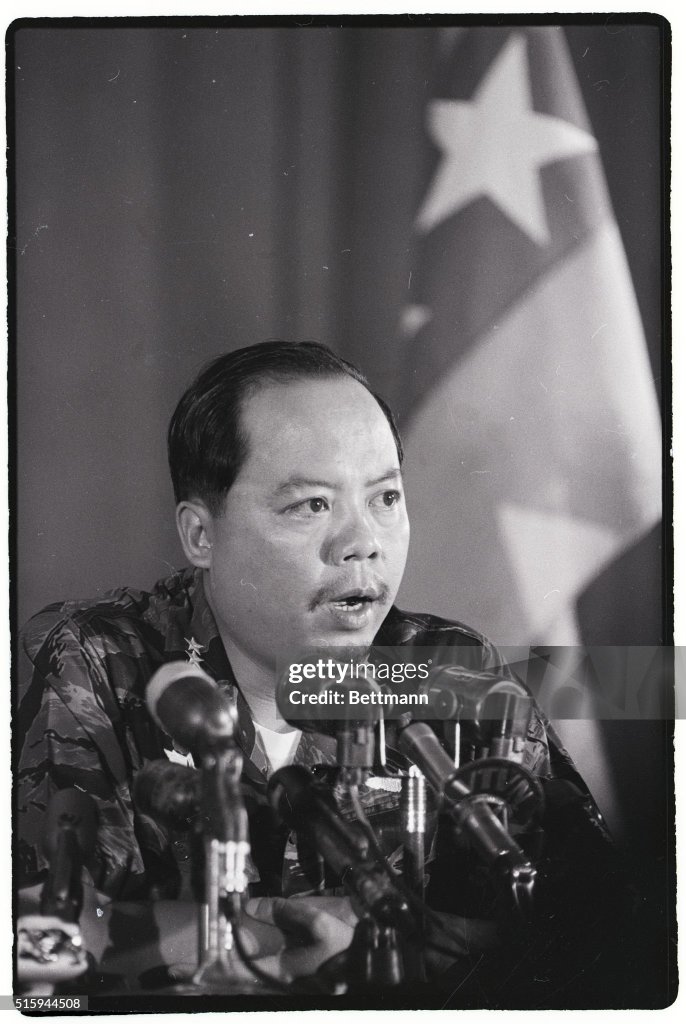
Lieutenant General Nguyễn Khánh declared today that the armed forces had assumed national sovereignty but would restrict their role to that of a mediating one in the political crisis confronting South Vietnam. General Khánh, the commander in chief, said at a news conference that two of the leaders in the Hương Government, which was toppled yesterday in an army coup d’état, would remain on, in caretaker roles until the formation of a new government. In advance of this development, the Buddhist leaders yesterday ordered their followers throughout South Vietnam to halt anti-government demonstrations and observe the military leaders actions.
Nguyễn Xuân Oánh, Harvard educated economist, was named Acting Premier. Mr. Oánh served as third Deputy Premier in the cabinet of Trần Văn Hương and was regarded mainly as a technician. Phan Khắc Sửu, chief of state, has agreed to stay on temporarily in the transition period. General Khánh said that he and his fellow generals in the Armed Forces Council, which carried out the coup, had “no ambition to take over the Government.”
General Khánh, when asked if Maxwell D. Taylor, the United States Ambassador, had approved of the military assumption of power, replied rather stiffly and dwelt on the matter of national sovereignty. “I am sure that the United States and its representatives would accept any of our actions which are in the interest of Vietnam and the United States and not of any group or individual,” General Khánh said. In an allusion to the Buddhist political agitation, General Khánh said the armed forces would “not permit dissension, whether regional or religious.”
General Khánh’s remark that the Armed Forces Council had no ambition to take over the Government seemed to be qualified somewhat by Air Vice Marshal Nguyễn Cao Kỳ, the influential Air Force commander, who was the only other military leader to attend the news conference in the Officers Club at the Joint Chiefs of Staff’s headquarters compound. Pressed after the conference as to whether General Khánh would eventually resume the Premiership, Marshal Kỳ replied. “That would depend on the attitude of the whole Armed Forces Council.”
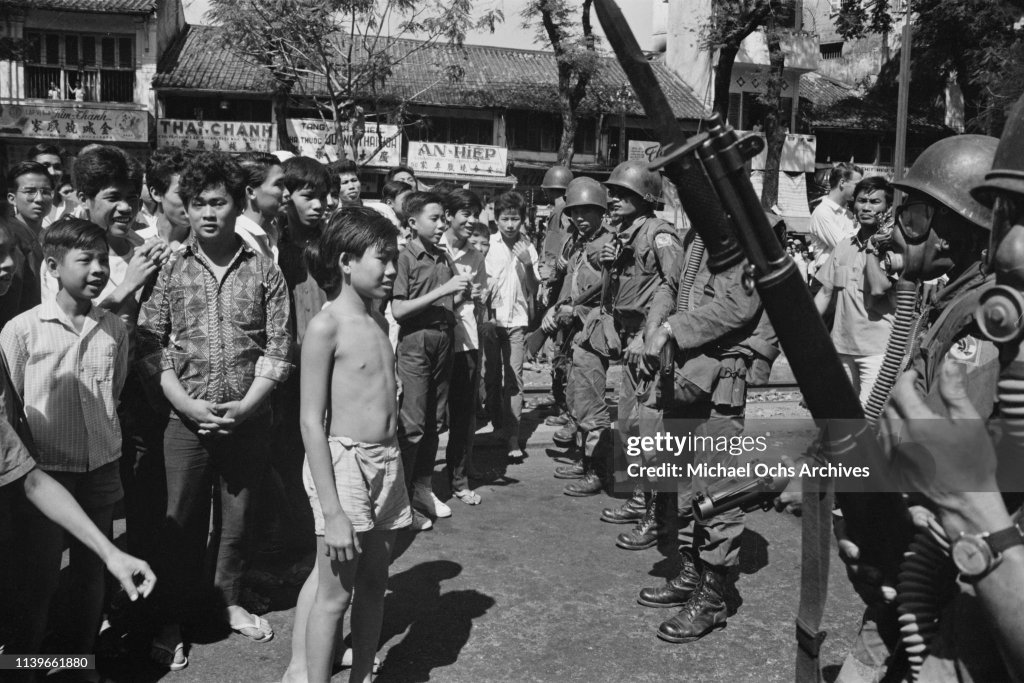
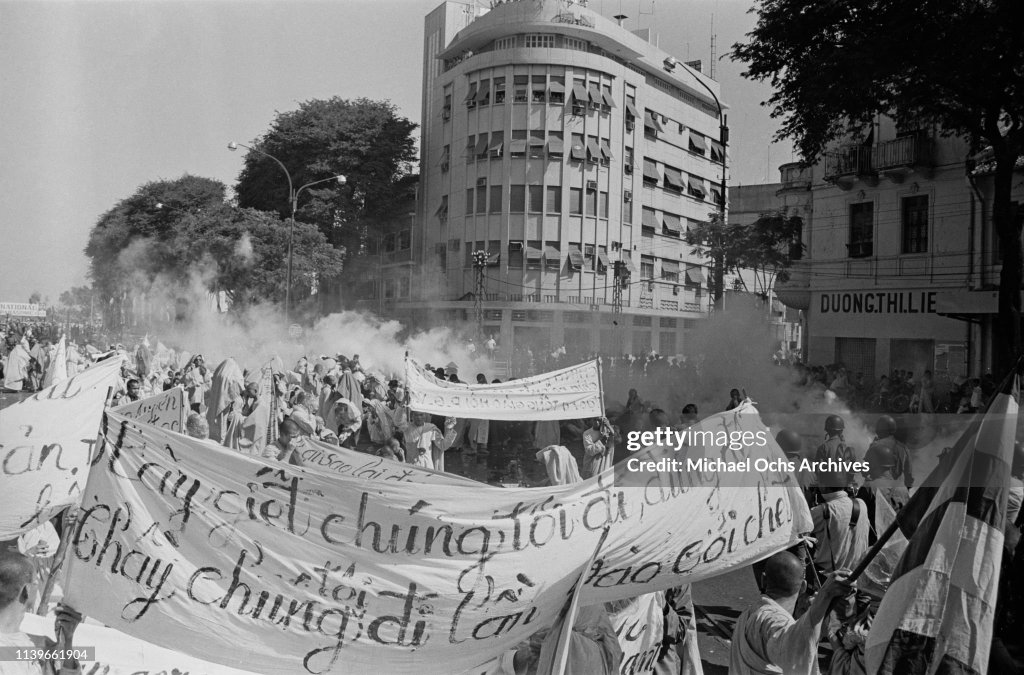
The swift coup by which General Khánh as head of the armed forces took firm control of Saigon was in effect another rebuff to United States efforts to establish a stable civilian government to press the war effort against the Việt Cộng. Premier Hương fell under the pressure of Buddhist agitation that gave the group of young generals an opportunity to reassert political influence. Although the Buddhists have called for an end of the demonstrations that disrupted principal cities over the last two weeks, the Secular Institute — the monks’ political arm — said that only their immediate objective had been satisfied. This was the overthrow of Premier Hương. In a communiqué, the monks ordered Buddhists to keep calm and orderly, to assess the situation clearly, “not to be pessimistic or optimistic as yet, and to be ready to receive orders.”
Implicit in the communiqué was a warning that the Buddhists would resort to protests again if the new Government failed to satisfy their demands for influence. Five senior monks, including Thích Trí Quang, the militant Buddhist political leader, ended their hunger strike after eight days. They had vowed a “fast unto death” to compel Premier Hương and his government to resign. Buddhist leaders were assembling for a meeting here to define their attitude toward the Armed Forces Council. Aides of Premier Hương said he would refuse to resign until he was forced out through a formal military notification that would demonstrate to the people that he had been compelled to step down.
A struggle for political power began today between Lieutenant General Nguyễn Khánh, the South Vietnamese military commander, and Thích Trí Quang, the activist Buddhist leader. An alliance between the men. who helped to overthrow Premier Trần Văn Hương Wednesday, seemed to have ended. In its place there was political maneuvering over the establishment of a new government. “The armed forces will not tolerate any dissension, whether regional or religious,” General Khánh said at a news conference when asked if he expected the Buddhists to interfere in governmental affairs.
Thích Trí Quang, asked if he thought General Khánh was a likely candidate to become premier, replied, “He is too bad a man.” The Buddhist leader insisted today that he and his followers are not anti-United States. But they were distressed, he said. at American “misunderstanding” of Vietnam’s problems. “For us Buddhists, there is no anti-American policy,” he said. Meanwhile, in Huế, a central Vietnam Buddhist center, Buddhist students after a meeting announced that they would continue to agitate against the United States to compel the recall of Ambassador Maxwell D. Taylor and force unspecified changes in the United States aid program.
In Washington, the White House declared that Ambassador Taylor would remain in Saigon with President Johnson’s full confidence. United States Embassy officials watched from the sidelines as the power struggle developed between General Khánh and Thích Trí Quang. Ambassador Taylor stood by the embassy’s declaration that the United States would not pass judgment on the changes.
In Nha Trang, where a 17 year-old Buddhist girl burned herself to death on Tuesday in protest against the government, there was a peaceful meeting at a pagoda. Letters she had written were read. In the afternoon, a funeral procession moved through the seaside resort city in Central Vietnam.
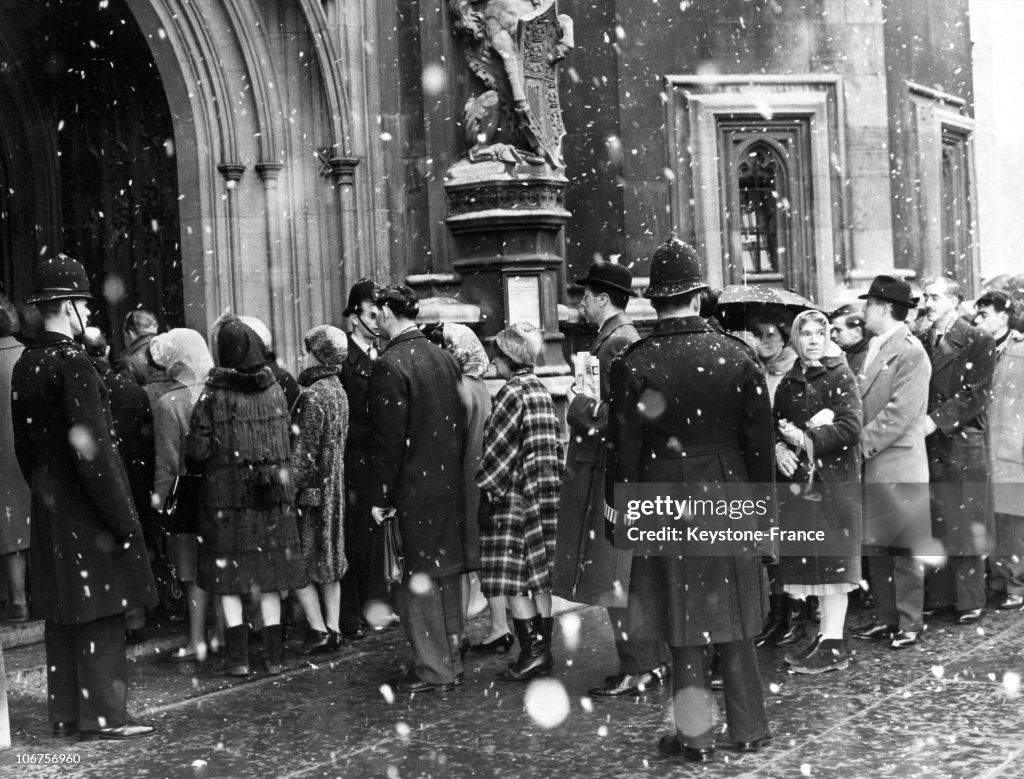
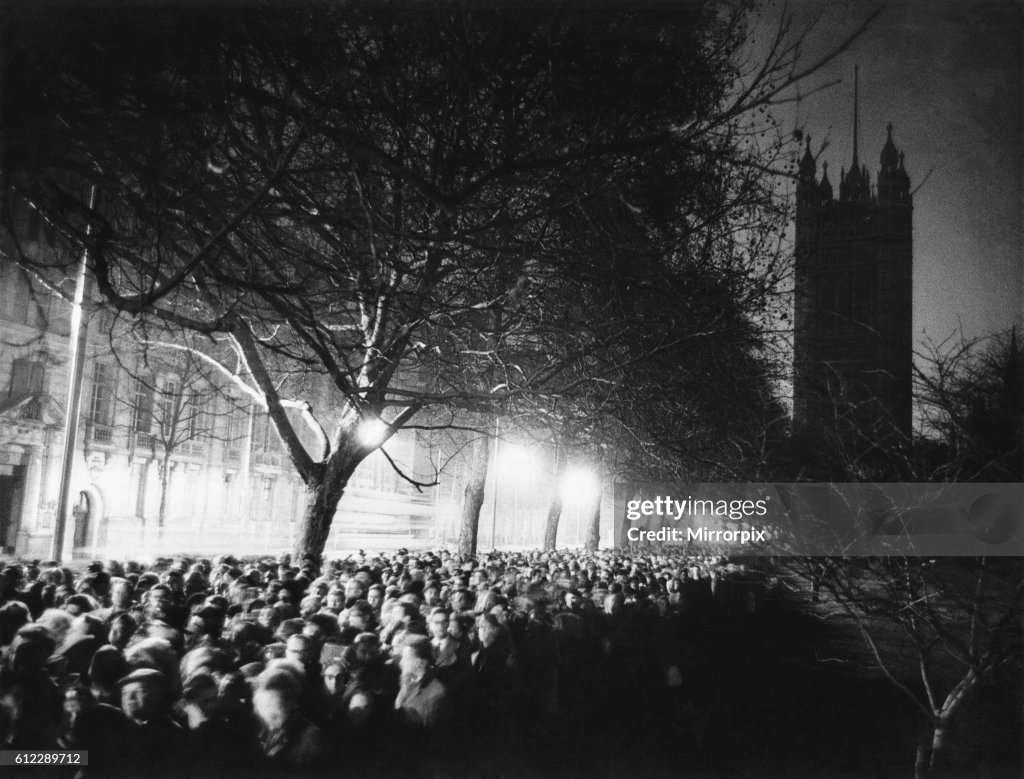
Queen Elizabeth paid an extraordinary tribute tonight to the greatest conmoner of the age. She visited Westminster Hall to walk past the bier of Sir Winston Churchill. It was something that no British sovereign in memory had done for anyone, save royalty.
As she and members of her family drove to the hall from Buckingham Palace, the long, patient line of people was still waiting to enter the ancient edifice. More than 150,000 persons had walked past the black-draped catafalque.
World leaders were gathering in London to pay their last respects to Sir Winston. Altogether 113 countries have been invited to send representatives for the funeral Saturday and 111 have accepted. The only refusal has come from Communist China, which has a chargé d’affaires in London but decided not to be represented. The Mongolian People’s Republic, whose Ambassador in Warsaw is also accredited to Britain, has not yet decided because the Ambassador is ill.
The Soviet Union warned today that its navy was carefully monitoring the movement of United States Polaris submarines and was capable of destroying them with nuclear missiles. The Soviet Navy declared it knew the regions where the Polaris submarines were stationed and kept them covered by missiles “capable of turning them into common graves for American seamen.” Admiral Sergei G. Gorshkov, commander in chief of the navy and a Deputy Defense Minister, delivered the warning in an article in the magazine Za Rubezhom (Life Abroad). A summary of the article was issued by the official press agency Tass. The admiral added that his forces would have little difficulty in spotting and destroying any surface ships that would make up the proposed mixed-manned nuclear surface fleet.
Indonesia associated herself with Communist China on a wide range of political questions in a joint statement issued in Peking today. The statement was signed by Marshal Chen Yi, the ChineseCommunist Foreign Minister. and his Indonesian counterpart. Dr. Subandrio, who has been visiting China. In return for strong Chinese hacking for her policy of “confrontation” against Malaysia. Indonesia joined Peking in attacking the United States “war of aggression in Indochina” and in renouncing the possibility of “peaceful coexistence” with the West.
The statement also said that China and Indonesia had decided to “strengthen their friendly contacts in the military field” and had concluded a credit agreement. In Jakarta the Indonesian press agency Antara reported: that Indonesia had received credits worth $100 million from Communist China for economic development. Dr. Subandrio went to Peking for the announced purpose of seeking military assistance from the Chinese Communists. The joint statement reiterated Premier Chou En-lai’s pledge that Communist China would “absolutely not sit idly by” if Britain and the United States dared to “impose war on the Indonesian people.”
The 17-nation Council of Europe Assembly urged member governments today to take immediate action to prevent war crimes from remaining unpunished. The plea was designed to exclude “crimes against humanity” from the 20-year limit after which penal proceedings may no longer be opened in most European countries. Nazi war crimes went “beyond all human measure” and normal statutory limitations should not therefore apply, the motion asserted. It was carried, 65 to 15 with one abstention. Most British members present and some Scandinavians voted against the proposal. contending that the law should not be modified to fit circumstances.
The Portuguese Government of Premier Antonio de Oliveira Salazar charged today that the Communist party was trying to infiltrate the armed forces through university groups.
An Argentine police patrol searching for derelicts and thieves in a wooded area near the Ezeiza International Airport was attacked before daybreak today by Nazi terrorists. No one was injured, and the suspects escaped. A large quantity of explosives and weapons were found which apparently were intended for a terrorist attack on Jews.
Premier Moise Tshombe of the Congo, heading a 20-man negotiating team, arrived in Brussels from Leopoldville today to straighten out his country’s financial problems with Belgium.
East Germany-West German talks on permits for West Berliners to cross the Berlin wall were interrupted today amid indications that the Communists might want to renege on an agreement providing for family visits at Easter and Whitsuntide.
The official state visit of East Germany’s President, Walter Ulbricht, to Cairo February 26 will put the United Arab Republic’s diplomatic ties with West Germany to a severe test.
Washington is speculating as to why President Johnson did not send Vice President Hubert H. Humphrey to represent him at Sir Winston Churchill’s funeral.
Rifle fire killed a guard and dynamite blasts damaged three U.S. Air Force F-84 jets in a mysterious attack on a plant in Canada. A German imigrant was arrested.
General Maxime Weygand, most famous for taking the German surrender in World War I and surrendering French armies to Hitler in World War II, is dead at 98.
The government of Syria announced that it had been decreed the right to dismiss and appoint religious leaders, effectively giving itself control over the messages being delivered by Muslim and Christian clerics to its citizens.
Queen Elizabeth II proclaimed the new Canadian flag, three months after the design by Jacques Saint-Cyr had been approved by Prime Minister Pearson. A filibuster by the Tory Party had delayed approval by Parliament.
President Johnson ended months of speculation today by naming Nicholas deB. Katzenbach as Attorney General. Mr. Katzenbach had been Acting Attorney General since last September, when Robert F. Kennedy resigned to run for the Senate from New York. The President named Ramsey Clark, the 37-year-old son of Supreme Court Justice Tom C. Clark, to succeed Mr. Katzenbach as Deputy Attorney General. Mr. Clark has been an Assistant Attorney General in charge of public lands. In recent weeks, he has spent part of his time at the White House, working on budget and Interior Department matters. He was appointed by President Kennedy in 1961. The White House also announced that W. Marvin Watson, resigning chairman of the State Democratic Executive Committee of Texas, would be a Special Assistant to the President, beginning February 1. Mr. Watson, 40 years old, will be paid $28,500 a year. He will have administrative duties, and will work on special projects with state and local officials, the White House said.
President Johnson called on Congress to approve constitutional amendments that would reform the electoral college system and resolve the problem of Presidential succession and disability. President Johnson asked Congress today to propose a constitutional amendment covering Presidential disability and the filling of a vacancy in the office of Vice President. The President endorsed an amendment on Presidential disability and Vice-Presidential succession already introduced in the Senate by Senator Birch Bayh of Indiana and in the House by Representative Emanuel Celler of Brooklyn. Mr. Bayh and Mr. Celler are both Democrats. This proposal. which passed the Senate last year but was not considered by the House, provides for both Presidential-disability procedures and for filling a vacancy in the office of the Vice-Presidency.
President Johnson’s Great Society passed its first test in the Senate, which approved a bill giving the government broad powers to control water pollution. The Senate passed today a new program for combating water pollution throughout the nation. The vote was 68 to 8. The measure thus became the first item of President Johnson’s legislative program for the 89th Congress to win floor approval in either house. A similar bill was approved by the Senate in the fall of 1963 but did not reach a final test in the House. The program’s chances in the present Congress are considered good. The program stresses prevention of pollution as well as abatement of pollution already created. It features Federal grants to assist research and improve facilities.
President Johnson told Congress today that the nation could look forward to another year of sustained and healthy economic growth.” But he conceded in his annual Economic Report that there might be little or no further reduction in the unemployment rate, mainly because a large growth in the teenage labor force was expected this year. In the last quarter of last year, 5 percent of the labor force was unemployed. Mr. Johnson said his overall budget program would “once again contribute expansionary force rather than restrictive pressure on our economy.” He estimated that his program would stimulate additional spending of more than $8 billion in the economy in the calendar year 1965. More than half this stimulus would come from higher federal spending and the rest from a reduction in tax rates to spur private spending.
President Johnson was reported to be seeking an end to the 18-day strike of East and Gulf coast longshoremen. The shipping industry in New York appealed to President Johnson yesterday to intervene in the 18-day-old dock strike that has choked off foreign trade in ports from Maine to Texas. Citing losses to the nation of $1 billion an official estimate of the Maritime Administration the New York Shipping Association said it had a firm contract with the International Longshoremen’s Association but the strike continued. At the press office in the White House last night it was said the appeal was being studied. A union official said intensive efforts were being made to bring other ports into line. and that “all we need is time.” The union is expected to send a message to the White House this morning asking the President not to act immediately. Union leaders believe that despite the setbacks a final solution to the dispute is only a few days off.
The General Motors Corporation reported yesterday the biggest annual profit ever registered by any company in the United States. The record performance by the world’s largest manufacturing enterprise in 1961 reflected both the continuing boom in the automobile industry and the sustained surge in the nation’s economy. The company’s sales were greater than the annual budgets of most nations. General Motors had a profit of $1,735,000,000, equal to $6.05 a share last year. This represented an advance of 9 percent from the giant automaker’s earnings of $1,592,000,000, or $5.56 a share, in 1963.
The Senate Rules Committee, currently engaged in probing the activities of Bobby Baker, has issued a subpoena for the appearance next Thursday of former White House aide Walter Jenkins.
House Republican leaders proposed a voluntary Medicare plan for the aged that would pay doctor, hospital and medicine bills out of general tax funds and from contributions by beneficiaries.
Black leaders in Selma, Alabama asked a federal judge today to order Sheriff James G. Clark to show cause why he should not be held in contempt for arresting persons in the Dallas County voter-registration line. The N.A.A.C.P. Legal Defense and Educational Fund, Inc., filed a motion in Federal District Court in Mobile charging that the sheriff had violated an injunction restraining him from harassing or intimidating citizens attempting to register. Fifty-six persons were arrested Tuesday in and around the line after a United States deputy marshal, H. Stanley Fountain, ruled that they were not entitled to be there under the terms of the injunction. Most of them, including John Lewis, chairman of the Student Nonviolent Coordinating Committee, were still in jail today.
The injunction, issued by Judge Daniel H. Thomas, called for a line of 100 each day the Board of Registrars is open. Black leaders, however, said there was nothing in the injunction to prevent more than 100 from standing in line to demonstrate the slow rate of registration here and in other Alabama counties. The Legal Defense and Educational Fund also asked Judge Thomas to clarify his restraining order, but he declined to do so immediately. The fund further asked the transfer of the 56 arrest cases from county to Federal court. The registration office was closed today and Blacks began marshalling their forces for next Monday, when the Rev. Dr. Martin Luther King Jr., is scheduled to return to Selma and lead renewed demonstrations. During three days of registration here this week, the board processed about 70 applications, most of them from Blacks. Applicants will be advised in about three weeks whether they passed the registration test, which includes questions on government and the Constitution.
Four judges issued orders today against a planned racial demonstration tomorrow at the County Courthouse in Jackson, Mississippi. The leaders of the planned demonstration — called to protest the slaying of a young Black prisoner by a deputy sheriff — showed reluctance to defy the injunctions, which were issued by three circuit judges and a county judge. Charles Evers, a Jackson Black leader and Mississippi field secretary of the National Association for the Advancement of Colored People, said: “An injunction’s an injunction, whether it’s right or wrong.”
But speaking at a meeting of about 500 persons tonight, he called the shooting a murder and said of the court orders: “As far as we are concerned, what they drew up is not worth the paper it’s written on.” He added, however, that N.A.A.C.P. lawyers were working through the night on the matter. He said that a decision on whether to demonstrate would not be announced until tomorrow morning. The demonstration was planned, Mr. Evers said, after Blacks had tried unsuccessfully to discuss the shooting of the youth with Hinds County Sheriff Fred Pickett, Mayor Allen Thompson of Jackson, and Governor Paul B. Johnson Jr.
“The Who” make their 1st appearance on British television programme “Ready Steady Go!”
Dow Jones Industrial Average: 900.95 (+1.43)
Born:
Curt Jarvis, NFL nose tackle and defensive end (Tampa Bay Buccaneers), in Birmingham, Alabama.
Lynda Boyd, Canadian actress (“Final Destination 2”, “On Thin Ice”), in Vancouver, British Columbia, Canada.
Died:
Maxime Weygand, 98, French Army general and former High Commissioner for Syria. On November 11, 1918, as chief of staff to Marshal Ferdinand Foch, Weygand had read the terms of the German surrender to representatives of the German Army and Navy inside a railway car at Compiègne. On June 22, 1940, General Weygand signed the French surrender to Nazi Germany at the same site.
Alfred P. “Tich” Freeman, 76, English cricket player who remains the only man to take 300 wickets in an English season.


[The tests were satisfactory and the company was confident that the hot-cycle system would be widely used, although the XV-9A was noisy and had a high fuel consumption. The company was unable to mitigate the problems and the development by Hughes of pressure-jet systems did not proceed. The Army tests were completed in August 1965 and the helicopter was returned to Hughes.]
 History Diaries