President Ford asks Congress for an additional $522 million in military aid for South Vietnam and Cambodia. President Ford reveals that North Vietnam now has 289,000 troops in South Vietnam, and tanks, heavy artillery, and anti-aircraft weapons ‘by the hundreds.’ Despite new warnings of strong Congressional opposition, President Ford asked Congress today — as his aides had said he would — to appropriate $300‐million in additional military aid for South Vietnam and $222‐million more for Cambodia. “With adequate United States material assistance, they can hold their own,” Mr. Ford said of South Vietnam and Cambodia in a special message to Congress seeking the additional funds. “We cannot turn our backs on these embattled countries.”
The request for additional aid in this fiscal year, which had been expected, was sent to Congress shortly after leaders of both houses told the President at a bipartisan meeting at the White House that it would be “extremely difficult, if not impossible” to get the votes to approve the President’s request. The assessment of the Congressional leaders’ views was relayed by Senator Robert C. Byrd of West Virginia, the Senate Democratic whip, who said that Mr. Ford and Secretary of State Kissinger had described the requested aid as “imperative.” Mr. Byrd said the Congressional leaders had been told that if additional ammunition and other aid were not provided to Saigon, “The North Vietnamese will take over little by little.” The request for additional aid came just over two years after the Paris cease‐fire accords, but Mr. Kissinger said at a news conference later today that he hoped the request would not “rekindle the entire debate on Vietnam,” because, he said, “that is emphatically not involved.”
Mr. Kissinger noted that the Administration had asked for $1.4‐billion in military aid to South Vietnam in the current fiscal year, which ends June 30, but that Congress had cut the authorization to $1‐billion and had actually appropriated only $700‐million. He said the Administration was asking Congress to appropriate the $300‐million to bring aid up to the authorized $1‐billion level because of “stepped‐up military operations” in Vietnam. Congress also had imposed a $200‐million ceiling on military aid to Cambodia.
In his message to Congress, Mr. Ford said that North Vietnam had violated “most of the major provisions” of the Paris agreements, had built up its army in South Vietnam to a strength “greater than ever,” with close to 289,000 troops, and had sent in tanks, heavy artillery and antiaircraft weapons “by the hundreds.” “Recent events have made it clear that North Vietnam is again trying to impose a solution by force,” Mr. Ford said. “Our intelligence indicates, moreover, that their campaign will intensify” further in coming months.” He said the $300‐million additional “does ‘not meet all the needs of the South Vietnamese Army” and would not allow “for replacement of equipment lost in combat.” However, he said, it is the “minimum needed to prevent serious reversals by providing the South Vietnamese with the urgent supplies required for their self‐defense against the current level of North Vietnamese attacks.”
Turning to Cambodia, Mr. Ford said that a refusal to provide more aid would “undermine the chances for peace and stability in the area.” “The Cambodian Government forces, given adequate assistance, can hold their own,” he said. “Once the insurgents realize that they cannot win by force of arms, I believe they will look to negotiations rather than war.” Discussing the needs of both South Vietnam and Cambodia, Mr. Ford said that unwillingness by the United States “to provide adequate assistance to allies fighting for their lives would seriously affect our credibility throughout the world as an ally. “And this credibility,” he said, “is essential to our national security.”
Hanoi said today that the United States must halt reconnaissance flights over North Vietnam, provide it with reconstruction aid and end “military involvement and intervention” in South Vietnam to obtain a peaceful settlement. Xuân Thủy, who was chief North Vietnamese delegate to the Paris peace talks, reiterated his government’s terms in a speech last night marking the second anniversary of the signing of the cease‐fire agreements. The speech was broadcast by Radio Hanoi. United States officials have acknowledged that reconnaissance flights have continued over North Vietnam.
China accused President Nguyễn Văn Thiệu of South Vietnam and his American backers today of continually sabotaging the Paris peace agreements.
Official North Vietnamese representatives conferred with Vatican officials today in the first sueh meeting between them, Vatican sources said.
Turkey will withdraw about 1,000 troops from Cyprus in what appears to be a token concession to U.S. congressional pressure for a Cyprus settlement. Turkish Defense Minister Ilhami Sancar said the pullout would be completed by the end of this month — five days short of a congressional deadline for severing military aid to Turkey unless there is substantial progress toward a settlement.
British officials expect to make contact with the Irish Republican Army within the next 24 hours to arrange a new cease-fire, according to a British source in Belfast. His statement followed Monday’s onslaught of terrorist bombings in Manchester and London in which 26 people were hurt. The bombings have raised fears of reprisals by Northern Ireland Protestants against Catholics, from whom the IRA draws its support. “It’s a race against the clock,” the Belfast source said.
Portugal’s Socialist and Communist parties, at odds over the extent of democratic liberties to be allowed under their coalition government, plan to hold separate rallies in Lisbon Friday, ostensibly to see which party can attract the most supporters. But in Oporto, where riots inflamed the dispute last weekend, the Communists, Socialists, and the center-left Popular Democrat Party planned a joint rally, also for Friday. Observers saw this as an indication that the rift is healing.
France adopted a 10-year energy plan aimed at cutting overall dependence on imported fuel to 55 to 60 percent of consumption. It would limit reliance on any one exporting country to 15 percent of consumption. The goal set by the National Planning Council projects a sharp cutback in the growth of consumption. France imported 76 percent of her energy supplies in 1973.
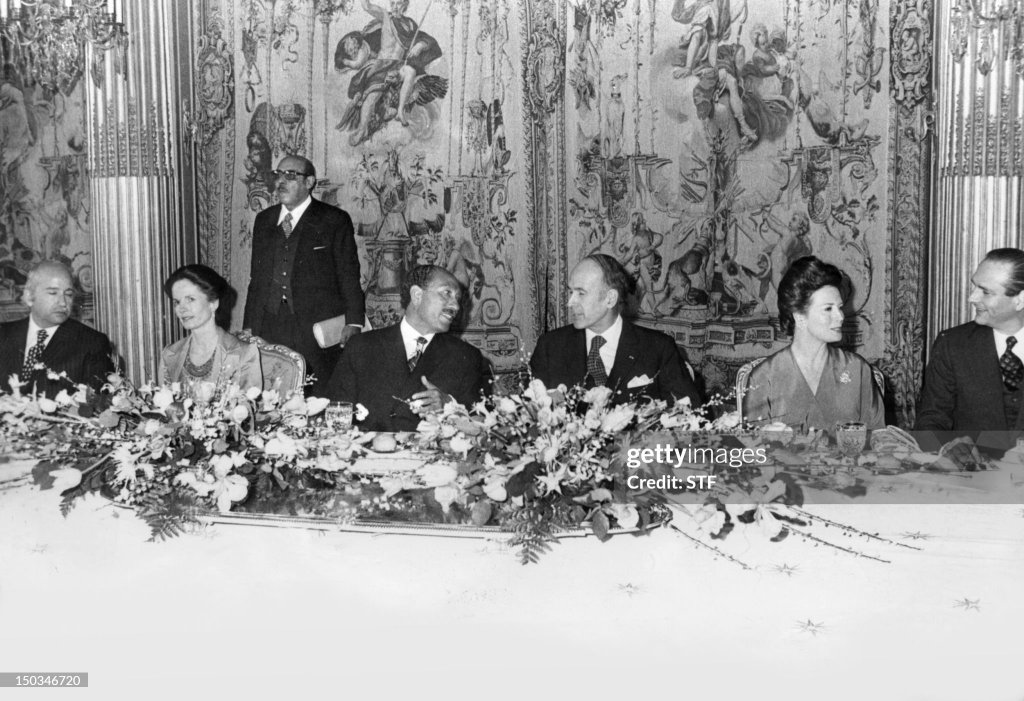
President Valery Giscard d’Estaing of France has ordered that all presidential invitations to holders of French titles of nobility be addressed simply to “Monsieur,” “Madame” or “Mademoiselle.” The only exception will be for the Count of Paris and the Prince Napoleon as heirs of the Bourbon monarchy and Napoleonic empire.
Denmark’s Prime Minister Poul Hartling, a Liberal, resigned after the Folketing (parliament) supported 86 to 85 an opposition motion calling for efforts to form a majority government. The development came in the first session of the Folketing which I was elected January 9 in national elections called by Hartling. The motion that defeated him was offered by the Social Democrats, Denmark’s largest party.
Three Seattle women identified as Irene Jacobs, 49; Kim Rene Swinehart, 25, and Linda Kim Mitleore, 27, were arrested in Vienna when they claimed suitcases containing 57 pounds of hashish. The bags were shipped from Pakistan and mistakenly unloaded in Amsterdam, where their weight made Dutch officials suspicious. The hashish was discovered and the Dutch forwarded the bags to Vienna, tipping off Austrian customs. The women denied knowledge of the hashish.
The state parliament of Serbia dismissed eight professors from the philosophy faculty of the University of Belgrade because of their opposition to the official Communist Party line. Several previous attempts by the party to remove them failed because of support for the professors from within the university, which is self-governing. The law had to be changed to give the parliament of this eastern Yugoslav province power to dismiss them.
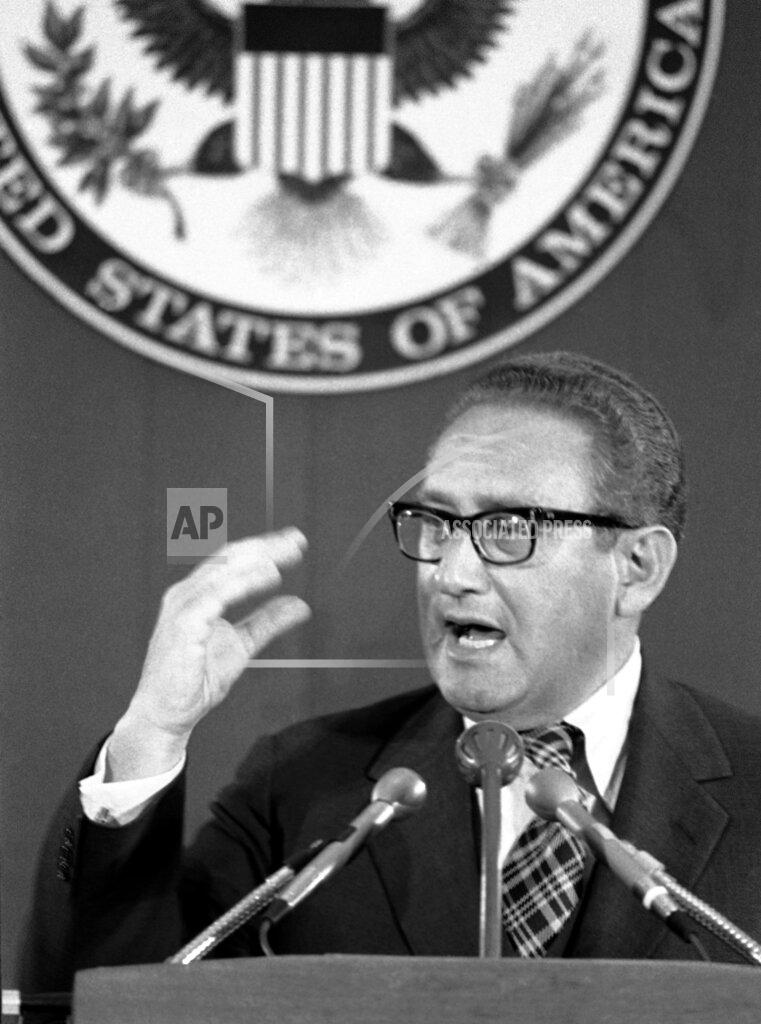
Secretary Kissinger said at a Washington news conference that he now believed a formula could be found to reconcile Israel’s desire for progress toward peace with Egypt’s insistence that additional Sinai territory be returned. But he cautioned that his next Middle East trip would be exploratory, not to settle anything or generate shuttle diplomacy. Previously Mr. Kissinger had said he would not go back until he was sure he could make progress. But today he said, “I have changed my tactic at the request of all of the parties and based on the belief that the urgency of the situation requires that this step be taken.” Diplomats and American officials said Egypt and Israel were still far apart on their terms. They said Mr. Kissinger had agreed to go back largely at Israeli insistence.
President Anwar el‐Sadat of Egypt has made the return of two key passes, Mitla and Gidi, and of captured oil fields, at Abu Rudeis, the minimum conditions for an accord. The Israelis have linked the return of occupied territory to political concessions indicating that Israel is more acceptable to the Arabs. So far, Israel has offered to pull back 30 miles from the current cease‐fire line, but has refused to yield either the strategic passes or the oilfield. The problem has been made more difficult by the taking of hard public positions. Mr. Sadat has refused to make political concessions until all occupied land is returned. Shimon Peres, the Israeli Defense Minister, repeated today Israel’s refusal to yield the passes or oilfields in this round of talks.
At the same time Senator Charles H. Percy, just back from the Middle East, said there were limits to American support for Israel and that Israeli leaders were “unrealistic” to believe that they could avoid contact with the Palestine Liberation Organization. The Illinois Republican said, “We cannot support Israel right or wrong.”
The Iranian government is planning a two-square-mile development in Tehran that is intended to make the capital a major world city. The cost is expected to be $3 to $5 billion. The senior partner in Llewelyn-Davis International, an architectural firm based in London, said the firm signed a contract to start the design. Jacquelin Robertson of New York, formerly in the Lindsay administration, will direct it.
The change‐over to a presidential form of government and the establishment of a new administration have stirred uneasiness and distrust among some Bengalis and diplomats. Although the constitutional change announced in Parliament Saturday was predictably applauded by newspapers and has roused expectations among ordinary people, independent opinion is skeptical by and large. Sheik Mujibur Rahman, who assumed absolute authority as President, said the change marked the beginning of “a second revolution” that, he promised, would result in economic self‐sufficiency, better administration and the elimination of corruption and other ills. However, his first action, the choice of a cabinet to assist him, did not reflect any change in administration or governing style. The entire old team, in power during three years of economic deterioration, is retained, with Home Minister Mansur Ali as Prime Minister.
Japan and the Soviet Union signed an agreement for a joint venture of drilling for oil on Sakhalin Island, former Japanese territory that became part of the USSR. In return for funding of the development, Japan would receive “a significant discount on half of the pumped oil” for ten years.
Typhoon Lola which swept across the Philippines over the weekend left at least 32 persons dead and more than 17,000 homeless, according to official Manila sources. Officials, still tabulating the havoc, said at least 17.769 were left homeless in four provinces.
Philippine President Ferdinand E. Marcos said today that the Muslim insurgents on Mindanao Island controlled three major towns and were staging frequent ambushes of military detachments. A battalion commander and 41 of his men were killed, he said. Marcos accused the Moro National Liberation Front, the main rebel group, of having broken a cease‐fire by staging forays in all the Muslim provinces of southern Mindanao.
Argentina’s Marxist People’s Revolutionary Army claimed its first assassination victims of 1975 when gunmen killed a senior Labor Ministry official and his bodyguard in Buenos Aires. Fortunato Canziani, a regional coordinator, and his aide died when attackers drove up behind their limousine, riddled it with bullets, and drove away.
Secretary of State Kissinger said today that Latin America’s year-long “new dialogue” with the United States was in jeopardy as a result of the postponement of a hemisphere foreign ministers’ meeting in Buenos Aires.
Senator Frank Church (D-Idaho) was elected chairman of the Senate’s newly created special committee to investigate the Central Intelligence Agency, FBI, and other intelligence agencies. He pledged, “We are going to look into all aspects of the alleged misdeeds of the CIA and FBI when the 11-member committee begins work, probably next week. In answer to a question, Church left open the possibility that former President Richard M. Nixon would be summoned to testify, although he cautioned it was still “much too early to speculate.” Church also said the panel’s first task would be to establish “very strict security measures to guard against leaks.
Representative Al Ullman, chairman of the House Ways and Means Committee, said that a special committee of top-ranking members of Congress would seek a compromise plan to reduce oil imports, avoiding a confrontation with the White House. He also introduced an antirecession bill that would give 94 percent of the individual tax relief to individuals and families with incomes under $20,000. President Ford’s proposal would give 43 percent to persons with incomes over $20,000.
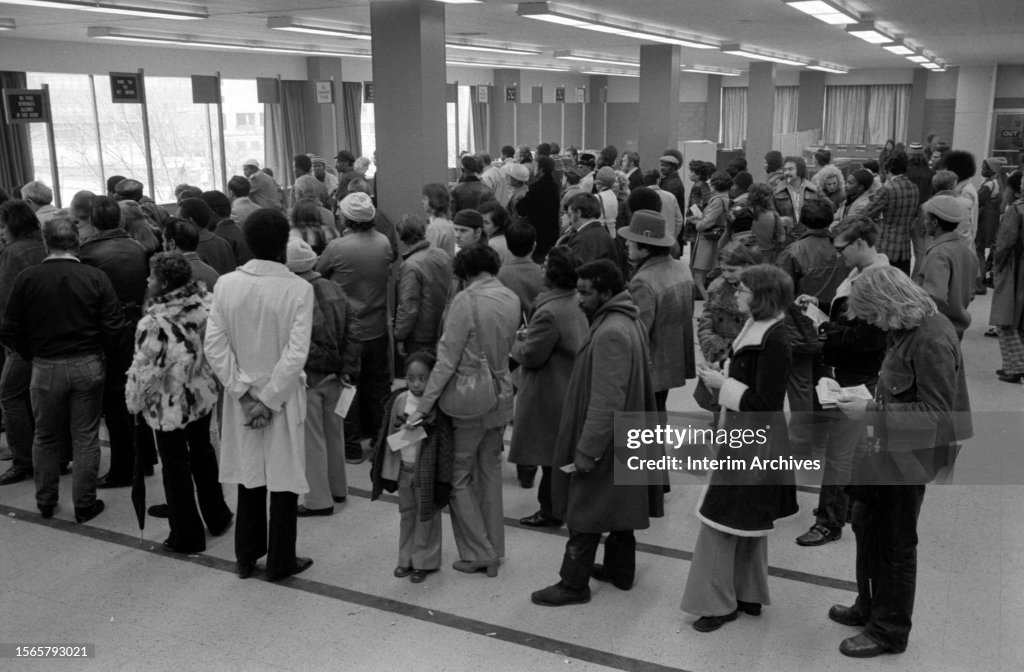
Agriculture Department figures to be released this week are expected to show that 17.1 million persons — 8 percent of the country’s population — are using its food stamps to buy their groceries. For the first time, those who earn low salaries or recently became unemployed are said to outnumber persons on welfare in the food stamp program.
The U.S. Senate took its first concrete step toward settling the disputed New Hampshire Senate seat race by referring the issue to its Rules Committee and refusing to seat either contender immediately. On a 58-34 straight party line vote, it approved a resolution by Majority Leader Mike Mansfield of Montana after sweeping aside GOP moves to seat the Republican claimant pending an investigation and to declare the seat vacant so a new election could be held. Both contestants, Republican Louis C. Wyman and Democrat John A. Durkin, were on hand to witness the vote.
The Senate Judiciary Committee completed its questioning today of Attorney General-designate Edward H. Levi and, although several witnesses remain to be heard, the committee’s speedy recommendation of his confirmation is expected.
Rep. Wilbur D. Mills (D-Arkansas), an admitted alcoholic whose escapades with a striptease dancer led to his fall from congressional power, has been released from Bethesda Naval Hospital, a spokesman said. Mills was admitted on December 3 to be treated for exhaustion. While there, Mills disclosed in a statement that he was an alcoholic but that when he left the hospital he would return to his duties.
The Justice Department disclosed in Washington that a federal grand jury in New York is investigating alleged price-fixing by major sugar refiners during 1974 when prices soared some 400 percent. The disclosure came when a spokesman for the department confirmed industry reports that the grand jury was holding sessions here. The spokesman, however, would not specify which companies were under investigation. The new investigation began late last year. Subpoenas are reported to have been served in the last few days on the Amstar Corporation, the Sucrest Corporation, Savannah Foods & Industries, Inc. and the CPS International Corporation. All have headquarters in the East. Six major sugar refiners operating in the West and Midwest were indicted in San Francisco in December for pricing practices from 1970 to 1972.
Former State Assemblyman Joseph A. Fusco of New York City was sentenced to two years in prison for his admitted part in a ring that delivered stolen Cadillacs from New York to Florida. U.S. District Judge Whitman Knapp said Fusco played a central role in a scheme to bring together car thieves in New York City and the prospective buyers in Florida. That plus the defendant’s background as a lawmaker were key factors in determining the sentence, Knapp said. Fusco, 48, a Republican had pleaded guilty to one charge of conspiracy to transport stolen cars across state lines.
William R. Phillips, former New York City policeman who was a star witness at the 1971 Knapp Commission hearings into police corruption, was sentenced to 25 years to life in prison for the slaying of a pimp and a prostitute. Phillips, 45, was convicted last October in the shooting deaths of Sharon Stango and James Goldberg, allegedly when Goldberg balked at paying protection. In a bitter, 35-minute statement prior to sentencing, Phillips charged that the court, the prosecution and the detective who arrested him were out to get him because he disclosed police corruption. The defense said it would appeal.
Resisting efforts to shake his testimony, a veteran pilot said he would have made the same fatal descent that led to the crash of a Trans World Airlines passenger jet last month near Dulles International Airport in the worst U.S. air disaster of 1974. TWA pilot Lloyd W. Brundage said he would have started down under similar circumstances because he had been trained to assume that a ground radar controller would not issue a landing approach clearance if obstacles lay ahead. Flight 514 smashed into a mountain, killing all 92 persons aboard. The crash hearing seems to indicate that serious confusion exists over whether the pilot or the controller should have kept the plane safely above the mountains.
The shooting of an Indian militant has broken a ceasefire between national guardsmen and Indians occupying an Alexian Brothers estate at Gresham, Wisconsin, a spokesman for the Indians said. The man was reported to have been shot in the leg when patrolling the estate, which is blocked off by troops. The Indian spokesman charged that the shot had been fired by a guardsman or by a white resident of the area. Whites have been urging the Guard to evict the Indians and have threatened vigilante action.
The Counterintelligence Program of the Federal Bureau of Investigation attempted to encourage the dismissal of an Arizona State University professor in 1970 by filing an anonymous, derogatory letter about him with a college committee that was reviewing his teaching contract, according to documents from FBI files.
Senator Barry Goldwater said today that former President Richard M. Nixon had told him that he would like to get back into politics to help the Republican party.
The U.S. Army has successfully tested an artillery shell that can be guided by laser to change course in flight to hit its target. Officials believe it will revolutionize the battlefield role of artillery. With feasibility demonstrated, the Army is starting engineering development and hopes to reach the production stage in a few years. With the new shell, whose course can be changed in flight to bring it down on a target with high accuracy, artillery would have, for the first time, a capability of attacking moving targets, such as tanks. At a test firing yesterday at the White Sands Missile Range in New Mexico, for example, one of the new shells hit a tank moving 20 miles an hour at a range of about three miles. In test firings over the last six months, the shell has scored similar hits against moving targets at longer range. The test firings have demonstrated the technological feasibility of what is called the “cannon — launched guided projectile.” The Army is now moving into engineering development of the new, shell and, it is hoped, production the next few years.
A General Motors spokesman said Environmental Protection Agency reports of possible health hazards created by catalytic antipollution devices were exaggerated — but Ford and Chrysler did not dispute the EPA findings. General Motors is the world’s largest producer of the catalytic converters, which the EPA said may be generating harmful sulphates including sulphuric acid, while reducing carbon monoxide and hydrocarbon exhaust pollutants. The EPA said wider use of the catalysts to meet tougher standards in 1977 could pose serious national health hazards. GM’s spokesman called the hazards “a negligible risk.” While not disputing the report, however, Ford and Chrysler both called for relaxation of federal emission standards to allow removal of the devices from automobiles.
“Be My Valentine, Charlie Brown” premiered on CBS.
8th ABA All-Star Game: East 151 beats West 124 at San Antonio.
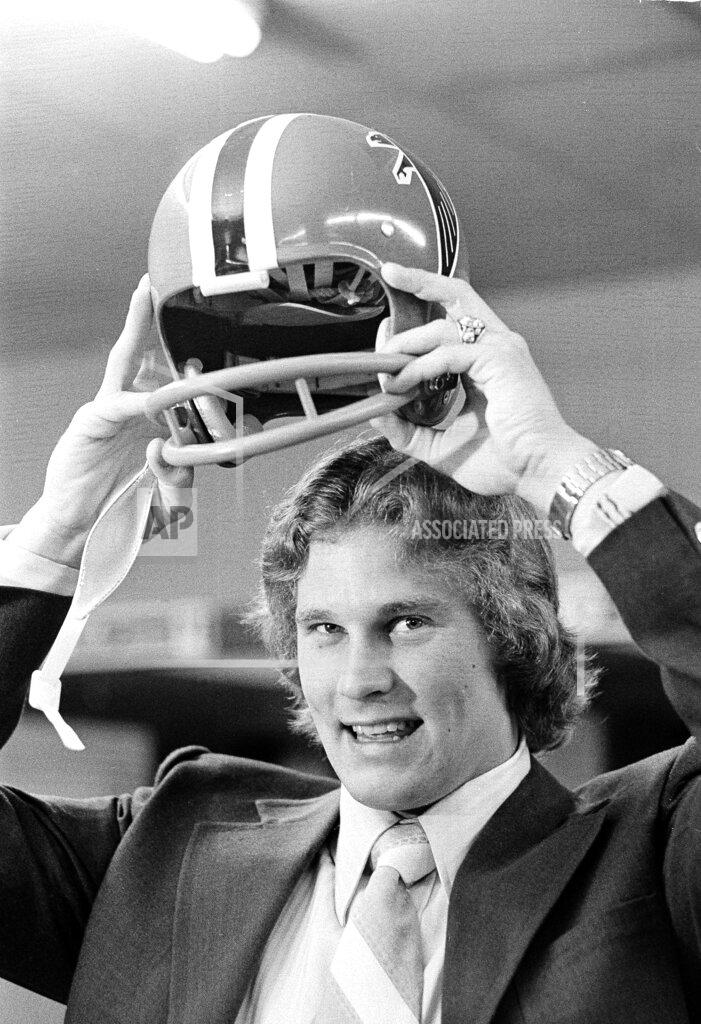
1975 NFL Draft: Quarterback Steve Bartkowski from the University of California is the overall first pick by the Atlanta Falcons.
Dow Jones Industrial Average: 694.77 (+2.11, +0.30%)
Born:
Junior Spivey, MLB second baseman (All-Star, 2002; Arizona Diamondbacks, Milwaukee Brewers, Washington Nationals), in Oklahoma City, Oklahoma.
Lee Latchford-Evans, British pop singer (The Steps), in Chester, England, United Kingdom.
Terri Conn [Colombino], American actress (“As the World Turns”), in Bloomington, Indiana.
Died:
Antonín Novotný, 70, President of Czechoslovakia 1957-1968
Arthur Judson, 93, artists’ manager for New York Philharmonic and Philadelphia Orchestra and a co-founder of the Columbia Broadcasting System.

 History Diaries