South Vietnam’s Lieutenant General Nguyễn Khánh led a coup d’état and removed the civilian government led by Prime Minister Trần Văn Hương. The next day, Khanh appointed Nguyễn Xuân Oánh, who had once been a professor of economics at Trinity College in Connecticut, as the new premier. The Armed Forces Council ousts Premier Hương and his civilian government in a bloodless coup; General Nguyễn Khánh is empowered to establish a stable government, The Council says it will observe the constitution of October 1964 and that the promised elections for a national congress will proceed. The Buddhists immediately order their followers to stop the anti-government demonstrations and hunger strikes, but their leaders do not hide their dislike of Khánh and the U.S. influence.
The military leaders of South Vietnam ousted the civilian government of Premier Hương today. Lieutenant General Khánh was appointed to deal with the crisis caused by current anti-government demonstrations. A statement by the Armed Forces Council declared that the Hương Government had shown itself “unable to cope with the present critical situation.” It asserted that the armed forces had therefore withdrawn their support from the Premier and the chief of state, Phan Khắc Sửu. The Council pledged to stand by those clauses of the October charter that called for converting a national congress to act as an interim legislature and draft a new constitution.
The statement said that the Council would accept the terms of an electoral law proclaimed this week that provides for elections and the meeting of the national congress on March 21. The terms of the statement made it clear that the military had once more seized power in what appeared to be a bloodless coup d’état. The legal position of the government was not immediately known in the hours shortly before noon when the statement was issued. However, without military support in the face of the Buddhist agitation sweeping the country, the government was powerless. The statement said that General Khánh “would immediately convene an Army-Peoples Council consisting of 20 representatives of the religions, of the armed forces and personalities from various parts of the country.”
“The Army-Peoples Council will advise the government in all its important decisions,” the statement said. The statement, which was broadcast by General Khánh over the Saigon radio at 11 AM local time, asserted that “the” future Government will convene the National Congress according to the provisions” of the electoral law. It declared that the October charter was “still in force except for the clauses that are contrary to the spirit of this document.” The statement was signed by the Armed Forces Council, which was an indication that the military leaders had acted jointly rather than under the absolute direction of General Khánh.
The military leaders exploited a wave of disorder that swept the country during the last week as a result of the militant demonstrations by Buddhists against the Hương Government and the United States in the person of Ambassador Maxwell D. Taylor. The Ambassador was denounced by the Buddhists for having lent his support to Premier Hương. It seemed certain that the United States would regard the latest military move as another setback in the effort to create! a stable government that would successfully prosecute the war against the Việt Cộng. Ambassador Taylor was scheduled to return here this morning after a one-day trip to Thailand and Laos. The United States mission had received some indication that a military move in the Buddhist crisis was imminent and Mr. Taylor’s unexpected departure might have been in some way connected with the latest upheaval.
A hint that military intervention in the Buddhist crisis was impending was given Monday by Brigadier General Nguyễn Chánh Thi, commander of the First Corps area, which includes central Vietnam, the center of Buddhist influence. General Thi told student leaders privately to hold off on their demonstrations because a change of government would probably take place within hours. In his radio broadcast General Khánh said that the army had been compelled to act because the political situation had lowered the morale of the troops at the front.
The Johnson Administration appeared inclined today toward acceptance of the new military-dominated Government in Saigon as the only political course open to South Vietnam or the United States. Administration officials, who had hoped until the last few days that a stable civilian government was emerging, seemed discouraged at the latest manifestation of political instability in South Vietnam. But the Administration’s reaction to the military coup was far more relaxed and resigned than was its reaction last December, when the Vietnamese armed forces first challenged the civilian government.
Last month Washington sought to impose political conditions for a resolution of the Saigon crisis and warned that the United States might be forced to curtail aid if a unified civilian government was not restored. Now the Administration has concluded that it must accept Saigon’s power struggle as inevitable in a nation still emerging from colonial control. Partly as a result of lessons learned in the December crisis, Washington was no longer trying to impose Western political solutions, The hope here was that at least a facade of a continuing civilian government could be maintained.
In this connection, officials were encouraged by indications that Lieutenant General Nguyễn Khánh, while obviously moving into a position of behind-the-scenes authority, was apparently not attempting to establish an outright military government, General Khánh was expected to preserve at least some of the structure of the civilian government, providing continuity of authority and responsibility. Officials also took encouragement from the Armed Forces. Council’s endorsement of previous decisions to hold a national election and to call a national convention to draft a constitution. The Administration was maintaining silence about the Saigon developments rather than issue prompt public statements of concern and criticism, as it did in December.
In the two months since it arrived, the Special Forces team at Plei Me, 18 miles from the Cambodian border, has killed one Việt Cộng soldier. The anti-guerrilla unit, made up of 12 Americans and 400 Vietnamese and mountain tribal troops, has also killed nine Bahnar tribesmen believed to have been working for the Communist guerrillas. The cost to the Special Forces camp has been three tribal soldiers killed and 32 Vietnamese or Montagnards — as the tribesmen were called by the French — wounded in action. Two American enlisted men have also been wounded.
The hill villages of the surrounding area are hostile. Thirteen months ago, when the camp was first built, nearby villagers burned their own huts and tried to follow the Việt Cộng. The camp’s medics have stopped their visits to neighboring villages because they found themselves dispensing most of their medicines to sympathizers of the Việt Cộng. They caught villagers pretending to take pills but slipping them instead into their pockets.
Americans here consider their main accomplishment the disruption of enemy travel patterns. The Việt Cộng had been moving down their supply route — the Hồ Chí Minh Trail — in Laos and Cambodia and crossing through this region of South Vietnam. This activity apparently continues, but the Communists must now move more cautiously to avoid contact with the patrols from the border camps. The 17 Special Forces teams in the mountainous central Vietnamese area have different missions, depending on their location.
U.S. National Security Advisor McGeorge Bundy and Secretary of Defense Robert S. McNamara presented to President Johnson their report, “Re: Basic Policy in Vietnam.” In what would become known as the “‘Fork in the Road’ memorandum”, Bundy and McNamara recommended him to escalate the Vietnam War rather than to pursue a peaceful resolution. “What we want to say to you”, Bundy wrote, “is that both of us are now pretty well convinced that our current policy can lead only to disastrous defeat… Bob and I are persuaded that there is no real hope of success in this area unless and until our own policy and priorities change.” The “two alternatives” that they envisioned were presented as assertiveness or timidity: “The first is to use our military power in the Far East and to force a change of Communist policy”, while the other was “to deploy all our resources along a track of negotiation, aimed at salvaging what little can be preserved.” Of those choices, “Bob and I tend to favor the first course”, Bundy wrote, “but we believe that both should be carefully studied and that alternative programs should be argued out before you.” He closed by noting ‘McNamara and I have reached the point where our obligations to you simply do not permit us to administer our present directives in silence and let you think we see real hope in them.” Johnson would choose the first alternative, and by the end of the year, more than 200,000 American troops would be in South Vietnam.
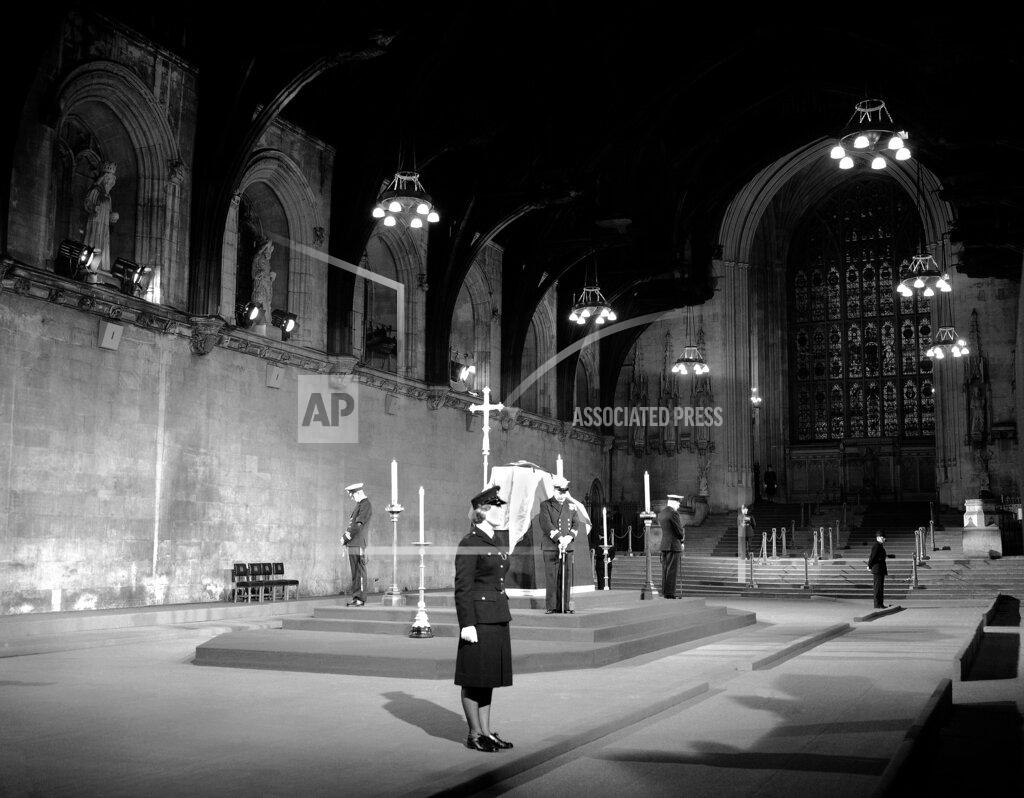
In the bitter cold of a winter’s night, they stood and waited to walk past the bier of Sir Winston Churchill. The line stretched a mile or more tonight from Westminster Hall, and policemen told new arrivals it might take two hours to reach the hall. Similar warnings were posted in subway and railroad stations. Still they came, stamping their feet and clutching their coats against the icy wind blowing over the Thames. The line wound along the river embankment over Lambeth Bridge and back along the other bank. As the people walked through St. Stephen’s Gate to the top of the stairs into Westminster Hall, they were separated into two streams. Down each side they came, two long lines, taking nearly three minutes to walk the 100-yard length of the great medieval hall.
It was a scene of darkness and light, the black of mourning and the red, silver and gold of military ceremonial dress. In the center was the catafalque, 40 feet long and 7 feet high, covered in black velvet with silver edging, a deep maroon carpet at the base. The coffin, closed and covered with the Union Jack, rested high on the catafalque. At its head, on top of the draped flag, was a black silk cushion bearing the golden insignia of the Order of the Garter — the collar, star, and garter. A huge candle stood at each corner, and a slightly smaller one at head and foot, At the head, rising higher even than the coffin, was a gold cross. At each corner was a member of the Guards standing in funeral posture, head tilted forward, eyes looking down to the point where his bare sword touched the ground at his feet. A fifth soldier looked on from an alcove in the wall nearby.
Every 20 minutes the guards changed. Now it was the Grenadiers in red coats with one black armband, brass buttons, black trousers with a red stripe, great bearskins on their heads. Then it was time to change, and the crowd slowed to watch. From a portal came two members of the Horse Guards, in red with silver, white-plumed helmets, and two of the Blues with deep-blue uniforms and red-plumed helmets. Slowly, almost painfully, each mounted the three steps, threw out one arm in a striking drill movement, lowered it over the other, grasping the hilt, and stood again with the sword at his feet. The hall was in semidarkness, the candles and a few lights shining on the cold stone walls and up onto the beautiful carved beams of the roof buttresses. As the visitors reached the exit at the south end, they could turn back for just a moment and see the bier — a splash of red, gold, and black framed against a stained-glass window above the entry stairs.
As midnight approached, there was no slackening in the river of people, five abreast, that flowed slowly forward. Its pace had begun at 4.000 an hour, then speeded up to 4,500 or more. Now about 60,000 had filed through the hall. Thousands more were waiting, patient and dignified, in the outside cold. Many were too young to have known Winston Churchill in his heroic days. There were Africans in the throng and Salvation Army women and men in bowlers and striped trousers. Lady Churchill and her daughter, Mrs. Mary Soames, stood unnoticed for a quarter of an hour watching the scene of homage and the changing of the guard. The Prime Minister, Harold Wilson, was the first through as Big Ben struck 9 this morning. He returned tonight, accompanied by his wife and son.
President Johnson said this evening that he would not fly: to London for the funeral of Sir Winston Churchill. Propped up on pillows in his four-poster White House bed, Mr. Johnson said his doctors had warned him against the trip; “on the theory that I am susceptible to reinfection.” Mr. Johnson came home from the hospital yesterday after spending three and one half days there undergoing treatment for a bad cold. He was sniffling, coughing and blowing his nose as he spoke to a group of reporters today. The President said that the official United States delegation to the Churchill funeral Saturday would consist of Secretary of State Dean Rusk. Chief Justice Earl Warren and the Ambassador to Britain, David K. E. Bruce.
The General Assembly met in special session today to hear 27 speakers extol the life and work of Sir Winston Churchill, one of the founding fathers of the United Nations.
Scotland Yard is mounting the largest security operation in its history to protect the government leaders, kings and other dignitaries who will attend Sir Winston Churchill’s funeral Saturday.
The Johnson Administration acted to seek Senate reversal of a House-passed ban on food sales to the U.A.R. by sending Secretary of State Dean Rusk into a special Senate meeting to protest the ban. At a hastily summoned meeting of the Senate Foreign Relations Committee this afternoon, Secretary of State Rusk warned that such legislative reprisals would deprive the President and himself of the needed flexibility in dealing with President Gamal Abdel Nasser and could have very serious consequences in the Middle East and the Congo.
Cuba charged that the Dominican and Puerto Rican governments are cooperating actively in the Cuban exile campaign and warned them of possible serious consequences.
Another south Indian, the second in 48 hours, burned himself to death today in protest against the establishment of Hindi, the tongue of north India, as the official language of this vast, diverse republic.
Mrs. Indira Gandhi stood in a glass-walled tower on Park Avenue in New York City last night to welcome world and national figures to the opening of a photographic essay on the life of her fater, Jawaharlal Nehru.
The Soviet leadership is believed to have turned down an appeal by leaders of the Communist party of Britain for a postponement of the preparatory conference of Communist parties due to start here March 1.
Walter Ulbricht, the Communist leader of East Germany, has accepted an invitation by President Gamal Abdel Nasser to visit the United Arab Republic next month, Neues Deutschland, the party newspaper, announced today.
France has achieved little more from her recognition of Communist China than praise for French foreign policies, hints of future diplomatic cooperation and a somewhat deceptive increase in trade.
Shah Mohammed Reza Pahlevi entrusted the Premiership of Iran today to Amir Abbas Hoveida, Finance Minister in the Cabinet of Premier Hassan Ali Mansour who died last night.
Austen Albu was appointed Minister of State for Economic Affairs in the UK government by Prime Minister Harold Wilson.
The Knesset (Parliament) rejected today opposition motions for a debate on the citizenship status of Mrs. Rina Eitani, a member of the town council of Upper Nazareth. Her mother was a German Christian, her father an unknown Polish Jew. The Nazis persecuted the family during the war and they emigrated to Israel afterwards.
The Polish Government has demanded the death sentence for three meat-distribution officials on trial for alleged operation of a massive meat-swindling racket in Warsaw.
Colombian President Guillermo Leon Valencia dismissed his controversial Defense Minister, General Alberto Ruiz Novoa, today.
The chairman of the Senate Foreign Relations Committee, Senator J. W. Fulbright of Arkansas, disclosed today that he was dropping his role as floor manager and chief defender of the Administration’s $3.38 billion foreign aid legislation. The refusal of the committee chairman to shepherd the controversial measure through the Senate for the first time in its 15-year history placed in jeopardy its chances of getting through the Senate without substantial cuts and important policy restrictions. The immediate cause of Senator Fulbright’s decision was President Johnson’s unannounced rejection of the Senator’s demand that the economic and military programs be covered in separate authorization bills.
The Administration has asked $2.21 billion for economic-development loans and grants and $1.17 billion for military aid to friendly non-Communist governments. Basically, however, Senator Fulbright believes that the traditional form of extending foreign aid through bilateral agreements with recipient governments has outlived its usefulness and could make as many enemies as friends for this country. He believes this is an inescapable result of the debtor-creditor relationship that the bilateral system entails. He thinks further that all United States development loans should be made available through multilateral institutions like the International Bank for Reconstruction and Development and its subsidiary International Development Association or the Organization for Economic Cooperation and Development as well as United Nations agencies.
President Johnson and Vice President Hubert H. Humphrey have agreed on procedures which would permit Humphrey to become acting President should Mr. Johnson become disabled. The agreement was identical to agreements made by President Dwight D. Eisenhower and Vice President Richard M. Nixon in 1958, and President Kennedy and the then Vice President Johnson in 1961.
The United States intends to explore the moon, not just visit it, President Johnson said today. It will “explore and chart the planets as well,” the President told Congress in submitting a review of “significant successes” scored last year by United States space programs. His announcement of a lunar exploration program went beyond the Apollo Project to land two men on the moon by 1970. The President’s report said the goal of the United States was to become the world’s leading “spacefaring” nation. But it also said that one of 1964’s most significant space features was the speedup in Soviet launching activities. As for the United States, last year’s space successes were “gratifying and heartening omens of the gains and good to come,” Mr. Johnson said.
He added that “practical uses of the benefits of space technology were almost commonplace around the globe — warning us of gathering storms, guiding our ships at sea, assisting our mapmakers, and serving, most valuably of all, to bring the peoples of many nations closer together in joint peaceful endeavors.” In addition to the ambitious post-Apollo moon and planetary programs, Mr. Johnson said, “we shall expand our earth laboratories into space laboratories and extend our national strength into the space dimension.”
Sheriff’s deputies in Selma, Alabama jailed 24 more persons today in a continuing dispute over how many Blacks should be permitted in a voter registration line at one time. Twenty of the arrests were made this morning. Four others, including a white woman who is a civil rights worker, were jailed this afternoon. All were taken into custody for remaining in the voter registration line outside the Dallas County Courthouse after being told to leave, or urging others to remain in line. In Mobile, meanwhile, it was disclosed that Black lawyers plan to ask a federal court judge tomorrow to issue an order directing Sheriff James G. Clark of Dallas County to show cause why he should not be held in contempt for making arrests.
About 280 arrests have been made since the Rev. Dr. Martin Luther King Jr. started a Black voter registration drive in Selma 10 days ago. Most of the arrests were made before Blacks obtained an injunction from Federal Judge Daniel Thomas directing local officials not to interfere with Black voter applicants. Judge Thomas also spelled out in his order just where and how the Blacks should line up. He instructed voting officials to assign applicants a number, one through one hundred, and take the applicants on a first-come, first-served basis.
Officials have interpreted this to mean that only 100 applicants should be permitted in the line at one time. Blacks disagree, contending this was merely a suggested figure. About 50 state troopers are standing by in Selma to guard against any outburst of racial trouble. The troopers moved in yesterday, but only a few have been used at the courthouse to bolster local forces. Today was the last day this week, and the next to the last day this month, that voter applicants will be permitted to register in Dallas County.
Seventeen white men pleaded innocent to charges of conspiring to kill three civil rights workers in Mississippi. Neshoba County Sheriff Lawrence A. Rainey and 16 other men pleaded not guilty today in Meridian, Mississippi to indictments charging them with conspiracy in the murder of three civil rights workers last June 21. United States District Judge W. Harold Cox said he would set a trial date after he ruled on defense motions to dismiss the charges. He took the motions under advisement after two days of hearings and indicated it would be at least two weeks before he ruled.
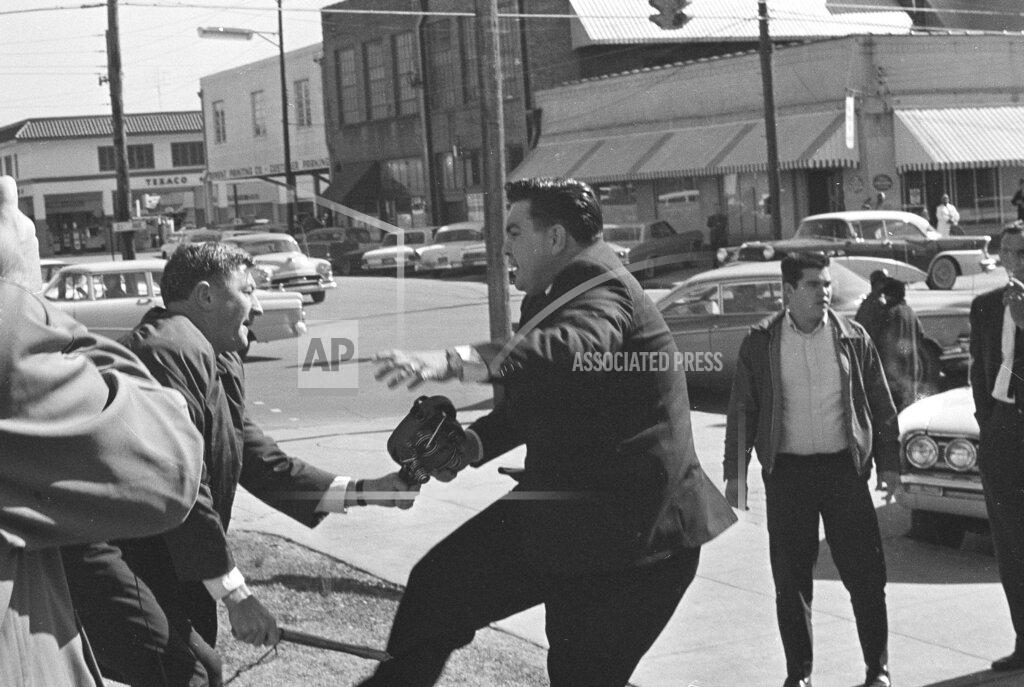
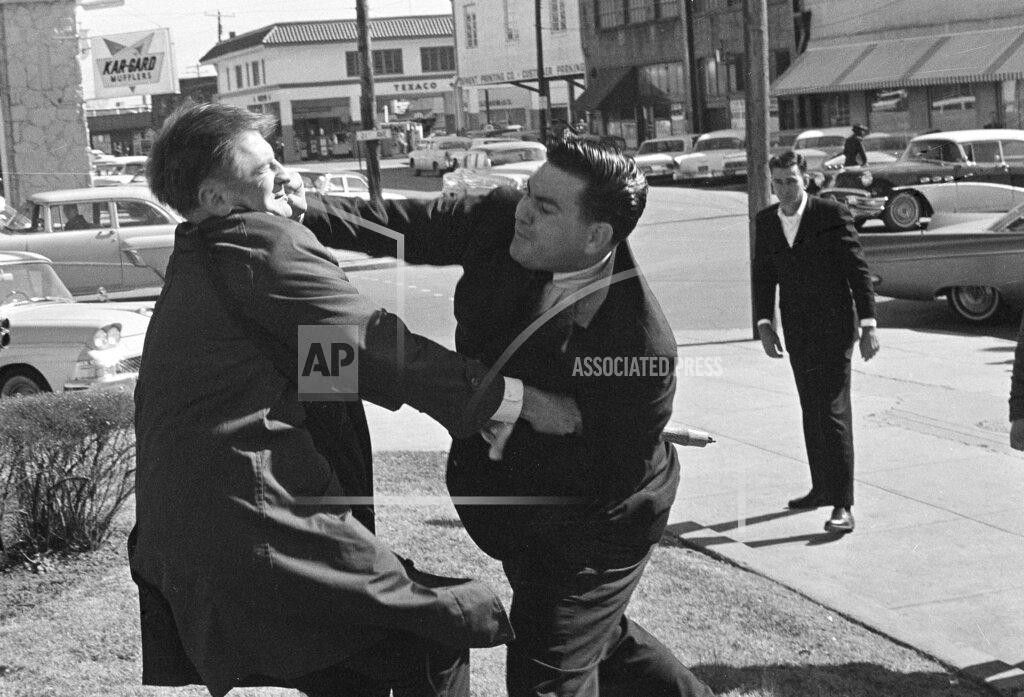
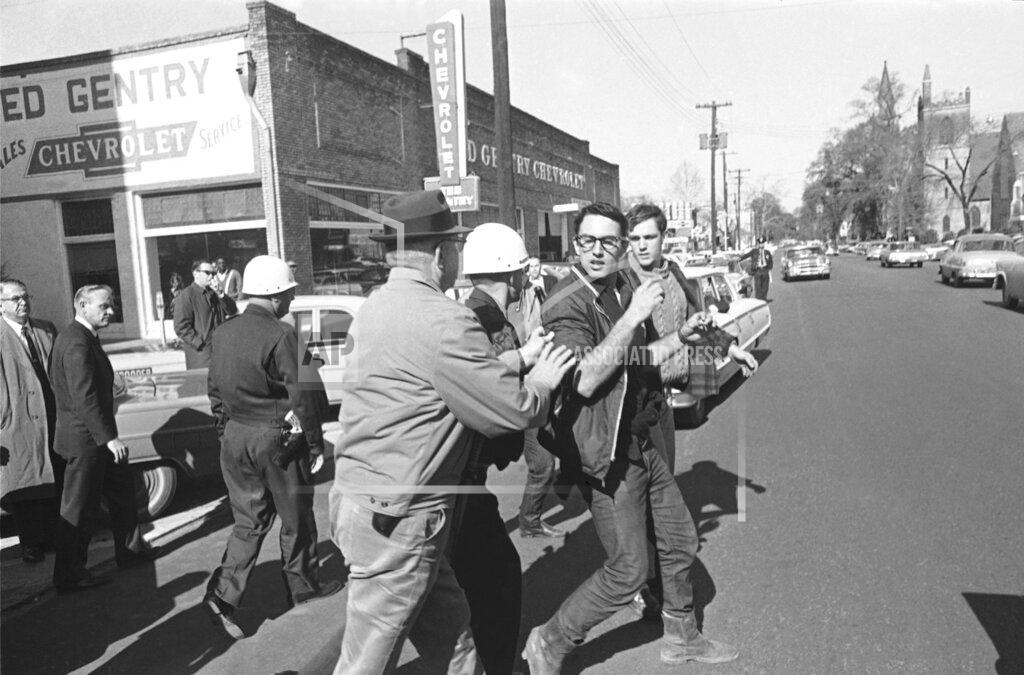
During the noon recess, one of the defendants, Alton Wayne Roberts, a 26-year-old barroom bouncer, kicked a cameraman between the legs, then sent him reeling with a right to the eye while a city policeman looked on. The incident occurred on the Courthouse lawn after a scuffle on the sidewalk had started when Sheriff Rainey and another defendant, Jimmy Lee Townsend, had shoved photographers aside. Laurens Pierce, of Montgomery, a 49-year-old cameraman for the Columbia Broadcasting System, suffered a cut over the left eye that required six stitches to close. Roberts’s foot struck the cameraman’s leg a glancing blow near the crotch. The defendants and spectators were filing out of the court house when Mr. Pierce and other photographers ran ahead of the sheriff to get his picture. Mr. Pierce said the sheriff shoved his camera and he felt someone strike him on the back of the neck. Films taken by other photographers showed the attacker to be Townsend.
Mr. Pierce fought back with a club-like stick he uses to hold his movie camera and retreated to the curb. Roberts jumped out of the crowd, accused Mr. Pierce of hitting him and forced him back across the lawn. Roberts then kicked at Mr. Pierce’s groin, grabbed a stick in his left hand and struck Mr. Pierce in the face with his right. While Mr. Pierce lay on the lawn bleeding, Roberts shouted: “I’m going to file suit against you. I’ve got witnesses.” During the attack a policeman, W. E. Sollie, stood a few feet away and said, “Wayne, you shouldn’t do that.” Sheriff Rainey looked on and said, “They (the cameramen) are always causing trouble.”
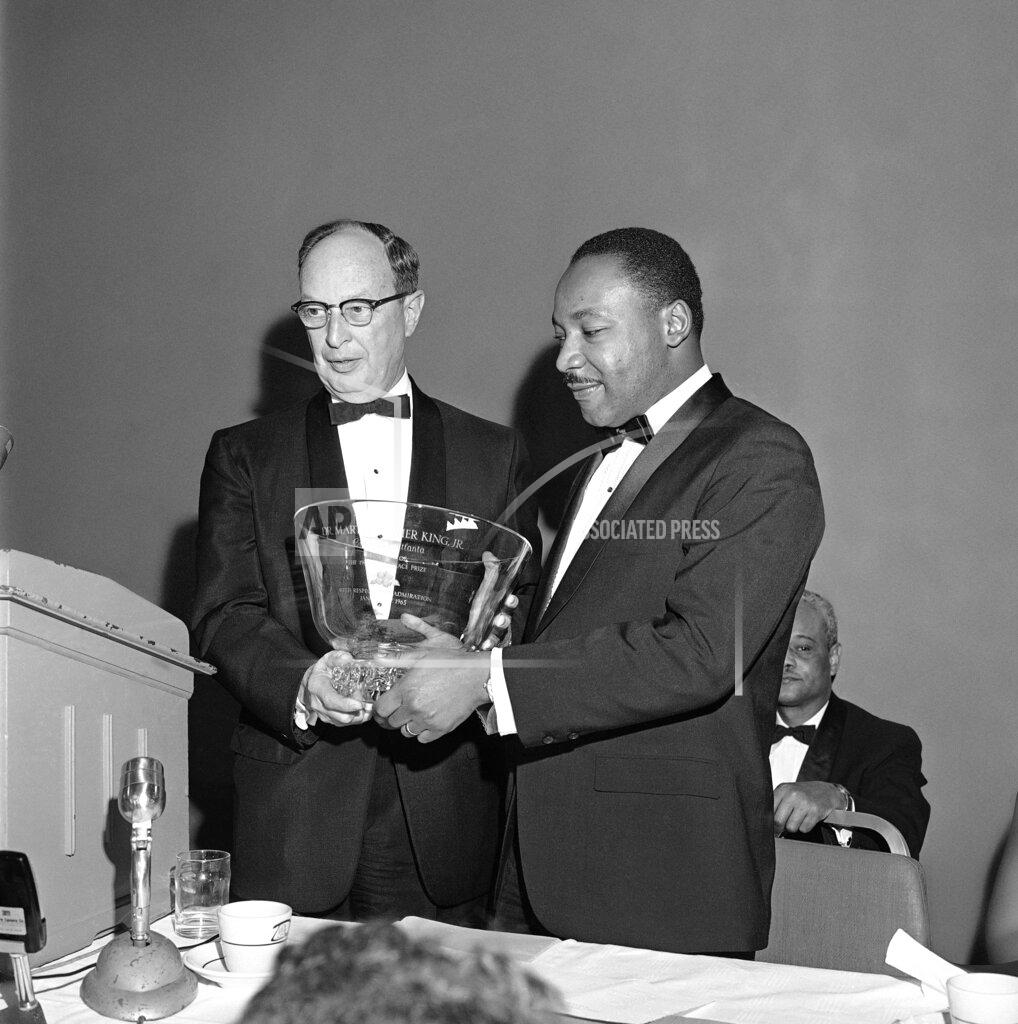
The Rev. Dr. Martin Luther King Jr. received praise tonight from the leaders of Atlanta — a city that once arrested him in a sit-in demonstration. More than 1,500 of Dr. King’s fellow Atlantans, about half of them white, gathered at a testimonial dinner to deliver short speeches of praise and to give a specially commissioned Steuben glass bowl to the 36-year-old Black integrationist in recognition of his winning the Nobel. Peace Prize. At the end of the dinner, all 1,500, white and black, stood and sang two verses of “We Shall Overcome.” the most famous song of the civil rights movement. Mayor Ivan Allen Jr., in his tribute, said: “Under Dr. King’s leadership, the philosophy of the nonviolent movement is being proved. His deep and complete dedication and devotion to this method of social revolution has won him recognition by the Nobel Committee. “I take great pride in honoring this citizen of Atlanta who is willing to turn the other check in his quest for full citizenship for all Americans.”
The House Ways and Means Committee started work today on the Administration’s program of health care for the aged with favorable action all but assured.
The Air Force Academy announced that 30 more cadets have resigned in the school’s cheating scandal, bringing the total to 65. Thirty-five more may be involved.
Barry Goldwater is considering a return to active politics by bidding for either a Senate or a House seat, but won’t seek the Presidency.
Federal Communications Commissioner Lee Loevinger accused his own agency of violating the Constitution by requiring radio and television stations to carry religious programs acceptable to the commission.
Rep. Emanuel Celler (D-New York) accused Senator John J. Williams (R-Delaware) of doing him a “grievous injustice” by the manner in which Williams linked Celler to the Bobby Baker investigation.
The National Science Foundation announced that it had selected a site 100 miles (160 km) northeast of the Hawaiian island of Maui as the site for Project Mohole, an attempt to dig the world’s deepest hole, in order to penetrate the Earth’s crust and into the Earth’s mantle. The word “mohole” was derived from the Mohorovicic discontinuity, a band of matter discovered by Yugoslavian seismologist Andrija Mohorovičić and lying between the crust and the mantle.
The first ground station-to-aircraft radio communication via satellite is made.
Groundbreaking for the “Dragon Gateway” at Grant Avenue entrance to San Francisco’s Chinatown.
Dow Jones Industrial Average: 899.52 (+1.68)
Born:
Alan Cumming, Scottish stage, film and television actor who won a Tony Award for best actor for his performance in “Cabaret” in 1998; in Aberfeldy, Perth and Kinross, Scotland, United Kingdom.
Igor Matoushkin, Belarusian hockey defenseman (Olympics, 1998, 2002), in Chelyabinsk, Russian SFSR, Soviet Union.
Rusty Richards, MLB pitcher (Atlanta Braves), in Houston, Texas.
Tom Rehder, NFL tackle and guard (New England Patriots, New York Giants), in Sacramento, California.
Ignacio Noé, Argentine comic book artist and children’s book illustrator; in Belén de Escobar, Argentina.
Died:
C. Douglass Buck, 74, American engineer and politician, former Governor of Delaware (1929-1937) and U.S. Senator (1943-1949).
Theo Uden Masman, 63, Dutch big band orchestra leader (The Ramblers).
 History Diaries