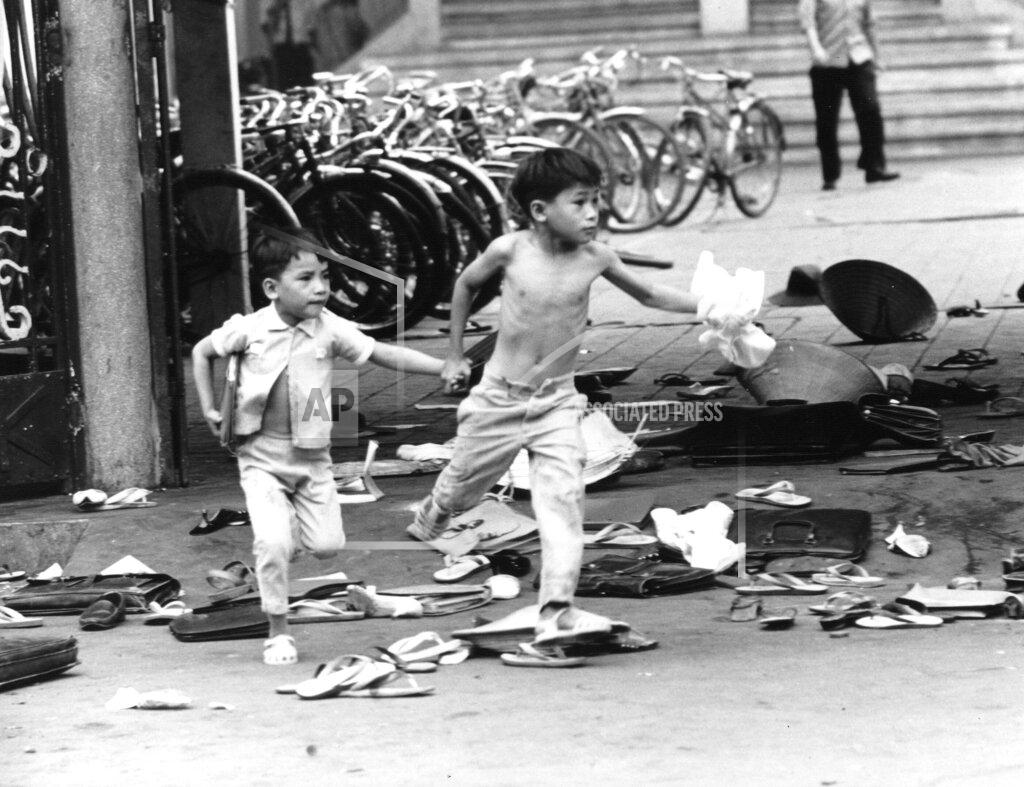
Paratroopers occupied a Buddhist school in Saigon Monday after they had fired tear gas into classrooms at students shouting anti-Government slogans, The Associated Press reported. About 70 persons, including 12 Buddhist monks, were arrested.
The military leaders of South Vietnam intervened today and tried to dissuade Buddhists from holding demonstrations against the Saigon Government and the United States. The Armed Forces Council, following urgent talks with Premier Trần Văn Hương and United States Embassy officials, decided on a show of force and a simultaneous effort to open talks with the Buddhist faction for a political settlement. Lieutenant General Nguyễn Khánh, the commander in chief, disclosed that the council had agreed to impose martial law in Huế, in central Vietnam, which has been the main center of Buddhist agitation for the overthrow of the Hương Government.
The general said in an interview that a decree would shortly he signed by the Chief of State, Phan Khắc Sửu. It would apply to the entire Province of Thừa Thiên, which embraces the former imperial capital of Huế. About 15,000 Buddhist sympathizers participated in a silent protest march through Huế. Their banners demanded the resignation of Premier Hương and the recall of Ambassador Maxwell D. Taylor. The Buddhists have violently attacked Ambassador Taylor during the last three days as a symbol of the United States policy of support for the Huong Government. Only one outburst of violence was reported from Huế, where on Saturday a mob sacked the United States Information Service library.
Students, who had been told at a meeting that a Buddhist monk had been arrested, attacked the homes of the chief of police and the head of the Vietnamese information service. The mob dragged furniture from the two houses and burned it. Peaceful Buddhist demonstrations on a smaller scale. than the procession in Huế were reported from other Central Vietnamese cities, at Quảng Trị and at Đà Nẵng, site of a key United States Air Force base. In an attempt to conciliate the Buddhists, Brigadier General Huỳnh Văn Cao, chief of the political warfare department of the army, was sent to the headquarters of the Buddhists to seek the opening of talks with their leaders. Within the Buddhist headquarters, barricaded by troops, five leading monks, including Thích Trí Quang, the religious affairs chief, and Thích Tâm Châu, head of the secular organization, were in the sixth day of their hunger strike. A Buddhist spokesman said the monks, who have been partaking only of mineral water, have pledged to fast unto death to force the resignation of the Government. The Buddhists have been demanding a government that would be more amenable to their influence and political activities.
The army was seeking a way to permit the Buddhist leadership to escape its commitment to fight to the death against the Hương Government through means of some face-saving compromise. In the past the Buddhists have refused any settlement short of the resignation of Premier Hương, whom they have singled out as the personification of their grievances. “We must talk to the Buddhists,” General Khánh said. He added with a smile: “You cannot kill them all.” General Khánh asserted that “something must be done to check the growing upsurge of anti-Americanism.” “The Buddhists talk against Ambassador Taylor,” he said, “but that is only a form of anti-Americanism. If it goes on it will slow down our war against the Communists.”
The general obviously still feels that he has been slighted by United States officials since he was forced from power as premier and chief of state in the previous government. Tonight, however, he sought to minimize any differences with Ambassador Taylor and spoke of the need for a new common effort against the Việt Cộng guerrillas. The general was interviewed in the garden of his residence after he and his wife had given a party for Vietnamese war orphans. General Khánh was asked whether he thought the Buddhist crisis could be resolved satisfactorily by the resignation of Premier Hương. He replied that the immediate problem might be handled in this manner, but that another crisis would arise in a month or two. “A more definite settlement is needed,” he said.
There have been reports that General Khánh was seeking to exploit the Buddhist agitation to reinforce his political position and to prepare for an eventual return to the leadership of the Government. General Khánh said the Armed Forces Council was continuing to support Premier Hương despite its approach to the Buddhists. The Premier has taken a firm stand against yielding to Buddhist insistence in the ouster of his government.
American Special Forces officers in Buôn Ma Thuột (Banmethuot) believe they have averted another uprising by mountain tribesmen. January 7 was chosen for a demonstration against the South Vietnamese Government but the day passed peacefully throughout the mountainous region in Central Vietnam. Intelligence sources indicated that some of the rebel leaders had grown concerned about Communist infiltration in their ranks and feared that the demonstrations would lead to American casualties. Last September 19 a revolt at five camps of the American Special Forces, the anti-guerrilla units, was begun by the hill troops, who make up a large majority of the troops at the isolated bases throughout the II Military Corps. Before the insurrection was put down one week later, 29 Vietnamese soldiers had been killed and 100 captured. At one point the Montagnards, as the hill tribes were called by French colonizers, held 20 Americans as hostages.
North Vietnam charged that three warships under the command of United States and South Vietnamese authorities shelled a village near the demilitarized zone today, setting fire to a house. The Hanoi radio, in a broadcast monitored here, said one of the attacking naval vessels was set afire by North Vietnamese army units.
No one was to blame for the series of explosions that destroyed 10 aircraft. including nine T-28 fighter-bombers, yesterday at Vientiane’s military airport in Laos, an inquiry has found. “No person is responsible for this incident,” a military communiqué said today. The explosions were attributed to a “technical fault.” It was found that a fighter-bomber’s machine gun had short-circuited in firing a bullet, which struck a fuel tank. The explosion caused a chain reaction on bomb-laden T-28’s ready for a mission. The loss was the greatest ever incurred by the Laotian forces. The damage was estimated at a million dollars. Military sources said it was likely that the United States would be asked to replace the lost aircraft. The T-28’s were given to Laos by the United States. Five had been lost in action and three in accidents.
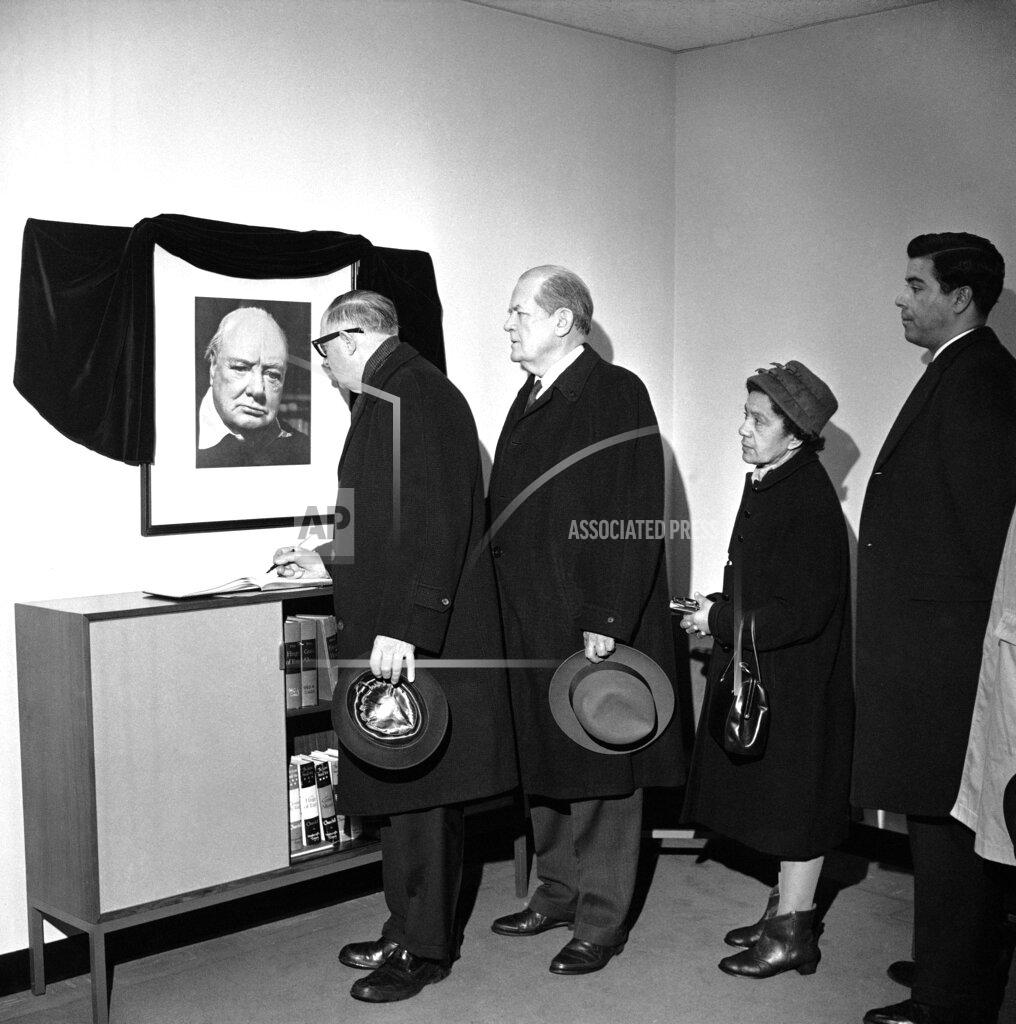
The death of former British Prime Minister Winston Churchill was mourned worldwide. In the United States, President Johnson ordered that all U.S. flags be flown at half-staff on federal buildings, naval vessels, and American embassies, bases and government installations worldwide.
The House of Commons said farewell today to the greatest of its own. Sir Winston Churchill was eulogized on both sides of the chamber where he spent more than 60 years of his political life. It was a simple occasion, brief — and moving in its affection. “He was a child of this House,” Prime Minister Harold Wilson said, “He took from it and he gave to it… All of us here at least know the epitaph Winston would have chosen for himself: ‘He was a good House of Commons man’.” He spoke after the reading of a message from Queen Elizabeth extolling Sir Winston. There was just one empty place in the crowded house, a spot of green leather amid the black of the members’ mourning wear. It was the seat on the front bench, just below the gangway, where Sir Winston sat for so many years. As this simple scene was enacted, plans were going forward for the elaborate, almost medieval pageantry of a British state funeral. Sir Winston will be buried Saturday in the country churchyard of Bladon, near his ancestral home, Blenheim. The days before that will be crowded with ceremony.
At a meeting of the Chinese Communist Party’s Politburo, Party Chairman Mao Zedong and Chinese President Liu Shaoqi had what proved to be a fateful confrontation over Mao’s proposals for an overthrow of the party’s bureaucracy. It was then, Mao would tell interviewer Edgar Snow years later, that he decided that Liu “had to go.”
Thousands of students demonstrated today in Tamil-speaking Madras, a state in south India, against a law that will make Hindi, the language of the north, the sole “official language” of the Indian Union. The police used tear gas against the demonstrators and arrested 11 in the city of Madras. Five persons were wounded in Madurai, where students set fire to a huge tent decorated for tomorrow’s celebration of the 15th anniversary of the Indian republic.
The Home Minister, Gulzarilal Nanda, told the people of Kerala today that if the “leftist” pro-Chinese Communists were elected to the state Assembly in the elections March 4 they would not be allowed to function.
About 5,000 Philippine workers, students and representatives of peasant groups staged a demonstration in front of the United States Embassy in Manila tonight. A cardboard “Uncle Sam” was burned at the embassy gate.
The United Arab Republic is increasing its pressure on West Germany to cease arms shipments to Israel and to refrain from extending diplomatic recognition to her this year. The latest move by the regime of President Gamal Abdel Nasser was the publication of a report in the authoritative daily Al Ahram yesterday that East Germany’s leader, Walter Ulbricht, has expressed a desire to visit Cairo and is expected to come here in February. Mr. Ulbricht’s visit would presumably be timed to the signing of a $75 million industrial credit for the United Arab Republic, now being worked out by an East German economic delegation here. If Mr. Ulbricht’s visit materializes, it will pose a problem for the West German Government. At the least, it would be an obstacle in the path of West Germany’s relations with the Arab world and it would eliminate the possibility of Mr. Nasser’s visiting West Germany this year. At the worst it could be seen as a de facto recognition of the East German regime, and therefore give Bonn reason to break diplomatic relations with Cairo.
As outlined by Premier Eisaku Sato in the Diet (Parliament) today, Japan’s new assertiveness in Asian diplomacy will be aimed at the advancement of democracy and free enterprise.
The United States is studying a note from the Soviet Union explaining the recent Russian nuclear explosion amid reports the radioactive fallout outside Russia’s borders stemmed from an accident during an underground test.
French unions in nationalized industries and civil service plan “soft” strike to retain public support without cutting home utility service.
Havana Radio said Eloy Gutierrez Menoyo, widely known guerrilla leader, has been captured by militia.
The future of the world depends to a large extent on solving problems of the population explosion, U.N. Secretary General U Thant warned.
Congolese Premier Moise Tshombe has banned a Leopoldville newspaper that opposed his Government.
Joseph Bamina became the new Prime Minister of Burundi, ten days after the assassination of Pierre Ngendandumwe.
Malta became the 18th nation to join the Council of Europe.
Pope Paul VI appointed 27 new cardinals, including the Most Rev. Lawrence Joseph Shehan, Archbishop of Baltimore, and three prelates from Communist countries. One of those was Czech Archbishop Josef Beran, who was imprisoned 14 years by Reds.
The British liner RMS Queen Elizabeth 2 ran aground off Cherbourg, France, but was refloated undamaged shortly afterwards.
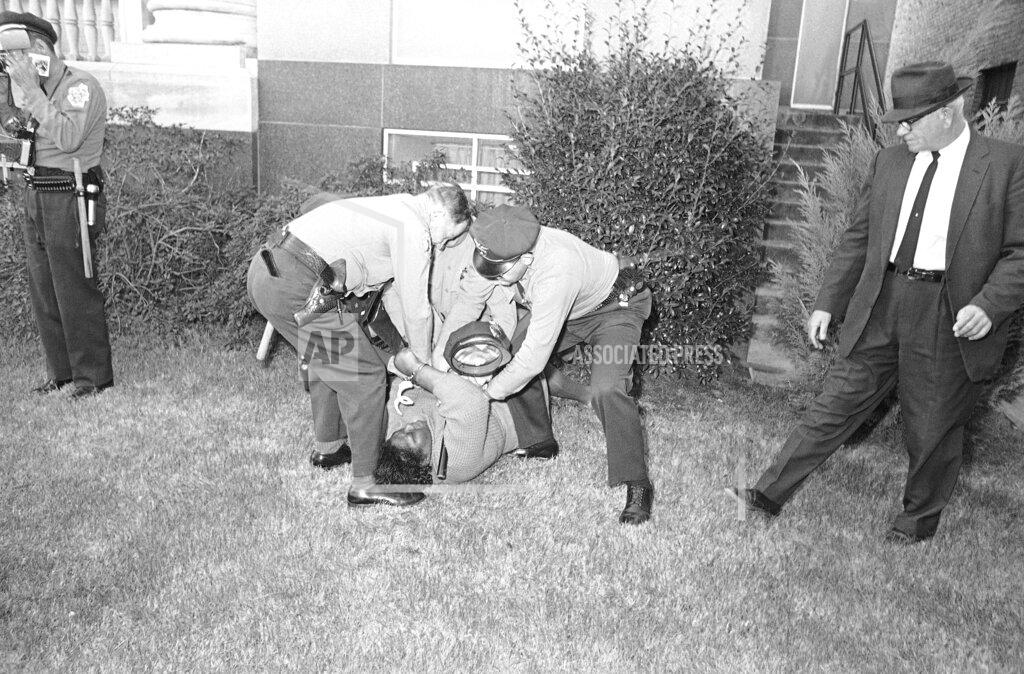
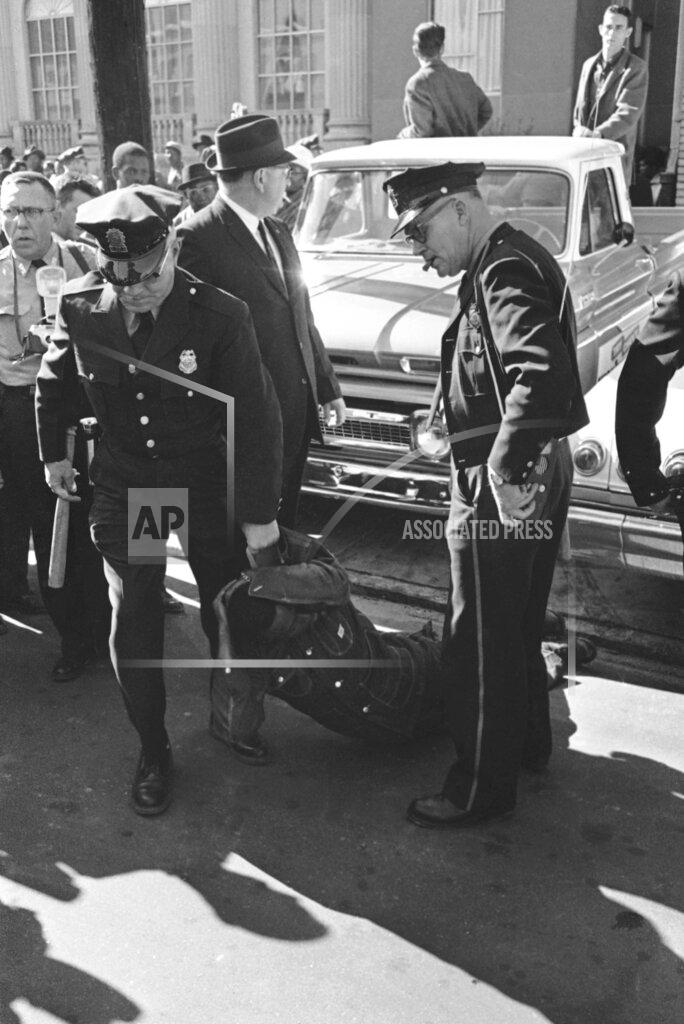
Civil rights activist Annie Lee Cooper punched Dallas County, Alabama, Sheriff Jim Clark in the face. The large Black woman stepped out of the voter registration line today and punched Sheriff James G. Clark in the face. Three deputies grabbed her and wrestled her to the ground, and in the flailing, kicking struggle that followed, Sheriff Clark clubbed her. She was then taken off to jail in two pairs of handcuffs with a wound over her right eye. Deputy Sheriff Doyle Wright, who took part in the melee, lost some skin from the back of his neck and had a knot on his cheek. Clark, the local sheriff, was confronted by Cooper when she tried to defend a man who was attempting to register from being kicked by the police. While in line, Cooper was prodded by local sheriff Jim Clark with a baton. Clark poked Cooper in the neck with his billy club, and she spun around giving him a hard right hook knocking Clark to the ground. Cooper proceeded to jump on Clark until she was pulled away by other sheriffs.
Cooper was then arrested and charged with criminal provocation. She was held in jail for 11 hours before the sheriff’s deputies dropped the charges and released her, hastening to protect her from being attacked by Clark upon his return to prison. Cooper spent the period of her incarceration singing spirituals. Some in the sheriff’s department wanted to charge her with attempted murder, but she was released. Following this incident, Cooper became a registered voter in Alabama. “I try to be nonviolent,” Ms. Cooper told a Jet magazine reporter a few weeks after the incident, “but I just can’t say I wouldn’t do the same thing all over again if they treat me brutish like they did this time.”
As the Sheriff of Dallas County, Alabama, James Gardner Clark Jr. had earned a reputation as a violent man. He recruited the Ku Klux Klan to keep Black Alabamians away from the voting booths, violently beat and arrested non-violent protestors, and even used cattle prods to stab Black citizens. Clark’s behavior was so vile that when he finally died in 2007, The Washington Post‘s obituary on him all but celebrated his demise. “Mr. Clark seemed to relish confrontation,” the article read. “He hit at least one organizer, C.T. Vivian, in the face, though he later said he did not recall doing so until an X-ray exam showed he had a linear fracture in a finger on his left hand.” Asked if Cooper was married, Sheriff Clark replied: “She’s a n****r woman and she hasn’t got a Miss or a Mrs. in front of her name. She says she’s a secretary at a motel, but I think she’s a bouncer.”
Following his defeated bid for reelection in 1966, Clark sold mobile homes. He also became involved in a number of dubious enterprises. These included being a broker for ‘the Tangible Risk Insurance Company’ in Birmingham, which got him indicted with eight other men for mail fraud, to which he pleaded no contest. Then, in 1973, he served in North Carolina as general manager of the Pinehurst Mortgage & Loan Company, which turned out to be a loan-sharking outfit; the company eventually accused Clark of embezzlement but the company itself folded in the face of securities law enforcement. By 1976 Clark was back in Alabama as an officer of ‘International Coal & Mining’, but one of his partners was prosecuted for fraud and embezzlement. In 1978, a federal grand jury in Montgomery indicted Clark on charges of conspiring to smuggle three tons of marijuana from Colombia. Clark was sentenced to two years in prison and ended up serving nine months. In 2006, he told the Montgomery Advertiser that concerning his actions during the civil rights movement, “Basically, I’d do the same thing today if I had to do it all over again.”
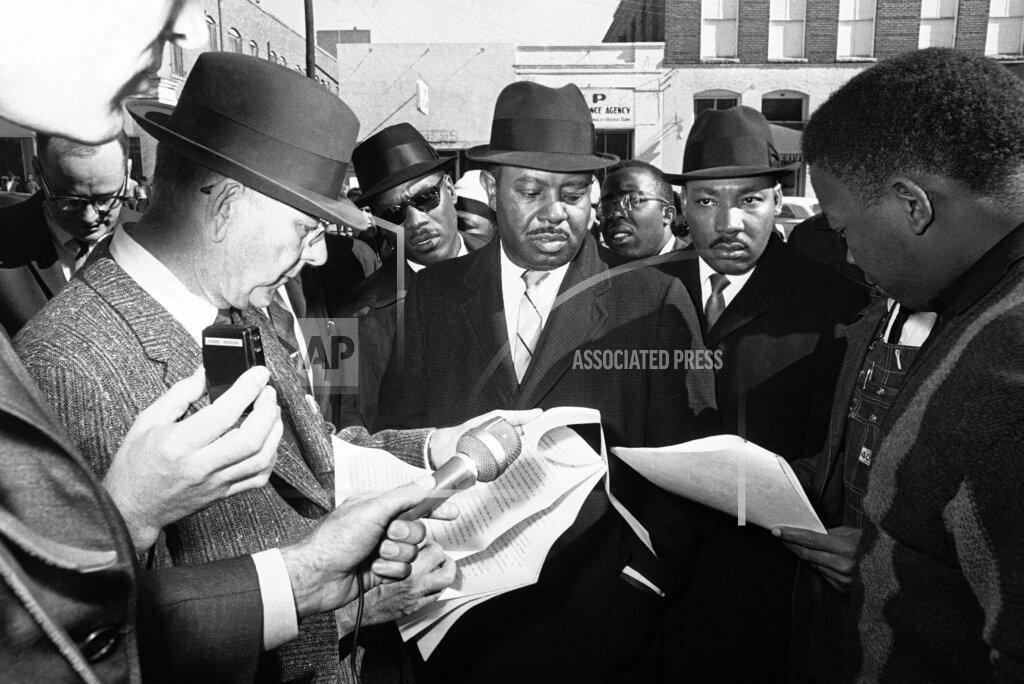
The Rev. Dr. Martin Luther King Jr., who was standing a few feet away on this day, called the sheriff’s action “absolutely uncalled for and absolutely unnecessary. We have seen another day of brutality. We still have in Dallas County a sheriff who is determined to trample over Negroes with iron feet of brutality and oppression.” He called for demonstrations at the courthouse and urged the Blacks to “fill up all the jails of Dallas County and every surrounding county” if necessary.
The continuing turmoil in Selma is not over. It will culminate in a few weeks in what is remembered as Bloody Sunday; an act of violence so disgusting that even Alabama Governor George Wallace would be appalled and would denounce Sheriff Clark.
President Johnson sent to Congress today a $99.7 billion budget that contained the biggest expansion of domestic welfare and educational programs since the New Deal of the nineteen-thirties. The $99.7 billion figure was the spending estimate in the regular, or administrative, budget for the fiscal year beginning next July 1. It represents a rise of $2.2 billion from the current year. Programs like Social Security, highways and medical care for the aged are not included in this figure because they are paid for by special taxes of their own. With these programs added and some of them expanded this year, total federal spending comes to $127.1 billion — a rise of $6 billion, all of it in domestic programs. This larger figure is called the cash budget and gives a truer picture of the impact of the government’s operations on the citizen and on the economy.
The spending figure in both the cash and administrative budgets was the highest ever, as expected, though a number of individual programs showed decreases. Increases in Social Security benefits and in numerous welfare-oriented programs in the regular budget added up to a huge total spending rise of $6.3 billion in the welfare and educational fields. The single year’s increase in these categories amounted to three-fourths of the entire federal budget of $8.4 billion in 1938, at the height of the New Deal. The spending rise was accompanied by proposed tax changes both upward and downward, the main changes being an unspecified reduction of $1.75 billion in excise taxes in July, and a rise in Social Security taxes next January 1. In addition, the economy this year will see some further benefit from the second stage of the big income-tax cut enacted last year, though withholding will not be cut again.
The net result of the spending and tax changes, according to government officials, is $8.5 billion worth of stimulus to the national economy, nearly all of it to come in the last half of this calendar year. The stimulus would be reduced next year when a $3.1 billion increase in the Social Security tax takes effect. Stimulus comes from upward changes in expenditure and downward changes in tax rates, both of which add to total spending in the economy. The stimulus supplied to the economy by the budget, while large, was not quite as much as in 1961. But the President estimated that the economy would grow $58 billion in the calendar year 1965 to a gross national product of $660 billion — about as much growth as in 1964 and indicating another highly prosperous year. The stimulus was reflected, in part, in a planned deficit of $3.9 billion in the cash budget and $5.3 billion in the administrative budget. Both deficits are reduced slightly from the latest estimate for the current fiscal year. This would be the sixth consecutive year of budget deficits. The increases in spending in the social and educational fields were virtually across the board — education at all levels, health, public assistance to the needy, unemployment compensation, the new poverty program, Social Security, manpower training and development of depressed areas. Part of the $6.3 billion increase is in grants to the states.
Large as it was, the $6.3 billion increase understates the expansion in social and educational areas. New government programs take time to generate cash payments and the level of appropriations requested indicates an additional rise of at least $2 billion in future years. Moreover, the figure does not include anything for medicare, because benefits will not begin until the next fiscal year. The biggest single rise in the entire budget was a $2 billion annual increase in Social Security benefits for the aged, with a retroactive payment of about $1 billion due in July or August. Defense remained the largest item in the cash budget as well as in the administrative budget. At $47.9 billion, however, or $49 billion with military foreign aid included, defense spending was down $2.3 billion from the fiscal year ended last June 30 and $300 million from the current year. It amounted to well under half the total cash outlay approached by the $36.8 billion for social and educational programs, including Social Security.
The military budget submitted to Congress today marks the end of a four-year build-up that President Johnson said had raised the national defenses to “a level of commanding superiority.” As proposed in the budget, the military would spend $49 billion in the coming fiscal year — $300 million less than this year’s spending. The sum also is $2.2 billion less than in the fiscal year that ended last June, but in the Pentagon’s view the spending proposed for the coming fiscal year completes the military build-up. The reduction from this year, although small, signifies an important new trend developing in defense spending, by far the largest item in the government’s overall budget. After rising rapidly, as the Kennedy-Johnson Administration expanded both the nuclear and conventional forces, the defense budget has reached a plateau.
Defense spending may rise gradually in subsequent years. largely because of the increasing costs of paying active and retired personnel. But at this point sharp increases are not foreseen, such as those of recent years when the defense budget jumped from $44.7 billion in the fiscal year 1961 the start of the Kennedy Administration to a peak of $51.2 billion in the fiscal year 1961. “We have largely completed build-up of the world’s most powerful military establishment,” the President told Congress, “and our balanced forces are clearly superior to those of any potential aggressor.” Now, the President continued, the nation is in the position of maintaining a massive defense establishment of steadily growing power with reduced outlays. The reductions, he explained, are made possible by three factors: Completion of the build-up, elimination of less effective, less economical forces. such as the older bombers and missiles, and the Pentagon’s cost-reduction program. Reflecting the changing emphasis was a marked decrease in spending on strategic armaments. In the coming year $4.5 billion will be spent on strategic nuclear forces. This is half the level of the fiscal year 1962, when the build-up began.
The Pentagon will continue to buy strategic weapons: but at a much reduced rate. The Air Force will add a squadron to its present 16 squadrons of Minuteman Intercontinental Missiles as it builds up to its goal of 1,000 Minutemen. The Navy will add nine missile-carrying Polaris submarines to its fleet of 29 submarines, each carrying 16 missiles. As these newer weapons come; into the strategic arsenal, the Pentagon will retire some of the older, more costly and more! vulnerable weapons. All the Atlas and older versions of Titan I ballistic missiles will be retired in 1966, as well as two squadrons of the older version of the B-52 bomber and the remaining B-17 bombers.
While it decreases spending on strategic forces, the Administration will continue to expand the conventional forces, for handling situations short of all-out nuclear war. Spending on “general purpose forces” will total $19 billion, nearly a $1 billion increase. This spending will maintain 16 Army divisions and three Marine divisions. The Air Force will increase its tactical squadrons from 112 at the end of the 1964 fiscal year to 119 in 1966.
President Johnson’s record high 1965-66 budget, projecting a substantial deficit for the sixth straight year, is part and parcel of the “expansionary” or pump-priming economic doctrine adopted by the late President John F. Kennedy — and now Mr. Johnson.
Republicans were sharply critical of what was called “bookkeeping manipulation” in the budget.
The House Ways and Means Committee put the hospital care bill on the express track today. Chairman Wilbur D. Mills, Democrat of Arkansas, said that no public hearings would be held although Republican leaders favored them. Mr. Mills said that committee work would start on Wednesday and that he hoped to have ready for House action in mid-March a bill providing hospital care for persons over 65 and for increased Social Security benefits and taxes. Hearings on hospital care consumed three weeks last year and Mr. Mills believes that the problem has been thoroughly explored.
President Johnson was “feeling much better” as he recuperated from a cold, but aides were still unsure whether he will be well enough to attend Sir Winston Churchill’s funeral in London. President Johnson appeared today to be virtually recovered from his cold and sore throat, but he remained in the hospital for a third day.
Forty more cadets reportedly quit the Air Force Academy in the wake of a cheating scandal which would bring to 69 the total number of resignations.
The U.S. Supreme Court ruled today that a worker may not sue his former employer for severance pay in state court if he has not made an effort first to invoke the grievance procedure in his union’s contract.
The Supreme Court agreed today to review the first case ever to raise squarely the question whether the Constitution permits the trial of a Congressman for accepting money to make a speech on the floor of the House.
Congressional sponsors and the American Bar Association began today an intensive campaign for early ratification of a constitutional amendment to deal with Presidential disability and vacancies in the Vice Presidency.
Four stockholders in a water desalting company being investigated in the Senate in an aspect of the Bobby Baker inquiry are connected with the Murchison financial empire.
Vice President Hubert Humphrey in Tucson called for a new “charter of freedom” to break the nation’s bonds of poverty. The Administration focused its anti-poverty program today on the millions of underprivileged Indians, Mexican-Americans, Blacks and Anglo-Americans of the Southwest.
President Johnson disclosed today that he planned to ask Congress to reduce excise taxes this year by $1.75 billion, a cut that is somewhat smaller than had generally been expected.
President Johnson asked Congress today for $20 million to push research on high-speed rail transportation between Washington, New York and Boston — the so-called Northeast Corridor.
The Mississippi Supreme Court threw out today the conviction of a Black for the attempted rape of a 16-year-old white girl. In doing so, it specified for the first time strict legal requirements that Blacks be assigned to jury service. Without dissent, the court ordered a new trial for the defendant.
Three anti-Castro Cubans were indicted by a Queens grand jury in New York on charges growing out of the firing of a bazooka toward the United Nations on December 11, during the visit and speech of Che Guevara.
The United States Court of Appeals let stand today a lower court’s temporary restraining order blocking a strike by three shopcraft unions against the nation’s railroads.
Northern Illinois battled its way out of a paralyzing ice storm and braced for a new onslaught. At the same time hurricane-force winds hammered the Southwest.
A $70,000 United States bobsled was wrecked today on its first practice run for the four-man world bobsled championships and was withdrawn from competition.
Born:
Esa Tikkanen, Finnish National Team and NHL left wing (Olympic bronze medal, 1998; World Championship bronze medal, 2000; Stanley Cup 1985, 1987, 1988, 1990- all Oilers, 1994- Rangers; Edmonton Oilers, New York Rangers, St. Louis Blues, New Jersey Devils, Vancouver Canucks, Florida Panthers, Washington Capitals), in Helsinki, Finland.
Brian Holman, MLB pitcher (Montreal Expos, Seattle Mariners), in Denver, Colorado.
Lynn James, NFL wide receiver (Cincinnati Bengals, Cleveland Browns), in Navosta, Texas.
Jerry McCabe, NFL linebacker (New England Patriots, Kansas City Chiefs), in Detroit, Michigan.
Died:
Sumner Sewall, 67, American World War I flying ace who later served as Governor of Maine from 1941 to 1945.
Dow Jones Industrial Average: 896.46 (+2.87)




 History Diaries