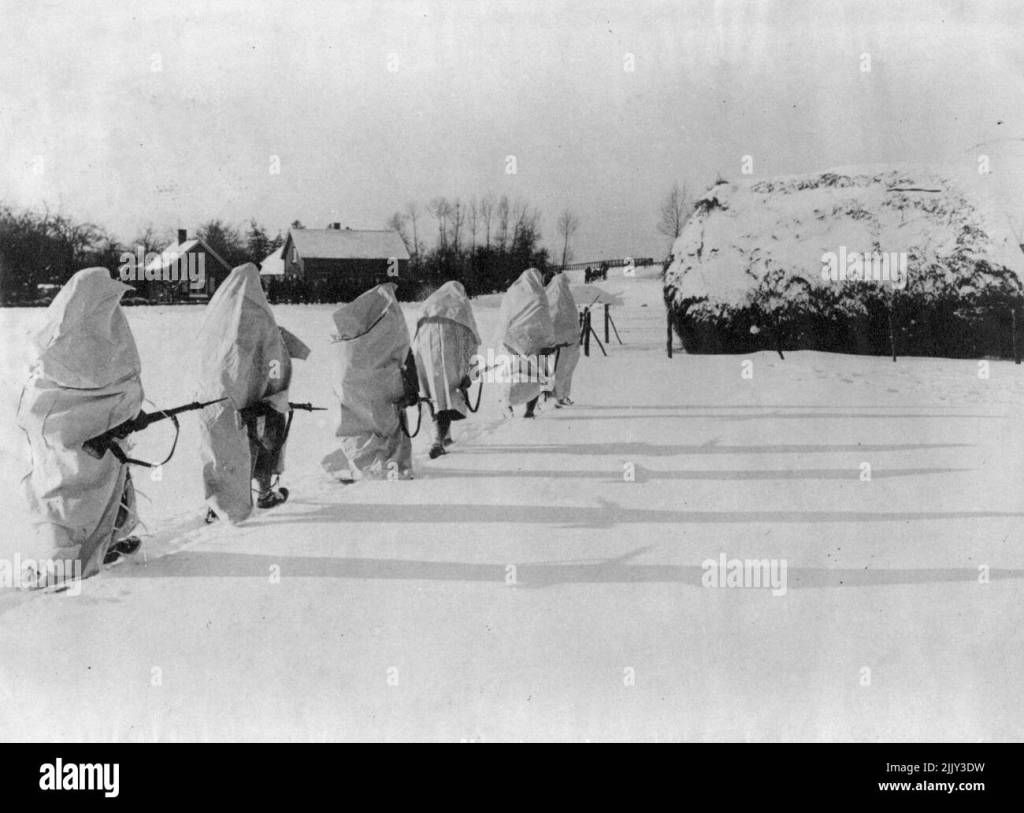
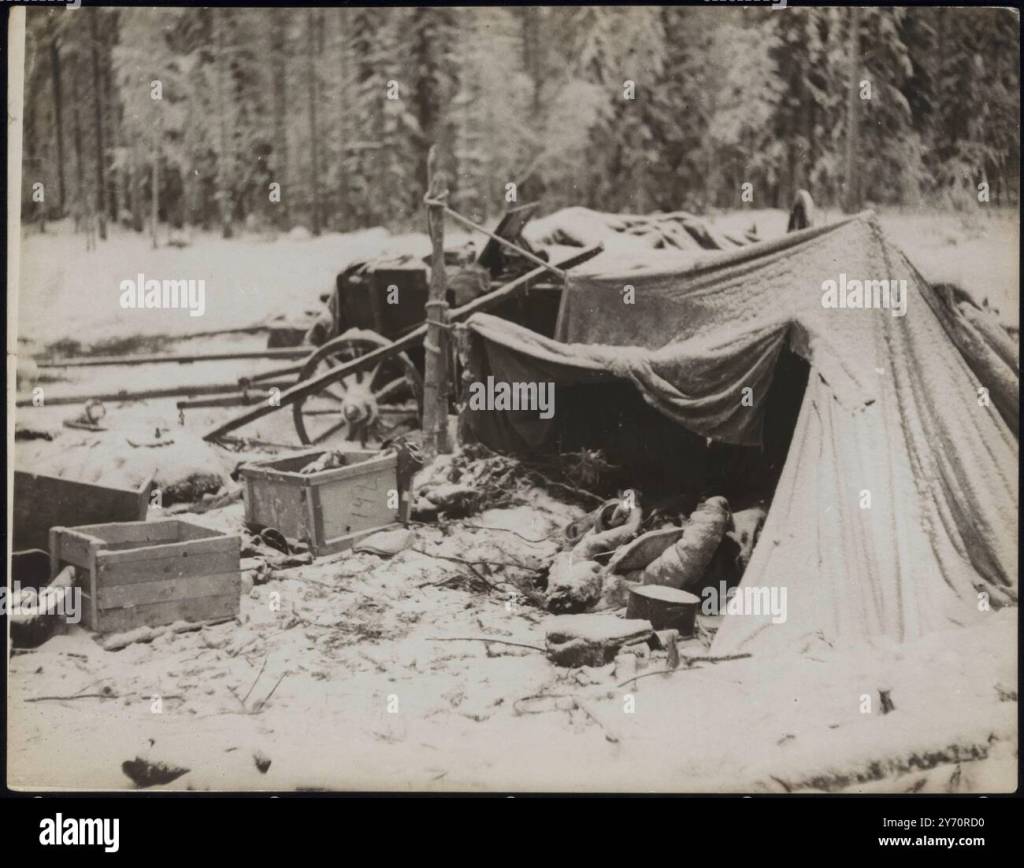
The Soviets continue to prepare a new offensive against Mannerheim Line. Unlike in the initial attack, General Semyon Timoshenko is carefully planning and amassing overwhelming firepower which the Finns cannot hope to match. He abandons Meretskov’s failed strategy to fight along the entire frontier. He instead concentrates all his forces in a direct assault on the Karelian Isthmus to wear down the Mannerheim line in a battle of attrition; essentially this is Chief of Staff Shaposhnikov’s original plan. There is no intention to continue offensives along the Northern frontier or reinforce the divisions already engaged in this region. Thousands of Soviet troops trapped North of Lake Lagoda are left to their fate, although 54th division will be supplied by airdrop.
At Salla, many of the advanced Soviet troops have been pushed back to the town. A small, isolated force remains at Maerkaejaervi a few miles further down the road, but it is cut off. Supplies are being air-dropped to it.
Finnish troops repulse the enemy offensives in Taipale and on the northeast side of Lake Ladoga. The battle of Taipale ends. Finnish forces have successfully resisted the Soviet attempt to break through the left flank of the Mannerheim Line in hand-to-hand fighting.
On the Central Isthmus there is even heavier than normal enemy shelling in the Summa and Lähde sectors. The Soviet 7,000-shell daily bombardment of Summa continues.
Finnish 9th Division arrived at the village of Kuhmo to prepare for a planned attack on the Soviet 54th Division. This is one of the divisions that Timoshenko’s plan leaves without a purpose, and it is to receive no reinforcement and reduced priority. Basically, the Soviet division has been left to live or die on its own where it stands and using its own resources. Colonel Siilasvuo arrives in Kuhmo with the staff of the 9th Division and settles into the Jämäs barracks.
Group Ilomäki is placed under command of the 9th Division.
In Ladoga Karelia, three battalions of Group Talvela launch a counteroffensive on the River Aittojoki.
An Soviet detachment of company strength attacks the islands of Suursaari and Rumakoira in Lake Muolaanjärvi. The Finnish defenders repulse the assault.
In North Karelia, 11 enemy aircraft bomb Nurmes, killing 21 people and injuring 39.
In Northern Finland, a Finnish Gladiator fighter is hit by an explosive shell, bursts into flames and crashes behind enemy lines 3 kilometres west of Märkäjärvi. The pilot, Swedish volunteer Second Lieutenant Johan Sjökvist, is killed.
Finland’s employers recognize the trade union movement. The Central Organization of Finnish Trade Unions (SAK) now has 80,000 members.
The author Frans Emil Sillanpää donates his Nobel Gold Medal to the defence of Finland.
Swedish Conservatives sponsored a bill deposited today in both Riksdag chambers providing for dissolution of the Communist party and aiming at cancellation of its present six seats in Parliament. One Communist member was in the House.
Britain lowered the road speed limit to 20 miles per hour at night time in populated area in response to the sharp rise in night time automobile accidents due to the blackout.
Oliver Stanley announced in the House of Commons that kilts would not be issued to members of Scottish regiments except to pipers and drummers, for reasons connected to the possible use of poison gas by the enemy.
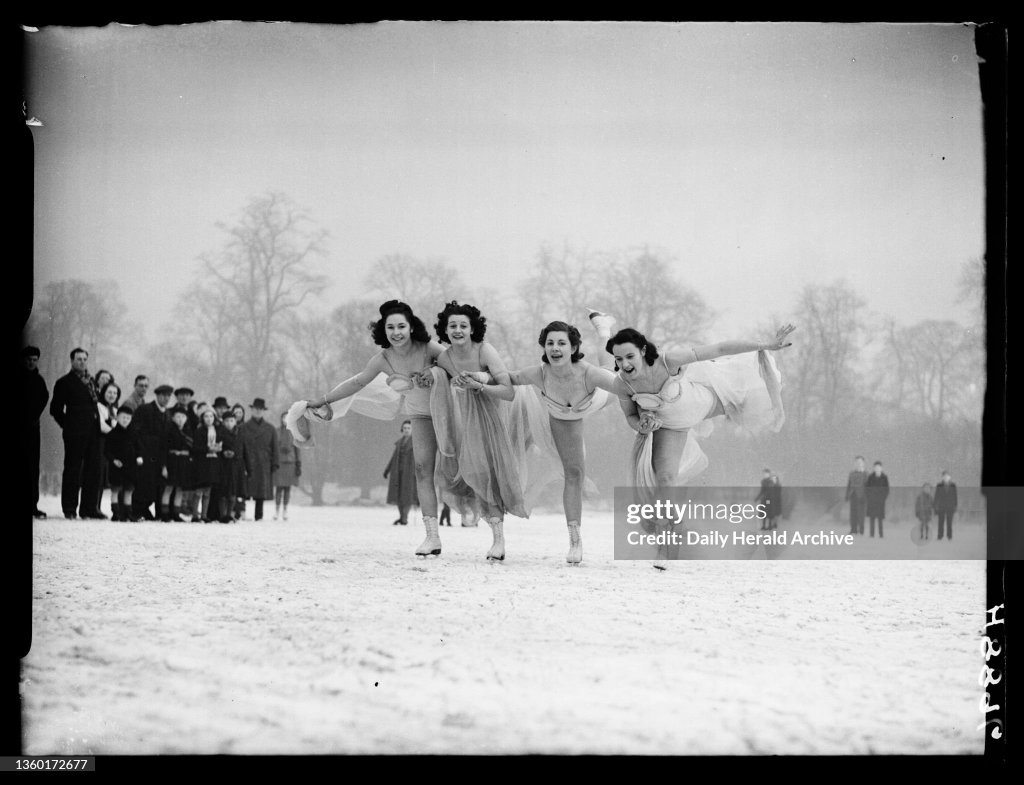
Britain was gripped in the coldest winter since 1894; Southampton docks and parts of the river Thames were frozen over.
Following allegations by troop entertainers that ENSA’s organization in France is in a “chaotic muddle,” its officials are to report to the war office.
Vatican Radio broadcasts excerpts from Cardinal Hlond’s January 6 report to the Pope. (See January 6). The Vatican City radio station made two more broadcasts today, adding many details to the atrocities that supposedly are being committed in German-occupied Poland.
Many pieces are missing from the Balkan jigsaw puzzle, but enough are at hand to put together the broad outlines of the picture that is forming there. In the center is Rumania, with rich oil fields coveted by Germany, of necessity, and by the Allies, with a dog in the manger attitude. On her northern and eastern borders German and Russian divisions are gathered, while in Bucharest, the capital, there is a swarm of Allied and German agents countering threats with bribes and vice versa. in the terrific war of diplomacy and economics that is raging throughout the still peaceful Danubian nations. In just this sort of atmosphere, Sir Reginald Hoare, the British Minister to Rumania, has informed officials of that country that the Allies sincerely hope that nothing will happen to impair the present most cordial relations between them and the little country that they have guaranteed against aggression. This is merely a diplomatic way of informing King Carol not to lean too far backward in his effort to conform to the German view of what constitutes neutrality.
Italian Foreign Minister Count Ciano and Ustaše leader Ante Pavelić discuss plans for an insurrection that would separate the province of Croatia from Yugoslavia. Italy considers the Balkans to be within its sphere of influence.
The Polish National Council meets in Paris for the first time instead of Anvers, with all Polish parties represented. 79-year old pianist and diplomat Ignaz Paderewski was elected head of the Polish National Council, the quasi-parliamentary group that was considered the Polish parliament in exile.
Former South African Prime Minister J. B. M. Hertzog introduced a motion in the House of Assembly that “the time has arrived that the war with Germany should be ended and that peace be restored.” The motion’s wording was ambiguous as to whether it was advocating a general or a separate peace. This is widely interpreted as pro-German. Jan Smuts immediately rebuts it.
At 0701 hours on 23 January 1940, the U-18, commanded by Oberleutnant zur See Ernst Mengersen, fired a G7e torpedo at a small steamer and observed a hit on the starboard side near the bridge and the sinking of the vessel within 40 seconds about 100 miles southeast of Shetland Islands (58° 51’N, 1° 00’E). The U-boat had spotted the ship at 0050 hours and missed her with a first torpedo at 0649 hours. Its victim was very likely the unescorted and neutral Norwegian steam merchant Bisp (Master Rolf Kvilhaug) which was reported missing en route from the UK to Norway. The Bisp was lost with all hands (15 men). The 1,000-ton Bisp was carrying coal and was bound for Åndalsnes, Norway.
At 0843, the neutral Norwegian steam merchant Pluto, was torpedoed and sunk by the U-19, commanded by Kapitänleutnant Joachim Schepke, southeast of the Farne Islands off the southeast Scottish coast in the North Sea (55° 35’N, 1° 27’W). In the morning of 23 Jan 1940, U-19 spotted about 20 single and unescorted steamers east of Longstone Island, apparently ships that had arrived at Methil the day before in convoy HN-8 and were now heading south along the coast. At 0843 hours, Pluto was hit just aft of amidships by one G7e torpedo and sank by the stern within 6 minutes. Baltanglia (Master George Edward Thomas) steamed behind her and manoeuvered to rescue the crew, thinking the other ship had been mined. But a Finnish steamer already picked up the survivors and later landed them at Seahouses, Northumberland. The 1,598-ton Pluto was carrying ballast and was bound for Middlesbrough, England.
At 0855, the British steam merchant Baltanglia was torpedoed and sunk by the U-19 southeast of the Farne Islands (55° 35’N, 1° 27’W). The Baltanglia had been in convoy HN.8 that arrived at Methil the day before and was travelling unescorted down the coast when it had been spotted. At 0855 hours, Baltanglia was hit amidships by one G7e torpedo and sank by the bow after 14 minutes southeast of the Farne Islands. The crew abandoned ship in two lifeboats, which were towed in by local fishing vessels from Seahouses. Of the ship’s complement, all 22 survived and were picked up by a Finnish steamer. The Baltanglia was the second vessel sunk by U-19 that day. The 1,523-ton Baltanglia was carrying general cargo and was bound for Rochester, England.
At 2213, the Finnish cargo ship Onto struck a mine laid on 8 January 1940 by U-56 and sank within minutes 2.7 miles at bearing 251° from Smith’s Lightvessel, off Cross Sand (52° 51’N, 2° 11’E). The crew quickly abandoned ship in two lifeboats: 14 occupants in one of them were rescued by a Greek steam merchant, while the master and five others were picked up from the other boat by HMS Auckland (L 61) (Cdr J.G. Hewitt, RN), which was escorting the nearby convoy FN.79. The 1,333-ton Onto was carrying ballast and was bound for Tyne, England.
The Norwegian cargo ship Ila came ashore on the south coast of England.
The German trawler Mulhausen struck a mine and sank in the Baltic Sea off Pillau, East Prussia.
Convoy OA.78GF departs Southend.
U.S. freighter Excellency, detained at Gibraltar the previous day, is released.
U.S. freighter Excambion, detained at Gibraltar by British authorities since 17 January, is released to proceed on her voyage to Genoa, Italy, but not before 470 sacks of mail (bound for Germany and Italy) are seized.
The War at Sea, Tuesday, 23 January 1940 (naval-history.net)
Light cruiser NEWCASTLE departed Scapa Flow on Northern Patrol, but arrived back on the 29th with defects.
Heavy cruiser NORFOLK arrived in the Clyde.
Destroyers JUNO and JERVIS departed the Humber with minelayer PRINCESS VICTORIA for operation LB, and returned on the 24th after the minelay.
Destroyers ZULU and COSSACK departed Rosyth, with ZULU proceeding to Leith for repairs and refit, and COSSACK to carry out exercises on the 24th. However, she had to return because of an influenza outbreak among the crew.
Destroyers JACKAL, JAGUAR, JAVELIN and ASHANTI departed Rosyth to hunt for a submarine reported off Kinnaird Head.
Destroyers ECHO and ECLIPSE attacked a submarine contact ENE of May Island in 56-14N, 2-23W. Later in the day, ECHO attacked a contact ENE of Montrose in 56-46N, 2-12W.
Anti-submarine trawler BEDFORDSHIRE (443grt), escorting cable ship MARIE LOUISE MACKAY as she was repairing cables west of Lundy Island, dropped depth charges on a submarine contact in 51-11-29N, 5-46-33W. Destroyers ICARUS and IMPULSIVE joined her, but the attack was unsuccessful.
Convoy FN.79 departed Southend, escorted by sloops AUCKLAND and STORK, and arrived in the Tyne on the 24th.
U-18 sank Norwegian steamer VARILD (1085grt) with all hands NE of Kinnaird Head.
U-19 sank British steamer BALTANGLIA (1523grt) and the Norwegian PLUTO (1598grt) NE of the Tyne in 55 35N, 01 27W. All the crew of both steamers were picked up by British fishing vessels.
Finnish steamer ONTO (1333grt) was lost on a mine 2.7 miles 251° from Smith Knoll Light Vessel off Cross Sands in 52-51N, 2-11E which had been laid by U-56 on the 8th. The entire crew were rescued by sloop AUCKLAND.
German trawler MULHAUSEN (327grt) was lost by mining off Pillau.
Battleship VALIANT, light cruiser ENTERPRISE, and destroyers HUNTER and HEREWARD departed Bermuda and arrived at Halifax on the 26th.
The CAVALRY convoy departed Marseilles escorted by Australian destroyers HMAS VOYAGER and HMAS VAMPIRE. Off Malta, they were relieved by Australian sister ship HMAS VENDETTA which escorted the convoy to Haifa.
President Roosevelt today conferred on the matter of additional aid to Finland as the Senate Banking and Currency Committee prepared to open hearings tomorrow with Secretary of State Cordell Hull scheduled to testify in executive session.
President Roosevelt announced the establishment of an interdepartmental committee to deal with foreign purchases of war materials in Washington today. He nominated Captain John H. Towers, Chief of Naval Aeronautics, to be a rear admiral.
The Senate debated the $251,000,000 supplemental Defense Appropriation Bill, heard Senator Mead criticize British interference with American mails and recessed at 4:56 PM until noon on Thursday. The Monopoly Committee resumed its study of the steel industry.
The House approved a resolution extending for one year the Dies committee investigating un-American activities, began debate on the $1,032,154,612 Treasury-Post Office Supply Bill, and adjourned at 4:48 PM until noon tomorrow. The Naval Affairs committee continued study of the naval expansion program, the Ways and Means Committee continued hearings on the reciprocal trade agreements program and the Smith committee continued questioning of review attorneys of the National Labor Relations Board.
Attacking the New Deal policy of borrowing and spending as certain to result in national bankruptcy and disaster, if continued, Thomas E. Dewey declared tonight that any federal administration that wished to do so could balance its budget. He added that, if the Roosevelt administration could not affect a balance, it was time to get a new administration. New York State’s candidate for the Republican nomination for President spoke at a large and enthusiastic meeting in Mechanics Hall under the auspices of the Republican Club of Massachusetts, the Women’s Republican Club of Massachusetts and the Professional Women’s Republican Club of Massachusetts.
In discussing how the federal budget might be balanced, Mr. Dewey took an illustration from his administration of the office of District Attorney of New York County. In the year before he became District Attorney, he said, the cost of public prosecution in his county. was $1,150,000. He added that, though he could easily have doubled that budget, he reduced the cost to $886,000 the first year and to $829,000 the second year. “That is a reduction of 28 percent,” Mr. Dewey continued. “It wasn’t easy; it was the hard way.”
As a first step toward balancing the national budget, Mr. Dewey suggested a reduction in the number of Federal employees, which, he said, had been increased from 570,000 since June 30, 1933, the first year of the Roosevelt administration, to 930,000. An even more important step, “the first duty of the next Administration,” he said, “would be to release the energy of private enterprise, now checked by the burdens placed by the New Deal on industry, to transform unemployment into employment and relief into jobs. “Only in this way can any Administration balance its budget,” he asserted. “Only in this way can it restore the balance of our national life. That is the step no New Deal administration can ever take because it would be turning its back on all the theories of these seven lean years. Only a new broom can sweep clean the budgetary litter of the New Deal.” Mr. Dewey said that “the seven lean years” of the New Deal made it difficult for any Administration to balance the national budget overnight.
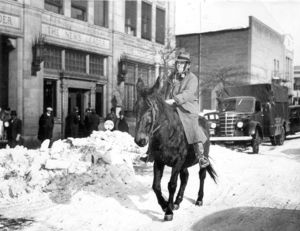
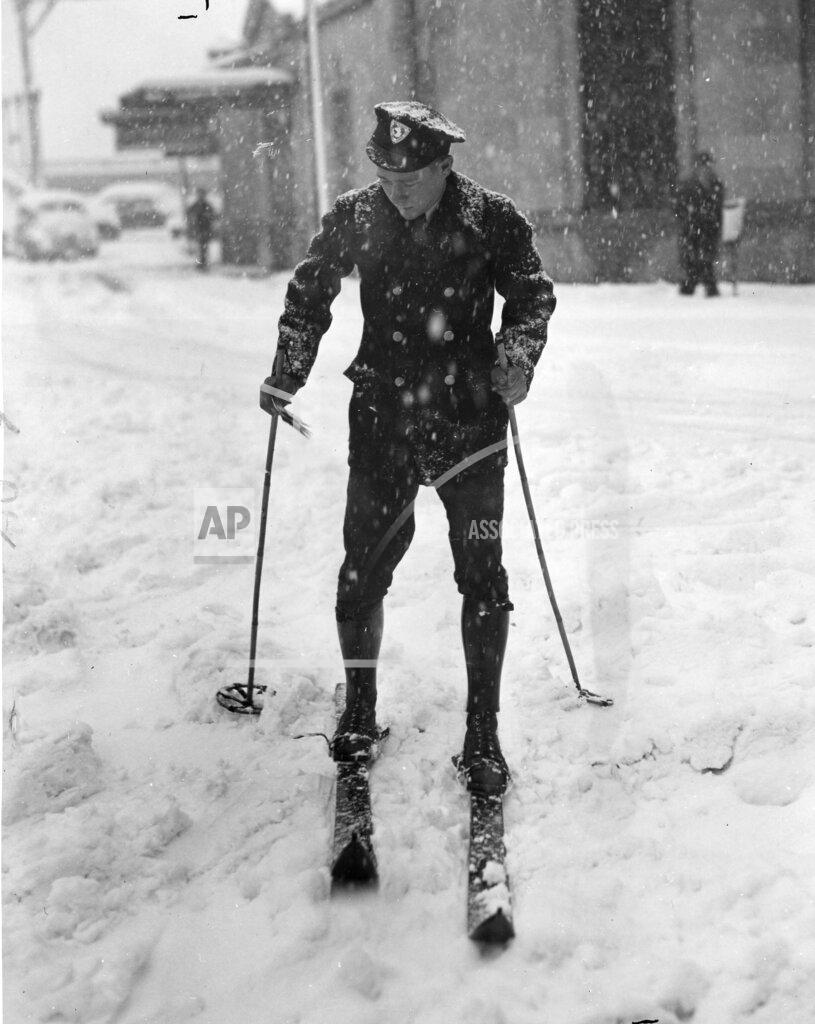
A monster snowstorm hits large portions of the eastern United States, and much worse than predicted. It is known as “the Great Snow of 1940.” Women city workers in Richmond, Virginia (over 16 inches of snow) are told they can stay home, but male workers are still expected to show up because the Mayor can walk to work. Winter even brought an unusual mantle of white to the land of cotton as a heavy snowfall blanketed much of the South, hampering traffic, closing schools and doing widespread crop damage. Over eight inches of snow fell as far south as Atlanta.
By a vote of 345 to 21 the House of Representatives this afternoon extended the life of the Dies committee for another year and ordered it to continue its investigation into un-American activities.
A further cut of more than $200,000,000 in the $1,300,000,000 Naval Expansion Bill may be made by the House Naval Affairs Committee before it reports the bill to the House, it was indicated today.
Senator James M. Mead, Democrat, of New York, urged in the Senate today that Great Britain adopt a “more friendly, more neighborly, more sympathetic attitude toward us.”
Great Britain’s mild surprise of a few days ago over the United States’ protests against operation of the British blockade changed rapidly today to fear that their relations might be seriously impaired by London’s insistence on examining United States mails and detaining United States ships and forcing them into belligerent waters. The last thing the Chamberlain government wants to do is to add to its multitudinous problems a serious squabble with Washington. This was most obvious in London today. Foreign Office officials and members of the staff of the Ministry of Economic Warfare not only denied that they were discriminating against American ships in favor of Italian but were clearly surprised and a little disappointed that such a charge had been made in Washington’s aide memoire last Saturday.
After Earl Browder, general secretary of the Communist party in the United States, had appeared in Federal Court yesterday to file an appeal from his conviction of passport fraud, his followers filed a petition with the Board of Elections last night naming him as the Communist candidate for Congress.
Urging support for the voluntary hospitals of New York, Wendell L. Willkie, president of the Commonwealth and Southern Corporation, warned yesterday against the “progressive game” of government absorption of private agencies.
Joseph Patrick Ryan, president of the International Longshoremen’s Association; ten other union officials, the International Longshoremen’s Association, two of its locals, and a local of the building teamsters’ union were indicted yesterday by a federal grand jury on a charge of conspiracy to violate the Sherman antitrust act. They are accused of having attempted to force certain retail lumber dealers to coerce their employees to leave their own union, Local 104 of the United Retail and Wholesale Employes of America, an affiliate of the Congress of Industrial Organizations, and become members of the defendant unions, which are members of the American Federation of Labor.
Caught in a blinding rainstorm, a U.S. Army Air Corps B-18 Bolo medium bomber struck a hillside near Riverside, California today, killing four of its six occupants. Two men parachuted to safety.
Unification of the British and French commissions for buying war supplies in the United States was consummated officially yesterday afternoon. Formation of the Anglo-French Purchasing Board was announced.
In crisp zero weather an interested crowd of several hundred persons welcomed James H.R. Cromwell, the new United States Minister to Canada, and his wife, the former Doris Duke, when they arrived at Ottawa at 11:30 this morning from Montreal.
Great Britain and France announce they will attack any German vessels encountered in Pan-American Safety Zone. In a more conciliatory tone than Great Britain used, but nevertheless unequivocally, France has replied that a sea security zone around the Americas does not seem practicable.
U.S. Navy destroyer USS J. Fred Talbott (DD-247) arrives at Wreck Bay, Galapagos Islands, to assist U.S. tuna boat City of San Diego (see 24 January).
Argentina and Brazil tonight signed a new treaty of commerce and navigation granting each other unconditional and unlimited most-favored rating treatment.
Chinese Winter Offensive: Elements of Japanese 22nd Infantry Division advancing toward Shaohsing against Chinese 3rd War Area.
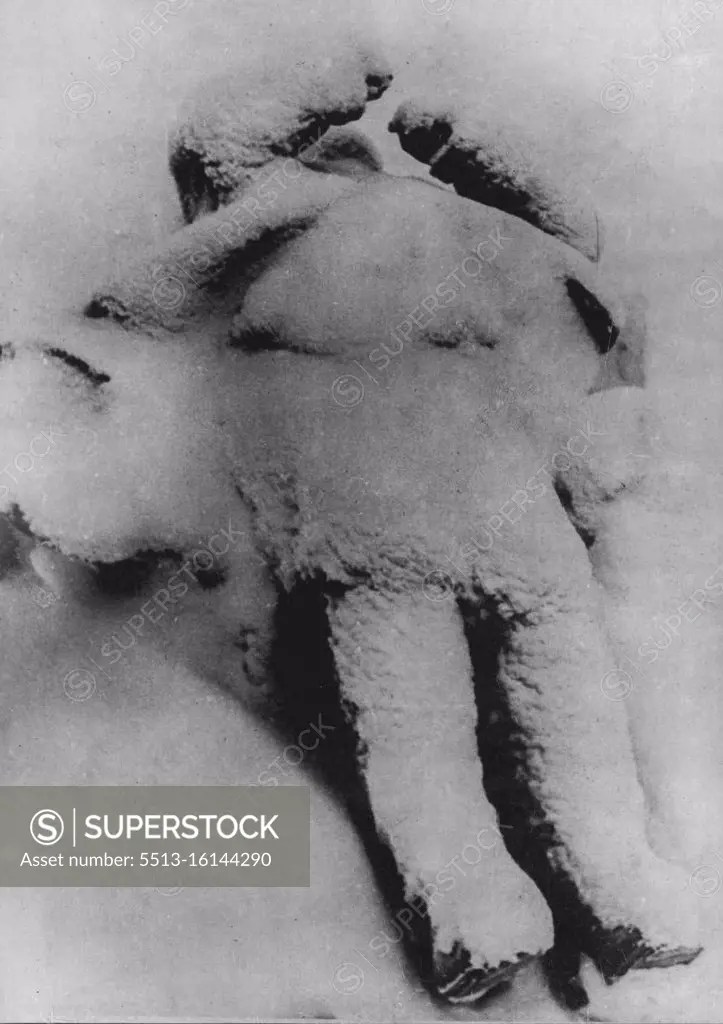
A severe cold wave hits China; 650 die in Shanghai alone. Over 400 were reportedly infants or small children.
The Chinese claimed an important victory over the Japanese forces north of Hupeh today. A Japanese column of 20,000 men, advancing northward from Suihsien, was said to have been smashed at Kaocheng. Several thousand Japanese were reported killed or injured as the Chinese cut the rear of the Japanese column and recaptured Kaocheng by frontal attacks. Meanwhile snow blankets most of the battlefields and record cold weather is gripping most parts of China.
In battles fought in pelting snowstorms and bitter cold, the Chinese reported today that they had routed a Japanese attack near Chaocheng in Western Shantung Province; they had thrown back a Japanese attempt to break through their lines in Northern Hupeh Province, and dynamited two troop trains in Shantung. In the Chaocheng battle, the Chinese said, many Japanese dead and large quantities of arms were left on the field. Many were killed when the trains were blown up on the Tsingtao-Tsinan Railroad, they said.
There has not been a single denial of the substantial correctness of the reported pact between Wang Ching-wei and the Japanese from even a semi-official Japanese source. Chou Fohal, chairman of the executive committee of the Wang party, said at Tsingtao that the published document was not an agreement but “only a private draft prepared by a group of Japanese and not based upon the wishes of the Japanese Government. He added that the document differed greatly from the final text of the actual agreement and included embellishments with terms not contained in the original Japanese draft.
Diplomats in Shanghai say that if less than half the document’s demands are authentic, they mean repudiation of repeated promises by three succeeding Japanese Governments that Japan does not intend to infringe on the rights and interests of third powers in China except the minimum necessary while hostilities continue. It is impossible to overestimate the damage the disclosure of the agreement has done to Wang Chingwei’s move to establish a puppet government. It is alienating the prospective support of many important Chinese who had been debating whether to join the Wang group.
Commenting on the secret agreement that Wang Ching-wei and the Japanese are reported to have recently signed, Generalissimo Chiang Kai-shek today warned the people of countries friendly to China that a Japanese menace to the interests and territory of third powers was inherent in the agreement. General Chiang said the agreement “baldly indicated” the present policy of Japan “is the complete military, political and economic domination of China, making her a Japanese protectorate in all but name.
Relations between the United States and Japan will continue on the present basis after the expiration on Friday of the commercial treaty of 1911, but these relations will be on a day-to-day basis. They will be subject to change at any time and will not even have the benefit of a most-favored-nation modus vivendi as a stop-gap until such time as a new commercial treaty is concluded. This was the burden of an oral statement made today by A. A. Berle Jr., Assistant Secretary of State, to Kensuke Horinouchi, the Japanese Ambassador, who called for information on the subject. It was what had been expected as the Friday deadline approached — a negative statement carrying such assurance as it does for the present but containing no commitments for even the immediate future.
Ambassador Horinouchi had planned to see Secretary of State Cordell Hull but he was confined to his hotel with a cold and instead the Ambassador was referred to Mr. Berle. Ambassador Hourinouchi asked three questions:
- Whether, on the expiration of the commercial treaty, there would be any change in the import duties and tonnage rates.
- Whether there was any possibility of any exchange of notes between the two governments defining the status of trade relations.
- What would be the status of Japanese merchants who under the treaty provision have been doing business in the United States.
In response to the first question he was told that the expiration of the treaty would not of itself bring any changes, but, as this government had repeatedly made clear, further commercial relations between the two countries would depend upon developments. In answer to the second question he was told this would have to be held open and presumably form a part of the discussions that have been taking place in Tokyo between Joseph C. Grew, the United States Ambassador, and the Japanese Foreign Minister. The reply to the third question was more detailed and technical. The Japanese Ambassador was informed that it had been decided that aliens who in the absence of treaty provisions within the meaning of Section 2 (6) of the Immigration Act of 1924, as amended, and who ceased to have the status of “treaty merchants” would be permitted to qualify as visitors temporarily admitted for business or pleasure under Section 3 (2) of the Immigration Act of 1924.
Japan lodges a formal protest over the British seizure of 21 German passengers on the Asama Maru on 21 January 1940. The Privy Council will act tomorrow on the Cabinet’s decision to take measures to prevent another British seizure of Germans from a Japanese ship, according to Domei, the Japanese news agency.
Dow Jones Industrial Average: 145.49 (+0.36)
Born:
Jimmy Castor, American pop & funk musician (“Troglodyte (Cave Man)”, Jimmy Castor Bunch), in New York, New York (d. 2012).
Johnny Russell, American country singer, in Moorhead, Mississippi (d. 2001).
Ed Holler, NFL linebacker and punter (Pittsburgh Steelers), in Bluefield, West Virginia.
Dick Burwell, MLB pitcher (Chicago Cubs), in Alton, Illinois.
Naval Construction:
The Royal Navy “S”-class (Third Group) submarines HMS Safari (P 211), HMS Sahib (P 212), and HMS Saracen (P 247) are ordered from Cammell Laird Shipyard (Birkenhead, U.K.).
The Royal Navy “S”-class (Third Group) submarine HMS Sceptre (P215) is ordered from the Scotts Shipbuilding and Engineering Company (Greenock, Scotland).
The Royal Canadian Navy Flower-class corvettes HMCS Matapedia (K 112), HMCS Arvida (K 113), HMCS Summerside (K 141), and HMCS Louisburg (K 143) are ordered from the Morton Engineering and Dry Dock Co. (Quebec City, Quebec, Canada).
The Kriegsmarine (German Navy) Type 35 torpedo boat T5 is completed.
 History Diaries