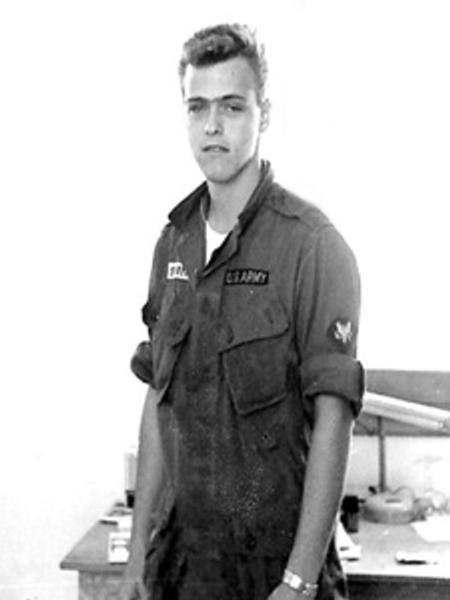
William is buried at Mount Olivet Cemetery, Bloomfield, Essex County, New Jersey. He is remembered on the Wall at Panel 1E, line 83.
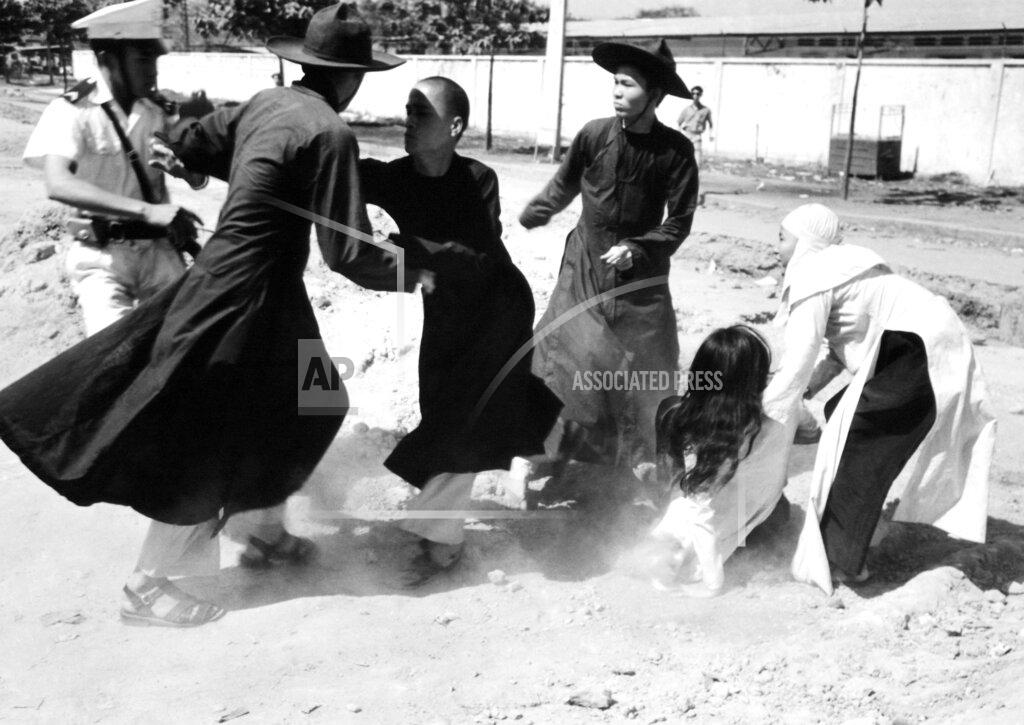
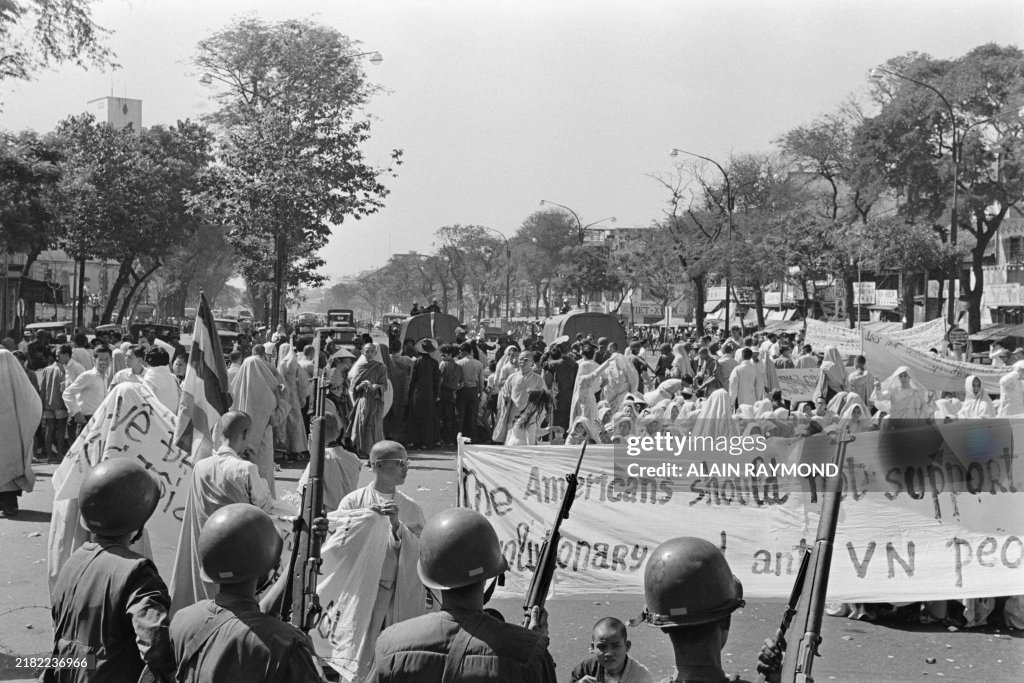
Rioters in the city of Huế, South Vietnam burned down the U.S. Information Agency, and a teenage girl set fire to herself in protest, after South Vietnam’s Prime Minister Trần Văn Hương issued a decree to increase the number of young men who would be drafted into the Army of the Republic of Vietnam (ARVN) to fight against the Viet Cong. After the rioting continued nationwide for ten days, the ARVN’s generals replaced him. Buddhist leaders of South Vietnam ordered a militant struggle today against the United States to protest its support for Premier Trần Văn Hương. In Huế, the central Vietnamese city where the Buddhists are strongest, student-led demonstrators sacked the United States Information Service library. A mob of 5,000 attacked the two-story library and destroyed 8,000 books, according to telephoned reports. Agitators demanded the withdrawal of Maxwell D. Taylor, the United States Ambassador, within 48 hours. They warned shops and restaurants to refuse to do business with Americans, including servicemen.
A communiqué issued by the Buddhist headquarters in Saigon denounced Premier Hương as a “lackey” of Ambassador Taylor. It accused Mr. Taylor of seeking to exterminate the Buddhists. The communiqué summoned Buddhists to follow the example of Thích Trí Đức, the first monk to burn himself to death in the 1963 campaign that led to the removal of President Ngô Đình Diệm. Buddhist leaders spread rumors in the capital that a new suicide by burning might soon. take place before the United States Embassy. The violence of Buddhist rallying cries seemed to be a reaction to the firmness adopted by the government and the United States Embassy in the face of Buddhist agitation.
Troops have largely thwarted plans for a general strike. They have cordoned off the main Buddhist pagodas. The police said 223 persons were arrested yesterday in demonstrations before the Embassy, in the stoning of the United States Information Service library here and in rioting at Buddhist schools. Ambassador Taylor and U. Alexis Johnson, the Deputy Ambassador, conferred with Premier Hương and were informed of decisions taken by the Cabinet at an emergency session. Government sources said that the Cabinet, which includes four military leaders, had decided to curb demonstrations but to avoid incidents that might provide martyrs for the protest movement. There was discussion of a conciliation effort, but no move has been made so far.
The campaign against the United States began to gather momentum after a meeting on January 10 between Ambassador Taylor and Thích Trí Quang, the activist Buddhist leader. The Ambassador refused to bend to the monks’ political demands. Grievances ranging from persecution to suppression of the church press have been lodged by Buddhists against Premier Hương. Independent analysts suggest, however, that the Buddhist organization is motivated more by a desire for political power than by religious or other reasons. Buddhist leaders have also been angered by the impassive response of government and embassy officials to the current hunger strike of five leading monks. Thích Trí Quang, head of the church’s religious arm, and Thích Tâm Châu, leader of the secular organization, are among the monks who entered the fourth day of the “fast unto death.” At the Buddhist headquarters, barricaded by troops, five yellow-robed monks reclining on mattresses near a huge statue of Buddha prayed by counting their beads and slept. Officials at the center said they were ill and in deteriorating condition.
In the Buddhist communiqué, Thích Huyền Quang, secretary general of the headquarters organization, asserted: “The policy of the United States Ambassador and Hương, lackey of the United States Ambassador, is to let leaders of Vietnamese Buddhism die and to exterminate Vietnamese Buddhism.” The troubles in Huế began this morning when about 90 monks and nuns paraded from their pagodas to the United States consulate. They presented a petition addressed to President Johnson, appealing to him and to Ambassador Taylor to stop supporting the Hương Government.
The demonstrators carried two banners. One read, “Thanks” to Americans for Sacrifices for the Freedom Ideal of the Vietnamese People.” The other declared “Down With Taylor, Who Supports the Policies of Demolishing Buddhism.” This two-sided attitude toward the United States was typical of the Buddhists until they adopted their new, violent line. The abrupt hardening of their attitude appeared to reflect a change in the thinking of Thích Trí Quang, who in September, 1963, was granted sanctuary in the United States Embassy after he escaped from President Diem’s police.
In Huế, about 5,000 people in a three-hour parade before the United States consulate shouted. “Taylor, go home!” Members of the crowd began throwing stones despite admonitions from some student leaders at the windows of a nearby building. About 40 demonstrators broke into the library on the ground floor and set fire to the books, smashed furniture” and broke windows. William B. Stubbs 3d, a public affairs officer, escaped from the building through the backdoor with an American teacher. The police did not interfere. Mr. Stubbs returned to the burning library with Vice Consul Samuel B. Thomsen. They sought to put out the blaze with fire extinguishers and pails of water. Mr. Thomsen called at the office of the provincial government to protest the attack. The Saigon police still held 12 monks and 8 nuns arrested during the library stoning.
Seven other Buddhists, including Tràng Định, lay assistant of Thích Trí Quang, were arrested as they drove out of the Buddhist center in a black limousine. Government spokesmen have accused Tràng Định of leftist sympathies. Most experienced observers have found little evidence, however, that the Buddhist leadership has been infiltrated by agents of the Việt Cộng. The observers say that it is the rank and file of the Buddhist movement that has been infiltrated. In demonstrations such as those in Huế and Saigon, the police have arrested agitators described as Việt Cộng agents. United States officials feel that the recent Buddhist tactics have served Communist purposes even if the leadership has not been doing so intentionally.
Premier Hương made an emotional radio appeal tonight for an end to the violence directed against him and the United States. “At this solemn hour.” he said, “the life of the nation is in the people’s hands. Have we the right to let the nation be taken over by hoodlums who will hand it over to the Việt Cộng and their masters, the Chinese Communists? The answer is no, certainly no.” Premier Hương condemned the rioting in Huế and Saigon and especially the attacks on United States buildings.
A traveler who arrived at Phan Thiết, on the South China Sea coast, reported today that his bus was stopped three times in one hour by Việt Cộng roadblocks. The first time, in daylight about 70 miles east of Saigon, the passengers watched from the bus as the driver paid an undisclosed sum to the Communist guerrillas and was given a printed receipt. The second time, the bus was searched by the guerrillas and one man was taken off. The third time, two Vietnamese Air Force began circling overhead, attracted by the halted line of vehicles. The guerrillas disappeared into the jungle.
Assistant Secretary of State William P. Bundy said today. that “significant numbers” of trained North Vietnamese soldiers had for the first time been infiltrating into South Vietnam to support the Communist guerrillas.
North Vietnam charged that six warships under the command of United States and South Vietnamese authorities shelled one of its towns early today, killing a woman and child, wounding three others and destroying a house. The Hanoi radio, in a broadcast monitored here, said one of the attacking warships had been damaged by the North Vietnamese army. The broadcast said. Colonel Hà Văn Lâu, chief of the liaison mission of the North Vietnamese army’s high command, had informed M. A. Rahman, Indian chairman of the International Control Commission in Hanoi, of the alleged attack.
Three months after the fall of Nikita S. Khrushchev, the Chinese-Soviet conflict threatens to erupt again with all its old bitterness. Western specialists here feel that it is only the determined, almost desperate restraint of the new Soviet leaders that prevents an immediate resumption of all-out public polemics. The Russians have refrained so far from answering increasingly harsh attacks by the pro-Chinese leaders of Albania and the Communist party of Japan. The Russians are understood to be determined to cling to this moderation as long as they can, and certainly through the meeting of the 26-member drafting commission that is to begin here March 1 to make preparations for a world conference of Communist parties.
This meeting, which was originally to have opened December 15. has been called by Moscow in defiance of strong opposition by the Chinese Communists of the 26 parties, 18 are certain to attend, six are certain to stay away and two are doubtful, according to information here. The Cuban and the Rumanian parties are the doubtful ones. Both have been taking a relatively independent line in the ideological conflict. And both have remained silent on the issue of the coming conference in spite of strong pressure from Moscow. Those that will stay away are China, North Vietnam, North Korea, Albania and the Communist parties of Indonesia and Japan. Their number may be reduced by one if the Russians decide to invite a newly created pro-Soviet splinter party in Japan. This is a step that they may hesitate to take as it could set a precedent dangerous for them in other countries. The Chinese are reported to have refused to accept a letter containing an invitation to the March meeting when the Soviet Ambassador tried to deliver it recently in Peking. But so far they have not commented publicly on the conference issue. If the Chinese decide to issue a public statement, as is thought likely here, it could be only a strong blast that would sharpen the conflict.
So far the Chinese have been making their strongest attacks on the new Soviet leader by indirect means. A few days ago the Chinese published an editorial that had appeared in the Albanian Communist newspaper Zeri i Popullit, accusing the new Soviet leaders of having adopted Mr. Khrushchev’s entire “revisionist” policy and calling the Soviet policy an “ulcer” that must be eradicated by revolutionary action. Jenmin Jih Pao, the Chinese Communist party organ, also gave two full pages last Monday to an only slightly less vitriolic attack on the Kremlin by the Japanese Communists.
In the Congo, a rebel force struck across the Congo River today from the former French Congo and captured the village of Nkolo, 200 miles north of Leopoldville. Radio reports received this afternoon from Bolobo, a town 20 miles south of Nkolo, said the rebels were marching toward the town. About 20 whites in Bolobo, including several British Protestant missionaries, were reported to be preparing to evacuate the town. Radio contact with Bolobo was lost late this afternoon. The fragmentary reports reaching here gave no indication of the size of the rebel force that crossed the river. However, the Congolese rebels are known to have a training base at Gamboma, just across the Congo River from Bolobo. About 900 rebels are believed to be in training at Gamboma under Chinese Communist instructors.
Iranians are still speculating why a youth tried Thursday to kill Premier Hassan Ali Mansour, who was reported today to be making good progress in recovering from his wounds. Mohammed Bokharii, the youth who shot the Premier outside the Parliament building, was probably a religious fanatic. He belonged to a religious group called Maktab, which the authorities had ignored because it seemed harmless. That movement is under the influence of a cleric named Ruhollah Khomeini.
Efforts continued today to find a compromise formula for settling the thorny issue of United Nations financing without a confrontation between the United States and the Soviet Union.
The Spanish Government has decided to broaden cultural and economic exchanges with the Soviet Union and other Communist countries in Eastern Europe.
This is a presidential election year in Portugal, and for the first time in more than three decades the results could have a decisive influence on the country’s course.The election is important not because opponents of the 33-year-old regime of Premier Antonio de Oliveira Salazar are expected to triumph, but because Dr. Salazar will be 76 years old in April. The outcome is expected to have a bearing on the succession. “Only Salazar can overthrow the Salazar regime,” neutral political observers have said. It is generally believed that Dr. Salazar’s rule will end only with his death or forced retirement because of illness or age.
The chairman of the Labor party, Ray Gunter, said tonight that British workers would have to get over “selfishness” and get down to work if Britain’s economy was to grow.
A Tibetan monk who escaped last September from the monastery of the Panchen Lama declared here today that the Lama’s life was in danger from the Chinese Communists.
The Mongolian Communist party is hunting down pro-Chinese elements in its ranks who advocate a rupture of relations with the Soviet Union, the journal Partiinaya Zhizn (Party Life) said today.
Reaction here to the recent joint declaration by President Johnson and Premier Eisaku Sato of Japan on United States administration of the Ryukyu Islands ranges from mild satisfaction to resentment. The declaration acknowledged Japan’s claim to the Ryukus but reaffirmed a need for the American military presence here until such time as a reduction in Asian tensions permits the” United States to withdraw its forces from Okinawa. It was an outgrowth of talks between the two leaders during Premier Sato’s visit to Washington. Okinawans who would most like to see the Ryukyus revert to Japanese control are Government workers and teachers. They contend, perhaps with some justification, that Japan’s social security and pension systems would work to their advantage.
Israeli Deputy Defense Minister Shimon Peres warned Lebanon today that her decision to divert the headwaters of the Jordan might provoke punitive action by Israel.
General Mustafa al-Barzani, leader of the Kurdish revolutionary movement in northern Iraq, has appealed to “friendly countries” and the United Nations “to prevent another war and to resolve our national question peacefully and justly.”
Italy is engaged in a long-term war on poverty that, comparatively, reduces President Johnson’s action in the same field to a skirmish, Naples is in the front line. The United States is attacking pockets of poverty in a vast continent of unexampled prosperity. Italy has the task of bringing 40 percent of her area and slightly more than a third of her population-the entire country south of Rome plus the big islands of Sicily and Sardiniaout of stagnation and poverty and into a mid-20th century economy.
Paolo Emilio Taviani, the Italian Minister of the Interior, has declared war against pinball machines and slot machines.
Argentine President Arturo U. Illia sounded an urgent warning today for the Latin-American nations to take a “firm and decisive stand” against all movements that advocate subversion and terrorism as a political weapon.
Sir Edric Bastyan, Governor of South Australia, officially opened Kensington’s Olympic sports arena.
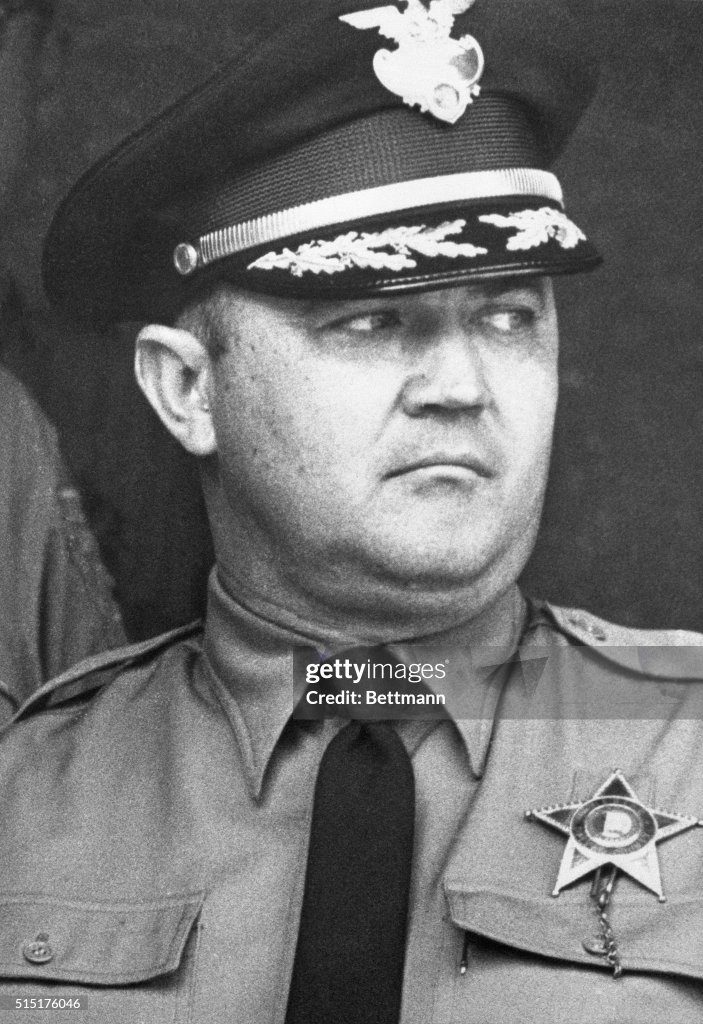
A Federal judge ordered Sheriff James G. Clark today to quit interfering with Black voter applicants, and warned that “violence on either side will not be tolerated.” District Judge Daniel T. Thomas issued the order from Mobile after last night’s confrontation, in which Sheriff Clark and his deputies routed more than 100 Black teachers from the courthouse steps, using their clubs. Judge Thomas said his temporary restraining order was not intended “to interfere with the legal enforcement of the laws of Alabama, Dallas County, or Selma,” but added: “Under the guise of enforcement there shall be no intimidation, harassment, or the like, of the citizens of Dallas County legitimately attempting to register to vote, nor of those legally attempting to aid others in registering to vote, or encouraging them.”
The latter statement apparently gave the Rev. Dr. Martin Luther King Jr., head of the Southern Christian Leadership Conference, freedom in pushing the Selma integration drive, which he began last Monday. Dr. King left the city the next day to keep speaking engagements in the North, but returned last night and said the teachers’ march on the courthouse to protest voter-registration procedures had made his “dream” come true, His dream, he said, was to see professional, well-educated Negroes join the civil rights movement.
Dr. King left Selma again this morning to spend the weekend at his home in Atlanta, but plans to return Monday morning, when the voter-registration office will be open again. Selma was quiet today and Black leaders said they planned no further activity before a mass meeting tomorrow night. A white segregationist, James Robinson, who slugged Dr. King last Monday when he integrated a local hotel, was back in town and was under close watch by city and federal officers. Judge Thomas’s order went into the Selma situation in detail and spelled out just how the court felt the voter applicants should be physically handled. “Unnecessary arrests have been made, provoked by unnecessary assemblage by people at improper places,” he said,”
He directed the sheriff’s office to issue applicants consecutive numbers, 1 through 100, on a first-come, first-serve basis. “Those seeking to register and those seeking to act as vouchers will form an orderly line not more than two abreast from the entrance of the office of the Board of Registrars down the corridor in a line through the entrance of the Lauderdale Street door… and such persons are to be admitted in the office of the Board of Registrars numerically.” Sheriff Clark has insisted that the Blacks stand in an alley awaiting their turn to register.
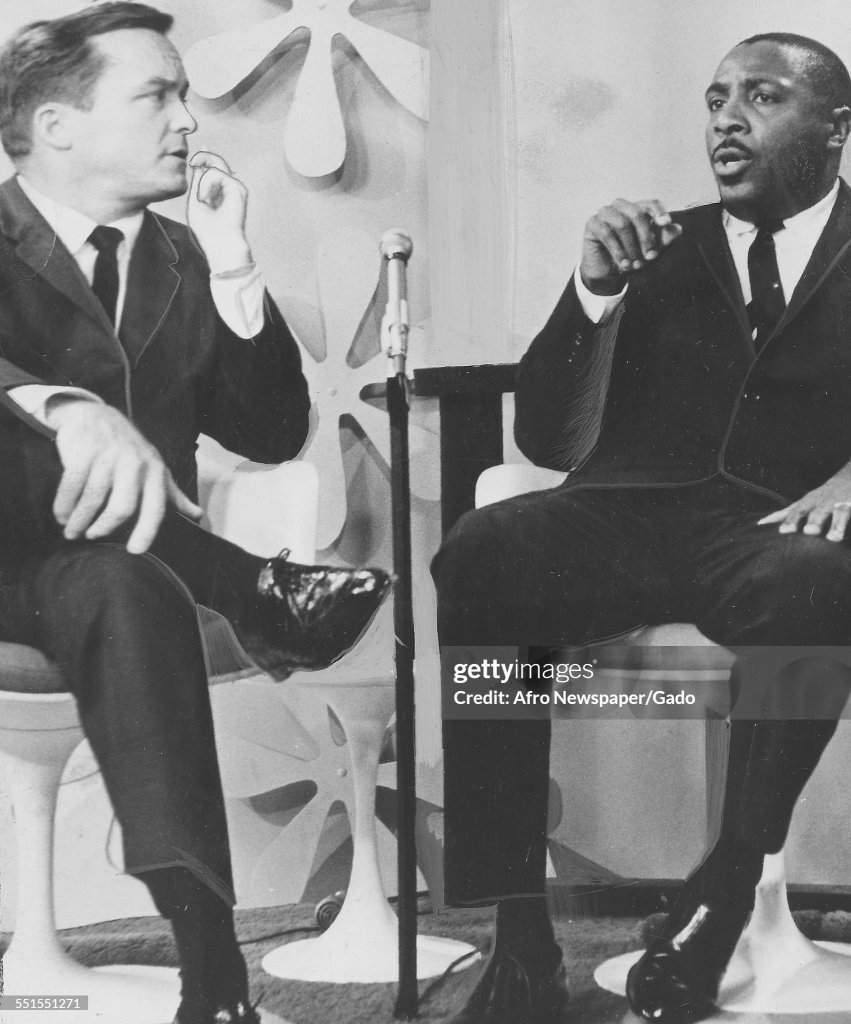
Bright as a fiery cross is the illuminated message on the marquee of the Muse Theater in Perry, on the southern edge of the central Georgia peach belt. No matter how popular the movie, top billing, in foot-high letters, goes to the words: “COMMITTEE OF 1,000 PRIVATE.” The conversion of the theater into a private club is symbolic of the evasion, intimidation, and humiliation that some Southern Blacks say they have encountered while seeking the access to public accommodations guaranteed by Title II of the Civil Rights Act of 1964. Southern segregationists have suffered setbacks in the larger cities. But, backed by economic power and generations of customs, they are fighting delaying actions in smaller cities, towns, and rural areas and even in some metropolises in which desegregation seems uniform. This was the consensus among the prominent Blacks interviewed during a 10-day tour of the South. First-hand observation gave support to their view. The type of compliance found in some areas was demonstrated last week in Tuscaloosa, Alabama, Dick Gregory, the Black comedian, led a group into a restaurant there under the full glare of publicity. They were served. A day earlier, however, other Blacks were not. An authority in the Justice Department in Washington says of this opposition to desegregation: “We will have to come grips with evasion.”
Delays in desegregation have produced a number of offshoots that have stirred resentment among Blacks in the South who have been active in the fight. One result has been to discount idealism among Southern whites. This was summarized by Mrs. Ruby Hurley, who heads the National Association for the Advancement of Colored People in the Southeastern states. “There are only two languages the white folks understand,” she said, “the ballot and the buck. When the cash registers keep quiet, they react.” Some Black leaders concede that Blacks themselves are partly to blame now that the Civil Rights Act is law. This is the position of the Rev. Kelly Miller Smith of Nashville. “We are now in another phase of the desegregation fight,” he said. “Negroes have to be educated. Too many Negroes are not desegregated mentally yet.”
In Jackson, Mississippi, the Greyhound bus terminal is, technically, desegregated. Blacks, however, go to one waiting room and whites to another. When a bus arrives, the Blacks do not go aboard until the whites have. The whites sit in the front and the Blacks at the rear. There are no segregation signs in the waiting rooms. No one orders the Blacks to go to the rear of the bus. Blacks say that if they sit in the white waiting room, however, they may be insulted or threatened. Much worse, however, is the economic power that can be used against a Black who violates a local custom that is much older than the Civil Rights Act. The Blacks say that if they are recognized there is a chance they will be reported to their employers and will be discharged.
One of the most widespread complaints heard concerns restrooms at gasoline stations. Very often, all signs on the restrooms have been removed or painted out. When a Black wants to go to a restroom, he is directed by the attendant to the one that is reserved, as always, for Blacks of both sexes. If he asks to be allowed into one of the other restrooms, he will be told that the attendant has lost the keys to those rooms or that the plumbing is defective. In western Tennessee, outside Memphis, where segregationist sentiment is much stronger than in such cities as Nashville or Chattanooga, a white attendant was attacked by whites when he allowed a Black to use toilet facilities usually segregated for whites.
In a small town in southern Georgia the other day, a Black tourist stopped at a hamburger stand on U.S. 301, the main route between New York and Florida. He sat at a counter formerly reserved for whites and received prompt and polite service. While he was there, two Blacks who live in the area, both teachers, went to the rear of the establishment and placed their orders. “There was no requirement that they go to the rear,” said a civil rights leader who observed this incident. “They were doing what was expected of them by the white community.” Variations of this story can be heard and seen throughout the South. While racial barriers have been breached at one establishment after another, whites say, there is probably less desegregation in restaurants, motels. theaters and at athletic events — especially in the Deep South — than there was immediately after the Civil Rights Act of 1964 was enacted six months ago.
Testing of the law by civil rights groups, widespread during July and August, has declined in many areas. Fewer Blacks are seen now in establishments open to them. The use of public accommodations once restricted to whites has not become a pattern among Southern Blacks. This finding is based on a survey of the region and on interviews with white businessmen, local officials and members of the Federal agencies concerned with the implementation of the law. The consensus among whites is that there has been more compliance with less strife and disruption of business than had been anticipated. John Doar, head of the Justice Department’s Civil Rights Division, agreed.
“There doesn’t seem to be any unified or organized resistance to Title Two on a broad basis,” Mr. Doar said. “Some individual cities and businesses continue to resist, and these problems have to be dealt with on a case-by-case basis. But my reaction is positive. The business community deserves a heck of a lot of credit and I am counting on it to do as well in respect to employment opportunities.” Although most Southern businessmen oppose the law as an infringement on their liberty, many of them seem relieved now that it is in force. “With or without the law, integration of public accommodations was coming,” one business leader said. “Some who wanted to desegregate were afraid of adverse reaction by their white customers. The law applies to everyone and gives them an out.”
A hometown banquet honoring the Rev. Dr. Martin Luther King Jr., which provoked behind-the-scenes controversy in Atlanta business circles when it was proposed, has won overwhelming public endorsement.
A constitutional test of Virginia laws that make it a crime for a white person to marry a Black will begin in federal court in Richmond, Virginia next week. The case is regarded as certain to go to the United States Supreme Court and may become a landmark.
A “well-organized” group of Air Force Academy cadets has been stealing academic examination papers and “offering them for sale,” it was announced today. More than 100 cadets, including about 30 members of the academy football squad, are believed to be involved in the cheating scandal that broke out Monday. Twenty-nine cadets have already resigned, but the dimension of the scandal rocking the newest of the nation’s four service academies had not been made public until today. The announcement was made in Washington by Eugene M. Zuckert, Secretary of the Air Force. He disclosed that the investigation “so far indicates the existence of a well-organized group of 10 to 12 cadets who have been stealing test papers and offering them for sale.”
The Labor Department said today that about 20 million Americans did not have even the minimum training required for most jobs today.
Republicans in the House indicated some support today for President Johnson’s $1.255 million school aid bill.
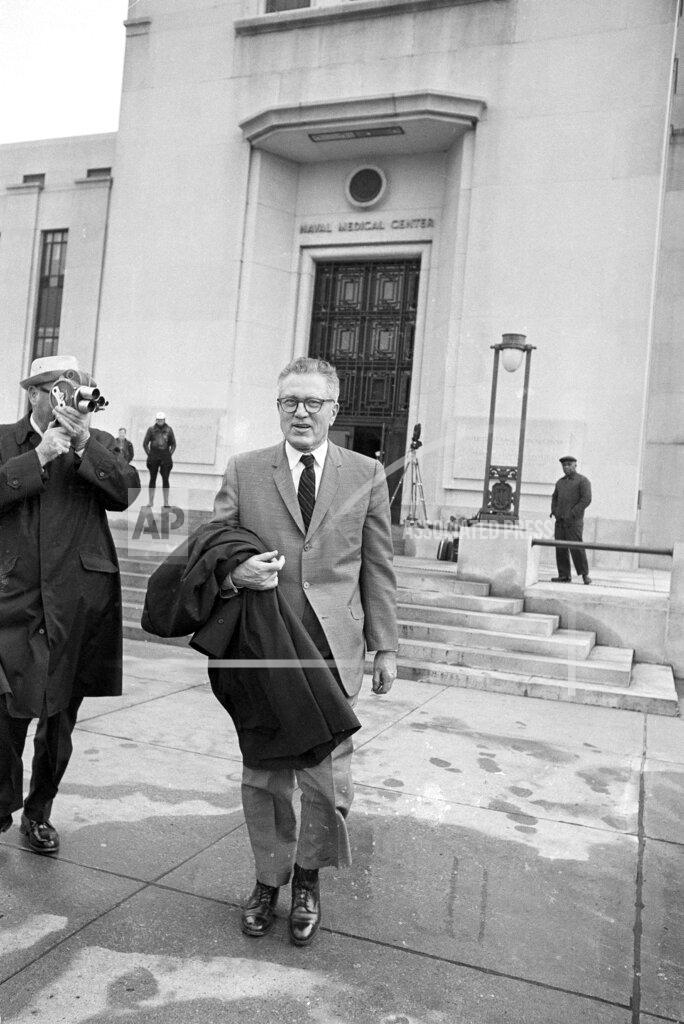
President Johnson was hospitalized early this morning with a cold, a severe sore throat and what he called “a miserable cough.” But after a day of complete rest in bed, Mr. Johnson was pronounced in “excellent shape” and responding “very well” to treatment. At 8:08 PM, the White House press secretary, George E. Reedy, called a last briefing of the day to say that doctors told him the President “could not be doing better.” Mr. Reedy said he had just left the President, who was eating a steak sandwich in his suite at the Bethesda Naval Hospital and was “resting quite comfortably.”
Mrs. Lyndon B. Johnson, with a severe cold herself, was also admitted to the Naval Hospital at Bethesda this afternoon.
Senator John L. McClellan, Democrat of Arkansas, said today that his two Senate investigating bodies had disclosed income tax cheating and other Federal tax losses aggregating more than $29 million in the last 10 years.
Ray C. Bliss, the new Republican National Chairman, said today that he intended to operate as “a realistic politician.” He declared that he would not “waste time” on intraparty feuds over ideology or projects that were not almost certain to produce results at the polls.
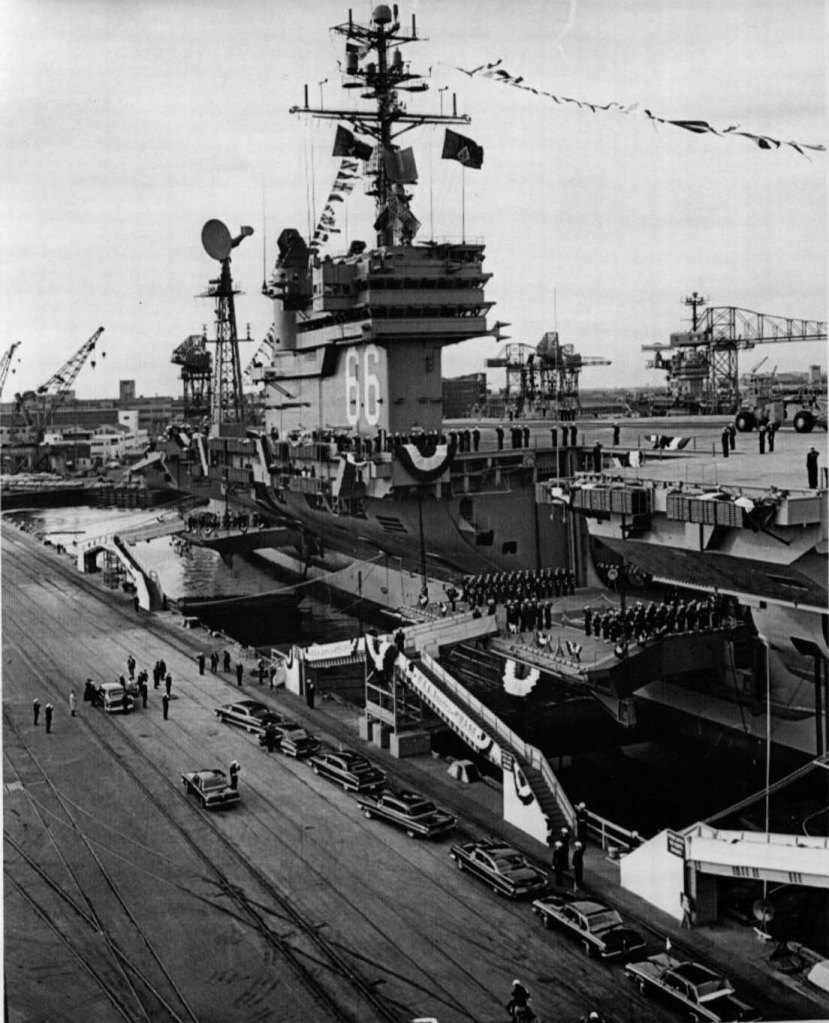
The supercarrier USS America was commissioned at the Norfolk Naval Shipyard, and placed under the command of Captain Lawrence Heyworth Jr.. One of the three Kitty Hawk-class aircraft carriers, America had a total length of 1,048 feet (319 m) and a width of 248 feet (76 m), and room for almost 5,200 officers and sailors. Forty years later, it would be scuttled on May 14, 2005, after being retired and put through live weapons testing, and would become the largest warship in history to be sunk.
Defense Secretary Robert S. McNamara announced that the U.S. Department of Defense was requesting proposals from the aerospace industry for design studies to support development of the Manned Orbiting Laboratory (MOL) (especially cost and technical data). Three contractors would be chosen to conduct the studies, a step preliminary to any DOD decision to proceed with full-scale development of the space laboratory.
The director of one of the nation’s chief atomic research centers, Oak Ridge National Laboratory in Tennessee, believes that immensely cheap nuclear power is a real possibility and that a new industrial revolution will result.
Musical variety program “King Family Show”, featuring big band vocal group The King Sisters, premieres on ABC TV.
Boston Celtics’ center Bill Russell misses all 14 shots in 104-100 loss to Philadelphia 76ers, led by newly acquired Wilt Chamberlain.
Born:
Michael Schade, Swiss-born Canadian operatic tenor; in Geneva, Switzerland.

 History Diaries