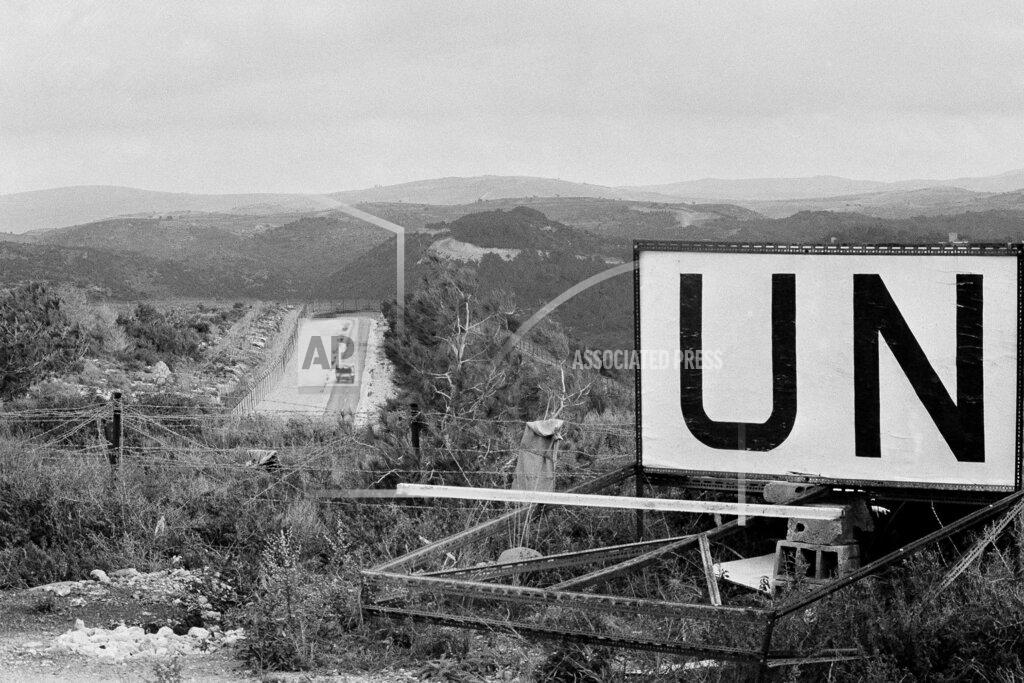
South Vietnamese Government forces made a helicopter assault today on North Vietnamese forces threatening a provincial capital 55 miles north of Saigon, the Saigon command reported. The command said the helicopters, backed by air strikes, landed troops on Núi Bà Đen (Bà Đen Mountain) in an attempt to retake a base and communications center six miles northeast of Tây Ninh city. The North Vietnamese captured the base on January 6, a day before other North Vietnamese forces captured Phước Bình, the capital of Phước Long Province, 75 miles northeast of Saigon. It was reported from Tây Ninh that some helicopters had landed infantrymen on top of the mountain, and that other helicopters had been turned back by antiaircraft fire. South Vietnamese bombers; were said to have assaulted the mountaintop with napalm and rockets to soften up North Vietamese resistance.
There is every indication that the Ford Administration will seek to make a major political issue of its request to Congress for $300‐million in supplemental military aid to South Vietnam. And every indication from Congress is that the request will fail. Administration leaders and the overwhelming majority of the legislators are making divergent political calculations. Key Democrats and liberal Republicans maintain that while the American people may or may not care about the fate of Vietnam, they certainly do not want to spend more money there. President Ford and Secretary of State Kissinger, according to their aides, are taking a different view because they believe that a Communist takeover in Saigon would outrage the American people. Much is riding on these judgments. On a philosophical plane Mr. Kissinger’s belief in flexibility for the President in foreign affairs and the inviolability of executive commitments is pitted against a Congressional mandate to cut spending abroad, particularly in Vietnam, and to concentrate on domestic economic problems. “Just think,” a Senatorial aide said, “one of The first things this new revolutionary Congress will be asked to vote on is whether to give $300‐million to President Thiệu.”
In Congress the attitude is predominantly negative, with some legislation withholding their intentions. The assistant Democratic leader in the Senate, Robert C. Byrd of West Virginia, said: “I think most Senators will take a rather dim view of it. We can’t go on indefinitely appropriating more aid. What will it be next year? Where will it end?” Senator John G. Tower, Republican of Texas, agreed with Mr. Byrd’s assessment of the vote, “given the present complexion of the Congress,” but said he would support the President. Representative Richard L. Ottinger, Democrat of Westchester, who is chairman of the freshman Democrat caucus of about 75, said: “No way?” when asked about the chances that the supplemental would pass in the House of Representatives. The House minority leader, John J. Rhodes of Arizona, commented that the Administration had not consulted with him about the supplemental and that its chances depended on “how strong a case they’re prepared to make.” He added: “I’ll be talking with my colleagues and looking at the evidence.”
Two barges carrying ammunition arrived here this morning after running the Cambodian rebels’ blockade of the Mekong River. The barges, covered with sandbags, left Tan Chau, South Vietnam, Tuesday night, escorted by Cambodian Government gunboats, helicopter gunships and T-28 fighter planes. Despite bombing and strafing of the river banks, the insurgents managed to attack the vessels. Even after the barges reached] the Phnom Penh area the insurgents fired three rockets, and one killed a barge crewman.
It was the first river-borne supply to reach Phnom Penh since the insurgents opened their offensive on New Year’s day. Before the drive, Phnom Penh had been supplied by one Mekong convoy a week. Today some of the people of Phnom Penh, low on rice, became concerned when they learned that the convoy had brought only ammunition. Meanwhile heavy fighting continued two miles from the capital at Arey Khast, on the eastern bank of the Mekong opposite the former royal palace. Last night and this morning, five persons were killed and at least 20 wounded by insurgents’ rockets at the city’s airport and in Phnom Penh.”
Secretary of State Kissinger reportedly told the Senate Foreign Relations Committee that when the latest round of Israeli-Egyptian negotiations have been concluded, the Soviet Union will probably have to be included in the next phase of Middle East peace efforts. President Ford said tonight that if Secretary of State Kissinger failed to make progress toward a new Egyptian‐Israeli accord the United States would probably be “forced to go to Geneva” for a reconvening of the conference strongly advocated by the Soviet Union.
Defense Secretary James Schlesinger made several major statements regarding the Middle East to reporters after his address to the Economic Club of New York Wednesday. He said that he was confident the United States “can provide the resources” to sustain Israeli forces if there is another Middle East war and that he did not think a new conflict would last more than three weeks. He reaffirmed the “military feasibility” of military intervention in Middle East oil areas to prevent national strangulation. He said flatly that such action was “within the power” of the United States and this was “a statement of fact.”
Roy A. Medvedev, the dissident Soviet historian, charged today that Senator Henry M. Jackson had sought “pretentious personal publicity” in his efforts to force the Soviet Union to relax emigration regulations for Jews. Mr. Medvedev, who frequently criticizes the Soviet leadership, also strongly suggested that while the Washington Democrat’s efforts helped relax emigration rules at first, his “ultimatums” eventually led to Moscow’s decision to reject the Soviet‐American trade agreement. Amendments to an American bill that would have implemented the agreement were initiated by Senator Jackson and other legislators in an effort to induce the Russians to allow more Jews and others to emigrate.
Whether Britain should withdraw from the Common Market will be decided by a nationwide vote by the end of June, Prime Minister Wilson announced today in a long-awaited statement in the House of Commons. Mr. Wilson said his government would make a recommendation to the people on how to vote. The referendum will mark a historic departure from British traditions. Mr. Wilson once opposed a referendum as a breach of constitutional custom. The referendum proposal, however, fulfills a major plank in the Labor party’s platform. The government is negotiating to try to get better membership terms. Opponents claim Britain pays an unfairly high contribution to the market’s budget and membership has led to an increase in agricultural prices.
A suspected Irish Republican Army bomb exploded at a waterworks pumping station in northeast London in the first bombing incident in Britain in a month. Two workmen were hit by flying glass and at least four persons were treated for shock from the blast which disrupted water supplies. Police warned of a possible second bomb in the area.
The I.R.A. Provisionals have decided to renew their cease‐fire in Northern Ireland, a Republican newspaper circulating in parts of Belfast said tonight. The paper, TheAndersonstown News, a local publication close to the Irish Republican Army Provisionals, said the new cease‐fire order is expected to be issued to all I.R.A. units within the next 48 hours.” It said no formal announcement of the cease‐fire would come before early next week. The paper has a reputation for speaking authoritatively about I.R.A. policy decisions. It predicted the end of the 25‐day cease‐fire a week ago, before the official announcement. British officials in the province remained cautious about the report, noting the increased level of violence in the last few days. Earlier today it was announced that British Army activity would be intensified. The announcement, which means that there will be more patrols and more road blocks and searches, followed the bombing of Belfast’s best-known hotel, the Europa.
The Defense Department, in a notification published in the Congressional Record, said it plans a $229.9 million sale of military equipment to Turkey but pledged that the arms would not be delivered if the congressional ban on such weapons shipments takes effect February 5. The notification stirred speculation that the Administration is seeking a legal loophole by which it can continue arming the Turks.
After two working sessions, the talks on the political future of Cyprus appear to be off to a rocky start. When the talks resume tomorrow, Greek and Turkish Cypriotes will again consider the international airport at Nicosia, which has been closed since the Turkish invasion last July. The proposals made thus far by the two negotatiors—Glafkos Clerides for the Greek Cypriotes and Rauf Denktaş for the Turkish Cypriotes — seem quite far apart. This has been dispiriting to diplomats here, who hoped that rapid progress on the airport question might give some momentum to the talks and foster feelings of trust between the two sides. The Americans are particularly disappointed, since continued military aid to Turkey, which they do not want to terminate is linked to progress on a settlement of Cyprus. In the face of Administration protests, Congress voted last month to cut off aid to Ankara on February 5 unless substantial progress was made in Cyprus. Yesterday, a Defense Department statement that it intends to sell Turkey $230‐million in arms to modernize her tank forces reopened the controversy in Washington.
Kidnappers freed confectionary manufacturer Egidio Perfetti, 62, on the northern-outskirts of Milan. Perfetti, who was taken by armed men January 13 outside his home near Milan, I was released from a car with his hands and legs bound. There was no official indication if a ransom was paid.
West German Chancellor Helmut Schmidt criticized the United States for failing to attack inflation in time to avoid the current economic crisis. Speaking from Bonn on a U.S. Public Broadcast Service program, Schmidt said: “I think the United States was wrong on two grounds: First at the end of the 60s and the first few years of the 70s, you had to stop that enormous gap in your balance of payments. You didn’t do that in due. time.” Secondly, the chancellor said, the United States failed to institute anti-inflationary measures after West Germany began floating its currency and abandoned the Bretton Woods system of fixed exchange rates.
Dr. Andreas Gruentzig, a heart surgeon at the University of Zurich, successfully inflated a double-lumen balloon catheter (which he had designed with his wife, assistant to her husband) to dilate the iliac artery of a dog without the side effects of creating an embolism. Later in the year, on September 24, he would first test the method on a coronary artery, and on September 16, 1976, he would use the technique for the first angioplasty on a human being.
The Ford Administration has informed Congress that it will sell Israel about 200 Lance missiles, a short‐range missile capable of carrying nuclear warheads, Defense Department officials said today.
Premier Yitzhak Rabin said today that Israel rejected any deadline for the completion of negotiations or troop withdrawals such as those proposed in recent interviews by president Anwar el‐Sadat of Egypt.
Canadian immigration officials are looking for the mastermind of an illegal operation smuggling East Indians into Canada for as much as $10,000 each, putting them in debt “for the rest of their lives.” Doug Cook, head immigration officer in Victoria, British Columbia, said 25 persons, mostly young men, had been lured into the scheme over the past month by “a single agent who traveled back and forth from India,” promising riches in Canada.
Oil from two ruptured tanks of the Greek-registered tanker Michael C Memos formed big oil slicks less than a mile from St. Croix on the southern coast of Puerto Rico. Apparently neither of the slicks, between 500 and 1,000 yards wide, presented an immediate danger to the coastline, the US. Coast Guard said. Between 10,000-50,000 gallons of oil gushed from the tanks as the ship entered the Hess oil harbor area. Officials ordered the tanker out to sea and the ship left a trail of oil in its wake. The cause of the rupture in the tanks was not reported.
About 30 right-wing terrorists invaded the plant of a moderate newspaper in Cordoba, Argentina, held employes at gunpoint and blew up a $600,000 press with timed explosive charges. The terrorists fled in cars, leaving behind handbills that identified themselves as members of the Argentine Anti-Communist Alliance.
South Africa’s Premier John Vorster in a summit with black leaders rejected key demands that blacks be allowed to be homeowners in white urban areas and that political detainees or exiles be granted a general amnesty. After the summit, Chief Gatsha Buthelezi, leader of the country’s 4 million Zulus, said “civil disobedience and disruption of services” would be the only alternative to continued “discrimination” and “abuse.”
“Friends of the Earth,” a conservation organization, called for a temporary ban on all whaling and the abolition of the International Whaling Commission. The group said the IWC “had done little more than provide a cloak of respectability to cover the continuing over-exploitation of the whale. The group wants a ban on all whaling to allow time for reserves of various whale species to be reconstituted.
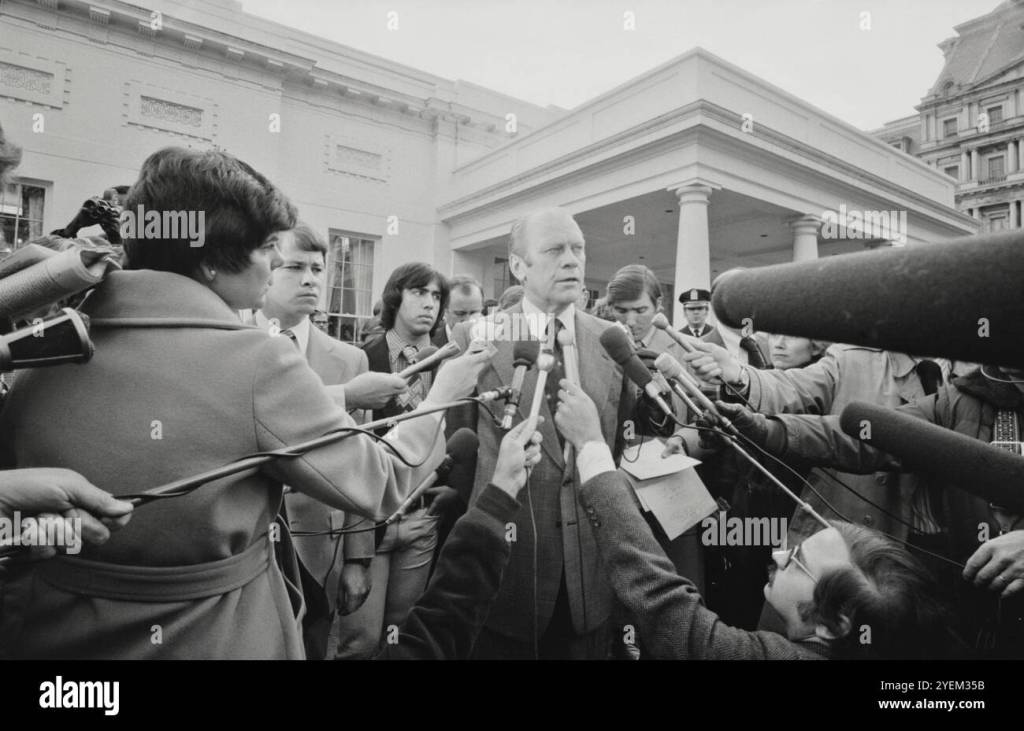
President Ford signed a proclamation increasing the import fee on petroleum. Meanwhile, Democratic members of Congress declared that his action constituted “an abuse of presidential power, like Watergate,” and major moves were made in the House and Senate even before Mr. Ford signed the proclamation to prevent the increased fees from ever taking effect. U.S. President Gerald Ford signed a proclamation for an eventual three-dollar per barrel fee on imported oil, with a one dollar fee effective on February 1, followed by similar increases on March 1 and April 1. Ten northeastern States would receive rebates on the fees due to their heavier reliance on imported oil. Congress voted to delay the increase for 90 days, and a federal court eventually ruled that the President did not have the power to implement fees independently of Congress.
The Federal Energy Administration said that President Ford’s energy and tax-cut proposals, if enacted by Congress, probably would add to the spendable income of some households and certainly would shrink it for others, and released figures in support of its statement.
The general board of the A.F.L.-C.I.O., in an emergency meeting to discuss President Ford’s energy economic proposals, demanded a boycott of oil from the Arab nations that took part in the 1973-74-embargo and called for rationing at home. It also rejected Mr. Ford’s economic program, which the organization’s president, George Meany, described as “the weirdest one I have ever seen.” He also rejected proposals by Democrats in Congress as “press statements” with no substance.
Three leading economists of both political parties, all former high Government officials, supported today President Ford’s plan for a $12‐billion rebate of 1974 income taxes to stimulate the economy, although they differed on some details. The economists were Charles L. Schultze and Gardner Ackley, who held top economic positions in the Administration of President Johnson, and Paul W. McCracken, who was the first Chairman of the Council of Economic Advisers under President Nixon. They testified before the Congressional Joint Economic Committee.
The Democratic Compliance Review Commission extended the reach of a key party reform tonight after a confused and often comical all‐day struggle in which five proposed formulas were rejected before a compromise was finally struck. The rules will govern the selection of delegates to the 1976 Democratic National Convention.
Secretary of the Treasury William E. Simon told Congress today that the Government needed an increase of $36-billion in the statutory debt ceiling, to a total of $531-billion, to continue operations through June 30.
The Boston School Committee voted unanimously to approve a voluntary school desegregation proposal that puts the responsibility for its success in the hands of the parents. The plan will be forwarded to U.S. District Judge W. Arthur Garrity Jr. on. Monday for his approval. The committee said it anticipated a favorable reaction. The committee has until. that day to submit an “authorized. plan to the court. The new plan has some similarities to a plan rejected by the committee on December 16 but relies instead heavily on voluntary transfers of students. The earlier plan called for the busing of 35,000 students.
In a last-minute decision, the U.S. Civil Rights Commission has endorsed a move to expand the 1965 Voting Rights Act to protect many more Spanish-speaking people. The decision was announced as the commission released a 478-page report recommending that Congress extend the act for another 10 years and that the Justice Department step up efforts to enforce it. The act expires in August but Congress is expected to renew it. A controversial issue is whether the act will be renewed without change or whether it will be enlarged to reach many more states, counties and cities. It currently covers six Southern states and parts of 11 others, ranging from New Hampshire to Hawaii. The law applies a broad range of requirements to areas with a record of low voter participation by minorities or discriminatory laws.
Former President Richard M. Nixon’s legal defense fund, almost broke after paying another $20,000 in lawyers’ fees, is appealing to foreign contributors for help in raising $1 million to aid him. Rabbi Baruch Korff, head of the President Nixon Justice Fund, said it brought to $100,000 the legal fees paid by the fund since Mr. Nixon resigned Aug. 9. Rabbi Korff said it left a balance of $142,322 owed to the firm of Miller, Cassidy, Larrea & Lewin.
The St. Paul Fire & Marine Insurance Co. announced it would stop writing the present type of medical malpractice insurance policy covering 48,000 doctors in 47 states on June 30. The Minnesota firm, third largest in the troubled malpractice insurance business, said it would switch to a new “pay as you go” policy that might cost doctors less the first year but more by the fifth year. St. Paul said it was experiencing “large underwriting losses.”
Two Mormon missionaries, missing since late November, were officially declared dead at an inquest hearing in Austin, Texas. After testimony indicated the bodies of Gary Darley, 20, of Simi Valley, California, and Mark Fischer, 19, of Milwaukee, were sawed into small pieces with a meat saw in the back of a taxidermist shop, a justice of the peace ruled that the deaths were homicides “at the hands of another.” Robert E. Kleasen, 42, charged with two counts of capital. murder in connection with the case, sat impassively through the hearing. He has been held in a federal hospital for psychiatric tests.
Democratic regulars overrode reformers’ protests and limited the scope of the party’s new “affirmative action rules to political activities at the statewide level or above. On a vote of 14 to 9 after a nine-hour meeting in Washington, the Democratic Compliance Review Commission restricted application of the phrase “all party affairs” to the selection of state and national officers. It meant that the new rules to involve minorities at the county, city, and precinct levels would not be enforced, as the reformers wanted. An appeal was planned.
The Chrysler Corporation reported that its rebate program had lifted sales of its compact cars, although overall sales were still behind levels of a year ago. The first nationwide sales figures compiled since the program went into effect January 13 show that Chrysler’s compact sales were up 12 percent from a year ago. Just prior to the rebates, sales of those models had been running at half of the 1974 levels.
New statistics indicate that a man in his 40’s or 50’s is less likely to die of a heart attack than men of the same age a decade ago, possibly because of public-health campaigns. The drop in the coronary death rate, first noted last year in data from the 1960s, continued through 1972, indicating that “the downtrend is real, not a statistical fluke,” according to Dr. Jeremiah Stamler, a leading heart specialist.
A states’ rights issue developed in Nevada when that state joined in a suit against the federal Environmental Protection Agency challenging imposition of air pollution standards more strict than those in Nevada law. In the action, the state maintains that under the federal Clean Air Act it has been assigned primary responsibility for control of air pollution within its borders. The petition argues that strict, new federal standards affect the state’s ability to carry out that responsibility.
The first measurement of astronomical data by an asteroidal occultation took place as astronomers in North America gathered information from the passage of 433 Eros between the Earth and the star Kappa Geminorum.
The police comedy-drama “Barney Miller” premieres on ABC TV.
Ralph Kiner earns Baseball Hall of Fame membership by a single vote.
Paul Wiggin, a defensive line coach for the San Francisco 49ers, signed a three-year contract today as head coach of the Kansas City Chiefs of the National Football League.
Dow Jones Industrial Average: 656.76 (+4.15, +0.64%)
Born:
Tito Ortiz, American martial artist; UFC light heavyweight champion, 2000 to 2003; in Santa Ana, California.
Phil Dawson, NFL kicker (Pro Bowl, 2012; Cleveland Browns, San Francisco 49ers, Arizona Cardinals), in West Palm Beach, Florida.
Kevin Alexander, NFL wide receiver (New York Giants), in Baton Rouge, Louisiana.
Died:
Karel Paul van der Mandele, 94, Dutch financier, director (Rotterdam Bank), administrator, and economist.

 History Diaries