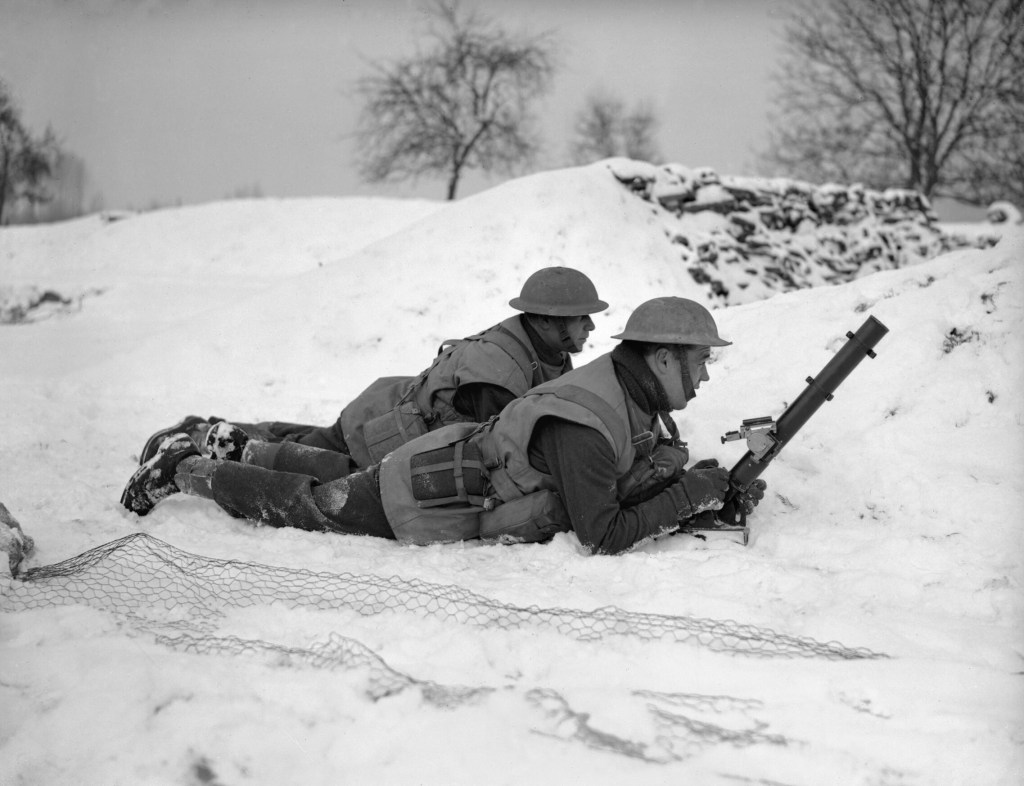
Soviet 122nd Rifle Division of 9th Army withdraws further and stabilizes line in the Salla sector. The Soviets continue lobbing their 7,000 artillery shells a day at Summa. The Finns are losing men in this trench warfare that they cannot afford to lose, some 3,000 during the month. The Finnish artillery is short of ammunition and under orders not to counter-fire, but only to fire against direct ground attacks. The Soviet strategy obviously is to wear the Finns down in a battle of attrition before striking a strong blow at the strongest part of the line.
In Ladoga Karelia, Soviet troops continue their offensive at Kollaa, on the River Aittojoki and in Ilomantsi.
At Mikkeli, General Headquarters turns down the proposal by the Lapland Group to continue their advance to Märkäjärvi. The available forces are to be concentrated to consolidate the ground already taken.
Sortavala in Ladoga Karelia and Ivalo in Lapland are the focus of enemy bombing.
The Merivoimat (Finnish Navy) transport ship Valamon Luostari was sunk by Soviet Tupolev SB-2 bomber aircraft from the 41st squadron of the Ladoga Flotilla, at Vanha Niikkanenlahti. Most of the crew were ashore, and there was no loss of life.
Three Soviet spies dressed in Finnish-style military uniforms have been captured off Ylläppäänniemi on Lake Ladoga.
Finland welcomes foreign volunteers willing to serve in the Finnish armed forces. The Finns, with Swedes and Norwegians already fighting with them, announced the formation of a “Foreign Legion” which would include British, Estonian, Lithuanian, French, German, and Italian volunteers. Already, Swedish volunteers are flying bombing missions and others are on the front lines. Numerous British are flocking to help the Finns, including a young Christopher Lee.
In Leningrad, staff officers are executed for failing to provide proper protection for field kitchens.
The Norwegian rucksack collection for Finland reaches its goal of 50,000 filled rucksacks, which are duly surrendered to the collection committee.
The Russian monarchist government led by the pretender to the Russian throne, Grand Duke Vladimir, recognizes Finnish independence and urges Russian émigrés to join in the work of freeing their country.
The great Finnish runners Paavo Nurmi and Taisto Mäki set out for the United States to publicize the situation at home and take part in exhibition races on behalf of Finland.
The French Academy invites Jean Sibelius to become an associate member of its composers section.
A correspondent on the English paper News of the World describes the Finns as the equal of the American Indians in forest warfare.
The speech on January 20 by First Lord of the Admiralty Winston Churchill, imploring neutral countries to support Finland (a thinly veiled invitation to Norway and Sweden to allow Allied troops passage across their territory to Finland), rebounds on him. He is reprimanded by British Foreign Secretary Lord Halifax for interfering with foreign policy. Also, he is ignored by Norway and Sweden, who realize that British access to Finland is a means to choke off supplies of Swedish iron ore to Germany. They rightly suspect that Hitler would react to any Allied presence by intervention of his own. French Prime Minister Daladier favors Churchill’s plan as a way to fight the Germans away from French soil.
From today newsreels must be submitted to the ministry of information before they are exhibited. Newsreels were exempt from scrutiny by the British Board of Film Censors because they were produced to tight deadlines twice weekly. The ministry film division has appointed a liaison officer to convey guidelines for film propaganda to newsreel producers. An “editor” will view all newsreels before release. The word “censor” is not used in the announcement.
Hermann Göring, acting as Germany’s Economic Czar, confiscates former Polish state property.
Armed German forces, acting as railway police, reached the Rumanian frontier through Russian-occupied Poland today, it was learned from official sources.
Pope Pius XII made a radio broadcast condemning Germany’s actions in Poland. An outspoken denunciation of atrocities in Poland was made over the papal radio station this morning. Germany, as well as Russia, was strongly crit icized in this authorized talk, which spoke of the Pope as being “profoundly pained.”
More than 250,000 Jews have been wiped out in Poland by military operations, disease and starvation since September 1, according to an estimate released yesterday by the Joint Distribution Committee on the basis of reports it has received. It added that 80 percent of the remaining 1,250,000 Jews in the German-occupied area have been “reduced to beggary.”
Typhus epidemics are raging in Warsaw, Lodz and many other towns, and their virulence is augmented by the widespread starvation and exhaustion, the committee said. Economic life has been “completely strangled,” and hundreds of thousands of families, uprooted from their homes, wander along open roads, seeking shelter. Women, aged men and children are “subjected to countless indignities.” Although the suffering from starvation, epidemics, pogroms, persecutions and wholesale expulsions is most acute in the German-occupied territories, there is also great hardship in the Russian-occupied section, where 600,000 Jews have taken refuge, and among the refugees in the bordering countries, according to the report of the committee.
In Nazi Poland 2,500 Jews are reported to have committed suicide, and their number is being increased daily, according to the committee, while “many hundreds” have been summarily executed. Hundreds of others have been and still are being held for ransom, the report says. The wearing of a yellow armband bearing a six-pointed star has been instituted in many cities.
“Not the least of the hardships confronting the Jews of Poland are their fears for the future,” the report says. The institution of a ghetto in Warsaw, which would have crowded 350,000 people into a few square blocks, half of whose buildings were destroyed by bombardment or fire, was officially ordered but has been delayed because of fear that epidemics might spread to the rest of Warsaw’s population. “The search for corpses in the debris of the bombed Jewish sections of Warsaw continues even today. Rumors that the Nuremberg racial laws are shortly to be introduced have added to the panic of Poland’s Jews.”
Italy will never join any future plan for a European customs union or free commercial exchanges of any kind, Virginio Gayda makes clear today. Self-sufficiency has come to stay, he says, and this country is looking out for itself.
General Bernard Freyberg arrives in Cairo by air from Australia, with his troops still en route from Australia and New Zealand.
The neutral Swedish motor merchant Gothia was torpedoed and sunk by the U-51, commanded by Kapitänleutnant Dietrich Knorr, west by north of St. Kilda off the northwest coast of Scotland (57° 46’N, 9° 50’W). At 0933 hours the Gothia was hit in the bow by a torpedo from U-51, developed a list to port and sank after one hour. Three crew members were lost. The Germans did not see the nationality markings and only identified the vessel after she was already hit. The survivors abandoned ship in two lifeboats and one of them reached the Hebrides with 11 survivors, but the other with nine occupants was never seen again. The 1,640 ton Gothia was carrying paper pulp and sulphate and was bound for Genoa, Italy.
The neutral Norwegian motor merchant Segovia, with a complement of 23, was reported missing off the west coast of Scotland, approximate position 58° 00’N, 8° 45’W. As there is no corresponding U-boat report on the incident it is believed that the Segovia was sunk by the U-55, commanded by Kapitänleutnant Werner Heidel, which did not return from patrol. Wreckage and debris spotted in two different places northwest of the Hebrides on 27 and 28 January 1940 probably were from Andalusia and Segovia. The 1,387 ton Segovia was carrying general cargo, oil, cork, wine, and almonds and was bound for Oslo, Norway.
The neutral Norwegian steam merchant Songa was stopped by the U-25, commanded by Kapitänleutnant Viktor Schütze, 220 miles west of Isles of Scilly, west of England in the Atlantic Ocean (49° 45’N, 12° 35’W). At 1138 hours on 22 January 1940 the unescorted and neutral Songa (Master Otto Lie) was stopped by U-25 with four rounds across her bow in good weather about 220 miles west of Scilly Isles. Schütze ordered the crew to abandon ship in the two lifeboats after it became clear that she was carrying contraband on her first voyage for the new Norwegian owner, being routed through the English Channel and therefore obliged to stop off Deal for contraband control. At 1326 hours, the U-boat fired one G7a torpedo from a stern torpedo tube as coup de grâce, which struck on port side amidships and caused the ship to sink within three minutes after breaking in two. The Germans provided each lifeboat with a bottle of rum and told them to steer an easterly course where they could expect to be picked up when reaching the shipping lanes. The lifeboat of the master and ten men was equipped with a motor and took the second boat in charge of the chief officer with 13 occupants in tow. However, they were forced to heave to by a strong gale after 24 hours and lost contact to each other. 13 survivors were picked up by the British trawler Lodden on 26 January and landed at Kinsale the next day. The boat in charge of the master had sighted the Fastnet Lighthouse in the evening of 26 January, but had a further night to hove to before making landfall near Rock Island Lighthouse at the entrance to the inlet of Crookhaven, from where they were taken to Goleen, Co. Cork. All survivors from Songa were reunited in Cork on 28 January. The 2,589 ton Songa was carrying empty barrels, sponges, motor tires, copper, beans, coffee, cotton and tin and was bound for Antwerp, Belgium.
The unescorted and neutral Norwegian steam merchant Sydfold was torpedoed and sunk by the U-61, commanded by Oberleutnant zur See Jürgen Oesten, northeast of Scotland in the North Sea (58°40′ N 0°30′ W). At 2127 hours on 22 Jan 1940 the unescorted and neutral Sydfold (Master Gunnar Egge) was hit by one torpedo from U-61, caught fire and sank slowly, with 5 men lost. The 19 survivors were picked up by the Norwegian steam merchant Rona. The 2,434 ton Sydfold was carrying ballast and was bound for Newcastle, England.
The German fishing trawler Mulhausen sank due to icing in the Baltic Sea off Pillau. Some sources say she was sunk by a mine laid by the Polish submarine Żbik in September 1939 but witnesses reported no explosion. She was lost with all twelve hands.
The German tanker Altmark, under command of Captain Heinrich Dau, set sail for Germany from the South Atlantic Ocean. The Altmark had been in the South Atlantic in a successful attempt to avoid being spotted the Royal Navy since it picked up the British merchant sailors that the pocket battleship SMS Admiral Graf Spee had captured on October 29, 1939. The Altmark would avoiding the shipping lanes and pass between Iceland and the Faeroe Islands before reaching Norwegian territorial waters on February 14.
The U.S. freighter SS Excellency is detained at Gibraltar by British authorities; the U.S. freighter SS Nishmaha, detained there the yesterday, is released.
Convoy HX.17 departs Halifax for Liverpool.
The War at Sea, Monday, 22 January 1940 (naval-history.net)
Destroyers MAORI and TARTAR arrived at Rosyth.
Destroyers ICARUS and IMPULSIVE arrived at Loch Ewe for refueling.
Destroyers JACKAL, JAGUAR and JAVELIN departed the Humber for submarine hunting duties, arrived at Rosyth on the 23rd, but were ordered not to be used for convoy work.
Destroyer ECLIPSE escorted cable ship ROYAL SCOT from Leith.
Destroyers SIKH and MOHAWK departed Rosyth to hunt for a submarine reported in the North Sea.
On patrol in the North Sea, submarine TRITON suffered damage to one of her valves and put into Lister for repairs which were soon accomplished.
Destroyer MONTROSE departed Quiberon Bay with convoy BC.22 at 0700/21st, and on the 22nd, was ordered to check a U-boat contact off Caldy Island in 51 33N, 04 42W. She was joined by destroyer VANQUISHER, which attacked a submarine contact. MONTROSE then searched Carmarthen Bay and the approaches to Bristol Channel before relieving VANQUISHER at dawn on the 23rd at the location of her attacks. MONTROSE proceeded to 51-12N, 5-45W to search for a submarine reported by anti-submarine trawler BEDFORDSHIRE (443grt), and joined by VANQUISHER, searched the entrance of the Bristol Channel near the Breaksea Light Vessel. MONTROSE returned to Milford Haven to refuel on the 24th, departing that afternoon to rejoin VANQUISHER searching in Barnstaple Bay, where the latter made an attack in 51-04.5N, 4-25.25W. They then patrolled between Bull Point and Helwick Sands the night of the 24th/25th, before MONTROSE proceeded to Milford Haven on the morning of the 25th.
Convoy FN.78 departed Southend, escorted by sloops FLAMINGO and WESTON, and arrived in the Tyne on the 23rd.
French sloop AMIENS attacked a submarine contact off Calais in 51-03.5N, 2-02W.
U-57 laid a minefield in Cromarty Firth during the night of the 21st/22nd, one which one merchant ship was lost.
U-25 sank Norwegian steamer SONGA (2589grt) 220 miles west of the Scilly Islands, but the entire crew was rescued.
U-51 sank Swedish steamer GOTHIA (1640grt), 45 miles W by N of St Kilda in 57 46N, 09 50W, with the loss of twelve crew.
U-61 sank Norwegian steamer SYDVOLD (2434grt) in 58 40N, 00 30W. Five crew were lost, and 19 survivors rescued by Norwegian steamer RONA (1376grt).
Norwegian steamer SEGOVIA (1387grt) departed England for Norway on the 22nd and was not heard from again. Seekrieg and Uboat.Net states she was sunk by U-55, a claim provisionally confirmed by Rohwer’s “Axis Submarine Successes”. There were no survivors.
Steamer KIRKPOOL (4842grt) ran aground and was a total loss on the south coast of England.
In the South Atlantic, German supply ship ALTMARK (10,850grt) began her return to Germany and passed through the Faroes-Iceland Channel undetected on 11 February.
Convoy HX.17 departed Halifax at 0800 escorted by Canadian destroyers HMCS FRASER and HMCS RESTIGOUCHE, and was joined by light cruiser EMERALD, also from Halifax, as ocean escort the same day. The destroyers turned over the convoy to her at noon on the 23rd. EMERALD then detached on 3 February and proceeded to England to refit – escort duty in the North Atlantic had damaged the main engines and strained and buckled her decks. She arrived at Portsmouth on 4 February and was refitting at Southampton from 15 February to 30 April. Destroyers VANESSA, VANSITTART, KEITH and WARWICK joined HX.17 on 7 February as escort until its arrival at Liverpool later that day.
A minor fire started by a welding torch broke out on Italian battleship LITTORIO, under construction at the Ansaldo Yards at Genoa.
Light cruiser GALATEA departed Malta on patrol, and arrived back on the 30th.
Light cruiser DAUNTLESS departed Singapore on patrol duties, and arrived at Penang on the 27th.
Destroyers HARDY and HOSTILE departed Freetown on the 13th with convoy SLF.16, and then Gibraltar on the 22nd. HARDY reached Plymouth on the 25th for docking and repair, but was able to proceed in a few days and arrived at Greenock on 14 February for duty with the Home Fleet. HOSTILE reached Dover on the 25th, before going on to Sheerness and then Chatham were she docked for repairs and refit lasting until 26 February when she also left to join the Home Fleet.
Destroyers HERO and HASTY departed Freetown on the 22nd and arrived at Gibraltar on the 29th.
Submarine OLYMPUS arrived at Colombo after patrolling the Seychelles area and in the Mozambique Channel.
In Washington today, President Roosevelt discussed legislative matters with Congressional leaders and attended the state funeral of Senator Borah.
The Senate and House joined in state funeral services for Senator Borah, the Senate adjourning at 1 PM, until noon tomorrow and the House adjourning at 1:02 PM, until noon tomorrow.
The House Rules Committee approved a resolution for a one-year extension of the Dies Committee to investigate un-American Activities; the Ways and Means Committee heard further opposition to extension of the Trade Agreements program and the Smith committee resumed hearings on the procedure of the National Labor Relations Board.
The capital paid its highest tribute to William E. Borah today when all branches of the Federal Government and the diplomatic corps participated in a state funeral in the Senate Chamber for the man whose distinguished career was developed in thirty-three years of service there. In the Chamber, where the air was heavy with the fragrance of floral offerings, President Roosevelt headed the list of those who sat silently through an Episcopal service conducted jointly by the Rev. Dr. ZeBarney T. Phillips and the Rev. Dr. James Shera Montgomery, chaplains, respectively, of the Senate and House.
There were no eulogies or other demonstrations beyond the conducting of the simple service, but the number and prominence of those persons who attended exemplified the regard held for the late Senator, who died on Friday night after an illness which began six days ago. with a cerebral hemorrhage. Tonight Mr. Borah’s body was being carried westward on a special train, escorted by a committee consisting of ten Senators and ten Representatives.
Other services will be held at Boise, Idaho, Senator Borah’s home city, in the Idaho State Capitol, Thursday afternoon and interment will be made at a Boise cemetery. later that day. The funeral service here began at 12:30 PM and was concluded twenty-five minutes later. Present were virtually the full membership. of the Senate and House, the secretary or acting head of each department, members of the Supreme Court, the commanding officers of the army, navy, marine corps and coast guard and the chief officer of each embassy and legation.
The galleries surrounding the chamber had every seat filled while several hundred persons stood along the walls. On the floor, a shortage of seats required about a hundred Representatives also to stand through the service. Mrs. Borah excused herself from the ordeal of sitting in the usual section reserved for surviving relatives, in the well of the Senate, and listened to the service outside the Senate door, which leads to the Vice President’s office. With her were about twenty relatives and friends.
U.S. Communist Party General Secretary Earl Browder is sentenced to four years in prison for illegally obtaining a U.S. passport. Earl Browder, general secretary of the Communist party in the United States, was convicted by a jury of eleven men and one woman in the Federal court late this afternoon of using a United States passport obtained by making a false statement, an offense against Federal law. He was immediately sentenced to four years in Federal prison and a $2,000 fine by Judge Alfred C. Coxe, who allowed him to remain at liberty on $7,500 bond as before, pending appeal.
Appearing a few hours later before 19,000 Communists who gave him a five-minute ovation in Madison Square Garden, Browder charged that Supreme Court Justice Frank Murphy had “gladly accepted” Communist support when he ran for Governor of Michigan, and had offered “a head on a charger” to redeem himself when he saw an opportunity for the Supreme Court. He boasted that the Communists had even drafted speeches for other prominent New Dealers before the Roosevelt Administration “betrayed” its New Deal objectives last Summer; charged that Communist party votes elected Governor Lehman over Thomas E. Dewey, and asserted that President Roosevelt’s peace policy was “contradictory” because his daughter-in-law came from “a munitions family.”
With Fritz Kuhn, “Führer” of the German-American Bund, already serving a Sing Sing’ term of two and one half to five years for embezzling the funds of his own organization, Browder became the second leader of revolutionary agitation in this country to get a prison sentence for violation of Federal or State laws since the NaziSoviet pact was signed. Browder, who has had legal training, made a surprise appearance as his own advocate in an hour-and-fifteen-minute summing up of his case to the jury yesterday morning. He accused the government of persecuting him on “technicalities” because of his Communist views and activities on behalf of “the working people.”
The House Rules Committee set the stage today for the expected overwhelming House approval tomorrow of a resolution extending for a year the life of the Dies committee to investigate un-American activities.
The United States Treasury published a list of Americans who made salaries of more than $75,000 in 1938. The list revealed that Claudette Colbert was the highest-paid star in Hollywood that year with a salary of $301,944, followed by Warner Baxter who made $279,807.
The pressure of orders for military airplanes for Great Britain and France has become so great, Secretary Morgenthau indicated at his press conference this afternoon, that President Roosevelt has requested him to coordinate domestic and foreign plane procurement to guard against interference with deliveries to the army and navy.
The United States Circuit Court of Appeals held today that the National Labor Relations Board has no authority to “dictate” to an employer the number of workers he must use to run his business.
Joint amphibious exercise concludes in the Monterey, California, area, having afforded the Fleet profitable experience in joint planning. It also demonstrates interservice cooperation.
Rear Admiral Adolphus E. Watson becomes Commandant Fourth Naval District and Commandant Philadelphia Navy Yard in the wake of the death of Rear Admiral Julius C. Townsend on December 28, 1939.
First radio broadcast of “Road to Happiness” on CBS.
“Abe Lincoln in Illinois” starring Ray Massey premieres in Washington, D.C.
The U.S. Navy light cruiser USS Helena (CL-50) arrives at Buenos Aires, Argentina, on her shakedown cruise (see 29 January).
Chinese Winter Offensive: Elements of Japanese 22nd Infantry Division attacking Chinese 3rd War Area, capturing Siaoshan (Hsiaoshan). Japanese forces were reported today to have captured Siaoshan, an important Chinese base in Chekiang Province, after they had crossed the Chientang River near Hangchow in a blinding snowstorm and advanced twenty miles against ineffective resistance. Clearing weather later enabled army and navy airplanes to assist the Japanese attack while small naval surface vessels shelled Chinese positions, it was announced by the Japanese. An army spokesman here said this extension of operations into a part of Chekiang hitherto free from invasion was a mere prelude to a smashing blow designed to rid the Shanghai-Hangchow-Lake Taihu areas of anti-Japanese elements and “safeguard law and order.” Siaoshan is about 115 miles south of Shanghai.
31st Army Group of Chinese 5th War Area engaged with Japanese forces around Chiangchiaho, Pichiashan, Kusaoling, Chihshanai, and Yinchiatien.
Wang Ching-wei arrived in Tsingtao today for a conference with heads of the Japanese-controlled governments at Peiping and Nanking in an attempt to agree on a new central regime. Wang Keh-min, chief of the Peiping provisional government, arrived a short time later, accompanied by Lieutenant Gen. Seiichi Kita, Japanese military attaché and political manipulator. Nanking representatives are expected tomorrow. Japanese military authorities took special precautions to protect the delegates.
The agreement that his former colleagues say Wang Ching-wei signed with the Japanese would “make China a second Manchukuo and Wang a second Pu Yi (Japan’s puppet Emperor in Manchukuo), a spokesman for the Chinese Government said today. He added that the agreement had aroused increased bitterness in Chungking against Mr. Wang and Japanese militarists. The spokesman said his government yesterday received from Kao Tsung-wu and Tao Hsi-sheng photostatic copies of the preliminary agreement in Japanese, together with a letter explaining their break with Mr. Wang. The spokesman denied that the letter from the two, both formerly leaders in the Kuomintang, asked for clemency. Their letter explained that when Mr. Wang referred the preliminary agreement to them for study, they were unable even to consider it as a basis for negotiations, but took copies and photostats. They say the agreement signed is the same as the preliminary document except for changes in two articles.
Yakichiro Suma, Foreign Office spokesman in Tokyo, said today the purported pact published in the Hong Kong newspaper Ta Kung Pao “sounds like Chinese propaganda.” He declared “such an agreement cannot exist because the new regime has not been established; therefore no agreements can be made.”
The removal of twenty-one German seamen from a Japanese liner by a British warship yesterday caused the Japanese Government to protest vigorously to Britain tonight that the action was “a serious unfriendly act” for which it required “a full and valid explanation promptly.” The emphatic note of protest, which also warned that Japan “reserves its right” to demand the return of the captured seamen and that any repetition would aggravate Japanese feeling against Britain, was handed to Sir Robert Leslie. Craigie, the British Ambassador, by Masayuki Tani, the Vice Foreign. Minister. Its terms were decided this afternoon in a conference by Foreign Office, navy and army officials. The note recapitulated the circumstances in which the Germans had been taken off the liner Asamu Maru near the Japanese coast. It declared that the British Government must know that Japan adhered to the principle, in accordance with generally accepted usage, that only enemy nationals actually in the armed forces could be seized aboard neutral vessels on the high seas. Nevertheless, a British warship had taken “forcible measures” against a Japanese ship; hence the Japanese Government attached “the greatest importance” to the incident.
Philippine President Manuel L. Quezon broke the ice in the National Assembly today on “re-examination” of the Philippine independence problem by making a surprise pronouncement that “I am unalterably opposed to prolongation of the present political set-up beyond 1946 because I believe it is not conducive to our best interests.”
Dow Jones Industrial Average: 145.13 (-0.51)
Born:
John Hurt, English actor (“Elephant Man”, “Alien”, “Midnight Express”), in Chesterfield, England, United Kingdom (d. 2017).
Addie “Micki” Harris, American pop singer (Shirelles – “Will You Love Me Tomorrow”; “Soldier Boy”), in Passaic, New Jersey (d. 1982).
George Seifert, NFL head coach (NFL Champions, Super Bowl 24 and 29-49ers, 1989, 1994; San Francisco 49ers, Carolina Panthers), in San Francisco, California.
Eberhard Weber, German acoustic and electric double bassist, cellist and chamber jazz and ambient music composer, in Stuttgart, Germany.
Tilo Medek [Müller-Medek], German composer (“Die Todesfuge”), musicologist, and music publisher, brn in Jena, Germany (d. 2006).
Naval Construction:
The Royal Navy orders seventeen Flower-class corvettes from shipyards in Canada. These will be the first of 104 Flowers and modified Flowers built in Canadian yards during the war. All will ultimately serve in the Royal Canadian Navy.
The Royal Navy Thornycroft 73 foot-type motor torpedo boat HMS MTB 25 is commissioned.
The Royal Navy Havant-class destroyer HMS Hesperus (H 57), originally laid down as the Brazilian Navy Juruena, is commissioned. Her first commanding officer is Lieutenant Commander Donald George Frederick Wyville MacIntyre, RN.

 History Diaries