Some 1,500 ARVN troops are transported by helicopter to confront a large Việt Cộng unit in the Mekong Delta province of Kiến Hòa; the ARVN reports killing 46 and capturing 61. Helicopter-borne South Vietnamese forces crushed a large Việt Cộng unit in the Mekong River delta 50 miles south of here yesterday in one of the most successful fights Saigon has had in weeks. According to reports from United States authorities, the government troops killed 46 Việt Cộng and captured 61 other guerrillas in the fight. Thirty-five other persons were rounded up as suspects. Three of the assaulting helicopters were downed by heavy enemy fire, but friendly losses for the day were listed as only five killed and 11 wounded.
During the government attack, about 1,500 government troops were poured into the landing zone in Kiến Hòa Province where enemy forces had been reported, The Saigon troops were carried in two big waves, both of which drew heavy fire. Rescue parties carrying out American crewmen from the downed helicopters reportedly drew fire. The government forces captured two mortars, 19 individual weapons and a large stock of ammunition in the fighting.
United States policies in South Vietnam came under new criticism today from Lieutenant General Nguyễn Khánh, commander of the armed forces, and from a leader of Buddhist resistance to the Government. General Khánhh complained that the United States failed to understand the nature of Vietnamese nationalism. The Buddhist leader, Thích Trí Quang, deplored Washington’s support of Premier Trần Văn Hương. Thích Trí Quang and four other leading monks are in the second day of a “fast unto death” to force the resignation of the Government. Riot policemen barricaded the streets leading to the Buddhist compound, and only reporters were admitted there. Paratroops arrested nine persons in the neighborhood after a crowd of youths and women clashed with police guards. Both critics of the United States — political opponents themselves — couched their opinions in careful terms to avoid incurring antagonism. But they were indicative of the restiveness felt by some Vietnamese about the extent of the United States involvement in the political affairs of their country.
Answering questions in the town of Cần Thơ, 75 miles southeast of Saigon, General Khánh said the United States should assist Vietnam not only by sending equipment but also by fostering a spirit of nationalism that would impel the country forward. Taking note of United States impatience with the turbulence of Saigon politics, the general said Americans must accept “the egotism and capricious acts of the Vietnamese.” Discussing the military uprising of December 20, General Khánh said the ensuing political crisis was “not a great affair for us.” In the uprising, a group of young generals dissolved the High National Council, which was serving as a provisional legislature. In opposing the dissolution of the council, General Khánh observed, United States officials kept talking about legality. In fact, he added, the council did not represent the entire population. The general asserted that the provisional Charter, under which the council was set up. had not functioned properly. “So far, we have not had any government that is really representative,” General Khánh said. He served as chief of state and as Premier until last August, when he yielded to demonstrations demanding civilian rule.
There were reports that General Khánh was still smarting from his clash with Maxwell D. Taylor, the United States Ambassador, after the generals’ revolt. Ambassador Taylor was highly critical, and Washington held up discussions on an expansion of the aid program pending the return of a civilian government competent to fulfill commitments. The generals restored power to the Hương Government on January 10, and four generals were brought into the Cabinet yesterday. Some uncertainty continues, however, because Thích Trí Quang, the air force commander, accepted his Cabinet post only after a delay and a sensitive round of negotiations.
An American Special Forces soldier in South Vietnam usually has three hired Chinese bodyguards to protect him. These are the Nungs, a mercenary band of professional soldiers who serve with Special Forces teams along the Laotian border. At each post there are about a dozen Americans; three dozen Nungs, and a few hundred Vietnamese irregular guard troops. The Vietnamese forces, at least in central Vietnam, are undertrained and unwilling soldiers. Americans living at the isolated outposts would have little protection against the mutinous moods of their Vietnamese colleagues if it were not for the Nungs. The Nung tribes left China for North Vietnam when the Communists captured the mainland. In the mid-nineteen-fifties, after the Communists had extended their influence to North Vietnam, the Nungs again moved South. About 40,000 Nungs settled around Saigon. The men of the families began to earn their living in their traditional way as mercenaries.
North Vietnam charged today that two naval vessels of the United States and South Vietnam shelled Conco Island for 20 minutes this morning. No damage or casualties were reported. The island is situated just north of the demilitarized zone that divides South Vietnam and North Vietnam.It was the second such accusation made by the Communists. Yesterday, North Vietnam said three American and South Vietnamese warships shelled a village. The United States State Department said it had “no information to support such an allegation.”
The Soviet Union urged the United States today to refrain from bombing and strafing Laotian territory. Last week two United States planes were downed while attacking North Vietnamese supply routes passing through officially neutral Laos. The Soviet Union is co-chairman with Britain of the Geneva Conference on Indochina. Its message was sent to the United States through the British Ambassador, and the leaders of the three factions in Laos — the rightists, pro-Communists, and neutralists.
Indonesia formally withdrew from the United Nations tonight, leaving the organization with 114 members. The formal letter from Foreign Minister Subandrio was handed to the Secretary General, U Thant, in his office by Lambertus N. Palar, Indonesia’s chief delegate. The letter expressed the hope that “our decision may become the catalyst to reform and retool the United Nations in spirit and in deed, lest the present atmosphere of complacency shown by the neocolonial powers may undermine the lofty spirit of the United Nations.”
Indonesia, the first nation to quit the world organization since it was formed two decades ago, objects to Malaysia’s recent election to the Security Council as a nonpermanent member. Dr. Subandrio sald this was “just the further proof of this international body being manipulated by colonial and neocolonial powers. The Foreign Minister acknowledged Secretary General Thant’s plea to reconsider. But he said Indonesia’s adherence to the principles of international cooperation “can be implemented outside as well as inside the United Nations’ body.” He specified that Indonesia was also withdrawing “from specialized agencies like the Food and Agriculture Organization, United Nations Children’s Fund, and United Nations Educational, Scientific and Cultural Organization.”
He asked to have the Indonesian mission maintain its official status until March 1, “which will also be the case with your United Nations office in Jakarta.” A spokesman for the United Nations said the Indonesian message. was being studied. He said there was no comment on whether the United Nations considered Indonesia a member or nonmember. Mr. Palar said this morning on returning from consultations in Jakarta, “I have come back to close the office.” President Sukarno announced December 31 that Indonesia would withdraw if Malaysia, which he does not recognize, took the nonpermanent seat on the Security Council to which it had just been elected.
The Communist Warsaw Pact powers said today that the establishment of a nuclear force by the North Atlantic Treaty Organization would compel them to take countermeasures.
In the by-election in the London suburb of Leyton, Ronald Buxton of the Conservative Party narrowly defeated the Labour Party’s Patrick Gordon Walker, Prime Minister Harold Wilson’s choice for Secretary of State for Foreign Affairs. It was the second failure for Walker, who had also been beaten in an October by-election in the Birmingham suburb of Smethwick. Buxton won by only 205 votes (16,544 to 16,339), but the victory reduced the Labour Party’s majority in the House of Commons to only three seats, with only 318 of the 630 member body.
Hassan Ali Mansur, the 41-year-old Prime Minister of Iran, was shot and fatally wounded as he stepped out of his limousine and prepared to walk into the parliament building in Tehran. Mohammed Bokhara’i, a 19-year-old student, fired five shots and struck Mansur twice, wounding him in the abdomen and in the neck. Bokhara’i was a member of the Islamic radical group Fada’iyan-e Islam, a group affiliated with Muslim clerics close to the exiled Ayatollah Khomeini.
President de Gaulle has thrown his support behind a meeting of the four chief Western foreign ministers to discuss the next steps toward German reunification, a qualified source said tonight. The general’s endorsement of a meeting early this spring on German reunification was one of the major concessions made to Chancellor Ludwig Erhard in their conference here Tuesday and yesterday, the source declared. Chancellor Erhard’s Government, which considers a new approach to the Soviet Union on unity a matter of urgency, wants the talks held before the four foreign ministers assemble for the North Atlantic alliance meeting in London in the middle of May. The first step, the source said, probably would be discussions among the West German, French and British Ambassadors in Washington and a representative of the State Department.
The French Government believes that Secretary of State Dean Rusk will endorse a meeting of foreign ministers and that the British Labor Government will welcome it. Britain, it was pointed out. may be able to give her allies some idea of current Soviet thinking on reunification after the visit to London in the middle of March of Foreign Minister Andrei A. Gromyko. There are signs, however, that Bonn may not wish to wait that long.
Latin-American delegates tonight rejected a vital provision of a plan to solve the United Nations financial crisis. The plan, drawn by Alex Quaison-Sackey, President of the General Assembly, and U Thant, the Secretary General, sought to avoid a showdown between the United States and the Soviet Union over assessments. The Latin-American group voted unanimously to keep Dr. German Zea of Colombia in the race for chairman of the Assembly’s Political Committee. Mr. Quaison-Sackey appealed to the Latin Americans yesterday to withdraw Dr. Zea’s candidacy, thus making it possible for the Assembly to elect seven committee chairmen and 17 Vice Presidents unanimously.
Spain’s representative charged today that Britain’s refusal to negotiate on the status of Gibraltar was no longer a question between the two countries but “an insult to the United Nations.”
Foreign Minister Andrei A. Gromyko called today for a settlement on Cyprus respecting the rights of the two “national communities” there. He added that Greek and Turkish Cypriotes might decide to “choose a federal form” of government.
The Lebanese Parliament was meeting in secret session early today debating a Cabinet request for authority to decide when troops of other Arab countries should be invited to enter Lebanon.
Hundreds of university students massed in front of the United States Embassy in Manila today, yelling, “We want Blair” and waving anti-American placards. William McCormick Blair Jr. is the United States Ambassador to the Philippines.
The Soviet leaders congratulated President Johnson briefly today on his inauguration.
Kenya told fellow African nations today that their economic boycott of South Africa was “far from effective” because both the East and the West had been expanding their trade with South Africa.
Sir Winston Churchill, who suffered a stroke a week ago, has not weakened further since he was described on Wednesday to be at a very low ebb.
U.S. Secretary of the Army Stephen Aries and Thomas C. Mann, Assistant Secretary of State for Inter-American Affairs, will leave Wednesday for a week of exploratory discussions in four Latin-American countries on the building of a sea-level canal from the Atlantic to the Pacific.
The General Motors Corporation is planning to build a huge new automotive manufacturing and assembly plant in Europe, probably in Antwerp, informed sources disclosed today.
On the first day of his four-year term of office, President Lyndon Johnson worked on problems ranging from nuclear proliferation to the masking of the junkyards that mar the nation’s highways. Mr. Johnson, who was sworn into office yesterday, also gave a review of the international situation to the Democratic and Republican leadership of Congress. Late in the afternoon he met with the Democratic chairmen of the committees of the House of Representatives to discuss his legislative program. And Christian A. Herter, the President’s special representative for trade negotiations, called to discuss the Kennedy round of tariff negotiations now under way at Geneva. Mr. Herter will go there next week.
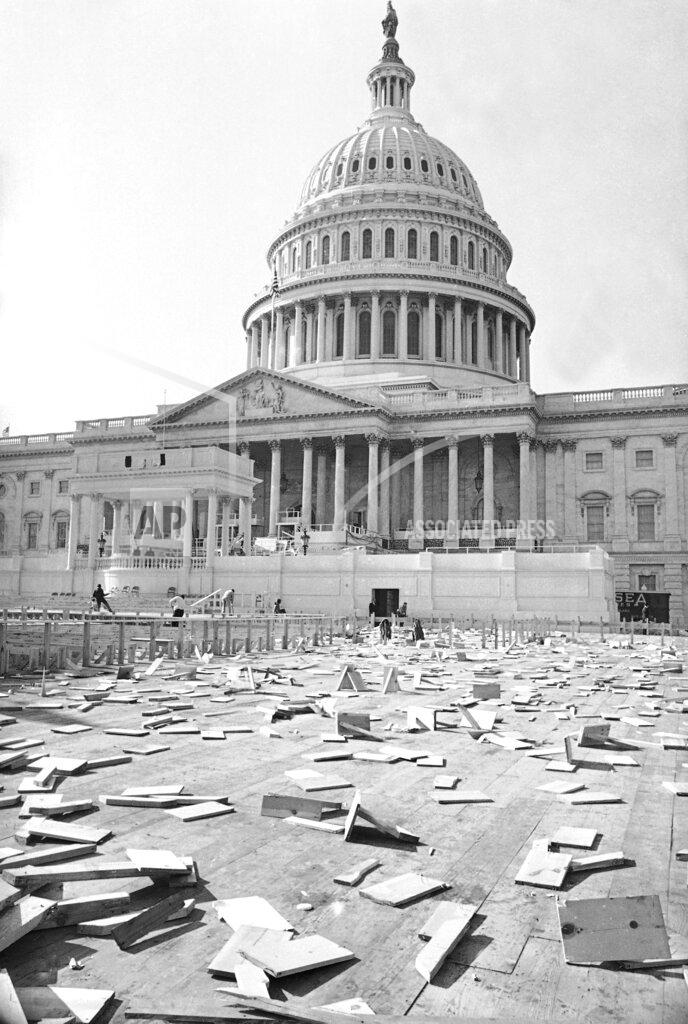
The Inaugural parade viewing stands in front of the White House on Pennsylvania Avenue were being dismantled today, and yesterday’s festive spirit was replaced with a down-to-business mood. The hour-and-45-minute meeting with the bipartisan leadership of Congress was apparently arranged late last night, possibly while the President was touring five inaugural balls. The White House press secretary, George E. Reedy, said there was “no crisis whatsoever.” He said it was a “very frank and thorough discussion of the international situation… At the beginning of his term he is planning to make every effort to keep them [the leaders] fully informed on developments throughout the world,” Mr. Reedy said.
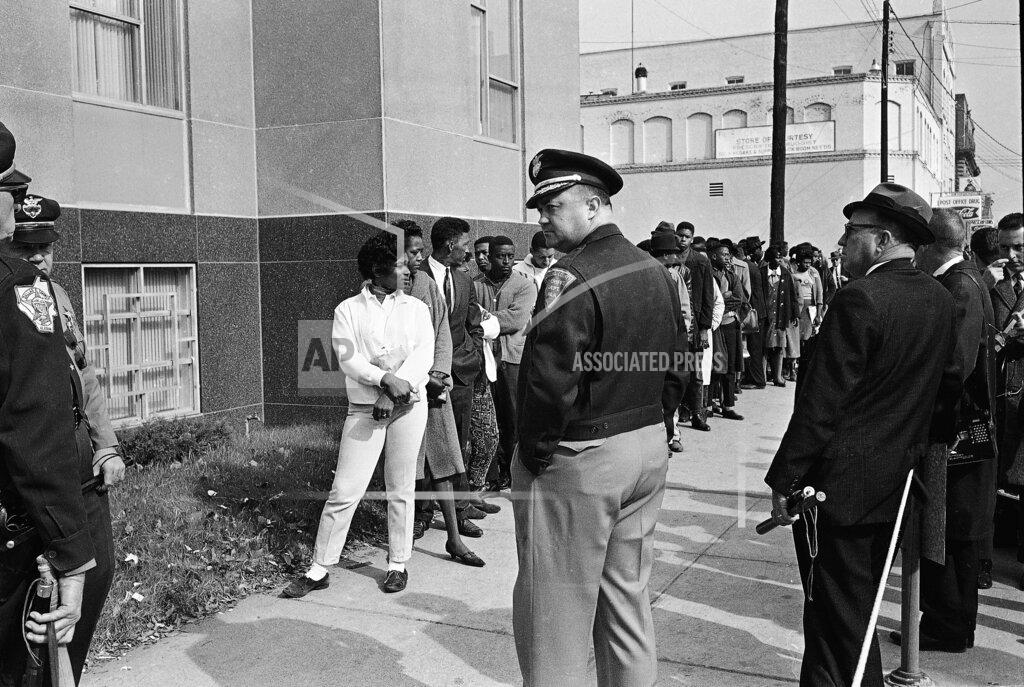
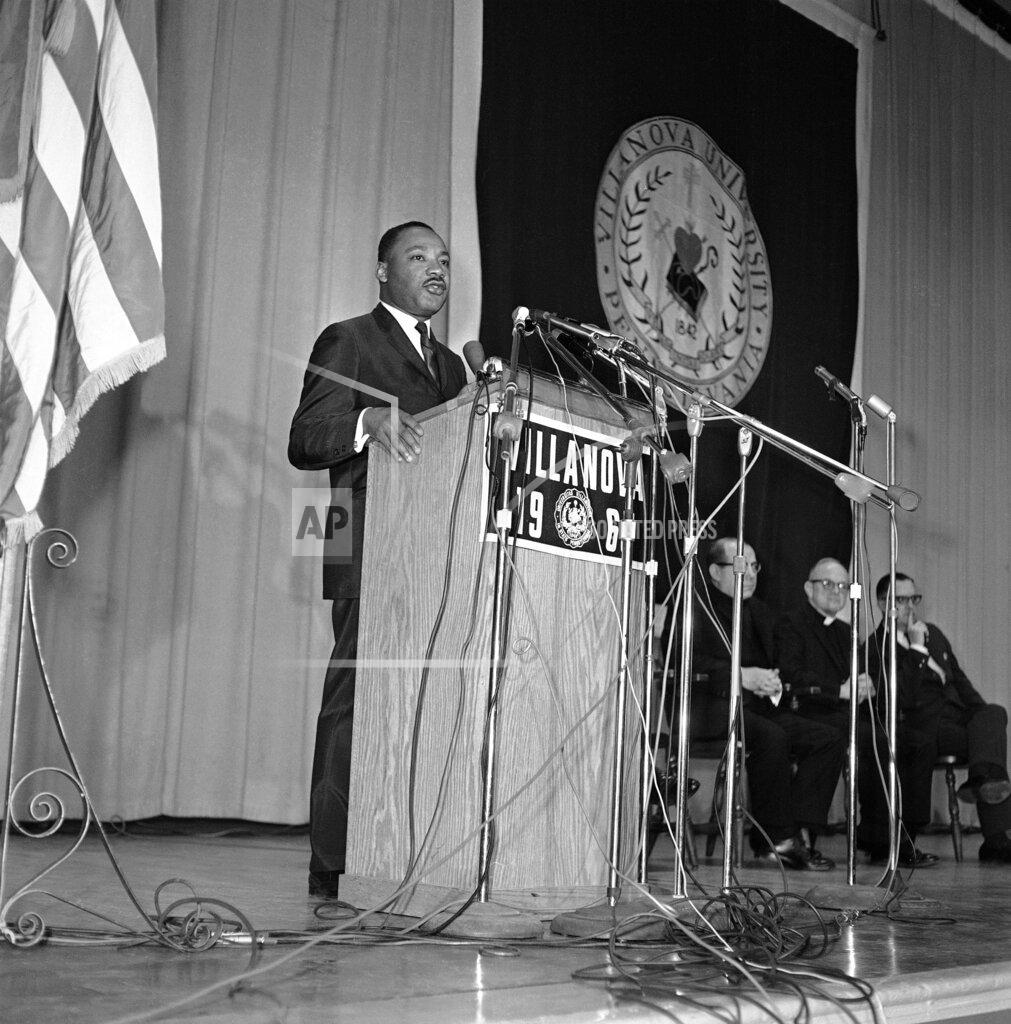
The Dallas County Board of Registrars in Selma, Alabama issued a public statement today suggesting that there was more involved in demonstrations in front of the courthouse than the desire of 150 Blacks to register and vote. The Rev. Dr. Martin Luther King Jr. and other Black leaders agree. They want to register 370,000 Blacks across Alabama and to retire men like Governor George C. Wallace and Dallas County Sheriff James G. Clark from politics. They are using Selma as a likely place to dramatize the barriers that exist against Black voting and to speed their removal, a prospect that has been taking place slowly but surely through the federal courts. The prospects, then, are for more and larger street demonstrations. “Continue to play Dallas County creatively and nonviolently,” Dr. King told 800 cheering Blacks before he left town this week. He will return this weekend to lead them.
The board, headed by V. B. Atkins Sr., said in a statement today that only a handful of Blacks showed up to register until Dr. King organized the demonstrations. “What is it they want?” the board asked. “Is it really the vote and good of our Black citizens? Is it simply to sow discord and stir trouble?” The Rev Frederick D. Reese, president of the Dallas County Voters League, a Black organization, said that Blacks had become discouraged over the test and waiting period and had quit going to the office before the drive started.
One aim of the demonstrations seems to be to gain the sympathy of the nation so that economic and political pressure will be exerted to accelerate the change that appears likely to come anyway through the courts. “If they refuse to register us,” Dr. King said when he opened the campaign on January 3, “we will appeal to Governor Wallace. If he doesn’t listen, we will appeal to the Legislature. If the Legislature doesn’t listen we will dramatize the situation to seek to arouse the federal government by marching by the thousands by the places of registration. We must be willing to go to jail by the thousands.”
In 1947, Alabama had 6,000 Blacks registered. By the November 3 election last year the number had increased to an estimated total of 111,000. But 370,000 others of voting age — 79.6 percent of the potential are not registered. By comparison, 946,000 whites — or almost 70 percent of the potential — are registered. Blacks make up a little more than 10 percent of the electorate. The Justice Department filed a suit in the United States District Court in Montgomery a few days ago charging that the present requirements for registering were designed to freeze the present racial imbalance on the registration rolls.
Attacked in the suit is a new voter application test prescribed by the Alabama Supreme Court. It consists of 100 alternating sets of questions. Each applicant is asked four questions concerning government and four involving the United States Constitution and is given a dictation test on excerpts from the Constitution. Questions used include: “Ambassadors may be named by the President without approval of the U. S. Senate. True or False.” “Where do presidential electors cast ballots for President, their home state, the District of Columbia or their home county?” The Government charged that the test was above the sixth grade education standards prescribed by the 1964 Civil Rights Law and was discriminatory in that most now on the rolls were not required to take it.
Dick Gregory, the comedian, and 14 local Blacks were served today at a Tuscaloosa, Alabama steakhouse that turned them away yesterday. A group of 15 other Blacks ate in a drugstore in a building that houses the offices of Robert M. Shelton, imperial wizard of the Ku Klux Klan. About 30 policemen, including Chief William Marable, kept spectators from congregating near the steak house. There were no incidents. Mr. Gregory said before entering the restaurant that he thought the desegregation drive here had progressed well, and he praised police for “doing their job.”
A white supremacist convicted of assaulting Dr. King was himself beaten severely in a barroom brawl, the police said today. James George Robinson, 27 years old, a member of the militantly segregationist National States Rights Party, received hospital treatment following the altercation in a Birmingham beer tavern Tuesday night. He had been freed on appeal bond after his conviction in Selma of assaulting Dr. King when the civil rights leader registered at a previously white hotel Tuesday.
The Federal Communications Commission rebuked a Georgia radio station today for refusing to carry a reply to a broadcast editorial attack on the Rev. Dr. Martin Luther King Jr. The F.C.C. said station WALG of Albany — a frequent racial trouble spot — had failed to comply with the commission’s fairness doctrine. That rule requires broadcasters who present one viewpoint on controversial issues to provide an opportunity for the broadcasting of conflicting viewpoints. WALG, in a broadcast editorial last October 21, criticized the award of the Nobel Peace Prize to Dr. King, head of the Southern Christian Leadership Conference, of which the Albany Movement is an affiliate.
Former Senator Barry Goldwater declared today that he would oppose “any third party movement” by hard-core conservatives. There are reports that a number of conservatives are upset about the arrangement by which Ray C. Bliss will be chosen tomorrow to replace Dean Burch as Republican national chairman. A few of the defeated Presidential candidate’s associates were still grumbling today because Mr. Goldwater had not insisted that control of the party organization remain within his conservative political family.
President Johnson is taking a hard look at existing economic aid programs to find the best formula for helping depressed areas throughout the nation.
The House Veterans Committee will investigate a decision by the Veterans Administration to close 32 of its facilities, including 11 hospitals.
Secretary of Defense Robert S. McNamara says revolutionary changes “have been driven into the bedrock” of the giant military establishment and will remain after him. He says he no intention of moving on from his post.
Four Air Force Academy cadets voluntarily resigned today while an investigation continued into reports of cheating on examinations.
An expanding role by the Federal Government in providing birth-control information was reported by the District of Columbia’s Director of Public Health, Dr. Murray Grant.
Dow Jones Industrial Average: 893.26 (-2.05)
Born:
Jam Master Jay (stage name for Jason Mizell), American rap DJ with Run-D.M.C.; in New York, New York (murdered, 2002).
Robert Del Naja, British trip-hop singer-songwriter (Massive Attack), and artist, born in Bristol, England, United Kingdom.
Cordell Crockett, American rock bassist (Ugly Kid Joe – America’s Least Wanted), born in Alameda, California.
Brian Bradley, Canadian NHL centre (NHL All-Star, 1993, 1994; Calgary Flames, Vancouver Canucks, Toronto Maple Leafs, Tampa Bay Lightning), in Kitchener, Ontario, Canada.
Eric Moore, NFL guard and tackle (New York Giants, Cincinnati Bengals, Cleveland Browns, Miami Dolphins), in Berkeley, Missouri.
Matt Stark, MLB pitcher (Toronto Blue Jays, Chicago White Sox), in Whittier, California.
Died:
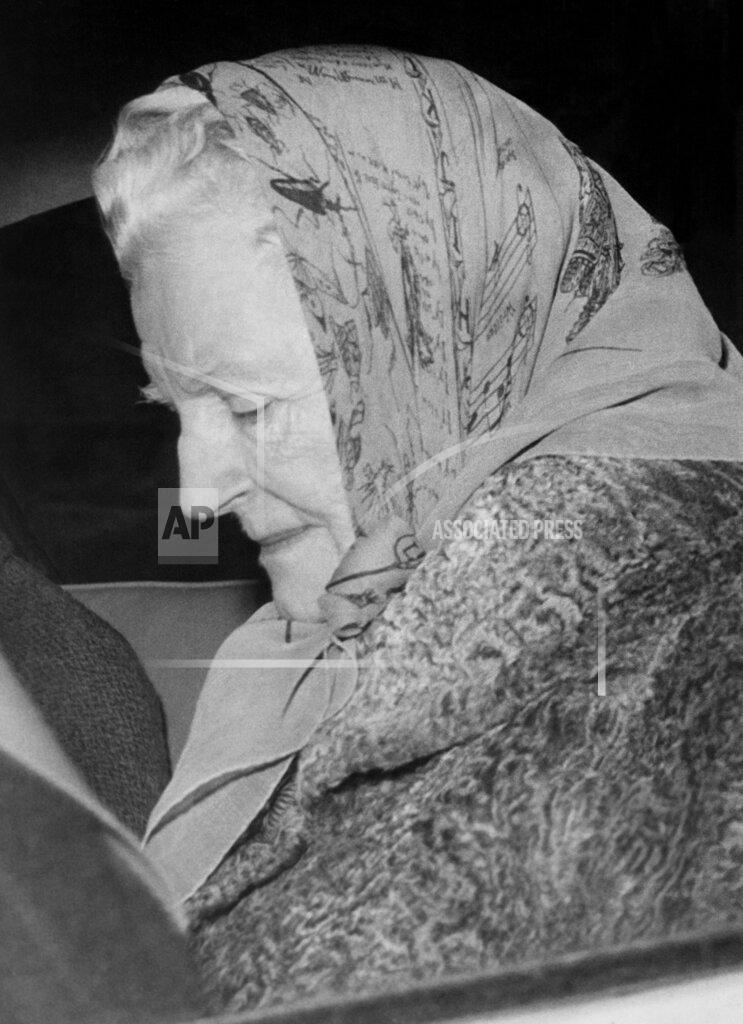
Dixie Bibb Graves, 82, American politician who served as United States Senator for Alabama from August 1937 to January 1938 at the same time that she was the First Lady of Alabama for her husband, incumbent Governor Bibb Graves.

 History Diaries