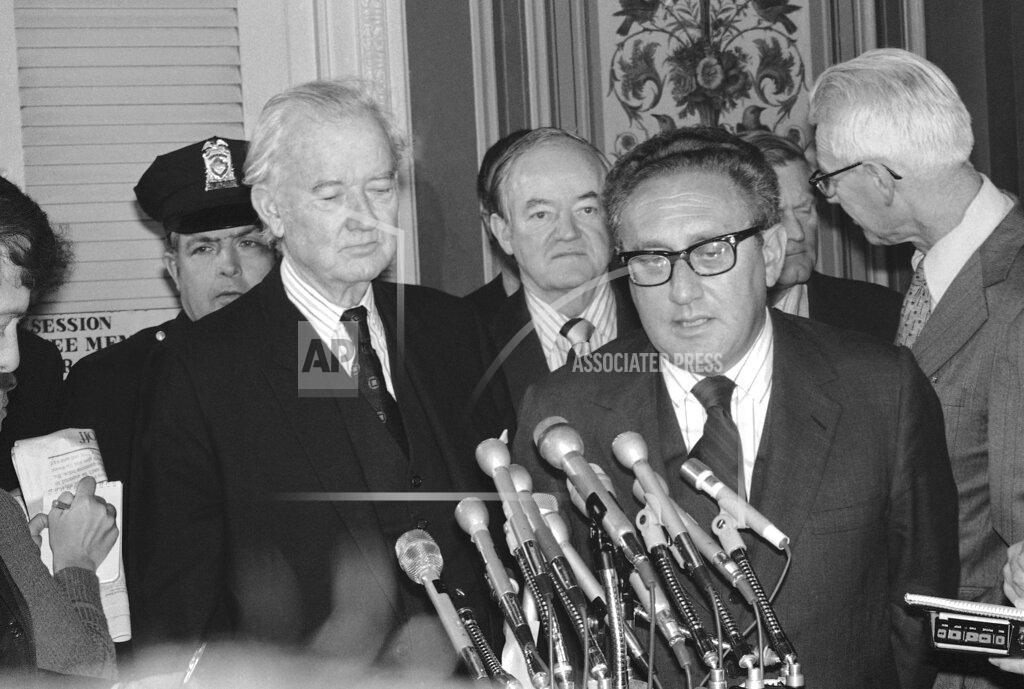
President Ford denounced North Vietnam for violating the Paris cease-fire accords and confirmed that he would ask Congress for $300 million in additional military aid to South Vietnam. He said at a televised press conference today that he could not foresee the re-entry of the United States into the war but that he did not rule out the possibility of asking Congress to let him use American air power or naval power against North Vietnam. He backed Secretary of State Kissinger’s “hypothetical” comment that if the West was undergoing “actual strangulation” he might consider force against oil producers.
In recent weeks, the Ford Administration has deliberately refused to rule out under all circumstances the possible use of American force, either in case of “strangulation” by oil producers, or in case North Vietnam launched a large‐scale offensive against South Vietnam. Under current law, no American combat forces can be reintroduced in Indochina without Congressional approval. They could be sent to the Middle East but would be subject to Congress’s eventual approval under the War Powers Act. Under the provisions of that 1973 act, the President could commit American armed forces to hostilities for up to 60 days, but would then hav to terminate that commitment unless Congress declared war, or specifically authorized the commitment or if the United States were under attack. The President could extend the time period by 30 days more if he certified “military necessity” in bringing about their disengagement. Congress, at any time, could vote to disengage the troops if no declaration of war or specific authorization were passed.
The Administration has kept these options open, not because it was considered likely that forces would be neded in either area, but rather to caution radical Arab states against putting too much pressure on the United States and to leave some doubt in Hanoi’s mind on what the United States might do. Mr. Ford was asked whether the state of the American economy permitted additional military and economic aid to Vietnam or Cambodia, both of which have come under military pressure in recent weeks because of the dry season and the increased mobility of their Hanoi‐backed opponents. “I believe it does,” he said, confirming earlier published reports that he would seek a supplemental appropriation of $300‐million. “I think it’s a proper action by us to help a nation and a people prevent aggression and violation of the Paris accord,” he added. Asked to evaluate the situation in Vietnam, he said the North Vietnamese had infiltrated “substantial personnel and many, many weapons in violation of the Paris accords.”
Mr. Ford said that the South Vietnamese were fighting “skillfully and with firmness.” “I think it’s essential for their morale as well as for their security that we proceed with the supplemental,” he said. Congress is not expected to respond to Mr. Ford’s request, and he repeated his concern, voiced in the State of the Union address, that Congressional limitations on the day‐to‐day conduct of foreign affairs “are harmful to a President in the execution and implementation of foreign policy.” Earlier in the day Mr. Kissinger testified before the Senate Foreign Relations Committee in closed hearing and discussed what he said were “some areas where we would appreciate the advice of the Senate, particularly how to conduct trade relations with the Soviet Union in the future.” But he said no specific recommendations were made to the committee.
An outsider in South Vietnam is forcefully struck by the appearance of normality almost everywhere. In the bustling cities, in the beautiful, expansive countryside, people conduct their lives in seeming obliviousness to the war. After decades of foreign intervention and civil conflict, this may be one of the people’s most precious achievements, but it appears to be extremely costly. The mental stress of a war whose weapons have been as much psychological as military has been enormous, and since the uneasy cease‐fire of January, 1973, it appears to have become even more intense. “In the beginning there was great hope for peace,” a Saigon psychiatrist said, “and now the despair is greater because there had been hope.” He said that after it became apparent that the fighting would continue, a number of women with draft‐age sons came for treatment for acute depression. They had hoped that their 17‐year‐olds and 18‐year‐olds would be spared.
The Strait of Hormuz, leading to the Persian Gulf and the world’s richest oilfields, is becoming the focus for global strategy involving the United States, the Soviet Union and their allies east of Suez. According to qualified military sources in Washington and London, the next great diplomatic or military trial of strength may develop in the gulf and the lands surrounding it and the United States is taking steps to meet what it considers a growing threat. As evidence of this situation, these sources put forward these developments.
- Prime Minister Zulfikar Ali Bhutto of Pakistan has told American visitors that his offer of an American air and naval base on the shore of the Arabian Sea close to the Iranian frontier, originally made to former President Richard M. Nixon, still stands. The expectation is that he will renew the offer when he meets President Ford later this month.
- The United States is asking Britain for the use of airfield facilities on Masira Island, off the east coast of Oman 400 miles from the Strait of Hormuz, in what is regarded by qualified sources as a move to counter growing Soviet air power in the gulf area.
- The Soviet Union, according to a nonofficial source, is flying MIG‐23 fighter‐bombers out of Iraq over Iran and over the gulf states. The pilots are believed to be “volunteers” from the Soviet Air Force.
- Soviet supply of arms to Iraq has now gone well beyond the totals required for that country’s campaign against the Kurdish forces, which have received weapons and other supplies from Iran.
- Shah Mohammed Riza Pahlevi of Iran has told Western visitors that he is worried over the prospect of a rebellion in the Pakistani province of Baluchistan, that would be fomented by India as an excuse for a “Bangladesh” operation against Pakistan.
The potential for confrontation has been underlined by other military developments in the oil‐producing area. The Soviet Union has completed a three‐lane highway system through Afghanistan leading from Soviet Central Asia to the northern frontier of Pakistan. Since the highway’s present traffic consists of goats, the assumption is that the Russians must have a military purpose in mind.
The Soviet Union has deployed new long-range supersonic bombers with combat units for the first time, U.S.. intelligence sources said. It was reported earlier this month that the Russians had deployed their first intercontinental ballistic missiles capable of carrying multiple nuclear warheads. The developments underscored the pace of Soviet acquisitions as the United States and Russia moved toward final agreement on a pact to limit nuclear armaments.
Pravda charged today that the Atlantic alliance countries were dragging out the European security conference by making excessive demands for measures aimed at increasing confidence in East and West about the military intentions of the other side.
At least three men died as the Irish Republican Army struck out in the most serious outbreak of violence since the end of a recent cease-fire. Two IRA men were killed in the first of two bomb explosions in central Belfast. Police received a dozen bomb alerts and evacuated a Belfast-Liverpool ferry boat. A British army war veterans club was blown up near the Irish Republic border and British troops killed an IRA gunman in a gun fight at the border. Two would-be IRA bombers, John Kelly and John Stone, were killed when the bomb they were transporting detonated prematurely in Victoria Street, Belfast, Northern Ireland. Only the bombers were killed in the explosion.
In the English town of Todmorden, Dr. Harold Shipman, a young general practitioner, made a house call to 73-year-old widow Lily Crossley, who died half an hour after he left. Later in the day, he visited Elizabeth Pearce, 84, who died a few minutes later of what he listed as a cerebral hemorrhage. At the close of the day, he visited Robert Lingard, 63, who died minutes later of what Dr. Shipman described as a heart attack. They were the first of hundreds of Dr. Shipman’s patients to die after he treated them, until his arrest in 1998. Officially, there were 215 confirmed victims, and he was suspected in the deaths of another 200.
Several hundred Greek Cypriot students marched to the Greek parliament in Athens and delivered a resolution calling for a policy to block what they saw as plans to partition Cyprus. Copies of the resolution were given to the speaker of the House, Prime Minister Constantine Karamanlis, and the leaders of political parties. The resolution said partition was part of Turkey’s imperialistic plans.
French Interior Minister Michel Poniatowski announced a further reinforcement of security measures at Orly airport today in the hope of thwarting terrorist attacks like the one last Sunday.
Norway should be self-sufficient enough to export oil in large quantities by 1980, said Soeren C. Sommerfelt, Norwegian ambassador to the United States. He said that by the end of this year, production of Norway’s North Sea oil should meet all his nation’s needs.
Israeli Army units on the Lebanese border have intensified a campaign in recent weeks to carry their battle against the Palestinian guerrillas to the Lebanese side of the frontier. The Israelis are using almost daily artillery fire, commando sweeps and night raids against selected villages to create what army sources here describe as a “military curtain” north of the border through which the guirrilla bands will have to pass to reach the frontier and the Israeli settlements to the south. The objective is to keep the guerrilla units off balance by constant harassment and, if possible, to confine the shooting to the area of the “curtain.” Israeli soldiers in armored personnel carriers have been rolling across the border nearly every night on search‐anddestroy operations in several areas of southern Lebanon. Special demolition squads have been sent in to destroy buildings where guerrillas are believed to have taken shelter and to blow up bridges just north of the border. Last week, for the first time in more than two years, Israeli tanks were used to shell suspected guerrilla targets.
As a result the guerrillas have been forced to abandon the rolling terrain along the central border region and to concentrate their units in the more protected mountainous areas to the east. This region was the target of most of the Israeli operations last week. The new Israeli strategy of carrying the battle across the border seems to have succeeded in its principal objective so far. Despite repeated attempts by the guerrillas, who have also stepped up their operations, no Palestinian squads have managed to penetrate any of the Israeli settlements for more than a month. The last successful penetration was on December 18, when a band of Palestinians broke through the defense perimeter of the Hanita kibbutz, near the Mediterranean coast, and wounded one civilian. The aggressive new Israeli strategy has not been without casualties, however. Twenty soldiers have been wounded and one killed so far this month in battles with guerrillas in the “curtain” area. The Arab casualties have been higher, but no figures are available here.
The village of Shuba, Lebanon, where Palestinian guerrillas decided to make a stand against Israeli raiders last week, is abandoned now. Most of the stone and concrete houses have been damaged by Israeli artillery. The 1,500 residents driven from the village are Lebanese, not Palestinians. They have been given shelter in schools at Merj ‘Uyun, the nearest town under Lebanese Army control. As the villagers were allowed to gather their belongings Sunday during a three‐hour ceasefire arranged by the United Nations, Israeli soldiers looked down from heights a mile away across the border. “This is the way we left Palestine,” commented a Palestinian employee of a private relief organization. At a school in Merj ‘Uyun, a Lebanese woman with several children, sitting on the cold concrete floor, said to a social worker: “I’m afraid we will never be allowed to go back.”
Lebanon accused Israel today of carrying out a series of attacks against the village of Shuba in which 11 villagers were wounded. Six others were kidnapped by Israeli soldiers, Lebanon charged in a letter to Secretary General Waldheim. The village is in southern Lebanon in an area Israel says is a base for terrorist attacks against Israel. Lebanon’s letter charged that the Israeli raids between January 11 and 17 and mortar fire had transformed Shuba into “a deserted village.”
Opposition parties joined forces against Prime Minister Indira Gandhi’s Congress Party to win a parliamentary by-election in India. The seat, which had been held by the Congress Party since independence 27 years ago, went to Shared Yadav, 29. Only the pro-Soviet Communists failed to back him. Yadav, elected in central Madhya Pradesh state, called himself a people’s candidate. He will be the youngest member of Parliament. The incumbent died last year.
Pakistan’s Prime Minister Zulfikar Ali Bhutto said today that India was in an expansionist mood and that there was anxiety among Pakistanis about her intentions. Citing the explosion of a nuclear device, the virtual takeover of Sikkim and private comments by Indian officials, Mr. Bhutto said in an interview that tensions would ease on the Asian subcontinent “if India were to play a modest role and not aspire to control the destiny of this region and dearly pretend to be Mother India feeding her children.”
Prime Minister Mujibur Rahman was given unqualified authority to dispense with parliamentary democracy in Bangladesh. He recently declared a national state of emergency in the bankrupt country. According to a source in Mujib’s Awami League Party, the new regime will be modeled after Tanzania’s, with Mujib as president holding executive power and exercising rule through a cabinet headed by a prime minister. In Tanzania, there is only one effective political party.
The bodies of ten men and three women were found at Club Gargantua, a topless bar in Montreal, victims of an apparent gangland slaying. It came as a harsh shock to Canadians who think of their society as peaceful and nonviolent, in contrast to the United States. The club’s manager was shot, and the entire group was herded into a storeroom, which was then padlocked and set afire. The 29-year-old gangster suspected in the murders, Richard Blass, nicknamed “The Cat” for his ability to elude attempts on life and to escape jail three times, was killed three days later by Montreal police after going for his gun when he was cornered.
Two crewmen were presumed dead after the 550-foot Cypriot tanker Lucky Era ran aground and exploded on a Bahamian reef. The US. Coast Guard said 34 crewmen, including three injured men, were rescued by a. Russian ship. The captain at first refused to abandon ship but was taken off by a Coast Guard helicopter about seven hours after the ship had sent a mayday signal. The tanker had already discharged its cargo of naphtha in Puerto Rico.”
A strike by 3,500 workers idled Venezuela’s recently nationalized iron mining industry. Previously employed by two U.S.-owned companies, the workers began a partial walkout in a dispute over severance pay that spread to the entire operation. An official of the state agency in charge said the strike was illegal. Before nationalization, the firms involved were US. Steel’s Orinoco Mining Co. and Bethlehem Steel’s Iron Mines Co.
President Ford moved to head off a drive in Congress and elsewhere for gasoline rationing. He said that he would veto mandatory rationing by itself as a superficial answer to the need to use less energy. He told his news conference that rationing was short-sighted, inequitable and inadequate to meet the long-range goal of ending dependence on foreign sources. He also said that he would ask Congress to defer passage of national health insurance because of projected budget deficits.
The Labor Department reported that the rise in consumer prices abated a little in December but that 1974 was the worst year since 1946 in consumer price inflation. The December increase in the Consumer Price Index was seven-tenths of 1 percent — one of the smallest monthly increases of the year and well below the rate for the previous four months. The Consumer Price Index was 12.2 per cent higher at the end of 1974 than at the beginning. The last time the inflation rate was worse—18.2 per cent —was in 1946, when wartime price controls were removed and inflationary pressure that had built up during World War II was expressed in a splurge of demand.
Al Ullman of Oregon, the new chairman of the House Ways and Means Committee, told its organizing meeting that President Ford had concurred in the committee’s plan to concentrate on a tax-cut bill and to defer consideration of increased oil taxes. Mr. Ford had wanted action on both, but Mr. Ullman argued that the committee could not act swiftly on an antirecession tax cut while considering the more controversial and complex energy tax problem.
The Supreme Court, in overruling its 1961 decision, said that shifting economic and social patterns have made it constitutionally unacceptable for states to deny women equal opportunity to serve on juries. The 8-1 majority decision in Taylor v. Louisiana broke new ground when it said that women’s role in society was changing and that the courts must recognize their growing economic independence in contemporary life.
Assured there will be no witch hunt, the Senate moved toward establishment of a select committee to investigate the Central Intelligence Agency and other intelligence groups, including the FBI. Senator John O. Pastore (D-Rhode Island) introduced a resolution to create the committee and after an hour of debate, the Senate set a vote on it for Monday. Neither a witch hunt nor a whitewash will be conducted,” said Majority Leader Mike Marisfield of Montana. There will be no wholesale dismantling of our intelligence community.”
Richard Helms assured the Senate Foreign Relations Committee two years ago that the domestic surveillance of antiwar activists was not a proper function for the Central Intelligence Agency, a review of previously published testimony shows.
Clarence M. Kelley, Director of the Federal Bureau of Investigation, said today that the bureau keeps files on members of Congress, but he denied any impropriety. Mr. Kelley, in a three‐page statement, said current F.B.I. practice was to seek out information on Senators and Representatives only in investigations of Federal crimes or in background checks of men nominated for posts in the executive branch or in the courts. Unsought information that the bureau comes across, he said, is also kept in case a man should receive an appointment at a later date.
The Oklahoma House rejected the Equal Rights Amendment today amid assertions that it would take women off a pedestal and fears of future United States Supreme Court rulings. The “do pass” motion in the House Committee of the whole was 45–51, and a “report progress” motion failed, 44–51. A “do not pass” motion carried, 50‐43, killing the proposal.
Ralph Nader said the Ford Administration’s own analysis showed automobile fuel economy could be raised 40% by 1980 without relaxing tighter auto emission standards set for 1977 and 1978. Nader released copies of a previously secret Federal Energy Administration analysis as the Environmental Protection Agency opened hearings on a request by the auto makers to postpone for one year the 1977 standards. President Ford has proposed that current standards be tightened slightly and then a five-year freeze be imposed. Nader released what he said was an executive summary that showed the course chosen by Mr. Ford was not favored by any government agency representatives.
John M. Doar, the Justice Department’s civil rights chief during the Johnson administration, once recommended that federal antipoverty and neighborhood legal services programs be used to gather intelligence about civil disorders, department spokesman Robert Havel said. Doar, who also served as chief counsel in the House impeachment inquiry last year, made the suggestion in a 1967 memorandum to then-Attorney General Ramsey Clark, Havel said in response to questions. Havel added that he did not know whether the plan was put into action or what, if any, intelligence it produced.
Three gunmen traded their five hostages for three policemen and headed out of town in an unmarked police van, South Bend, Indiana, police said. The men, armed with shotguns, took five persons hostage in a downtown clothing store during an attempted robbery and held them captive for two hours. A police helicopter followed the blue van given to the gunmen after they left the store and drove onto a highway but no roadblocks were immediately set up.
The government has accused General Motors of refusing to notify the owners of an estimated 816,000 older model automobiles of alleged safety-related defects in their cars. The Transportation Department’s National Highway Traffic Safety Administration said it had filed two suits in federal court seeking a total of $800,000 in civil penalties. One suit seeks to force GM to notify owners of 1965 and 1966 Chevrolets and 1966 Buicks built before March 28, 1966, that a fire hazard exists from allegedly faulty carburetor plugs. The second suit concerns 1965 through 1968 Buick Electra 225s and Buick Wildcats and some early production 1970 model Cadillacs that allegedly have a defect in the engine mounts.
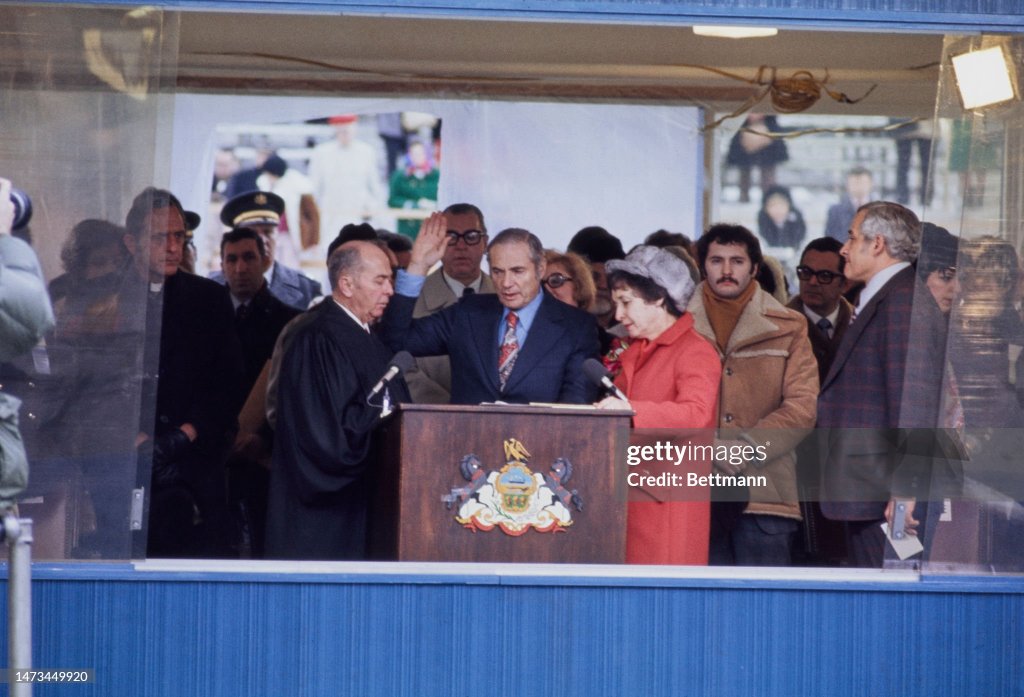
Milton J. Shapp, the only Pennsylvania Governor to succeed himself in more than a century, began his second term today with a pledge to persevere in the liberalism that brought both acrimony and acclaim to his first four years in office.
Champlin Petroleum Co. agreed on a two-year settlement containing pay boosts of 28.8% for refinery workers and the head of the union said only a few major oil firms were still holding out on new contracts A.F. Grospiron, president of the Oil, Chemical and Atomic Workers Union, said the Champlin contract covered about 800 workers in California, Oklahoma and Texas. He said only 27,000 of the 80000 union members were without contracts Grospiron claimed the settlements were not inflationary because refiners productivity had increased in recent years.
The atomic workers union challenged today important aspects of Federal and state investigations into the death of Oklahoma laboratory technician Karen Silkwood and the charges she made about the plutonium plant where she worked.
Biologists advising British Government research agencies yesterday warned that “rigorous safeguards” would be needed to control studies of potentially beneficial new techniques for so-called genetic engineering transferring genes, units of heredity, into and among single-cell bacteria.
Actress Zsa Zsa Gabor (57) weds toy inventor Jack Ryan (48) (divorced 1976).
28th NHL All-Star Game, Montreal Forum: Wales Conference beats Campbell Conference, 7-1; MVP: Syl Apps Jr., Pittsburgh, Centre.
The National Hockey League became the first American sports league to allow women journalists into the players’ locker room for interviews, a privilege formerly reserved for men. The NBA followed suit later in the year, with MLB and the NFL not admitting female reporters until later. The two women included in the press at the game in Montreal (which the Wales Conference won 7–1 over the Campbell Conference) were Robin Herman of The New York Times and Marcelle St. Cyr of Montreal radio station CKLM.
Dow Jones Industrial Average: 641.90 (-5.55, -0.86%)
Born:
Casey FitzRandolph, American speed skater (Olympics, 500m, gold medal, 2002), in Verona, Wisconsin.
Jennifer Howard, WNBA guard (Cleveland Rockers), in Vale, North Carolina.
Jason Moran, American jazz pianist, composer (The Bandwagon; Selma; From the Dancehall to the Battlefield) and educator, in Houston, Texas.
Died:
Marie Lohr, 84, actress (“Pygmalion”, “Small Hotel”, “Escapade”).
Ernst Gernot Klussmann, 73, German composer.






 History Diaries