Soviet 60th Rifle division attacks to relieve the isolated 18th Rifle Division of the Soviet 8th Army, encircled for a week north of Lake Ladoga.
In the Eastern Isthmus, fierce battles are being fought in Taipale.
Soviet troops attack the Finnish strongholds at Terenttilä and Kirvesmäki.
The Soviet 122d Division at Maekaejaervi on the southern prong of the Soviet advance out of Salla attempts to make a stand against Finnish attacks.
In the Central Isthmus, heavy enemy shelling pounds the Finnish defences in Summa village.
In Southwest Finland, the armoured coastal vessels Väinämöinen and Ilmarinen are redeployed to Turku to reinforce the city’s air defences.
Flight Luukkanen shoots down four enemy aircraft to the north of Lake Ladoga.
Thirty-seven enemy aircraft bomb Lahti and put the radio transmitter off the air. Five die and 19 are injured in the raid. The enemy is now broadcasting its own propaganda on the Lahti transmitter’s frequency. Turku, Tampere and Kouvola are also bombed.
Soviet bombers attack the ports of Turku and Hango and set massive fires with 75 incendiary and 150 explosive bombs. The Soviets also perform strafing missions.
A group of foreign correspondents visit the city of Turku to inspect the damage caused by the bombing.
A Finnish Centre for Nordic Aid aircraft begins transport flights from Vaasa to Sundsvall.
Fifty-eight American Finnish volunteers arrive in Oulu.
The Red Army paper Krasnaya Zvezda acknowledges the slow progress of the Soviet troops and demands that the Red Army be taught how to ski.
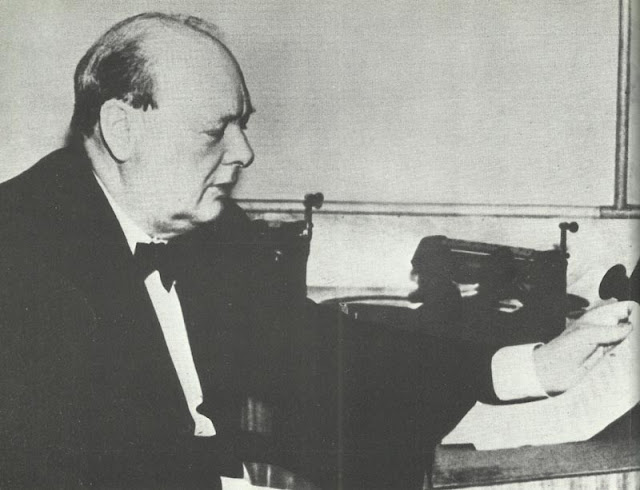
Winston Churchill gave an address over the radio referred to as the “House of Many Mansions” speech, with neutral nations its primary subject. Churchill explained that there was “no chance of a speedy end” to the war “except through united action”, and asked listeners to consider what would happen if neutral nations “were with one spontaneous impulse to do their duty in accordance with the Covenant of the League, and were to stand together with the British and French Empires against aggression and wrong?” Churchill concluded, “The day will come when the joybells will ring again throughout Europe, and when victorious nations, masters not only of their foes but of themselves, will plan and build in justice, in tradition, and in freedom a house of many mansions where there will be room for all.” Churchill, First Lord of British Admiralty, admonished neutral nations to support the Allied cause, claiming, “Each one hopes that if he feeds the crocodile enough, the crocodile will eat him last.”
Churchill also has unusually harsh words for the Soviets. Previously, he has been quite circumspect about lumping them in with the Germans. However, this time he calls them “brutish” and compares “Germandom to Bolshevism” and finds both wanting. In Churchill’s speech, he voiced support for Finland while criticizing brutal Soviet attacks. The Finnish government presumed that this meant British support would soon arrive, but it never did. The German government interpreted the speech as a hint on British involvement in Scandinavia, thus plans for the invasion of Norway were re-prioritized.
The British Government releases some reconnaissance photographs taken over Germany.
Fear of the retaliatory powers of the Allies caused a fatal hesitation on Germany’s part and prevented the “Blitzkrieg” that was Chancellor Hitler’s best chance of victory, Viscount Halifax said today.
London recorded a temperature of 12 degrees Fahrenheit – the city’s coldest day since 1881.
A temperature of −30.1 °C (−22.2 °F) was recorded in the Valley of the Lesse in Rochefort, Belgium – the country’s coldest temperature ever.
On the Western Front the cold is growing even more intense — 13 degrees below zero Fahrenheit in some exposed parts — but it has not entirely interrupted activity. One French scouting party in particular proceeded fai into the German lines in the Blies sector, southwest of Zweibrücken. On its return it encountered two enemy groups and there was a brief skirmish. It is reported that the French were able to return to their lines without losses. Farther to the east the Germans took the initiative and engineered a raid which, according to the communiqué, failed in its objective.
Hitler reduces the “alert period” before the implementation of Operation Yellow (Fall Gelb) from 4 days to 24 hours for security reasons. He also uses his intuition (and perhaps intercepts) to surmise that the British are thinking of invading Scandinavia (they are). Thus, he agrees with the Generals to put off Fall Gelb until the spring but begins thinking himself more seriously about invading Norway.
Dr. Ritter writes in a progress report to the DFG: “Through our work we have been able to establish that more than ninety percent of so-called native Gypsies are of mixed blood… The Gypsy question can only be considered solved when the main body of asocial and good-for-nothing Gypsy individuals of mixed blood is collected together in large labor camps and kept working there, and when the further breeding of this population of mixed blood is stopped once and for all.”
After a few weeks’ interval, deportations of Jews to the Lublin reservation in Poland were resumed last week, it is reported. Two transports carrying 600 Jews from the Czech protectorate arrived in Lublin.
The Cabinet Council for National Defense in Berlin tonight issued a decree regulating the handling of enemy property in Greater Germany, including the incorporated Polish territory.
The first tangible move in attempts by Turkey to form a unified Balkan bloc including Bulgaria and Hungary was seen today in an exchange of messages between President Ismet Inonu and King Boris of Bulgaria.
Generals Weygand and Wavell meet in Beirut.
RAF bombers make a bombing run in the North Sea and are attacked by anti-aircraft guns from four Kriegsmarine patrol vessels. British planes suffer no damage.
At 2026, the Norwegian freighter SS Miranda was hit by one torpedo from U-57 and sank within five minutes about 30 miles NW of Peterhead (58° 14’N, 2° 05’W). Miranda (Master Asser Hiorth) was hit by one G7e torpedo from U-57 about 30 miles northwest of Peterhead. The U-boat had spotted a group of five steamers and an escort and tried to attack the leading ship, but the distance was too short so they fired a torpedo with a magnetic fuze at the second ship. The explosion broke the keel of Miranda and caused her to sink within five minutes. Three crew survive, fourteen perish. The survivors spend the night in the water before being picked up by a passing Antarctic exploration vessel, RRS Discovery II and being taken to Kirkwall. The 1,328 ton Miranda was carrying coal and was bound for Oslo, Norway.
The British motor tanker Caroni River struck a mine laid the day before by U-34 and sank in Falmouth Bay (50° 06’N, 5° 01’W), while carrying out paravane trials and defensive armament tests. The entire ship’s complement of master, 42 crewmembers, Cdr J.G. Bradshaw RN and eleven naval personnel were picked up by the Falmouth lifeboat and a naval cutter and landed at Falmouth. The 7,807 ton Caroni River was carrying ballast and was bound for Falmouth Bay, England.
German submarine U-44, commanded by Kapitänleutnant Ludwig Mathes, torpedoed and sank Greek steamer Ekatontarchos Dracoulis at 40.20 N, 10.07 W off Portugal at 0415 hours. There are six lives lost, but there could have been more had Captain Mathes not held his fire as the crew took to the boats. U-44 had been hunting for Ekatontarchos Dracoulis for the past 6 hours after an unsuccessful attack the previous night. The 5,329 ton Ekatontarchos Dracoulis was carrying wheat and general cargo and was bound for Tyne, England.
The Estonian cargo ship Nautic foundered off the Shetland Islands, United Kingdom (63°43′ N 0°43′ E). All crew were rescued.
The Norwegian cargo ship Ila came ashore on the coast of Kent, United Kingdom. The motor life-boat John and Mary Meiklam of Gladswood (Royal National Lifeboat Institution) rescued her eighteen crew the next day. She was refloated and returned to service.
Convoy OA.76 departs Southend.
Convoy OB.76 departs Liverpool.
Convoy SL.17F departs Freetown for UK.
Convoy HXF.17 departs Halifax for Dover.
U.S. freighter Examelia is detained at Gibraltar by British authorities (see 31 January)
U.S. passenger liner Washington, bound for Genoa, is detained at Gibraltar by British authorities only a few hours before being allowed to proceed
United States protests delay of American shipping at Gibraltar
The War at Sea, Saturday, 20 January 1940 (naval-history.net)
Light cruiser DELHI departed Scapa Flow for Portsmouth where she arrived on the 22nd. When she left Scapa, the 7th Cruiser Squadron ceased to exist.
Light cruiser MANCHESTER stopped Norwegian steamer LISA and sent her to Kirkwall for inspection.
Destroyer ASHANTI arrived at Rosyth from Loch Ewe, via Scapa Flow.
Destroyers FAME and FURY arrived at Sullom Voe to refuel.
Destroyer KIMBERLEY sailed for the Clyde after unsuccessfully searching for the submarine that sank Swedish steamer PAJALA.
Destroyers SIKH, MOHAWK, IMPERIAL and IMOGEN departed Rosyth for a sweep in the North Sea. On the 21st, IMPERIAL was in a minor collision, but was able to continue, and then on the 22nd attacked a submarine contact off Buchan Ness in 57.31N, 01 16W. She was ordered to remain at the location until relieved by destroyers ENCOUNTER and ESCAPADE from Rosyth. Repairs to IMPERIAL were completed on the 26th.
Submarine TRIBUNE arrived at Rosyth from patrol with engine trouble, and was docked from 21 January to 22 March. Submarines TRIDENT, SEAL, and TRITON departed Rosyth for patrol on this date, but TRIDENT and SEAL arrived back next day.
Armed merchant cruiser SALOPIAN, en route from Devonport to the Clyde, was in a collision with Finnish steamer SAIMAA (2001grt) in the Firth of Clyde, and was grounded in the Clyde on the 21st.
Anti-submarine trawlers KINGSTON CYANITE (433grt), KINGSTON CORAL (433grt) and KINGSTON CRYSTAL (433grt) were en route from Belfast to Portland. Off Lizard Head in 49-57N, 4-50W and 49-58N, 4-58W, they attacked a submarine contact.
Convoy OA.76 departed Southend escorted by destroyers VERITY and VETERAN until the 23rd when the convoy dispersed.
Convoy OB.76 departed Liverpool escorted by destroyer WARWICK and sloop DEPTFORD until the 23rd.
Convoy FN.76 departed Southend, escorted by destroyer VALOROUS and sloop LONDONDERRY, and arrived in the Tyne on the 22nd.
Convoy FS.77 departed the Tyne, escorted by sloops FLAMINGO, WESTON and minelayer PLOVER, and arrived at Southend on the 21st.
Liner LLANDAFF CASTLE (10,786grt) departed London and was involved in a collision with an unknown vessel off Beachy Head. She returned to port but was able to continue her voyage to North Africa after a week’s repair.
U-34 laid mines off Falmouth during the night of the 19th/20th, which sank one merchant ship — tanker CARONI RIVER (7087grt) on the 20th in 50 06N, 05 01W, but without the loss of any member of crew, all of whom were saved.
U-44 sank Greek steamer EKATONTARCHOS DRACOULIS (5329grt) in 40 20N, 10 07W, with the loss of six crew. The survivors were picked up by Italian steamer NINOPADRE (4171grt).
Estonian steamer NAUTIC (2050grt) was lost NW of Bergen in 63 43N, 00 43E to unknown cause.
Convoy HXF.17 departed Halifax escorted by Canadian destroyers HMCS FRASER and HMCS RESTIGOUCHE, which detached on the 21st. Ocean escort was armed merchant cruiser ASCANIA, which stayed until the 29th. The convoy was escorted by destroyer VERITY from convoy OA.79 and VOLUNTEER from OB.79 from 29 January to 1 February, when it arrived at Dover.
Destroyers HEREWARD and HUNTER departed Bermuda for Halifax.
French heavy cruiser TOURVILLE and destroyers AIGLE and VAUBAN departed Toulon on the 20th to take a shipment of gold to Beirut, where they arrived on the 25th. The gold was sent on to Ankara to support Turkish military preparations. The French ships arrived back at Toulon on the 30th, sailed again and reached Malta on 3 February. after a patrol.
Convoy SLF.17 departed Freetown escorted by destroyers HASTY and HERO in the local approaches, and armed merchant cruiser JERVIS BAY until the 31st. On 2 February, destroyer WREN joined and escorted the convoy until its UK arrival on the 4th.
The highest ranking officials of the Federal Government and of the diplomatic corps will join on Monday in paying final tribute to Senator William Edgar Borah, dean of the Senate and internationally famous statesman, who died last night in his home here at the age of 74. Hasty provisions for a State funeral in the Senate chamber, and other honors to follow later at Boise, Idaho, the Senator’s home and the capital of his State, were made today when the Senate assembled only long enough to take the necessary steps to prepare its tribute. The House was not in session, but the hour of 12:30 PM was set for the funeral Monday, in order to permit the House to assemble at noon, name a formal delegation to attend the funeral and prepare to participate in the services.
Asserting that it had been settled by public opinion that there would be no American participation in the war in Europe, District Attorney Thomas E. Dewey expressed yesterday general agreement with the foreign policy of the Roosevelt administration but attacked its recognition of Soviet Russia as a “fuzzy-minded” departure from the American tradition as enunciated by successive Republican Secretaries of State.
In the first expression of his views on foreign affairs since the announcement of his candidacy for the Republican nomination for President, Mr. Dewey, who spoke at the nineteenth annual luncheon of the Women’s National Republican Club at the Hotel Astor, declared that the United States must mind its own business but should also search for a non-entangling opportunity to help bring about a genuine peace.
He criticized the New Deal policies of the Roosevelt administration, asserting that “citizens are entitled to remain free from abuse by those temporarily in power” and warned that staggering taxes and ever-mounting debt brought ruin to nations as well as to individuals.
Other speakers were Representative J. William Ditter of Pennsylvania, chairman of the Republican Congressional Committee, who called for a change in the administration of the National Labor Relations Act, a reduction in wasteful government expenditures and a check to the growth of the Federal bureaucracy, and Margaret Culkin Banning of Duluth, author, who urged the leaders of the Republican party, while continuing to stand for a decentralized government, Federal solvency and the profit system, to recognize the necessity of a wider and more generous distribution of profits by higher wages, pensions, insurance and other methods of raising the standard of living. Mrs. William Henry Hays, president of the club, who presided, declared that the New Deal must be defeated to avoid tyranny and dictatorship in this country. She asserted that public opinion was changing and predicted the election of a Republican President “because you cannot fool all the people all the time.”
Two thousand men and women, including Mrs. George M. Dewey of Owosso, Michigan, mother of the Presidential aspirant, attended the luncheon. The addresses of Mr. Dewey and the other speakers brought enthusiastic applause. Preceding the speeches, Mrs. Hays read a statement paying honor to the late Senator William E. Borah. Those present stood for a brief period in silent tribute.
President Roosevelt started the last year of his second term today without revealing whether he would seek a third term or accept the Democratic nomination if it were tendered through a “draft” movement.
A feeling of intense irritation with Britain, which it is feared is spreading in the United States and is capable of disturbing cordial Anglo-American relations, has developed in official quarters in Washington over the adamant British attitude toward joint problems.
Attorney General Robert H. Jackson, in his first, address as head of the Justice Department, said tonight that the government must safeguard the people against efforts to mold the law in behalf of private interests.
George Gordon Battle, trial counsel for Earl Russell Browder, general secretary of the Communist party in the United States, announced last night that no defense witneses would be called at the resumption tomorrow morning of Browder’s trial on a charge of using a United States passport obtained by making a false statement.
Admiral Harold R. Stark, chief of naval operations, has put Congress on notice that the navy is so hampered by legislation that it would take at least three months to negotiate contracts for new airplanes if this country were plunged into war.
The Senate Appropriations Committee today approved a defense deficiency appropriation bill, after paring almost $13,000,000 from the bill as passed by the House, and reducing it to $251,822,588.
Former President Herbert Hoover announced last night that a score of leading industrialists had pledged themselves to raise a second million dollars for the Finnish Relief Fund, Inc., of which he is chairman.
A Gallup poll reports 34% of Americans support the resumption of the Prohibition against alcohol, with 66% opposed.
Leaders of consumer organizations through the country discussed with Mrs. Franklin D. Roosevelt this afternoon the relation between the government and the consumer, with particular emphasis on expansion of government services to the consumer and coordination of such services.
Lillian Hellman, author of “The Little Foxes,” contended yesterday that theatrical benefits for Finnish relief would give a dangerous impetus to war spirit in this country. Her statement was in reply to an assertion by Tallulah Bankhead, in which the play’s star had intimated that Miss Hellman and Herman Shumlin, the producer, had refused to allow “The Little Foxes” to play a Finnish relief benefit because of a pro-Soviet bias.
Normal coal deliveries will be resumed tomorrow morning in New York as the result of a tentative agreement reached at 5:57 PM yesterday through the efforts of Mayor La Guardia and Edward F. McGrady, former assistant secretary of labor.
A general riot of 1,400 inmates at the Michigan Reformatory in Ionia broke out late today and hastily reinforced guards armed with rifles and tear gas bombs battled prisoners for nearly an hour before it was brought under control.
There is a three-alarm fire at the Central Christian Church in Cincinnati, Ohio. This church was located behind the quarters of Engine 45. Damages are estimated at $75,000 to $100,000.
Argentine President Roberto Marcelino Ortiz and minister of agriculture José Padilla issue a decree expanding Basque immigration from Spain and France.
Mohandas K. Gandhi today expressed approval of the recent speech by the Marquess of Linlithgow, the Viceroy of India, in which he said that only disagreement among the various Indian parties prevented England from granting dominion status to India.
During the Winter Offensive in the Second Sino-Japanese War, Chinese troops captured Licheng, Shanxi Province, China.
Senator Key Pittman asserted today that Japan would have to abandon the New Order in East Asia policy if the United States was to have due rights in Japanese-occupied China.
Japanese authorities refused the United States Navy today permission to land twenty-four survivors of the Japanese fishing boat No. 1 Seiho Maru on Saipan Island in the western Pacific. The Japanese were rescued on Monday by the navy after a storm wrecked their boat in the restricted area around Guam. Naval authorities had asked the Japanese for permission to land the survivors at Saipan, an island northeast of Guam. Instead, the Japanese asked that the USS Penguin, a minesweeper, put the rescued men aboard the steamer Saipan Maru at sea at 4 PM off Rota Island not far from Salpan.
Dow Jones Industrial Average: 145.64 (-0.22)
Born:
Carol Heiss Jenkins, figure skater (Olympic gold medal, ladies’ singles 1960; silver medal, 1956; World Championship gold, 1956–1960) and actor, in New York, New York.
Jorge Peixinho, Portuguese pianist, composer, and conductor, born in Montijo, Portugal (d. 1995).
Krishnam Raju, Indian actor and politician, born in Mogalthur, India.
Lars-Åke Lagrell, Swedish sports administrator (President Swedish Football Association 1991-2012) and politician (Governor Kronoberg County), born in Växjö, Sweden (d. 2020).
Died:
Omar Bundy, 78, U.S. Army general (Spanish–American War in Cuba).
Naval Construction:
The Nihon Kaigun (Imperial Japanese Navy) B1 type submarine HIJMS I-32 is laid down by the Sasebo Naval Arsenal (Sasebo, Nagasaki Prefecture, Japan).
The Royal Navy “T”-class (Second Group) submarine HMS Thorn (N 11) is laid down by the Cammell Laird Shipyard (Birkenhead, U.K.).
The Kriegsmarine (German Navy) Type VIIB U-boat U-86 is laid down by Flender Werke AG, Lübeck (werk 282).
The Kriegsmarine (German Navy) Type VIIC U-boat U-201 is laid down by F. Krupp Germaniawerft AG, Kiel (werk 630).
The Kriegsmarine (German Navy) Type VIIC U-boat U-434 is laid down by F Schichau GmbH, Danzig (werk 1475).
The Koninklijke Marine (Royal Netherlands Navy) O-21-class submarine HrMs (HNMS) O-22 is launched by Koninklijke Maatschappij De Schelde (Vlissingen (Flushing), The Netherlands).
The Nihon Kaigun (Imperial Japanese Navy) Kagerō-class destroyer HIJMS Yukikaze (雪風, “Snowy Wind”) is commissioned. Her first commanding officer is Commander Kenjiro Tobita.
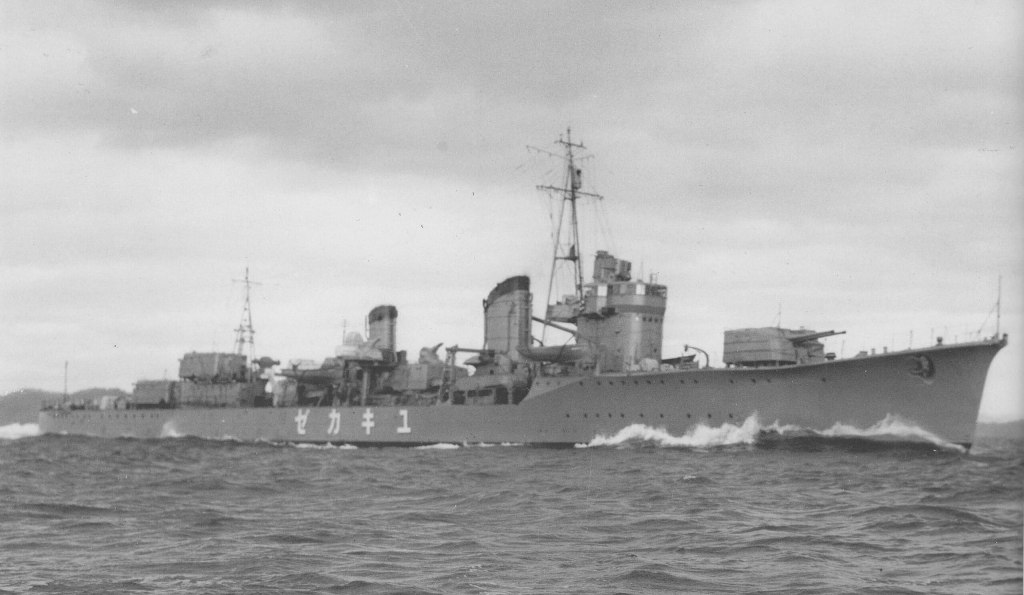
She was the only member of her class to survive the war, and did so without suffering any major damage. She participated in the battles of the Java Sea, Midway, and Santa Cruz, helping to sink the submarine USS Perch, and saw her first major surface action at the Naval Battle of Guadalcanal, sinking the destroyer USS Laffey and helping to sink the destroyer USS Cushing, alongside crippling the destroyer USS Sterett and lightly damaging the destroyer USS O’Bannon. She survived the devastating naval defeat that was the Battle of the Bismarck Sea undamaged, and led a Japanese counter attack at the Battle of Kolombangara, where she likely directly torpedoed the light cruiser HMNZS Leander and took part in a mass torpedo spread that sank the destroyer USS Gwin and torpedoed the light cruisers USS Honolulu and USS Saint Louis.
Yukikaze undertook escort missions during the Battle of the Philippine Sea, and later took part in the Battle of Leyte Gulf, surviving the allied attacks that sank dozens of Japanese ships and engaging the escort carriers and destroyers of Taffy 3, firing torpedoes at US escort carriers without obtaining a hit and engaging the destroyer USS Johnston. Yukikaze saw her last major action escorting and witnessing the sinking of the battleship Yamato during the Battle of Okinawa.
Following the war, the ship was transferred to the Republic of China Navy, where she was renamed Dan Yang (丹陽 DD-12) and served until 1966, before being scrapped in 1970.
 History Diaries