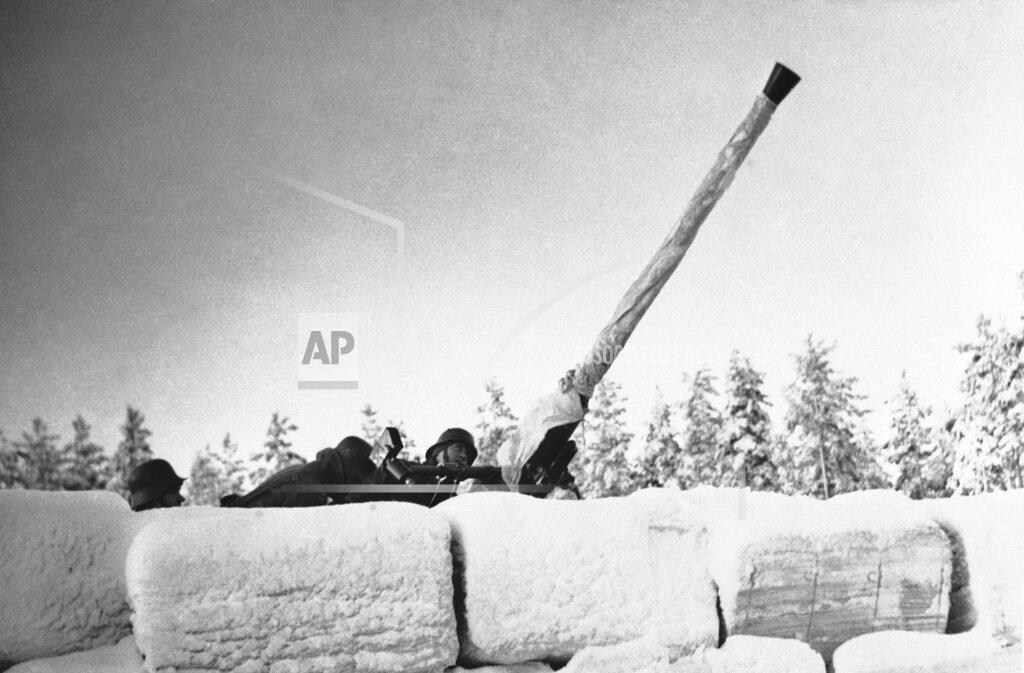
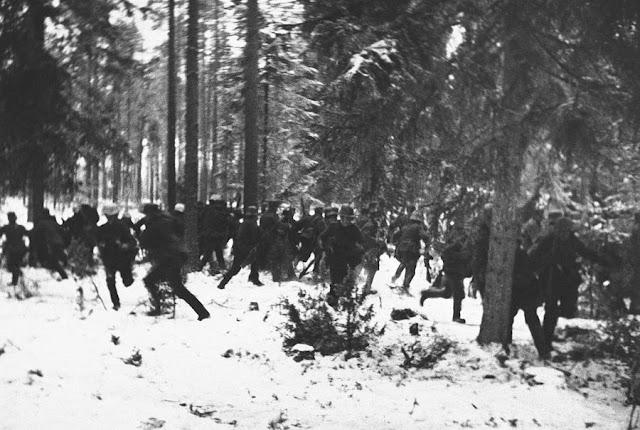
There is an unsuccessful Finnish attack against the positions of the Soviet 122nd Division at Salla.
Meanwhile, some 18,000 Soviet troops of the 18th Division have either been killed or captured while encircled north of Lake Ladoga, where they have been trapped since February 19th. Temperatures of -45° C (-82° F) are recorded.
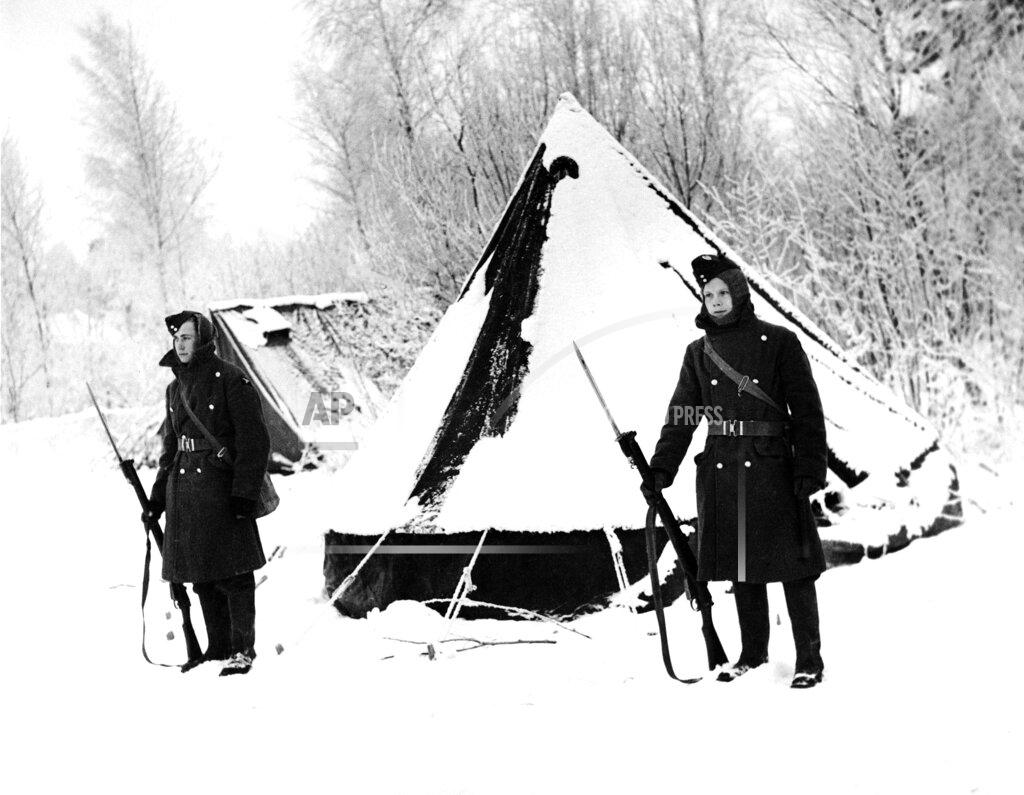
In Northern Finland, Finnish troops take up defensive positions at Märkäjärvi.
The Finnish 9th Division fighting in the Suomussalmi-Raate sector is ordered to move south to Kuhmo.
Attacks on Taipale gain no ground. The artillery bombardment of Summa continues.
Over the Karelian Isthmus, two Finnish fighters engage three enemy bombers over the Isthmus. One of the bombers is shot down. Three more Soviet aircraft are shot down over other parts of the Isthmus.
The Finnish cargo ship Kaija was bombed and sunk at Koivisto, Finland by Soviet Petlyakov Pe-2 aircraft.
Russian submarines withdraw from the Gulf of Bothnia. The naval blockade of the Gulf comes to an end.
The Stockholm newspaper Dagens Nyheter today quoted Taisto Maki, noted Finnish runner, as disclosing he had been wounded by a shell splinter shortly before Christmas.
In Helsinki, the use of blowlamps to thaw out frozen water pipes causes several fires in the city.
A special newspaper called Den Frivillege (The Volunteer) is introduced for Swedish volunteers in Finland. The author Olof Lagercrantz is appointed editor-in-chief.
Sweden gifts Finland two FK 52 reconnaissance aircraft.
The well-known author and explorer Sven Hedin suggests the funds intended for paying the 1939 and 1940 Nobel Peace Prizes be given instead to the Finnish Red Cross.
Swedish business has so far collected 62 million krona in aid for Finland.
Germany declines to mediate on Finland’s behalf in the Russo-Finnish War.
Even as far south as Italy, there is 20° of frost, all of Europe is covered by a massive cold front.
French President Edouard Daladier ordered the French military to “prepare a project concerning an eventual intervention for the destruction of Russian oil.” The British were firmly opposed to French plans to bomb Russian oil fields in the Caucasus in order to deprive Germany of Soviet oil supplies.
British 50th Motor Division begins moving to France.
The Danish Government states that it will fight to preserve its independence.
Almost 2,000 refugees huddled in river boats on the frozen Danube at Sulina, Rumania, have been ordered back to a concentration camp in Vienna and three Jewish refugee workers have been jailed by the Gestapo, German secret police, for failing to raise enough money to send the Sulina group to Palestine.
A decree issued today by the Governor of Warsaw imposing heavy penalties for profiteering on foodstuffs draws additional attention to difficulties the German authorities are having in providing food for the population of the former Polish capital.
General J.B.M. Hertzog, former Prime Minister and leader of the Opposition, today gave notice of his intention to revive the issue on which he was defeated last Sept. 6, namely, that the Union of South Africa should stay out of the European war.
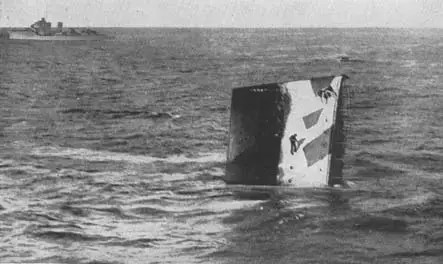
The British destroyer HMS Grenville (Capt. George E. Creasy) struck a mine in the Thames Estuary and sank. Seven ships of the First Destroyer Flotilla was operating out of Harwich with six other ships of the Flotilla were returning from an operation off the Dutch coast when in calm weather a mine exploded in the Thames Estuary, and HMS Grenville (H03), commanded by Capt. George E. Creasy, quickly capsized. Her bow was the last part of the ship to disappear. Two ships from the Flotilla disregarded their safety and lowered boats to pluck 118 men from the water. 77 to 81 officers and crew lost their life in the sinking (accounts vary). It is a brave move by the destroyers, who also are exposed to the mines. This is the last ship sunk by the minefield laid by German destroyers on 6 January 1940.
At 0145 hours, German submarine U-9, commanded by Oberleutnant zur See Wolfgang Lüth, torpedoed and sank Swedish merchant ship Patria, which escaped U-9’s first attack of two hours prior, in the North Sea (54° 16’N, 3° 30’E). 19 men were killed; 4 survivors were later picked up by Swedish merchant ship Frigg. The 1,188 ton Patria was carrying coal, paper and asphalt and was bound for Gothenburg, Sweden.
The neutral Norwegian Steam merchant Telnes was presumably torpedoed and sunk by the U-55, commanded by Kapitänleutnant Werner Heidel, northwest of the Orkneys, north of Scotland in the North Sea (60° 00’N, 4° 00’W). All of the ship’s complement of 18 died. More details about the incident are not available because the ship was lost with all hands and the U-boat was also sunk a few days later. The 1,694 ton Telnes was carrying general cargo and was bound for Antwerp, Belgium.
At 2109, the unescorted French steam merchant Quiberon was torpedoed and sunk by the U-59, commanded by Kapitänleutnant Harald Jürst, off Great Yarmouth off the eastern coast of England (52° 34’N, 2° 05’E). Quiberon (Master Arsène Guillevic) was hit on port side aft by one G7a torpedo about 13 miles east of Great Yarmouth. The stern broke off and sank immediately, followed by the forward part that sank vertically within four minutes after being hit; there were no survivors. The 1,296 ton Quiberon was bound for Lincolnshire, England.
German submarine U-44 began tracking Greek steamer Ekatontarchos Dracoulis at 2200 hours in the Bay of Biscay. Around midnight, U-44 fired a torpedo at the Greek ship, but the torpedo detonated prematurely before reaching the target.
The British cargo ship Mile End collided with the Royal Navy trawler HMT Faraday off the mouth of the River Tees, County Durham (51°45′ N 2°40′ E) and sank with the loss of five of her 16 crew. The survivors were rescued by HMS Stork.
The British cargo ship Bonnington Court struck a mine and sank in the Thames Estuary almost 1 nautical mile (1.9 km) off the Sunk Lightship ( Trinity House) with the loss of two of her 37 crew.
The British cargo ship Kirkpool was driven ashore in the southwest of England. All crew were rescued. She was salvaged and repaired in 1941.
British submarine HMS Sunfish fired four torpedoes at German submarine U-14 off Helgoland, Germany; all torpedoes missed.
Convoy OA.75G departs Southend.
Convoy OB.75 departs Liverpool .
The War at Sea, Friday, 19 January 1940 (naval-history.net)
The Northern Patrol sighted 56 eastbound ships from the 19th to 31st, and 30 were sent into Kirkwall for inspection. Warships arriving back from Patrol were armed merchant cruisers CALIFORNIA and CHITRAL in the Clyde and light cruiser SHEFFIELD at Scapa Flow after being relieved by light cruiser MANCHESTER. Light cruiser DUNEDIN departed Scapa Flow on Patrol, but was recalled on the 25th and arrived back on the 26th. Also arriving at Scapa were heavy cruisers BERWICK and DEVONSHIRE from Rosyth and light cruiser DELHI.
During the night of the 18th/19th, operation ST.3 was carried out off the Dutch coast with destroyers GRENVILLE, GRENADE, and GRIFFIN and escort vessel WHITLEY. Two Dutch, one Norwegian and one Swedish ship were sent in for inspection. Returning to Harwich, GRENVILLE (Captain G E Creasy, D.1) was sunk by mine at 1250 off Kentish Knock in 51 39N, 2 17E. Seventy-six ratings were lost, and the survivors picked up by accompanying GRENADE and GRIFFIN.
Operation ST.4 was carried out by destroyers GREYHOUND, GLOWWORM, GRAFTON and the Polish ORP BŁYSKAWICA during the night of the 19th/20th. One Norwegian and one Swedish ship were sent in for inspection. In the four ST operations, destroyers GRENVILLE (ST.1 and ST.3), GREYHOUND (ST.1 and ST.4), GLOWWORM (ST.1 and ST.4), GRAFTON (ST.2 and ST.4), GRIFFIN (ST.2 and ST.3), GRENADE (ST.3) and BLYSKAWICA (ST.2 and ST.4) had taken part in the sweeps. Anti-submarine trawlers STELLA LEONIS, WILLIAM WESNEY, RIVER CLYDE, ARKWRIGHT, STELLA RIGEL, CAPE MELVILLE, PYROPE, EDWARDIAN and MILFORD PRINCESS were also involved.
Anti-aircraft cruisers CALCUTTA and CAIRO departed Sheerness on escort duties, and arrived in the Humber on the 20th.
Destroyer EXMOUTH departed Invergordon escorting tanker HORN SHELL (8272grt) as far as Cape Wrath, and then returned to Aberdeen on the 20th to escort steamer CYPRIAN PRINCE (1988grt) to Scapa Flow.
Minelayer PRINCESS VICTORIA departed Rosyth escorted by anti-aircraft cruiser CURLEW, destroyer ESCAPADE and escort ship WHITLEY with an MT convoy for the Humber.
Destroyer BEDOUIN departed Rosyth.
Destroyer ASHANTI departed Loch Ewe with salvage ships ANCHORITE and DISPERSER for Scapa Flow.
Destroyer COSSACK arrived at Rosyth from Leith after repairs.
Submarine THISTLE departed Rosyth on patrol.
Destroyer VETERAN attacked a submarine contact off Owers Light in 50 28N, 00 45W.
French anti-submarine trawlers LA ORIENTAISE (590grt) and LA NANTAISE (590grt), sweeping to the northeast of Barfleur Light, attacked a submarine contact off Pointe de Barfleur in 49 45N, 0 03W. On 20 January, LA ORIENTAISE and sloop YSER were sweeping in the area.
Convoy HN.8 of two British, 28 Norwegian, three Swedish and five Finnish ships departed Bergen and was joined at sea by destroyers ICARUS, IMOGEN, ISIS, INGLEFIELD, KASHMIR, KHARTOUM and KIMBERLEY. Light cruisers GLASGOW and EDINBURGH departed Rosyth on the 17th in support. On the 18th, EDINBURGH dropped depth charges on a submarine contact ESE of Sumburgh Head in 60-21N, 1-09E. On the 19th, KHARTOUM and KASHMIR were detached to hunt for a submarine in Moray Firth and attacked a contact. On the 20th, the two destroyers again attacked a contact in Moray Firth in 58-03.5N, 02-07.5W. Nine steamers were detached to ports on the west coast, and arrived at Methil early on the 22nd escorted by KASHMIR, ICARUS, ISIS and IMPULSIVE; the last two destroyers reinforcing the convoy on the 19th after the submarine contact.
Convoy FS.76 departed the Tyne, escorted by sloops BITTERN and FLEETWOOD, and arrived at Southend on the 20th.
U-9 sank Swedish steamer PATRIA (1188grt) in 54 16N, 03 30E. Nineteen crew were lost and the survivors rescued by Swedish steamer FRIGG (1248grt).
U-59 sank French steamer QUIBERON (1296grt) off Great Yarmouth.
Steamer MILE END (859grt) was sunk in a collision with trawler FARADAY (322grt) in 51 45N, 02 40E in the North Sea. Sloop STORK picked up the survivors.
Senator William Borah (R-Idaho), 74, leader of the isolationists in the United States, died suddenly of cerebral hemorrhage in Washington, D.C. William E. Borah, dean of the Senate and member from Idaho for almost thirty-three years, died at his home here tonight after an illness which began with a cerebral hemorrhage Tuesday morning. He was 74 years old. Senator Borah’s death had been expected momentarily since yesterday noon when Dr. Worth Daniels, his physician, pronounced his case as hopeless. High tributes were paid to Senator Borah by President Roosevelt, members of the Cabinet, Congressmen, and others.
When the Senate adjourned today until tomorrow, most of the members expected that the Saturday session would be devoted to preparations for a funeral fitting the position of the now dead Senator. Mr. Borah died without regaining consciousness, while in a coma from which he had recovered for only brief periods in the last three days. At about 8:45 PM, a nurse attending him noticed the symptoms of approaching death and hastily called Mrs. Borah, who had gone almost entirely without rest since the Senator’s last illness began, and Miss Cora Rubin, secretary to the Senator for more than thirty years. Death occurred almost immediately.
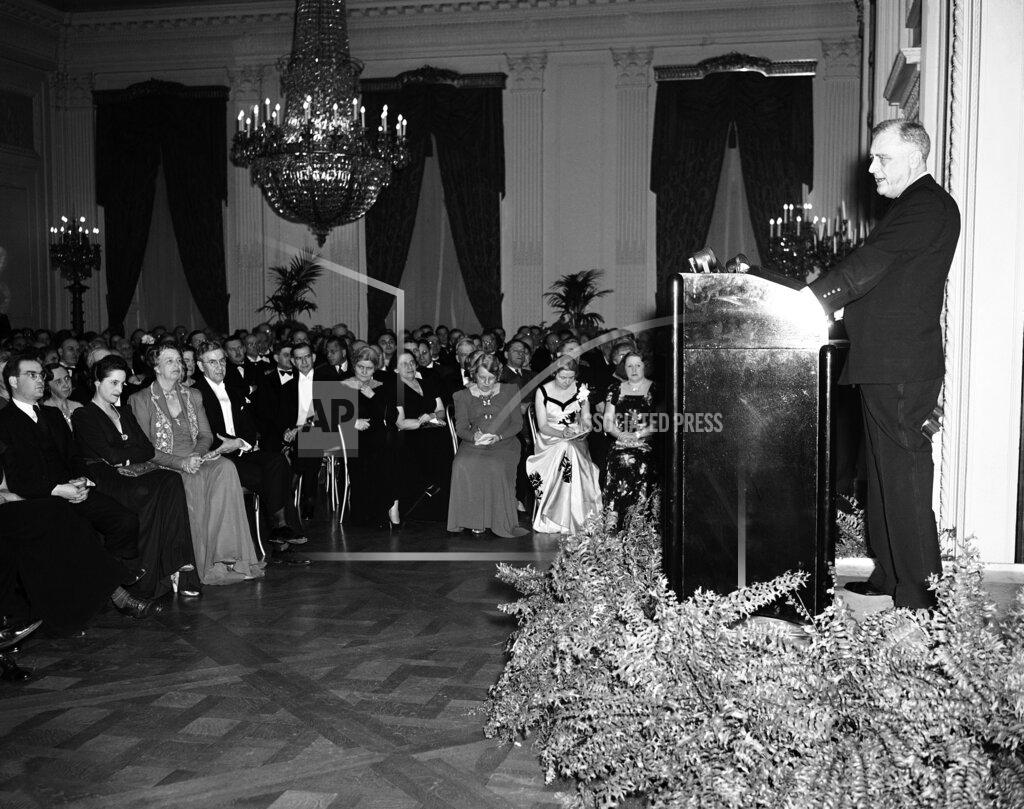
President Roosevelt received from the Apostolic Delegate the reply of Pope Pius XII to his Christmas peace message and tonight addressed from the East Room the White House Conference on Children in Democracy.
The Senate in a six-minute session confirmed postmasters and adjourned at 12:06 PM. At noon tomorrow it will receive a report on the death of Senator Borah.
The House was in recess, but the Ways and Means Committee continued its hearings on the Reciprocal Trade Agreements Act and its special committee continued its investigation into NLRB procedure.
President Roosevelt today condemned as false economy approval by the House yesterday of the elimination of funds for three government agencies, the National Resources Board, the Office of Government Reports and the Council of Personnel Administration. It was the first time the President has taken issue with Congress on a major matter at this session. With regard to the National Resources Board, Mr. Roosevelt took the position that to eliminate its services would cost the country much more in the future than the small present saving, and with regard to the other two that essential services were being eliminated to save only a few thousand dollars.
He expressed the hope that the funds would yet be made available. and said that this could be done either by Senate action on the Independent Offices Bill or by permitting the agencies to draw their funds from general relief appropriations. The President made his views clear at his press conference after. he had been asked what he thought of the economies affecting New Deal agencies by which the House removed about $95,000,000 from the Independent Offices Bill by upholding the reductions made by the Appropriations Committee.
Mr. Roosevelt pointed out that the principal reduction was in funds for the Maritime Commission. It was a question of policy, he said, as to how fast the nation would build a merchant marine. Practically speaking, he remarked, there was an almost complete cessation of ship building from World War times, and most American vessels now afloat are nearly twenty years old. The total proposed appropriations for the three other Now Deal agencies for which funds were withheld, the President continued, were so small that together they would cost but about half what one merchant ship would cost. This, the President thought, was an interesting parallel. Appropriations of about $2,000,000 had been asked for the three agencies.
The success of the American defense program is being seriously threatened as the result of the activities of unnamed persons in re-exporting strategic materials to foreign countries, principally to Russia but also, to a lesser extent, to Germany, according to army and navy authorities. Practically all of the exportations, which, to use the words of a high War Department official, have reached in the last few weeks “scandalous proportions,” involve pig-tin and rubber, materials vital in the manufacture of military weapons and equipment.
The re-export of these strategic materials is continuing in the face. of a warning by the government, several months ago, that such transactions, if continued, might weaken “the national defense position of the United States.” Most of the transactions have originated in New York City, a large part of them negotiated by the Amtorg, the principal purchasing agency of the Soviet Government in this country.
Evidence continues to pile up that the United States is becoming a major source of supplies for the Soviet Government for materials vitally necessary in the equipment of its armed forces. Facts bearing on huge exportations of gasoline from the United States to Russia were disclosed in The New York Times this morning. The seriousness of the situation involving pig-tin and rubber was made public this afternoon in a joint statement signed by Charles Edison, Secretary of the Navy, and Louis Johnson, assistant secretary of war, who spoke for the army and navy munitions board, of which they are co-chairmen.
The Pope’s reply to President Roosevelt’s Christmas peace appeal was delivered to the White House today by the Apostolic Delegate in person.
The Associated Press reports 82 deaths in 24 states from the Arctic cold front passing through the upper United States. The temperature dips as low as six below zero as far south as Tuscaloosa, Alabama.
After two days of testimony, the government rested its case yesterday afternoon against Earl Browder, general secretary of the Communist party in the United States, on trial in the Federal court on the charge of using a United States passport obtained by making a false statement. Judge Alfred C. Coxe then adjourned court until 10:30 o’clock Monday morning.
Senator Robert A. Taft of Ohio raised a question tonight whether President Roosevelt has accepted the view of the country that the United States must stay out of war, except a war of defense.
In the face of reports that his income tax returns were being investigated by the Federal Government, Paul V. McNutt, Federal Security Administrator and aspirant for the Democratic Presidential nomination, said today that he welcomed any such investigation.
The coal deadlock in New York remained unbroken last night despite a demand from Mayor La Guardia that deliveries be resumed pending agreement on the terms of a new contract between dealers and drivers.
Auxiliary USS Bear (AG-29) steams eastward to begin flight operations in the vicinity of Biscoe Bay; the ship’s embarked Barkley-Grow floatplane (Rear Admiral Richard E. Byrd, navigator) reconnoiters Sulzberger Bay to determine leads in the ice to permit Bear’s movement further to the east.
The Three Stooges film “You Nazty Spy!” about the Nazis released with the disclaimer “Any resemblance between the characters in this picture and any persons, living or dead, is a miracle.”
LPGA Titleholders Championship Women’s Golf, Augusta CC: Helen Hicks wins by 1 stroke ahead of Helen Dettweiler.
The sudden revival of the feud between Premier Mitchell Hepburn of Ontario and Prime Minister W.L. Mackenzie King so soon after a sort of concordat seemed to have been reached has created a profound stir in political circles in Ottawa.
Chinese today reported fresh successes on the Kwangtung front in South China, where their accounts pictured Chinese forces driving spearheads from different directions toward Canton. They said their troops had recaptured a station on the CantonHankow Railway, thirty-three miles north of Canton, and caused 500 Japanese casualties, while another force was heading toward Kongtsun, only ten miles north of Canton. The Japanese were silent on the Kwangtung situation, but said their soldiers were making rapid progress in a fresh offensive in the Tapieh Mountains of North Hupeh, Central Chinese province. They reported Kaocheng, the principal Chinese stronghold in the region, had been captured and Chinese forces put to flight with the Japanese in close pursuit.
The Japanese outer defenses of Canton are reported by the Chinese to be crumbling following one of the most serious setbacks inflicted on the invaders in the two-and-one-half-year-old war. The Japanese have been pushed back fifty miles since a series of retreats in Kwangtung Province forced them to leave Yingtak, important communication center on the Canton-Hankow railway, eighty miles north of Canton, the Chinese declared. The pursuing Chinese were said to have established lines forming an arc, with their western wing only eighteen miles from Canton and their center and eastern forces twenty-five miles away. The Japanese for several days have maintained silence on their Kwangtung campaign. They acknowledged a week ago that some of their forces were withdrawing from the northern area of the province after completing what they said was merely a drive to mop up remnants of the Chinese Army there.
High Chinese sources in Hong Kong admitted their successes were achieved only by great casualties, numbering between 15,000 and 20,000 Chinese troops. They said a “moderate estimate” of Japanese losses would be about 5,000 men. Neutral observers said the Chinese admission of such a great proportion of losses over those of the Japanese and the silence on the part of the invaders gave considerable credence to the Chinese reports.
It was reported without confirmation in Peiping that a Japanese warship on January 4 shelled Siulam, Kwangtung Province, damaging the American United Brethren Mission Hospital.
The new Chinese Government to be formed by former Premier Wang Ching-wei in Nanking will follow a foreign policy parallel to that of the Japanese Government, Mr. Wang told Domei, the Japanese news agency, tonight.
The Foreign Office spokesman said today that Japanese-American commercial relations after January 26 would depend entirely upon the attitude of the Government of the United States. The spokesman explained that when the Japanese-American commercial treaty expires next Friday relations between the two nations will rest on domestic and international law.
The question of the promulgation of an ordinance suspending possible discriminatory tariffs against American products now is under consideration by this government, but no decision has been reached, he said, adding that the new Cabinet headed by Admiral Mitsumasa Yonai “undoubtedly will consider the matter next week.” “Promulgation of the ordinance will be subject to developments in Washington,” he said, indicating that Japan will allow the United States to take the lead and will attempt no discrimination against American imports unless Washington makes a prior move discriminating against this country.
The general feeling is that nothing will happen immediately when the treaty — the basic agreement between Japan and the United States — expires. Trade will go on as usual, it is believed, and the right of residence for business men of each country will not be interfered with. For the long-term outlook, however, the Japanese were not so certain. A continued no-treaty period, it was said unofficially, would be likely to cause “very grave dislocations in Japanese-American relations.”
Dow Jones Industrial Average: 145.86 (+0.25)
Born:
Mary Mills, American golfer (US Open 1963, PGA 1964, 1973), in Laurel, Mississippi.
Barend J du Plessis, South African minister of Finance (1984–1992), in Johannesburg, Transvaal, Union of South Africa.
Mike Reid, comedian and actor, in London, England, United Kingdom (d. 2007).
Died:
William E. Borah, 74, American politician (Senator-R-Idaho), of a cerebral hemorrhage.
Naval Construction:
The U.S. Navy escort carrier USS (ex-HMS) Charger (CVE-30; formerly Royal Navy D 27) is laid down by the Sun Shipbuilding & Drydock Co. (Chester, Pennsylvania, U.S.A.); she is built under a Maritime Commission contract (hull number 61) as the civilian passenger/cargo ship Rio de la Plata, then later converted to an escort carrier in 1941.
The Royal Navy M 1-class minelayer HMS M 2 (M 34) is commissioned.
 History Diaries