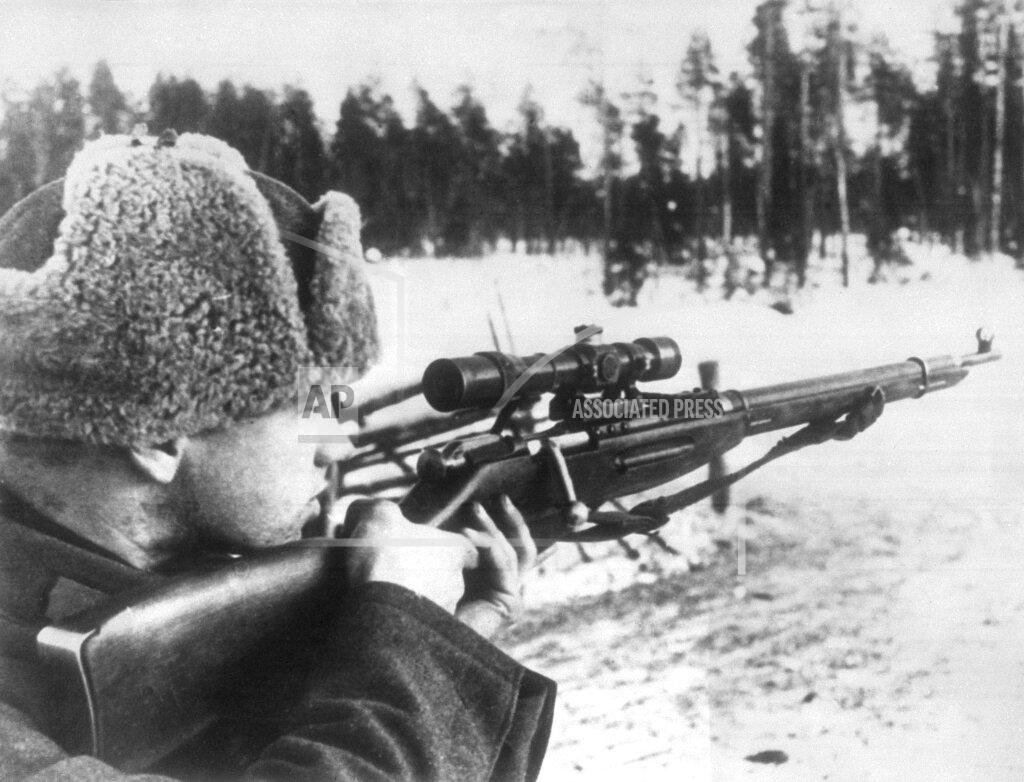
Having already destroyed Soviet 163rd and 44th Divisions, Finnish Army Colonel Siilasvuo was ordered to take the Finnish 9th Division 30 miles south to Kuhmo to attack the Soviet 54th Division of the Soviet 9th Army, commanded by V.I. Chuikov.
In Ladoga Karelia, Finnish troops take the barracks area in Pitkäranta, forming a ‘motti’ with one flank open onto the frozen Lake Ladoga.
Fresh concentrations of enemy divisions are observed at Pitkäranta and at Käsnäselkä in the Uomaa sector.
In Northern Finland, four Finnish battalions mount an assault on Märkäjärvi, but the Soviet 122nd Division holds firm.
On the Gulf of Finland, Finnish troops begin to attack a Soviet naval detachment trapped in the ice near the island of Someri.
The Soviet 9th Army at Salla completes its withdrawal to Maerkaejaervi.
Soviet launch an air attack against the Finnish port of Kotka. Finnish icebreaker Tarmo severely damaged by Soviet aircraft at Kotka. Russian bombers hit the icebreaker Tarmo while it is undergoing repairs in Kotka harbour. Thirty-nine crew members are killed and 11 wounded. The Finns claim to have brought down five Soviet bombers.
The Swedish Parliament debates the question of aid for Finland. Public opinion in Sweden sees the country’s future as closely bound up with the outcome of Finland’s struggle.
“Finlands sak är vår” (Finland’s cause is our own) is adopted as the slogan of the popular movement campaigning on behalf of aid for Finland.
Doctor of Law Urho Kekkonen is appointed to head the supply centre for evacuees.
Hungarian professor Albert Szent-Györgyi, winner of the 1937 Nobel Prize for Medicine, gifts his Nobel Medal to Finland.
The defeats suffered by the Soviet Army in Finland are attributed to the disorganization caused by Joseph Stalin’s purge of the Soviet High Command and of thousands of trained officers since 1937, in the opinion of Alexander Barmine, former Soviet diplomat, who has just arrived in New York.
There is an artillery duel to the west of the Saar.
The Dutch crown declares a state of siege in several coastal areas, extending such areas from the German border.
The Kriegsmarine orders unrestricted U-boat warfare on Britain and France. This follows months of warfare bound by the international Law of Prize, though the first British passenger ship was sunk on the very first day of the war, 3 September 1939 (apparently mistaken for a warship). U-boats are authorized to sink, without warning, all ships “in those waters near the enemy coasts in which the use of mines can be pretended.” Exceptions were to be made in the cases of the United States, Italian, Japanese and Soviet ships. This marks the institution of full and illegal unrestricted submarine warfare for the first time since 1918. [This is according to evidence produced by Admiral Doenitz at the Nuremberg Court following World War II. The Allies argued that 3 September 1939 was the commencement of unrestricted U-boat warfare by Germany. The court did not specify which date was correct but did find Admiral Doenitz guilty on two counts.]
It is extremely significant that Dr. Karl Clodius, Germany’s principal Balkan trade negotiator, has arrived in Bucharest, and in well-informed circles today it was stated that his arrival was connected with the oil question.
Palmiry massacre: 255 Jews in Warsaw were arrested at random. Over the next week they would be taken to the Palmiry Forest outside the city and shot dead. In January and February 1940 the Gestapo infiltrated and crushed the underground organization Polska Ludowa Akcja Niepodległościowa (PLAN) (“Polish People’s Independence Action”). On 14 January, the PLAN commander, Kazimierz Andrzej Kott, escaped from the Gestapo headquarters at 25 Szucha Avenue. Soon after, several hundred people were arrested in Warsaw, among them 255 leading Jewish intellectuals. On 21 January about 80 hostages, including two women, were executed in Palmiry. Among the victims were Fr. Marceli Nowakowski (rector of the Church of the Holiest Saviour in Warsaw, and former member of parliament) and 36 Jews (including attorney Ludwik Dyzenhaus, dentist Franciszek Sturm and chess master Dawid Przepiórka). Another 118 people arrested after Kott’s escape, mostly Jews, were probably murdered in Palmiry in the first months of 1940 Between December 1939 and July 1941 more than 1700 Poles and Jews – mostly inmates of Warsaw’s Pawiak prison – were executed by the SS (Schutzstaffel) and Ordnungspolizei in a forest glade near Palmiry.
German newspapers warned the Allies tonight that Italy may enter the war on Germany’s side and pointed to the Rome speech of Ettore Muti, Secretary General of the Fascist party, saying that Italy may be compelled to take up arms “at any moment.”
In a series of explosions, five employees are killed at the Waltham Abbey explosives factory in Essex. Nazi saboteurs are blamed.
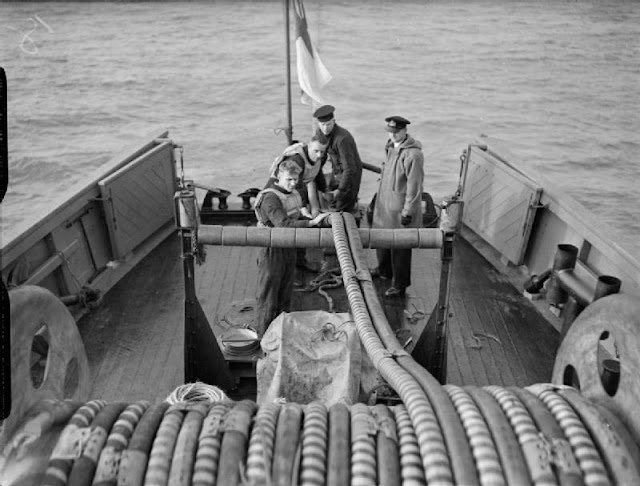
The British Insulated Callendar’s Cable Company delivered the first buoyant cable. The cable was to be is towed behind wooden trawlers with a current generated by the ship producing a magnetic field that would detonate the magnetic mines being used by the Germans against the Allies merchant shipping.
British commence censorship of air mail passing through Bermuda; censor there removes through-bound mail for European destinations from Lisbon-bound Pan American Airways Boeing 314 American Clipper. A written protest is lodged and no assistance in the unloading process is offered.
At about 1745, the Swedish cargo ship Foxen was sunk by an explosion about 85 miles from Pentland Sound (58° 52’N, 0° 22’W). The ship broke in two and sank within 90 seconds. On 24 January, the Norwegian steam merchant Leka picked up one survivor, another survivor was rescued earlier by another Norwegian ship, which took him to Bergen. The other 17 of her crew were lost. There is no corresponding U-boat report since U-55 (Kapitänleutnant Werner Heidel) did not return from her patrol, but the likelihood is that she sank the Foxen. The 1,304 ton Foxen was carrying pit coal and was bound for Gothenburg, Sweden.
At 2030, the Swedish cargo ship Patria was spotted on a southerly course by U-9 (Oberleutnant zur See Wolfgang Lüth) and was suspicious because no national markings could be seen from the distance of 500 meters. At 2223 & 2240, the U-boat fired one torpedo each, but missed with both. 30 minutes later, the Swedish cargo ship Flandria was spotted & sunk with one torpedo about 95 miles north of Ymuiden. U-9 then continued her pursuit of the Patria.
The neutral Swedish steam merchant Flandria was torpedoed and sunk by the U-9, commanded by Oberleutnant zur See Wolfgang Lüth, north of Ymuiden, Holland (54° 00’N, 3° 40’E). Of the ship’s complement, 17 died and 4 survivors were picked up from a raft by the Norwegian steam merchant Balzac after two days. The 1,179 ton Flandria was carrying general cargo and paper and was bound for Amsterdam, Netherlands.
At 1625, the Swedish cargo ship Pajala was hit in the bow by one torpedo from U-25 (Kapitänleutnant Viktor Schütze), after the ship had been spotted 20 minutes earlier together with an escort. A first coup de grâce at 1650 missed due to bad visibility, but the second at 1703 hours hit in the stern and caused the ship to sink 10 miles 072° from North Rona, Hebrides (59° 05’N, 5° 56’W). The Pajala was being escorted to Kirkwall for contraband inspection by the armed boarding vessel HMS Northern Duke. The HMS Northern Duke picked all of the ship’s complement of 35, forced the U-25 to submerge by gunfire and attacked unsuccessfully with depth charges. The 6,873 ton Pajala was carrying grain and cattle food and was bound for Gothenburg, Sweden.
At 1126, the Danish refrigerated cargo ship Canadian Reefer was torpedoed & sunk by U-44 (Kapitänleutnant Ludwig Mathes), 25 nautical miles east of Cape Villano (42° 39’N, 9° 42’W). The crew were given 30 minutes after interception by U-44 to abandon ship before she was torpedoed and sunk. They were rescued by the Spanish trawler Jose Ingacio de C. The 1,831 ton Canadian Reefer was carrying oranges and grapefruits and was bound for Glasgow, Scotland.
The German cargo ship August Thyssen struck a mine in the Baltic Sea off the Åland Islands, Finland and sank. All crew were rescued.
Convoy OG.15F forms at sea for Gibraltar.
The War at Sea, Thursday, 18 January 1940 (naval-history.net)
Battleship WARSPITE and battlecruiser HOOD with destroyers FURY, FAME, FORESTER, FOXHOUND, FEARLESS, FORESIGHT, FIREDRAKE, and FORTUNE of the 8th Destroyer Flotilla departed Scapa Flow. FORESTER and FIREDRAKE attacked submarine contacts on the 20th, east of the Faroes in 62-27N, 2-01W, and FORESIGHT attacked a contact NE of the Faroes in 62-54N, 3-10W on the 20th. The force returned to Scapa Flow on the 24th.
Convoy FN.74 departed the southern terminus escorted by destroyer GREYHOUND and sloop AUCKLAND, with GREYHOUND being relieved by sloop STORK, which had been delayed at the start. The convoy arrived in the Tyne on the 19th. There was no FN.75.
Convoy SA.26 of two steamers departed Southampton, escorted by sloop ROSEMARY, and arrived at Brest on the 19th.
Destroyers AFRIDI and BEDOUIN departed Rosyth to provide anti-aircraft protection for the merchant ships at Methil.
Heavy cruisers DEVONSHIRE and BERWICK, after undergoing alterations, departed Rosyth for Northern Patrol.
Heavy cruiser NORFOLK’s Walrus of 712 Squadron crashed on landing at Cadder, near Bishopbriggs, Glasgow. Lt (A) E F Pope and Leading Airman J Baxter were killed.
Armed merchant cruiser WORCESTERSHIRE arrived in the Clyde from Northern Patrol, while CARINTHIA arrived in the Clyde from Portland for duty with the Patrol.
Polish submarine ORP ORZEL departed Rosyth on patrol.
Destroyer IMOGEN arrived at Rosyth from convoy ON.8.
Destroyers INGLEFIELD and FORESIGHT arrived at Sullom Voe to refuel prior to joining convoy HN.8.
Destroyer KIPLING arrived at the Clyde from Portland.
Destroyers MAORI and TARTAR were sent to hunt for a submarine reported in 63-30N, 7-30E.
Destroyer VERITY, escorting a convoy, attacked a submarine contact south of Scilly Island in 49-02N, 6-14W.
Sloops FOXGLOVE and ROSEMARY were escorting a convoy bound for Brest when a tanker going in the opposite direction advised them of a submarine contact. FOXGLOVE attacked a contact north of Alderney in 50-06N, 2-14W.
Destroyers BROKE, WALKER, and DIANA were sent to investigate a report of a U-boat on the surface west of Lizard Head in 49-58N, 5-30W. DIANA dropped depth charges on a submarine contact.
Convoy OB.73GF had departed Liverpool on the 15th, and OA.73GF from Southend on the 16th escorted by destroyer BROKE from the 16th to 18th. On the 18th, the two convoys merged as OG.15F, totaling 26 ships. Escort was provided by sloop ABERDEEN and destroyer DOUGLAS from the 18th to the 23rd, when the convoy arrived at Gibraltar.
Convoy BC.23S of steamers BALTRADER, BARON KINNAIRD, BRITISH COAST, DUNKWA (Commodore) and FABIAN departed Bristol Channel escorted by destroyer MONTROSE, which attacked a submarine contact west of Hartland Point in 50-55-45N, 5-18-30W. The convoy arrived safely in the Loire on the 20th.
French torpedo boat BRESTOIS attacked a submarine contact off Boulogne in 50-35N, 2-32W.
U-9 sank Swedish steamer FLANDRIA (1179grt) in 54 00N, 03 40E, 100 miles off Ymuiden. Seventeen crew were lost and four survivors rescued by Norwegian steamer BALZAC (963grt).
U-25 sank Swedish steamer PAJALA (6873grt) ten miles 72° from North Rona. The crew of 35 was picked up by armed boarding vessel NORTHERN DUKE, at the time escorting her to Kirkwall for inspection. NORTHERN DUKE attacked the submarine, and destroyers ASHANTI and KIMBERLEY were dispatched to assist her.
U-44 sank Danish steamer CANADIAN REEFER (1831grt) 25 miles NE of Cape Villano, but her crew was picked up by Spanish trawler JOSE IGNACIO DE C. (300grt).
U-55 sank Swedish steamer FOXEN (1304grt) in 58 52N, 00 22W. Eight crew were lost and the sole survivor was picked up by Norwegian steamer LEKA (1599grt) on the 24 January according to Uboat.Net.
German steamer AUGUST THYSSEN (2342grt) was sunk on a mine off Aland Island in the Baltic, part of a Swedish field, according to Seekrieg.
Heavy cruisers DORSETSHIRE and SHROPSHIRE arrived at Port Stanley from Rio de Janiero to escort heavy cruiser EXETER to England.
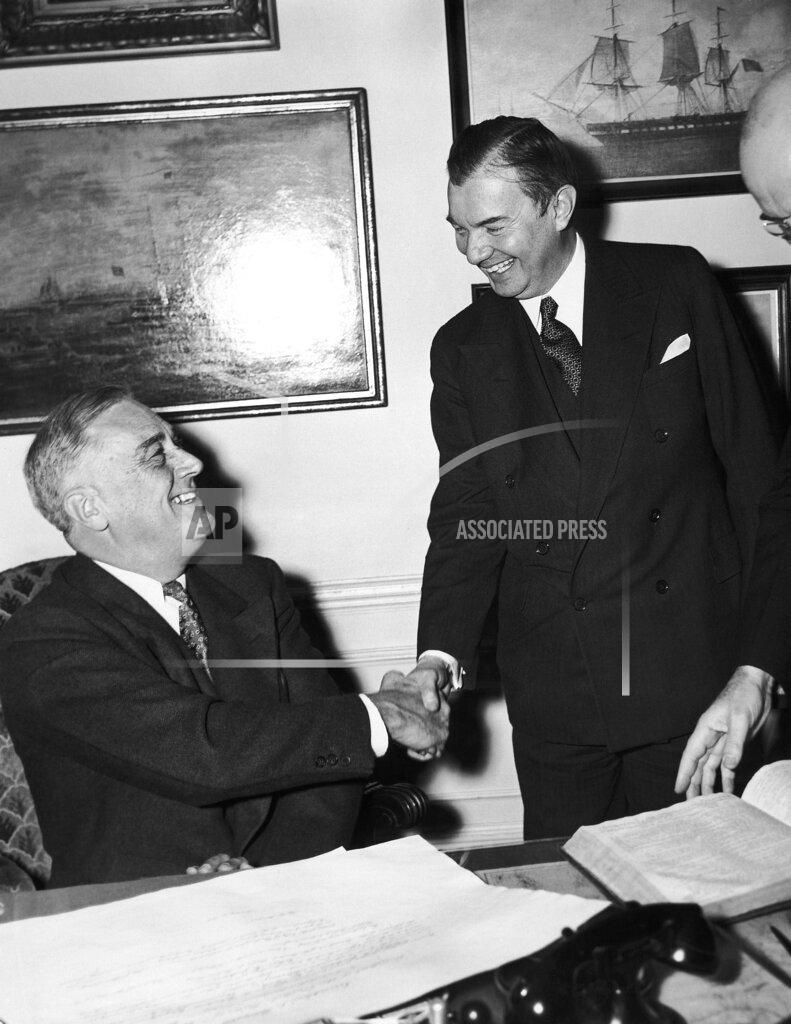
Today in Washington, President Roosevelt participated in the ceremonies of administering oaths of office to Associate Supreme Court Justice Frank Murphy and Attorney General Robert H. Jackson, discussed plans for the infantile paralysis drive with Keith Morgan and George Allen, conferred with Mayor Kelly of Chicago and with Senators Wagner and Glass. With Mrs. Roosevelt, he entertained tonight at the annual departmental reception at the White House.
The Senate considered its consent calendar, confirmed the nomination of Harry Slattery as Administrator of the Rural Electrification Authority, passed a bill requiring annual inspection of coal mines and adjourned at 3:29 PM until noon tomorrow. The Privileges and Elections Committee delegated a subcommittee to study two amendments to the Hatch act, and the Temporary National Economic Committee continued its study of the copper industry.
The House passed the $1,100,187,263 Independent Offices Appropriation Bill, passed a bill extending the period during which exhibits to the San Francisco Fair may enter the country duty-free and adjourned at 5:09 PM until noon Monday. The Naval Affairs Committee continued hearings on the Naval Expansion Bill and Chairman Vinson announced abandonment of part of the program; the Ways and Means Committee questioned Henry F. Grady on the Trade Agreements program and the Smith committee continued questioning of National Labor Relations Board trial examiners.
Frank Murphy and Robert H. Jackson were sworn in as associate justice of the Supreme Court and as Attorney General today in one of the most elaborate ceremonies of its kind ever held in the White House. On hand in the Oval Room on the second floor were members of the Cabinet, the families and friends of the principals and a list of administrative officials that read like a Who’s Who of the New Deal. President Roosevelt, chief figure in the formalities, congratulated both men on the service they had already given to their country and expressed his pleasure and gratification at seeing two old friends move into higher governmental posts. Mr. Murphy moved up from Attorney General and Mr. Jackson succeeded him after nearly two years as Solicitor General.
In the gathering were two other recent appointees of Mr. Roosevelt, Francis Biddle, named to succeed Mr. Jackson as Solicitor General, and James H. R. Cromwell, named American Minister to Canada. It was to have been a triple swearing-in, but Mr. Biddle delayed the taking of his oath until Monday in order that his family might be on hand. Associate Justice Stanley Reed, the President’s second appointee to the Supreme Court, administered the oaths and later welcomed Mr. Murphy to the membership of the high court. The White House was careful to explain, however, that Mr. Murphy had taken only his Constitutional oath of office and that he would follow custom later by being sworn in officially in the Supreme Court chambers.
The House Naval Affairs Committee announced today that it would reduce by about $500,000,000 the $1,300,000,000 originally authorized in the 1939 naval expansion bill as drafted and approved by the Administration. This will be the largest reduction so far made in an appropriation bill by any Congressional committee in the present economy drive and also the largest cut in proposed naval appropriations since the beginning of the present expansion program in 1933.
When the committee convened for public hearings on the bill this morning Chairman Vinson announced that a motion would be made to limit the originally proposed increase in combatant units to forty-one instead of 77, to be accomplished by the elimination of the destroyer part of the authorization in its entirety and substantial reductions in the cruiser and submarine categories. The only category not included in the proposed slashing is that of aircraft carrier authorizations, which will remain at three ships of an aggregate tonnage of 75,000. The cost of the combatant units to be left in the bill will be about $550,000,000.
The tonnage of the authorizations, including auxiliaries, in the original bill was 400,000. In the redrafted bill the aggregate tonnage will be 218,000, a reduction of nearly 50 percent. Cruiser tonnage will be cut from 192,000 to 110,000 tons, the size of the cruisers to be left to the Navy Department. This may mean, Mr. Vinson said, a squadron of great battle-cruisers each of 27,000 tons, or a larger number of small cruisers which, whatever the decision, are to be larger, faster and of greater gun power than any now in commission in any navy. The submarine tonnage will be cut from 45,000 to 33,000 tons, enough for about 30 submarines, Mr. Vinson said.
Representative Maas, of Minnesota, ranking Republican member of the committee, said he was in agreement with Mr. Vinson on tonnage reduction and cost, but gave notice that, in his opinion, this did not mean that the naval program should be reduced. “This is with the understanding that we are not in any way restricting the navy’s program,” Mr. Maas said. “We are simply authorizing all the ships possible to build in the next three years, and next year, if conditions in the world are the same or worse than now, we will go right ahead with the bill as originally drafted.” Mr. Vinson subscribed to what Mr. Maas said, adding that the navy could not build faster than provided for in the new bill.
The House sustained its economy leaders today in slashing $94,517,206 from the Independent Offices Supply Bill, sending the. $1,100,187,263 measure to the Senate without the formality of a record vote. Earlier, the Naval Affairs Committee announced its intention to cut $500,000,000 of the $1,300,000,000 authorized in the Naval Expansion Bill. The unprecedented reductions made by the Appropriations Committee and backed by the overwhelming majority of the House marked the first moves in the economy leaders’ efforts to reduce budget estimates by an amount sufficient to prevent the imposition of new taxes or the raising of the debt limit, assuming that all other conditions of President Roosevelt’s budget recommendations are met.
The Maritime Commission, which bore the brunt of the budget slashing to the tune of $75,000,000 in the Appropriations Committee, saw its program further curtailed today when the presiding officer, Representative Lindsay Warren of North Carolina, sustained a point of order by Representative Taber, Republican, of New York, striking from the bill a provision for a contractual authority of $150,000,000 during the fiscal year 1941. The elimination of the contractual authority did not change the total amount of the appropriation items, but it will seriously handicap the commission in its shipbuilding program and will mean smaller budget requests next year.
Leaders in the move for United States financial aid to Finland declared today that they would push on, but recognized that they were doing so against mounting odds. As the proposal seemed thus to be settling in a Congressional bog, Senator Arthur H. Vandenberg of Michigan introduced a resolution in the Senate requesting the President to advise that body as to whether Russia had fulfilled her obligations under the Litvinov agreements of November 16, 1933, under which this country recognized the Soviet. One of these was that no effort would be made by Russia to disturb the form of the internal government of the United States.
The resolution was construed as another move in the growing agitation in Congress to withdraw formal diplomatic recognition of Russla. Mr. Vandenberg recently suggested severing relations with the Soviet Union. When asked today if his resolution was a step toward that end, he replied: “You can draw your own conclusions.”
Simultaneously with the introduction of the resolution, Mr. Vandenberg inserted in The Congressional Record a statement he had prepared for publication by the Young Republicans. “The original recognition of the Soviet Russian Government by the United States was a colossal blunder,” it said in part. “I felt and said so then. I repeat it now. The only atonement — the only cure — is to acknowledge the mistake and undo it. That means withdrawal not only of our Ambassador to Moscow but also withdrawal of all our diplomatic recognition of an alien regime which, through its American tools here, seeks to promote Moscow’s ‘world revolution.’”
Senator Borah, dean of the Senate and its best known orator, lay near death at his home in Washington, with all hope for recovery abandoned by his physicians. The 74-year-old statesman, who was serving his thirty-third consecutive year in the Senate, suffered a cerebral hemorrhage Tuesday morning. At 9:25 o’clock tonight the Senator’s office announced that his condition was “unchanged.” He was still in a state of coma, as he had been most of the day except for rare, brief intervals. It was stated at that time that there would be no further bulletin issued during the night, unless the Senator’s condition changed. Except for lessened vigor credited to his age, Senator Borah had been in good health. On Monday he attended the session of the Senate after visiting his doctor for a routine check-up, which he told his friends showed him to be in better physical condition than at any time in recent years.
Last Thursday he delivered a forceful speech, during consideration of the confirmation of Charles Edison as Secretary of the Navy, in which he vigorously attacked the delegation of extreme powers to the Executive under the guise of emergency legislation. While Senator Borah’s confinement to his home Tuesday and Wednesday occasioned some comment, it was explained that he had fallen in his apartment. Only today did the nature of the fall become generally known, when Mrs. Borah, at her apartment, and Miss Cora Rubin, the Senator’s secretary, at his office, simultaneously announced that he actually had suffered a cerebral hemorrhage and that his recovery was not probable.
The Dies committee should be much more vigorous in its investigation of organizations like the Christian Front and should follow its trail wherever it may lead, even if that should require an investigation of the activities of the Rev. Charles E. Coughlin, Representative Jerry Voorhis of California, member of the committee, declared tonight.
Secretary Morgenthau today opposed as “a matter of government policy” the extension of loans to Great Britain secured by British-owned securities in this country.
Refuting the summary judgment that this is just “another of these wars,” or a phony war, British Ambassador Sir Ronald Hugh Campbell today, at an American Club luncheon, declared that it was as much a war of principle as the American War of Independence and that very shortly it may become more grim and ghastly than any war that has gone before it.
Warnings that the army and navy are inadequate and arguments on why Congress should authorize large appropriations to build up both services to a strength capable of insuring the safety of the United States were voiced by Lieutenant General Hugh A. Drum, commander of the Second Corps Area and Rear Admiral Clark H. Woodward, commandant of the Third Naval District.
With Earl Browder, general secretary of the Communist party in the United States, staring coldly at him from a front seat, Nicholas Dozenberg, former Red Army secret agent, testified for the government yesterday at Browder’s trial in Federal Court on the charge of using a United States passport obtained by making a false statement.
A nationwide effort to elect delegates to the Democratic National Convention who will be for the nomination of Vice President John N. Garner for President, was announced today by Maury Hughes of Dallas, co-director of the Garner campaign.
By a vote of 44 to 10, the provincial legislature of Ontario passed a motion introduced by Premier Mitchell Hepburn criticizing Canadian Prime Minister William Lyon Mackenzie King for making “so little effort to prosecute Canada’s duty in the war in the vigorous manner in which the people of Canada desire to see.”
The divergent views of Great Britain and the American republics are susceptible of reconciliation in an agreement governing the safety zone set up by the latter in the waters surrounding the Western Hemisphere, in the opinion of Foreign Minister Jose Maria Cantilo of Argentina.
A settlement was reported today to have ended an outbreak of fighting between the regular Chinese forces of General Yen Hsi-shan and his new communist-influenced volunteers. Frequent friction between these elements of the army in Southern Shansi Province had been reported, but foreign military reports discounted reports of a civil war or any widespread fighting.
Aggressive intentions which, if carried out, would enable the American fleet to cross the Pacific and fight the Japanese fleet near Japanese waters were discerned by the newspaper Asahi in the naval plans now being discussed in Washington. If those building plans are completed by 1945, their aggressive intention will be unmistakable, says Asahi, but it adds that it is doubtful whether American dockyards can complete the program in time. Even if the new fleet remains partly on paper, says Asahi, it wonders what America’s objective can be. Since the fleet cannot be intended against Germany in view of Great Britain’s vast navy, Asahi asserts, the United States may be preparing to maintain superiority in the expectation of calling a naval conference after the war.
“But,” Asahi continues, “if the United States thinks to intimidate Japan by its naval plans it is making a big mistake. The United States has refused to discuss a trade modus vivendi and Senator Pittman’s proposal for economic sanctions comes up shortly. If the United States by those methods is trying to restrain Japan it is wasting time, because at this stage Japan cannot retreat under any pressure whatsoever.” At a press conference Rear Admiral Masao Kanazawa, Navy Department spokesman, did not reveal the Japanese Navy’s reaction to the United States plans for huge battleships beyond making the bromidic comment that their appearance would mark an epoch in naval armaments. He said he understood difficulties connected with transit of such big ships through the Panama Canal had been removed.
Dow Jones Industrial Average: 145.61 (-0.20)
Born:
Pat Britt, American jazz saxophonist, flute player, and producer, in Pittsburgh, Pennsylvania (d. 2022).
Pedro Rodriguez, Mexican racing driver (Le Mans, 1968), in Mexico City, Mexico (d. 1971).
Died:
Kazimierz Przerwa-Tetmajer, 74, Polish poet and writer (“Young Poland”).
Naval Construction:
The Kriegsmarine (German Navy) Type VIIC U-boat U-756 is laid down by Kriegsmarinewerft (KMW), Wilhelmshaven (werk 139).
The Kriegsmarine (German Navy) Type IIC U-boat U-63 is commissioned. Her first commanding officer is Oberleutnant zur See Günther Lorentz.
 History Diaries