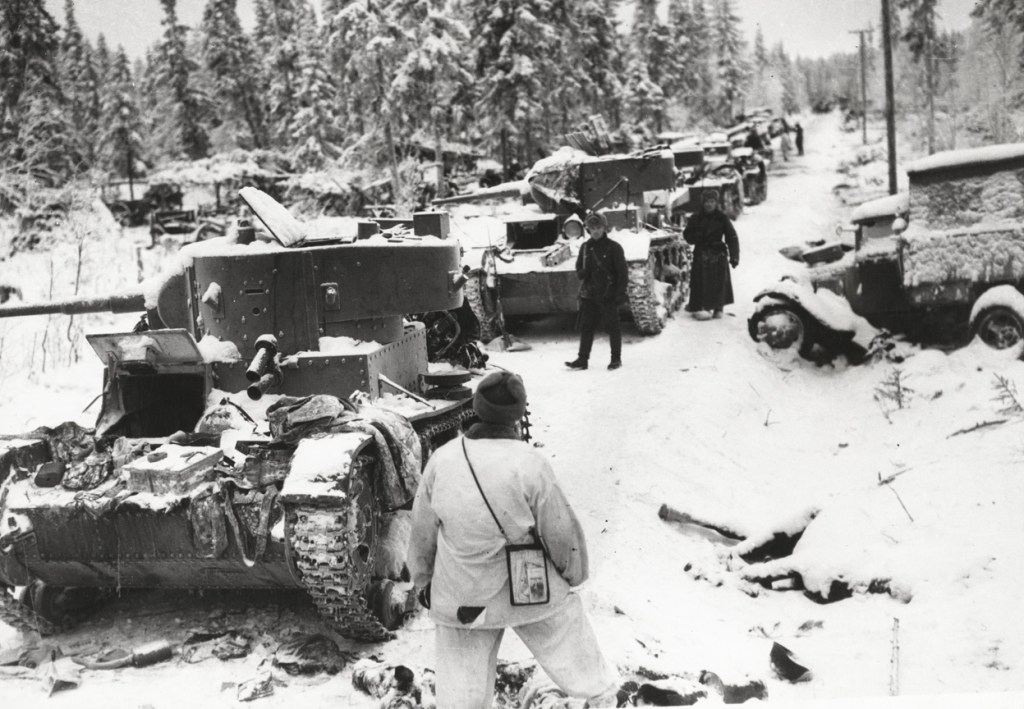
Record cold weather strikes Finland. The mercury drops to −43°C (−45°F) on the Karelian Isthmus and −45°C (−49°F) further North in Summa. Even at noon it is −39°C (−38°F) in Taipale and Lake Lagoda freezes over completely creating new problems for the Finns as well as the Soviets. Soviet troops freeze to death while Finns stay warm in heated tents and mobile saunas. However, frostbite leads to thousands of casualties on both sides. It is a brutal winter, so brutal that the waters between Sweden and Denmark are said to have frozen over. In Moscow, 79 degrees of frost are recorded.
Finnish forces recapture Kursu, southwest of Salla. Soviet forces are driven back some 12 miles (19 km).
Finland’s IV Army Corps halted its offensive in the Pitkaranta area. The force did not have sufficient strength to push on to the border.
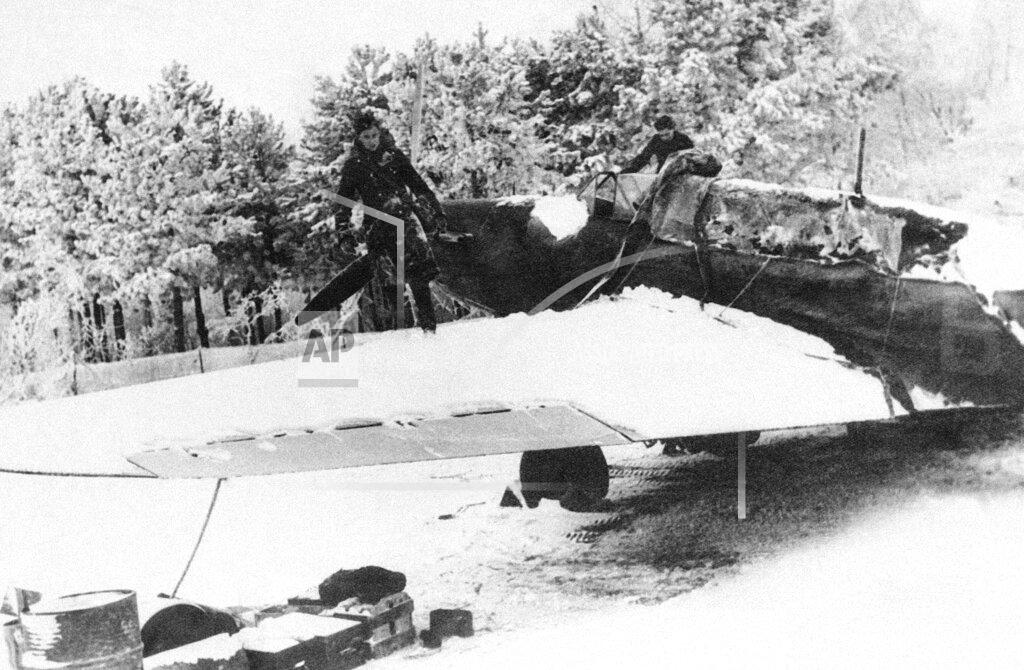
Finnish Fokker fighters from the 24th Squadron shot down 8 enemy Tupolev SB “high speed bombers” over the Isthmus.
The Soviets keep pounding away with their artillery at Summa.
In the Central Isthmus, in the Lähde road sector, heavy enemy shelling inflicts serious damage on ‘Fort Poppius’. This concrete fortress named after Second Lieutenant Poppius can house up to 26 men.
In Ladoga Karelia, the Finnish 12th Division launches its offensive in the Uomaa sector.
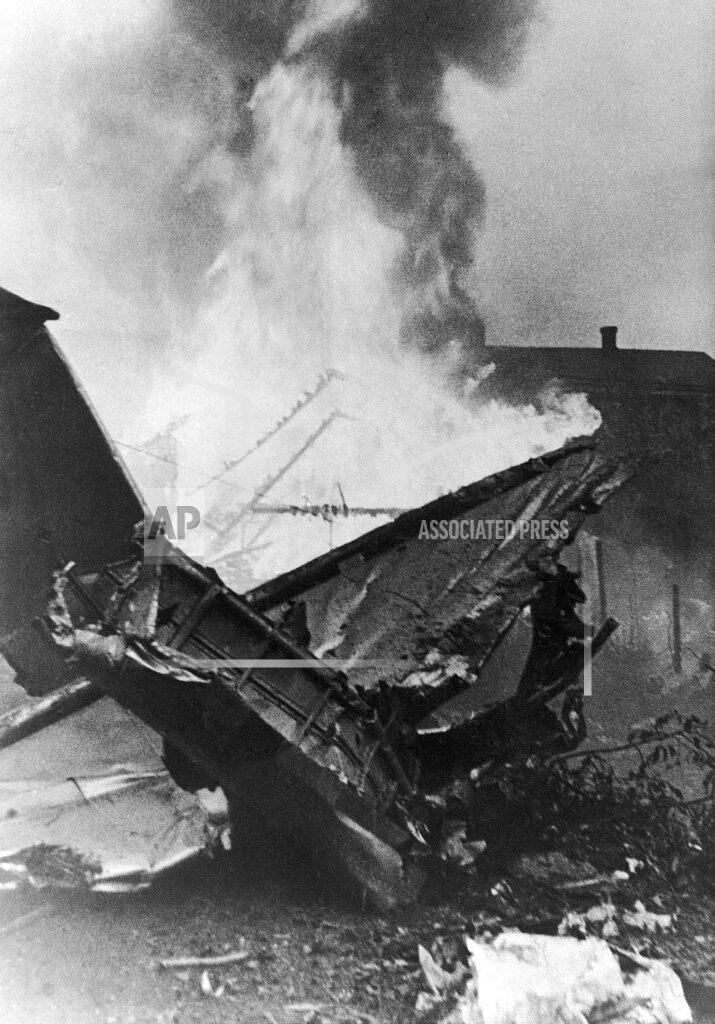
Soviet bombers hit Turku, Hanko, Lappeenranta and Koivisto.
At Viipuri, bombers concentrate on the south harbor.
Finland’s civil defence chief reminds members of the public to keep their identity papers with them at all times.
The Finnish Ministry of the Interior is to set up a supply centre for evacuees.
Norwegian fruiterers have today donated six trainloads (50,000 kilos) of apples to Finland.
The United States has decided to send two military attachés to Finland.
Finland’s President Kyosti Kallio appealed to Americans today to provide Finland with a fleet of fighter airplanes — not for aggressive or military use against Russia but solely to defend Finnish civilians from attacks that Russian airplanes are making daily on towns and cities with their daily toll of civilian lives.
The Swedish Riksdag was thrown into an uproar today when Rickard J. Sandler, until recently Foreign Minister, demanded that Swedish troops be sent to Finland’s Åland Islands at the entrance to the Gulf of Bothnia.
In Uppsala, the author Frans Emil Sillanpää addresses a Swedish audience on the situation in Finland.
An anonymous individual comes up to the Finnish Minister in London, Mr. Gripenberg, hands him £5,000, and walks away.
Marshal Karl Gustav Mannerheim, commander in chief of the Finnish armies, in an interview with the Paris-Soir, said today that Finland was determined to destroy everything before the enemy so that “they would find the country cursed by the scourge of God” if the little Baltic country were overrun. Baron Mannerheim pointed out that Finland is fighting against 50-to-1 superior forces and that it would be difficult to hold out indefinitely unless outside help was increased. His message was regarded as a clear warning to the Allies that if they intend to help Finland they must act quickly or it may be too late. “If our foresight, determination and the unlimited courage of our men have halted the first wave of savage columns of the invader, I desire that nobody forget for long that we fight against 50 to 1,” Baron Mannerheim said.
Europe was struck by a cold wave. In Finland the mercury dipped as low as −45 degrees Celsius, while in England the River Thames froze up for the first time since 1888.
It is frosty across Europe, and it would have been a terrible day for Hitler’s Fall Gelb.
Belgium revealed to the German ambassador that Belgium had learned German plans and not-yet-executed orders for the invasion of Belgium.
The tension caused by the fear of a German attack on the Netherlands and Belgium has obviously relaxed. The War Office and Air Ministry announced tonight that most of the men whose leave was canceled last week-end had been permitted to return to their homes.
Adolf Cardinal Bertram, Archbishop of Breslau, took issue today with recent announcements of Nazi leaders concerning children born out of wedlock in wartime. On December 23 Heinrich Himmler, head of all German police, urged the black-uniformed Elite Guard to beget children, in or out of wedlock, especially in wartime. Rudolf Hess, deputy leader of the Nazi party, announced that the party would stand sponsor for any soldiers’ children born out of wedlock. Cardinal Bertram, in a pastoral letter, which is to be read to his diocese, on Sunday and on January 28 and February 4, has especially urged observance of the Sixth Commandment in the Catholic decalogue, ‘Thou Shalt Not Commit Adultery.’ “Do not give credence to assertions that in wartime the Sixth Commandment is not to be taken seriously,” the Cardinal admonished.
A royal decree, published today in the Official Gazette, has ordered the establishment of a general commission with powers to organize, control and direct the entire petroleum industry in Rumania.
After correcting an error in the plans for the Enigma rotors IV and V rotors, Polish cryptologists made the first break into wartime Enigma traffic. The German Enigma code is first broken by Polish and French cipher experts at Poste de Commandement Bruno (Chateau de Vignolles at Gretz-Armainvillers, 40 km northeast of Paris) and Dilly Knox’s team at Government Code and Cypher School (Bletchley Park, England), using a German transmission intercepted by the Poles on 28 October 1939.
RAF Whitley bombers make night leaflet raids on Prague and Vienna.
At 1156, U-25 (Kapitänleutnant Viktor Schütze) spotted two steamers 6-7 miles north of Muckle Flugga, Shetland Isles (61° 00’N, 1° 00’W) and fired one torpedo at 1235 hours that missed the first ship, the Norwegian cargo ship Enid. Ten minutes later, another torpedo was fired at the second ship, the British cargo ship Polzella, which was hit near the bridge and sank in 12 seconds with the loss of all men. The Norwegian ship went to her assistance and the order was given to lower the boats, but the U-boat surfaced and fired a shot across the bow to stop her. When the ship turned away they opened fire and after three shots the crew of the Enid abandoned ship. Then the U-boat fired 21 rounds from the deck gun and hit seven times. At 1410 a coup de grâce was fired that broke off the forepart and caused the ship to sink. One part of the Norwegian crew of the Enid reached land in their lifeboats, while the rest were rescued by a Danish ship of A. P. Møller & Co and taken to Las Palmas. The 4,751 ton Polzella was carrying Iron ore and was bound for Middlesbrough, England. The 1,140 ton Enid was carrying wood pulp and was bound for Dublin, Ireland.
At 1700, the British cargo ship Cairnross (Master Laurence Halcrow) in Convoy HXF.16 struck a mine, laid on 6 January by U-30 (Kapitänleutnant Fritz-Julius Lemp) and sank seven miles at bearing 276° from the Bar Lightvessel, Liverpool (53° 32’N, 3° 27’W). The master and 47 crewmembers were picked up by HMS Mackay (D 70) & landed at Liverpool. The 5,494 ton Cairnross was carrying general cargo, including coal and earthenware and was bound for St. John, New Brunswick, Canada.
The British submarine HMS Tribune (N 76) reported firing six torpedoes against an enemy submarine in the Skagerrak Strait northeast of Skagen, Denmark, between the North Sea and the straits of Denmark, and all torpedoes missed. No German submarine reported this attack.
Greek steamer Asteria (3313grt) sinks in the German destroyer minefield off Cromer, 9.5 miles NE of Haisborough Light. Fourteen crew were lost and eleven rescued. The wreck was subsequently dispersed by explosives.
The Italian cargo ship Ernani collided with the Brake Lightship, off the Goodwin Sands, Kent and ran aground. All 12 crew were rescued by the Ramsgate and Margate lifeboats. The lightship sank.
The German cargo ship Gratia ran aground at Außenems and was wrecked.
Convoy OA.74 departs Southend.
Convoy OB.74 departs Liverpool.
British Foreign Office replies to U.S. protest on treatment of mail, concluding that “His Majesty’s Government find themselves unable to share the views of the United States government that their [the British] action in examining neutral mail in British or neutral shipping is contrary to their obligations under international law.”
U.S. passenger liner SS Manhattan & freighter SS Excambion are detained at Gibraltar by British authorities; the former is kept there for only a few hours before being allowed to proceed.
The War at Sea, Wednesday, 17 January 1940 (naval-history.net)
Submarine TRIBUNE fired six torpedoes at 0250 at a submarine in 57-50N, 11-00E at the mouth of the Kattegat, and fired two more at 0253, but there was no German submarine in the area.
Light cruiser DUNEDIN arrived at Scapa Flow after Northern Patrol.
Armed merchant cruisers ANDANIA arrived in the Clyde from Northern Patrol and CALIFORNIA departed the Clyde for Northern Patrol.
Destroyer KANDAHAR arrived at Scapa Flow.
Submarine SNAPPER departed Blyth on patrol.
Destroyers MAORI, TARTAR, INGLEFIELD and FORESIGHT were sent to patrol off the Norwegian coast to intercept German ore ships.
Convoy OA.74 departed Southend escorted by destroyers WHITEHALL and WIVERN from the 17th. WIVERN was detached on the 19th and WHITEHALL on the 20th, both to convoy HGF.16.
Convoy OB.74 departed Liverpool escorted by destroyers WANDERER and MACKAY which later transferred to HXF.16. Steamer CAIRNROSS (not CAIRNCROSS as originally reported, 5494grt) from the convoy was lost on a mine seven miles, 276° from the Bar Light Vessel off Mersey Light laid by U-30 on the 9th. The entire crew was rescued, all 48 of them by MACKAY according to Uboat.net.
Convoy FN.73 departed Southend, escorted by destroyer WOOLSTON and sloop GRIMSBY. In a gale, the convoy had to turn back just off the harbour entrance, but finally arrived in the Tyne on the 20th.
Convoy FS.75 departed the Tyne, escorted by destroyer VALOROUS and sloop LONDONDERRY, and arrived at Southend on the 19th.
Captain K A Beattie DSC (Rtd), appointed to command sloop AUCKLAND on the 8th, died on the 17th. Cdr J G Hewitt was appointed in command from the 20th.
Italian steamer ERNANI (6619grt) collided with Lightship BRAKE in the Thames Estuary. BRAKE sank and ERNANI was badly damaged.
U-25 sank Norwegian steamer ENID (1140grt) six to seven miles 10° of Muckle Flugga and badly damaged steamer POLZELLA (4751grt) off Muckle Flugga. POLZELLA sank next day without a trace, and there were no survivors. The entire crew of ENID was rescued by Danish steamer KINA (9823grt) and British fishing vessel GRANADA. Destroyers FORTUNE and FIREDRAKE and anti-submarine trawlers of the 10th Anti-Submarine Force were sent to hunt for the U-boat, and FIREDRAKE scuttled the wreck of ENID.
German steamer GRATIA (2068grt) was stranded and lost at Aussenems.
German steamer SANTOS (5943grt) departed Rio de Janiero for Hamburg where she safely arrived on 16 March.
French large destroyer JAGUAR collided with British destroyer KEPPEL at 0435, 100 miles SW of Vigo. KEPPEL had been escorting convoy HG.15F until 1900/16th when she turned the convoy over to sloop ENCHANTRESS. She was badly damaged and escorted to Gibraltar by French destroyer LA RAILLEUSE and the British VORTIGERN, screened by French light cruiser DUGUAY TROUIN. KEPPEL arrived at Gibraltar on the 20th, departed on 10 February and was repaired in the dockyard at Malta from 14 February until 5 April. She arrived back at Gibraltar on 19 April. JAGUAR was repaired at Brest.
Repair ship RESOURCE departed Malta for the South Atlantic, escorted by Australian destroyer HMAS STUART as far as Gibraltar, reaching there on the 21st. RESOURCE sailed from Gibraltar, while French destroyer LA RAILLEUSE left Casablanca on the 23rd and light cruiser NEPTUNE left Freetown on the 25th, to join her. The British ships arrived at Freetown on the 29th, while RAILLEUSE reached Dakar on the 27th. She left on 1 February and arrived back at Casablanca on the 5th.
President Roosevelt held a series of conferences in Washington today with administrative and diplomatic officials, including a review of Federal procurement policy with Secretary Morgenthau and military and naval officials.
With the Senate in recess, its Foreign Relations Committee agreed tentatively to survey Japanese-American relations; the Banking and Currency Committee questioned Jesse H. Jones, Federal Loan Administrator, on the amount of proposed financial aid to Finland, and the Monopoly Committee continued its study of the copper industry.
The House debated the Independent Offices Appropriation Bill and adjourned at 4:43 PM until noon tomorrow. The Naval Affairs Committee, meanwhile, heard Rear Admiral Samuel M. Robinson on the proposed naval expansion program; the Ways and Means Committee heard Henry F. Grady in support of the Reciprocal Trade Agreements Act, and the committee investigating the National Labor Relations Board continued questioning of trial examiners.
President Roosevelt’s plan for further financial aid to Finland appeared today to be bogging down in Congressional opposition and skepticism inspired in part by Vice President John N. Garner. Mr. Garner was reported to have expressed to various Senators who asked his views on the subject considerable doubt as to whether Congress should take any action that could be interpreted abroad as direct aid, financial or military, to any one country involved in Europe’s disputes. He represented the President’s plan as at least approaching the danger line of United States neutrality. The Vice President’s views were expressed only to those Senators and Representatives who sought his advice. He made no public statement on the matter.
The Senate Banking and Currency Committee, called into special meeting to discuss the President’s plan, adjourned for a week after having heard Jesse H. Jones, Federal Loan Administrator, give a noncommittal explanation of the scheme under which a new credit would be extended to the beleaguered little country for the purchase of strictly non-military supplies in the United States. Mr. Jones put squarely up to Congress the question as to whether such additional assistance should or should not be extended.
From discussions in the committee rooms and questions propounded to Mr. Jones, it was obvious to many members that the plan would encounter extreme difficulties both in committee and on the Senate floor. Even sponsors for legislation for Finnish aid appeared lukewarm toward this particular proposal. They had insisted from the start that what the country needed to meet the attacks from Russia were not civilian supplies but weapons and munitions, and what it wanted from the United States was an outright loan of cash with which it could purchase military equipment for quick delivery from countries nearer the scene of conflict.
The interest of the sponsors may be quickened, however, if Finland’s representatives are able to work out a plan whereby civilian supplies purchased on credit in the United States may be transferred immediately to other nations for cash or arms. A scheme of that sort was being discussed today in diplomatic circles friendly to Finland.
Former President Hoover was quoted in the committee as saying that Finland did not need immediately the sort of supplies she would be able to purchase under Mr. Roosevelt’s proposed non-military credit. Senator Robert A. Taft reported that in Mr. Hoover’s calculations the Finns could hold out until Spring on their present stores of foodstuffs and clothing, and with what they coould expect from Norway and Sweden.
Former President Herbert Hoover, who has disagreed with the Administration on some points of foreign policy, issued a statement backing President Roosevelt’s proposal that Congress help Finland, in her defensive struggle against Russia, with credits for raw materials and manufactured goods, “not including implements of war,” and added that food products should be given free from American surpluses. Mr. Hoover agreed with President Roosevelt that the type of help proposed would not involve the United States in war. He likewise held that it would not establish a “dangerous precedent.” On the question of precedents, said Mr. Hoover, one already has been created in the loan made to China.
The $1,300,000,000 Naval Expansion Bill now before the House Naval Affairs Committee may be reduced by about $200,000,000, Chairman Vinson indicated today. He said he would support such a reduction and confirmed reports that practically all of the proposed cuts would apply to the destroyer category, leaving intact aircraft carrier, cruiser and submarine authorizations. Reduction of the destroyer authorizations would cut the total. tonnage provided for in the bill to about 320,000 tons, of which 192,000 tons would be for cruisers and 75,000 tons for aircraft carriers.
Mr. Vinson also characterized as absurd estimates that put the total cost of naval replacements and new construction during the next five years at $2,700,000,000. He insisted that, including construction authorized in the pending bill, it would total about $1,700,000,000. Rear Admiral Samuel M. Robinson, Chief of the Bureau of Engineering, was the witness before the committee today. He said a survey of private and government-owned shipbuilding facilities shows these facilities to be ample to complete the proposed expansion program in about five years.
Underage tonnage of the navy, Admiral Robinson added, will amount to only about 998,000 on July 1 of this year. Broken down into categories, this means an underage fighting fleet of twelve battleships, six aircraft carriers, eighteen heavy and seventeen light cruisers, seventy-four destroyers and thirty-three submarines. Overage tonnage will include the battleships New York, Texas and Arkansas, the admiral said.”
The House of Representatives refused today to veer from its economy course on the billion-dollar Independent Offices Supply Bill, and indicated that it intends. to stand by the $94,500,000 cuts made by the Appropriations Committee. The members shouted down an amendment designed to increase the funds for new post office buildings from $15,000,000 to $37,000,000. The entire day’s consideration of the bill served to cut the total sum carried by $25,040. This was accomplished on a point of order by Representative Dirksen of Illinois. Unless this sum is restored by a separate act of Congress, it means the end of an executive-created agency, the Council of Personnel Administration.
American relations with Japan will be subjected to extensive study by the Senate Foreign Relations Committee under an arrangement announced today by Senator Key Pittman, the chairman.
A bill to pay $20 to $60 a month to World War veterans for partial or total disability was introduced in the House today by Representative McCormack of Massachusetts. He estimated its cost the first year at $100,000,000 and thereafter at $200,000,000, which he termed “a small added expense indeed to pay for America’s past security.” The bill provides pensions for all disabled World War veterans, whether or not the disability was incurred in service. The measure has the backing of the Veterans of Foreign Wars. Observing that in the past the United States usually waited about twenty years to start such pensions, Mr. McCormack pointed out that twenty-three years have elapsed since this country’s entry into the World War. His bill would provide pay for World War veterans on the same basis as that provided for SpanishAmerican War veterans. Mr. McCormack estimated that if his bill becomes law, about 500,000 vocationally handicapped men would receive pensions the first year, and that for several years thereafter about 1,000,000 veterans would be on the rolls. The average age of World War veterans is now 48.
The trial of Earl Russell Browder, general secretary of the Communist Party of the United States of America, on the charge of using a United States passport he obtained by a false statement, opened in the federal court in New York with unusual speed. A jury of eleven men and a woman was selected during the morning, and in the afternoon all defense motions had been made and denied, counsel for both sides had delivered their opening statements and the first witness had testified. If this rate is maintained, the prosecution may complete its case this afternoon and a verdict may be expected by the end of the week. If Browder is found guilty he will face a maximum sentence of ten years’ imprisonment and $4,000 fine. He is free now on $7,500 bail. Throughout the day in court, Browder sat with his three lawyers at their counsel table, facing the jury with an intensely preoccupied look. A slight man, 48 years old, with black hair brushed tight against his head and with a closely cropped mustache, he wore a gray double-breasted suit and presented the conventional appearance of a business man rather than the popular picture of a revolutionary.
An explosion of 6,000 pounds of unprocessed nitroglycerine killed two workmen at the Repauno plant of E. I. du Pont de Nemours Co. in Gibbstown, New Jersey.
A combination strike and lockout cut off more than half of New York City’s normal coal supply as the temperature dropped to the lowest point this year.
A prediction that a new central government of China would be formed by February 1 under the leadership of the Japanese-favored Wang Ching-wei, former Chinese Premier, was made in Shanghai today by Mr. Wang’s followers.
Chinese Winter Offensive: As Japanese 21st Army retires toward Canton, Chinese 4th War Area settles into inactivity in positions about 50 miles north of the city.
31st Army Group of Chinese 5th War Area engaged with Japanese forces around Wanchiatien, Chientingmiao, Lohanting, and Huashan.
13th Infantry Division of Chinese 5th War Area attacked by Japanese forces around Yehchiachi and Lochiachi and in danger of being driven into the Han River.
Dow Jones Industrial Average: 145.81 (+0.14)
Born:
Tabaré Vázquez, Uruguayan politician and physician (President of Uruguay, 2005-10, 2015-20), in Montevideo, Uruguay (d. 2020).
Anson Chan [née Fang], Hong Kong politician (Chief Secretary of Hong Kong, 1993–2001), in Shanghai, China.
Kipchoge “Kip” Keino, Kenyan athlete (Olympic gold 1,500m 1968, 3k steeplechase 1972), in Kipsamo, Kenya.
Richard Maloof, American bassist and tuba player (Lawrence Welk Orchestra, 1967-1982), in Sacramento, California.
Naval Construction:
The Royal Navy “T”-class (Second Group) submarine HMS Traveler (N 48) is laid down by the Scotts Shipbuilding & Engineering Co. (Greenock, Scotland).
The Royal Navy Flower-class corvette HMS Convovulus (K 45) is laid down by Charles Hill & Sons Ltd. (Bristol, U.K.); completed by Richardson, Westgarth & Clark.
The Svenska Marinen (Royal Swedish Navy) Göteborg-class destroyer HSwMS Norrköping (J10) is laid down by Eriksbergs Mekaniska Verkstad, Gothenburg.
The Royal Australian Navy armed merchant cruiser HMAS Westralia (F 95) is commissioned. Her first commanding officer is Commander Alvord Sydney Rosenthal, RAN.

 History Diaries