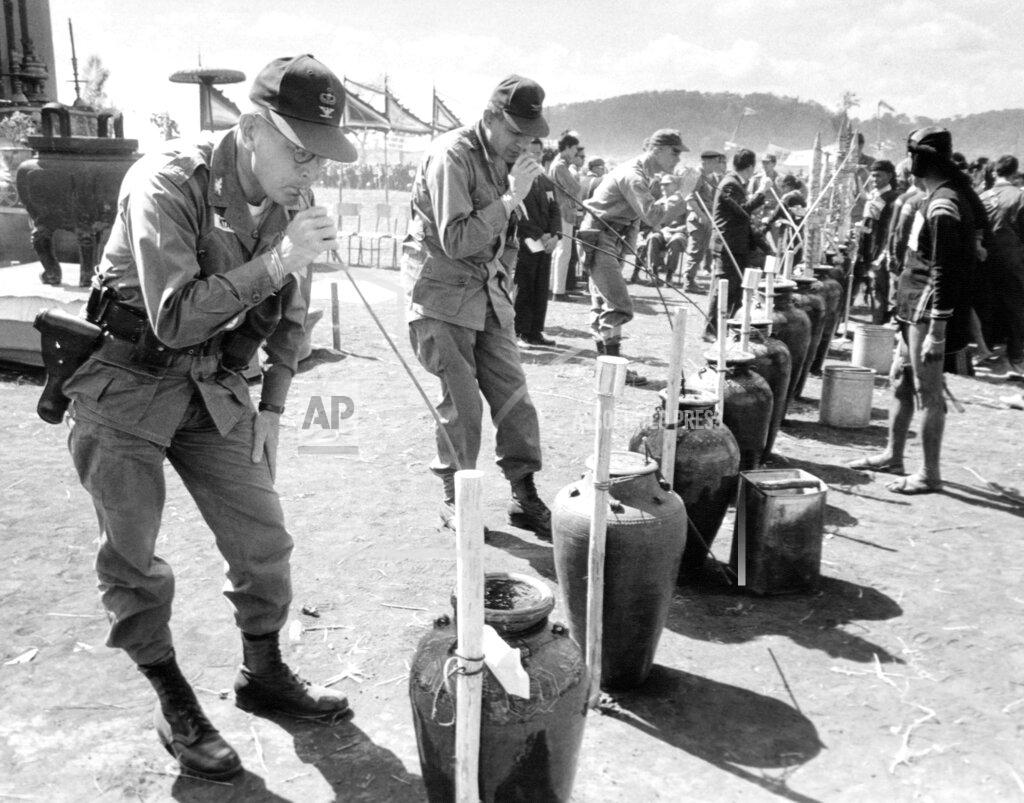
The new South Vietnamese Government is empowered to draft Vietnamese youth into the armed forces for up to one year. At the same time, it is reported that about 30 percent of the draftees desert within the first six weeks in service.
Anti-government demonstrations by student and Buddhist groups broke out in central Vietnamese cities of Huế and Đà Lạt today. Four students were shot and wounded. The protests occurred as the government reported two new clashes with Communist guerrillas. In one battle, a government unit outwitted the Việt Cộng and inflicted heavy casualties as they were preparing an ambush. At Huế, the ancient imperial capital near the North Vietnamese border, 2,000 students, including some Buddhists, massed outside the radio studio and shouted demands for the dismissal of Premier Trần Văn Hương. They were angered by reports that the four students wounded in Đà Lạt had died. Actually the students were being treated at a private clinic and the nature of their wounds was not disclosed.
In the Đà Lạt demonstration, 500 students paraded through the streets, forcing shops to close. Policemen and troops set up barricades to keep order, but the preventive measures shortened tempers and rocks were thrown. A United States Embassy source said there were reports that a Vietnamese national policeman in civilian clothes had fired the shots. The demonstrators were reported to include students from two Government-run high schools the Hưng Đạo School for boys and the Bùi Thị Xuân School for girls and from a Buddhist school.
In the fighting at Tây Ninh, near the Cambodian border meanwhile, government forces killed 25 Communist troops after discovering a Việt Cộng ambush plot. Instead of breaking through the rebels’ roadblock, the government troops halted and called for reinforcements to steal behind the Việt Cộng troops lining the road. Two government soldiers were killed and one was wounded. A number of Việt Cộng weapons were seized, including 11 rifles, 2 pistols, 2 carbines and a radio.
In other action, government troops using 105-mm. artillery fire, supported by Vietnamese Air Force strikes, drove off two Việt Cộng companies 10 miles south of Bình Giã. United States military spokesman said two government outposts had withstood the Việt Cộng assault despite casualties totaling 10 killed and 15 wounded. The artillery fire and the air strikes finally drove off the Communist forces, the spokesman said.
Three generals will receive high posts in a new Cabinet being formed by Premier Trần Văn Hương in another effort to give the government a measure of stability, informed sources said today. Mr. Hương will relinquish the Defense Ministry to Major General Nguyễn Văn Thiệu and also give him the title of Vice Premier, the informants said. General Thiệu is a key member of the Young Turks, a group of generals who brought the civilian government near collapse December 20 when they dissolved the High National Council, a provisional legislature that theoretically had authority over the military. Air Vice Marshal Nguyễn Cao Kỳ, commander of the Vietnamese Air Force and another Young Turk, is expected to become Youth and Sports Minister. Brigadier General Linh Quang Viên, chief of military security, will be given the Ministry of Information.
Mr. Hương presented the new Cabinet list to the chief of state, Phan Khắc Sửu, this morning, the informants said. The appointments indicated a more powerful voice in the governmental councils for Lieutenant General Nguyễn Khánh, the former Premier who commands the armed forces. A big unanswered question is the reaction of the country’s restive Buddhists who have been campaigning for an end to military rule. The government gave the ministries new authority to draft personnel for up to one year for civil as well as military duty. The ministries also will be able to requisition movable property for up to six months and real estate for up to three years.
United States servicemen at the big air base at Đà Nẵng, officially reticent about their actions in Southeast Asia, are still expressing awe about an extraordinary mission that took place Wednesday. That was the day United States fighter-bombers smashed a bridge on a Communist supply route in western Laos. Those jets were taking off for 20 minutes or more Wednesday morning.” United States Army officer recalled. “There must have been 30 of them.” Men who saw the aircraft return later that day said that some appeared damaged, several badly. Repair work was under way on the F-100 and F-105 jets that were damaged in the Laos air strike. Fourteen other F-100’s and seven F-105’s, all in seemingly good condition, stood on the airfield today. Officers said 10 more F-105’s were either aloft or being repaired.
One Air Force sergeant said an F-105 was flown in on Wednesday with a gaping hole behind the cockpit. Other servicemen told of having seen a Marine helicopter bring in part of the fuselage of a jet fighter Thursday. They said they could not state definitively that it was one of the aircraft shot down in Laos. Officially, United States Air Force spokesmen refused to discuss their bombing missions. Captain William O. Ezell, commander of the 23d Air Battalion Group, which controls the jets while they are in Vietnam, said he had been ordered to say nothing. The pro-Communist Pathet Lao forces are understood to possess accurate radar-controlled anti-aircraft guns furnished by Communist China, with Chinese-trained operators.
The U.N. Secretary General, U Thant, will present a bleak picture of the United Nations financial position when the General Assembly reconvenes tomorrow. According to reliable sources, the Secretary General will tell the Assembly that it will be difficult, if not impossible, to meet the February payrolls unless the organization can find a solution of its financial difficulties promptly. The United Nations had only $8 million in the bank at the end of last year. It managed to meet its January payrolls only as a result of recent partial payments of arrears by the Soviet Union, Nationalist China and other members.
The financial difficulties arise primarily from the fact that the Assembly has not yet imposed assessments for the 1965 budget although it has given Mr. Thant an interim authorization to meet expenses. The delay in the 1965 budget is a result of the unsolved financial and constitutional crisis resulting from unpaid assessments for peace-keeping forces. Since it convened December 1, the Assembly has operated on a no-vote procedure to postpone a confrontation between the United States and the Soviet Union on the enforcement of Article 19 of the Charter.
The Soviet Union, France and more than a dozen other members are now subject to Article 19, which provides that any member two years behind on paying its assessments “shall have no vote” in the Assembly. According to reliable sources, Mr. Thant’s statement tomorrow will make clear the need for voluntary contributions to put the organization’s finances in order, but will not specifically request donations.
The dismantling of the Indonesian mission to the United Nations has entered its final phase with the reassignment of most of its diplomats.
President Johnson must decide soon whether to step up United States military aid to the Government of Moise Tshombe or see the situation in the Congo deteriorate, according to high officials in Washington.
Sir Winston Churchill has weakened further. His doctor, Lord Moran, reported some irregularity in his pulse. Outside medical authorities said his condition must be regarded as critical. Yesterday, at services all over this land, Britons great and humble prayed for him. Sir Winston,, who was 90 years old last November 30, became gravely ill last Friday. It was disclosed that he had suffered a stroke-the obstruction of an artery supplying the brain following a cold. A medical bulletin issued at 8:33 tonight (3:33 PM Eastern Standard Time) said: “After a restless start, Sir Winston has had a peaceful day but he has lost ground.” The next bulletin will be issued tomorrow morning.
The Lebanese Government is planning to ask Parliament for power to invite troops of other Arab states into Lebanon if believed necessary to help defend projects to divert headwaters of the Jordan River.
An Israeli border policeman was seriously wounded today in a sharp exchange of gunfire with Jordanian forces on Mount Scopus in the Jordanian sector of Jerusalem.
The Soviet Communist party chief, Leonid I. Brezhnev and Premier Aleksei N. Kosygin paused tonight en route to Warsaw, where the first full-dress meeting of East bloc leaders outside the Soviet Union will open Tuesday.
Top officials of the World Council of Churches believe the new Soviet regime may be undertaking a major conciliatory shift in its attitude toward Christianity.
The Turkish minority of northern Greece believes it is undergoing various forms of discrimination as a result of emotions raised by the Cyprus crisis.
U.S. Government departments and agencies have quietly started seeking compliance with the mandate of the Civil Rights Act of 1964 that no one shall be denied the benefits of any program receiving federal financial assistance because of race. The muscle behind this mandate is the power to cut off federal funds from programs that discriminate. Federal officials say that the purpose of the provision is not to withhold money but to achieve desegregation of schools and other programs that get Federal aid. They say they will move slowly, seeking voluntary compliance through negotiation. There already are indications, however, that some Southern segregationists foresee a new crisis.
Governor John J. McKeithen of Louisiana announced at Baton Rouge last week that he and other Southern Governors would meet in Washington Tuesday to discuss what to do about the mandate to end school segregation or risk the loss of Federal funds.
Some government officials concerned with its enforcement think that Title VI, which provides for the cutoff of Federal funds to discriminatory programs, may ultimately prove to be the most effective provision in the act for bringing about desegregation. However, it is too early to say how well it will work. The major departments and agencies involved have finished the difficult job of drafting the regulations under which the mandate will be administered. They have just begun to seek assurances from the recipients of federal aid that their programs are free of discrimination.
The most notable result of the act so far, according to Justice Department officials, has been widespread compliance in the South with its ban on discrimination in public accommodations. Even so, problems remain. The Rev. Dr. Martin Luther King Jr., head of the Southern Christian Leadership Conference, has called for massive street demonstrations in Selma, Alabama, beginning tomorrow to desegregate restaurants and theaters. In the more than six months the Civil Rights Act has been in force, the experience under its other major operating titles can be summarized briefly as follows:
- The voting provision has been of some help in knocking down racial barriers to the right to register and vote, but progress has been painfully slow.
- The Community Relations Service, created by the act to help communities resolve racial conflict, is functioning and has achieved some success.
- There has been almost no activity under the provisions that gave limited authority to the Justice Department for the first time to bring suits to compel desegregation of schools and publicly owned facilities such as parks and libraries.
- The fair-employment-practices provision will not go into effect until July 2, but some business and labor organizations are already taking steps to try to assure voluntary compliance.
Summing up the experience So far, Burke Marshall, Assistant Attorney General in charge of the Civil Rights Division of the Justice Department until he resigned last Friday, said: “The thing that the act reaches is the official caste sys(tem in this country. Our experience shows that we are going to get rid of it. It may take 10 more years, but it won’t take more than that. Even Mississippi is changing. There are two Negroes at the university. Three school districts in Jackson, Carthage and Biloxi have been desegregated. Only two years ago there was a war going on down there. There is much more compliance than is apparent. Most people,” Mr. Marshall declared, “wanted to have this caste system over with. They were sick of it. For one thing. it was bad for business.”
President Johnson announced today that 88 new anti-poverty projects would be begun at a cost of $101,960,782. It was the third package of projects in the drive against poverty since Congress appropriated $784.2 million last year for the program in the current fiscal year. It brought the total funds allotted so far to $221 million. In the next fiscal year, which begins on July 1, Mr. Johnson has promised to ask Congress for about $1.5 billion — a doubling of this year’s effort.
Mr. and Mrs. Johnson flew back to Washington this evening after a weekend at their LBJ Ranch, 65 miles west of Austin. They took with them Governor John B. Connally Jr. of Texas and Mrs. Connally and a group of Texas relatives and friends to attend Mr. Johnson’s inauguration on Wednesday. The President had been at the ranch since Thursday night. On Friday and Saturday he had Prime Minister Lester B. Pearson of Canada and Mrs. Pearson as his guests.
Tomorrow Mr. Johnson will send to Congress a special message on national defense. White House Press Secretary George E. Reedy said that it would outline Mr. Johnson’s “goals, objectives and aims” in that field and that it would be “rather lengthy.”
Two major cases bearing on the Justice Department’s efforts to knock down racial barriers to registration and voting by Blacks in the South will be argued before the United States Supreme Court next week. The Court will reconvene tomorrow after a month’s recess to resume consideration of some highly important and controversial questions. The voting cases are the first two of four statewide suits filed by the Justice Department to reach the Supreme Court since the enactment of the Civil Rights Act of 1964 last summer. In one case, Louisiana is appealing the decision of a three-judge Federal District Court that a state law conditioning voter registration on the ability to understand and give a reasonable interpretation of any section of the state or Federal Constitutions — allegedly used to prevent the registration of Blacks — violates the Federal Constitution.
Pre-dawn fires of undetermined origin destroyed two rural Black churches near the north Louisiana town of Jonesboro today. The churches had both recently been the sites of civil rights meetings. The FBI is investigating to determine if any civil rights violations had occurred.
The U.S. Navy is preparing to bring about the renaissance of the gun in this age of the missile. Its plans to seek new firepower represent recognition of the need for more accurate fire support for amphibious landing operations and for a weapon capable of dealing with small, fast surface targets.
In answer to demands from the fleet and from the Marine Corps the Navy is developing! one new gun, studying the possibility of developing others and considering the reactivation from the reserve, or “mothball,” fleet of cruisers or even battleships. Four 16-inch gun battleships — the Missouri, Wisconsin, Iowa, and New Jersey — are still retained in the reserve fleet and some of the studies have envisaged the possibility of modifying one of these ships by replacing some of its guns with missiles and by reducing its speed and increasing its magazine capacity for bombardment ammunition.
Because of budgetary and personnel restrictions the reactivation and modification of a battleship appears unlikely in the near future, but more serious study is being given to the desirability of adding another eight-inch gun cruiser to the active fleet this year and possibly another next year. To provide more fire support for amphibious landings, the Navy plans to activate in the next fiscal year four reserve fleet LSMR’s, or landing ships equipped with batteries of rockets to provide saturation fire on beaches just before landings.
A new lightweight, five-inch, .54-caliber gun, now under development, is 18 months to two years away from operational readiness. One model of it is contemplated with an unarmored and unmanned mount, with the gun captain housed in a remote-control, protected mount well away from the gun. Its fully automatic loading mechanism would be fed by ammunition handlers in the ship’s magazine.
The ninth child born to Senator and Mrs. Robert F. Kennedy was named Matthew Maxwell Taylor Kennedy at a baptismal service yesterday at St. Patrick’s Cathedral. The baby’s middle names were for Maxwell D. Taylor, United States Ambassador to South Vietnam, a good friend of the Kennedys. Surrounded by a dozen kinsmen, including Mrs. John F. Kennedy and her two children, the newest member of the Kennedy family cried once as he was held over a marble baptismal font and a priest placed drops of water on his head.
Auto racing legend A. J. Foyt, who had twice won the Indianapolis 500 and was the defending U.S. Auto Club National Champion, was pronounced dead at the scene of a crash at the Motor Trend 500 race in Riverside, California. Foyt’s car had flipped several times after his brakes went out and his back was broken, but the judgment by one of the doctors on the scene turned out to be premature. After recovering from surgery, Foyt would resume racing and win two more Indy 500s, the Daytona 500, and the 24 Hours of Le Mans race. Fifty years later, Foyt would celebrate his 80th birthday.
Born:
Sylvain Turgeon, Canadian NHL left wing and right wing (NHL All-Star, 1986; Hartford Whalers, New Jersey Devils, Montreal Canadiens, Ottawa Senators), in Noranda, Quebec, Canada.
Terrence Anthony, NFL defensive back (St. Louis Cardinals), in East St. Louis, Illinois.
Manolo (Manuel Sánchez Delgado), Spanish footballer for Atlético Madrid, with 28 caps for the Spanish national team; in Cáceres, Spain.




 History Diaries