At 8 a.m. French supreme commander Maurice Gamelin saw the British response to the guarantees to the Belgians: they were offering a watered down version that was most unlikely to be acceptable to the Belgians. At the same time he received messages from the advancing forces that the Belgian border troops had stopped removing the border obstacles and had not been ordered to allow them entrance into their country. Three hours later Daladier, prompted by Gamelin who insisted that the premier should make the Belgian government “face up to its responsibilities”, told Pol le Tellier, Belgium’s Ambassador in Paris, that unless the French had an invitation to enter Belgium by 8 p.m. that evening, they would not only withdraw all British and French troops from the border but would refuse to carry out similar maneuvers during further alerts until after the Germans had invaded.
The Belgian cabinet was unable to come to a positive decision about the French invitation to have the Allies enter Belgium. The invasion that had been predicted for the January 14 had failed to materialize. Heavy snowfall continued on the eastern border, making an immediate German attack unlikely. The King and Van Overstraeten, both staunch neutralists, hoped a diplomatic solution could be reached to end the war and had no intention to involve their country unless it were absolutely necessary. Around 12 p.m. Van Overstraeten ordered the Belgian border troops to rebuild the barriers and reminded them of the standing order to “repulse by force any foreign unit of whatever nationality which violated Belgian territory”. At 6 p.m. Daladier told a disappointed Gamelin he “could not take the responsibility of authorizing us to penetrate preventively into Belgium.”.
The Mechelen incident of January 10th has been followed by much diplomatic activity. For a time the British and French have believed that they will be invited to move troops into Belgium even before a German attack but this possibility is now firmly ruled out by the Belgian government.
With the element of surprise lost due to the Mechelen Incident, the poor road conditions due to snowfall, and the bleak weather prospects, General Alfred Jodl, the Wehrmacht’s Chief of Operations, advised Hitler to call off the invasion of the Low Countries indefinitely. General Jodl of OKW advises Hitler that the weather is too poor for an invasion and it should be called off indefinitely, not just postponed for a few days now and again. Hitler, still set on an early invasion, decides to think it over and gives no firm decision.
Belgium protested to Germany over the Mechelen incident.
The fresh alarm in Belgium and the Netherlands regarding the possibility of a German invasion is treated in Berlin with guarded reticence. Semiofficially this is attributed to a German desire not to dramatize the present nitration and to avoid everything that might lead to an extension of the war’s front.
The Italian press today takes the attitude that Belgium and the Netherlands have had a false alarm deliberately fostered by the British.
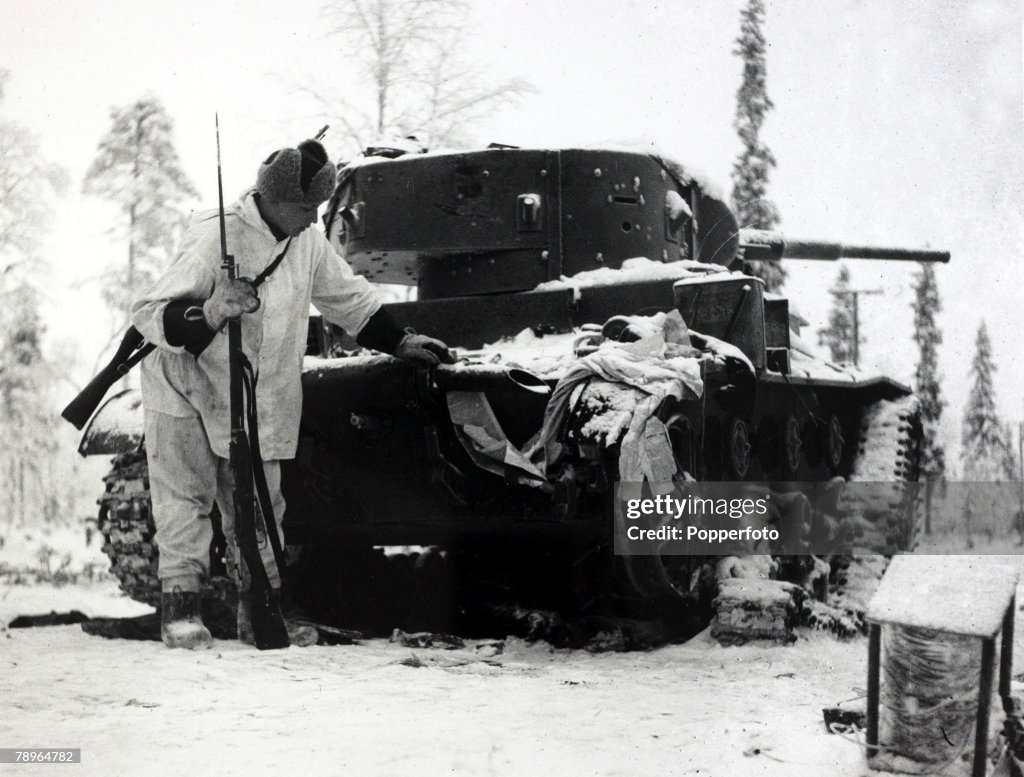
Heavy Soviet artillery fire heralds a new and more robust Soviet effort there led by Timoshenko. The Soviet forces begin to bombard the Finnish lines around Summa. This softening-up process will continue until the end of the month, giving the defending Finnish troops little rest and doing considerable damage to their defenses. The Finnish & Soviet Armies face each other along the entire frontier but there is little movement. On the Karelian Isthmus, Red Army shells the Mannerheim Line to wear down the Finns & chip away at their defenses. Red Army divisions have been abandoned by Stalin and are freezing all the way North from Lake Lagoda. Held at Salla, Raate & Kollaa, they are isolated and chopped into mottis by the Finns.
At Taipale, Finnish troops repulse an assault by a fairly small enemy detachment.
Finnish patrols on the eastern border are still vigorous and effective.
In Northern Finland, Finnish troops begin to pursue the retreating enemy in Salla by advancing from Joutsijärvi in the direction of Märkäjärvi.
In Ladoga Karelia, Viitavaara on the River Aittojoki is finally lost to the Russians.
Russian bombing planes swarmed upon Southern Finland from their Estonian bases today, and for the fourth consecutive day carried out what Finnish officials alleged to be a methodical wave of terror against women and children, hospitals and workers’ districts. Soviet planes today bomb Viipuri and Turku, in Finland. Viipuri is subjected to surprise attacks from the air. The sirens start up at 23 minutes past noon as the first bombs explode. The late warning means there are still many people on the streets and in shops and offices. Three people are killed and several injured. The attack devastates the area around Punaisenlähteentori square.
Undeterred by his jammed machine gun, Staff Sergeant Siltavuori, a squadron test pilot, downs an enemy DB bomber by cutting its rudder with the propeller on his Fokker.
The Swedish Government responds to the Soviet note accusing Sweden of abandoning its neutrality and the Swedish press of publishing anti-Soviet material. The Swedes reject the accusation and affirm their commitment to freedom of the press.
Almost simultaneous protests from Sweden and Norway, charging that Russian planes had violated their neutrality, increased the growing tension between Russia and the Scandinavian States tonight.
The German Foreign Ministry denies rumours of German attempts to play a mediating role in the Finno-Soviet conflict and claims that the visits of the German Ambassador in Moscow to Foreign Minister Molotov have merely concerned economic relations between the two countries.
The Swedish novelist Selma Lagerlöf donates her gold medal from the Swedish Academy and her Nobel Gold Medal to the collection in aid of Finland.
The French Foreign Office warned tonight of possible simultaneous action by Germany and Russia against neutral nations in Western and Eastern Europe and promised the “formidable support” of Great Britain and France to any neutral attacked by the Germans.
General Sir Archibald Wavell is appointed the British Commander-in-Chief Middle East.
The British government took over control of the country’s meat industry.
Side by side with the reconstruction of damaged homesteads, farms, villages and towns in conquered Poland, Germany is making preliminary surveys for a network of double-lane motor highways linking her new eastern provinces with the web of concrete roads spun throughout the Reich.
The Germans request that the Danes blackout their island of Roenoe, which the British are using as a guide to the German base on Sylt. The Danes comply.
At 0013, the Norwegian cargo ship Fagerheim was hit by one torpedo from U-44 (Ludwig Mathes) about 80 miles SW of Quessant at 47° 20’N, 6° 16’W, broke in two & sank. The survivors were rescued and taken to Vigo, Spain. The 1,590 ton Fagerheim was bound for Middlesbrough, England.
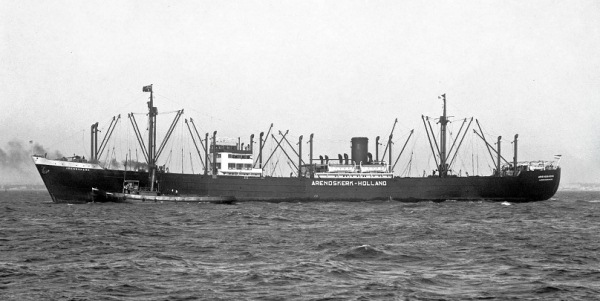
At 0705 hours, the Dutch neutral Arendskerk (Master Cornelis Johannes Hendrik Wijker) was spotted by U-44 about 100 miles SW of Ouessant (46° 55’N, 6° 34’W) and tried to escape when the U-boat was sighted. It needed seven shots across her bow to stop the vessel. When the papers were checked it became clear that she carried contraband and the crew was ordered to abandon ship. At 1010, one torpedo struck in the engine room, breaking the ship in two. The stern sank, but the forepart remained afloat and had to be sunk 30 minutes later by 18 shells from the deck gun. The survivors were picked up by the Italian merchant Fedora, transferred to the Dutch merchant Poelau Bras and landed at Lisbon. The 7,906 ton Arendskerk was carrying 4,000 tons of general cargo, including barb wire, galvanized sheets, nails, iron, brass tubes and mail and was bound for Durban, South Africa.
The British fishing vessel Newhaven struck a mine and sank in the North Sea 18 nautical miles (33 km) south-southeast of Lowestoft, Suffolk.
The Belgian cargo ship Meuse departed from Newcastle-upon-Tyne, Northumberland, United Kingdom for Bruges, West Flanders, Belgium, and vanished without a trace. No further trace was found of her but the bodies of four of her twelve crew were found on the English coast. The rest of her crew were reported missing.
The British steamer Kildale (3877grt) was damaged two miles east of South Shiphead Buoy, in the minefield laid by German destroyers on 6 January 1940.
The War at Sea, Monday, 15 January 1940 (naval-history.net)
Battleship ROYAL SOVEREIGN departed Devonport after refitting, escorted by destroyers ACHATES, ARROW and ANTHONY for Halifax. On the 16th, the escort was relieved by destroyers WINDSOR, VISCOUNT, and VANQUISHER.
Destroyer HEARTY (Lt Cdr D G F W Macintyre) was completed, and following working up at Portland, joined the 9th Destroyer Flotilla operating with the Home Fleet. On 27 February, she was renamed HESPERUS to avoid phonetic confusion with destroyer leader HARDY.
Submarine CACHALOT was refitting at Chatham until 21 March, leaving on 29 March for Portsmouth.
Convoy ON.8 departed Methil with six British, three Norwegian and one Finnish ship escorted by destroyers DUNCAN (Cdr J S Salter, escort SO), IMPULSIVE, IMPERIAL, ISIS and submarine NARWHAL. Destroyer EXMOUTH departed the next day and escorted chartered aircraft transport FOSSBECK (4918grt) and cable vessel LASSO to Scapa Flow. Light cruisers EDINBURGH and GLASGOW left Rosyth on the 17th to cover this convoy. On the 17th, DUNCAN collided with Norwegian steamer HAUKESFJELL (2495grt) of the convoy and was badly damaged. She was towed by IMPULSIVE, screened by EXMOUTH, to Invergordon arriving at Cromarty at 0800/18th. DUNCAN was relieved by destroyer KIMBERLEY, and after towing in the damaged ship, IMPULSIVE returned to the convoy. At Invergordon, EXMOUTH and minesweeper SPHINX went alongside DUNCAN to take off ammunition to lighten ship. The convoy arrived at Bergen on the 19th without enemy interference.
Destroyers ECHO, ECLIPSE, and ENCOUNTER departed Methil escorting a MT convoy to the Tyne. In bad weather, the convoy dispersed and ECHO and ECLIPSE each took half the convoy and escorted them back to Methil on the 16th. The three destroyers departed again on the 17th with this convoy for the Tyne and again was forced to return. The convoy finally left Methil the evening of the 18th.
Anti-aircraft cruiser COVENTRY departed Sullom Voe for the Humber where she arrived later the same day. She went on to Chatham and arrived on the 16th for docking and repairs. These were completed on 29 April, and she left that day for Sheerness to take on ammunition.
Convoy OA.72 departed Southend escorted by destroyers WHITEHALL from the 13th to 15th and ANTELOPE from 14th to 15th, when the convoy dispersed.
Convoy OB.72 departed Liverpool escorted by destroyers WANDERER and WALPOLE, and dispersed on the 18th.
Convoy FN.72 departed Southend, escorted by sloops FLEETWOOD and BITTERN. Gales forced the convoy to shelter in the Humber, and it arrived in the Tyne on the 18th.
Convoy FS.73 departed the Tyne, escorted by destroyer VIVIEN and sloop PELICAN, and arrived at Southend on the 17th.
Destroyers ECHO, ECLIPSE, and ENCOUNTER escorted a group of merchant ships from Methil to the Tyne. Convoy FS.74 was cancelled.
Armed merchant cruiser WOLFE ran aground.
Destroyers GRIFFIN and GRAFTON and the Polish ORP BŁYSKAWICA swept off the Dutch coast in Operation ST 2 during the night of the 15th/16th, supported by destroyers JERVIS, JUNO, JANUS, JACKAL, JAVELIN and JUPITER. GRAFTON sent Latvian steamer RASMA (3204grt) in for inspection.
U-44 sank Norwegian steamer FAGERHEIM (1590grt) 80 miles SW of Ushant in 47-20N, 6-16E, Dutch steamer ARENDSKERK (7906grt) in 46 55N, 06 34W, and Greek steamer PANACHANDROS (4661grt) west of Brest. FAGERHEIM lost 14 crew, and her survivors were picked up by Greek steamer IRIS. ARENDSKERK’s entire crew was picked up by Italian collier FEDORA (5016grt).
Merchant ship GRACIA (5642grt) of convoy OB.71 was badly damaged on a mine laid by U-30 on the 9th five miles WSW of Bar Light Vessel. Destroyer VOLUNTEER attacked a submarine contact in Liverpool Bay while investigating the damage, and dropped depth charges in 53-30N, 3-28W.
Trawler NEW HAVEN (162grt) was sunk on a mine eighteen miles SSE of Lowestoft.
Convoy CAVALRY departed Malta on the 15th, reached Marseilles on the 18th, left again on the 23rd, arrived at Malta on the 25th, and then proceeded to Haifa. The convoy consisted of liners DILWARA (11,0880grt), ROHNA (8602grt), DEVONSHIRE (11,275grt), TALAMBA (8018grt), LANCASHIRE (9557grt), and RAJULA (8478grt). LANCASHIRE did not go to Haifa, but proceeded independently to Bombay after leaving Malta. Australian destroyer HMAS VOYAGER departed Malta with the convoy on the 15th, sister-ship HMAS VAMPIRE joined the next day, and they remained with the convoy until its arrival at Marseilles. VAMPIRE and VOYAGER rejoined the convoy on the 23rd when it left Marseilles, and destroyer VENDETTA joined off Malta on the 25th.
Light cruiser AJAX, returning to England from the South Atlantic for repairs, met Force H, battlecruiser RENOWN and aircraft carrier ARK ROYAL, in mid-South Atlantic and arrived at Freetown on the 19th.
The degaussing of British ships began in mid-January. By 9 March, 321 warships and 312 merchant ships had been fitted with degaussing cables and 219 more warships and 290 more merchant ships were in hand for degaussing installations.
In Washington, President Roosevelt reported to Congress on the expenditure of $11,776,501,570 for relief since April, 1935, forwarded a report of the TVA requesting authority to develop a national playground in the Tennessee Valley, ordered Treasury records of income and other tax returns for 1936-37-38 to be made available to the LaFollette Civil Liberties Committee, and kept routine appointments with a number of administrative officials.
The Senate received the Barbour resolution authorizing a conference to draft Federal farm policy and legislation, confirmed the reappointment of Chairman Schram and four directors of the Reconstruction Finance Corporation, confirmed the nomination of Albert G. Black to be Governor of the Farm Credit Administration, and adjourned at 12:21 PM until noon tomorrow. The Judiciary Committee approved the nominations of Frank Murphy to be an associate justice of the Supreme Court, Robert H. Jackson to be Attorney General and Francis Biddle to be Solicitor General.
The House considered its private and consent calendar, received the army engineers’ recommendations for flood control and rivers and harbors projects and adjourned at 1:59 PM until noon tomorrow. The Naval Affairs Committee again questioned Admiral Stark on the Naval Expansion Bill, the Smith committee continued its investigation of the National Labor Relations Board and the Ways and Means Committee heard UnderSecretary of Commerce Noble urge extension of the trade agreements program.
President Roosevelt forwarded to Congress today a request of the Tennessee Valley Authority for additional power to develop into a vast recreational area parts of the six Southern States embraced in the TVA project. It was the first time that the agency had dwelt at length on the recreational aspects of the undertaking. Mr. Roosevelt began a message of transmittal accompanying the report with the observation that many citizens and even government officials believed the purpose of the law creating the TVA was primarily the development of electric power. He added: “It is perhaps time to call attention to this utter fallacy.” Actually, according to the President, the development of electric power was only a relatively small part of a great social and economic experiment in one of the major watersheds of the continent. It was time that the public understood this as well as the manifold objectives underlying the TVA plan, said the President.
Among the purposes, Mr. Roosevelt mentioned the prevention of loss of life and property incident to floods which had taken an annual toll of $20,000,000 in property damage. The construction of dams on the Tennessee River and its tributaries for this purpose also had made possible the production of a large amount of power and afforded. barge navigation for hundreds of miles up the river, it was recalled. “Furthermore,” President Roosevelt stated, “the original objective of the law included many other things, such as the planting of water-retaining forests near the headwaters of the many rivers and streams, the terracing of farm hillsides, the building of small checkdams, the development of fertilizers, the diversification of crops and other soil-building methods, the improvement of the highways and other forms of transportation, the bringing in of small industries, the extension of rural electric lines and many other similar activities.”
As for the vast recreational potentialities dealt with in the long TVA report, the President said: “It is coming to be realized more and more that in the improvement of our American civilization we cannot stop at hospitals and schools. any more than we can confine ourselves to strictly economic subjects. Recreation in its broad sense is a definite factor in the improvement of the bodies and minds of our future citizens.” Without recommending any action on the TVA proposal, Mr. Roosevelt closed his message with the expression of a hope that the report would “dispel any erroneous impression that the Tennessee Valley Authority’s work is concerned principally with the mere development of electric power.”
In a letter to President Roosevelt, accompanying the report, Harcourt Morgan, chairman of the TVA, pointed out that the agency now was limited by statute to such recreational projects as were incident to studies and surveys authorized in the law and which therefore were of a “demonstration” or experimental nature. As for the possibilities of the Tennessee Valley for recreational purposes, the report said that when the agency’s program was completed there would be available for a vast national playground more than 500,000 acres of water surface and nearly 6,000 miles of publicly owned shores surrounding its man-made lakes in six States.
The Senate Judiciary Committee approved unanimously today the nomination of Attorney General Frank Murphy to be an associate justice of the Supreme Court. It then proceeded immediately, and also without a dissenting vote, to recommend Senate ratification of the nomination of Solicitor General Robert H. Jackson to be Attorney General and of Circuit Court Judge Francis Biddle to be Solicitor General. Efforts will be made to bring the nominations quickly before the Senafe for final approval, Senator Ashurst, chairman of the committee, said, adding that he expected little discussion to precede favorable action by the Senate. Mr. Murphy, who appeared before the committee after it had voted, shook hands with each member. “I have one piece of advice,” Senator Ashurst said. “You are a great speaker, but from now on you can talk about only two things — art and the weather.”
President Roosevelt plans to send a special communication to Congress tomorrow suggesting further financial aid by this government to Finland.
Seventeen men, most of whom appeared more frightened than revolutionary, were held in $50,000 bail each by Federal Judge Grover M. Moscowitz yesterday on charges of conspiring to overthrow the United States Government. According to the federal authorities, they were all members of an inner circle drawn from the Christian Front and from similar anti-Semitic and professedly ultra-patriotic organizations, and when they were arrested over the weekend they were about to undergo a practice course in bombing that was to be followed by a series of real bombings of New York public buildings.
United States Attorney Edmund J. Brandon and special agents of the Federal Bureau of Investigation have been working since October on an extensive investigation in Boston of the activities of underground groups aiming at sabotage and a dictatorial form of government, it was learned today.
The Munich agreement which led to the disappearance of Czecho-Slovakia as a nation was apparently interpreted by the United States Government as a danger signal because the negotiation of that agreement by Great Britain, France, Germany and Italy was followed by the decision to increase the fighting strength of the United States Navy. Admiral Harold R. Stark, Chief of Naval Operations, testifying today in support of the $1,300,000,000 Naval Expansion Bill, was asked when and where that measure, which would expand the navy to a fighting strength of about 2,000,000 tons, had been decided on, He replied that the place was the Navy Department and the time that of the Munich conference. It is becoming evident that the bill is facing considerable opposition both houses of Congress, particularly in the Senate, where passage may be delayed by exhaustive debate after prolonged hearings in the Committee on Naval Affairs, of which Senator Walsh of Massachusetts is the chairman.
Members of the House Naval committee expect a fight on the floor of their chamber but insist that the majority for the bill is fairly well in hand. The real trouble, they say, seems to be developing in the Senate, where a combination of Republicans and Democrats may hold up enactment for many weeks or even bring about the defeat of the bill. Apart from the bill, President Roosevelt asked Congress today to appropriate an extra $31,000,000 for the Navy Department for immediate use to replace vessels, armor, armament and ammunition. He transmitted a letter from Assistant Budget Director John B. Blandford Jr., stating that funds for this purpose in the Naval Appropriation Bill last year were insufficient to meet payments during the current year under existing contracts.
Louis Johnson calls for the U.S. to be equipped for a ‘Million Man Army.” Johnson, Assistant Secretary of War, told 1,000 bankers dining last night at the WaldorfAstoria Hotel that this country should strive to have on hand actual munitions, reserves, and equipment to put 1,000,000 men on a war basis in an emergency.
House leaders arranged today for consideration next Friday of a resolution to extend for one year the life of the Dies committee investigating un-American activities, with indicestions that $100,000 in expenses would be alloted for the inqury.
Admiral Byrd’s giant snow cruiser is unloaded from the merchant ship North Star in the Antarctic. It breaks through the wooden ramp that is required to unload it, but once it is on the ground, its (unaccountably) smooth tires (designed for swamps) give it little traction. It quickly gets stuck. Experimenting, the team discovers that the cruiser is able to drive through the snow and ice — but only in reverse. Some exploration drives are made with it in that fashion — over very level ground.
Admiral Byrd drove the beast — in reverse — for a few weeks. He covered up to 92 miles (148 km) in one journey. However, eventually, even in reverse the snow cruiser eventually gets stuck. Rather than attempt further heroic measures, Byrd just left it in situ and used it as a heated camp for his Little America 1- a function which it performed admirably, though burning a lot of precious gasoline. Byrd left it behind when the expedition concluded — and there it sits to this day, assuming the ice below it never melted.
Joint amphibious exercise begins in the Monterey, California, area, to provide training for the Army and Navy in planning and executing Joint operations, to train Army troops in embarking and disembarking, and to afford an opportunity for elements of the GHQ Air Force and Navy patrol squadrons to work together and with ground forces (see 22 January). Commander Battle Force (Admiral Charles P. Snyder) conducts the Navy portion of the exercise.
The first meeting of the Inter-American Neutrality Committee is held to strengthen neutrality zone in western hemisphere. It holds its first meeting in Brazil.
Chinese Winter Offensive: Chinese 9th War Area halts offensive operations approximately this date. The offensive has regained vital territory and helped bring down the Japanese government.
Official dispatches from the Kwangtung front today said that the Japanese were continuing to fall back toward Canton in the sector north of the city. The Chinese were said to be closely pressing the Japanese twenty to thirty miles from the metropolis. Both the Hamamoto and the Imperial Guard divisions reported as being withdrawn toward Canton for replenishment and reorganization. Improvement in China’s communications with Indo-China which were restricted by the loss of Naning and the recent Japanese bombing of the French-owned Yunnan Railway has been brought about by the new Kwangsi-Indo-China highway to the west of Nanning and by the partial resumption of train schedules on the railway.
In a fierce battle in Hupeh Province the Chinese claimed they had destroyed large sections of the Canton-Hankow railway and had inflicted heavy losses upon the Japanese. The Japanese were said to have launched a drive westward from Kaifeng, capital of Honan Province, in the direction of Chengchow, junction of the Lunghai-Canton-Hankow railways.
Japan’s efforts to obtain a modus vivendi from the United States on the basis of most-favored nation treatment as a stopgap until a new commercial treaty is concluded consequent upon the lapse of the existing twenty-nine-year-old accord on January 26 apparently are doomed to failure. According to authoritative indications today, and unless something of an exceptional character develops during the next eleven days in the conversations that Joseph C. Grew, the United States Ambassador in Tokyo, has been conducting with the Japanese Foreign Office, commercial relations with the two countries will be governed after January 26 by domestic and international law only.
This will mean, in the opinion of competent observers, that the door will always be open to discriminatory acts if Japan practices discrimination against the United States. A new commercial treaty is being discussed by Ambassador Grew in Tokyo at the prompting of the Japanese, but other questions, including those of a political nature involving Japan’s program in China, are also being touched upon, and officials emphasize that the discussions have not reached the point of negotiations.
All questions in which the two governments are interested have been under discussion from time to time by Mr. Grew and the Japanese Foreign Office, Secretary of State Cordell Hull said today at his press conference. They include the subject of a commercial treaty, but he maintained the position that there would be no developments at this time that called for any comment by him. As for a modus vivendi, other officials intimated that none would be considered definitely, unless Japan gave effective guarantees. that American interests would receive equal and fair treatment in the Japanese-dominated areas of China. The absence of an agreement, however, will not necessarily mean a period of discrimination and retaliation. In fact, experts pointed out that this status was not unusual. As an example they referred to the many years that the United States had no commercial treaty or modus vivendi with France, yet commercial relations were maintained on an undisturbed plane through application of domestic and international law.
About 300 persons were injured and 50,000 were made homeless today by fire which swept the port city of Shizuoka, Japan’s tea-shipping center, ninety miles southwest of Tokyo.
Japanese fishing schooner No. 1 Seiho Maru is stranded on reef off southeast coast of Guam, Marianas Islands. A detail of Guam Militia (12th Company) renders necessary assistance during salvage operations (see 21 January). Minesweeper Penguin (AM-33) rescues the 24-man crew. She was later salvaged.
Dow Jones Industrial Average: 144.65 (-0.54)
Born:
Tommy Gilbert, professional wrestler, in Lexington, Tennessee (d. 2015).
Jim Hadnot, ABA center (Oakland Oaks), in Jasper, Texas (d. 1998).
Naval Construction:
The Royal Navy “O”-class destroyers HMS Offa (G 29) and Oribi (G 66) are laid down by the Fairfield Shipbuilding & Engineering Co. (Govan, Scotland).


 History Diaries