This morning, a United States Army helicopter crashed into a power line north of Saigon, killing two of the American crewmen and a Vietnamese and injuring the other two Americans aboard. The helicopter, an armed UH-1B, was escorting a road convoy when it crashed and burned. No hostile ground fire was reported and the mishap, three miles south of Biên Hòa air base, apparently was accidental. The crash reportedly killed the pilot, an enlisted gunner and a Vietnamese observer. The co-pilot was seriously injured and the other gunner reportedly was injured but in good condition.
Earlier, 1,200 South Vietnamese soldiers attacked a Việt Cộng concentration 140 miles southwest of Saigon. They killed 11 Communists and took 12 prisoners.
Reliable Vietnamese sources said today that South Vietnamese fighter-bombers and PT boats had been hitting military targets inside North Vietnam. United States planes and warships were reported to have provided cover. Military informants said the Vietnamese strikes had thus far been carried out on a limited scale by propeller-driven planes and PT boats. They described them as “quick raids” that could be expanded at any time. The sources said the attacks had been coordinated with the United States Air Force and the United States Seventh Fleet.
The United States went ahead today with its program of expanded military and economic aid for South Vietnam in the war against the Communist guerrillas. Maxwell D. Taylor, the United States Ambassador, was understood to have informed the Government that Washington was ready to underwrite an increase of 100,000 men in the South Vietnamese armed forces, bringing their strength to 660,000. Ambassador Taylor has told Premier Tran Van Huong that the aid increase should be put into effect as soon as possible, now that Saigon has resolved the political crisis that arose from the military uprising of December 20. The uprising, in which a group of young generals dissolved the civilian legislature, brought a halt in talks on broadening the assistance program. The United States insisted that it could deal only with a single civilian authority competent to carry out its decisions.
This condition was apparently satisfied by the dissident generals’ restoration of supreme authority to the Government last Saturday. This morning Lieutenant General Nguyễn Khánh, commander in chief of the South Vietnamese armed forces, attended the weekly meeting of top United States and Vietnamese officials. General Khánh had been boycotting the policy discussions since Ambassador Taylor criticized his role in the military power seizure. As the aid discussions resumed, optimism also arose from the news of the raid carried out Wednesday by United States jet fighter planes on Route 7, a principal link between North Vietnam and the Laotian areas controlled by pro-Communist Pathet Lao forces. The action was seen by officials here as an important psychological stimulant to the South Vietnamese at a critical moment in their struggle against the Việt Cộng.
Well-informed sources said United States jet raids along the Hồ Chí Minh Trail had delayed and hindered North Vietnamese activity. The Communists are reported to have shifted vital installations out of the area of Tchepone, which was once the hub of the Hồ Chí Minh Trail, as the Communists’ network of supply paths is called. Military columns no longer move openly on roads in the Laotian corridor adjacent to Vietnam. United States jets from the base at Đà Nẵng in central Vietnam have participated in attacks in cooperation with T-28 fighter bombers of the Royal Laotian Air Force. Military sources said, however, that these attacks had been of only limited value and had served to harass and to delay Communist traffic rather than to block it. These sources said strikes might be undertaken later on more important supply routes and depots in North Vietnam. Attacks on Communist targets in Laos and in North Vietnam, it was said, might discourage North Vietnam in its direction and support of Việt Cộng operations. But in explanations of Việt Cộng successes, as viewed here, there is no tendency to attribute more than 20 percent to fighting cadres and supplies from the north.
Senior United States officials say that the actual rate of infiltration from the north is not known, although the annual influx of cadres, or leadership teams, is believed to number in the thousands. In planning, Ambassador Taylor and his aides continue to put their emphasis on stable government in Saigon and on an effective long-term pacification program in the countryside. A highly experienced United States officer said he doubted that anyone still believed that victory could be achieved in less than two years. General Khánh and the young generals who wielded the actual power in the uprising regard their relations with Ambassador Taylor as satisfactory and businesslike. Their recognition of the authority of the Government entailed an understanding that at least two or three generals would be brought into Premier Hương’s Cabinet.
Plans for the increase in South Vietnam’s armed forces are nearly completed and will be submitted soon to Washingiton, it was understood. The new men are to enlarge the regular forces, the national police and paramilitary units used for local defense against the Việt Cộng. According to official sources here, 240,000 of the present servicemen are in the army, the navy, the marines and the air force. The national police number 30,000, and the rest are in paramilitary forces. United States assistance in curbing Communist infiltration into South Vietnam is also to be enlarged.
In a Washington speech, Senator George McGovern, Democrat of South Dakota, joined a growing number of Congressmen in urging a “political settlement” for Vietnam. He said a military victory was impossible.
The State Department declined today to say whether the United States still felt bound by the Geneva accord prohibiting foreign military intervention in Laos. The department’s silence reflected the difficulty of the position in which the country finds itself as a signer of the 14-nation accord, which was reached in July, 1962. The principal objective of the agreement was to guarantee the neutrality and independence of Laos. On one hand, the Administration does not wish to renounce the agreement openly. In fact, it hopes the accord may provide an avenue for removing Laos from the East-West struggle in Southeast Asia.
Confronted, however, with the rising Communist insurgency in Southeast Asia, the Administration wants to take military actions in Laos that are not sanctioned by the agreement. The Administration’s dilemma, imposed by conflicting legal obligations and military objectives, has been heightened by the increasing activity of United States warplanes over Laos on reconnaissance and attack missions that have been going on quietly for about six months. On Wednesday a squadron of American fighter bombers wrecked a bridge on a Communist supply route near the central Laotian town of Ban Ban. Officials acknowledge privately that there is no legal basis under the 1962 accord for carrying out such missions in Laos.
Thus far, officials insisted today, the United States air strikes have been limited to Communist supply routes in Laos. The officials were emphatic in denying that the United States had participated, even indirectly, in air strikes against North Vietnam. After a closed-door briefing of the Senate Foreign Relations Committee, Secretary of State Dean Rusk said that no United States air strikes had been carried out against North Vietnam. Senator John J. Sparkman of Alabama, acting chairman of the committee, said, “We can plainly say we are not escalating the war.” The State Department also denied reports from Saigon that the United States had been providing air and naval cover for South Vietnamese attacks on military targets in North Vietnam. State Department spokesmen said, “There has been no U.S. involvement in such reported actions.” Officials did not deny, however, that South Vietnamese forces had been carrying out occasional air and naval raids against North Vietnamese targets near the border. Such raids were understood to involve only small penetrations into North Vietnamese territory.
Thus far the Administration has been reluctant to extend United States air operations into North Vietnam, partly because of concern over the instability of the South Vietnamese Government and partly because of uncertainty over the reaction of Communist China., But the Administration wants South Vietnam to step up its air strikes against North Vietnam. The principal difficulty, according to officials, is in training South Vietnamese crews to a point at which they could strike without American assistance. In the case of Laos, however, officials made it clear that the United States intended to continue airstrikes against Communist supply routes. The principal purpose of these raids is to slow the flow of supplies to the Pathet Lao forces in Laos. But they are related indirectly to the American strategy in South Vietnam. A shift of thinking is apparently taking place within the Administration; instead of taking a separate view of the struggles in Vietnam and Laos, the Administration is tending to view the two as interdependent.
By conducting air strikes in Laos, therefore, the Administration can emphasize its firmness in South Vietnam. The legal justification offered by officials for reconnaissance missions in Laos was that these flights have been requested by the Laotian Government. The Geneva accord permits the Laotian Government to request outside military assistance, but this is limited to the supply of military equipment and does not include military activities. In fact, one provision specifically prohibits the introduction of foreign troops or military personnel in any form whatsoever.” Privately, officials argued that the Communists had virtually nullified the accord by introducing troops, by breaking the cease-fire and by using Laos to introduce supplies and men into South Vietnam. The legal justification, therefore, is that since the accord has been violated by the Communists, the United States is no longer bound by it.
Malaysia demanded today that Indonesia “cease hostilities and all acts of aggression” if it wanted a peaceful solution to the crisis between the two countries. A government statement noted the “desire so piously expressed by President Sukarno” of Indonesia, who suggested yesterday that an African-Asian group or the United Nations investigate whether the North Borneo states of Sarawak and Sabah want to remain in Malaysia. Mr. Sukarno said he would abide by the result. He also called on Malaysia’s Prime Minister, Prince Abdul Rahman, to return to the negotiating table.
The Malaysian statement said: “After experience of a series of abortive peace talks with Indonesia, Malaysia naturally would rather see a genuine demonstration of the professed desire rather than hear mere expressions of it.” A Foreign Ministry spokesman. Ahmad Nordin, said Malaysia was still willing to accept the proposal for an African-Asian peacemaking commission, which the Philippines originally proposed. But he emphasized that this would be acceptable only after “Indonesia ceases hostilities and all acts of aggression and is ready to respect Malaysia’s sovereignty and territorial integrity.” Mr. Nordin said Malaysia could not ask for less in view of Indonesia’s withdrawal from the United Nations, “statements by its leaders following that and the build-up of [Indonesian] military forces in Borneo and Sumatra, together with the threat of increasing attacks on Malaysia.” Deputy Prime Minister Tun Abdul Razak said earlier that Mr. Sukarno “must prove he wants peace by deeds, not words alone.” Mr. Razak said the situation! was “as serious as ever” and that “war or peace in this area depends on Sukarno.”
Meanwhile, the build-up of British forces in northern Borneo continued. A British artillery battery was flown in, and several anti-aircraft guns arrived. British transport planes flew in more Gurkhas, tough Nepalese troops, from Hong Kong. Five hundred Gurkhas are being flown in this week, joining 1,000 already there. Britain’s Army Minister, Fred Mulley, ending a three-day tour of Malaysian Borneo, said he was satisfied that the forces there could deal with any action Indonesia might take. But he added that “if additional forces are required, we will do our best to provide them.” The Malaysian Prince said: “Sukarno’s words are honored more in the breach than in the observance. His words will not lull us into a state of unpreparedness.” The Prime Minister praised the support Malaysia has received from Britain, Australia and New Zealand, its Commonwealth allies, and pledged, “We will spare no money, time or energy in strengthening our defenses.”
Foy D. Kohler, United States Ambassador to the Soviet Union, reviewed the current state of Soviet-American relations for almost an hour today with Foreign Minister Andrei A. Gromyko. An Embassy spokesman declared that the possibility of a visit to the United States by Soviet leaders was not among the subjects discussed. The impression that diplomatic observers here have gained is that the suggestion for such a visit has not progressed since it was made in a surprise move by President Johnson in his State of the Union Message.
Meanwhile, the Soviet news agency Tass has announced that the Consultative Committee of the Warsaw Pact organization. the Eastern European counterpart of the North Atlantic Treaty Organization, will convene in Warsaw Tuesday. The principal purpose of the Warsaw meeting is believed to be discussion of possible countermeasures to Western plans for a multinational force within NATO. The United States has been the prime mover behind these plans. Opposition to the multinational force has been the most prominent feature of Soviet foreign policy for many months. When Mr. Gromyko was in the United States last month, he discussed the issue of the force with President Johnson and Secretary of State Dean Rusk.
The Soviet Union carried out its first “peaceful nuclear explosion” with the excavation detonation of a nuclear bomb in advance of construction as it began its “Program 7”, “Peaceful Nuclear Explosions for the National Economy.” The result was a crater that would become “Lake Chagan” in the Kazakh SSR from the damming of the Chagan River. The body of water is colloquially referred to as the “Atomic Lake” because it remains radioactive.
Secretary General U Thant said tonight that he would make a new appeal Monday to all members to find a way out of the current financial-political crisis. He acknowledged that there had been “no meeting of minds” to solve the deadlock over unpaid assessments of the Soviet Union and other members but expressed optimism. Mr. Thant said he would make a statement in the General Assembly when it reconvened Monday “to give a precise picture of the United Nations’ financial situation.” He was speaking at a reception for the executive committee of the United Nations Correspondents Association. Adlai E. Stevenson, the United States Permanent Representative, warned Western European delegates today that Washington would not yield any ground to get out of the current deadlock. He said that Article 19, denying the right to vote in the General Assembly to countries two years in arrears, could not be suspended.
Sir Winston Churchill has suffered a stroke and slipped into a coma. He was 90 years old on November 30. A medical bulletin issued at 9:41 PM last night said: “There has been little change in Sir Winston’s condition during the day. He is slipping into deeper sleep and is not conscious of pain or discomfort.” His own doctors would not characterize his condition. But a spokesman for the British Medical Association said it must “obviously be regarded as extremely grave.” His age gave rise to anxiety among all who cherish him as a symbol of courage and of life, of the irrepressible human spirit. The Prime Minister, Harold Wilson, visited Sir Winston’s home last night. Queen Elizabeth II kept in touch with the situation. In the United States and on the Continent there were expressions of concern and affection.
Members of the family went to the house during the day. The first to arrive were Sir Winston’s daughter Mary and her husband, Christopher Soames, a former Conservative Minister of Agriculture. His only son, Randolph, was there in the evening with the latter’s son, Winston, Sir Winston’s grandson. Another daughter, Sarah, an actress, flew home from Italy and visited the house briefly. Sir Winston’s doctor, Lord Moran, was asked as he left the house last night whether Sir Winston was conscious. He replied, “I don’t think I am going to answer that.” He said the bulletin would describe Sir Winston as “drowsy,” a word it did not actually use when it appeared shortly afterward. Lord Moran also said he did not expect to pay another medical call until noon today. A first medical bulletin was issued just before 3 PM yesterday. It was just one sentence: “After a cold, Sir Winston has developed a circulatory weakness and there has been a cerebral thrombosis.”
About 300 persons, including a student from Jamaica named Winston Churchill Spencer, maintained a vigil tonight in the cold night air in front of 28 Hyde Park Gate.
British Prime Minister Harold Wilson will cross the Atlantic again next month for talks in Washington, at the United Nations and in Canada.
Pierre Ngendandumwe, a Hutu politician who had returned to office as the Prime Minister of Burundi only eight days earlier, was shot and killed by Tutsi extremists as he walked out of a hospital in the capital, Bujumbura, where his wife had just given birth to a baby. The man whom Ngendandumwe had replaced as premier, Tutsi politician Albin Nyamoya, was arrested for suspicion of involvement, but would be released in March. Joseph Bamina (who would be killed before the end of the year) was sworn in as the new Prime Minister on January 25 after Pié Masumbuko briefly served as the acting premier.
More than 2,000 children marched through the streets of Leopoldville today in a demonstration against former Premier Cyrille Adoula and countries said to be supporting him.
The Rev. Ndabaningi Sithole, former leader of the banned Zimbabwe African National Union, won a High Court appeal today against his conviction and 12-month prison sentence on charges of having published a subversive pamphlet.
Tanzanian President Julius K. Nyerere accused two United States diplomats today of subversive activities and ordered them to leave that East African country within 24 hours.
Israeli Premier Levi Eshkol said today that war or peace in the Middle East depended on whether the Arab states implemented plans to deprive Israel of her “just share” of water from the Jordan River.
President Johnson and Prime Minister Lester B. Pearson of Canada will sign an agreement tomorrow to eliminate tariffs at the manufacturer’s level on automobiles and most parts.
A Federal grand jury handed down indictments today in connection with the slaying three civil rights workers near Philadelphia, Mississippi, last June. Federal Judge William Harold Cox ordered secrecy until arrests were made. Late this evening none of the 19 alleged conspirators named last month by the Federal Bureau of Investigation had been picked up by Federal marshals. In Philadelphia, Sheriff Lawrence A. Rainey, most prominent of the suspects listed by the FBI, said he hoped Federal officers would let him surrender quietly. The 225-pound chief law officer of Neshoba County said: “If we just knew where they [Federal officers] wanted us, we’d go to the United States Commissioner’s office and be waiting for them.”
But he grumbled that the FBI probably would “make a big production out of the case; it seems to be what they want.” The 23-member grand jury, which included one Black, reported to Judge Cox late this morning. The foreman, Dallas Cowan, a wealthy insurance executive, told the judge: “We have returned 84 true bills [indictments] and two no bills [refusals to indict].” Judge Cox thanked the jurors for an “outstanding job.” “You obviously have been very conscientious and sincere in the performance of your work,” he told them. Under federal law, indicted persons must be brought before a United States Commissioner “in reasonable time” for the setting of bond.
The Justice Department filed suit today against the state of Alabama, charging that its new voter registration test was too difficult and illegally discriminated against persons trying to register. The suit was the fourth statewide action filed by the department in its drive to remove barriers to Black registration and voting. The suit, filed in the Federal District Court in Montgomery, asked that all applicants who had been rejected for failing the test be placed on the voting rolls. The Justice Department said there was no estimate available as to how many persons were involved. The department also asked the court to forbid the use of the new registration test throughout the state, to forbid the use of any testing procedures that were more difficult than those previously used, and to forbid the state to engage in any act that would deprive Alabama citizens of the right to register and vote without racial distinction.
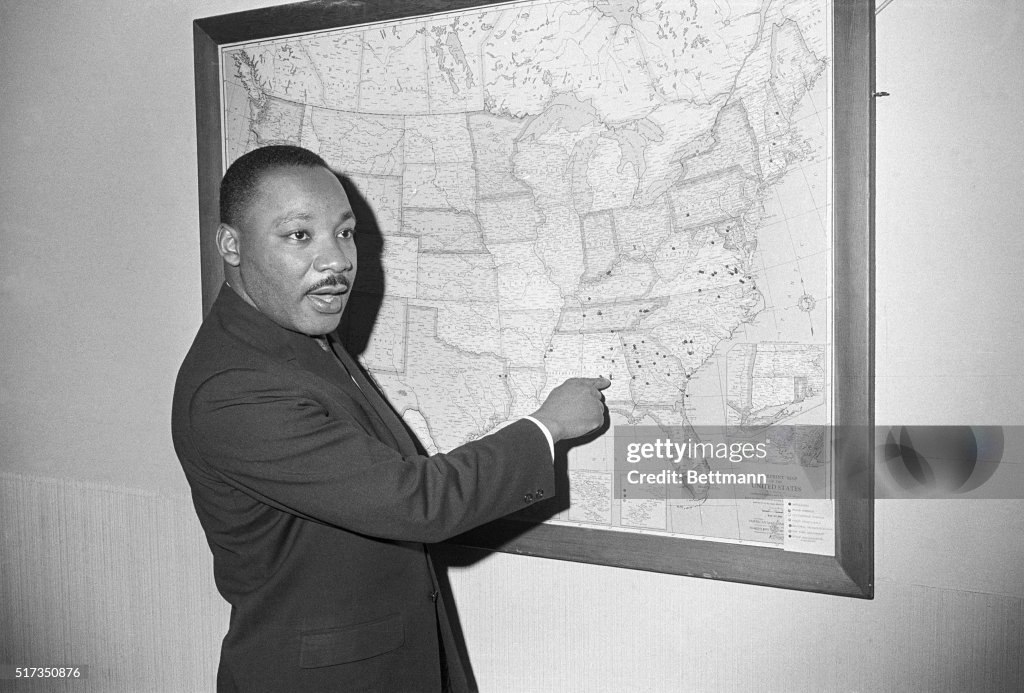
President Johnson telephoned Martin Luther King Jr., on King’s 36th birthday to convey greetings. King then congratulated Johnson on the President’s recent State of the Union address, and raised a proposal “to have a Negro in the Cabinet”, commenting that “We feel that this would really be a great step forward for the nation, for the Negro, for our international image, and do so much to give many people a lift who need a lift now, and I’m sure it could give a new sense of dignity and self-respect to millions of Negroes who—millions of Negro youth who feel that they don’t have anything to look forward to in life.” Later in the year, Johnson would nominate Robert C. Weaver to become the first United States Secretary of Housing and Urban Development, and the first ever African-American Cabinet Secretary.
The Greenville School Board in Mississippi has voted unanimously prepare a desegregation plan to comply with the Civil Rights Act of 1964 and its clause affecting federal aid.
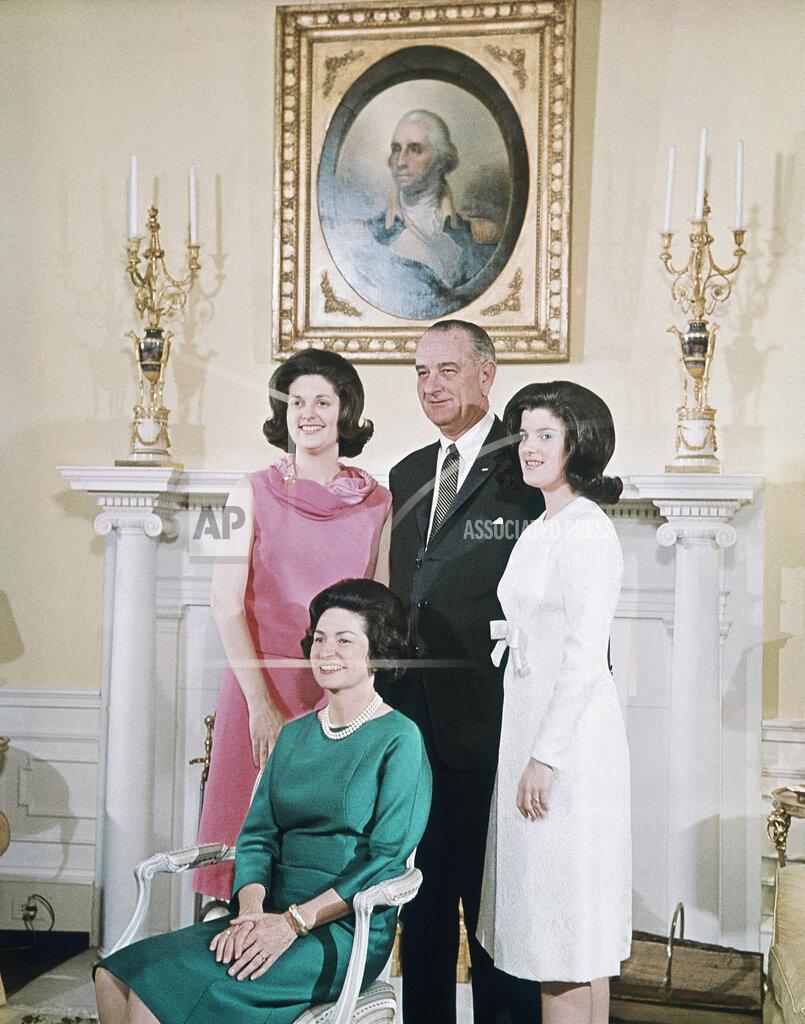
President Johnson asked Congress today to increase the budget of the Arms Control and Disarmament Agency “to assure the continuing leadership of the United States in the purposeful pursuit of peace.” In letters to the House and Senate, the President proposed that the disarmament agency be authorized to spend $55 million over the next four years. A statement of the need for the additional funds and for a four-year authorization was contained in a letter to the President from the disarmament agency’s director, William C. Foster, which Mr. Johnson endorsed and forwarded together with a draft authorization bill.
If the request is approved by Congress, as seems likely, the three year old disarmament agency will be given a more stable, more affluent lease on life. Until now the agency has been limited to two-year budget authorizations of $20 million. In practice, however, Congress has appropriated less money for the agency than was authorized. In the last two fiscal years, for example, the agency received a total of $16.5 million. The President said today that the extended, increased budget authorization for the agency was necessary “to intensify our efforts in this critical area” of disarmament. The President laid particular emphasis on the need for an agreement to stop the spread of atomic weapons. Since the Chinese Communist nuclear explosion last October, this has emerged as the most immediate, principal objective of the Administration’s disarmament policy.
“I am determined,” Mr. Johnson wrote Congress, “to work in every way that I can for safeguarded agreements that will halt the spread of nuclear weapons, lessen the risk of war and reduce the dangers and costly burdens of armaments. This effort as much as our continuing preparedness efforts militarily is essential to our security, for a continued increase of modern weapons can actually decrease our security,” he said. The President gave a pointed endorsement to the disarmament agency, which, since its creation in 1961, has been regarded with skepticism by Congress and the State Department. The agency’s “record of achievement,” the President said, has “refuted the doubts of those who questioned whether there was effective work for such an agency to perform.”
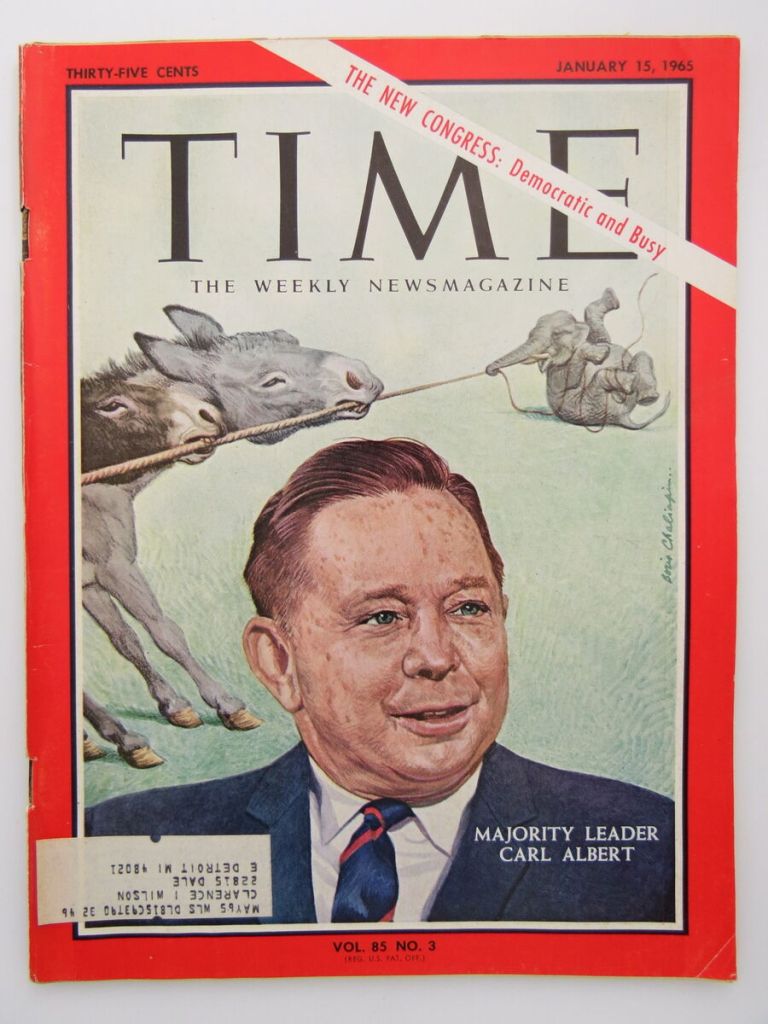
The Senate Democratic leader, Mike Mansfield of Montana, led in the Senate today a wrathful denunciation of Administration plans to close 11 veterans’ hospitals as an economy move.
Senate Republicans approved today committee assignments that permitted South Carolina’s Strom Thurmond to keep at least some of the seniority power he had gained as a Democrat.
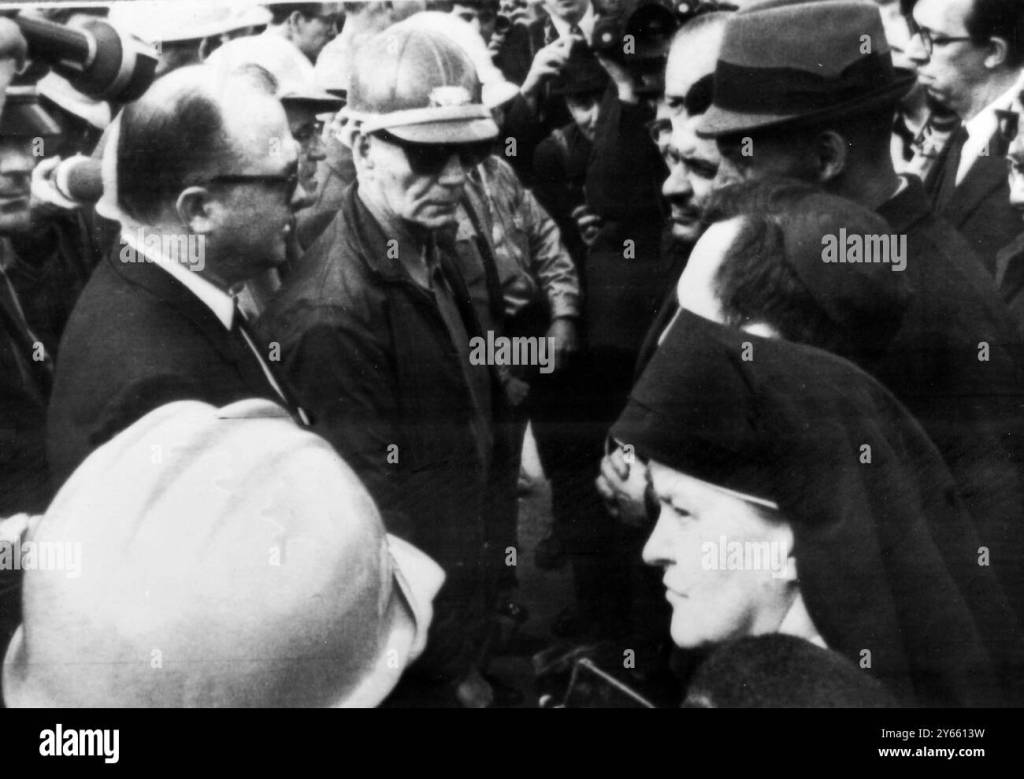
Dock union leaders said yesterday they would not make another move toward settlement of the waterfront strike in the Port of New York until a majority of the 24,000 members had asked for a second vote on the agreement that they had rejected last week.
Former President Harry S. Truman, expected to be the only ex-President at the inauguration of Lyndon B. Johnson, disclosed today that he would be unable to attend. Truman, 80, is recovering from two broken ribs after a fall in his home.
Secretary of Labor W. Willard Wirtz gave farmers who hire foreign workers no encouragement today in their fight to have the so-called bracero program reinstated. Mr. Wirtz testified after spokesmen for Western growers told the Senate Agriculture Committee that sufficient qualified domestic labor was unavailable.
The chairman of the Federal Communications Commission opposed here today the repeal of the equal-time requirement for political campaign broadcasts.
The largest yearly gain in nonfarm payroll employment since the recovery year of 1959 was made in 1964, the Labor Department reported today.
The first showing of “The Sound of Music,” starring Julie Andrews and Christopher Plummer in 20th Century Fox’s film adaptation of the Rodgers & Hammerstein musical, was made in a “sneak preview” at the Mann Theatre in Minneapolis, Minnesota, with director Robert Wise in attendance. Preview cards from the audience showed 223 “excellent” votes, three “good” votes, and none for any lower category. Another showing was made at the Brook Theatre in Tulsa, Oklahoma, the next day. Prior to the premiere (and subsequent regular showings) on March 2 at the Rivoli Theater in New York City, “three brief sequences” were removed.
Brunswick Records releases the single “I Can’t Explain” by British rockers “The Who” in the UK, their first after changing their band name
The Mets trade outfielder George Altman back to his original team, the Cubs, for outfielder Billy Cowan.
Dow Jones Industrial Average: 891.15 (+3.97)
Born:
Bernard Hopkins, American professional boxer who held the world middleweight championship (between 1995 and 2005) and world light heavyweight championship (between 2011 and 2014) for different circuits (WBA, WBC, IBF, IBO); in Philadelphia.
Michael “Pinball” Clemons, NFL and CFL running back (NFL: Kansas City Chiefs; Canadian Football League’s Most Outstanding Player (for the Toronto Argonauts) and later guided the Argonauts to the CFL championship as their head coach); in Dunedin, Florida.
Jeff Alexander, NFL running back (Denver Broncos), in Baton Rouge, Louisiana.
Greg Lee, NFL defensive back (Pittsburgh Steelers), in Pine Bluff, Arkansas.
Adam Jones, American guitarist for Tool; in Park Ridge, Illinois.
Derek B, British rapper (“Bullet From A Gun”), in London, England, United Kingdom (d. 2009).
James Nesbitt, Northern Irish actor, in Ballymena, Northern Ireland, United Kingdom.
Maurizio Fondriest, Italian cyclist, in Cles, Italy.

 History Diaries