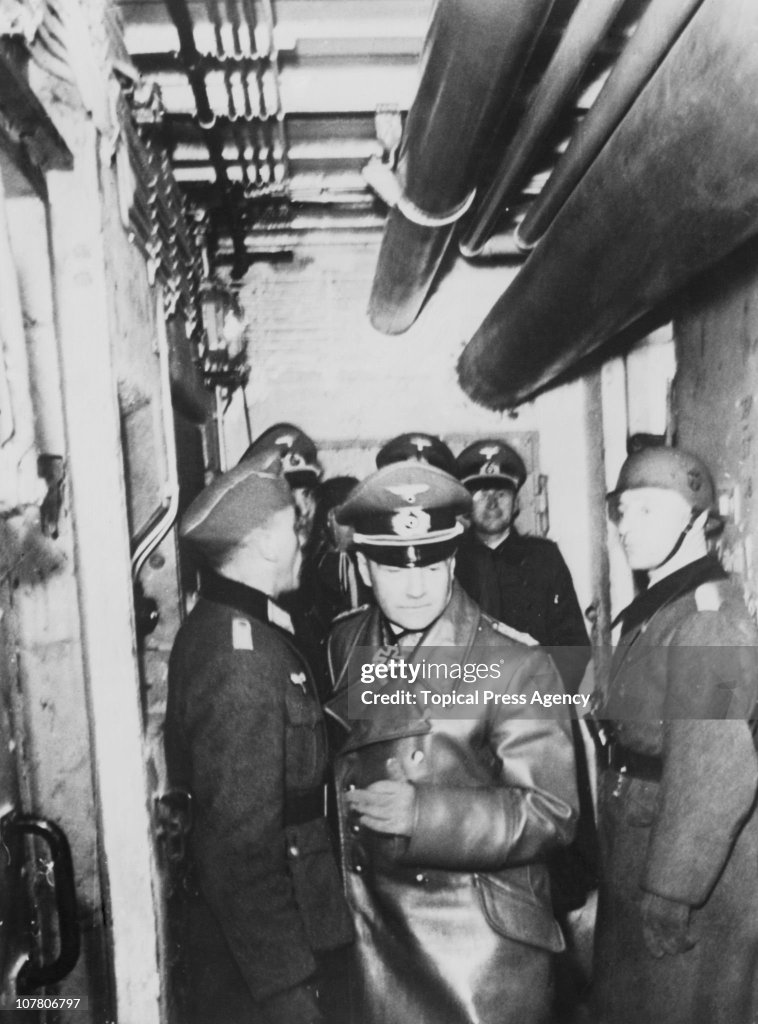
Hitler ordered that no one would be allowed to know more than he did about any secret matter.
The war of nerves rather than guns broke out afresh tonight when on the heels of reports of Belgian and Dutch military preparations and of renewed vigilance on the Belgian and Netherland frontiers the British War Office announced that all British Expeditionary Force furloughs had been suspended temporarily. The reason for the decision to defer the promised ten-day holiday to all British soldiers serving in France was not forthcoming from London officials. When questioned the officials said any one could make his own guess. They would not comment on whether the cancellation of army furloughs was connected with a possible threat of German aggression against the Low Countries. The furloughs had been going on in rotation since December 18, those who had been first sent to France getting the first choice. When the furloughs from the quiet front line. began the men were told their continuance would depend on the military situation.
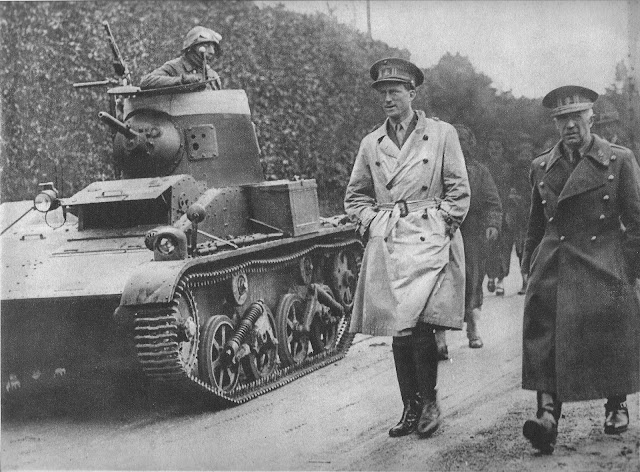
In response to the Mechelen Incident, King Leopold III of Belgium sent a message to Britain’s First Lord of the Admiralty, Winston Churchill, via Admiral Sir Roger Keyes, a friend of the King’s who had established himself as the secret link man to the British Government, asking for certain guarantees. The guarantees included assuring that the Allies would not open negotiations for a settlement of any conflict without Belgium’s agreement. Keyes added a rider that he believed Leopold might be able to persuade his government to call the Allies immediately if the guarantees were forthcoming. This was of interest to the Allies because both Britain and France had been trying to persuade Belgium to let their troops in ever since the war had started.
The French are informed of King Leopold III of Belgium’s message to Britain, although there was no reference to the fact that Keyes was only giving his opinion about the calling in of the allies. The French record stated that ‘the King would ask his Government to ask the Allied armies to occupy defensive positions inside Belgium immediately’, if the Belgians received satisfaction in related guarantees. Edouard Daladier, the French President, quickly told the British Government that, as far as France was concerned, the guarantees could be given. The French believed that the Belgians would receive a satisfactory response from the British Government in relation to the guarantees, and would then immediately invite the Allied Armies to march in.
At 3:50 PM, Daladier informed French supreme commander Maurice Gamelin that the Belgians had in principle agreed to a French advance and asked whether he was ready to execute it. Gamelin was very pleased, responding that due to heavy snowfall at the Belgian-German border the Germans would be themselves be unable to advance quickly, that a German invasion was therefore unlikely and that this posed an ideal situation for a French entrenchment, adding “We must now seize the occasion”. Gamelin ordered that the Allied troops under his control during the night of January 14-15 should make their approach march to cross the Franco-Belgian border so that they would be ready to enter at a moment’s notice.
In reaction to the Belgian alert concerning information received from Dutch Military Attaché in Berlin Gijsbertus Sas’ the previous evening regarding the In response to the Mechelen Incident, Dutch supreme commander Izaak H. Reijnders ordered that no leave was to be granted to any soldier and to close the strategic bridges while fuses should be placed within their explosive charges. In the afternoon the population became worried by the radio broadcast about the leave cancellation as it was feared that the Germans would take advantage of the severe cold to cross the now frozen New Hollandic Water Line.
Belgian Chief of the General Staff Lieutenant-General Édouard van den Bergen, who acted precipitously on the night of the 13th to cancel leave in a dramatic national broadcast, falls into disgrace when the invasion he expects on the 14th fails to occur.
In essence, the Mechelen Incident is turning into one of the most successful, albeit completely unintended, subversive operations to unnerve and split the enemy of the entire war.
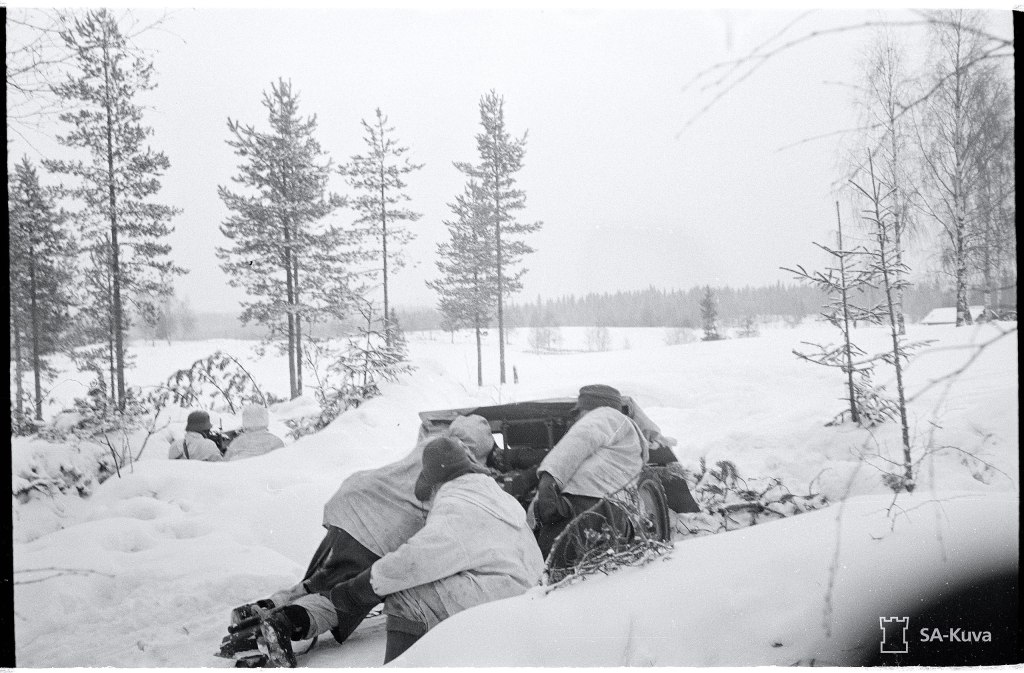
In Ladoga Karelia, a Soviet Division is ordered to take Uomaa village and push the Finnish detachments out of the terrain between Uomaa and Lavajärvi.
In Northern Finland, the Soviet 122nd Division disengages from Vuosamonselkä and withdraws to Märkäjärvi.
Detachment Roininen and the 40th Infantry Regiment are ordered to prepare themselves to pursue the enemy.
At the same time word comes through that the Soviet 88th Division is concentrating troops at Salla.
The Merivoimat (Finnish Navy) submarine Iku-Turso returns from patrol without having sighted the enemy.
In Viipuri, Soviet aircraft begin to bomb the city.
At Vaasa 10 people die in air-raids, among them women and children.
Another flight of 40 planes bombs the Petamo front in the far north, and Helsinki is bombed twice.
The villa of United States Minister H. F. Arthur Schoenfeld, twelve miles north of Helsinki, was bombed by Soviet raiders today during a continuation of the large-scale Russian offensive in the air, which has been in progress since the hazy weather cleared.
Enemy bombers hit Rauma, Pori, Uusikaupunki, Sottunga in the Åland archipelago, Hanko, Karjaa, Salo, Tammisaari, and Kauniainen.
At Haparanda the air-raid warning lasts 1½ hours.
In the Gulf of Bothnia, Soviet aircraft also bomb the Swedish coastline. Soviet aircraft drop bombs near Lulea, Sweden and violate Norwegian airspace. Soviet warplanes fly over both Swedish and Norwegian territory.
Norway and Sweden issue diplomatic protests over the incidents involving Soviet aircraft engaged in the war against Finland.
In Helsinki, an ambulance donated by the French Red Cross arrives from Stockholm with four nurses.
The Soviet Union, charging the Swedish and Norwegian press with carrying on an intense anti-Soviet campaign, disclosed today that a strong protest had been delivered against the recruiting of Scandinavian volunteers and allowing transit of war materials for the aid of Finland. Tass, the official news agency, announced that the representations were delivered January 5 to Sweden. They were quoted as saying the “impermissible campaign” in the Swedish press could be explained only if “Sweden were in a state of war with the U.S.S.R., or preparing for war.”
“The press organs closely connected with the governments of both countries and certain official personages, with the connivance and support of Swedish and Norwegian authorities, commenced a wide-scale campaign against the U.S.S.R. and embarked on actions incompatible with the policy of neutrality proclaimed by the governments of both countries,” Tass said. Tass published summaries of both the Russian representations in Norway and Sweden and those nations’ answers, concluding that “they cannot be regarded as entirely satisfactory.”
The Kriegsmarine takes over planning the invasion of Norway and begins revising & expanding Studie Nord. They considerably increase the commitment of troops from one division to a full army corps (mountain division, airborne division, motorized rifle brigade & two infantry divisions) & propose a simultaneous occupation of all strategic targets to reduce the threat of Norwegian resistance (& retaliatory British intervention). Denmark is added as a target to create a land bridge in the direction of Norway. Warships are to be used as troop transports to speed and the element of surprise. The plan becomes more comprehensive but also exposes the force to potential Royal Navy attacks.
Two years of compulsory labor was ordered today for all Jews between the ages of 14 and 60 in the German-ruled section of Poland that has not been incorporated in the Reich. The order, issued by police and military authorities in the name of Governor General Hans Frank, said the time could be prolonged “if the instructive object of the service is not attained in the two-year period.” Jews were ordered to appear at specified meeting places with tools or hand machinery, if they owned any, and food supplies for two days. All were forbidden to dispose of their tools in any way. In addition all Jews and Poles in Cracow, Poland’s ancient capital, were ordered to surrender all radio sets and equipment by tomorrow.
Deaths, mainly from starvation, in the Jewish ghetto of Warsaw are estimated to be running at 70 per day.
British Minister in Panama Charles Dodd transmits response of British government to note sent by the President of Panama on behalf of the 21 American Republics concerning the violation of American neutrality that occurred in the Battle of the River Plate. The British “reserve their full belligerent rights in order to fight the menace presented by German action and policy and to defend that conception of law and that way of life, which they believe to be as dear to the peoples and Governments of America as they are to the peoples and Governments of the British Commonwealth of Nations” (see 12 February and 8 March).
The British government revealed that nearly twice as many people had been killed on the roads than the number of people killed in enemy action. The blackout was among the chief reasons.
The British trawler St. Lucia struck a mine in the North Sea and sank with the loss of all 12 crew.
The coaster Hullgate collided with Moyle (also British) in the Scheldt, Belgium and sank.
The German merchant Phaedra (619 GRT) is captured in the North Sea by the British destroyer HMS Greyhound (Cdr. W.R. Marshall-A’Deane, RN).
The German cargo ship Albert Janus was intercepted by the Marine Nationale (French Navy) auxiliary cruiser Victor Schoelcher, 75 nautical miles (139 km) west of Cape Finisterre, Spain and was scuttled by her crew.
The U.S. freighter SS Narbo, detained at Gibraltar by British authorities the previous day, is released to continue her voyage to Italy, Yugoslavia, and Greece, but not before some items from her cargo are removed as contraband
Convoy OG.14 forms at sea for Gibraltar.
Convoy HX.16 departs Halifax for Liverpool.
The War at Sea, Sunday, 14 January 1940 (naval-history.net)
Battleship WARSPITE and destroyers FAULKNOR, FORESIGHT, FORESTER, FOXHOUND, FORTUNE, FEARLESS, FIREDRAKE, FAME, and FURY of the 8th Destroyer Flotilla departed Greenock on patrol, and arrived at Scapa Flow on the 17th.
Light cruiser AURORA departed Scapa Flow on the 14th to intercept German steamer TRAUTENFELS (6418grt) which was reported six miles off the Norwegian coast without a rudder. Light cruisers MANCHESTER on the 15th and NEWCASTLE on the 16th departed Scapa Flow, while destroyers MAORI, KASHMIR, KANDAHAR and TARTAR departed Rosyth, and destroyers INGLEFIELD, ICARUS, KIMBERLEY, KELVIN and KHARTOUM departed the Clyde on the 15th to support AURORA. Destroyer AFRIDI was to have accompanied this group from Rosyth, but was held back with defects. The operation was cancelled when it was learned that German steamer RAUENFELS (8460grt) had taken TRAUTENFELS in tow and took her into Narvik.
Armed merchant cruiser CIRCASSIA arrived at the Clyde from Portland for Northern Patrol.
Submarines TRIAD and NARWHAL were exercising in the Firth of Forth. Later in the day, TRIAD departed for patrol.
Submarine TRUANT arrived at Rosyth after patrol.
All available J-class destroyers were ordered to Harwich to support operation ST 2, and JERVIS, JANUS, JUNO, JACKAL met JAVELIN and JAGUAR west of Outer Dowsing.
After submarine SALMON on patrol off Terschelling reported that shipping was moving coastwise between Germany and Holland, patrols were ordered off the Dutch coast to intercept this traffic. Destroyers GLOWWORM, GREYHOUND, and GRENVILLE of the 1st Destroyer Flotilla from Harwich and minesweeping trawlers WILLIAM WESNEY (364grt), RIVER CLYDE (276grt), STELLA LEONIS (345grt) operated off the Dutch coast on operation ST 1 during the night of the 14th/15th. At 2250/14th, German steamer PHAEDRA (619grt) was captured off the Dutch coast near Ijmiuden in 52 17N, 04 19.5E by GREYHOUND after being sighted by WILLIAM WESNEY. Danish steamers SVANHOLM (1321grt) and KNUD (1944grt) were sent to the inspection station in the Downs escorted by RIVER CLYDE, and two Dutch and one Swedish ship were stopped, but after inspection allowed to continue.
PHAEDRA was renamed EMPIRE SENTINEL for British service and in 1943 taken over by the Royal Navy for use as a wreck dispersal vessel RAMPANT.
Destroyer WESSEX was in a collision at 0600 in the Bristol Channel with French steamer THISBE (1782grt) which stood by. WESSEX was holed before the bridge and one rating killed. Destroyers HYPERION and HOTSPUR were in the convoy escort with WESSEX, which arrived at Milford Haven for repairs. At the end of the March, repairs were delayed due to a strike by shipwrights, but completed on 8 April.
Destroyers HOTSPUR and HYPERION departed Bermuda on the 4th. At 1130/14th, they attacked a U-boat contact west of Lundy Island in 51-12N, 5-10W which had been reported on the 13th to them and destroyer WESSEX which was also investigating. Both HOTSPUR and HYPERION arrived at Portsmouth on the 14th. HYPERION went into dock there for refitting and repairs until 2 March, prior to joining the Home Fleet, while HOTSPUR sailed for Chatham on the 15th for docking and refitting, completing on 27 February, also before joining the Home Fleet.
Anti-submarine trawler LOCH MONTEITH (531grt) in Liverpool Bay in 53-32N, 3-55W attacked a submarine contact.
Light cruiser ENTERPRISE departed Halifax and arrived at Bermuda on the 17th.
Convoy HX.16 departed Halifax at 0900 escorted by Canadian destroyers HMCS OTTAWA and HMCS SAGUENAY. The destroyers turned over the convoy to ocean escort battleship MALAYA and detached at 1800/15th. The battleship detached on the 23rd. Destroyers VENETIA and WINDSOR escorted the convoy from the 25th to 28th, when the convoy reached Liverpool.
French destroyer FOUGUEUX attacked a submarine contact off Oporto in 41-26N, 10-26W.
Liners DUCHESS OF ATHOLL (20,119grt) and ETTRICK (11,279grt) departed Marseilles escorted by French destroyers SIMOUN and TEMPÊTE to Malta. They then departed Malta on the 16th, escorted by destroyer WATERHEN for Alexandria and Port Said, respectively.
Sloop LOWESTOFT departed Port Said for Malta en route for England. After repairs at Malta, she sailed on the 24th for Gibraltar.
German steamer ALBERT JANUS (1598grt) departed Vigo on the 13th to return to Germany. On the 14th, 75 miles west of Vigo off Cape Finisterre, she was intercepted by French armed merchant cruiser VICTOR SCHOELSCHER and scuttled to prevent capture.
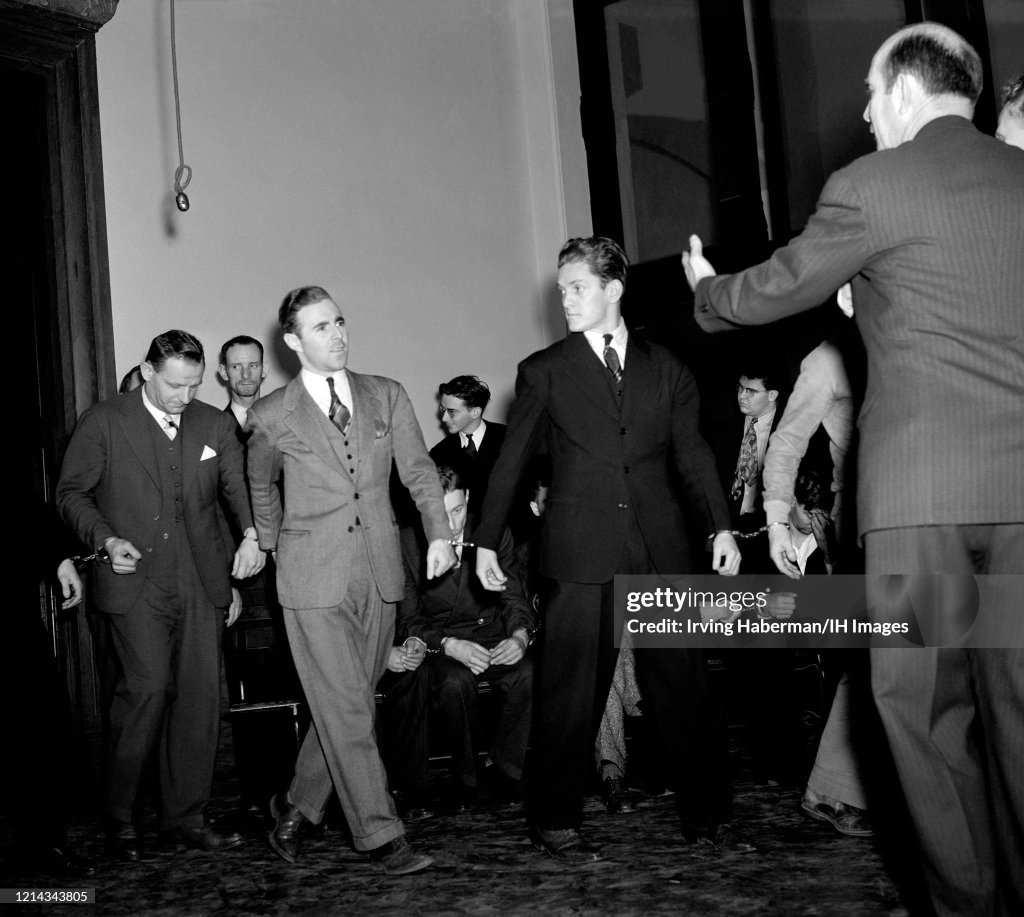
The German-American Bund in New York City is raided and seventeen people arrested. FBI agents arrested 17 members of the Christian Front for planning a vast plot to overthrow the U.S. government and establish a fascist dictatorship. J. Edgar Hoover, chief of the Federal Bureau of Investigation, announced the arrest of seventeen members of the Christian Front, an anti-Semitic organization, on charges of plotting the overthrow of the Government of the United States. For equipment in this undertaking they were found to possess eighteen cans of cordite, an explosive; twelve Springfield rifles of .30-06 caliber, 3,500 rounds of .30-’06 ammunition and a small assortment of other arms.
More than half of those seized were either in the New York National Guard — one of them holding the rank of captain — or had served. in other branches of the armed forces of the nation, either actively or as reservists. The ammunition for the Springfields was said to have been stolen from National Guard armories and checks were. being made to determine if the rifles and other equipment had come from the same source. Mr. Hoover named as the two principals among the group arrested William Gerald Bishop, head of a secret group within the Christian Front known as “The Sports Club,” or “The Country Gentlemen,” and John F. Cassidy, whom he named as head of the Christian Front in Brooklyn. The National Guard captain was John T. Prout Jr. of Astoria, Queens, whose command is in the 165th Infantry Regiment.
The FBI chief said that the men had, in conversations among themselves, laid down a program that was to begin with efforts to recruit a larger force, to augment their store of arms and ammunition from the stores of the National Guard, to lay down a campaign of terrorizing Jews and go on to bombings in New York of the Jewish Daily Forward, The Daily Worker, the Cameo Theatre in West Forty-second Street, which shows Russian-made films, and quarters of the American League for Peace and Democracy in Brooklyn. These conversations, it was charged, also included plans for the blasting of bridges and the seizure of all utility facilities-power plants, telegraph and telephone networks, docks and railway terminals, the United States Custom House, the General Post Office and the Federal Reserve Bank in order to obtain control of the gold supply.
“Plans were discussed,” said Mr. Hoover, “for the wholesale sabotage and blowing up of all these institutions so that a dictatorship could be set up here, similar to the Hitler dictatorship in Germany, seizing the reins of government in this country as Hitler did in Germany. Their scheme was to spread a reign of terrorism so that the authorities would become thoroughly demoralized.” One of the aims of the group was the eradication of the Jews of the United States, Mr. Hoover said. The fantastic notion of a program of such size being carried out by eighteen men with twelve rifles and eighteen bombs — in a city with 18,000 well-equipped police and several regiments of United States Army regulars handy — was apparently no part of their thought.
The Christian Front was founded in November 1938 in response to the prompting of radio priest Charles Coughlin, who had called for a “crusade against the anti-Christian forces of the Red Revolution” in the May 23, 1938, edition of his newspaper, Social Justice. Its membership numbered several thousand and consisted mostly of Irish-Americans in New York City. The Christian Front sold Social Justice, organized boycotts of Jewish businesses, and held parades and rallies. They made no distinction between “Reds” and Jews. Their rallies welcomed attendees from like-minded organizations like the German American Bund and Crusaders for Americanism. They heard speakers denounce Jews as international bankers, war mongers, and communists, mock President Roosevelt as Rosenfelt, and praise Franco and Hitler. The Roman Catholic Bishop of Brooklyn, Thomas Molloy, was a prominent supporter and his diocesan newspaper, the Tablet once addressed the charge that the Christian Front was antisemitic: “Well what of it? Just what law was violated?”
One government official admitted off the record that the Front was really being prosecuted for un-Americanism. The charges did not mention antisemitism or Coughlin. For Macklin Boettger, John Viebrock, William Bishop, and Captain Prout, the trial resulted in a hung jury. The other thirteen defendants were acquitted. The federal government dropped its charges in 1941, at which point the new Attorney General, Robert Jackson, called the charges “a bit fantastic”. One historian has called the trial an exercise in “public relations” that exaggerated the danger posed by “a pathetic bunch.”
Backed by the knowledge that President Roosevelt is on their side and that the government’s financial position favors their argument, economy advocates expressed the belief tonight that for the first time in years they have a good chance to “sell” their colleagues on the idea of adhering to, if not actually cutting, the Bureau of the Budget figures for the 1941 fiscal year. The magnitude of the task of preventing “pressure groups” from increasing expenditures this year as in the past appears to be appreciated by the economy leaders, but they nevertheless felt that a constant repetition of the alternative — “either stay within the budget or prepare to raise taxes and the national debt limit” — would do far more to keep Congress within bounds than all the arguments they might make.
Representative Woodrum of Virginia, who has been the foe of pressure groups for several years, declared tonight that the economic picture looked more hopeful than at any time within the past decade. “The budget message speaks for itself,” he said. “It means that those who want to spend must take affirmative action to raise the budget figures, and it is well known that it takes strength to raise a budget figure.”
On the Senate side, Senators Harrison, Adams and Byrnes also expressed the view the $8,424,000,000 budget total would not be exceeded, although they felt that there might be an “adjustment” whereby some items would be cut and the savings given to purposes not adequately cared for, or slighted in the preparation of the budget report, such as parity payments for agriculture. The first real test on economy is expected to come Tuesday in the House when the billion dollar Independent Offices Supply Bill, the largest single appropriation measure of the session, goes to the floor from the Appropriations Committee, which is understood to have cut the budget figures about $30,000,000.
President Roosevelt made what were described as “bedrock” cuts in 1941 supply figures for the independent agencies, but the Appropriations Committee lopped off, it was reported, relatively large sums from the Securities and Exchange Commission, the Maritime Labor Board, the National Labor Relations Board, the Federal Trade Commission, Federal Power Commission and the Home Owners Loan Corporation. The Appropriations Committee, which started to work on this bill two months ago, was understood to have been “hard-boiled” with the agencies concerned, forcing them to justify even the jobs of many which in the past were only lightly challenged, if at all.
The war abroad has imposed on the Federal Communications Commission new and exacting problems in preserving the neutrality of the American air waves, according to the commission’s annual report, made public today.
“Work projects already suggested by Federal and State departments would keep a Civilian Conservation Corps of 1,500 camps busy for from thirty to fifty years,” said the late Robert Fechner, Civilian Conservation Corps Director from its inception until his death, December 31, in his annual report, posthumously presented today.
Auxiliary Bear (AG-29) reaches Bay of Whales, Antarctica. Along with Interior Department motorship North Star, Bear will establish the two bases to be used in the U.S. Antarctic Service’s 1939-1941 expedition under Rear Admiral Richard E. Byrd, USN (Ret.).
Major League Baseball Commissioner Kenesaw Landis gives free agency to 91 Detroit players and farm hands. Citing cover-ups in its organization, Landis hands freedom to Roy Cullenbine, Benny McCoy, Lloyd Dietz, and Steve Rachunok from the parent roster and orders $47,250 paid as compensation to 14 players. Johnny Sain is one of 23 players who will later make it to the Major Leagues. Landis’s edict nullifies a deal that would have brought Wally Moses to the Tigers for Benny McCoy and George Coffman. McCoy is considered the plum of the emancipation, and several clubs bid for the second baseman. Connie Mack keeps Moses and signs McCoy for a $45,000 bonus and 2-season contract at $10,000 a year.
The reigning NFL champion Green Bay Packers beat an all-star team 16–7 in the National Football League All-Star Game at Gilmore Stadium in Los Angeles. The Packers defeated the All-Stars by a score of 16–7 on three field goals and a 92-yard touchdown pass from Cecil Isbell to Don Hutson. The all-star game format was continued for another three seasons before ending due to World War II. A new all-star format, branded as the Pro Bowl, began after the 1950 NFL season, with these all-star games retroactively considered the first Pro Bowls.
The Marquess of Linlithgow, Viceroy of India, left Bombay tonight for Baroda after a week’s stay. Although his visit was primarily private, Lord Linlithgow saw many political leaders and the feeling is growing that these meetings will assist toward a settlement of the current disagreement over Indian support for the British Government in the war.
Chinese Winter Offensive: Chinese 5th War Area begins six days of attacks around Kaocheng, Shihlingszu, Wangchiatai, Sunchiatien, and Chuchiamiao.
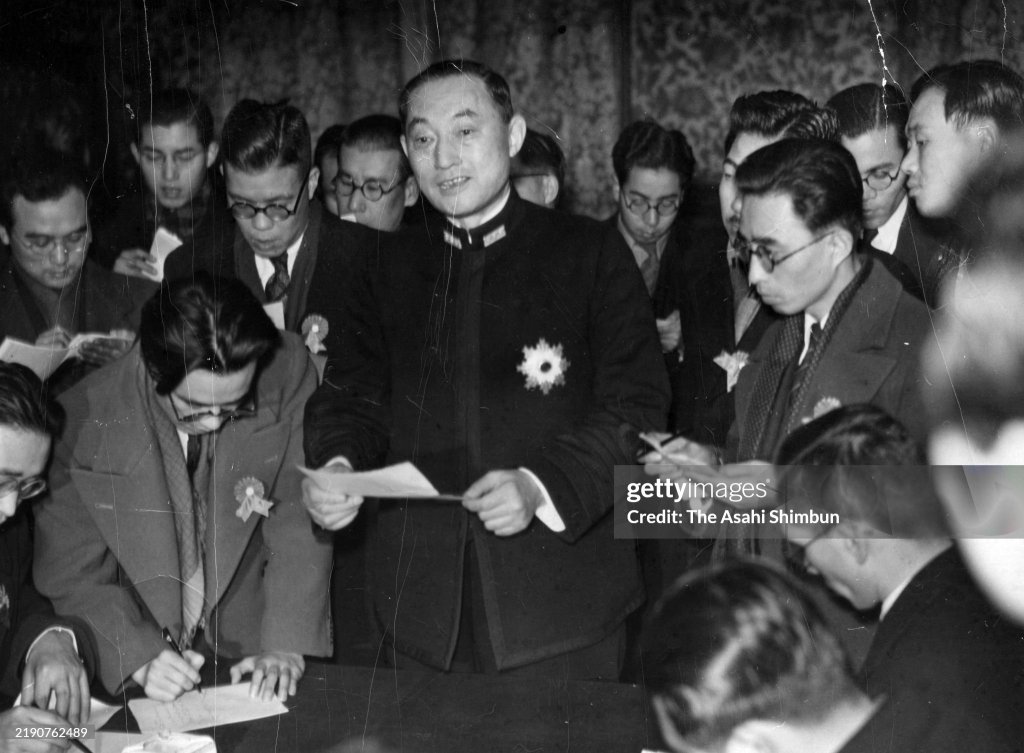
Faced with serious and unexpected reverses in China from the Chinese Winter Offensive, the Abe government resigns. Japanese Prime Minister, General Abe Nobuyki, and all his Cabinet resign and Admiral Yonai Mitsumasa is chosen to form a new government. Admiral Yonai tonight received and accepted the imperial command to form a new Japanese Cabinet and take the post of Premier. The appointment, though unexpected by the public, is welcomed with a sense of satisfaction and relief. The only dissenting voice is that of the pro-German newspaper Kokumin, which calls Admiral Yonai the “puppet of the Senior Statesmen.” Admiral Yonai is seeking to form a moderate, middle-of-the-road administration, and is expected to continue the last Cabinet’s policy.
The Foreign Office spokesman in Tokyo said this morning that Japan’s draft of a stop-gap commercial agreement with the United States was already in the hands of the American State Department and that a response was expected before the lapse of the Japanese-American treaty on January 26, The United Press reported. The State Department early this morning said that no such document had been received. If it has been handed to Ambassador Grew, it was stated, it has not been transmitted here or is en route.
Born:
Julian Bond, civil rights leader and politician (D-Georgia, Georgia House of Representatives, 1967-1975, Georgia State Senate, 1975-1987), in Nashville, Tennessee (d. 2015).
Wayne Hightower, NBA and ABA power forward (NBA: San Francisco Warriors, Baltimore Bullets, Detroit Pistons; ABA: ABA All-Star, 1969; Denver Rockets, Los Angeles-Utah Stars, Texas Chaparrals, Carolina Cougars), in Philadelphia, Pennsylvania (d. 2002, of a heart attack).
Ron Kostelnik, NFL defensive tackle (NFL Champions-Packers, 1961, 1962, 1965, 1966, 1967; Super Bowl I and II Champions, 1966, 1967; Green Bay Packers, Baltimore Colts), in Colver, Pennsylvania (d. 1993, from heart attack).
Died:
Felician Myrbach, 86, Austrian painter, graphic designer and illustrator.
Naval Construction:
The Nihon Kaigun (Imperial Japanese Navy) auxiliary submarine chaser Shonan Maru No. 17 is laid down by Osaka Tekkosho K.K. (Innoshima, Japan).
The Kriegsmarine (German Navy) Type VIIC U-boat U-432 is laid down by F Schichau GmbH, Danzig (werk 1473).

 History Diaries