A squadron of United States Air Force fighter-bombers yesterday knocked out a key bridge in Laos on the principal Communist supply route leading from North Vietnam. The secret operation was described today as the largest, most successful air strike against Communist positions in Laos since the United States began attacking Communist supply lines several months ago. The destruction of the bridge, it is believed, will result in drastically stemming the flow of men and supplies from North Vietnam into Laos and thence to South Vietnam. However, Pentagon sources said that the primary purpose of the strikes has been to prevent the reinforcing and supplying of the Pathet Lao in Laos and only secondarily to harass a route also used by the Việt Cộng.
The large bridge knocked out yesterday was on Route 7, a road leading from the North Vietnamese coast into central Laos and the Plaine des Jarres, a stronghold of the pro-Communist Pathet Lao forces in Laos. The bridge is thought to be about 10 miles southeast of Ban Ban, where Route 7 crosses a tributary of the Son Ca River. More than 20 fighter-bombers based in South Vietnam carried out the air strike. They attacked the most heavily defended Communist position in Laos. Machine guns protecting the bridge were aimed with the aid of radar. Officials here had no comment on a report by Communist China that two groups of planes, totaling 24, had taken part in the bombing mission near Ban Ban. There were strong indications that the Chinese report was basically correct.
The Johnson Administration continued to cloak the air strike in the tightest secrecy, apparently on orders from the White House. In fact, it appeared that if two planes had not been shot down in the attack by Communist anti-aircraft fire, the Administration would have kept the bombing mission secret, as it has smaller, sporadic attacks in recent months against Communist supply lines in Laos. The first indication that the air strike had taken place came in a Defense Department announcement yesterday that two supersonic fighter-bombers-an F-100 and an F-105-had been shot down over central Laos.
The Pentagon declined to disclose the mission of the planes. But the fact that it did not say it was a reconnaissance mission, combined with the nature of the planes, indicated clearly that the fighter-bombers had engaged in a bombing mission. Aside from the success of the attack itself, officials were elated at the quick recovery of the two pilots whose planes were shot down. The rescue operation was said to have been carried out against heavy odds by United States helicopters flying deep into Laotian territory to locate the pilots as jet fighters flew protective cover and held back Communist forces with strafing.
Communist terrorists attacked tonight at Thủ Dầu Một, 15 miles north of Saigon. They exploded two mines and threw several grenades, reliable sources reported today. At least five Vietnamese civilians were killed and 20 wounded in the attack.
The South Vietnamese Government took firmer hold today after the crisis that nearly crumbled the political structure upon which success depends in the war against the Việt Cộng. Independent analysts said that the Cabinet of Premier Trần Văn Hương appeared capable, with the support of the armed forces, of withstanding Buddhist agitation. for its ouster. There was evidence that some generals who had been sympathetic to Buddhist demands were becoming impatient with the militant monk Thích Trí Quang.
Troops encircled the Buddhists’ national headquarters in the morning after monks and nuns voted to wage a violent campaign against the government in the capital. Security forces were thinned out later when it became apparent that the Buddhists did not plan any immediate demonstration. For the first time since the Buddhist current campaign began, troops in central Vietnam followed the example of security forces in Saigon and acted to break up a demonstration.
Brigadier General Nguyễn Chánh Thi, commander of the I Corps area there, declined to use troops earlier in the week to put down demonstrations and general strikes in the cities of Huế, Quảng Trị and Đà Nẵng. This morning, however, when 1,000 Buddhists, mostly students, tried to demonstrate in Đà Nẵng, a ranger unit moved in. The demonstrators quickly dispersed. In a country where political turmoil and Communist attacks occur with the suddenness of an earthquake, analysts stressed that it was risky to assume that the Government was firmly on the road to stability. The war against the Communists was obviously going badly.
In the last two days, however, the analysts have found signs that political uneasiness is passing after having gripped Saigon since the military uprising of Dec. 20. Premier Hương has arrived at an understanding with Lieutenant General Nguyễn Khánh, the military commander in chief, and with the young generals who dissolved the civilian legislature on December 20. The generals have acknowledged the supreme authority of the civilian government, and the Premier has agreed to bring military leaders into a reshuffled cabinet soon.
Reliable sources said that government leaders and the generals reached agreement yesterday on a draft of electoral laws for a meeting of a national convention March 21. The convention is to act as an interim legislature and is to draft a permanent constitution, Any danger of a new political upset is believed to come mainly from agitation by the Buddhists. Efforts over several days have failed to dissuade Thích Trí Quang from his determination to force the ouster of the Government. During the new vote taken at Saigon’s Buddhist headquarters, some monks and nuns volunteered to burn themselves to death publicly, as members of their church did in the 1963 campaign that led to the death of President Ngô Đình Diệm.
General Harold K. Johnson, the U.S. Army Chief of Staff, told newsmen today that the battle for South Vietnam is a “dirty war” that may last a decade. General Johnson, in New York to address a meeting of the National Security Industrial Association, said the conflict might last “an appreciably longer time than the public realizes; on the order of 10 years.”
Indonesian President Sukarno declared today that the only means of settling Indonesia’s quarrel with Malaysia was to have another United Nations survey of political sentiment in Sarawak and Sabah, the Malaysian states on the island of Borneo. He said he would “abide by” the findings of such a survey even though Indonesia had withdrawn from the United Nations. If the United Nations does not choose to make this survey he will welcome appointment of an African-Asian conciliation commission to mediate the dispute, he said. “Let us investigate the real feelings of the people of Sarawak and Sabah in a democratic manner,” he said. “This is my answer when you ask if I have a peaceful solution.”
The Indonesian President made his remarks to a small group of Western correspondents whom he took on a tour of his palace this morning. “I am calling on Tunku Rahman [Malaysia’s Prime Minister, Prince Abdul Rahman] to come back to the Manila agreements,” he declared. “Am I not a man of peace?” he asked. The Indonesian President did not discuss with newsmen guerrilla attacks against Malaysia or Prince Rahman’s demand that these troops be withdrawn and a cease-fire put into effect before an African-Asian commission could function. At Manila in August, 1963, Indonesia and the Philippines agreed to welcome Malaysia if a United Nations survey proved that the people of Sarawak and Sabah wanted to join Malaya and Singapore in a new federation. President Sukarno later rejected the affirmative findings of the United Nations.
The African-Asian conciliation commission was suggested at a meeting of President Sukarno, Prince Rahman and Diosdado Macapagal, the Philippine President, in Tokyo last June. Mr. Sukarno told newsmen he had rejected a request this morning by D. N. Aidit, chairman of the Indonesian Communist party, for the arming of workers and peasants to defend the country against possible attacks by Malaysians and the British. “I told him our own armed forces were strong enough to do this,” the President said.
Paul-Henri Spaak, Belgium’s Foreign Minister, assured Premier Moïse Tshombe today that the Belgian Government had not invited Cyrille Adoula, former Congolese Premier, to Brussels. In a telephone call from Brussels, Mr. Spaak is reported to have described as a misunderstanding the incident that caused Mr. Tshombe to cancel a trip to Brussels yesterday. Mr. Spaak is also believed to have asked Mr. Tshombe to reverse his decision and to visit Belgium as soon as possible.
Informed sources said tonight that Mr. Tshombe might still go to Belgium “in the near future.” They noted that even at the height of his anger last night Mr. Tshombe did not rule out such a trip. Observers suggested that Mr. Tshombe might go to Belgium to sign any financial agreement reached by Belgium with a Congolese delegation headed by Jean-Baptiste Kibwe. The delegation, which left here last night, is to discuss the long-standing financial dispute between Belgium and the Congo, her former colony. It centers on the return of a portfolio of shares held by the Belgian colonial government in private companies operating here.
Mr. Tshombe’s decision to cancel his trip was viewed here as part of an effort to separate the financial discussions from political concessions that Belgium is seeking from the Congo. These include the broadening of Mr. Tshombe’s Cabinet to include ministers more acceptable to other African countries, an amnesty for rebels not accused of crimes under the Congolese Criminal Code, and guarantees that opposition parties may take part freely in the election scheduled for late in March.
Mr. Adoula is one of the men that Belgium and the United States have suggested that Mr. Tshombe bring into the Cabinet. Therefore the arrival of Mr. Adoula in Brussels on the eve of Mr. Tshombe’s visit aroused fears that Belgium would try to force an accord. But diplomatic sources maintain that Belgium and the United States recognize that Mr. Adoula has no chance of being admitted to the Cabinet now.
United States officials regard the Congolese Government’s war with the rebels as a hardening stalemate. After nearly six weeks of Soviet arms deliveries, reports here indicate that the rebel army is being whipped into shape, possibly by foreign instructors, and is using modern weapons and more advanced combat tactics. There is a growing conviction in Washington that the support given to the rebels is intended to help them remove Western influence from the Congo. Reports indicate that at least 30 planeloads of arms have flowed through Juba, Sudan, on their way to the rebels, since late November.
The heads of government of Northern Ireland and the Republic of Ireland met for the first time since Ireland had become a separate nation, as Irish Prime Minister (Taoiseach) Seán Lemass visited Captain Terence O’Neill, the UK’s Prime Minister of Northern Ireland, at Stormont Castle in Belfast. Announcement of the meeting was made after Lemass had returned to Dublin. Escorted by unmarked police cars, Lemass had traveled across the border in an unadorned limousine on the 110-mile (180 km) trip between Dublin and Belfast. On February 9, O’Neill would visit Lemass in Dublin.
The United States delegation believes that the showdown over unpaid Soviet assessments for peace-keeping forces cannot be avoided when the General Assembly reconvenes next week.
Qualified sources said tonight that President de Gaulle would accept the proposal of Chancellor Ludwig Erhard of West Germany for a meeting of the Foreign Ministers of the European Common Market this spring to discuss European unity.
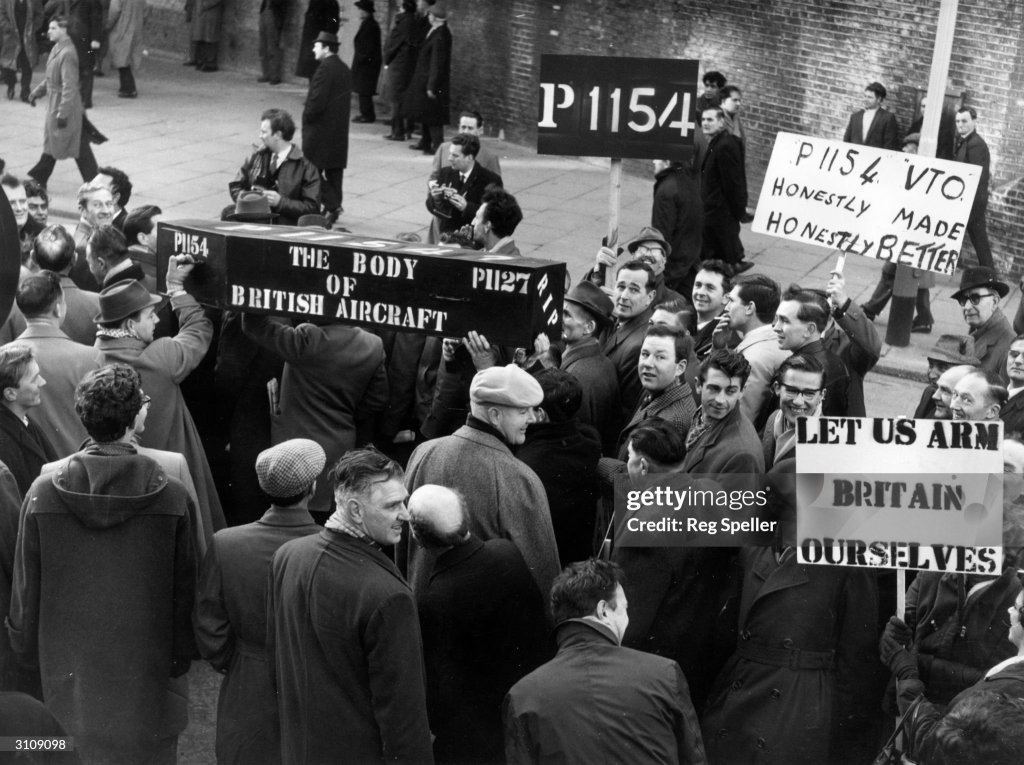
Ten thousand aircraft workers marched through the center of London today in protest against reported plans of the Labor Government to curtail production of British military planes. They carried critical banners aimed at Prime Minister Harold Wilson and at United States influence in Britain. These reflected reports that the Government would abandon the TSR-2, a new British aircraft, and use instead the American F-111, the tactical fighter plane that can fold its wings back in flight. “Harold Wilson, the all-American boy,” said one sign, Another said, “Keep the R.A.F. British.”
[Ed: The British, of course, will not use either. Eventually, they will get the Tornado.]
Officials at the London Museum announced that the remains of Anne de Mowbray had been discovered, 462 years after her casket had been reburied and then lost. On January 15, 1478, at the age of five, she was united in marriage with the four-year-old Prince Richard, Duke of York. When his older brother became King Edward V of England five years later, their uncle imprisoned the three children in the Tower of London.
French capital and labor took a largely negative attitude today toward Government efforts to maintain restrictions on prices and wages.
One thousand men, women and children picketed in front of the German Consulate in New York this afternoon in protest against the West German Government’s refusal to extend its statute of limitations on Nazi war crimes.
The Soviet Union announced today that the East European military organization would meet next week in what may be a high-level conference on the proposed allied mixed manned force.
The director of the United Nations Special Fund, Paul G. Hoffman, said today that “not a single representative of a developing country” supported recent Soviet charges that United Nations development work failed to benefit the recipients.
Colombian President Guillermo Leon Valencia, struggling with what is considered the gravest economic and political crisis he has faced, continued his efforts today to avert a general strike.
In his African jungle hospital at Lambaréné, Dr. Albert Schweitzer was acclaimed by hundreds of well-wishers as he observed his 90th birthday. The renowned medical missionary ate a hearty breakfast and heard the broadcast of a Bach concert.
Field Marshal Viscount Montgomery of Alamein declined comment today on a remark by General Omar Bradley of the United States that the British field marshal was “scared” during the Battle of Normandy which followed the 1944 allied invasion of Europe.
President Johnson sought today Congressional approval for a $3.38 billion foreign aid authorization for the next fiscal year. He said the program was designed to promote a world of stability, freedom and peace along with the security and well-being of the United States. In a special message describing his program for the fiscal year 1966, beginning next July 1, the President reminded Congress that “this minimum request is the smallest in the history of foreign aid.” He said it was “the lowest aid budget consistent with the national interest.” His request included $2.21 billion for economic loans and grants and $1.17 billion in military assistance to help independent developing nations remain free while acquiring the benefits of modern knowledge.
The total cost would be $136 million less than the White House requested last year and the lowest since the first Marshall Plan installment of $7.4 billion in 1948. Mr. Johnson said that the $500 million earmarked for military aid and supporting assistance to South Vietnam and Laos in the new fiscal year might not be enough. Therefore he asked for an additional “open,” or standby, authorization in these categories of aid, to be used only in Vietnam. Any such added amounts would be justified to the Congressional authorizing committees whenever an appropriation was requested, he said. The President sought to counter criticism that the aid program was too widely scattered over a large number of countries.
The relatively modest request apparently did nothing to soothe Chairman Otto E. Passman of the House Appropriations. Subcommittee, long a foe of foreign aid, who is trying to enlist right-wing sentiment against what he calls “wild Government spending.”
The Rev. Dr. Martin Luther King Jr. told 800 cheering Blacks tonight he would begin a massive test of the 1964 civil rights law in Selma, Alabama Monday. To the shouting, clapping and singing Blacks jammed in a church, Dr. King declared that the integration drive would be “Selma’s opportunity to repent.” The Black leader, recently awarded the Nobel Peace Prize, said the testing would cover voter registration and extend into all areas of accommodations “every restaurant, every theater, every motel on the highway and in the community.” Selma became known as a segregation holdout last summer when hundreds of Blacks were arrested after the civil rights law was passed. Dr. King also announced that desegregation drives would begin all over Alabama, but principally in 10 counties of the agrarian black belt. He did not identify the counties. “We will challenge the registration offices by a massive march on the courthouse,” Dr. King said. “We will march by the hundreds. We will announce to the nation that we are determined to vote.”
President Johnson is expected to send a special balance-of-payments message to Congress soon because of a sharp increase in the nation’s international payments deficit in the final quarter of 1964.
House Republicans disregarded the expressed wishes of their newly chosen leader today and re-elected Representative Leslie C. Arends of Illinois as minority whip. It was a severe blow to the prestige and perhaps to the future effectiveness of Representative Gerald R. Ford Jr. of Michigan, who overthrew Representative Charles A. Halleck of Indiana as minority leader just 10 days ago. Mr. Ford’s announced choice for the job, which ranks second to his own in the party’s House leadership structure, was Representative Peter H. B. Frelinghuysen of New Jersey. Mr. Arends, a genial and popular survivor of the Old Guard, won on a secret ballot, 70 to 59, at a closed meeting of the Republican conference, or caucus, in the House chamber.
In another development, Representative John W. Byrnes of Wisconsin resigned as the chairman of the House Republican Policy Committee in compliance with a new party rule. This rule, adopted at today’s caucus, prohibits the ranking Republican on any legislative committee from simultaneously holding a party leadership post in the House. Mr. Byrnes chose to continue as the senior Republican on the Ways and Means Committee. Mr. Arends, who now has the same status on the Armed Services Committee, said he would step down to the second-ranking place among Republicans on that panel. Representative William H. Bates of Massachusetts will replace him. Representative Arends attributed his victory over Mr. Frelinghuysen to a 21-year record of satisfactory service as whip under two leaders, Mr. Halleck and former Speaker Joseph W. Martin Jr. of Massachusetts.
Republicans on the other side of Capitol Hill gave Senator Strom Thurmond, the converted Democrat, one of his committee requests but denied another. Senate Republicans today gave Thurmond, their South Carolina proselyte, considerably less than he asked in committee assignments but considerably more than some Northern G.O.P. liberals thought he deserved. Senator Thurmond, who switched his party allegiance last fall, had asked to retain not only his seats on the Armed Services and Commerce committees but also the seniority on them that he had accumulated as a Democrat. In the event he was denied both or either, he had listed Judiciary and Labor and Public Welfare, in that order, as his next preferences. The Senate Republican Committee on Committees, which made public its recommendations today, proposed that Mr. Thurmond retain his place on the Armed Services committee with no loss of seniority. This means that he will be third-ranking Republican, after Leverett Saltonstall of Massachusetts and Margaret Chase Smith of Maine.
But Mr. Thurmond was denied his old seat on the Commerce Committee and both of his requested alternatives: Judiciary and Labor and Public Welfare. Instead he was given a place on the Banking and Currency Committee. On balance, the Northern liberals got much more out of this compromise than did the supporters of former Senator Barry Goldwater. While Mr. Thurmond retained a place on Armed Services, the liberals prevented an increase in conservative strength on the Judiciary, Commerce and Labor committees, all of which will be handling important legislation this session. At a Senate Republican conference last Tuesday, Senator Carl T. Curtis of Nebraska, a Goldwater supporter, argued that Republicans ought to encourage defectors and welcome converts. This, he said, was the way for the Republicans to become the majority party. He urged, therefore, that Mr. Thurmond be received into the fold with all the place and standing he had had as a Democrat.
Reports filed with the Clerk of the House showed that the Republicans collected nearly $4 million in the last five days of the Presidential campaign but held on to much of it to meet future bills.
The Senate investigators of the affairs of Robert G. Baker have alerted Walter W. Jenkins, the former White House aide, that he will be called shortly after President Johnson’s inauguration.
The United States Steelworkers of America formally rejected today the basic steel industry’s proposal to extend the expiration date of current labor contracts beyond May 1.
The possibility that the United States may offer to send Peace Corps volunteers to Eastern Europe was reported today to have been discussed within the Administration.
Governor George Romney suggested today that the Michigan Legislature should pass a tax-reform program during his second two-year term.
President Johnson flew from Washington to Texas tonight for a weekend at the LBJ ranch and an informal meeting with the the Canadian Prime Minister, Lester B. Pearson.
A task force in the Office of Manned Space Flight finished a two-month study to determine the requirements for reducing the interval between Project Gemini flights from three to two months. The findings and recommendations were presented to George E. Mueller, NASA Associate Administrator for Manned Space Flight, on January 19. The task force concluded that an accelerated launch schedule could be fully achieved by Gemini 6.
Jeanette MacDonald, the soprano who starred with Nelson Eddy in many popular Hollywood movies, died in Houston today of a heart attack. Miss MacDonald, who was 57 years old, had been admitted to the hospital two days ago for heart surgery.
Born:
Bob Essensa, Canadian NHL goalkeeper (Winnipeg Jets, Detroit Red Wings, Edmonton Oilers, Phoenix Coyotes, Vancouver Canucks, Buffalo Sabres), in Toronto, Ontario, Canada.
Alan May, Canadian NHL right wing, left wing, and centre (Boston Bruins, Edmonton Oilers, Washington Capitals, Dallas Stars, Calgary Flames), in Swan Hills, Alberta, Canada.
Greg Johnston, Canadian NHL right wing (Boston Bruins, Toronto Maple Leafs), in Barrie, Ontario, Canada.
Desiree Nosbusch, Luxembourgish actress (“The Fan”), in Esch-sur-Alzette, Luxembourg.
Hugh Fearnley-Whittingstall, British TV chef (“River Cottage”), writer and environmental activist, in London, England, United Kingdom.
Jemma Redgrave, English actress (“Buddha of Suburbia”), in London, England, United Kingdom.
Shamil Basayev, Chechen rebel, in Dyshne-Vedeno, Russian SFSR, Soviet Union (d. 2006).
Slick Rick [stage name for Richard Martin Lloyd Walters], English-born American rapper and record producer; in Mitcham, London.
Died:
Jeanette MacDonald, 61, American film and stage actress and opera singer; while awaiting open-heart surgery at the Methodist Hospital in Houston.
Dow Jones Industrial Average: 887.18 (+0.33)



 History Diaries