
The State Department said that the United States was free to breach the Vietnam cease-fire agreements because the North Vietnamese had violated them. In response to requests for confirmation that the United States had resumed reconnaissance flights over North Vietnam, the department spokesman said that international law permitted one party to breach an accord if the other side had already done so. Defense Secretary James R. Schlesinger virtually acknowledged the flights had been resumed. Schlesinger, at a news conference today, virtually acknowledged the flights. When asked whether they were going on, he said, “The blatant failure of North Vietnam to live up to its commitments has created a set of circumstances different from those at the time of the signing of the Paris peace treaty.”
Yesterday, the United States made public a diplomatic note in which it accused North Vietnam of “flagrant violation” of the agreements in stepping up its military activity against the Saigon Government. The note said Hanoi “must accept the full, consequences of its actions.” That note, as well as today’s veiled justification of the reconnaissance flights, seemed part of a concerted Administration effort to persuade Congress to allocate more military aid to Saigon. The campaign also appeared directed at bolstering the South Vietnamese Government, and at cautioning North Vietnam against launching a big offensive. Mr. Schlesinger seemed to warn Hanoi directly not to think it could take advantage of the American law barring United States combat involvement in Indochina. He said: “American opinion, indeed, is volatile. American opinion historically has reacted in anger to outright aggression, unprovoked massive attacks. Hanoi still recognizes that were a massive invasion of the type of 1972 to occur, that the President has the power to approach the Congress and the Congress under those circumstances might well authorize the use of American force.”
[Ed: Sadly, this is bluffing with a pair of twos. Congress wants nothing to do with Vietnam and is looking to cut them off altogether.]
Mr. Schlesinger said that he supported an increase in military aid to Saigon — now under active Administration study — because “it would be a serious error on the part of the United States, and I believe, a serious moral lapse for us to contemplate the semi‐abandonment of an ally by failure to provide with the financial resources.” As to the military situation in Vietnam, Mr. Schlesinger said it did not appear that Hanoi was likely to launch a large, countrywide offensive. Rather, he said, North Vietnam seems to be trying to weaken Saigon’s control of the countryside. The question of the reconnaissance flights came up at the State Department’s regular news conference. Mr. Anderson refused to confirm that they were taking place. But he did refer newsmen to a similar dialogue between newsmen and the department spokesman, Charles W. Bray 3d, on April 20, 1973.
As part of the January, 1973, Paris cease‐fire agreement, the United States agreed to “stop all its military activity” against North Vietnam. Officials at that time acknowledged that this included reconnaissance flights. And in April, Hanoi accused the United States of conducting such flights. Noting that Hanoi had violated the January accord by stepping up its infiltration of men and supplies into South Vietnam, Mr. Bray justified American actions on the basis of a “well‐known principle of international law.” Referring to a 1969 convention on the Law of Treaties, Mr. Bray said on April 20, 1973, that the convention provided that “a material breach of an international agreement by one party entitles the other party to suspend operation ‘of the agreement in whole or in part.”
North Vietnam and the Việt Cộng reacted sharply today to a United States protest note accusing Hanoi of grave violations of the cease‐fire. Both turned the charge back on the United States and accused it of increasing its military involvement in Indochina. A commentary on Radio Hanoi said the State Department had distorted “the determination by the South Vietnamese people and armed forces of their legitimate rights to self‐defense to punish the Saigon troops and defend the Paris agreement.”
Heavy fighting continued along the Cambodian border west of Saigon and on South Vietnam’s central coastal plane near Bồng Sơn, the South Vietnamese command reported today. The command said 151 North Vietnamese and Việt Cộng soldiers had been killed and three armored personnel carriers destroyed by South Vietnamese infantry, air strikes and artillery since an attack before dawn yesterday on a Government border post 55 miles west of Saigon. Six government soldiers were killed and 35 wounded, the command said. On the coastal plane about 300 miles northedst of Saigon, North Vietnamese forces attacked three hilltop positions west of Bồng Sơn that control access to rich rice fields in Bình Định Province. The command said the North Vietnamese fired 600 shells at the government positions, then followed up with an infantry assault. Remforcements moved in and drove back the attack, the command said.
Cambodian Khmer Rouge insurgent forces shelled a Mekong River convoy loaded with refugees from the besieged town of Neak Luong, killing 26 persons and wounding 42, Cambodian Navy sources reported today. The convoy was carrying more than 250 civilians, most of them women and children, who were being evacuated from Neak Luong, a naval base and ferry crossing 32 miles southeast of Phnom Penh. The base has been under siege for two weeks. The convoy ran through a 15-mile corridor of fire. All the casualties were in one boat that was hit by five artillery shells.
Prince Norodum Sihanouk, the nominal leader of the Cambodian insurgents, said today the guerrilla forces were encountering supply difficulties and it might take some time to overthrow the Lon Nol Government. In what the Swedish Broadcasting Corporation said was his first television interview since 1970, Prince Sihanouk said in Peking, “Now that there is detente between the east and west, we have to make a long war for total liberation of our country.
U.S. Secretary of State Henry Kissinger announced that the Soviet Union was rescinding its agreement to a trade deal with the United States, eleven days after the Jackson–Vanik amendment to the Trade Act of 1974 had been signed into law. The amendment, sponsored by U.S. Senator and Democratic presidential candidate Henry M. Jackson (as well as U.S. Representative Charles Vanik), provided that nations with “non-market economies” that restricted emigration were to be denied most favored nation status, and had been aimed at putting pressure on the Soviet Union to drop its opposition to allowing its Jewish citizens to emigrate. Soviet First Secretary Leonid Brezhnev had sent a letter to U.S. President Ford on December 25, warning that the amendment was unacceptable. The amendment had the opposite effect, with Jewish emigration decreasing by 35% between 1974 and 1975.
Defense Secretary James Schlesinger said in Washington that the Soviet Union had begun deploying two new intercontinental missiles presumably armed with multiple warheads — a step that had been expected and caused no immediate concern. At the same time, the White House announced that negotiations for a treaty to limit strategic weapons would begin in Geneva on January 31.
Accusing the United States of gunboat diplomacy aimed at intimidating the Arab oil nations, the Soviet media assailed the arrival of a US. naval task force in the Indian Ocean. The Pentagon said the task force mission was routine. A Defense Department spokesman said there now are about 24 Russian ships in the Indian Ocean, about half of them combat vessels.
French police searched among Arab students and Yugoslav exiles in Paris for two men who launched a bazooka attack at Orly Airport which missed an El Al Israeli plane and struck a near-empty Yugoslav aircraft nearby. Extra security police were stationed at the airport and three Arab students were held for questioning after a police check on the Latin Quarter.
A U.S. Marine Corps training exercise at a French base demonstrates “complicity” between the French government and the United States concerning possible use of force against Arab oil-producing nations, French Communist Party leader George Marchais charged. A company of about 200 marines from the U.S. 6th Fleet has begun 10-day maneuvers at the base in southern France.
Greek and Turkish Cypriot representatives opened talks at Nicosia, Cyprus, which diplomatic observers saw as a breakthrough in attempts to reconcile the two Cypriot communities. Former acting President Glafkos Clerides represented the Greek Cypriots and Rauf Denktash led the Turkish Cypriot delegation at the talks which will be held twice weekly.
Portugal and three African nationalist movements will sign an independence agreement for Angola in Penina, Portugal, tomorrow, official Portuguese sources said. The three groups will take turns in heading a joint presidential council which will rule Angola until it gains independence later this year. A spokesman for one of the movements said that the rotating leadership was part of the agreement.
Yugoslavia announced that five members of the country’s Albanian minority have been jailed for up to nine years for seeking to overthrow the nation’s constitutional order and territorial integrity. The five were identified by the Kosovo provincial parliament. More than 100 persons were arrested in Pristina, capital of Kosovo province, after an Albanian nationalist demonstration last month.
A dispute over leadership and policy on incomes dashed hopes for a coalition based on the two main parties in Denmark’s fragmented parliament. The present prime minister and Liberal leader Poul Hartling said he and Social Democrat leader Anker Joergensen failed to resolve major differences during a two-hour meeting. Hartling said he would continue his effort to find support for his minority government.
The British Government sought today to win an extension of the Irish Republican Army cease‐fire by holding out the prospect of the release of more political prisoners and a drastic reduction of the army’s role in Northern Ireland. Merlyn Rees, secretary or State for the province, stopped short of any specific concession between now and midnight on Thursday, when the cease‐fire is scheduled to end. He argued, however, that the I.R.A. Provisionals had more to gain than to lose by a “genuine and sustained end of violence.” The I.R.A., which called a halt to its campaign of violence on December 22, met in Dublin to consider its response. It extended the cease‐fire once before, after Mr. Rees announced that 20 of the nearly 608 prisoners held in detention without trial would be be released and 50 more would be allowed home for a three‐day parole.
17-year-old Lesley Whittle is kidnapped and murdered in Shropshire, England. Whittle, a teenage heiress, was kidnapped at gunpoint from her home in Highley, Shropshire, by Donald Neilson; a notorious burglar and murderer known as the Black Panther. Whittle was driven 65 miles from her home to an underground drainage shaft of a reservoir at Bathpool Park in Kidsgrove, Staffordshire, where she was tethered, naked, upon a narrow platform 54 feet (16 m) below ground by a wire noose affixed around her neck and with a hood placed over her head as Neilson made several unsuccessful attempts to collect a £50,000 ransom from her family over the following days. She is believed to have either fallen to her death from this shaft, or been pushed to her death by Neilson, on or about 17 January, causing her to die of vagal inhibition. Her emaciated body was discovered hanging from this shaft on 7 March 1975.
U.N. Secretary General Kurt Waldheim said today it was doubtful that the mandates of two United Nations peacekeeping forces in the Middle East would be extended next spring. The Secretary General made this statement at a news conference as he warned that “the situation remains very serious in the Middle East.” The official transcript of the news conference, released several hours ‘later, showed that qualifying phrase had been inserted so that Mr. Waldheim was reported as having said that “if there is no progress soon in political negotiations,” it is doubtful whether the mandates of the peace‐keeping forces in the Sinai Peninsula and the Golan Heights will be extended. Some diplomats here commented that Mr. Waldheim appeared to be trying to put pressure on Israel and the United States as they began new talks to review future policy for negotiations with Arab leaders.
Waldheim said President Hafez al-Assad of Syria made it “crystal clear” last fall that agreeing to the last extension did not mean that Damascus would accept another one. “The situation remains very serious in the Middle East and if we are not able to achieve the breakthrough either by the step‐by‐step policy of Dr. Kissinger or maybe later on by a Geneva peace conference, then I believe the situation this year will be extremely serious,” he said. Mr. Waldheim began his first news conference here in months with a wide‐ranging review of world conditions. He expressed particular concern about the increased fighting in Vietnam and called on all parties concerned to abide by the Paris cease‐fire agreement of 1973. In replying to a question, he said he was giving “careful study” to a United States note received yesterday urging him and the signers of the 1973 Vietnam agreement to call on North Vietnam and the Việt Cộng to halt their present military offensive.
Eight Israeli soldiers were injured in a Lebanese village last night when Arab guerrillas threw grenades at a cluster of soldiers and at two village women, according to a statement by Israeli military headquarters here.
King Faisal of Saudi Arabia received a tumultuous welcome here today as he arrived to begin a tour of three Arab countries whose confrontation with Israel he backs with financial aid. He said Saudi Arabia would put her oil wealth at the disposal of Syria, Jordan and Egypt in their struggle against, the Israelis, but he gave no specific figures on Saudi aid. “Arab unity is realized,” a Syrian radio announcer shouted over and over as the Saudi monarch drove into Damascus with the Syrian President, Hafez al‐Assad, along a route lined with wildly cheering Syrians. President Assad told King Faisal that their talks ‘would strengthen Arab solidarity, which he called “the only way to get what we want — liberation of the occupied lands and restoration of usurped Palestinian rights.”
Rebels tossed three bombs into the main post office of Asmara, capital of Ethiopia’s troubled northern province of Eritrea, residents of the city said. First reports said damage had been slight and there had been no casualties. The explosions sent panic-stricken crowds hurrying to the safety of their homes. Streets in the city center were deserted within minutes of the blasts.
President Park Chung Hee said today that South Korea’s Constitution, which gives him strong personal powers, would not be changed so long as the threat from North Korea continued.
The House Un-American Activities Committee, most notable for its investigations and accusations of Communist infiltration of Hollywood, was disbanded by the U.S. House of Representatives after 37 years. In 1969, it had been renamed the “Committee on Internal Security.”
President Ford’s new economic program includes a $16.5 billion reduction in individual tax rates in 1975, in addition to the $12 billion rebate of 1974 taxes announced Monday night, the White House disclosed. The rate reductions would heavily favor those in the lowest tax brackets, unlike the rebate, which would give the same percentage tax reduction to all with incomes under $40,000.
The White House said President Ford would ask Congress today to put a tax of $2 a barrel on all domestic crude oil and a comparable levy on all natural gas. As a result, prices of all petroleum products would go up, but by varying amounts. Gasoline prices might climb by 10 to 15 cents a gallon. There had been speculation earlier that the proposed tax on domestic oil would be $3 a barrel.
The Senate Democratic Caucus gave strong support today to the idea of establishing a bipartisan select committee, similar to the one set up after the Watergate break-in, to investigate fully the foreign and domestic activities of the Central Intelligence Agency and all other United States intelligence agencies.
Business and financial leaders, as well as economists and labor leaders, gave the President’s economic program a lukewarm reception. Some applauded — especially those in the auto industry — but others saw the pump-priming as inflationary and said they were worried about large federal deficits. Some utility and petrochemical industry officials reacted harshly to the energy program, as did real estate owners and developers.
The 94th Congress convened with Mike Mansfield of Montana in his 15th year as Senate Democratic leader and Carl Albert of Oklahoma re-elected Speaker of the House. Both urged cooperation with the Republican minority in each house.
In a secret 23-14 vote, apparently along ideological lines, Senate Republicans rejected the bid of Jacob Javits, a New York liberal, to head the Senate Republican Conference. Carl Curtis, a Nebraska conservative, was the winner.
Seven young Indians trying to slip through National Guard checkpoints into the Indian-occupied Alexian Brothers monastery near Gresham, Wisconsin, were taken into custody. Four men and three women, all in their 20s, were picked up near the building, which has been held by the armed Menominee Warrior Society since January 1. They were booked on charges of obstructing an officer. A search of the woods uncovered a rifle and a 357 magnum handgun, guard spokesmen said. The militant Indians say the land on which the Roman Catholic novitiate is located belongs to them and they want it back for a health facility. Negotiations are stalemated.
A Federal Trade Commission judge ruled that Encyclopaedia Britannica, Inc., has deceived customers and also its own salesmen in selling its books. The ruling said the company recruited salesmen through ads falsely offering management-type positions; salesmen entered customers’ homes by falsely claiming they were taking surveys and books were sold at prices that were not really the discount rates the salesmen claimed. The decision by the administrative law judge was an initial one that can be appealed by the company to the full commission.
The Atomic Energy Commission has issued notices and a warning to Kerr-McGee Nuclear Corp. for four apparent violations of AEC regulations at its plutonium plant near Crescent, Oklahoma. The AEC has said, however, that the plant presented no community hazard. The notices require the company to submit within 20 days a description of steps being taken to correct the violations and to prevent recurrences. An AEC spokesman said the apparent violations were identified during an investigation in November of the contamination of Karen Silkwood, a plant employee, and its investigation into union allegations about working conditions at the plant.
“He violates the rules, he threatens members unfairly and he abuses his power as chairman. With these charges, the citizen action group Common Cause gives Rep. F. Edward Hebert (D-Louisiana) the lowest marks on its newly issued “scoreboard of House Committee chairmen. Hebert, head of the Armed Services Committee, called the report so ridiculous, misleading and distorted as not to justify a comment The 315,000-member organization which lobbies extensively in Congress, rated 15 senior Democrats who seek reelection to chairmanships this week. Only Chairman Peter W. Rodino Jr. (New Jersey) of the Judiciary Committee was not criticized.
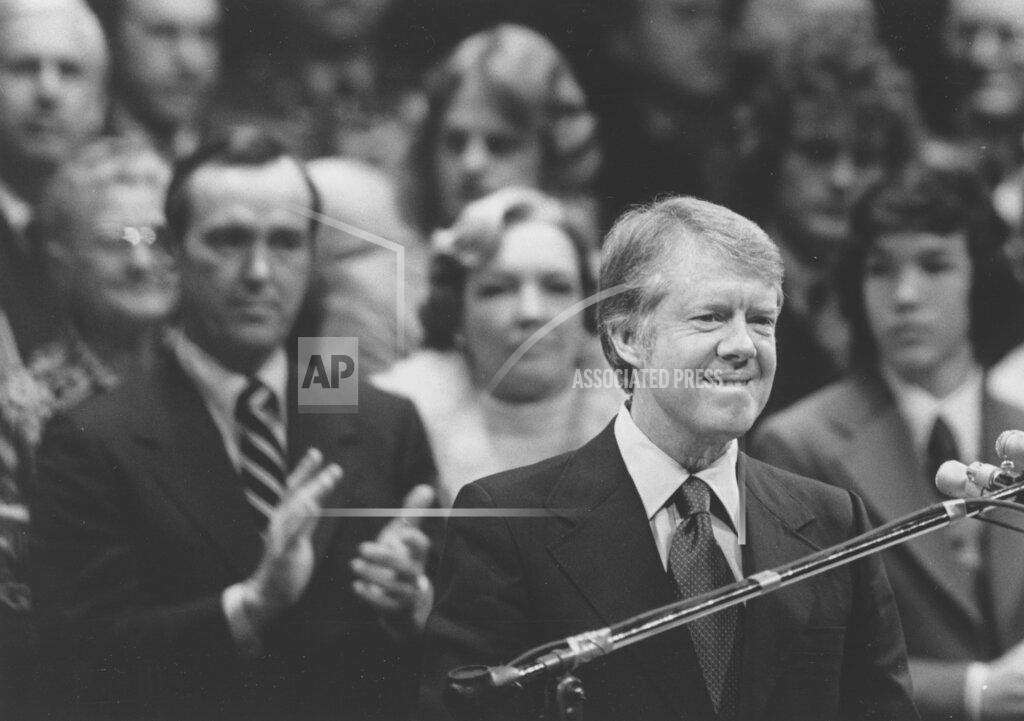
Taking the Senate Bible and his dark wood gavel with him as mementoes of eight turbulent years in Georgia’s top two jobs, Lester G. Maddox bowed out. Defeated by Governor George Busbee last fall in his bid to return to the governor’s mansion he occupied from 1967 to 1971, Maddox fulfilled his last official function by convening the General Assembly in Atlanta and an hour later his successor, Lieutenant Governor Zell Miller, took over. He wouldn’t do it over for “$1 million a year.” However, Maddox allowed, “I’d do it for nothing.” And if the people ever want him, he is just two blocks from the Capitol, passing out the fried chicken in his new Pickrick restaurant.
An 18-mile-long oil slick has dissipated and no longer is threatening beaches near Santa Barbara, the Coast Guard reported. The fact the oil was first spotted in the channel’s shipping lane and appeared to be lighter in color than crude oil indicates it may have been spilled by a passing tanker, according to Lieutenant Terrence O’Connell, Coast Guard commander at Santa Barbara. He said federal authorities would compare oil samples from a tanker seen in the area with samples of the slick. There are no drilling platforms near the slick’s origin, about eight miles off Point Mugu, O’Connell said.
The founder of the once popular Chad Mitchell Trio folk music group was convicted in federal court in San Antonio of smuggling 400 pounds of marijuana from Mexico to Texas. William Chadbourne Mitchell, 38, of New York City, folk singer of the 1960s, was found guilty in a nonjury trial after his October 21, 1973, arrest. Sentencing, which could be a maximum of five years in prison and a $15,000 fine, was set for February 12.
Light snow lingered in parts of the north-central states where a severe storm over the weekend claimed 57 lives. The blizzard was called the worst in Minnesota since 1888. It took 15 lives there, 14 in Nebraska, 8 each in Iowa, North Dakota and South Dakota, two in Michigan and one each in Illinois and Wisconsin. Scattered snow continued in the Great Lakes area and in the Appalachians and travel advisories remained for parts of Michigan and Pennsylvania. As the last remnants of the storm moved out of New England, snow squalls off Lake Erie dumped up to a foot of snow between Buffalo, New York, and Erie, Pennsylvania.
The Convention on Registration of Launched Objects into Outer Space, an international treaty requiring the signatory nations to keep the United Nations informed of the orbital details of any object launched into outer space, was signed in New York, and went into effect on September 15, 1976.
25th NBA All-Star Game, Arizona Vets Memorial Coliseum, Phoenix, Arizona: East beats West, 108-102; MVP: Walt Frazier, New York Knicks, point guard.
Dow Jones Industrial Average: 648.70 (-5.48, -0.84%)
Born:
Jermaine Fazande, NFL running back (San Diego Chargers), in Marrero, Louisiana.
Robert Reed, NFL kick returner and wide receiver (San Diego Chargers), in Hinds County, Mississippi.
Rodolfo Sancho, Spanish television actor, in Madrid.



 History Diaries