A general strike called by Buddhist opponents of the South Vietnamese Government disrupted activities in Huế, Quảng Trị, and Đà Nẵng in central Vietnam. Over the next 17 days, the major cities — especially Saigon and Huế — and much of central Vietnam are disrupted by demonstrations and strikes led by the Buddhists. Refusing to accept any government headed by Trần Văn Hương, because they see the United States as supporting that government, the Buddhists turn against U.S. institutions. Thích Trí Quang, the Buddhist leader, and other monks go on a hunger strike and a Buddhist girl in Nha Trang burns herself to death on the 26th (the first such self-immolation since 1963). Although Trần Văn Hương tries to appease the Buddhists by rearranging his government, they are not satisfied.
In Saigon today, Thích Tâm Châu, the head of the Buddhist Institute of Secular Affairs, denounced the government of Premier Hương for what the monk termed criminal activities against his coreligionists. Thích Tâm Châu urged the Buddhists to continue the long-term campaign against the Hương Government until their aspirations for unrestricted activity were satisfied. A Buddhist spokesman said leaders of the church were discussing what stand to take on the agreement reached Saturday between the armed forces and the Hương Government.
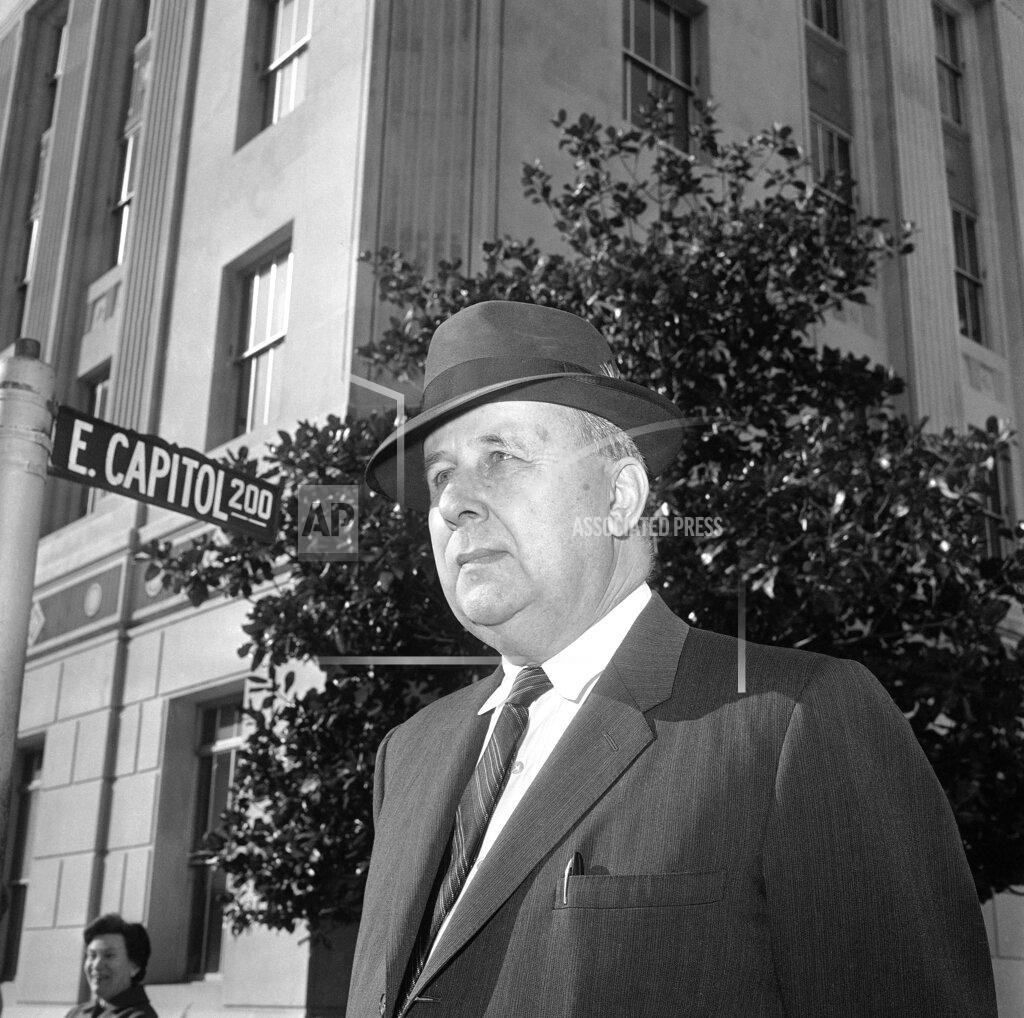
Senator Richard B. Russell said today that there could be no victory over the Communist insurgents in South Vietnam unless “a more stable government” was established in Saigon. The Georgia Democrat said that up to now we have been losing ground instead of gaining it.” The situation is at best a stalemate that promises to be prolonged endlessly, he said. Mr. Russell’s comments were made after a 3 hour and 15 minute briefing of the Armed Services Committee and the Defense Appropriations subcommittee by John A. McCone, Director of Central Intelligence. Mr. Russell is chairman of both Senate groups.
At the State Department it was announced that negotiations in Saigon for increased aid to South Vietnam would be. resumed “with the growth of stability and unity there” following the restoration of civilian control of the Government.” A three-week crisis in relations between the United States and South Vietnam was eased two days ago when Lieutenant General Nguyễn Khánh, commander of South Vietnam’s armed forces, agreed to restore control to the civilian Government headed by Premier Trần Văn Hương.
General Khánh acted for a group of young generals who dissolved the High National Council — the civilian legislature — on December 20 and arrested a number of civilian politicians. Soon afterward the United States suspended negotiations for an increase in aid until the military agreed to restore the government to civilian control. There was no interruption in the flow of scheduled aid, which has been running at about $2 million a day. Senator Russell said today that it was necessary to “reevaluate” the whole United States position in South Vietnam. However, he has also emphasized that his committee will restrict itself to the military situation and not trespass on matters of policy, which are the province of the Senate Foreign Relations Committee. Considering the “changing-chair government” in Saigon, Senator Russell said, it was “a miracle” that the war against the Việt Cộng had been carried on as well as it had.
Letters from President Sukarno explaining Indonesia’s withdrawal from the United Nations will be taken to leaders of African and Asian countries. A Foreign Ministry spokesman announced today that Mrs. Supeni Poedjoboentoro, a senior diplomat, was leaving tomorrow, bearing the letters. With the exception of the Chinese Communists and their allies, almost all Asian and African countries have expressed regret over President Sukarno’s move.
President Kwame Nkrumah of Ghana, who considers hímself a leader of the African nations, sent a special message appealing to President Sukarno to reconsider. Withdrawal from the United Nations is adding to the problems Indonesia will face at the second African-Asian conference, scheduled to be held in Algiers in March. The first conference, initiated by President Sukarno 10 years ago, was held at Bandung, Indonesia. It placed President Sukarno as a central figure among the leaders of the newly independent nations and those struggling for independence.
In recent months, Mr. Sukarno has clashed with the United Arab Republic and India over his insistence that what he calls the “new emerging forces” band together and use force if necessary against Imperialism. The United Arab Republic and India now. favor inviting Malaysia to the Algiers conference. Mr. Sukarno insists that Malaysia is a neocolonial creation of the British and must be crushed. The letters are believed to be an element in Mr. Sukarno’s effort to block an invitation to Malaysia.
Adding to Indonesia’s problems is the Soviet Union’s insistence on an invitation to the Algiers meeting. Peking is pressing Jakarta to oppose this because China contends the Soviet Union is not an Asian country and not eligible to attend. Indonesia is in the middle on this question. She is already in debt to the Soviet Union for a billion dollars’ worth of military and economic aid. Almost all other military equipment is now Russian and all supplies and spare parts must come from the Soviet Union.
HMS Eagle, an aircraft carrier described as the British Royal Navy’s most formidable warship, arrived at Singapore to become part of a 70-ship defence for Malaysia in the event of an attack from Indonesia.
Malaysia last week renewed her request to the United States for favorable credit terms in purchasing anti-guerrilla jet aircraft, but the Administration’s policy is to avoid providing military assistance to the Malaysians.
Efforts to resolve the dispute between the Philippines and Malaysia over territory in the Malaysian state of Sabah, formerly the British crown colony of North Borneo, appear to have reached an impasse.
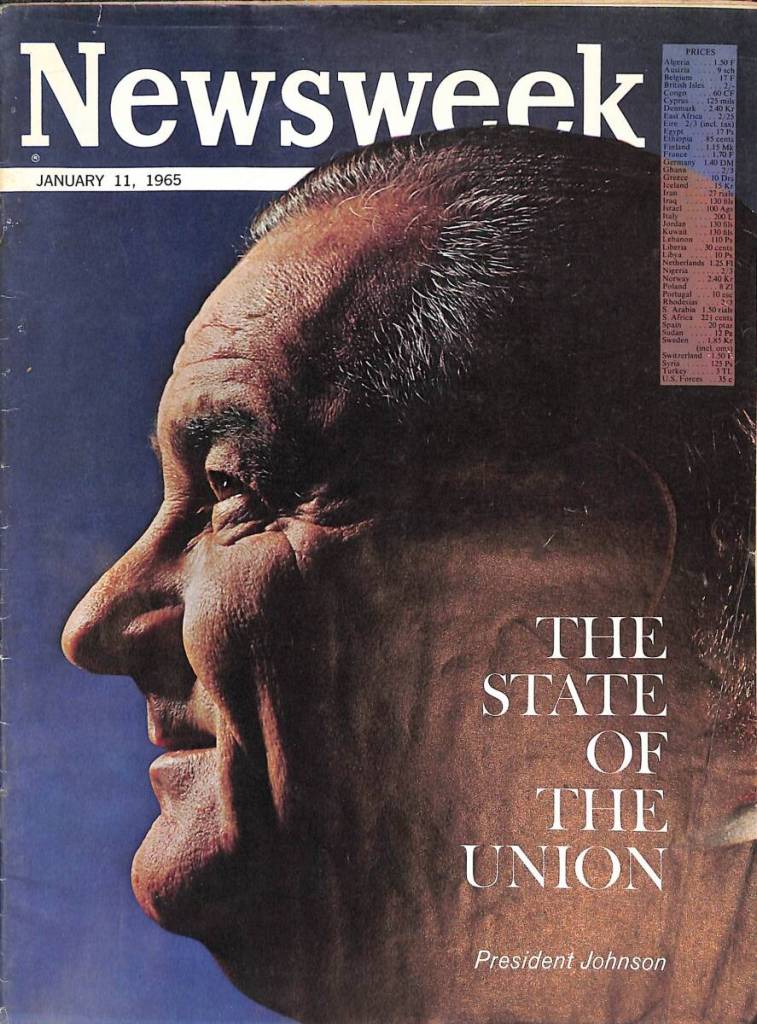
The downfall of Premier Khrushchev and China’s first nuclear explosion were “especially unfortunate” for President Johnson, according to an article in Jenmin Jih Pao, the Chinese Communist party newspaper. The article was signed by “Observer,” believed to be the pen name of a senior Chinese Communist official. Commenting on President Johnson’s State of the Union message, it said. “One of the main reasons for Khrushchev’s downfall is that he practiced a capitulationist policy toward United States imperialism and served the latter’s policies of aggression and war by forbidding the people of the world to combat it.”
The “Observer” article, quoted by Hsinhua, the Chinese Communist press agency, added: “China has grown more powerful. The United States policy of being hostile to and isolating China has proved a complete failure. China’s possession of nuclear weapons has further broken the United States nuclear monopoly and it has become more difficult for the United States to carry out its job of nuclear blackmail. This has greatly boosted the morale of the people of the world in fighting against United States imperialism. Thus Johnson has landed himself in a much tighter corner than Truman, Eisenhower and Kennedy had ever been.”
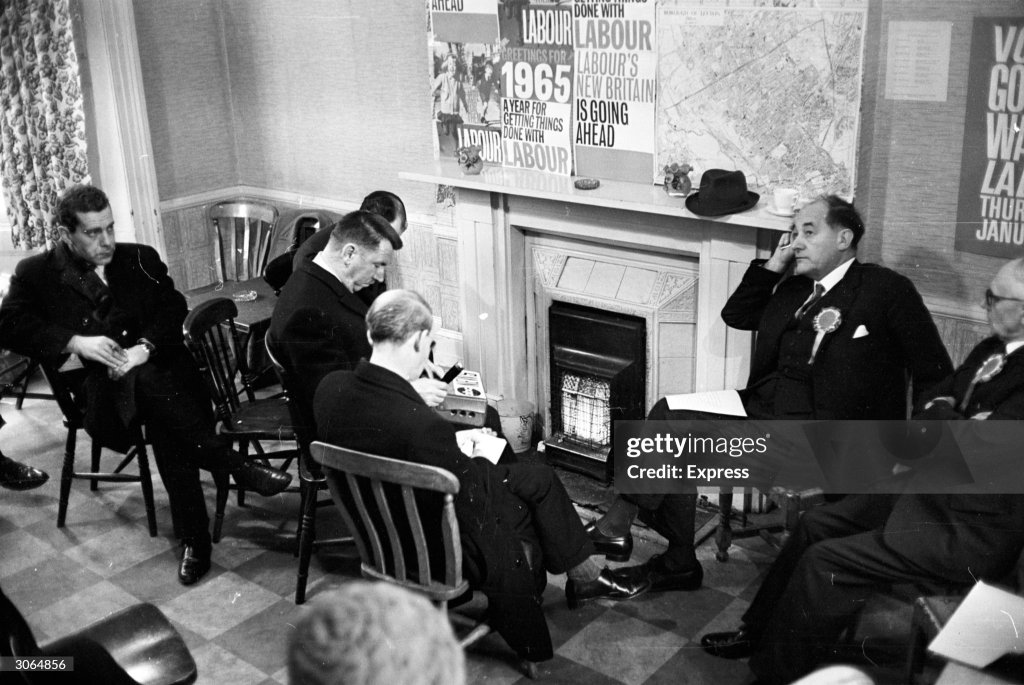
Harold Wilson and Aleksei N. Kosygin, the British and Soviet leaders who came to power about the same time last October, will exchange visits this year. An official announcement today said that Mr. Kosygin, the Soviet Premier, would visit Britain “in the spring” and that Prime Minister Wilson would return the visit later in the year. Mr. Kosygin’s visit is likely to be the first by a leader of the new Soviet regime to a Western country. The dates of the exchange will be fixed later, the announcement said.
Mr. Wilson’s office was unable to say how Mr. Kosygin’s visit might fit in with President Johnson’s recent invitation. Mr. Johnson said in his State of the Union Message that he hoped the Soviet leaders could visit the United States. However, Moscow’s acceptance of the London invitation was viewed as an important step in a possible trip to Washington. Mr. Wilson, who is known to favor regular and frequent high-level meetings, said in the House of Commons December 16 that the Soviet leader had accepted an invitation to come to London for talks.
Janos Peter, Hungary’s Foreign Minister, declared his interest today in the French Government’s ideas on an independent and enlarged Europe. Corneliu Manescu, Rumania’s Foreign Minister, signed a five-year cultural treaty with France and announced the early signature in Bucharest of an economic pact between the two countries. France’s Minister of Information, Alain Peyrefitte, returned from a three-day visit to Moscow to report an agreement for an exchange of radio and television programs between France and the Soviet Union.
These developments were in line with President de Gaulle’s objective, stated in his New Year’s Eve speech, of expanding ties with the Soviet Union and its allies in Eastern Europe as the internal evolution of the latter “orients them toward peace.” The well-publicized proliferation of French links with Eastern Europe, according to diplomats, will strengthen General de Gaulle in his efforts to bring the West German Government back onto the straight and narrow path of the general’s “European Europe.” Dr. Ludwig Erhard, the West German Chancellor, will arrive next Tuesday to confer with General de Gaulle.
Chancellor Erhard declared today that during his meeting with General de Gaulle next week he would make no commitment to France that was unacceptable to the United States.
Premier Eisaku Sato of Japan arrived in Washington tonight for two days of meetings with President Johnson on problems of Asia and of United States-Japanese relations.
Cyrille Adoula, former Premier of the Congo, called today for the elimination of his successor, Moise Tshombe, from the country’s political life and for negotiations with the Congolese rebels.
A bomb exploded early today in Nicosia’s Turkish quarter, a few yards from the office of Rauf Denktaş, Turkish Cypriot leader. It was the third blast in the capital in 14 hours. A Turkish Cypriot was slightly wounded by the explosion, which shattered windows and caused slight structural damage to United Nations headquarters. A blast in an old inn 300 yards from Mr. Denktaş’s office yesterday injured another Turkish Cypriot. An explosion in the Greek Cypriot section of the divided city last night shattered an emergency exit of a movie theater. No one was hurt.
A compromise that would allow the British-French project for a supersonic jet airliner to proceed, appeared possible tonight for the first time. French officials were reported to be ready to accept delays in starting production of the Concorde airliner if Britain would firmly agree that the plane would go beyond the prototype stage. There were indications that Britain was ready to make this commitment.
The British serial killer who had been dubbed “Jack the Stripper” killed his final known victim. During a 14-month period, the corpses of at least six young prostitutes in London, partially or fully undressed, were found in the area. All had been strangled or drowned. Bridget O’Hara was last seen alive on January 11, and her body would not be located until February 16. Two men who committed suicide during the spring of 1965 would be considered suspects, but the crime was never solved.
Panamanian students burned two U.S. Flags in separate incidents in Panama City in protest of what they called “Yankee imperialism.
A telephone conversation between future U.S. National Security Adviser and Secretary of Defense Frank Carlucci and another American diplomat, Robert Gordon, was recorded by intelligence officers in Tanzania, and Zanzibari and Tanzanian analysts concluded that the two had been discussing a military intervention in Zanzibar, codenamed “Second Twelfth.” Gordon and Carlucci would maintain that “second twelfth” meant only their plans to recommend U.S. President Johnson to send congratulations to Zanzibar’s President Abeid Karume in time for a celebration of the Zanzibar Revolution on February 12, and that Gordon’s statement that he was going to “need more ammunition” had only been a misunderstood American colloquialism. The Tanzanians doubted the explanation, and Carlucci and Gordon would be expelled.
Nationalist China paid $4,990,500 of its U.N. debt, allowing the United Nations to postpone plans to borrow money from a special account to relieve its critical cash shortage.
West Germany’s Bundestag lifted all restrictions against the televising of parliamentary sessions.
President Johnson set the stage today for another “preshrunk” foreign aid request, to be made in a special message to Congress Thursday. He told directors of the National Committee for International Development at a White House meeting that the aid program “is an investment. in man’s future.” He indicated, however, that the United States investment in that future would be on a declining scale and dependent on men’s ability to help themselves. Without attempting to reconstruct the President’s remarks, several participants in the meeting said the asking figure he would send to Congress later in the week would be somewhere between last year’s request of $3.5 billion and the $3.25 billion appropriated. They said his estimate would be nearer $3.5 billion.
The Johnson administration urged AFL-CIO leaders to give all-out support to the Great Society, and Vice President-elect Hubert H. Humphrey assured labor leaders that repeal of state “right-to-work” laws will be enacted.
Vice President-elect Hubert H. Humphrey told a legislative conference of the American Federation of Labor and Congress of Industrial Organizations today that Congress would enact day that Congress would enact a program for hospital and nursing home care for the elderly under Social Security “before the first flower of spring.”
President Johnson today will send Congress a kindergarten-to-college education program fashioned to help needy children get the best schooling possible.
U.S. Surgeon General Luther L. Terry said fewer adults are smoking than were a year ago as he reported progress against tobacco since the health hazard report of last year. But at least 125,000 Americans will die this year from the effects of cigarette smoking, despite a drop in the per capita rate of consumption.
Ohio Republican Chairman Ray C. Bliss said that he would accept his party’s national chairmanship only if Barry Goldwater approves. Ray C. Bliss announced he would agree to replace Dean Burch as Chairman of the Republican National Committee only if Senator Barry Goldwater sponsored the change. In a statement issued at Columbus, Ohio, the Ohio State Chairman, who was being promoted for the national post by non-Goldwater leaders seeking Mr. Burch’s removal, said: “I would not accept the chairmanship under any circumstances until such time as an actual vacancy occurred, and I were asked to do so by Senator Goldwater and had his full support.”
This was interpreted by reliable informants in Washington and elsewhere as a bid to have the defeated Presidential candidate himself propose the action and give it his blessing, thus averting an open battle within the party. A move for new direction at the party’s Washington headquarters is scheduled to be the priority business at a national committee meeting in Chicago late next week. Mr. Goldwater has vigorously been urging the retention of Mr. Burch, a political associate he personally selected as chairman at the outset of the Goldwater Presidential campaign last July. Following secret conferences at Mr. Goldwater’s Washington apartment last week, however, the word went out to key Republicans that a tenative settlement had been reached under which Mr. Burch would step aside for Mr. Bliss with Mr. Goldwater’s agreement
Senator Everett McKinley Dirksen, sharing the stage with a new partner, offered the Republican party a new top-level mechanism today to avert a repetition of last year’s election rout. The Senate minority leader, smiling like a winner, bade the audience a “happy New Year,” read half of a press release, and turned over the other half to Representative Gerald R. Ford Jr. of Michigan, the party’s new leader in the House.
Senate Republicans gave a coveted spot on their key Policy Committee to Senator Strom Thurmond (South Carolina), a former Democrat, but withheld decision on two other committee posts he is seeking.
Six Republican senators are drawing up a health care plan for the aged which reportedly goes beyond the measure proposed by President Johnson.
Government attorneys presented to a federal grand jury today the purported confessions of two of the 21 men accused in the slaying of three civil rights workers last June. The confessions are allegedly those of Horace Doyle Barnette, a 25-year-old meat truck driver who now lives in Cullen, Louisiana, and James Edward Jordan, who has acknowledged membership in the White Knights of the Ku Klux Klan. They were among seven witnesses called before the jury today. Jordan, 38, is a construction worker. The Justice Department sent John Doar, the new chief of its Civil Rights Division, to handle the presentation of evidence. The department is seeking indictments on conspiracy to violate the Federal Civil Rights Code. Murder is a state offense unless committed on federal property.
Mr. Doar faced the same jury of 23 Mississippians — 22 whites and one Black — that investigated the slayings when first empaneled at Biloxi last September. The jury at that time refused to return indictments in the killings, reportedly by the margin of a single vote. No confessions were available then. This time, however, the government had important new evidence. Besides the alleged confession of Barnette, it produced a second confession from Jordan. The two men are said to have witnessed the shooting of Michael H. Schwerner, 24, and Andrew Goodman, 20, both white and from New York, and James E. Chaney, a 21-year-old Meridian, Mississippi, Black on the night of June 21 near Philadelphia, Mississippi.
Barnette. was one of seven witnesses called to the jury room today. The other witnesses included two Mississippi highway patrolmen, H. B. Wiggs and Earl Poe, who were said to have participated in the arrest of the civil rights workers on speeding charges on the day of the slayings. The three rights workers were released from jail late at night by Deputy Sheriff Cecil Price after bond was posted. The government alleges that the deputy sheriff and nine others, including several mémbers of the White Knights of the Ku Klux Klan, shot the three men on a lonely side road near Philadelphia and buried their bodies in an earthen dam. The bodies were found in early August.
Sixty thousand members of the International Longshoremen’s Association walked out on strike on American ports on the East Coast and the Gulf Coast, from Maine to Texas. During the strike, estimated to cost shipping and receiving companies $20,000,000 per day, ships in port could not be unloaded or loaded. New York longshoremen were to vote again on a contract they previously spurned as officials sought to end a $20 million a day dock strike.
President Johnson will request a civilian space budget ‘slightly larger than the $5.25 billion that Congress appropriated last year, despite the hold-down on Government spending, informed sources said today. To some degree, this reflects the Administration’s awareness that the Soviet Union accelerated its space program last year more than in any other year since space flight began, these! sources said. The Russians launched more than twice as many satellites In 1964 than they had in any previous year. Most were unmanned Cosmos vehicles. Almost half of all the satellites the Soviet Union has launched since Sputnik 1 on October 4, 1957, were put up last year.
In addition, the Administration now has evidence that the Russians are developing a first-stage rocket more powerful than the one that has been the workhorse for past manned and unmanned Soviet shots, including the three-man Voskhod spacecraft launched last October 12. This has reinforced the belief, held by many in the space program, that the Soviet Union does intend to land men on the moon. Former Premier Nikita S. Khrushchev threw this issue into confusion in 1963 and there has been disagreement about Soviet space intentions since.
A California teenager, 16-year-old Tom Tawzer, became only the second person known to survive a drop from San Francisco’s Golden Gate Bridge. Up until then, there had been 278 fatal plunges from the bridge. Tawzer, from Livermore, leaped or fell 236 feet (72 m) and landed in the path of an ocean freighter, and a patrolman used flares to wave the ship off in time. Despite some internal injuries and a broken clavicle, Tawzer was able to swim to a Coast Guard crew that was coming to his rescue.
The Navy disclosed today that it had acted on 20 safety recommendations designed to prevent another disaster like the loss of the atomic submarine USS Thresher. This becomes the SUBSAFE program.
Commander Henry T. Stanley, a U.S. Navy pilot, died after staying with a falling jet-trainer so that he could steer it away from residences in Fremont, California. The jet, co-piloted by Lt. Commander Harford Field, had taken off from the aircraft carrier USS Midway (CV-41) and narrowly missed colliding with Mission San Jose High School and area homes, before impacting on a large vacant lot. Field ejected to safety on orders from Stanley.
The experimental XC-142, a four-engine tiltwing aircraft, made its first successful test of an inflight transition from horizontal to vertical wing position and back again. However, the project would be canceled after only five prototypes were built, and the XC-142 would never be put into regular operation.
At a hangar in Santa Monica, California, the Douglas Aircraft Company unveiled its new commercial jet airplane, the Douglas DC-9, billed as the “first American lightweight twin jet commercial transport.”
The test program to qualify the Gemini escape-system personel parachute began with two low-altitude dummy drops. The backboard and egress kit failed to separate cleanly; the interference causing the trouble was corrected, and the parachute was successfully tested in two more drops on January 15. Four high-altitude dummy drops followed during the week of January 18. System sequencing was satisfactory, but in two of the four drops the ballute deployed too slowly. The problem was corrected and checked out in two more dummy drops on February 12 and 16. In the meantime, low-altitude live jump tests had begun on January 28. The 12th and final test in this series was completed February 10. Aside from difficulties in test procedures, this series proceeded without incident. High-altitude live jump tests began February 17.
Dow Jones Industrial Average: 883.22 (+0.62)
Born:
Mark Halperin, American journalist, in Bethesda, Maryland.
Olivia Barash, actress (Laura-“Out of the Blue”), in Miami, Florida.
Loredana Romito, Italian model and actress (“Fatal Temptation”), in Benevento, Italy.
Tim Bergland, NHL right wing and centre (Washington Capitals, Tampa Bay Lightning), in Crookston, Minnesota.
Adrian Breen, NFL quarterback (Cincinnati Bengals), in Bronxville, New York.
Died:
A. V. Alexander, 79, British official who served as First Lord of the Admiralty during World War II, and later as the British Minister of Defence.
Wally Pipp, MLB first baseman (World Series 1923; AL Home Run leader 1916, 1917; New York Yankees), player who was replaced in the Yankee lineup by young Lou Gehrig, from a heart attack.





 History Diaries